
2023-24 Annual report to parliament on the administration and enforcement of the fish and fish habitat protection and pollution prevention provisions of the Fisheries Act
Fisheries and Oceans Canada and Environment and Climate Change Canada are committed to protecting Canada’s aquatic environment in ways that benefit fish for future generations. We actively work together to achieve an integrated approach to the conservation and protection of fish and fish habitat across Canada to empower Canadians to be informed and effective in managing threats and impacts to aquatic ecosystems caused by human activities. Our efforts include the support and collaboration of Indigenous Peoples, stakeholders, and other levels of government.
This annual report summarizes the administration, enforcement, and other activities undertaken by both Departments between April 1, 2023 and March 31, 2024 to ensure compliance with the fish and fish habitat protection and the pollution prevention provisions of the Fisheries Act.
Table of contents
- 1.0 Introduction
- 2.0 Protecting fish and fish habitat
- 2.1 Educating, advising and engaging
- 2.2 Reviewing proposed works, undertakings and activities
- 2.3 Impact assessments
- 2.4 Monitoring and enforcing compliance
- 2.5 Monitoring and reviewing energy projects
- 2.6 Protecting aquatic species at risk
- 2.7 Researching and providing scientific advice
- 2.8 Restoring fish and fish habitat
- 3.0 Preventing pollution from entering waters
- 3.1 Educating and promoting compliance
- 3.2 Modernizing and developing pollution prevention regulations
- 3.3 Analyzing self-reported effluent data
- 3.4 Enforcing the pollution prevention provisions
- 3.5 Supporting restoration using the environmental damages fund
- 3.6 Equivalency and administrative agreements
- 3.7 Monitoring marine water quality for bivalve shellfish
- 3.8 Streamlining environmental notifications
- 3.9 Monitoring and enforcing aquaculture activities
- 3.10 Preventing aquatic invasive species
- 4.0 Annex
1.0 Introduction
Each year, the Minister of Fisheries and the Minister of Environment and Climate Change report to Parliament on their efforts to administer and enforce the fish and fish habitat protection and the pollution prevention provisions of the Fisheries Act. This has been a legislative requirement since 1990.
This report describes how our departments carried out these responsibilities from April 1, 2023 through March 31, 2024. This includes our efforts to conserve and protect fish habitats across Canada in order to confront mounting environmental pressures while supporting economic activities. It also includes all of the activities we undertake in collaboration with our partners.
As in previous annual reports, we continue to highlight specific success stories and key results to showcase the different ways that we conserve and protect fish and fish habitat and prevent pollution from entering waters frequented by fish. This includes communicating key statistical information using infographics. We are introducing a few new features this year to include statistics on the compliance monitoring activities of our fishery guardians and the response of our environmental enforcement officers to incidents of unauthorized deposits from unregulated industries subject to the Fisheries Act. This year’s report will also showcase how monetary penalties for environmental violations are used to support projects that will benefit Canada’s natural environment via the Environmental Damages Fund.
Detailed information about the relevant provisions of the Fisheries Act, and the way our departments are organized to administer the fish and fish habitat protection and the pollution prevention provisions, are in the annex of this report. The annex also features tables with statistics on our activities to conserve and protect fish and fish habitat and to prevent pollution during the 2023-24 reporting year, as well as year-over-year comparative statistics to enable analysis and increased understanding about our work.
1.1 Collaboration
Fish and fish habitat are shared resources that benefit Canadians in social, economic, and ecological ways. However, if they are not well managed, these vulnerable resources can be depleted.
Fisheries and Oceans Canada (DFO) and Environment and Climate Change Canada (ECCC) work together throughout the year to prevent pollution from entering water and harming fish and their habitat. This includes working in collaboration to review cross-cutting regulations enabled through the Fisheries Act and to jointly administer programs with other departments and agencies.
For example, we work in collaboration with the Canadian Food Inspection Agency to jointly administer the Canadian Shellfish Sanitation Program. This long-standing federal program implements controls to ensure that bivalve molluscan shellfish meet food safety and quality standards before they enter domestic and international markets, which thereby minimizes the health risks associated with consuming contaminated shellfish.
We also collaborate with other partners to undertake broader measures that will conserve and protect fish and fish habitat for current and future generations. For example, we are working with the Parks Canada Agency to achieve Canada’s commitment to conserve 25 per cent of our lands and waters by 2025, and 30 per cent of each by 2030 in order to halt and reverse nature loss in Canada. DFO also collaborates with the Canada Energy Regulator to reduce federal administrative overlap when the agency is reviewing the same projects to ensure fish and fish habitat are protected.
The Fisheries Act supports co-operation and partnerships with Indigenous groups including provisions that allow a minister to enter into an agreement with an Indigenous governing body or a co-management body that has been established under land claims agreements to advance the purpose of the legislation.Footnote 1 The Fisheries Act also enables programs, such as the Indigenous Habitat Participation Program, to empower Indigenous communities to actively participate in the conservation and protection of fish and fish habitat. These collaborations respect the rights and interests of Indigenous Peoples and reflect both traditional knowledge and contemporary science.
Working with Indigenous communities and groups to safeguard fish and fish habitats also helps us support the implementation of the United Nations Declaration on the Rights of Indigenous Peoples Act and its 2023-2028 Action Plan.
Provincial and territorial authorities across Canada, as well as resource management boards established under land claims agreements, share a range of natural resource conservation responsibilities. Their laws and actions thus have the potential to either complement or impact the protections afforded by federal legislation and regulations. For example, land-use decisions made by these authorities may have a significant bearing on the quality, quantity, and function of fish habitat in a given watershed.
We collaborate closely with provincial and territorial governments, to reduce regulatory duplication and streamline administration related to Fisheries Act provisions. This includes the jurisdictions with which we have entered into pollution prevention-related equivalency agreements and/or arrangements. The Canadian Council of Fisheries and Aquaculture Ministers and the Canadian Council of Ministers of the Environment are key venues used to advance these partnerships.
Our collaborations extend to industry and proponentsFootnote 2 involved in, or considering, a project near water or those involved in sectors that have the potential to affect waterways, as well as non-governmental organizations and community organizations, that are involved in fish and fish habitat restoration activities. Some of the key results and success stories profiled in this report showcase these collaborations, including those using funding from the Environmental Damages Fund.
2.0 Protecting fish and fish habitat
DFO is responsible for administrative, regulatory, and enforcement activities related to the fish and fish habitat provisions of the Fisheries Act. In fulfilling this role, we educate, engage, and provide information to proponents who work in or near water on how to comply with the fish and fish habitat protection provisions of the Fisheries Act and the relevant provisions of the Species at Risk Act. We also undertake reviews of proposed development projects to protect fish and fish habitat across Canada, participate in and conduct environmental and impact assessments, and monitor and enforce compliance with the legislation and its regulations.
Our work is informed by research and science as well as Indigenous knowledge that is shared with us. We also support projects to restore fish and fish habitat across Canada.
2.1 Educating, advising and engaging
We use a suite of guidance documents to educate proponents on how to conserve and protect fish and fish habitat when they are considering or undertaking projects near water. For example, our:
- Fish and Fish Habitat Protection Policy Statement outlines how we interpret and apply regulatory and non-regulatory tools under the Fisheries Act
- Codes of Practice provide standardized guidance on works, undertakings and activities that can occur in or near fish habitat without contravening the Fisheries Act for:
- beaver dam breaching and removal
- clear span bridges
- culvert maintenance
- ice bridges and snow fills
- routine maintenance dredging for navigation
- temporary fords
- Offsetting Policy describes how a proponent must develop an offsetting plan by:
- characterizing the harmful impacts
- selecting appropriate measures to offset
- determining the extent of the offset measures needed
- establishing the monitoring and reporting plan
- Interim policy for establishing fish habitat banks explains how a proponent can establish a habitat bank, define the service area covered by the habitat bank, and manage credits for application to future works, undertakings and activities
These guidance documents are accessible via the Projects Near Water website to ensure proponents understand how to comply with the Fisheries Act and apply for authorizations under the Authorizations Concerning Fish and Fish Habitat Protection Regulations and the Species at Risk Act.
In 2023-24, we added new and interim guidance materials to further promote proponent compliance with the Fisheries Act and the Species at Risk Act. This included publishing:
- Position statements for the Management of Existing Facilities and Structures and the Management of Death of Fish (other than fishing)
- An interim Standard for in-water site isolation
- Four new interim Codes of Practice for:
- bridge repair and maintenance
- municipal and agricultural drain maintenance
- repair and maintenance of in-water structures
- repair, maintenance and construction of docks, moorings and boathouses
In 2023-24, we also advised proponents and answered their questions on 4,479 occasions (Table 4).
We collect, share and report on our advisory activities using an internal Program Activity Tracking for Habitat system. The system is also used to store and report data on our review of referrals. In addition, summaries of all Fisheries Act authorizations are posted on the publicly accessible Fisheries Act registry.
Our guidance documents and regulations are informed by engagement with our partners, including Indigenous groups and communities and other levels of government in Canada, as well as the perspectives of proponents and other stakeholders. To hear these perspectives, each year we undertake various engagement activities.
Wave 3 of the multi-wave engagement process that we began in the fall of 2020 also occurred between March 2023 and March 2024. It focused on advancing conversations on two topics that began in Wave 1 and one topic that began in Wave 2:
- The draft Policy for Applying Measures to Offset Harmful Impacts to Fish and Fish Habitat
- The draft Guidelines for Establishing and Managing Fish Habitat Banks
- The draft Framework for Aquatic Species at Risk Conservation
Wave 3 engagement also introduced five new topics for participants to consider:
- An interim Standard for in-water site isolation
- New interim Codes of Practice for:
- Bridge repair and maintenance
- Municipal and agricultural drain maintenance
- Repair and maintenance of in-water structures
- Repair, maintenance and construction of docks, moorings and boathouses
A number of subject matter experts participated in Wave 3 engagement sessions to answer questions and clarify the engagement materials. Recordings of their presentations, frequently asked questions, and draft products are posted on the ‘Talk Fish Habitat’ platform.
In total, 36 sessions were held during Wave 3, including:
- Four national virtual multi-interest engagement sessions
- Five national virtual engagement sessions with Indigenous groups and communities
- Ten regional multi-interest engagement sessions
- Seventeen regional engagement sessions with Indigenous groups and communities
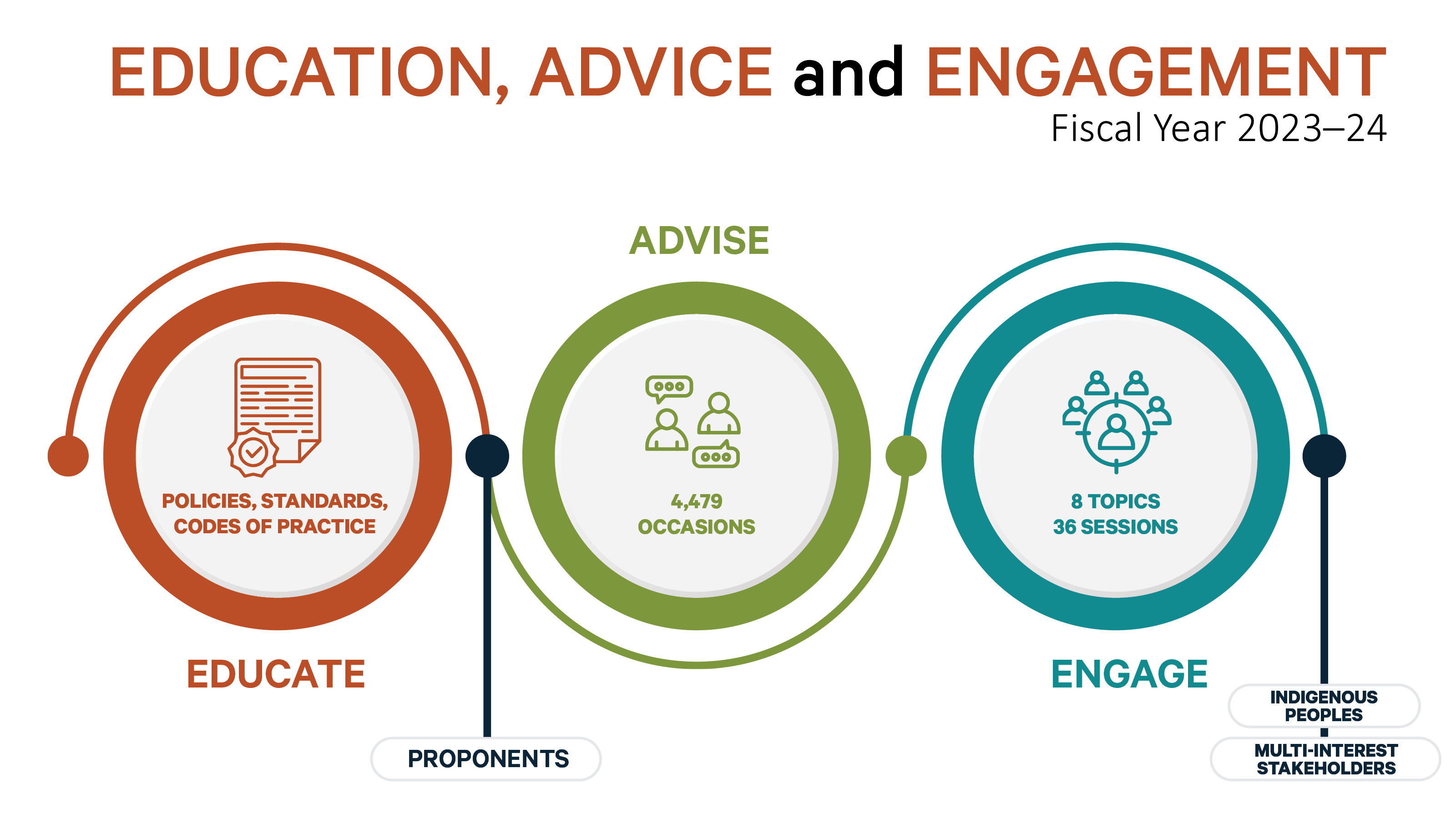
Infographic: Education, Advise, and Engagement: Fiscal Year 2023-24
Education:
Policies, Standards, Codes of Practice
Advice:
Advice given to proponents and/or questions answered 4,708 times.
Engagement:
8 Topics, 36 Sessions
Indigenous Peoples and Multi-interest stakeholders
The Canadian Council of Fisheries and Aquaculture Ministers’ Fish and Fish Habitat Protection Committee continues to provide a venue for federal-provincial-territorial discussions and information-sharing related to fish habitat protection and specific policies and tools required to implement the Fisheries Act. In 2023-24, the Committee held five virtual meetings, including a joint session with the Canadian Wildlife Directors’ Committee to gather advice on the development of the Framework for Aquatic Species at Risk Conservation.
Key result:
Helping Federal Contaminated Site managers minimize impacts to fish and fish habitat
The Federal Contaminated Sites Action Plan (FCSAP) was established in 2005 to reduce environmental and human health risks from known federal contaminated sites. We serve as an expert support department for this program. This means providing guidance, training, advice and scientific support to federal contaminated site managers so they can minimize any impacts to fish and fish habitat when they are managing contaminated site activities. Our support includes:
- reviewing site classifications and technical documents to ensure that the potential risks and/or impacts to fish and fish habitat have been appropriately considered
- developing guidance material and training on aquatic contaminated sites
- promoting regulatory compliance with the Fisheries Act and Species at Risk Act
In 2023-24, we conducted 36 site-classification reviews to confirm eligibility for FCSAP funding. In doing so, we met the service standard for site classification reviews 94 per cent of the time. We also conducted reviews of 40 technical documents in support of site assessment. remediation and risk management, meeting the service standard 93 per cent of the time.
To meet our responsibilities for guidance material and provide expert advice and training on the management of FCSAP sites to custodians, we also:
- published Ecological Risk Assessment Module 8: Fish Toxicity Reference Values and hosted training of FSCAP partners
- developed relevant agreements and Memoranda of Understanding with FCSAP partners and custodians for implementation of various collaboration projects, such as projects on passive sampling devices, per- and polyfluoroalkyl substances, and eDNA
- conducted a Habitat and Ecosystem Assessment Tool analysis of the proposed remediation to the Whitby Harbour benthic environment to understand impacts to fish and fish habitat
- produced a Habitat Enhancement and Restoration Opportunities report for improving fish habitat in Whitby Harbour done in collaboration with the Central Lakes Ontario Conservation Authority
We also participated in FCSAP national and regional working groups and site-specific technical committees to provide further advice on potential risks to fish and fish habitat.
2.2 Reviewing proposed works, undertakings and activities
When a proponent feels that the risk to fish and fish habitat from a proposed work, undertaking or activity in or near water cannot be avoided or managed with one of our codes of practice, they are invited to submit a request for us to review their proposal.
Our review is required because the fish and fish habitat protection provisions of the Fisheries Act prohibit a person from carrying out projects that result in the death of fish by means other than fishing, and/or the harmful alteration, disruption or destruction of fish habitat. The Species at Risk Act also protects aquatic species at risk from someone conducting an activity that would kill, harm, harass, capture or take it. This protection extends to an activity that would damage or destroy the residence or any part of the critical habitat of one or more aquatic species at risk.
If our review determines that the proposed work, undertaking or activity is likely to result in any of the prohibited effects to fish or fish habitat, the proponent needs to apply for and obtain a Fisheries Act authorizationFootnote 3 or Species at Risk Act permit. If issued, the authorization or permit would allow the proponent to contravene the prohibitions, as long as their work, undertaking or activity is conducted in accordance with the conditions outlined in the authorization or permit.
In their applications for a Fisheries Act authorization, proponents must explain the measures to be implemented as part of their project to avoid and mitigate risk to fish and fish habitat, and their plan to offset any harmful impacts. If the proposed project also results in prohibited effects on aquatic species at risk, the Information Required For The Consideration Of The Approval Of Activities That Are Otherwise Prohibited Under The Species At Risk Act must also be provided with their application for authorization.
Managing harmful alteration, disruption or destruction of fish habitat or death of fish
Our preference is to conserve and protect fish and fish habitat by first avoiding harmful impacts resulting from proposed works, undertakings, or activities in or near water. Then, proponents should direct their efforts to mitigate impacts to the extent possible, and finally offset any residuals impacts to counterbalance this loss through positive contributions to the aquatic ecosystem.
The way we review these applications is outlined in the Authorizations Concerning Fish and Fish Habitat Protection Regulations. We are also legally required to consult and, when appropriate, to accommodate Indigenous Peoples (First Nation, Inuit or Métis) when Aboriginal and treaty rights may potentially be adversely impacted by a decision, including ministerial decisions on whether to authorize works, undertakings or activities under the Fisheries Act and Species at Risk Act.
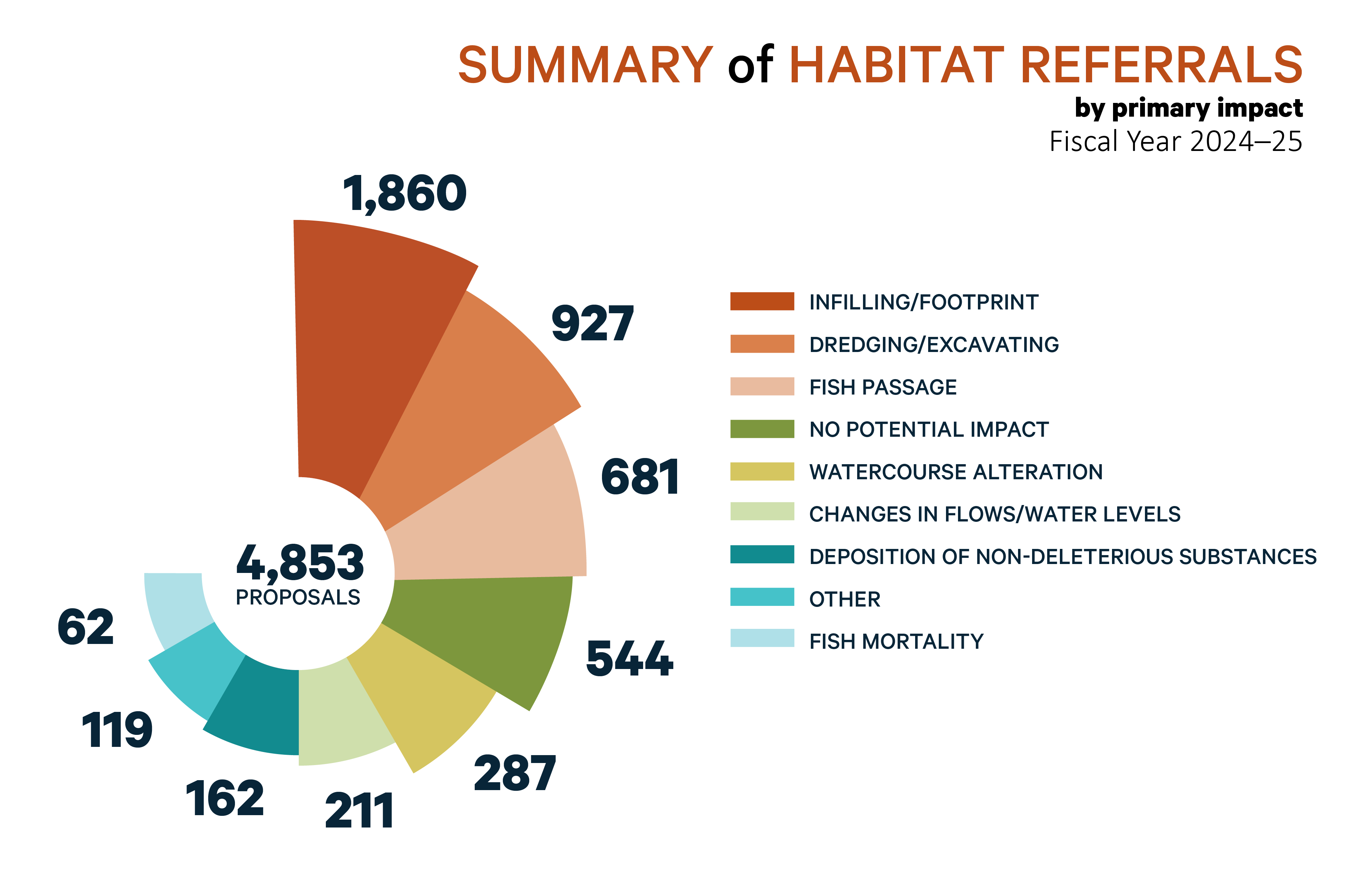
Infographic: Summary of habitat referrals by primary impact - fiscal year 2023-24
Derived from total referrals presented in Table 3.
Infilling/Footprint: 1,984
Dredging/Excavating: 896
Fish Passage: 606
No Potential Impact: 612
Changes in Flows/Water Levels: 176
Watercourse Alteration: 223
Fish Mortality: 75
Deposition of Non-Deleterious Substances: 145
Other: 119
Between April 1, 2023 and March 31, 2024, we reviewed 4,836Footnote 4 proposals (known as habitat referrals) and issued 239 authorizations.Footnote 5 We also achieved a 92 per cent compliance rate with our service delivery standards to confirm that applications for authorizations were complete and adequate within the regulated 60-day time limit, as well as a 100 per cent compliance rate for making the authorization decisions within the 90-day time limit.
In addition to project-specific authorizations, we managed 146 agricultural municipal drain class authorizations for maintenance activities in 2023-24, as shown in Table 5. These types of authorizations use a standard approach to eliminate the need for site-specific review of routine projects, but they are still tracked and reported because they authorize works, undertakings or activities that may result in the death of fish (by means other than fishing) and the harmful alteration, disruption, or destruction of fish habitat.
2.3 Impact assessments
Some public and private development projects in Canada may first require a federal impact assessment before we can consider issuing an authorization under the Fisheries Act and/or a permit under the Species at Risk Act. From a federal perspective, impact assessment legislation differs depending on where a project is located in the country. For instance, the Impact Assessment Act, and its predecessor the Canadian Environmental Assessment Act, 2012, apply in most jurisdictions except where it has been replaced by an alternative process derived from a modern land claims agreement.
When an impact assessment is being carried out by the Impact Assessment Agency or another party, our expert advice may also be required or requested to support their assessment as it relates to the project’s potential impacts to fish and fish habitat.Footnote 6 We may also have additional responsibilities as a decision-making authority (e.g., responsible minister) in northern Canada if a project requires a Fisheries Act authorization and/or Species at Risk Act permit.
We are prohibited from issuing an authorization under the Fisheries Act and/or a permit under the Species at Risk Act until an impact assessment has concluded and it has been determined through the assessment that the project may proceed to the regulatory phase.
In addition, if a project on federal lands requires a Fisheries Act authorization and/or Species at Risk Act permit, we may be required to undertake our own assessment under section 82 of the Impact Assessment Act to identify any potential significant environmental effects of the project. Furthermore, if another federal department is subject to conducting an assessment on federal lands, we may be asked to provide expert advice, based on areas within our mandate, to support their assessment.
During an impact assessment, we work closely with other federal departments and agencies to fulfill the Crown’s Duty to Consult.
2.4 Monitoring and enforcing compliance
Monitoring to promote proponent compliance with the fish and fish habitat protection provisions helps Canada conserve and protect fish and fish habitat, including aquatic species at risk. Inspections and enforcement activities undertaken by our fishery officers and fishery guardians are also key to achieve these outcomes.
Fishery officers and fishery guardians are designated by the Minister of Fisheries under the Fisheries Act (section 5) to perform specific compliance and/or enforcement activities. For example, fishery officers are designated to monitor and enforce provisions of the Fisheries Act, including the fish and fish habitat protection and pollution prevention provisions. Meanwhile, fishery guardiansFootnote 7, are empowered to conduct inspections to verify compliance of works, undertakings or activities taking place in or near water with the fish and fish habitat protection provisions of the Fisheries Act, whether they were previously reviewed or not. The enforcement powers of a fishery guardian are limited to the powers needed to carry out their duties, such as inspection and seizure of certain items. When further enforcement actions, such as charges, are required, fishery officers lead the necessary actions.
Our fishery officers devote time and effort to monitor and enforce compliance by:
- conducting fish and fish habitat patrols, inspections and investigations
- working with habitat biologists (some of whom are designated fishery guardians) on sites with authorized works, undertakings or activities
- responding to reports of potential violations of the fish and fish habitat protection provisions from members of the public
- assisting in fish habitat protection education activities held with the public
- working with other enforcement partners to support fish habitat protection
- working with Crown counsel on prosecutions
- other activities, as needed
When violations of the fish and fish habitat protection provisions are identified, fishery officers may issue warnings or directions to address the non-compliance. If warranted, they may also undertake investigations, lay charges and, when necessary, undertake major cases and special investigations. These enforcement actions are a part of a broader compliance promotion effort that combines monitoring, control and surveillance with education, shared stewardship, and stakeholder engagement.
During 2023-24, our fishery officers spent 34,537 hours verifying compliance with and enforcing the fish and fish habitat protection provisions. As a result, they:
- issued 19 warnings
- issued 21 directions
- laid 18 charges
- issued 1 alternative to prosecutionFootnote 8
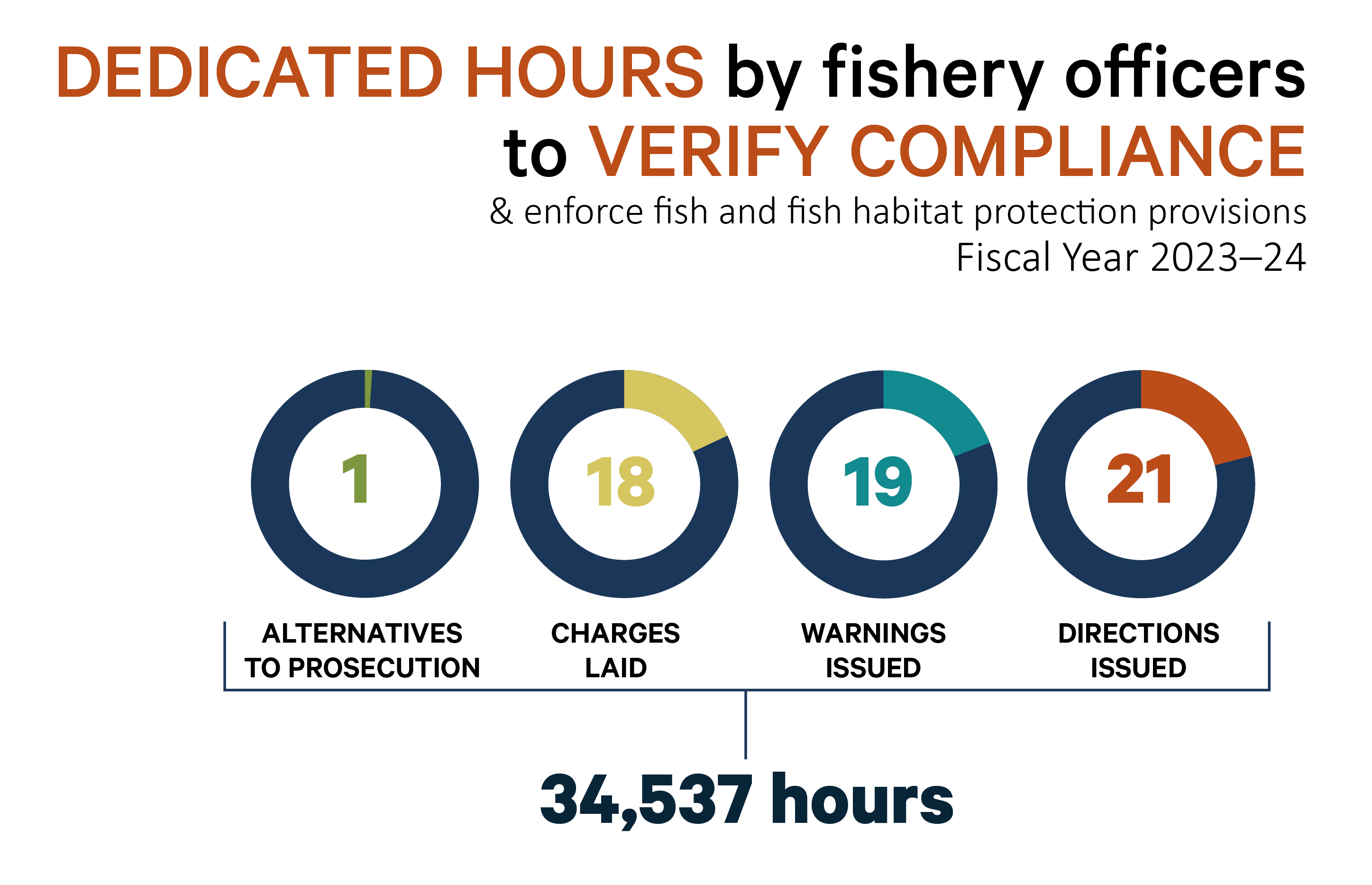
Infographic: Dedicated hours by fishery officers to verify compliance and enforce fish and fish habitat protection provisions - fiscal year 2023-24
34,537 hours verifying compliance.
18 Charges laid.
21 Directions issued.
19 Warnings issued.
1 Alternative to prosecution.
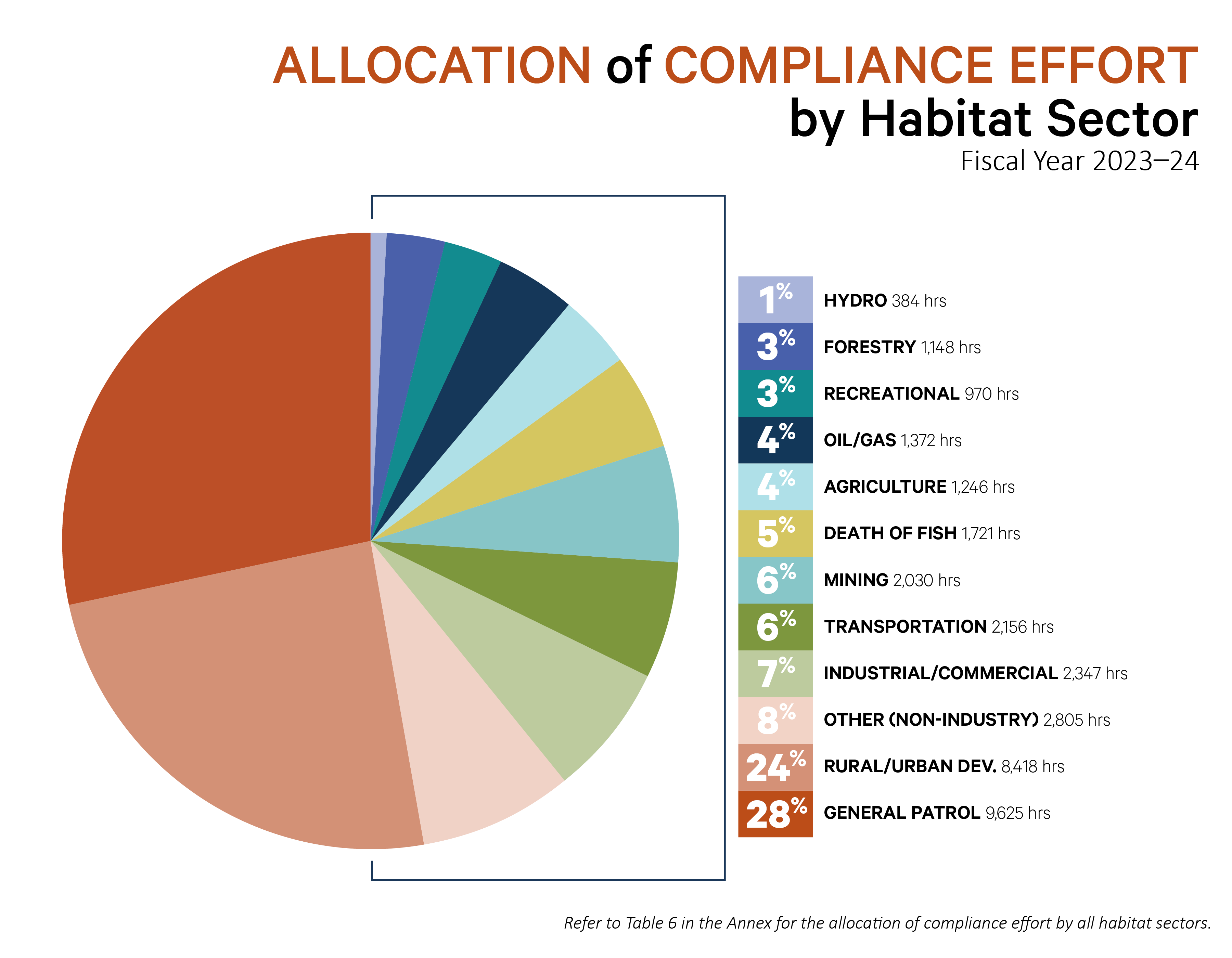
Infographic: Allocation of compliance effort by habitat sector - fiscal year 2023-24
Habitat Activities Hours Percentage:
Agriculture 1,246 or 4%
Death of Fish 1,721 or 5%
Forestry 1,148 or 3%
General Patrol 9,625 or 28%
Hydro 384 or 1%
Industrial/Commercial 2,347 or 7%
Mining 2,030 or 6%
Oil/Gas 1,372 or 4%
Other (Non-industry) 2,805 or 8%
Recreational 970 or 3%
Rural/Urban Dev. 8,418 or 24%
Transportation 2,156 or 6%
Refer to Table 6 in Annex 4.3 for the allocation of compliance effort by all habitat sectors
Success Stories:
Major habitat destruction along the Chilcotin and Kleena Kleene rivers - British Columbia
On May 28, 2024, the Quesnel Provincial Court received a guilty plea by a contractor that was performing unauthorized land clearing activities along the Kleena Kleene River.
The offending contractor was ordered to pay a fine of $90,000 for serious violations of Canada’s Fisheries Act and British Columbia’s Forest and Range Practices Act. Half the amount of this fine was levied by the Court to discourage other companies or individuals from earning money when performing unauthorized activities.
The guilty plea came about after a complex, six-year-long investigation by fishery officers into major habitat destruction along the Chilcotin and Kleena Kleene rivers. The investigation resulted in fines and orders to remediate the impacted sites along both the rivers within two years and to produce four reports comprehensively documenting progress and survival rates of plantings on riparian land adjacent to the rivers for the next decade.
Permanent damage to 400m2 of fish habitat in Bay of Quinte - Belleville, Ontario
On Monday, December 11, 2023, an individual from the Belleville, Ontario area was sentenced by the Ontario Court of Justice to remove an unauthorized infill that resulted in serious harm to fish and charged for failure to comply with the whole or part of a direction of an inspector or fishery officer. The individual was ordered to pay a fine of $20,000 that will be directed to the Mohawks of the Bay of Quinte for conservation and protection or restoration projects.
The offending work occurred in the spring of 2018 when an area was infilled in the Bay of Quinte adjacent to the Tyendinaga Mohawk Territory that is home to a number of fish species for spawning, rearing, feeding, and cover. The work permanently destroyed a wetted area and eliminated aquatic vegetation. The court ordered the individual to remove the infill in the area within 15 months of sentencing.
The company hired by the individual to carry out the work pleaded guilty to violations of the Fisheries Act in 2019 and was ordered to pay a fine of $15,000. These funds were also directed to the Mohawks of the Bay of Quinte.
Dredging of 39m2 of Pacific salmon spawning habitat - Sechelt, British Columbia
Late in 2021, our fishery officers and biologists inspected a site in Sechelt, British Columbia in which salmon eggs were lying on and buried within unauthorized dredged material. The unauthorized dredging work also resulted in the harmful alteration, disruption and destruction of 38.7 m2 of aquatic habitat which could have resulted in eliminating the 2021 salmon run from Stephens Creek, an area with some of the lowest historical returns of chum salmon, to the mainland Inlets and Strait of Georgia.
On June 11, 2024, the Sechelt Provincial Court ordered a fine of $70,000 against the homeowner for this unauthorized dredging work for offences under Canada’s Fisheries Act.
2.4.1 Other monitoring activities
In addition to the monitoring work of fishery officers, fishery guardians of our Fish and Fish Habitat Protection Program (FFHPP) conduct compliance monitoring of proponents who have applied to conduct works, undertakings or activities in or near water. This is done by completing desktop reviews of proponents’ required reports and conducting site inspections. When issues are identified, fishery guardians will either work directly with the proponent to correct the situation or forward the file to fishery officers for further action in cases of potential non-compliance.
In 2023-24, 1,293 desktop reviews and site inspections were conducted. 123 issues were identified, and 15 potential non-compliance incidents were referred to fishery officers for further action. Some of these numbers overlap, or duplicate numbers reported by Conservation and Protection above. We are looking at how to better integrate reporting on monitoring by both programs in the future.
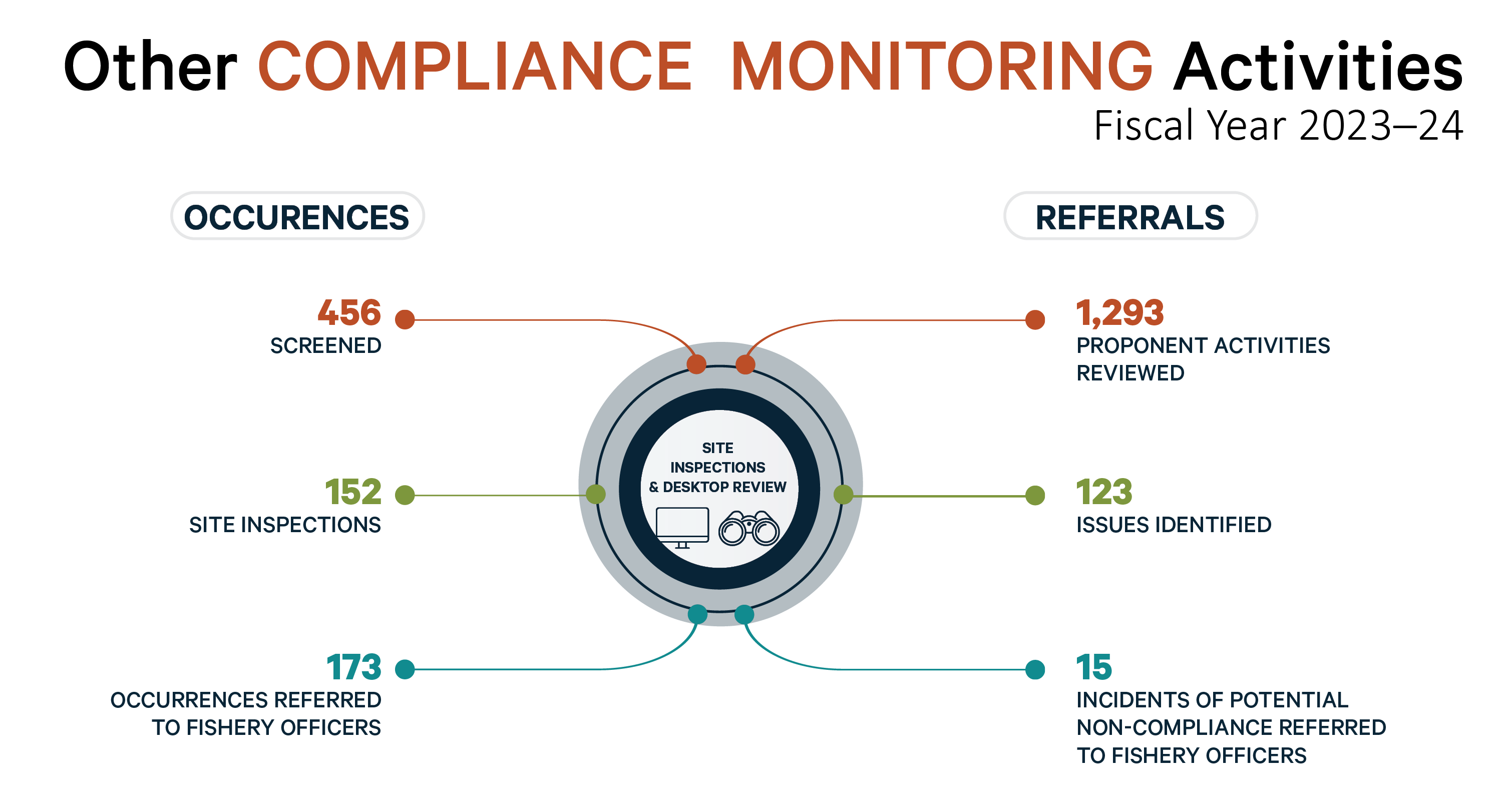
Infographic:
...
Refer to Table 9 and Table 10 in Annex 4.3 for additional FFHPP compliance monitoring informationFootnote 9
We receive incident reports (also called occurrences) of potential legislative violations. When an incident report is received, FFHPP gathers information and undertakes a risk assessment to determine whether enforcement action is necessary.Footnote 10
In 2023-24, fishery guardians screened 456 occurrences, conducted 152 site inspections to verify compliance, and referred 176 occurrences to fishery officers for further enforcement actions.
2.5 Monitoring and reviewing energy projects
In 2013, we entered into separate Memoranda of Understanding with the Canadian Nuclear Safety Commission (CNSC) and the National Energy Board (now the Canada Energy Regulator) to improve the efficiency and effectiveness of the assessment of applications for:
- Construction and operation, decommissioning and abandonment of energy infrastructure (CER)
- Class I nuclear facilities and uranium mines and mills (CNSC)
These memoranda were revised and updated in 2023 to reflect legislative changes. As a result, Class I nuclear facilities and uranium mines and mills now submit applications for works, undertakings or activities directly to us to review, while the CNSC continues to review impacts to the environment, including impacts to fish and fish habitat, under the Nuclear Safety and Control Act. The updated Memorandum of Understanding with the CNSC also focuses on collaboration and information sharing.
The potential of energy infrastructure projects to impact fish and fish habitat are reviewed by the CER under the authority of the Canadian Energy Regulator Act. Typically, this means reviewing proposals for the installation or maintenance of pipeline watercourse crossings. Under our revised Memorandum of Understanding, the CER continues to assess potential project impacts to fish and fish habitat under the Fisheries Act and the Species at Risk Act and proponents continue to be required to request the CER to review any works, undertakings or activities that could impact fish and fish habitat, unless they occur within aquatic critical habitat of a Species at Risk Act-listed species. In this case, they would need to submit their review request to us.
If the CER determines that any work, undertaking or activity may require a regulatory instrument under the Fisheries Act or Species at Risk Act, they refer those projects to us for review and action. The Minister of Fisheries also retains responsibility for decisions on the issuance of Fisheries Act authorizations and the conditions of these authorizations, as well as for permits under the Species at Risk Act.
The revised Memorandum of Understanding between DFO and the CER does not apply to proposed projects that are subject to federal impact/environmental assessment regimes, as that responsibility lies with the Impact Assessment Agency of Canada.
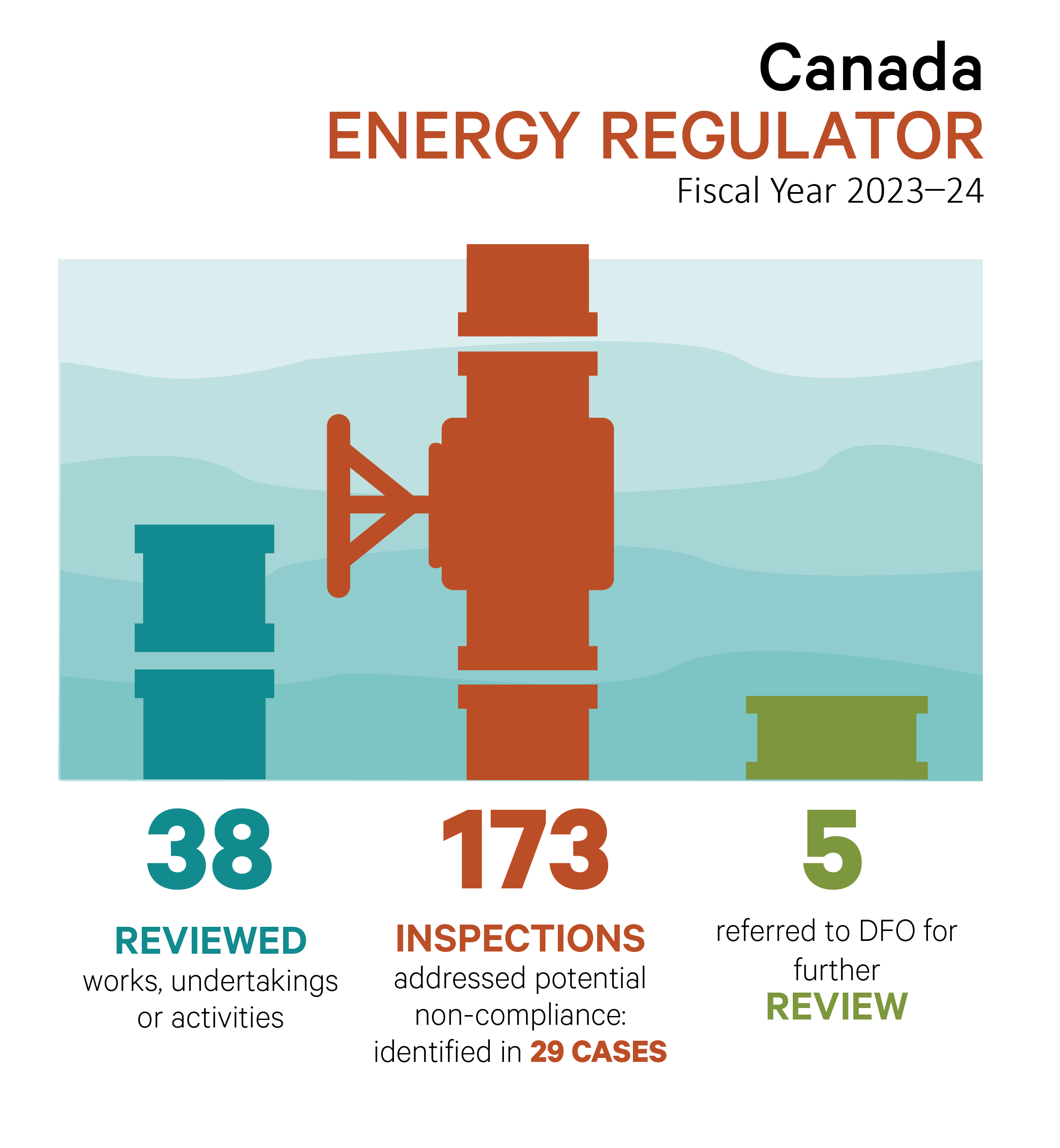
This year, the CER reviewed 38 projects involving works, undertakings or activities in or near water to assess the application of appropriate mitigation measures and the likelihood of impacts to fish and fish habitat. This included five projects associated with new applications and 33 projects related to the operations and maintenance associated with existing projects. Of the 38 projects reviewed, five were referred to us for review. Notably, one of these five was submitted directly to DFO by the proponent for the issuance of an Emergency Authorization, and two were submitted directly by the proponents due to the work being located within the critical habitat of an aquatic species at risk.
During the same time frame, the CER inspected 173 fish watercourse crossings. The inspections resulted in 11 instances of corrected non-compliance under the Canadian Energy Regulator Act and 18 notices of non-compliance under the same act. Following inspection, no projects were referred to us for further review.
2.6 Protecting aquatic species at risk
The fish and fish habitat protection provisions of the Fisheries Act enable us to take a holistic approach to conserve and protect fish and fish habitat. We also apply the relevant provisions of other acts and regulations when making decisions to ensure that fish and fish habitat are protected. This includes the Species at Risk Act (SARA).
For example, if a proponent’s proposed work, undertaking or activity is likely to result in a prohibited impact under SARA, our regulatory review would consider whether or not the permitting conditions of SARA could be met. If it is possible, the Fisheries Act authorization would also act as a Species at Risk Act permit which would impose certain pre-conditions and requirements on the proponent. If the conditions could not be met, we would refuse the authorization.
The Species at Risk Act protects the most at-risk species, the residence of their individuals and their critical habitat by prohibiting:
- the killing, harming, harassing or capturing of species listed as threatened, endangered and extirpated
- any damage or destruction of a species’ residence
- the destruction of critical habitat for species at risk (once this critical habitat has been identified).
Every year, we report to Parliament on our activities to administer the provisions of the Species at Risk Act that apply to aquatic species at risk, in a publication that is produced by ECCC. This includes highlighting key results and success stories.
2.7 Researching and providing scientific advice
Our scientists support fisheries and fish habitat management programs to understand the impacts of multiple human activities undertaken in and around aquatic ecosystems by researching and providing scientific advice. This advice covers a broad array of topics, including habitat science, species at risk, marine mammals, and cumulative effects. It may also reflect Indigenous knowledge that is shared with us.
Our internal peer review process for providing scientific advice is coordinated by the Canadian Science Advisory Secretariat. The scope of our advice ranges from informing policy development to advising on a specific project. Selected examples of the research products and scientific advice given in 2023-24 included:
- Threshold approaches and status of metrics selected to report on the state of fish and fish habitat in the Ontario and Prairie Region priority areas: Part 2
- Methods for Establishing Classification Schemes and Thresholds for Reporting on the State of Fish and Fish Habitat
- Science Reviews of Standardized Monitoring and Success Criteria Reports for Lake Construction, Channel Construction, and Aquatic Habitat Works.
- National Aquatic Invasive Species (AIS) Risk Assessment for Zebra Mussel (Dreissena polymorpha) and Quagga Mussel (Dreissena rostriformis bugensis) (PDF, 3.7 MB)
- Scientific advice on the design of a comprehensive long-term monitoring program for Redside Dace (Clinostomus elongatus) to inform recovery and management decisions (PDF, 1.3 MB)
- Update of stock status indicators of Atlantic Salmon (Salmo salar) in DFO Gulf Region Salmon Fishing Areas 15 - 18 for 2022 (PDF, 1.3 MB)
- Science Advice on Habitat-Based Reference Points for Saint John River Alewife, Upstream of the Mactaquac Dam (PDF, 2.1 MB).
The results of other scientific research that we undertake are also published and made publicly available. In addition, it is also shared with officials responsible for the conservation and protection of fish and fish habitat:
- as peer-reviewed scientific advice or in fact sheets
- during scientific workshops, science priority working groups and briefings, and/or technical discussions
Our communication and outreach of scientific research and management projects in freshwater habitats are also carried out through our Freshwater Habitat Science Initiative’s seminar series. In 2023-24, eight such seminars were held.
In 2023-24, we continued to leverage strong connections and co-management collaborations with partners and stakeholders to enable research and monitoring work in the field. For example, The Learning From Lake Sturgeon project research effort between Wildlife Conservation Society Canada and Moose Cree First Nation is helping us learn more about river ecosystems through scientific research and First Nations’ perspectives. With our funding support, the partners collected information on lake sturgeon health, behaviour, and habitat in the Moose Cree Homeland, and provided capacity-building opportunities for Moose Cree Youth. A summary of some of their research results can be found in their Learning from Lake Sturgeon booklet.
Our continued support of the Canadian Aquatic Barriers Database (CABD) project by the Canadian Wildlife Federation has also expanded the large and publicly available database of dams and other aquatic barriers in Canada, including updated information on more than 3,000 structures. In addition, the database has improved its functionality to search, filter, and download data on the CABD Web Tool.Footnote 11
Key result:
Science advice on threshold approaches and metrics selected to report on the state of fish and fish habitat
Understanding the state of fish and fish habitat is key to making informed decisions for the sustainable management of biodiversity and ecosystem services for future generations. In 2022, a science advisory process was held to assess the state of fish and fish habitats in the Lower Great Lakes Basin of Ontario and the East Slopes of Alberta. This assessment highlighted patterns in fish biodiversity, water quality characteristics, land use, and climate change, producing area-based reports for these two regions and resulted in a Science Advisory Report published in 2023.
Supporting this process, a research document summarized potential indicators, metrics, and data that can be used to report on species richness and habitat using the best available scientific knowledge. Importantly, the assessment identified data gaps and limitations in our current knowledge for certain regions and provided valuable information on how to prioritize future research and monitoring projects. This advice also provides measures for tracking changes in fish and fish habitat over time and managing the associated uncertainties, which are essential considerations when making informed decisions to protect these resources.
2.8 Restoring fish and fish habitat
The restoration of fish and fish habitat offers an opportunity to address past impacts to habitats and ecosystems, while supporting Government of Canada priorities such as climate change mitigation and adaptation strategies, biodiversity conservation, and protection of species at risk. The goal of fish habitat restoration is to rebuild healthy and functioning ecosystems that support fish throughout their lifecycles.
To follow up on the release of our Framework to Identify Fish Habitat Restoration Priorities, in 2023-24, we began to engage externally on the development of regional restoration priorities that would identify important species, areas, and ecosystem functions and define restoration goals. The framework and the regional restoration priorities aim to improve coordination of marine and freshwater restoration and inform resource management decisions by leveraging partnerships to help reverse habitat loss and degradation. The final results of this work are expected in 2025-26.
Fish habitat restoration projects occur in estuaries, along our coastlines and riparian zones, and throughout our inland waterways. We have a number of habitat restoration programs underway, including the Aquatic Ecosystems Restoration Fund that has $75 million over five years between 2022-23 and 2026-27 to support projects that will address impacts on Canadian coastal and upstream aquatic environments. This includes the impacts of climate change, new contaminants, algal blooms, and agricultural runoff, among others.
The Aquatic Ecosystems Restoration Fund builds on the success of the Coastal Restoration Fund. It has selected 45 projects that will:
- contribute to restoration priorities in coastal and upstream areas that have a direct impact on coastal aquatic ecosystems
- contribute to the development and implementation of aquatic restoration plans
- stimulate partnership with Indigenous communities, conservation groups, and academia to address threats to Canadian aquatic species and habitats
Examples of projects supported by the program include:
- An investigation by the Environmental Resources Management Association on how to improve the abundance of wild Atlantic salmon through the restoration and enhancement of aquatic habitats with a particular focus on watersheds that are favoured by juvenile Atlantic salmon.
- Tla’amin Nation Government’s work with partners to restore and support the reestablishment of Pacific salmon populations in the Unwin Lake watershed.
- The partnership between British Columbia Conservation Foundation and shíshálh and Tla'amin Nations to help restore and enhance kelp forests along the Sunshine Coast with the intent to restore over 67,000 m2 of kelp at 25 sites.
- The efforts of Ditidaht First Nation to restore the Doobah Creek watershed on Vancouver Island, which includes community initiatives and an informed, natural-based restoration approach to address lost and degraded critical salmon spawning and rearing habitats.
- Continued monitoring, adaptive management and restoration of historic marine-based log handling facilities in ecologically sensitive estuaries on Haida Gwaii by the Secretariat of the Haida Nation.
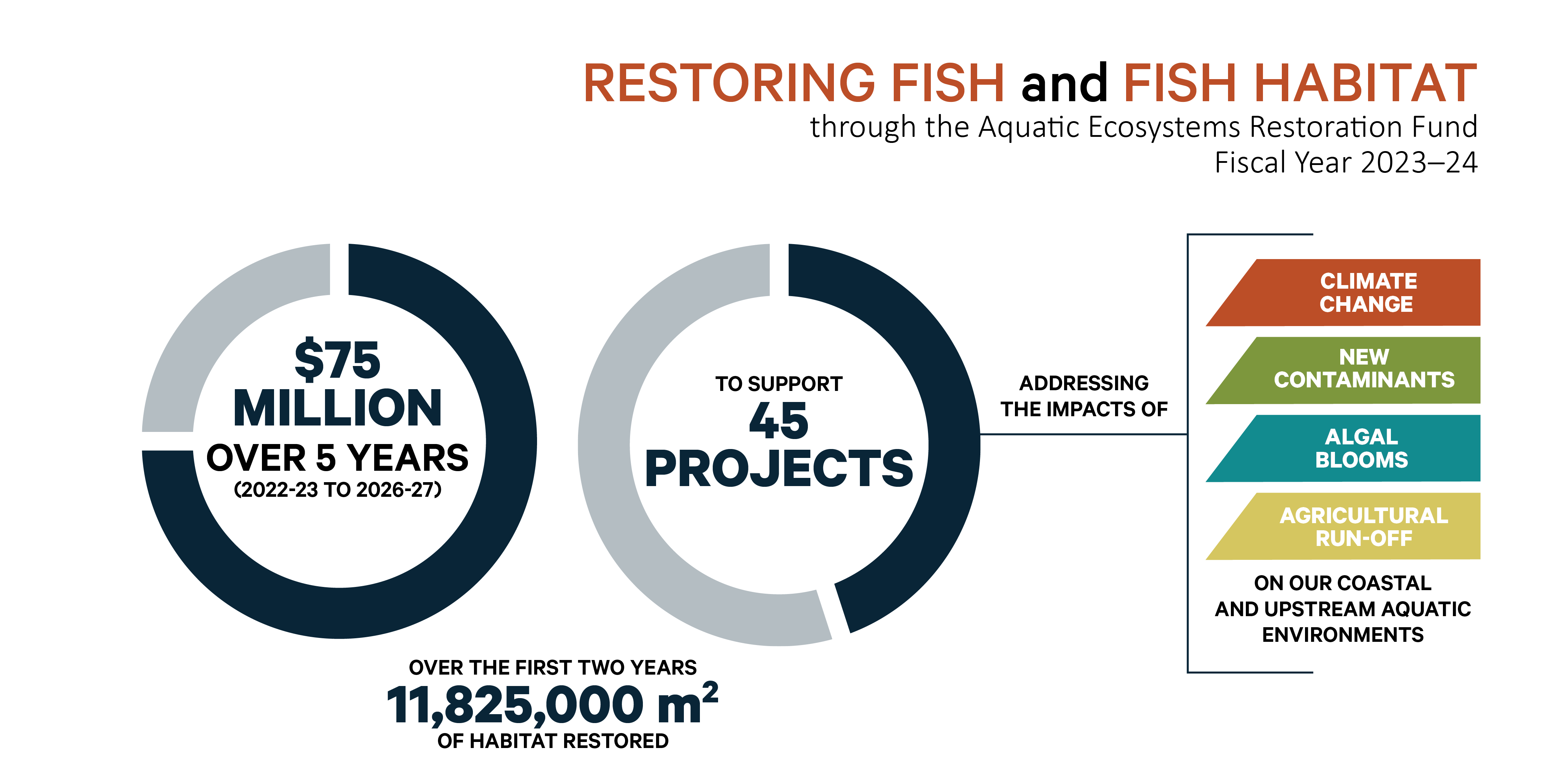
Infographic: Restoring Fish and Fish Habitat through the Aquatic Ecosystems Restoration Fund - fiscal year 2023-24
$75 million over 5 years (2022-23 to 2026-27) to support 45 projects addressing the impacts of:
- Climate change
- New contaminants
- Algal blooms
- Agricultural run-off
Coastal and upstream aquatic environments
Reports received from recipients during the first two years of this program are showing promising results with 11,825,000m2 of habitat restored.
Canada and 195 other countries adopted the Kunming-Montréal Global Biodiversity Framework in 2022. This framework identifies a set of global goals and 23 targets to halt and reverse biodiversity loss by 2030 and put nature on a path to recovery by 2050.
In 2023-24, we held engagement sessions on the Canada’s 2030 National Biodiversity Strategy target to “ensure that by 2030 at least 30 per cent of areas of degraded terrestrial, inland water, and marine and coastal ecosystems are under effective restoration, in order to enhance biodiversity and ecosystem functions and services, ecological integrity and connectivity”.
3.0 Preventing pollution from entering waters
ECCC has reported on the administrative, regulatory, and enforcement activities related to the pollution prevention provisions of the Fisheries Act for many years. Our role is to educate and promote compliance to help the industries and communities we regulate follow the legislation. We also work with these partners to develop, improve, and streamline pollution prevention-related regulations.
Throughout the year, our environment enforcement officers conduct both planned and unplanned inspections to verify compliance and respond to incidents. This includes responding to incidents of unauthorized deposits from unregulated industries subject to the Fisheries Act. They also carry out investigations to gather the evidence required to prosecute offenses. At the same time, our environmental protection and enforcement teams analyze self-reported effluent data from regulated industries, monitor the waters used as bivalve shellfish growing areas for pollution, and respond to emergencies to prevent pollution from entering waters frequented by fish across Canada.
In 2023-24, we continued our review of Fisheries Act regulations as mandated by the Treasury Board Secretariat of Canada. Specifically, we reviewed the Regulations Establishing Conditions for Making Regulations Under Subsection 36(5.2) of the Fisheries Act, which are administrative in nature as they enable us to make other regulations under the Act. This regulatory review was done in collaboration with DFO as both departments have responsibilities with respect to these regulations.
The pollution prevention provisions of the Fisheries Act that relate to aquaculture activities and which serve to prevent, control, and eliminate aquatic invasive species and aquatic pests are administered and enforced by DFO.
3.1 Educating and promoting compliance
We work to increase awareness and understanding about the importance of preventing pollution from entering waters frequented by fish and the consequences of non-compliance among the industries and communities that we regulate. These include the:
- Pulp and paper sector
- Metal and diamond mining sector; and
- Wastewater systems run by most federal, provincial and municipal governments, private companies, and Indigenous communitiesFootnote 12
We share this information via email and website postings, in letters, as brochures or other documents, and during site visits, information sessions and tradeshow booths. For example, in 2023-24, we continued to lead in-person engagement sessions with several First Nations communities, in conjunction with Indigenous Services Canada, which resulted in increased levels of wastewater systems compliance. In addition to on-site work, we participated in virtual meetings, tradeshows, presentations and phone calls with First Nations communities, Tribal Councils, technical associations, and Circuit Riders to build awareness and understanding of the regulatory requirements of the Wastewater Systems Effluent Regulations. We also continued to help these communities and their supporting agencies by participating in Indigenous-focused conferences and workshops, creating user-friendly compliance material for owners/operators, providing regular reporting reminders, and offering meetings to discuss any reporting challenges. In addition, we continued to engage First Nations communities and their supporting agencies to determine if communities are subject to the Wastewater Systems Effluent Regulations, and to increase their capacity to conduct ongoing sampling and reporting to comply with the regulations.
Key results:
Improving metal and diamond mining sector reporting
In 2023-24, we contacted all facilities subject to the Metal and Diamond Mining Effluent Regulations to inform them that two-factor authentication would soon be used in the Single Window Information Manager that they use to access and submit reports required under the regulations.
We also hosted a booth at the Prospectors & Developers Association of Canada’s 2024 Convention to promote the Metal and Diamond Mining Effluent Regulations by distributing fact sheets and answering questions.
Promoting information transparency of the data collected under the Pulp and Paper Effluent Regulations
The Pulp and Paper Effluent Regulations Annual Report summarizes the compliance and effluent discharge amounts of Canadian pulp and paper mills with respect to the selected standards prescribed by the Pulp and Paper Effluent Regulations. It also contains information pertaining to the Environmental Effects Monitoring studies that are conducted by these mills.
At the beginning of 2024, we published an update of the annual report. We also published updated regulatory data collected under the Pulp and Paper Effluent Regulations to the Open Data Platform, including data on effluent monitoring, bioassay, and sublethal toxicity.
These publications aim to make data collected under the regulations more accessible to Canadians, to provide context on compliance with the regulation, and to show trends in effluent discharge over time.
3.2 Modernizing and developing pollution prevention regulations
Eight regulations have been developed to date to protect waters that are frequented by fish from pollution. The regulations achieve this outcome by controlling the type and amount of substances that can be deposited into waterways by certain industries and wastewater systems or by setting other requirements that would support the protection of fish, fish habitat and human use of fisheries resources.
We regularly undertake regulatory reviews to strengthen environmental protections, improve administrative efficiencies, and reduce unnecessary regulatory burden on industry. For example, during 2023-24, we published the Modernization of the Pulp and Paper Effluent Regulations - Updated detailed proposal for consultation - January 2024. This document was developed through the analysis and consideration of comments and questions received during previous consultation sessions with interested stakeholders on the Pulp and Paper Effluent Regulations detailed proposal for consultation May 2019. After the document was posted online, we held six information consultation sessions and 11 meetings with interested stakeholders, other government departments, and provinces who had additional questions. We have since been analyzing any new comments received, and are preparing to publish the proposed amendments to the Pulp and Paper Effluent Regulations in Canada Gazette Part I.
We also advanced the development of Coal Mining Effluent Regulations by analyzing and updating the proposed approach based on comments and information identified during previous years’ engagement with an aim to publish the draft regulations in Canada Gazette Part I in 2025.
In 2023-24, the Oil Sands Mining Effluent Regulations Crown-Indigenous Working Group continued to examine options for managing the accumulation of oil sands mine water in tailing ponds and to explore alternatives to the release of treated effluent to ensure that all options are considered before a decision is made to regulate. Any such regulations would only be developed with strict protective standards reflecting the best available scientific information and Indigenous knowledge, and in collaboration with local Indigenous communities.
Key results:
Regulatory review of the Regulations Establishing Conditions for Making Regulations Under Subsection 36(5.2) of the Fisheries Act
In 2023-24, we initiated and completed the regulatory review of the Regulations Establishing Conditions for Making Regulations Under Subsection 36(5.2) of the Fisheries Act (“Enabling Regulations”) to ensure that they are still achieving their intended policy objectives.
Subsection 36(5.2) of the Fisheries Act provides authority to ministers to make regulations to authorize the deposit of deleterious (harmful) substances under certain conditions. The Enabling Regulations establish these conditions based on the subject matter:
- Under the first set of conditions, the Minister of Fisheries may develop ministerial regulations that authorize deposits of deleterious substances related to aquaculture, and the management of/or control of aquatic pests and aquatic invasive species.
- Under the second set of conditions, the Minister of Environment and Climate Change may develop ministerial regulations that authorize deposits of deleterious substances for the purpose of aquatic research.
- Under the third set of conditions, the Minister of Environment and Climate Change may develop ministerial regulations that authorize deposits of deleterious substances already managed by federal and/or provincial regulating authorities.
The Enabling Regulations are administrative in nature and apply only to these two ministers. They do not impose costs or burden on stakeholders or rights-holders. Both departments were involved in the review of these regulations. The review concluded that the Enabling Regulations will not change at this time and no additional action will take place other than documenting the identified issues.
Publication of Regulations Amending the Wastewater Systems Effluent Regulations
We continued to work towards amending the Wastewater Systems Effluent Regulations in 2023-24. Proposed amendments were published in the Canada Gazette Part I on May 27, 2023 for a 60-day public comment period. More than 100 written comments were received from municipalities, Indigenous groups and communities, associations, and non-governmental organizations. The proposed amendments were also informed by comments received during extensive public engagement and consultation between 2020 and 2022.
The proposed amendments aim to help regulatees meet their regulatory requirements by reopening transitional authorizations to give eligible communities time to upgrade their wastewater treatment system, expanding temporary bypass authorizations to allow planned releases from sewer systems under specific conditions, and improving overall clarity and consistency.
3.3 Analyzing self-reported effluent data
Every year, we analyze the data reported by facilities subject to Fisheries Act regulations; namely, pulp and paper mills, metal and diamond mines, and wastewater system facilities.
Our analysis of the 2022Footnote 13 monitoring data that was self-reported by the 74 pulp and paper mills subject to regulations shows a compliance rate of:
- over 99 per cent for total suspended solids and biochemical oxygen demand
- 98.7 per cent for the requirement that effluent not be lethal to fish; and
- 88 per cent for conducting and reporting on biological monitoring studies and sublethal toxicity testing required under environmental effects monitoringFootnote 14
Our analysis of the 2022 data self-reported by 147 metal and five diamond mine facilities subject to regulations shows that companies continue to report the following high rates of compliance:Footnote 15
- over 97 per cent for suspended solids
- over 98 per cent for the requirement for effluent to be within the prescribed minimum pH range
- over 99 per cent for all remaining substances
- over 97 per cent for the requirement that effluent not be lethal to fish; and
- 90 per cent for conducting and reporting on biological monitoring studies and effluent and water quality monitoring studies required under environmental effects monitoringFootnote 16
Our analysis includes the 2023 self-reported data on effluent quality results and the volumes deposited by more than 2,300 wastewater systems that are subject to regulations or are under an equivalency agreement. We also consider the self-reported data from the 280 medium and large wastewater systems that are required to conduct lethality tests. Our analysis shows that:
- 78 per cent met the effluent quality standards of 25 mg/L for both Carbonaceous Biochemical Oxygen Demand and suspended solids; and
- 91 per cent of the lethality test results were not lethal to fish
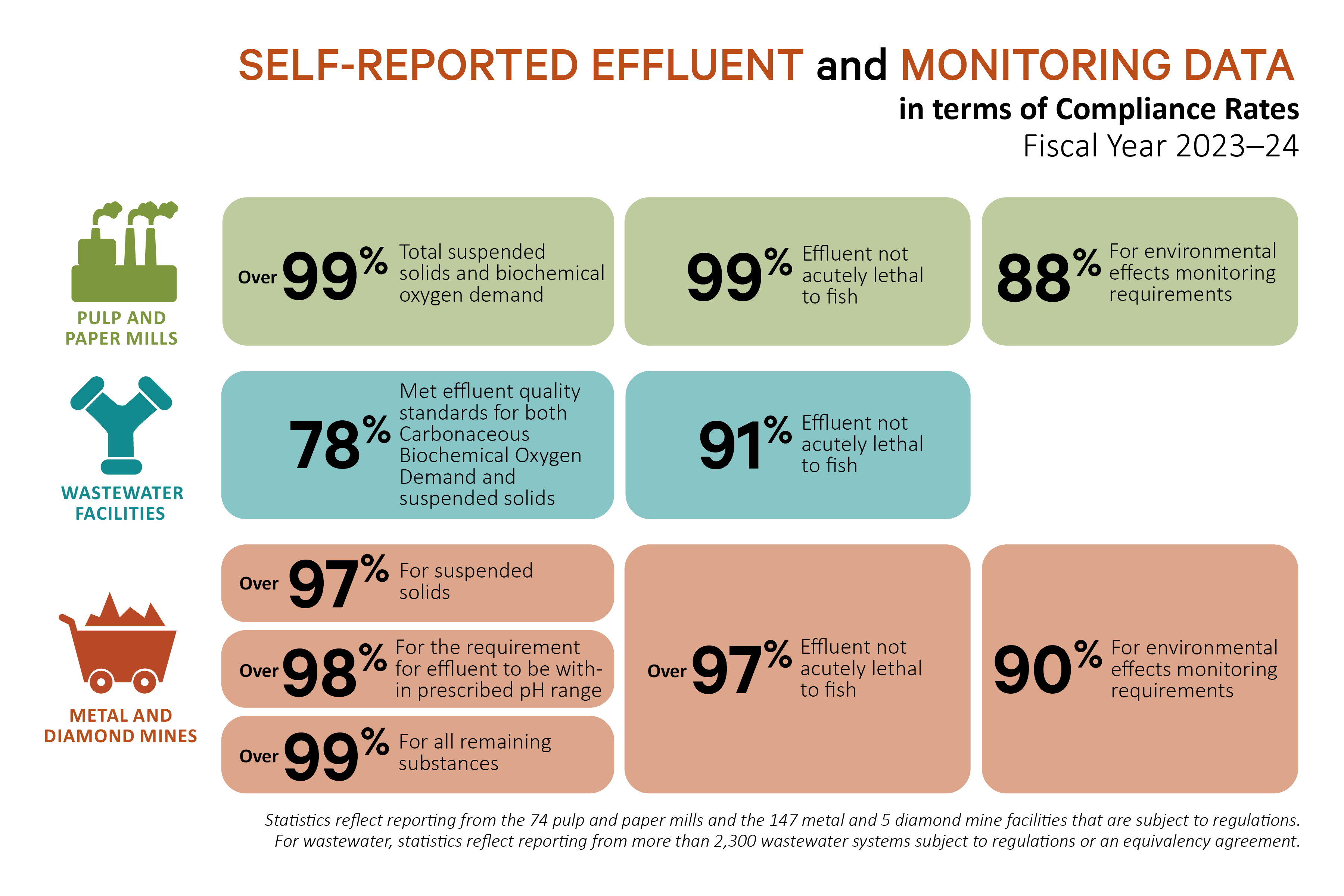
Infographic: Analysis of self-reported effluent data in terms of compliance rates - fiscal year 2023-24
Pulp and Paper Mills
Over 99% total suspended solids and biochemical oxygen demand
98.7% effluent not acutely lethal to fish
88% for Environmental effects monitoring requirements
Wastewater Facilities
78% met effluent quality standards for both Carbonaceous Biochemical Oxygen Demand and suspended solids
91% effluent not acutely lethal to fish
Metal and Diamond Mines
Over 97% for suspended solids
Over 98% for the requirement for effluent to be within prescribed pH range
Over 99% for all remaining substances
Over 97% Effluent not acutely lethal to fish
90% for environmental effects monitoring requirements
3.3.1 Transitional authorizations
Under the Wastewater Systems Effluent Regulations, owners or operators of a wastewater system that is subject to regulations but is not built to achieve the national effluent quality standards were able to apply for a transitional authorization before June 30, 2014. These authorizations established the conditions under which the wastewater systems could continue to operate, while setting a deadline to upgrade the system (end of 2020, 2030 or 2040) to meet the mandatory national effluent quality standards. The Wastewater Systems Effluent Regulations: registry of transitional authorizations publicly lists all transitional authorizations and their status.
We issued transitional authorizations for 65 wastewater systems, including five systems located in Quebec which are now subject to an equivalency agreement and managed by the Province of Quebec. Of the 60 transitional authorizations that we still manage, 22 systems have completed upgrades. Of the remaining 38:
- Five transitional authorizations expired on December 31, 2020Footnote 17
- Six must meet effluent quality standards by December 31, 2030; and
- Twenty-seven must meet effluent quality standards by December 31, 2040
Various factors can affect timelines for completing required upgrades, including access to infrastructure funding as well as the length of time needed to plan, design and construct a wastewater treatment plant.
Key result:
Completion of new wastewater treatment facilities across Canada
Two significant wastewater system upgrades were completed in 2023-24 when new treatment facilities were constructed at existing wastewater systems in Lloydminster, Saskatchewan and in Camrose, Alberta. These upgrades will greatly reduce the impact of un-ionized ammonia discharges into the North Saskatchewan River watershed and enable these systems to meet the requirements of the Wastewater Systems Effluent Regulations.
In 2023-24, several regulatees with transitional authorizations were also nearing completion of their new treatment facilities. These included facilities in Edwardsville and Port Morien on Cape Breton Island in Nova Scotia and in Tofino, British Columbia.
3.4 Enforcing the pollution prevention provisions
3.4.1 Enforcement priorities
In 2023-24, we continued to use a risk- and evidence-based framework to inform, plan, and allocate resources to our enforcement activities.
This entailed carrying out regional and national enforcement projects targeting high-risk toxic substances and high-risk water pollution sectors. These projects included inspections to assess industry compliance with the pollution prevention provisions of the Fisheries Act and/or its regulations. For example, in 2023-24, we conducted inspections at chemical manufacturing and power generation facilities identified as being most at risk of contravening subsection 36(3) of the Fisheries Act.
3.4.2 Enforcement activities
During the reporting period,155 environmental enforcement officers had been designated by the Minister of Environment and Climate Change as fishery officers under the Fisheries Act.Footnote 18These officers work in every province and territory across Canada and they are supported by a range of other experts, including intelligence officers and analysts, regulatory analysts, scientists, and legal advisors.
Our environmental enforcement officers are responsible for:
- conducting planned (proactive) inspections to verify compliance
- conducting unplanned (reactive) inspections in response to:
- complaints from members of the public
- reported spills and incidents
- referrals from internal and external partners
- conducting investigations to gather evidence necessary to prosecute offences in court
- working with Crown counsel on prosecutions
- working with other partners, including Indigenous communities, provincial and territorial environmental agencies, and other national and international organizations; and
- undertaking other activities, as needed
Work with Indigenous communities may include, but is not limited to:
- notifying communities before entering their lands, when possible, to conduct inspections
- meeting communities (e.g., to discuss the reason(s) for being in their community, explain our mandate, respond to any concerns the community may have, or collaborate to identify sources of pollution); and
- ensuring the harm or loss that an offence has caused to communities is documented, so the Court can take it into account when an offender is sentenced
Environmental enforcement officers issue enforcement measures to address alleged violations, including warnings, directions, and orders. They can also recommend files for prosecution. In addition, information collected by environmental enforcement officers may be considered by courts to impose injunctions.
The goal of any enforcement measure is to ensure that a violation is corrected within the shortest possible period so that the violator is brought into compliance with the Fisheries Act and discouraged from future non-compliance. For example, a direction is issued when immediate action is necessary to halt or prevent an unauthorized deposit of a harmful substance into water frequented by fish.
The Compliance and Enforcement Policy for Habitat Protection and Pollution Prevention Provisions of the Fisheries Act guides all of the enforcement activities we undertake to ensure industry and community compliance with the pollution prevention provisions of the Fisheries Act.
During 2023-24, our environmental enforcement officers undertook the following activities and measures to enforce the pollution prevention provisions of the Fisheries Act:
- conducted 2,399 inspections (893 on-site and 1,506 off-site)Footnote 19
- initiated 20 investigations
- issued 208 written warning letters to address 481 infractions
- initiated five prosecutions to address seven infractions
- issued 46 directions to address 70 infractions; and
- concluded eight successful prosecutions, which resulted in the conviction of nine subjects on nine counts and a total of $6,055,000 in imposed fines, most of which were directed to the Environmental Damages Fund
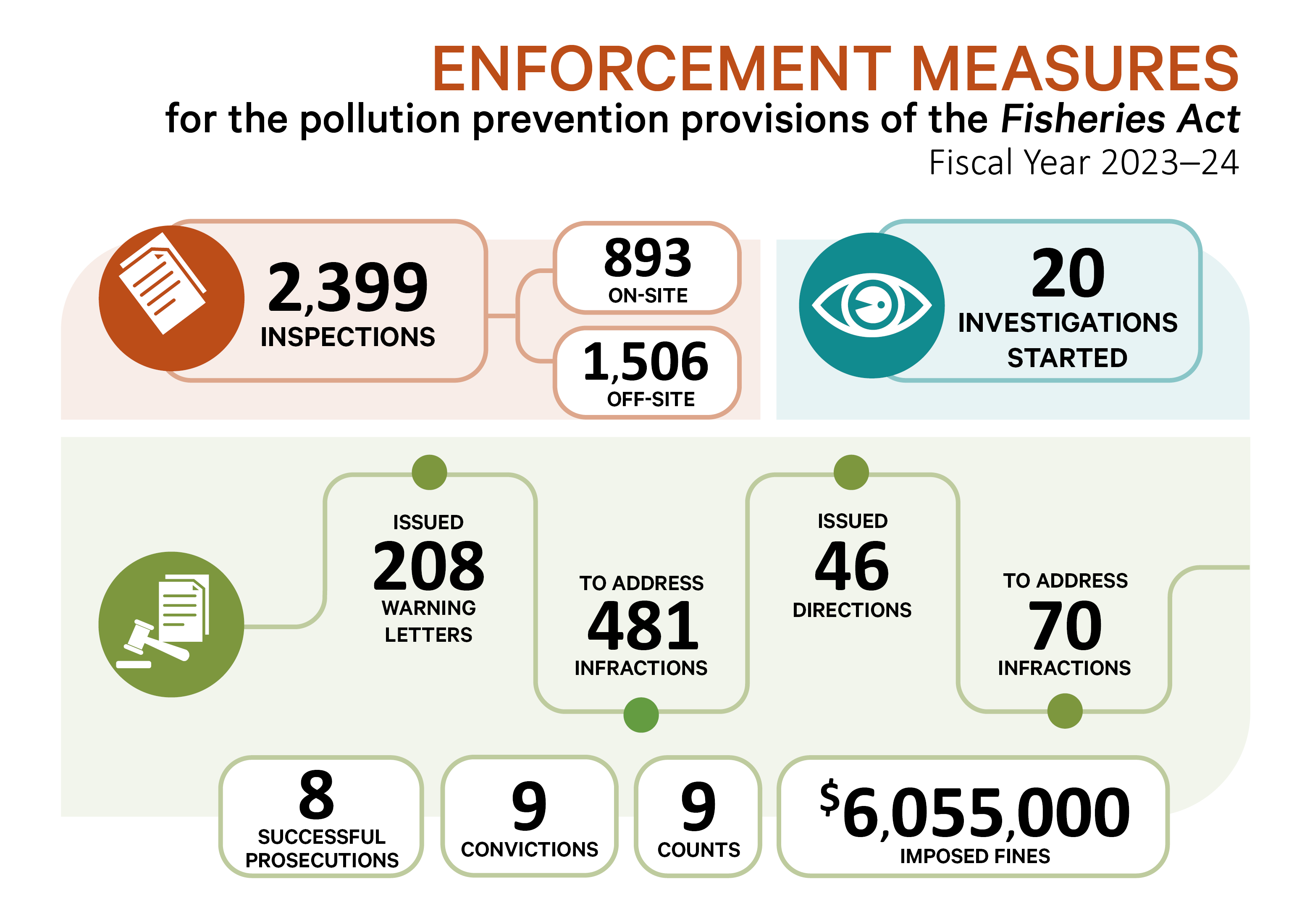
Infographic: Enforcement measures for the pollution prevention provisions of the Fisheries Act, fiscal year 2023-24
Infographic: Enforcement measures for the pollution prevention provisions of the Fisheries Act, fiscal year 2023-24
- 2,399 inspections
- 893 on site
- 1,506 off site
- 20 investigations started
- Issued 208 warning letters to address 481 infractions
- Issued 46 directions to address 70 infractions
- 8 successful prosecutions
- 9 convictions
- 9 counts
- $6,055,000 imposed fines
Complete information on our enforcement activities in 2023-24 is included in the following tables in the Annex:
- Table 12 - Inspections Conducted in Fiscal Year 2023-24
- Table 13 - Enforcement Measures in Fiscal Year 2023-24
- Table 14 - Investigations Breakdown for Fiscal Year 2023-24
- Table 15 - Prosecutions and Penalties in Fiscal Year 2023-24
3.4.2.1 Addressing unauthorized deposit incidents
In the 2019 Spring Report from the Commissioner of the Environment and Sustainable Development to the Parliament of Canada, the Commissioner recommended that we publicly share information on unauthorized deposits of deleterious substances incidents that our enforcement officers encounter and follow up on. We have thus added statistical information on our activities within this annual report.
In 2023-24, our enforcement officers undertook 822 enforcement activities related to suspected or confirmed deposits of deleterious substances under subsection 36(3) of the Fisheries Act that are not subject to a Fisheries Act regulation. They also undertook 62 enforcement activities in relation to suspected or confirmed deposits of deleterious substances at a place other than the Final Discharge Point subject to a Fisheries Act regulation over the same time period.
Key Result:
Major successes resulting from environmental enforcement officer actions
In 2023-24, there were just over $6 million in fines imposed on offenders convicted of offences under the pollution prevention provisions of the Fisheries Act. Most of these fines are credited to the Environmental Damages Fund to ensure “environmental good follows environmental harm” by supporting projects with measurable outcomes in communities across Canada. Persons other than individuals, such as a corporation, that are convicted of an offence are also added to the Environmental Offenders Registry.
A few case highlightsFootnote 20 from 2023-24 include:
- On April 4, 2023, the Court of Quebec ordered Enterprise Rent-A-Car to pay $1 million after the company pleaded guilty to one count of violating the Fisheries Act. The conviction stemmed from a gasoline spill on January 4, 2021. An investigation was launched after our enforcement officers received reports of a fuel spill at the company's service centre in Dorval, Quebec. The investigation determined that during a delivery of over 20,000 litres of regular gasoline, the fuel was transferred into a 5,000-litre gasoline trap, due largely to the negligence of the car rental company. The incident was caused by a lack of proper filling-pipe identification, insufficient supervision during delivery, and the absence of leak-detection procedures. Approximately 15,000 litres of gasoline were discharged into the site's storm sewer system, eventually reaching the fish-bearing waters of Bouchard Creek, which flow into Lake Saint-Louis. The Environmental Damages Fund will receive 100 per cent of the fine.
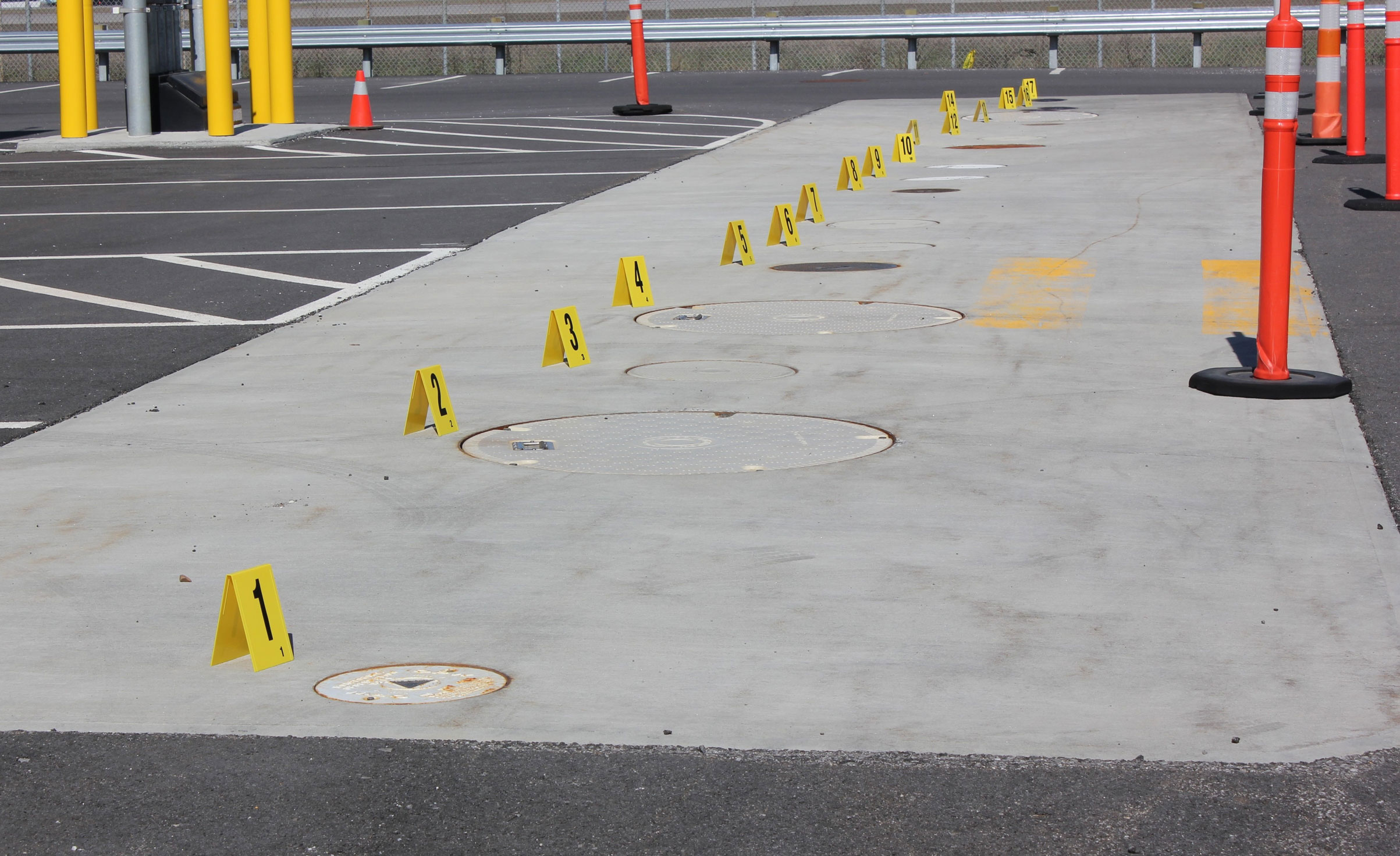
Picture 1: Overview of different manholes at the spill site
- On July 19, 2023, in the Provincial Court of British Columbia, Arctic Pearl Ice and Cold Storage Ltd. was ordered to pay $700,000 after pleading guilty to one charge laid under the Fisheries Act and $55,000 after pleading guilty to two charges laid under the Transportation of Dangerous Goods Act, 1992. These charges stemmed from offences related to transporting and discharging ammonia into a body of water that flows into fish-bearing water. In November 2017, we initiated a joint investigation with Transport Canada after an individual called for emergency medical assistance after inhaling ammonia gas at Arctic Pearl Ice and Cold Storage Ltd.’s warehouse. The investigation revealed that a storage tank containing a large quantity of contaminated ammonia, which had been removed from a fishing vessel during maintenance of the refrigeration system in October 2017, had been transferred to the warehouse and was releasing ammonia into a container of water. The contaminated water was overflowing into a storm drain that flows into Bath Slough and discharges into the Fraser River. The investigation also revealed the storage tank was not built to the required specifications for the transport of dangerous goods, the tank did not have the required shipping documents or safety marks, and the driver and individuals involved did not have the required training in handling, transportation, and storage of ammonia. Experts estimate that approximately 1,227 lbs of ammonia was released into the environment. In addition to the fines, the company was also ordered to pay $8,477.43 in restitution to the City of Richmond, representing the cost to the Richmond Fire Department’s response to the incident.
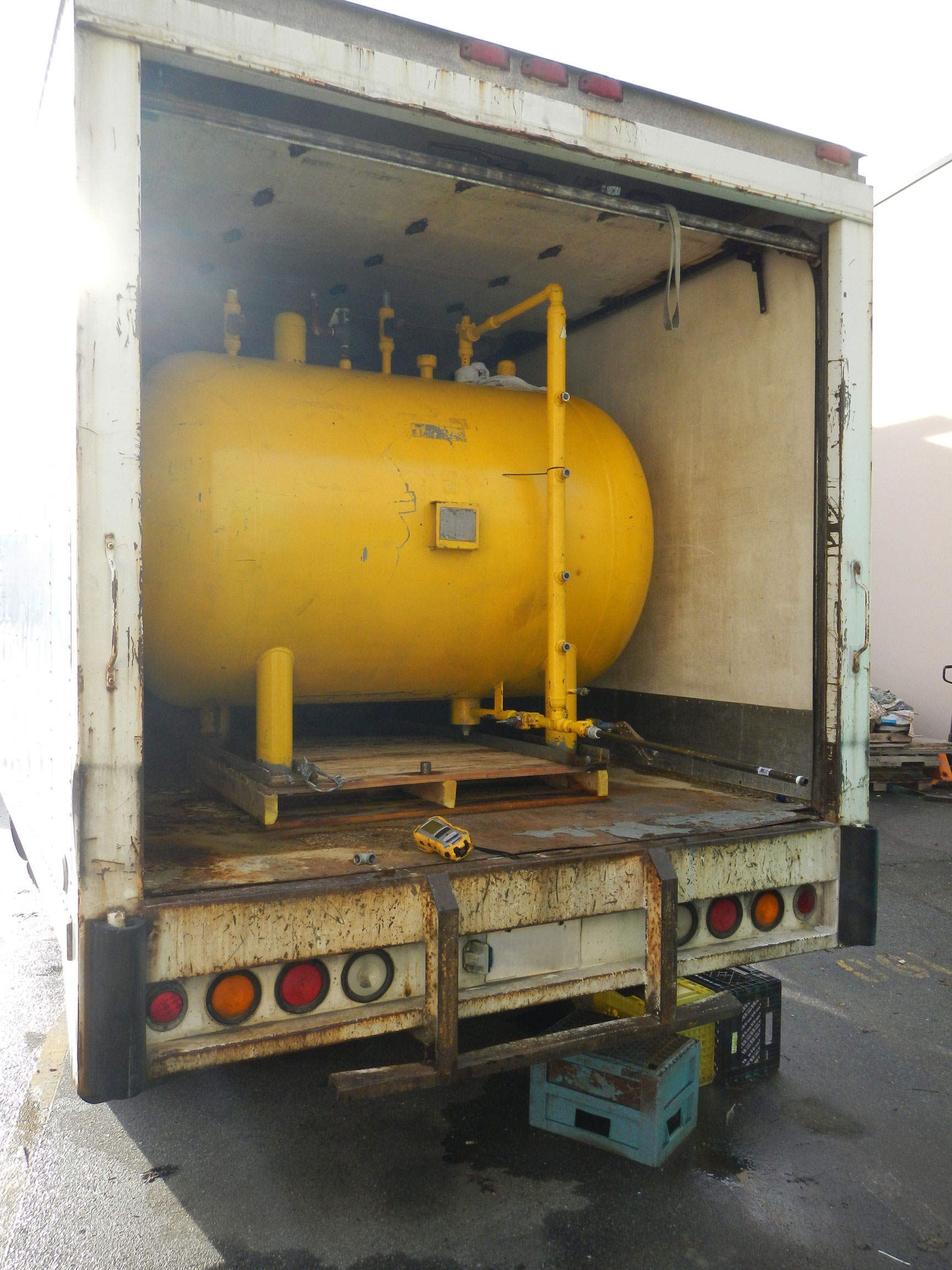
Picture 1: The ammonia tank in the back of a truck
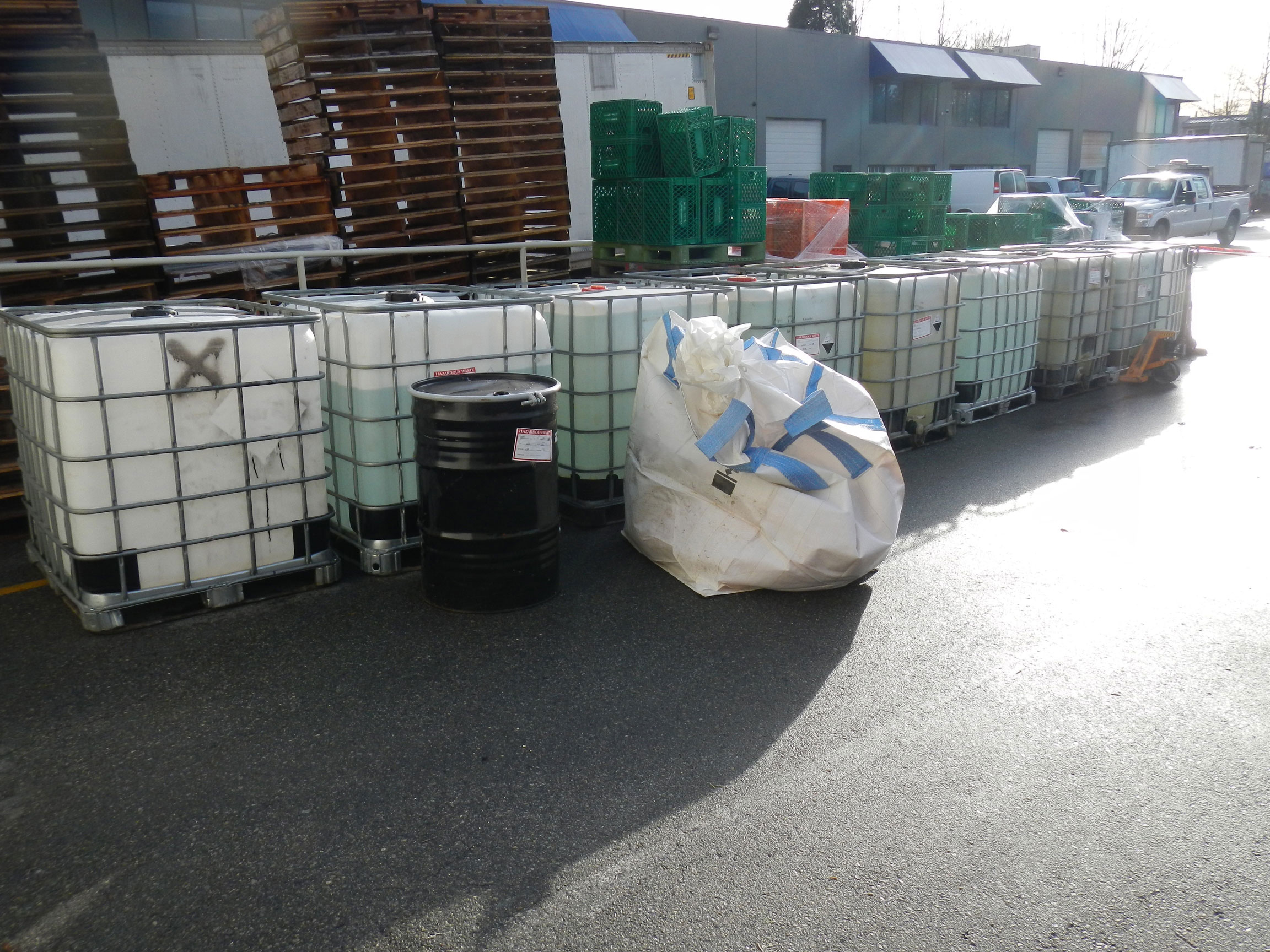
Picture 2: The resulting waste after the remaining ammonia was sparged into the water
- On July 31, 2023, Peace River Hydro Partners was fined $1.1 million by the Provincial Court of British Columbia, after pleading guilty to one charge of depositing a deleterious substance into water frequented by fish in contravention of the Fisheries Act. The charge stemmed from an investigation into the discharge of 3,300 m3 of contaminated drainage water into the Peace River on September 9 and 10, 2018. The investigation revealed the Site C Clean Energy Project's water management infrastructure was insufficient to treat additional drainage during a high rainfall event, resulting in a mix of treated and untreated water being released into the Peace River. A sample of the drainage water collected on September 9, 2018 determined that it contained a concentration of aluminum that was acutely lethal to fish.
- On December 15, 2023, Canadian Kraft Paper Industries Limited was fined $1 million for violating the Fisheries Act. This was one of the largest environmental fines in Manitoba history. The charges stemmed from a February 2019 pipe leak at the company’s pulp and paper mill in The Pas, Manitoba which resulted in the release of 23,000 litres of black liquor, a by-product of the manufacturing process, into the mill’s effluent treatment system. Our investigation determined that over the course of six days, close to 181,000,000 litres of acutely lethal effluent had been released from the effluent treatment system into the Saskatchewan River. This deposit was in violation of a condition of the authorization to deposit effluent that is set out in subsection 6(5) of the Pulp and Paper Effluent Regulations and is a contravention of subsection 36(3) of the Fisheries Act. In addition to the fine, the company was required to conduct an independent environmental audit within 12 months of sentencing to review its operations and make recommendations regarding the implementation of best available technology and best practices to prevent future deleterious deposits. A report identifying the recommendations and actions the company would take to address them must also be provided to us.
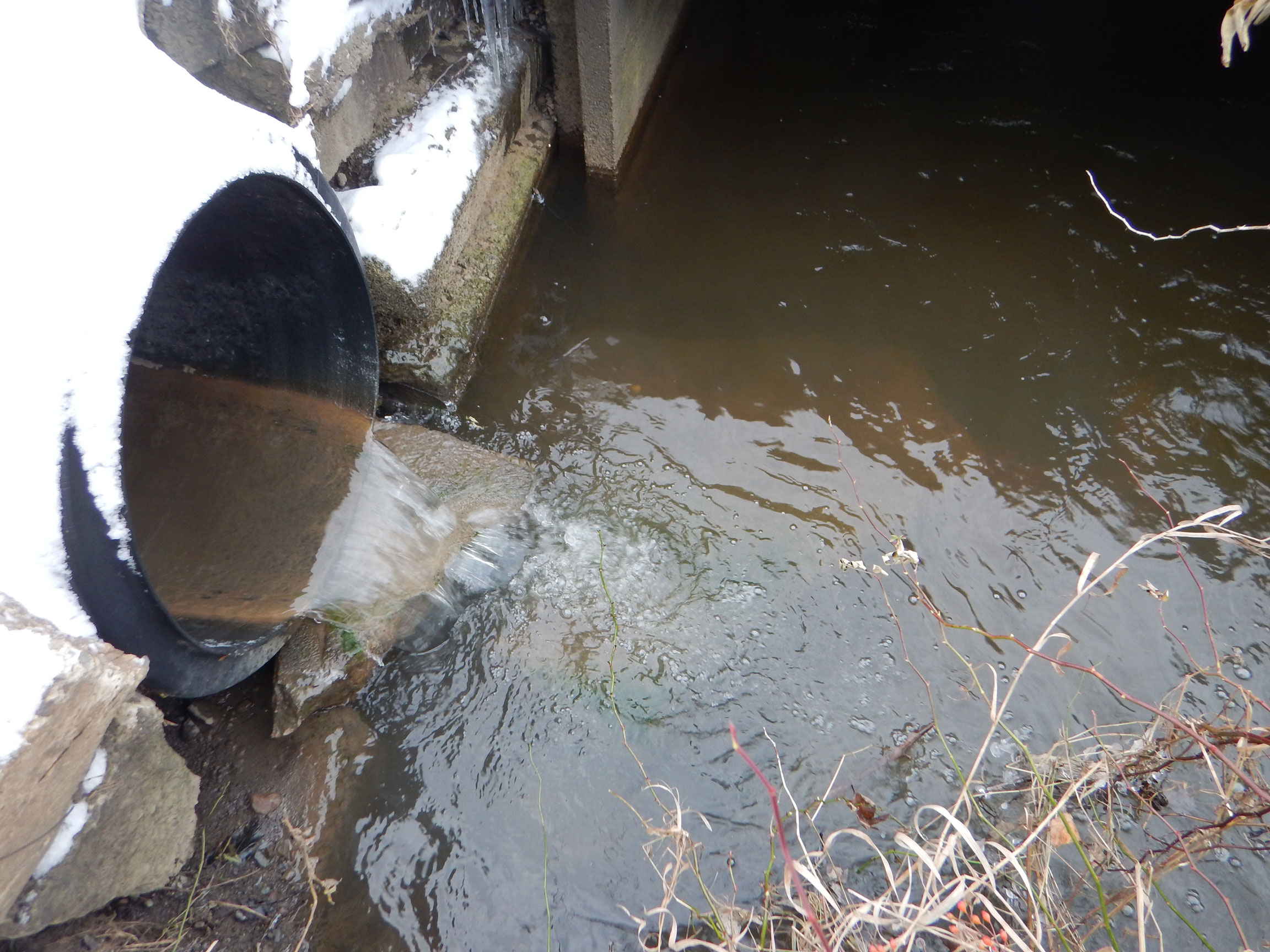
- On February 15, 2024, the Town of Trenton was fined $100,000 after pleading guilty to one count of violating the Fisheries Act at the Provincial Court of Nova Scotia. The charge stemmed from our enforcement investigation that determined raw sewage was discharged from an outfall connected to the Town’s municipal infrastructure into Lowden Brook between June 1, 2019 and January 4, 2020. Lab results determined that there were high levels of E. coli at the outfall and the culvert, and that the effluent was toxic to fish. On December 20, 2019, our enforcement officers issued a written Fisheries Act Direction to the Town, requiring it to develop a plan to stop the deposit and provide regular monitoring reports until the deposit was stopped. The total fine was directed to the Environmental Damages Fund. In addition to the sentence, the court also issued an order with several conditions to be met within 18 months. These include: training on the Fisheries Act and its requirements; training on proper effluent sampling protocols for Town of Trenton employees and contractors; completing routine sampling; and publishing emergency contact information and information about the incident and sentencing on the Town of Trenton’s website.
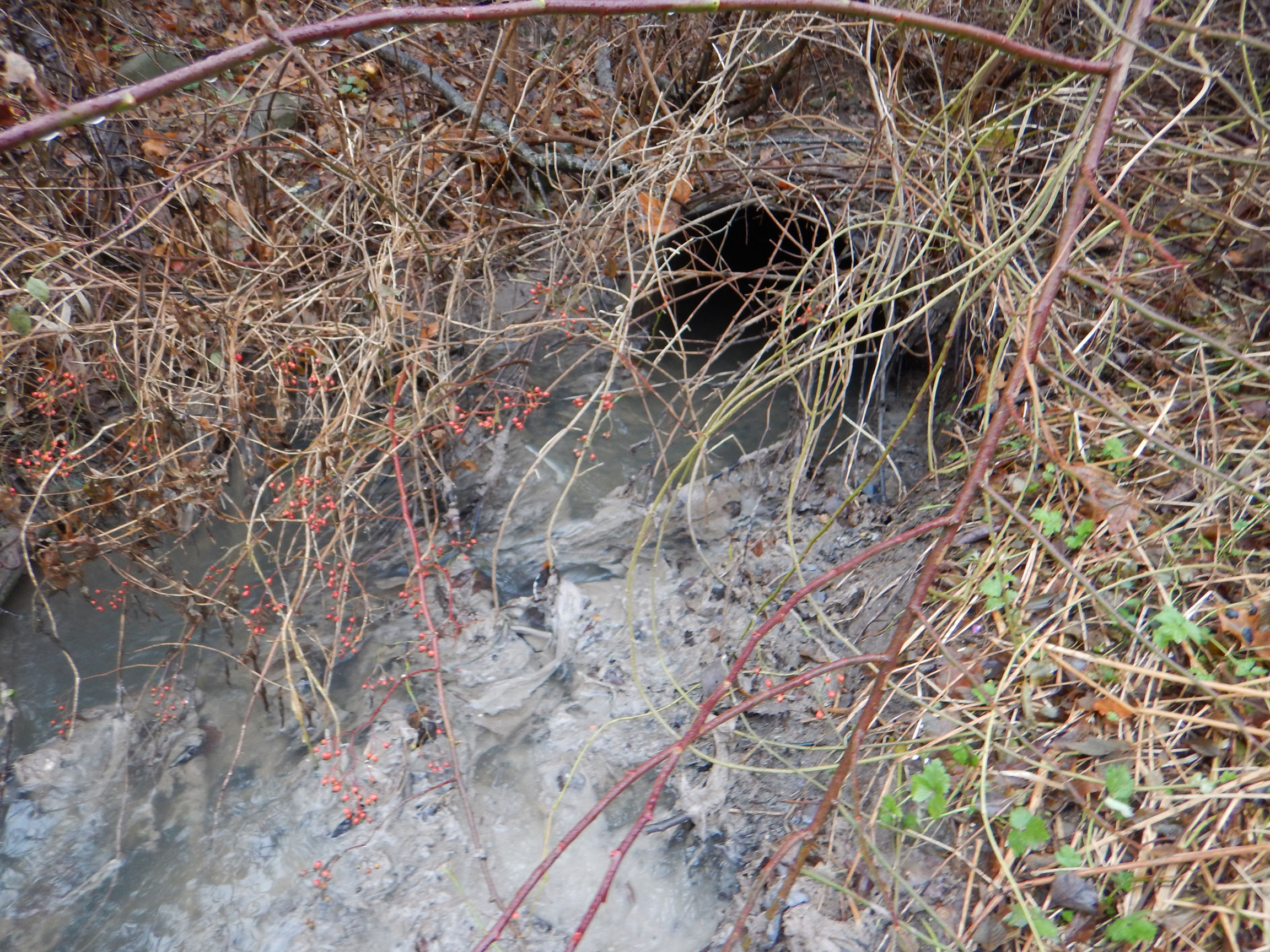
Picture 1: Untreated sewage overflowed into ditch due to blocked pipe
Picture 2: Untreated sewage flowed 325m along the length of the ditch into Lowden Brook. Enforcement officers collected samples and verified that it was deleterious to fish
3.5 Supporting restoration using the Environmental Damages Fund
The Environmental Damages Fund was created in 1995 to provide a mechanism for directing funds received as a result of fines, penalties, court orders, and voluntary payments to priority projects that would benefit our natural environment. The four key priorities are restoration, environmental quality improvement, research and development, and education and awareness.
The Environmental Damages Fund is administered by ECCC. Fines and penalties are automatically directed to the Fund under 14 federal legislative clauses, including subsection 40(6) of the Fisheries Act. Five federal statutes also contain discretionary clauses that can be used to direct fines and penalties to the Fund, including paragraph 79.2(f) of the Fisheries Act.
Since the Fund was created, more than $195 million has been invested in over 500 projects benefitting ecosystems and communities across Canada. In 2023-24, $4.78 million was directed to the Fund from fines for infractions to the Fisheries Act.
Highlights on some projectsFootnote 21 approved for funding in 2023-24 include:
Manitoulin Streams Improvement Association: Grimesthorpe Creek S14 Livestock exclusion, In-stream and Riparian Restoration 2024-25
The Recipient was awarded $102,015 to implement a project that will provide ecological, environmental, and social/economic benefits to the Lake Huron basin by restoring and improving cold-water ecosystems on Manitoulin Island. Activities will include garbage collection and shoreline clean up, stream restoration and tree planting, as well as installation of fencing and spawning beds, where necessary. Water sampling, as well as pre-and post-invertebrate and electrofishing surveys will also be conducted. To engage the community in the project, the Recipient will use social media and newsletters to publicize its activities and invite participants to outreach events so they can learn about restoration and assist with the clean-up and tree planting.
Bluenose Coastal Action Foundation: LaHave River Watershed Project
The Recipient was awarded $114,000 to implement a project that will focus on the restoration of 10,000m² of degraded aquatic habitat within the LaHave River watershed. It will also focus on addressing the survival of native fish species, such as Southern Upland Atlantic salmon, brook trout, and American eel, and conducting community outreach. Project activities include water quality monitoring and assessment, restoration (instream structure installation, riparian planting, sandwanding, etc.), participation in public events related to fish habitat and environmental topics, and the development of a fish habitat restoration plan and a final project report.
Albert Invasive Species Council: Addressing the Threat of Aquatic Invasive Species in the North Saskatchewan Watershed
The Recipient was awarded $2,157,907 to implement a project that will focus on the protection of the Lake Sturgeon habitat in the sub-watersheds of the North Saskatchewan River from aquatic invasive species. Specifically, the project is focused on increasing education and awareness to the public and land managers, and advancing research, prevention, and management to provide an all-encompassing strategy for protecting Lake Sturgeon habitat from aquatic invasive species. Activities that have taken place since the project was funded in 2023-24include environmental DNA sampling, analysis to establish habitat profiles for locations prioritized for restoration, and CD3 unit placement. These CD3 units are mobile watercraft cleaning stations that provide the public with all the necessary tools in one unit to properly clean, drain, and dry their equipment and watercraft, helping to mitigate the spread of aquatic invasive species. Locations will be continuously sampled throughout the five-year project, with analyses focusing on the organisms targeted by the restoration effort. Assessments will also take place to establish baseline animal biodiversity data for each sample location in order to allow for more comprehensive assessments of the impact of the restoration effort.
Highlights of a project that was completed in 2023-24 include:
Ktunaxa Nation Council: Columbia River Chinook Salmon Habitat Restoration and Adaptive Management Framework
The Recipient was awarded $630,533 to restore, protect or improve fish habitat in the Columbia and Kootenay River watersheds by developing an Adaptive Management Framework to guide the technical work needed to inform restoration efforts to reintroduce Chinook Salmon into the Columbia River basin. The funds specifically supported the fundamental Ktunaxa Nation-led work to return salmon to the Canadian Columbia River, which has been blocked for over 80 years. The return of salmon signifies the return of an important food source, as well as a critical social and ceremonial component of Ktunaxa life. The adaptive management framework supports the process for salmon reintroduction in a way that lays out critical actionable steps for integration of Indigenous Knowledge and western science for defensible environmental decision-making. The mainstem and tributary studies highlight areas of the Columbia that provide suitable habitat for Chinook and also provide guidance on restoration opportunities. Their methodologies may serve as a foundation for other suitable donor stocks for the Canadian Columbia River. The project successfully achieved its objectives, including developing methods to restore environmental damage, implementing reports and recommendations, engaging partners, and fostering community participation.
3.6 Equivalency and administrative agreements
The Fisheries Act enables us to develop bilateral agreements with a province, territory or Indigenous governing body to reduce regulatory duplication, streamline administration, facilitate co-operation, and enhance communications amongst Canada’s regulators.
Two types of bilateral agreements can be negotiated for regulated releases under the Fisheries Act. Under an equivalency agreement, federal regulations do not apply to those who are subject to a provincial or territorial regulatory regime, because it has been determined to be equivalent in effect to the federal regulations. Under an administrative agreement, federal and provincial and/or territorial regulatory requirements both remain in force, but provincial or territorial officials administer the federal regulations in their province or territory.
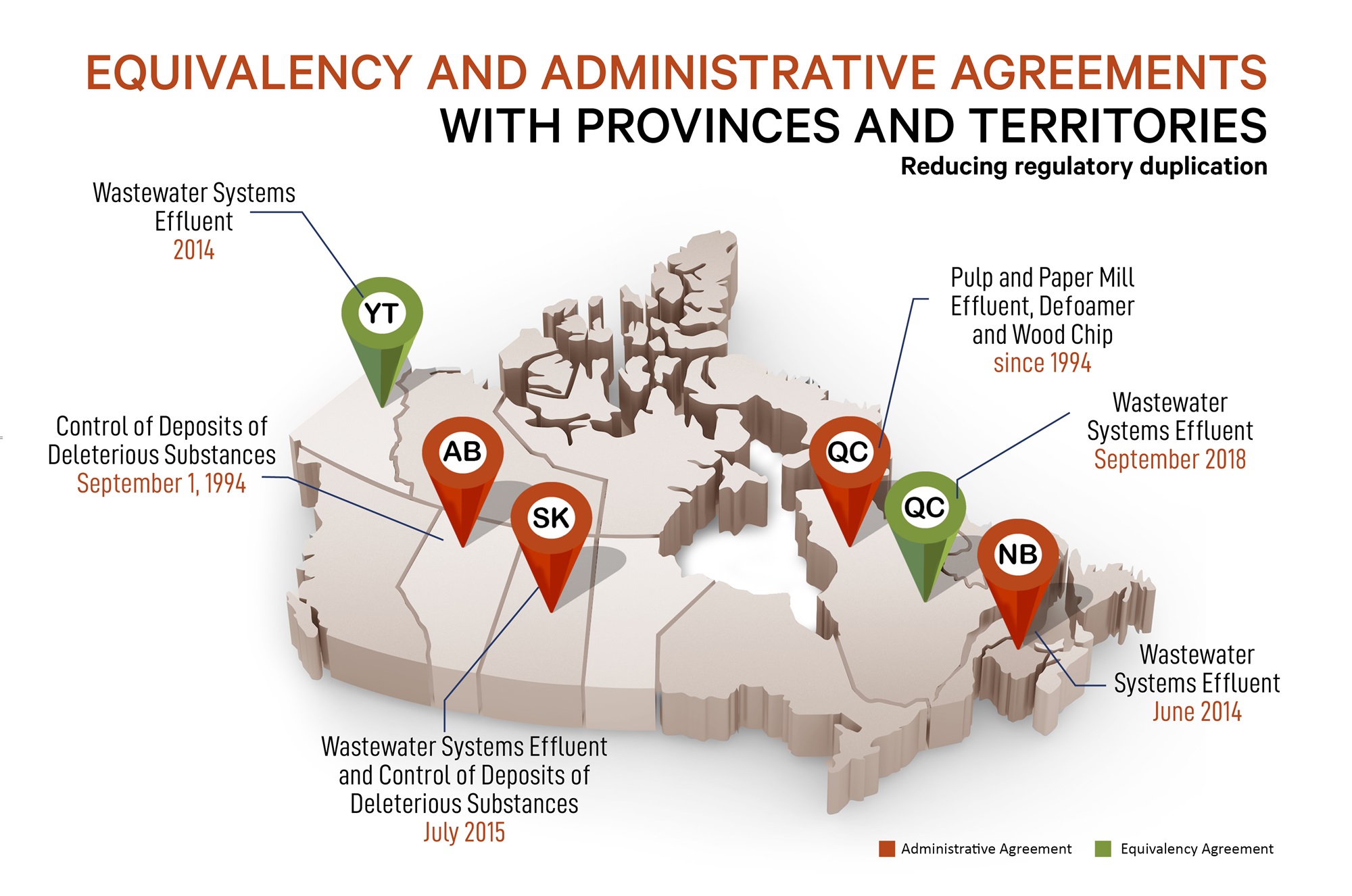
Infographic: Equivalency and Administrative Agreements with provinces and territories - Reducing regulatory duplication
- Wastewater systems effluent, 2014 - YT (equivalency agreement)
- Control of deposits of deleterious substances, September 1, 1994 - AB (administrative agreement)
- Pulp and paper mill effluent, defoamer and wood chip since 1994 - QC (administrative agreement)
- Wastewater systems effluent, September 2018 - QC (equivalency agreement)
- Wastewater systems effluent and Control of Deposits of Deleterious Substances, July 2015 - SK (administrative agreement)
- Wastewater systems effluent, June 2014 - NB (administrative agreement)
Canada presently has pollution prevention-related bilateral agreements with Yukon, Alberta, Saskatchewan, Quebec, and New Brunswick.
Yukon
In November 2014, the Governor in Council issued an Order declaring that the Wastewater Systems Effluent Regulations do not apply to wastewater systems that are subject to the Agreement on the Equivalency of Laws Applicable to Wastewater Systems Located in Yukon.
In 2023, five municipalities submitted their required reports. Only two systems discharged treated wastewater during that year. Of these, only one met the effluent quality standards of 25 mg/L for both Carbonaceous Biochemical Oxygen Demand and suspended solids.
While the City of Haines Junction’s wastewater licence expired on January 29, 2022, the city has committed to respect the conditions of the expired licence for reporting and operating its system. We continued to work collaboratively with the Yukon government to ensure consistency with the equivalency agreement until the licence is renewed by the Yukon Water Board.
Alberta
The Canada-Alberta Administrative Agreement for the Control of Deposits of Deleterious Substances under the Fisheries Act entered into force on September 1, 1994. The agreement establishes the terms and conditions for the co-operative administration of ss. 36(3) and the related provisions of the Fisheries Act, regulations under the Act, and the Alberta Environmental Protection and Enhancement Act. The agreement also streamlines and coordinates the regulatory activities of ECCC and Alberta Environment and Sustainable Resource Development to protect fisheries and reduces duplication of regulatory requirements for those regulated.
Saskatchewan
The renewed Administrative Agreement between the Government of Saskatchewan and the Government of Canada Regarding the Administration of the Wastewater Systems Effluent Regulations in Saskatchewan came into effect in 2020. In 2023, provincial officials corresponded with 49 members of the regulated community to administer the Wastewater Systems Effluent Regulations and promote and verify compliance with the regulations. The Canada-Saskatchewan Administrative Agreement for the Control of Deposits of Deleterious Substances under the Fisheries Act also sets out the principles for co-operation and identifies a preliminary list of activities to help develop detailed collaborative arrangements.
Quebec
The Province of Quebec and the Government of Canada have been collaborating to protect and conserve fish and fish habitat and prevent pollution since 1994. The parties currently co-operate through a memorandum of understanding for data collection, renewed in April 2018, whereby Quebec provides a single data-entry portal for regulated parties for the following federal regulations:
- Pulp and Paper Mill Effluent Chlorinated Dioxins and Furans Regulations made pursuant to the Canadian Environmental Protection Act, 1999
- Pulp and Paper Mill Defoamer and Wood Chip Regulations made pursuant to the Canadian Environmental Protection Act, 1999
- Pulp and Paper Effluent Regulations made pursuant to the Fisheries Act
Under the memorandum of understanding, pulp and paper mills continue to report their data for these regulations using the electronic reporting system administered by Quebec. Both orders of government retain full responsibility for carrying out inspections and investigations, and for taking appropriate enforcement measures in order to ensure compliance with their respective legislation.
In September 2018, the Governor in Council issued an Order declaring that the Wastewater Systems Effluent Regulations do not apply to the approximately 700 wastewater systems that are subject to the Canada-Quebec Agreement on Acts and Regulations Applicable to the Municipal and Provincial Wastewater Systems in Quebec. In 2023, approximately 79 per cent of these facilities met the effluent quality standards of 25 mg/L for both Carbonaceous Biochemical Oxygen Demand and suspended solids. This includes 55 small communities that had until the end of 2020 to build a facility that meets Quebec’s effluent quality standards that are equivalent to the federal standards but have yet to complete upgrades. The Quebec government is monitoring the situation closely and helping these communities put in place adequate wastewater treatment. Quebec’s Ministère du Développement durable, de l’Environnement et de la Lutte contre les changements climatiques also conducted 135 field inspections in the 2023 calendar year and issued 262 notices of non-compliance and 31 administrative monetary penalties.
In 2020, Quebec amended its regulatory regime for wastewater. We assessed the changes and determined that although the equivalency was maintained, the equivalency agreement would need to be amended to reflect changes to Quebec’s regime. While we anticipated that this work would be completed and reported in the 2021-22 report, the amendments are still being completed.
New Brunswick
The Administrative Agreement between the Government of New Brunswick and the Government of Canada Regarding the Administration of the Wastewater Systems Effluent Regulations in New Brunswick was renewed in February 2023. Under the agreement, provincial officials had 53 interactions with the regulated community to promote and verify compliance, and the results of these interactions were shared with us.
3.7 Monitoring marine water quality for bivalve shellfish
ECCC is one of three federal partners in the Canadian Shellfish Sanitation Program. We administer our role through the Shellfish Water Classification Program by surveying bivalve shellfish harvesting areas to help identify actual and potential sources of sanitary pollution and minimize the potential health risks associated with shellfish consumption. The basis of bivalve shellfish harvesting classification relies on accepted water quality standards and general sanitary conditions. Our bivalve shellfish harvesting classification recommendations are used by DFO to manage the harvesting areas based on the Management of Contaminated Fisheries Regulations.
In 2023-24, we collected 25,821 marine water quality samples at 6,473 stations to classify bivalve shellfish harvest areas along the coasts of the Atlantic and Pacific Ocean and the St. Lawrence Estuary.
Key Result:
Protecting Canadians from consuming contaminated bivalve shellfish
Federal partners in the Canadian Shellfish Sanitation Program have been working together to raise awareness amongst wastewater treatment plant operators about the importance of timely reporting when unexpected discharge events occur because early awareness and action successfully prevent Canadians from consuming contaminated bivalve shellfish harvested in the area.
As a result of these efforts, 2,294 environmental emergency events were reviewed and significant incidents were assessed to determine the need for emergency harvest area closures.
We also evaluated or re-evaluated five wastewater systems using leading-edge, three-dimensional hydrodynamic modeling technology to help redefine established classifications of bivalve shellfish harvesting areas located close to wastewater treatment plants. As a result of this work, we revised the harvesting limits in some locations.
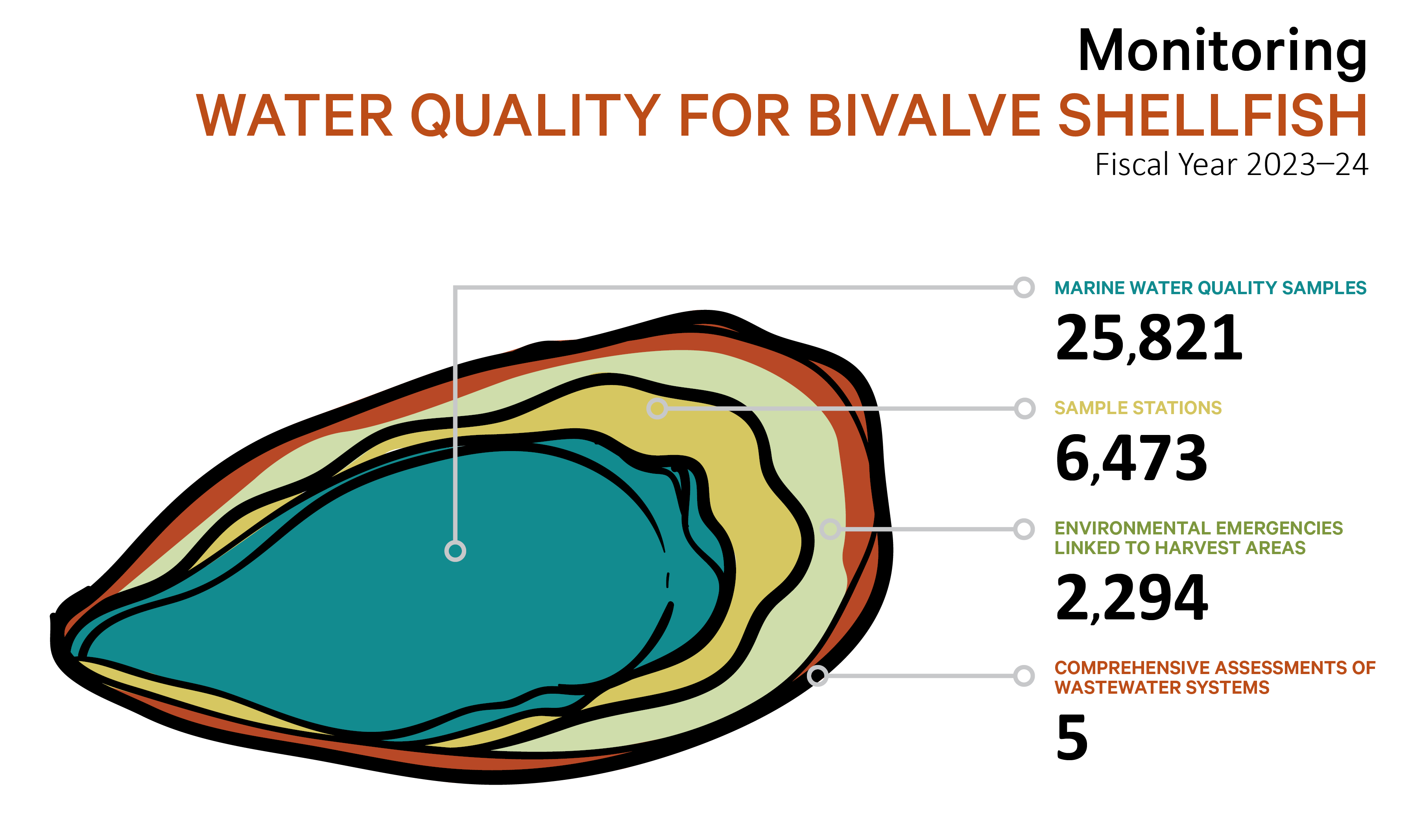
Infographic: Monitoring water quality for Bivalve Shellfish - Fiscal year 2023-24
25,821 Marine water quality samples
6,473 Sample stations
2,294 Environmental emergencies linked to harvest areas
5 Comprehensive assessments of wastewater systems
3.8 Responding to environmental emergencies
In the event of a significant water pollution incident, we oversee the response actions taken by the responsible party to counteract, mitigate or remedy any adverse effects. We also give science-based expert advice 24 hours a day, seven days a week through the National Environmental Emergencies Centre to inform these response actions to reduce the consequence of environmental emergencies. This is done in collaboration with other federal, provincial and territorial governments, Indigenous communities, municipalities, and stakeholders.
Our environmental emergency officers are authorized to:
- receive notifications of deposits of deleterious substances into the environment
- access and inspect the site of the deposits or any related documents in order to observe or to carry out spill-response activities
- collect relevant information and samples to establish the fate and effects of the pollutant, and determine environmental damage
- evaluate to ensure that reasonable measures are taken by the polluter to protect the environment and human health and, if the polluter is unable or unwilling to take reasonable measures, our environmental emergency officers are able to take or direct the measures; and
- support enforcement activities
In 2023-24, the National Environmental Emergencies Centre recorded 7,645 notifications involving the Fisheries Act. Of these notifications,
- 1,174 were escalated to one of the Centre’s duty officers for additional assessment and to ensure that all reasonable measures were being taken to protect the environment and human health
- 231 incidents resulted in specific communication with senior management (“Heads-up”) and 95 incidents resulted in scientific information being provided to the agency leading the response (“Advisory”) to inform decisions about appropriate response measures and operations. Such information includes:
- Sensitivity maps: environmental sensitivity mapping informs on priority ecosystems and wildlife
- Dispersion, drift or trajectory modelling: dispersion and trajectory modelling forecast the path and intensity of pollutants in the air or water, while drift modelling forecasts the path of solid objects in water
- Special weather forecasts: site-specific weather forecasts to support field response efforts; and
- Fate and behaviour science: analysis of how pollutants may behave in, and impact, the environment
- Seventeen incidents resulted in virtual or on-site deployments of environmental emergency officers to support the agency leading the response to the incident
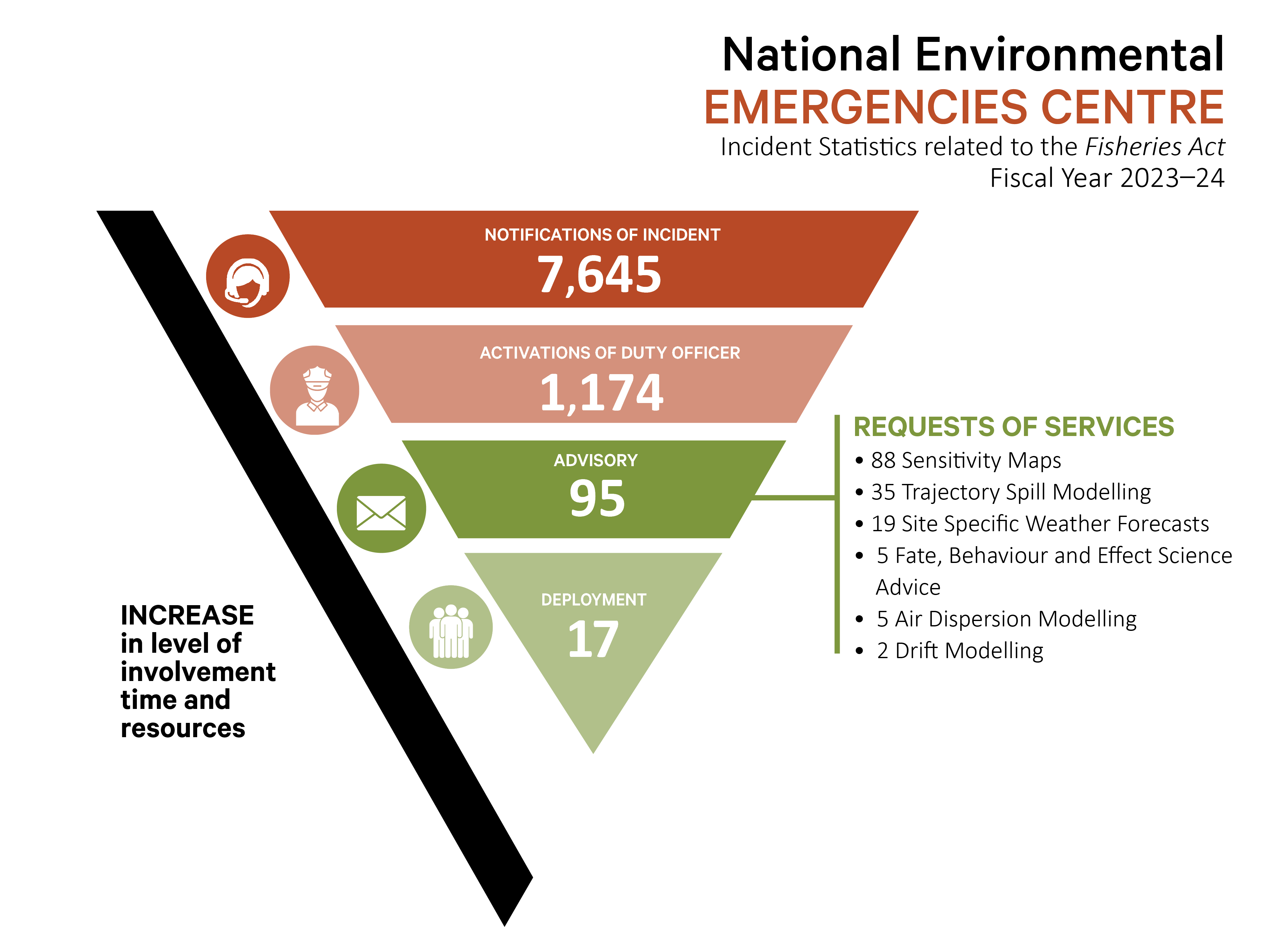
Infographic: National Environmental Emergencies Centre, Incident statistics related to the Fisheries Act, fiscal year 2023-24
Increase in level of involvement time and resources
- Notifications of incident: 7,645
- Activations of duty officer: 1,174
- Advisory: 95
- Requests of services:
- 88 sensitivity maps
- 35 trajectory spill modelling
- 19 site specific weather forecasts
- 5 fate, behaviour and effects science advice
- 5 air dispersion modelling
- 2 drift modelling
- Requests of services:
- Deployment: 17
Success Stories:
An environmental emergency response to the release of heavy fuel oil in Nanaimo Harbour in British Columbia
On July 26, 2023, the M/V Maipo River, a Hong Kong flagged bulk carrier, advised the Canadian Coast Guard’s Response Operation Centre of an oil discharge during fuel transfer operations in Nanaimo Harbour in British Columbia. An estimated 7,200 litres of heavy fuel oil was released to the deck of the vessel, a significant volume of which reached the marine environment. In response, approximately 1,300 metres of boom was deployed and over 12,000 metres of potentially impacted shorelines were assessed with 600 metres being identified for treatment.
The National Environmental Emergency Centre supported the Canadian Coast Guard’s response to the incident by providing essential scientific advice and technical support. This included identifying environmental and socioeconomic sensitivities, providing information on the fate and behavior of the pollutants, and spill trajectory modelling. The Centre also deployed two environmental emergency officers onsite to aid the Canadian Coast Guard by prioritizing ecosystems and wildlife, developing strategies to delineate and assess the impacted area, and providing leadership to the environmental unit through coordinating activities of response partners such as Canadian Wildlife Services, DFO, the British Columbia Ministry of Environment and Climate Change Strategy, and local First Nations. The environmental emergencies officers also worked with response partners to develop shoreline treatment recommendations for impacted shorelines leading to the removal and subsequent disposal of oil and oiled debris from the Nanaimo Harbour and Nanaimo River estuary.
Successful interdepartmental collaboration to address a spill of hydraulic fluid near Cap-aux-Meules in Quebec’s Magdalen Islands
In December 2023, the National Environmental Emergencies Centre was informed of a hydraulic spill event near the town of Cap-aux-Meules in the Magdalen Islands of Quebec. Our Shellfish Water Classification Program initiated a detailed analysis of the incident on potential options to support the respective roles of DFO and the Canadian Food Inspection Agency to reopen the close bivalve shellfish harvest site in this area.
The prompt response and thorough analysis of the spill by the National Environmental Emergencies Centre, along with the spill trajectory model generated by the Emergencies Science and Technology Section, contributed to our response towards safe bivalve shellfish harvest. This effort demonstrates successful interdepartmental collaboration in addressing complex environmental emergencies with potential impact to human and ecological health.
3.8.1 Streamlining environmental notifications
In an environmental emergency or occurrence that is likely to negatively impact fish and fish habitat, the person responsible for the incident or who has control of the activity that resulted in the emergency, must immediately notify an inspector, a fishery officer, or an authority listed in the Deposit Out of the Normal Course of Events Notification Regulations.
In 2021, we initiated a review of these regulations to identify areas for improvement and this review continued over 2022-23. Based on the feedback and insights gathered, we began developing the Regulations Amending the Deposit out of the Normal Course of Events Notification Regulations. Proposed amendments aim to clarify existing regulatory requirements, future-proof the contact information contained in the Schedule and re-align the Regulations with the fish and fish habitat protection provisions of the Fisheries Act to address compliance and enforcement challenges that have been identified.
In most cases, provincial and territorial laws also require notification of an environmental emergency or occurrence. To reduce duplication, we entered into environmental occurrences notification agreements with the governments of Alberta, British Columbia, Manitoba, Ontario, Saskatchewan, and Yukon. These agreements were re-negotiated in 2021-22. They have since been approved, signed and posted on the Government of Canada environmental occurrences notification agreement website. We are in discussions with the provinces regarding the standard operating procedures that stem from the notification agreements.
Notification agreements enable us to streamline the process for persons who are required to verbally notify one or more governments about an environmental emergency. Under the agreements, the person can notify the 24-hour authority operating for the province or territory and they will transfer the information to us so we can provide timely and effective oversight, possible scientific support, compliance verification, and appropriate enforcement response.
3.9 Monitoring and enforcing aquaculture activities
The Aquaculture Activities Regulations (AAR) clarify the conditions under which aquaculture operators may install, operate, maintain or remove an aquaculture facility, deposit organic matter, or undertake measures to treat their fish for pathogens and parasites. While the use of veterinary drugs and pesticides is sometimes necessary to responsibly manage the health and welfare of cultured fish, the AAR controls the deposit of these therapeutants in fisheries waters to avoid, minimize, and mitigate potential harm to wild fish and fish habitat. This includes deposits of:
- biochemical oxygen demanding matter
- drugs
- pesticides
What is biochemical oxygen demanding matter?
If organic material such as unconsumed feed, fecal matter, shellfish drop-off, and other organisms accumulate, the decomposition process begins to use oxygen and change the chemical properties of the nearby sediment.
The AAR requires that aquaculture operators submit an annual report to DFO on the deposit of drugs and pesticides used at aquaculture sites in Canada. The department then publicly reports on the facility-level usage of drugs and pesticides each year, which support the government’s commitment to openness and transparency.
We also implement public education and awareness activities to encourage all Canadians to protect fish and their habitats. Our fishery officers conduct regular patrols to promote and enforce compliance amongst aquaculture operators with the conditions of their licences. These officers also respond to complaints and conduct investigations when necessary. In 2023-24, fishery officers conducted 696 inspections of aquaculture operations and issued14 warnings and five tickets as a result. None of the warnings or tickets resulted in charges being laid.
In 2023-24, we continued research and analysis activities to support the development of a comprehensive aquaculture monitoring program which aims to address the potential impacts of the deposit of deleterious substances at marine finfish aquaculture sites on wild fish and fish habitat. This work builds on a Canadian Science Advisory Secretariat peer-review process undertaken in 2020 to support our efforts to assess potential methods to strengthen pesticide and drug environmental monitoring at aquaculture sites.
Key result:
National Aquaculture Public Reporting Data
Consistent with our commitment to openness and transparency, we publish a yearly report on the detailed drug and pesticide deposit data we receive from aquaculture operators, in accordance with the annual reporting requirements of the AAR. Aquaculture public reporting is also a key pillar of our Sustainable Aquaculture Program and supports the Government’s Directive on Open Government.
3.10 Preventing aquatic invasive species
Invasive species are plants and animals (including fish and invertebrates) that are introduced outside their natural habitats. These species can harm our environment and displace native species by competing for food, degrading habitats, and introducing diseases. Aquatic invasive species also contribute to the increasing number of at-risk fish, molluscs, and plants in Canada.
The Aquatic Invasive Species Regulations help us prevent the introduction and spread of aquatic invasive species and manage the species that have already established themselves in our waterways. Established under both the fish and fish habitat protection and the pollution prevention provisions of the Fisheries Act, these regulations enable federal, provincial, and territorial officials to take prevention and enforcement actions. Collaboration across jurisdictions is thus a key component of our efforts.
In 2023-24, we continued to develop policies and tools to integrate the Aquatic Invasive Species Regulations into our regulatory environment in order to mitigate impacts to fish and fish habitat related to aquatic invasive species. For example, intradepartmental partners participated in a tabletop exercise to better prepare for responses to aquatic invasive species incursions and to better enforce the Aquatic Invasive Species Regulations. We also advanced the process to make targeted amendments to the Aquatic Invasive Species Regulations and materials describing the potential changes were published on our Public Consultations website. Engagement sessions were also held with provincial and territorial partners, multi-interest holders, Indigenous groups and communities, and the public at large.
At the same time, we continued to foster and further develop relationships with our federal, provincial, and territorial partners through the National Aquatic Invasive Species Committee and the Aquatic Invasive Species International Border Working Group, among others.
On May 29, 2023, the Aquatic Invasive Species Prevention Fund was officially launched to support the mobilization of partners to prevent the introduction and spread of aquatic invasive species nationally. Eight multi-year projects received a total of $3.3 million dollars in funding over a three-year period starting in 2022-23 and four additional projects were selected for directed funding in 2023-24. In addition, following an open call for proposal that closed in August 2023, nine projects were approved for funding that are set to run from April 1, 2024 to March 31, 2027.
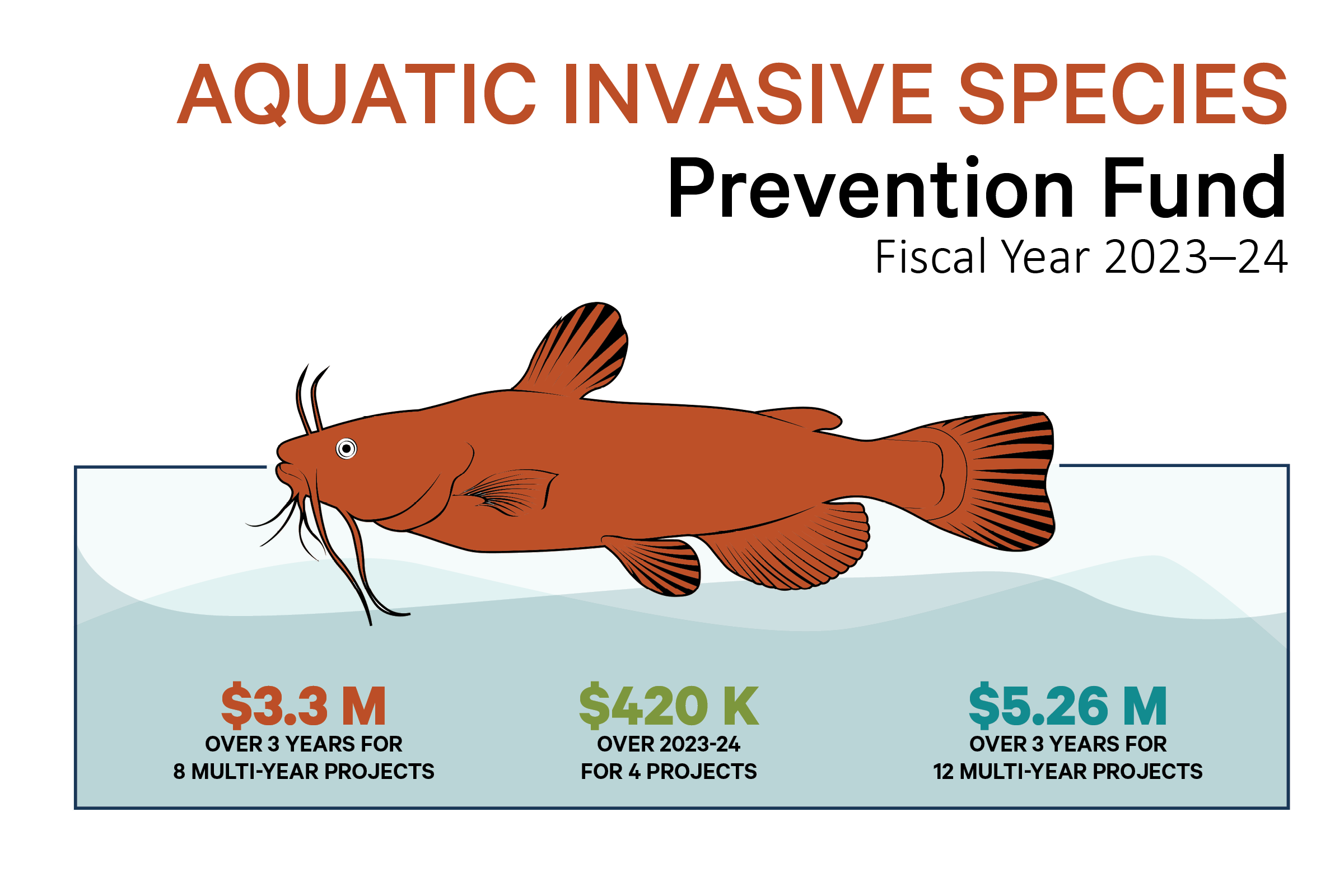
Infographic: Aquatic Invasive Species Prevention Fund - Fiscal Year 2023-24
- $3.3M over 3 years for 8 multi-year projects
- $420K over 2023-24 for 4 projects
- $5.26M over 3 years for 12 multi-year projects
In 2023-24, the environmental DNA laboratory to detect aquatic invasive species (AIS) in commercial products was launched. The facility will also detect new AIS occurrences and monitor their spread. In addition, work on the development of the aquatic invasive species spatial data infrastructure was initiated to track AIS detections and non-detections, and support priority setting nationally. Finally, we continued to advance internal consultations on the development of the draft response plan for organisms-in-trade. We also continued to promote nationally consistent messaging through the “Don’t Let it Loose” communication tool-kit to help prevent the release of aquarium fish and plants, live bait fish, live food fish, and other non-indigenous aquatic species into Canadian waters.
Over the course of 2023-24, a sea lamprey assessment and control program was deployed throughout the Great Lakes basin. This included working with partners to put in place all planned physical barriers to sea lamprey migration, operating sea lamprey traps and evaluating spawning runs, evaluating the presence and extent of sea lamprey infestation in over 200 tributaries, and successfully applied lampricide to a number of tributaries, including in American waters in the states of New York and Michigan.
The Asian Carp Program continued early detection surveillance efforts in the Canadian waters of the Great Lakes basin in 2023-24. Sampling was conducted in nearshore and tributary waters that have been identified as being suitable for Asian carp spawning, feeding or nursery habitat. Within those areas, 1,167 sampling events were completed. The various life stages of Asian carps were also targeted by using a variety of fish sampling nets and gear. Three Grass Carp were collected during the 2023 early detection surveillance season in Canadian waters, one of which was a fertile female captured by a commercial fish harvester in the Bay of Quinte on July 3. Following its capture, we worked with the Ontario Ministry of Natural Resources to complete five days of intensive, targeted sampling near the site of capture in the Bay of Quinte. No additional Grass Carp were captured, or observed, during our targeted efforts.
The watercraft inspection and decontamination program at the Emerson, Manitoba Port of Entry was operational between May and October 2023 in partnership with the Canada Border Services Agency. As a result, we inspected 847 watercraft and decontaminated 141. Seven invasive mussel-fouled watercraft were also intercepted during the 2023 season. Without our physical watercraft inspections at this port of entry, boaters with watercraft carrying aquatic invasive species subject to prohibitions under the Aquatic Invasive Species Regulations would have entered Canada. In turn, this may have resulted in the introduction and spread of AIS.
4.0 Annex
This annual report summarizes the legislative responsibilities of the Minister of Fisheries and the Minister of Environment and Climate Change to report on their efforts to administer and enforce the provisions of the Fisheries Act that help us protect fish and fish habitat and prevent pollution from entering waters frequented by fish. It demonstrates the commitment of both Ministers to fulfill their responsibilities and enables readers to learn more about Canada’s investments in healthy and sustainable fisheries, oceans, and other water resources.
4.1 Fisheries Act
The Fisheries Act provides the Minister of Fisheries and the Minister of Environment and Climate Change with powers and authorities to conserve and protect fish and fish habitat, including the waterways that sustain fish over the course of their life cycles. The key provisions of the Act (pertaining to non-fishing activities) essential to sustaining fish species are the ‘fish and fish habitat protection’ and the ‘pollution prevention’ provisions.
Fish and fish habitat protection provisions
The fish and fish habitat protection provisions include, among others:
- a prohibition against carrying on a work, undertaking or activity that results in the death of fish, by means other than fishing (section 34.4(1))
- a prohibition against carrying on a work, undertaking or activity that results in the harmful alteration, disruption or destruction of fish habitat (section 35(1))
- a framework of considerations to guide the Minister’s decision-making (section 34.1)
- ministerial powers to ensure the free passage of fish or the protection of fish or fish habitat with respect to existing obstructions to fish passage (section 34.3)
DFO is the lead department responsible for the administration of these provisions. We employ a risk-based approach to determine the likelihood and severity of potential impacts to fish and fish habitat that could result from a given work, undertaking or activity.
Pollution prevention provisions
The pollution prevention provisions serve to protect fish as a public resource by prohibiting pollution that could be deleterious to fish.
Subsections 36(3) to (6) of the Act are the main pollution prevention provisions protecting fish and other aquatic life by prohibiting pollution that could be harmful to them.
Subsection 36(3) prohibits the deposit of deleterious substances into water frequented by fish, or to any place, under any conditions, where they may enter waters frequented by fish. A deleterious substance can be any substance that, if added to any water, would degrade or alter the water quality such that it could directly or indirectly harm fish, fish habitat, or the use of fish by humans. A deposit of a deleterious substance can only be authorized under regulations made either under the Fisheries Act or under another Act of Parliament.
ECCC is the lead department responsible for the administration of these provisions.
4.2 Responsible programs
Fisheries and Oceans Canada
Fish and Fish Habitat Protection Program
We work to conserve and protect fish and fish habitat for future generations, while supporting sustainable development, by administering the fish and fish habitat protection provisions of the Fisheries Act. This contributes to the broader departmental mandate of ensuring that Canada’s oceans and other aquatic ecosystems are protected from negative impacts to ensure healthy biodiversity, prevent the spread of invasive species, protect species at risk and promote sustainable fisheries.
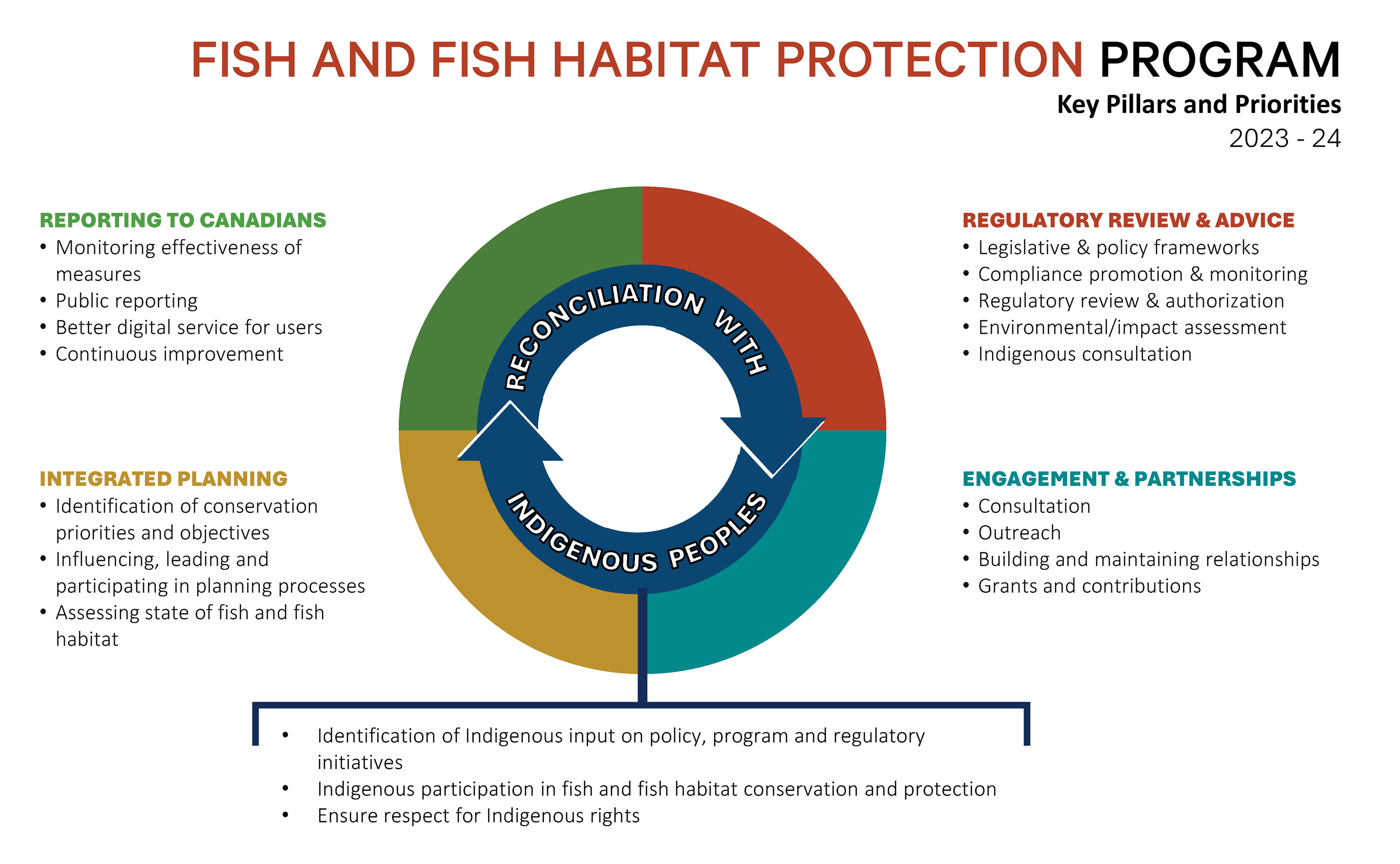
Infographic: Fish and fish habitat protection program - Key pillars and priorities - 2023-24
Regulatory review & advice:
- legislative & policy frameworks
- compliance promotion & monitoring
- regulatory review & authorization
- environmental/impact assessment
- indigenous consultation
Reporting to Canadians:
- monitoring effectiveness of measures
- public reporting
- better digital service for users
- continuous improvement
Integrated planning:
- identification of conservation
- priorities and objectives
- influencing, leading and participating in planning processes
- assessing state of fish and fish habitat
Engagement & partnerships:
- consultation
- outreach
- building and maintaining relationships
- grants and contributions
Reconciliation with indigenous peoples:
- identification of Indigenous input on policy, program and regulatory initiatives
- Indigenous participation in fish and fish habitat conservation and protection
- ensure respect for indigenous rights
Our team is structured into four areas of work:
- regulatory review and advice
- integrated planning
- engagement and partnerships, including with Indigenous Peoples
- reporting to Canadians
Our biologists designated as fishery guardians, are empowered to conduct inspections for the purposes of verifying compliance of works, undertakings or activities taking place in or near water with the fish and fish habitat protection provisions of the Fisheries Act, whether they were previously reviewed or not. Fish and Fish Habitat Protection Program staff also verify compliance by completing desktop reviews of reports required from proponents.
For our Program, reconciliation with Indigenous Peoples is rooted in a shared interest to conserve and protect fish and fish habitat. We aim to support reconciliation with Indigenous Peoples by undertaking actions that support improved relationships and outcomes for Indigenous Peoples across all areas of our work.
Conservation and Protection Program
We are responsible for monitoring compliance with legislation and regulations that have been set up to conserve and protect fish and fish habitat. Our fishery officers are authorized by the Minister to enforce fisheries regulations, including the fish and fish habitat protection provisions of the Fisheries Act. To complete this work, we conduct at-sea and inland patrols in marine and freshwater areas, monitor catches, conduct investigations, and give information to fish harvesters about relevant regulations and conditions of licence. Our fishery officers also devote a lot of time to conserve and protect habitat, as described in Section 2.4.
Conservation and Protection’s compliance and enforcement activities are delivered based on an intelligence-led, three-pillar approach:
- Education, Shared Stewardship and Stakeholder Engagement including informal and formal education programs and co-management/partnership agreements.
- Monitoring, Control and Surveillance including activities such as land, sea and air patrols, inspections and compliance monitoring of third-party service providers, and enforcement response to non-compliance.
- Major Cases/Special Investigations including formal intelligence gathering and analysis, forensic audits, and prosecutions.
Environment and Climate Change Canada
Industrial Sectors and Chemicals Directorate
The Industrial Sectors and Chemicals Directorate leads the administration of the pollution prevention provisions of the Fisheries Act. The Directorate is responsible for policy development, the administration of the general prohibition of the Act (subsection 36(3)), and regulatory development and implementation under the provisions.
The Fisheries Act is one of the main federal statutes used to prevent water pollution. Therefore, the administration of the pollution prevention provisions of the Fisheries Act is a key contributor to the protection and conservation of Canada’s water resources.
Two organizations within the Industrial Sectors and Chemicals Directorate focus on different sector expertise and the administration of the Act. The Mining and Processing Division administers the Metal and Diamond Mining Effluent Regulations and is responsible for the development of the proposed Coal Mining Effluent Regulations. In addition, the directorate is continuing to work with a Crown-Indigenous Working group, established in 2021 with nine Indigenous communities, to explore options to manage the accumulation of oil sands mine water in tailings ponds. Among the options for managing oil sands mine water, is the development of potential of effluent regulations that could authorize releases of oil sands mining effluent under strict and protective standards.
The Forest Products and Fisheries Act Division works on projects pertaining to substance and effluent deposits from pulp and paper mills, metal and diamond mines, and wastewater treatment plants in Canadian waters, as well as environmental effects monitoring for Fisheries Act regulations. This division is also responsible for the administration of the Pulp and Paper Effluent Regulations, the Wastewater Systems Effluent Regulations, and the general prohibition of the Fisheries Act.
Compliance with the general prohibition of subsection 36(3) of the Fisheries Act, which prohibits the deposit of any type of deleterious substance in Canadian water bodies frequented by fish, remains at the forefront of our work. We continue to monitor and closely analyze the general prohibition to ensure compliance with the help of the Environmental Enforcement Directorate.
Environmental Enforcement Directorate
The Enforcement Branch’s Environmental Enforcement Directorate supports ECCC’s mandate to protect and conserve our natural heritage, and ensure a clean, safe and sustainable environment for present and future generations. We do this by enforcing federal legislation that protects the Canadian environment, including the pollution prevention provisions of the Fisheries Act and its associated regulations.
The Directorate consists of environmental enforcement officers that work in five regions across Canada:
- Atlantic Region
- Quebec Region
- Ontario Region
- Prairie and Northern Region
- Pacific and Yukon Region
The Directorate also has teams in the National Capital Region that support the work of environmental enforcement officers by:
- Participating in the review of existing or new legislation to ensure that enforceability issues are identified and addressed
- Collaborating with partners and bringing together environmental enforcement officers and other experts to share information, address issues, and develop consistent enforcement approaches
Environmental Protection Operations Directorate
The Environmental Protection Operations Directorate contributes to ECCC’s strategic outcomes related to sustainable ecosystems, the sound management of substances and waste, and the promotion of compliance. The Directorate’s mandate is centered on policy and program development and implementation in six core areas: environmental assessment, contaminated sites, environmental emergencies, marine programs, compliance promotion, and expert support.
National programs are delivered by staff located in six regions and 17 regional offices to support the protection of ecosystems and reduce pollution risks to Canadians and the environment. These programs support pollution prevention efforts by:
- Responding to notifications through the National Environmental Emergencies Centre
- Supporting the remediation of contaminated sites in alignment with the Fisheries Act
- Offering Fisheries Act-based information and expertise through compliance promotion, with regional experts promoting awareness and understanding of the Metal and Diamond Mining Effluent Regulations and the Wastewater Systems Effluent Regulations among regulated communities
- Supporting the implementation of Fisheries Act regulations by reviewing the environmental effects monitoring information submitted by regulatees
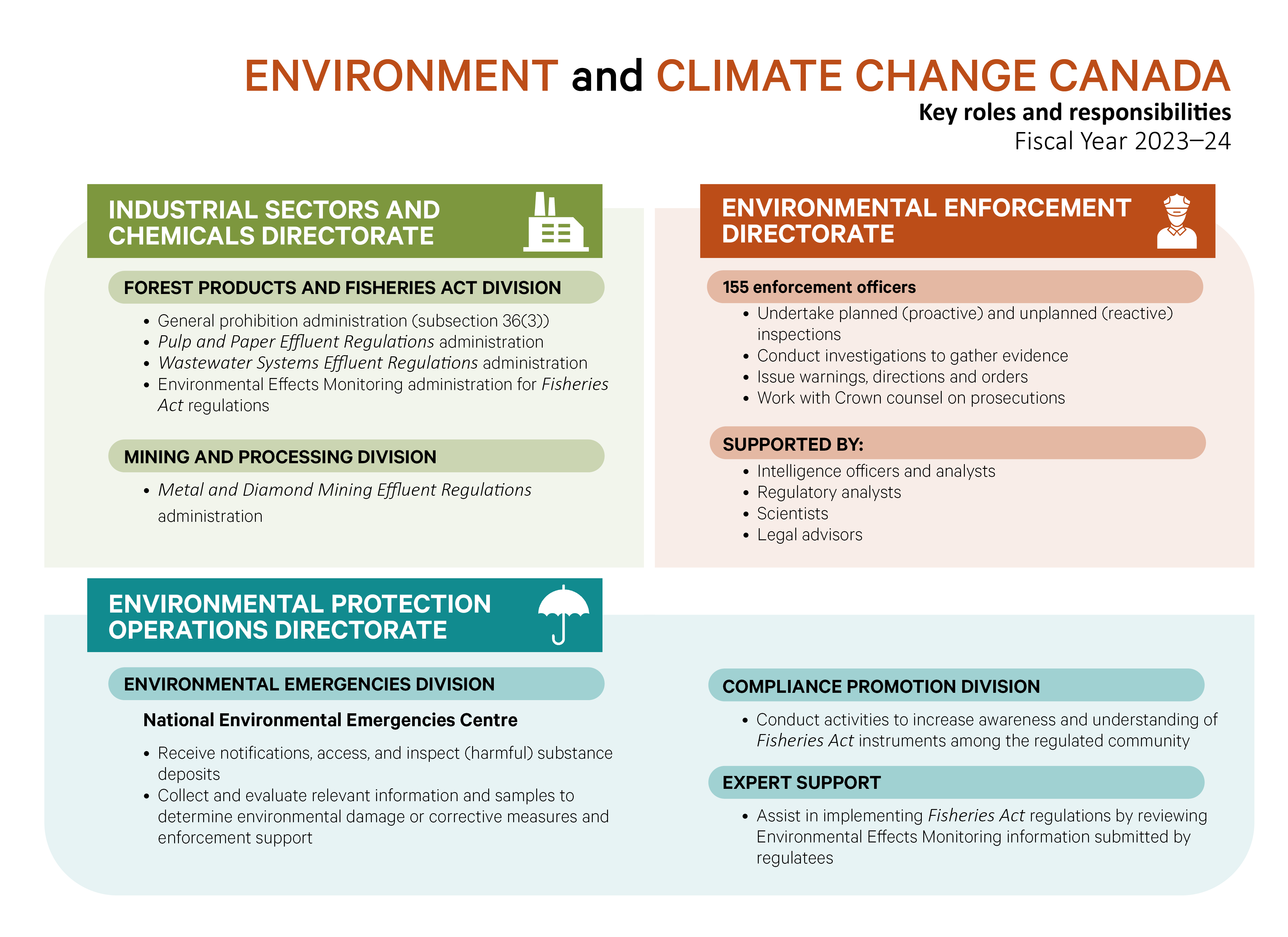
Infographic: Environment and Climate Change Canada - Key roles and responsibilities - 2023-24
Industrial sectors and chemicals directorate
- Forest products and fisheries act division:
- General prohibition administration (subsection 36(3))
- Pulp and Paper Effluent Regulations administration
- Wastewater Systems Effluent Regulations administration
- Environmental Effects Monitoring administration for Fisheries Act Regulations
Mining and processing division:
- Metal and Diamond Mine Effluent Regulations administration
Environmental enforcement directorate
- 155 enforcement officers:
- Undertake planned (proactive) and unplanned (reactive) inspections
- Conduct investigations to gather evidence
- Issue warnings, directions and orders
- Work with Crown counsel on prosecutions
- Supported by:
- Intelligence officers and analysts
- Regulatory analysts
- Scientists
- Legal advisors
Environmental protection operations directorate
- Environmental emergencies division
- National environmental emergencies centre
- receive notifications, access, and inspect (harmful) substance deposits
- collect and evaluate relevant information and samples to determine environmental damage or corrective measures and enforcement support
- National environmental emergencies centre
- Compliance promotion division
- Conduct activities to increase awareness and understanding of Fisheries Act instruments among the regulated community
- Expert support
- Assist in implementing Fisheries Act regulations by reviewing Environmental Effects Monitoring Information submitted by regulatees
4.3 Tables
Fisheries and Oceans Canada
| Determination | 2023-24 |
|---|---|
Deemed unlikely to result in requiring a Fisheries Act Authorization |
33 |
Deemed to potentially require a Fisheries Act Authorization and referred to DFO |
5 |
Total |
38 |
| Determination | 2023-24 |
|---|---|
Deemed to be compliant with the Canada Energy Regulator Act and Fisheries Act requirements for fish and fish habitat protection |
144 |
Non-compliance with the Canada Energy Regulator Act requirements for fish and fish habitat protection addressed by the Canada Energy Regulator |
29 |
Non-compliance with Fisheries Act - notification/discussion with DFO |
0 |
Total |
173 |
| DFO Region | Primary Impact | |||||||||
|---|---|---|---|---|---|---|---|---|---|---|
| Changes in Flows/ Water Levels | Deposition of Non-Deleterious Substances | Dredging/ Excavating | Fish Mortality | Fish Passage | Infilling/ Footprint | Watercourse Alteration | No Potential Impact | Otherb | Total | |
Newfoundland and Labrador |
11 | 19 | 35 | 1 | 61 | 87 | 1 | 39 | 0 | 254 |
Maritimes |
19 | 12 | 38 | 13 | 100 | 123 | 57 | 113 | 21 | 496 |
Gulf |
8 | 0 | 21 | 1 | 75 | 251 | 1 | 146 | 3 | 506 |
Quebec |
12 | 1 | 39 | 10 | 77 | 96 | 8 | 135 | 20 | 398 |
Ontario & Prairies and Arctic |
96 | 39 | 638 | 27 | 269 | 918 | 21 | 151 | 13 | 2,172 |
Pacific |
30 | 74 | 125 | 23 | 24 | 509 | 135 | 28 | 62 | 1,010 |
Total |
176 | 145 | 896 | 75 | 606 | 1,984 | 223 | 612 | 119 | 4,836 |
a. For reporting purposes, the receipt of a referral by DFO is accounted for in the statistics of the same year that the event actually occurred, while any DFO decisions linked to the referral could occur in a subsequent year and be accounted for separately in the statistics for that year.
b. “Other” includes referrals identified with the primary impact of “To be determined”.
| DFO Region | Advice/Response Provided to Proponent or Othersa | Authorizations Issuedb | Total |
|---|---|---|---|
Newfoundland and Labrador |
291 | 4 | 295 |
Maritimes |
499 | 21 | 520 |
Gulf |
506 | 16 | 522 |
Quebec |
478 | 35 | 513 |
Ontario & Prairies and Arctic |
1,766 | 52 | 1,818 |
Pacific |
939 | 111 | 1,050 |
Total |
4,479 | 239 | 4,718 |
a. Advice given to others includes: written advice to federal agencies, provincial/territorial/other agencies and boards, letters of advice to proponents, and recommended mitigation measures to permitting agencies. Program responses given through triage and other processes include: best management practices, Codes of Practice, no concerns/no potential effect to fish or fish habitat, partnership/other process in place, measures to protect fish and fish habitat (website) can be used, and regulatory review not required. Advice/Response numbers do not include Impact Assessment advice actions.
b. “Authorization Issued” numbers include both authorizations and amendments issued, so they are higher than the number of files. If a file is issued both an authorization and an amendment in FY 2023-24, it would also be counted as two authorizations issued.
| DFO Region | Class Authorizations Notifications | Code of Practice Notifications | Total |
|---|---|---|---|
Newfoundland and Labrador |
0 | 7 | 7 |
Maritimes |
0 | 18 | 18 |
Gulf |
0 | 13 | 13 |
Quebec |
0 | 27 | 27 |
Ontario & Prairies and Arctic |
111 | 377 | 488 |
Pacifica |
35 | 181 | 216 |
Total |
146 | 623 | 769 |
a. Number of placer mining applications reviewed for compliance with the watershed class authorizations issued in 2023-24 for specific watersheds in the Yukon. Site specific authorizations issued for placer mines, outside of the class authorization system, are counted in Table 4
| Habitat Activities | Hours* | Percentage* |
|---|---|---|
| Agriculture | 1,246 | 4% |
| Aquaculture | 100 | 0% |
| Death of Fish | 1,721 | 5% |
| Forestry | 1,148 | 3% |
| General Patrol | 9,625 | 28% |
| Hydro | 384 | 1% |
| Industrial/Commercial | 2,347 | 7% |
| Mining | 2,030 | 6% |
| Natural Event | 260 | 1% |
| Oil/Gas | 1,327 | 4% |
| Other (Non-Industry) | 2,805 | 8% |
| Recreational | 970 | 3% |
| Rural/Urban Development | 8,418 | 24% |
| Transportation | 2,156 | 6% |
| Total | 34,537 | 100% |
* rounded to nearest whole number
| DFO Region | Warnings Issued | Fisheries Act Direction | Charges Laid | Alternatives to Prosecution* |
|---|---|---|---|---|
Newfoundland and Labrador |
- | 2 | - | - |
Maritimes |
3 | 7 | 10 | - |
Gulf |
- | 1 | - | - |
Quebec |
5 | - | 1 | - |
Ontario & Prairies and Arctic |
4 | 4 | - | - |
Pacific |
7 | 7 | 7 | 1 |
Total |
19 | 21 | 18 | 1 |
* Alternatives to prosecution include out of court settlements aimed at restoring fish and fish habitat that have been harmed.
| DFO Region | Number of Occurrences |
|---|---|
Newfoundland and Labrador |
82 |
Maritimes |
66 |
Gulf |
35 |
Quebec |
53 |
Ontario & Prairies and Arctic |
66 |
Pacific |
603 |
Total |
905 |
a. There will be overlap between the number of occurrences referred by FFHPP to DFO’s Conservation and Protection (C&P) and C&P’s reported number of occurrences received (Table 8).
| DFO Region | Number of Occurrences | Number of Site Inspections | Number of Occurrences referred to Conservation and Protection for actiona |
|---|---|---|---|
| Newfoundland and Labrador | 56 | 17 | 39 |
| Maritimes | 107 | 47 | 37 |
| Gulf | 35 | 17 | 3 |
| Quebec | 49 | 9 | 7 |
| Ontario & Prairies and Arctic | 209 | 28 | 54 |
| Pacific* | 0 | 34 | 36 |
| Total | 456 | 152 | 176 |
* DFO’s Conservation and Protection is accountable for triaging occurrences received in the Pacific region. As such, the number of occurrences referred to C&P for actions reflect the screened occurrences sent to FFHPP for analysis of their impacts to fish and fish habitat.
a. There will be overlap between the number of occurrences referred by FFHPP to DFO’s Conservation and Protection (C&P), and C&P’s reported number of occurrences received (Table 8).
| Monitoring Activities* on Referrals undertaken by FFHPP | Issues Identified | Potential non-compliances referred to C&P for further actiona |
|---|---|---|
| 1,293 | 123 | 15 |
* Monitoring activities undertaken by FFHPP on referrals include site inspections conducted by the Program’s fishery guardians and reviews of monitoring reports required from proponents.
a. See above footnote
| DFO Region | Number of Convictions |
|---|---|
| Newfoundland and Labrador | - |
| Maritimes | 1 |
| Gulf | - |
| Quebec | - |
| Ontario & Prairies and Arctic | - |
| Pacific | - |
| Total | 1 |
Environment and Climate Change Canada
| Instruments | Total | On-Site | Off-Site |
|---|---|---|---|
Fisheries Act (Grand Total) |
2,399 | 893 | 1,506 |
General Prohibitionb |
1,203 | 612 | 591 |
| Deposit Out of Normal Course of Events Notification Regulations | 6 | - | 6 |
| Metal and Diamond Mining Effluent Regulations | 757 | 85 | 672 |
| Petroleum Refinery Liquid Effluent Regulations | 1 | 1 | - |
| Pulp and Paper Effluent Regulations | 185 | 27 | 158 |
| Wastewater Systems Effluent Regulations | 247 | 168 | 79 |
a. Only those regulations under which an inspection occurred during the time period are listed in this table.
b. Includes all inspections under the pollution prevention provisions of the Fisheries Act.
| Instruments | Measure Type | |||||
|---|---|---|---|---|---|---|
| Prosecutions | Written Warnings | Directions | ||||
| No. of Measures | No. of Infractions | No. of Letters | No. of Infractionsb |
No. of Directions | No. of Infractions | |
Fisheries Act (Grand Total) |
5 |
7 |
208 |
481 |
46 |
70 |
General Prohibitionc |
5 |
7 |
98 |
138 |
40 |
47 |
Metal and Diamond Mining Effluent Regulations |
- |
- |
44 |
125 |
3 |
3 |
Petroleum Refinery Liquid Effluent Regulations |
- |
- |
1 |
1 |
- |
- |
Pulp and Paper Effluent Regulations |
- |
- |
16 |
44 |
- |
- |
Wastewater Systems Effluent Regulations |
- |
- |
49 |
173 |
3 |
20 |
a. Enforcement measures are tabulated by number of measures issued at the regulation level. For example, if one warning was issued for two different regulations, the number of warnings would be two. Prior to 2021-22, these were tabulated by the number of files closed during the year that show at least one infraction for which the measure was taken.
b. Infractions are found at the section, subsection or paragraph level of an Act or Regulation. For example, if a written warning is sent to one person, but the alleged violations relate to three sections of the Fisheries Act, the number of infractions in this column would be three, even though just one letter was sent.
c. Includes all violations under the pollution prevention provisions of the Fisheries Act.
| Instruments | Started before the fiscal year and ongoing after the fiscal year | Started in the fiscal year | Ended in the fiscal year |
|---|---|---|---|
| Fisheries Act (Grand Total) | 54 | 20 | 12 |
| General Prohibition | 43 | 18 | 8 |
| Metal and Diamond Mining Effluent Regulations | 8 | 1 | 2 |
| Pulp and Paper Effluent Regulations | 2 | - | 1 |
| Wastewater Systems Effluent Regulations | 1 | 1 | 1 |
| Instruments | Prosecutions | Penalties | ||
|---|---|---|---|---|
| Convicted Subjectsa | Guilty Countsb | Environmental Damages Fund | Total Penalty Amount | |
| Fisheries Act (Grand Total) | 9 | 9 | $6,000,000 | $6,055,000 |
| General Prohibitionc | 8 | 8 | $5,000,000 | $5,055,000 |
| Pulp and Paper Effluent Regulations | 1 | 1 | $1,000,000 | $1,000,000 |
a. Convicted subjects are the number of persons (individuals or organizations) sentenced during the reporting period.
b. Counts are the number of sections of legislation or regulations for which there was a conviction during the reporting period. For example, in a case where a regulatee is found guilty of one count of violating ss. 36(1) and two counts of violating ss. 36(3), it would be considered one conviction against the subject and three counts.
c. Includes all prosecutions under the pollution prevention provisions of the Fisheries Act.
4.4 Year-over-year comparative statistics
In the past two annual reports, we presented comparative data sets from consecutive fiscal years to enable additional analyses and understanding about the ongoing results of our efforts. For this report, we illustrated the data of the past five fiscal years as well as interpretive text to explain this data.
The following tables and infographics showcase year-over-year statistics for:
- Administering the Fish and Fish Habitat Protection Program - DFO (FY2018-19 - FY2022-23)
- Enforcement Measures for the Fisheries Act - ECCC (FY2018-19 - FY2022-23)
- Monitoring Water Quality for Shellfish - ECCC (FY2018-19 to FY2022-23)
- Self-reported Effluent Data Analysis - ECCC (FY2018-19 to FY2022-23)
- Environmental Emergencies Notifications - ECCC (FY2020-21 to FY2022-23)
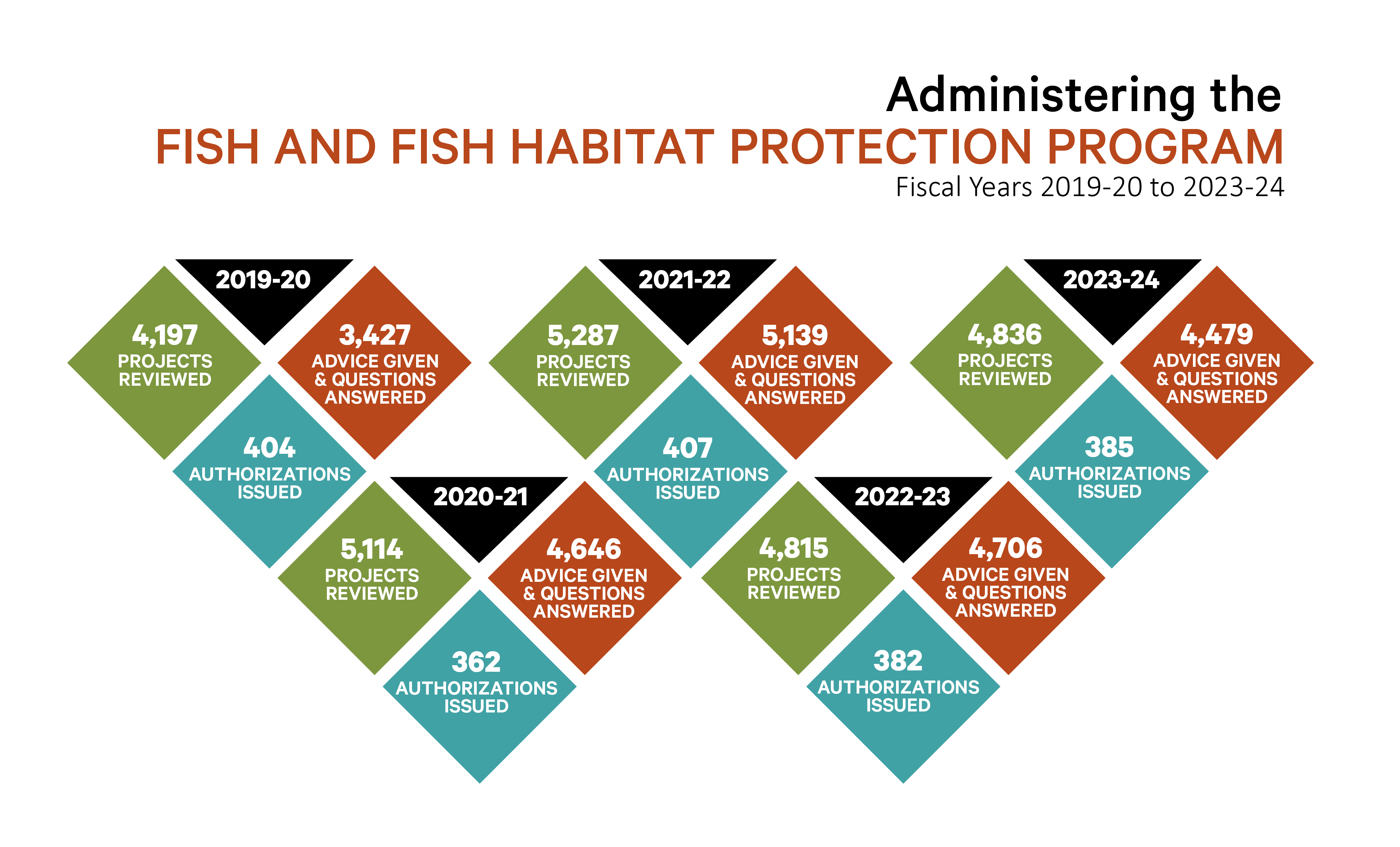
Infographic: Administering the Fish and Fish Habitat Protection Program - fiscal years 2019-20 to 2023-24
2019-20: 4,197 Projects reviewed, 3,427 Advice given and questions answered, and 404 Authorizations issued.
2020-21: 5,114 Projects reviewed, 4,646 Advice given and questions answered, and 362 Authorizations issued.
2021-22: 5,287 Projects reviewed, 5,139 Advice given and questions answered, and 407 Authorizations issued.
2022-23: 4,815 Projects reviewed, 4,931 Advice given and questions answered, and 382 Authorizations issued.
2023-24: 4,836 Projects reviewed, 4,479 Advice given and questions answered, and 385 Authorizations issued.
Authorizations Issued is a total of Authorizations (Table 4) and Class Authorizations Notifications (Table 5)
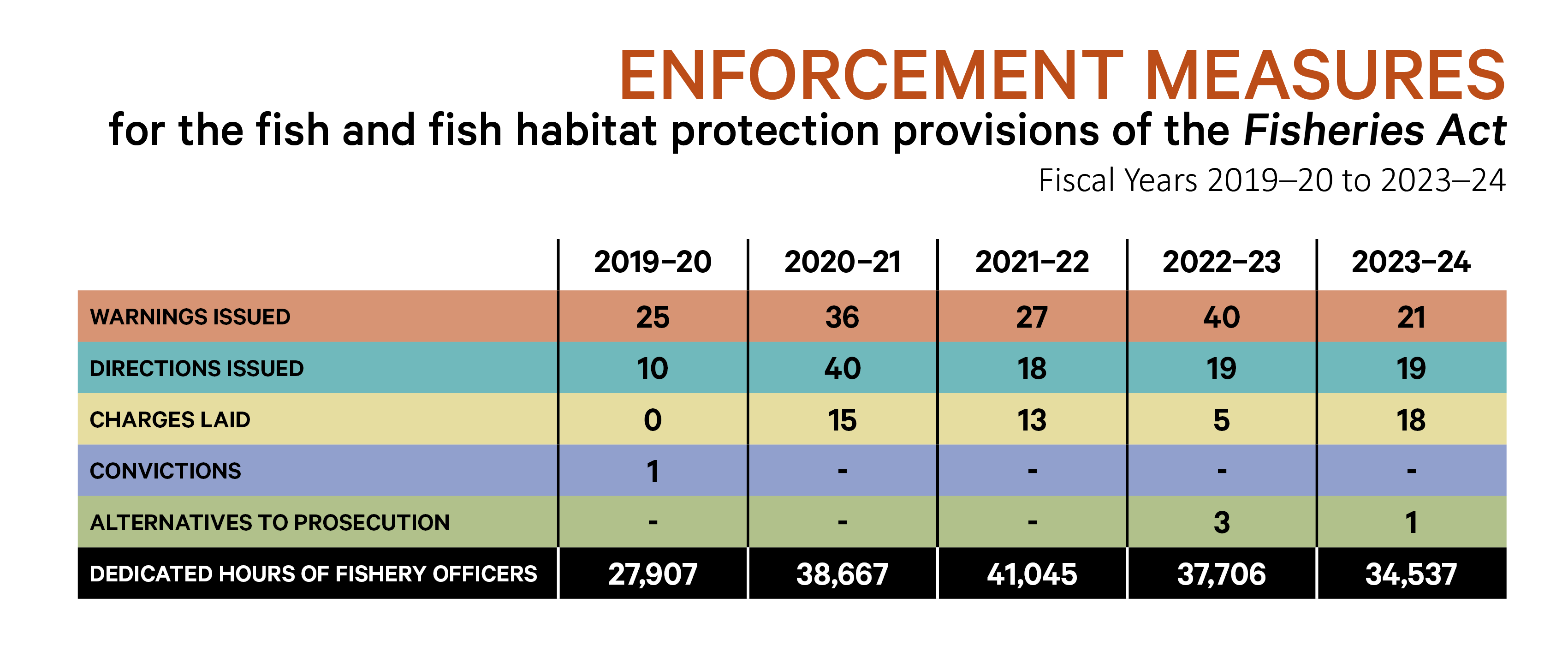
Infographic: Enforcement Measures for the Fish and Fish Habitat Protection provisions of the Fisheries Act - Fiscal Years 2019-20 to 2023-24
2019-20:
- 25 Warnings issued
- 10 Directions issued
- 0 Charges laid
- 1 Conviction
- 0 Alternatives to prosecution
- 27,907 Dedicated hours of fishery officers
2020-21:
- 36 Warnings issued
- 40 Directions issued
- 15 Charges laid
- 0 Convictions
- 0 Alternatives to prosecution
- 38,667 Dedicated hours of fishery officers
2021-22:
- 27 Warnings issued
- 18 Directions issued
- 13 Charges laid
- 0 Convictions
- 0 Alternatives to prosecution
- 41,045 Dedicated hours of fishery officers
2022-23:
- 40 Warnings issued
- 19 Directions issued
- 5 Charges laid
- 0 Convictions
- 3 Alternatives to prosecution
- 37,706 Dedicated hours of fishery officers
2023-24:
- 21 Warnings issued
- 19 Directions issued
- 18 Charges laid
- 0 Convictions
- 1 Alternatives to prosecution
- 34,537 Dedicated hours of fishery officers
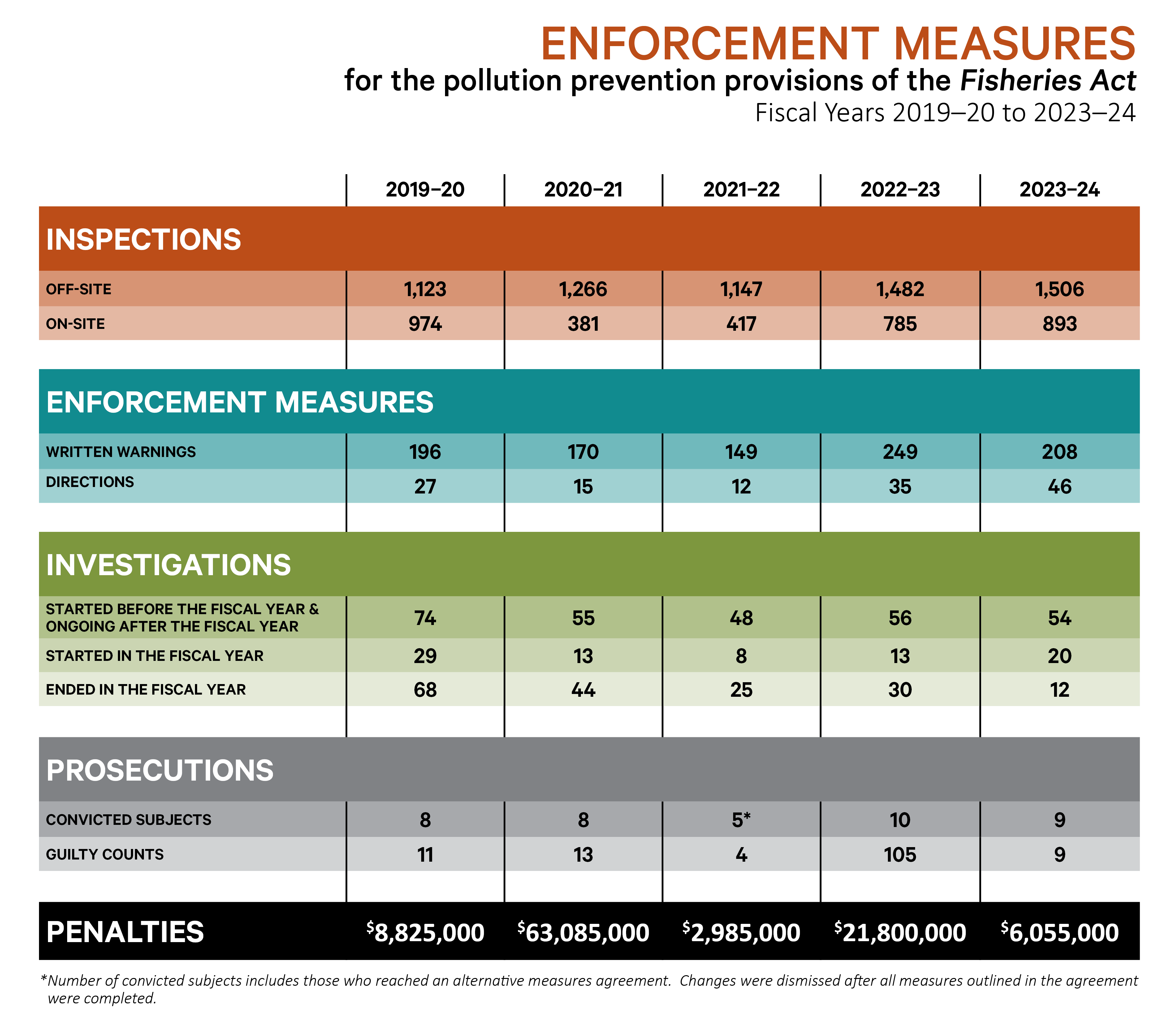
Infographic: Enforcement measures for the pollution prevention provisions of the Fisheries Act - fiscal years 2019-20 to 2023-24
2019-20
Inspections: 1,123 Off-site, 974 On-site.
Enforcement Measures: 196 Written Warnings, 27 Directions.
Investigations: 74 started before the fiscal year & ongoing, 29 Started in the Fiscal Year, 68 Ended in the Fiscal Year
Prosecutions: 8 convicted subjects, 11 Guilty Counts.
Penalties: $8,825,000
2020-21
Inspections: 1,266 Off-site, 381 On-site.
Enforcement Measures: 170 Written Warnings, 15 Directions.
Investigations: 55 started before the fiscal year & ongoing, 13 Started in the Fiscal Year, 44 Ended in the Fiscal Year
Prosecutions: 8 convicted subjects, 13 Guilty Counts.
Penalties: $63,085,000
2021-22
Inspections: 1,470 Off-site, 417 On-site.
Enforcement Measures: 149 Written Warnings, 12 Directions.
Investigations: 48 started before the fiscal year & ongoing, 8 Started in the Fiscal Year, 25 Ended in the Fiscal Year
Prosecutions: 5* convicted subjects, 4 Guilty Counts.
Penalties: $2,985,000
2022-23
Inspections: 1,482 Off-site, 785 On-site.
Enforcement Measures: 249 Written Warnings, 35 Directions.
Investigations: 56 started before the fiscal year & ongoing, 13 Started in the Fiscal Year, 30 Ended in the Fiscal Year
Prosecutions: 10 convicted subjects, 105 Guilty Counts.
Penalties: $21,800,000
2023-24
Inspections: 1,506 Off-site, 893 On-site.
Enforcement Measures: 208 Written Warnings, 46 Directions.
Investigations: 54 started before the fiscal year & ongoing, 20 Started in the Fiscal Year, 12 Ended in the Fiscal Year
Prosecutions: 9 convicted subjects, 9 Guilty Counts.
Penalties: $6,055,000
* Number of convicted subjects includes those who reached an alternative measures agreement. Charges were dismissed after all measures outlined in the agreement were completed.
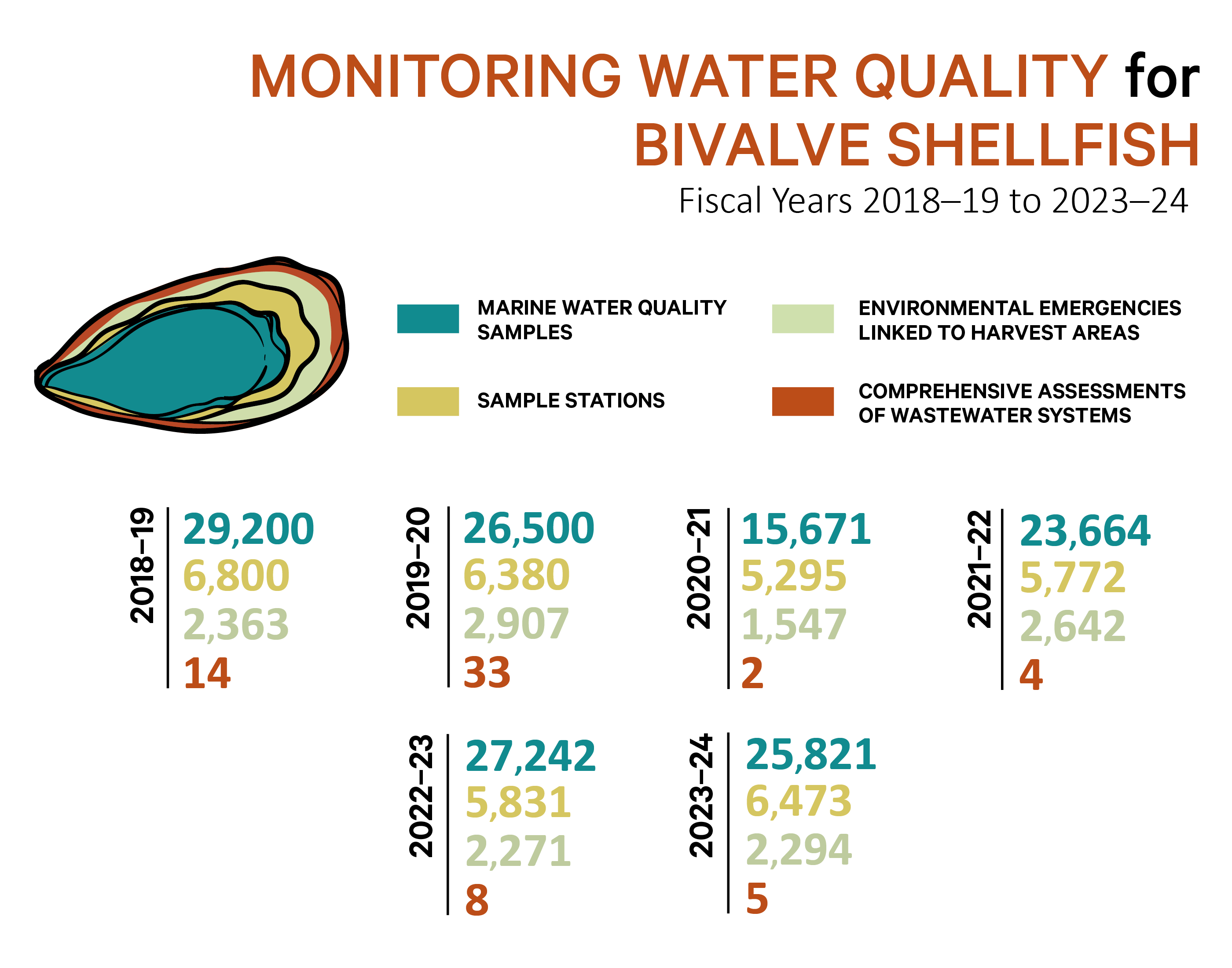
Infographic: Monitoring water quality for bivalve shellfish - fiscal years 2019-20 to 2023-24
2019-20
26,500 Marine Water Quality Samples, 6,360 Sample Stations, 2,907 Environmental Emergencies Linked to Harvest Areas, 33 Comprehensive Assessments of Wastewater Systems
2020-21
15,671 Marine Water Quality Samples, 5,295 Sample Stations, 1,547 Environmental Emergencies Linked to Harvest Areas, 2 Comprehensive Assessments of Wastewater Systems
2021-22
23,664 Marine Water Quality Samples, 5,772 Sample Stations, 2,642 Environmental Emergencies Linked to Harvest Areas, 4 Comprehensive Assessments of Wastewater Systems
2022-23
27,242 Marine Water Quality Samples, 5,295 Sample Stations, 1,547 Environmental Emergencies Linked to Harvest Areas, 8 Comprehensive Assessments of Wastewater Systems
2023-24
25,821 Marine Water Quality Samples, 6,473 Sample Stations, 2,294 Environmental Emergencies Linked to Harvest Areas, 5 Comprehensive Assessments of Wastewater Systems
In 2023-24, more inspections were conducted under the Metal and Diamond Mining Effluent Regulations than in previous years because continued attention is needed to maintain oversight on current levels of compliance and to address suspected non-compliance. The total amount of penalties decreased from the previous year due to the lower number of guilty counts, and the amounts of fines set by the courts tended to be lower in 2023-24. Marine water quality samples are collected at sample stations each year to classify bivalve shellfish harvest areas along the coasts of the Atlantic and Pacific oceans and the St. Lawrence Estuary. The year-to-year variability is due to additions for newly approved classified sites and removals of unclassified sites when there is a lack of harvesting interest. In rare circumstances, sampling numbers may also vary considerably due to external factors that limit the ability for samples to be collected, such as the COVID-19 pandemic, as seen in the 2020-21.
Environmental emergencies linked to harvest areas represent the number of assessments conducted for potential impacts from contamination to harvesting areas, with interannual variability due to differences in the number of extreme weather events within a year as well as any unforeseeable event that could contaminate bivalve shellfish harvesting areas (e.g., wastewater or chemical spills). Comprehensive assessments of wastewater systems help redefine established classifications of bivalve shellfish harvesting areas located close to wastewater treatment plants. The number of assessments will vary each year depending on the cyclical review of existing systems as well as any new system that may be identified of concern.
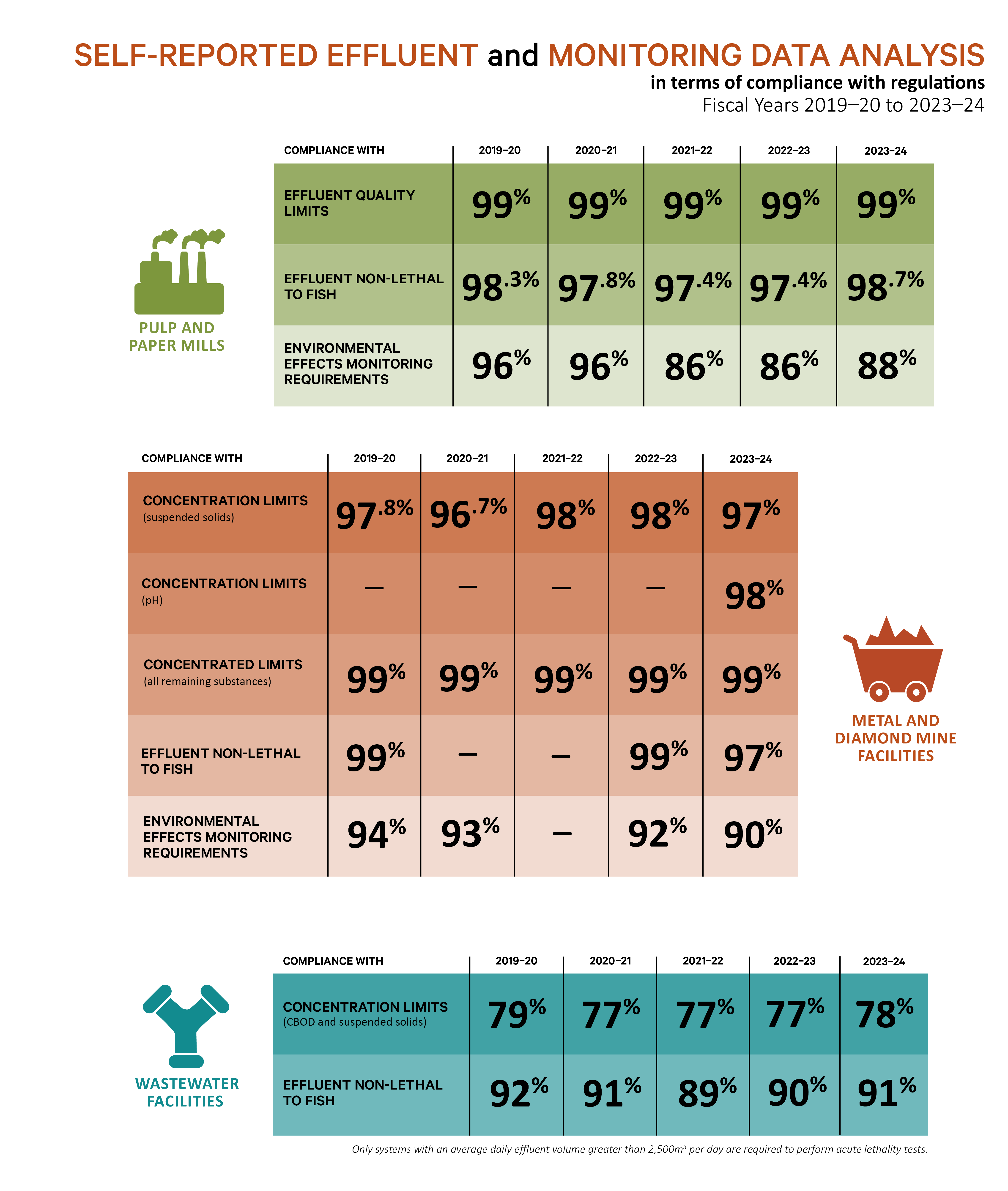
Infographic: Self-reported effluent and monitoring data analysis in terms of compliance with regulations - fiscal years 2019-20 to 2023-24
2019-20
Pulp and Paper Mills Compliance:
99% Effluent Quality Limits
98.3% Effluent Non-Lethal to Fish
96% Environmental Effects Monitoring Requirement
Metal and Diamond Mine Facilities Compliance:
97.8% Concentration Limits (Suspended Solids)
0% Concentration Limits (pH)
99% Concentration Limits (all remaining Substances)
99% Effluent Non-Lethal to fish
94% Environmental Effects Monitoring Requirement
Wastewater Systems Compliance:
79% Concentration Limits (CBOD and suspended solids)
92% Effluent Non-Lethal to Fish
2020-21
Pulp and Paper Mills Compliance:
99% Effluent Quality Limits
97.8% Effluent Non-Lethal to Fish
96% Environmental Effects Monitoring Requirement
Metal and Diamond Mine Facilities Compliance:
96.7% Concentration Limits (Suspended Solids)
0% Concentration Limits (pH)
99% Concentration Limits (all remaining Substances)
0% Effluent Non-Lethal to fish
93% Environmental Effects Monitoring Requirement
Wastewater Systems Compliance:
77% Concentration Limits (CBOD and suspended solids)
91% Effluent Non-Lethal to Fish
2021-22
Pulp and Paper Mills Compliance:
99% Effluent Quality Limits
97.4% Effluent Non-Lethal to Fish
86% Environmental Effects Monitoring Requirement
Metal and Diamond Mine Facilities Compliance:
98% Concentration Limits (Suspended Solids)
0% Concentration Limits (pH)
99% Concentration Limits (all remaining Substances)
0% Effluent Non-Lethal to fish
0% Environmental Effects Monitoring Requirement
Wastewater Systems Compliance:
77% Concentration Limits (CBOD and suspended solids)
89% Effluent Non-Lethal to Fish
2022-23
Pulp and Paper Mills Compliance:
99% Effluent Quality Limits
97.4% Effluent Non-Lethal to Fish
86% Environmental Effects Monitoring Requirement
Metal and Diamond Mine Facilities Compliance:
98% Concentration Limits (Suspended Solids)
0% Concentration Limits (pH)
99% Concentration Limits (all remaining Substances)
97% Effluent Non-Lethal to fish
90% Environmental Effects Monitoring Requirement
Wastewater Systems Compliance:
77% Concentration Limits (CBOD and suspended solids)
90% Effluent Non-Lethal to Fish
2023-24
Pulp and Paper Mills Compliance:
99% Effluent Quality Limits
98.7% Effluent Non-Lethal to Fish
88% Environmental Effects Monitoring Requirement
Metal and Diamond Mine Facilities Compliance:
97% Concentration Limits (Suspended Solids)
98% Concentration Limits (pH)
99% Concentration Limits (all remaining Substances)
97% Effluent Non-Lethal to fish
90% Environmental Effects Monitoring Requirement
Wastewater Systems Compliance:
78% Concentration Limits (CBOD and suspended solids)
91% Effluent Non-Lethal to Fish
Only systems with an average daily effluent volume greater than 2,500 cubic meters per day are required to perform acute lethality tests.
Information on dataFootnote 22 reported by owners and operators of metal and diamond mines under the Metal and Diamond Mining Effluent Regulations, as well as annual reports prepared by ECCC, is available online. The annual reports present a summary of the performance of Canadian mines with respect to the prescribed limits and requirements of the regulations. These reports also include information on mines subject to the regulations, effluent data, compliance performance and water bodies designated as tailings impoundment areas.
The indicator above uses compliance data provided by metal and diamond mines to ECCC under section 22 of the Metal and Diamond Mining Effluent Regulations. This is calculated by measuring the percentage of reported test results for all metal and diamond mines that are within limits authorized for the reported year for deleterious substances, pH levels and fish toxicity. For each substance, this is done by dividing the number of monthly mean results that meet the authorized limits by the total number of monthly mean results reported in a given year. For pH, this is done by dividing the number of pH measurements that are within the allowable pH range by the total number of pH measurements reported in a given year. For fish toxicity, this is done by dividing the number of non-lethal fish toxicity test results by the total number of fish toxicity test results reported in a given year.
Information on dataFootnote 23 reported by owners and operators of pulp and paper mills under the Pulp and Paper Effluent Regulations, as well as an overview of trends in effluent data, is available in the 2022 Annual Report. The annual reports, which began to be published in 2019 and are updated annually, present a summary of compliance and effluent discharge amounts of Canadian pulp and paper mills with respect to the selected standards prescribed by these regulations. These reports also include information on Environmental Effects Monitoring Studies conducted under the regulations.
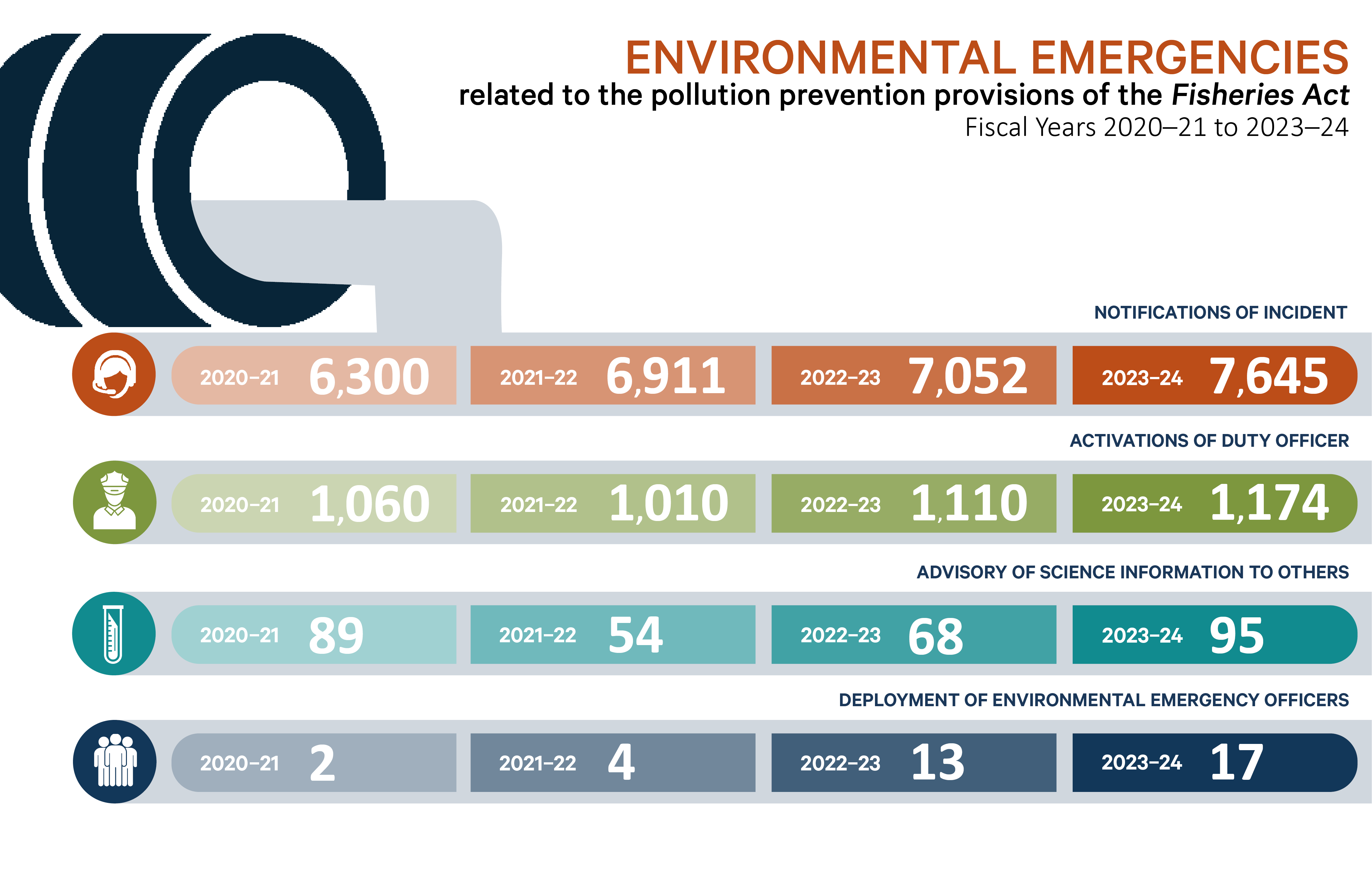
Infographic: Environmental emergencies related to the pollution prevention provisions of the Fisheries Act - Fiscal years 2020-21 to 2023-24
2020-21
6,300 Notifications of incident
1,060 Activations of duty officer
89 Advisory of science information to others
2 deployments of environmental emergency officers
2021-22
6,911 Notifications of incident
1,010 Activations of duty officer
54 Advisory of science information to others
4 deployments of environmental emergency officers
2022-23
7,052 Notifications of incident
1,110 Activations of duty officer
68 Advisory of science information to others
13 deployments of environmental emergency officers
2023-24
7,645 Notifications of incident
1,174 Activations of duty officer
95 Advisory of science information to others
17 deployments of environmental emergency officers
Incident notifications related to the Fisheries Act have been increasing over the past three reporting years. This is consistent with the increase in all notifications that we received over the same period. Various factors may influence how many notifications we receive each year or over time. The number of National Environmental Emergencies Centre duty officer activations related to the Fisheries Act is stable, with some fluctuations expected from one year to the next. The number of Advisory communication products issued varies from one year to the next and is related to the services requested of ECCC by the lead government agency. Environmental emergency officer deployments have been increasing since a low during the first year of the COVID-19 pandemic. Deployments should stabilize but with spikes in any given year.
- Date modified: