
Fisheries Act implementation accomplishment highlights
The Fisheries Act was amended in 2019 to restore lost protections and add modern safeguards. These amendments were accompanied by significant investments to protect fish and fish habitat while advancing reconciliation with Indigenous Peoples and supporting sustainable development. The following is a list of key accomplishments from 2019 to 2024.
Project reviews and enforcement
Reviewing more project proposals
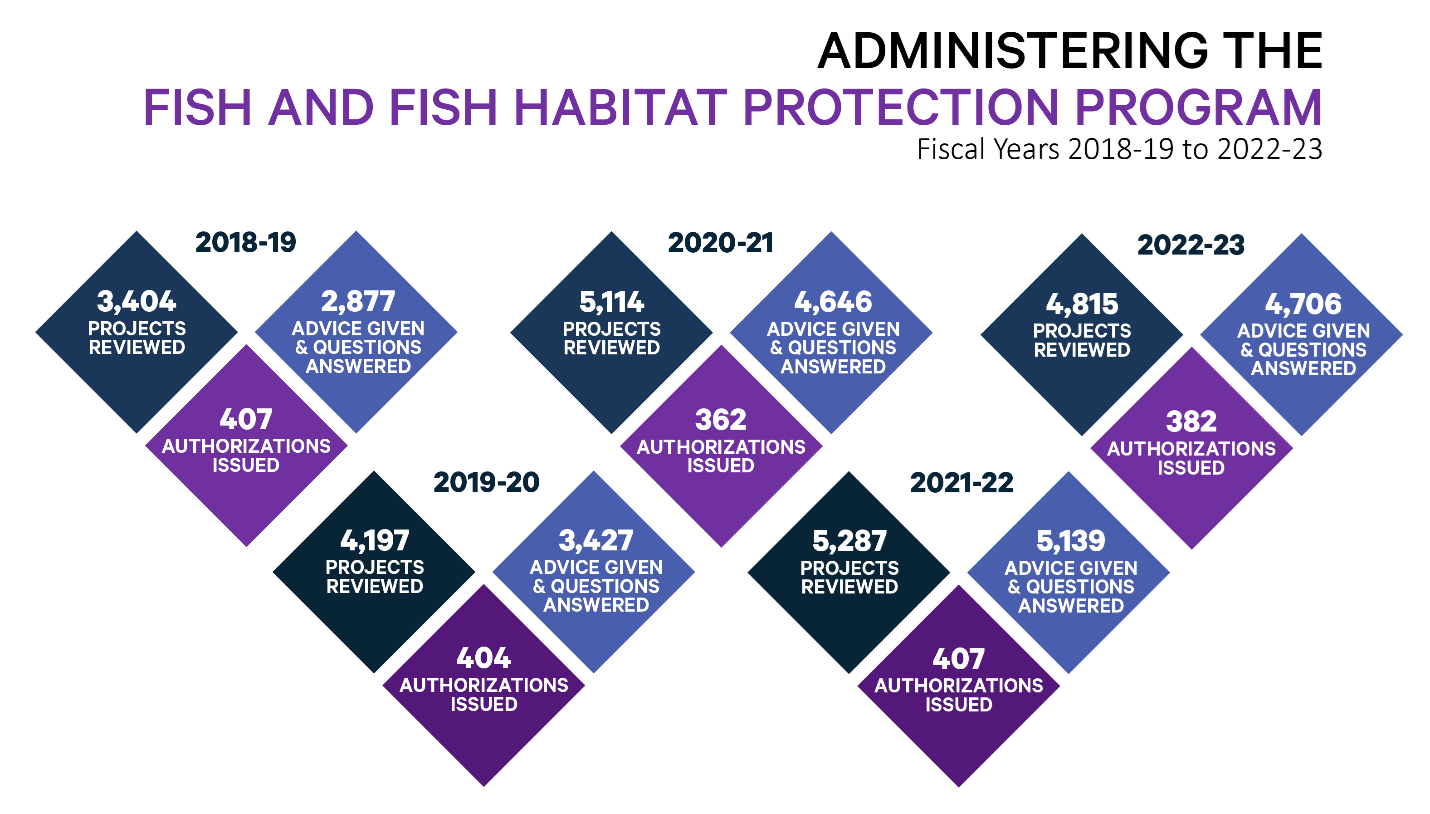
- More than 4,800 project proposals reviewed in fiscal year 2022-23 (compared to 3,404 reviews in 2018-19)
Description
Administering the Fish and Fish Habitat Protection Program: fiscal years 2018-19 to 2022-23
2018-19: 3,404 Projects reviewed, 2,877 Advice given and questions answered, and 407 Authorizations Issued.
2019-20: 4,197 Projects reviewed, 3,427 Advice given and questions answered, and 404 Authorizations issued.
2020-21: 5,114 Projects reviewed, 4,646 Advice given and questions answered, and 362 Authorizations issued.
2021-22: 5,287 Projects reviewed, 5,139 Advice given and questions answered, and 407 Authorizations issued.
2022-23: 4,815 Projects reviewed, 4,931 Advice given and questions answered, and 382 Authorizations issued.
Efficient project reviews within prescribed timelines
- 92% of applications reviewed within the 60-day service standard for completeness and adequacy for Fisheries Act authorizations in 2023-24
- 100% compliance with 90-day service standard to make regulatory decisions in 2023-24
Increased enforcement
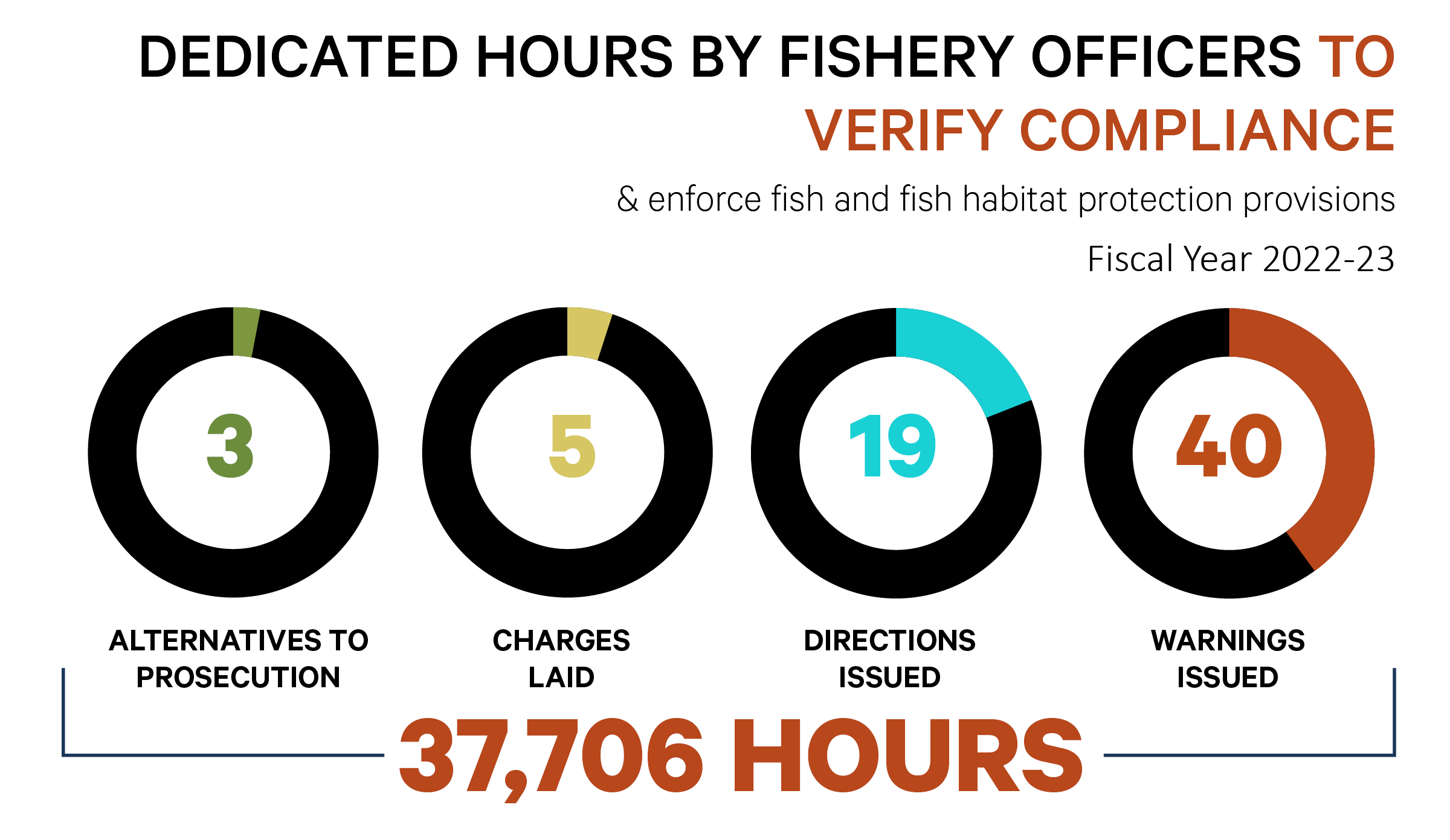
- More than 37,700 hours in 2022 to 2023 of compliance and enforcement activities undertaken for protecting fish and fish habitat (compared to fewer than 12,000 hours in 2014-15)
- 40 warnings
- 19 inspector directions
- 5 charges under the Fisheries Act
Description
Dedicated hours to verify compliance and enforce fish and fish habitat protection provisions: fiscal year 2022-23
37,706 hours verifying compliance.
5 Charges laid.
19 Directions issued.
40 Warnings issued.
3 Alternatives to prosecution.
Regulatory and policy tools
Regulatory changes
- Amendments to the Authorizations Concerning Fish and Fish Habitat Protection Regulations to align with the modernized Fisheries Act (August 2019)
New instruments
Standards and codes of practice provide conditions and measures to manage risks to fish and fish habitat:
- Standards provide clear guidance on how to design, implement, maintain, monitor and remove specific mitigation measures
- Codes of practice specify conditions and measures to manage risks to fish and fish habitat and are designed for routine projects
New policy documents
A range of new policy documents has been published to support Fisheries Act implementation:
- Fish and fish habitat protection policy statement (August 2019)
- Policy for applying measures to offset harmful impacts to fish and fish habitat (published December 2019; updated March 2025)
- Interim Policy for Establishing Fish Habitat Banks to Support the Administration of the Fisheries Act and Species at Risk Act (published February 2021; final guidelines published May 2026)
- Position Statement: The Management of Death of Fish (other than fishing), under the Fisheries Act and the Species at Risk Act (May 2023)
- Position Statement: The Management of Existing Facilities and Structures under the Fisheries Act and the Species at Risk Act (May 2023)
- Position statement on the consideration of cumulative effects in support of decision making on Fisheries Act authorizations concerning fish and fish habitat protection
New guidance
Guidance documents have been published to assist partners and stakeholders:
- Applicant’s Guide Supporting the Authorizations Concerning Fish and Fish Habitat Protection Regulations (published in 2019, last updated November 2021)
- Framework to identify fish habitat restoration priorities (February 2023)
- Framework for identifying, establishing, and managing ecologically significant areas (April 2023)
Reconciliation with Indigenous Peoples
Launch of Indigenous Habitat Participation Program (IHPP)
- IHPP is a $12M annual grants and contributions program launched in 2019.
- Provides funding to Indigenous communities to participate in fish and fish habitat conservation and protection activities, such as:
- consultations on Crown conduct
- engagement on regulatory, program and policy initiatives
- building capacity within Indigenous communities
- Support through the IHPP helps strengthen the role of Indigenous Peoples in project reviews, monitoring and policy development.
- IHPP has been well received by Indigenous Peoples, with higher participation than expected.
- In 2024, IHPP application and reporting processes were streamlined to reduce burden for funding recipients and improve access to funding.
| Indicator | 2021 to 2022 | 2022 to 2023 | 2023 to 2024 |
|---|---|---|---|
Arrangements and agreements signed to enhance fish and fish habitat technical capacity (Target: 100 or more) |
79 |
81 |
235 |
Funding to groups and communities to provide feedback into the development of regulatory, policy, process or program initiatives relative to the management of fish and fish habitat (Target: 40 or more). |
86 |
160 |
319 |
Evidence-based decision making
Science advice and tools
To support evidence-based regulatory decision making and policy development, since 2018 DFO has:
- conducted over 100 freshwater research projects to support development of policies and decision-making tools
- led over 22 peer-reviewed science advisory processes and published over 120 peer-reviewed documents on various topics, including cumulative effects, fish mortality, mitigation measures and more
- held 27 freshwater habitat-focused science seminars on subjects such as habitat restoration and fish productivity in changing landscapes
- provided funding to 10 projects led by academic institutions, non-governmental organizations and Indigenous organizations on digital and field research projects that align with freshwater habitat needs across the regions
See publications from our science advisory processes.
Fish habitat highlight reports
Each fish habitat highlight report examines one or more threats to fish and fish habitat in a specific geographic area of Canada. The reports are intended to ignite curiosity in fish and fish habitat and help foster a culture of stewardship. Six reports have been released from 2019 to 2024:
- Fish, floods and habitat connectivity in the Lower Fraser
- Assessing aquatic connectivity in Nova Scotia
- Managing aquatic invasive species in Nova Scotia watersheds
- Addressing the acidification of watersheds in Nova Scotia
- Reconnecting aquatic habitat to improve fish passage in Newfoundland and Labrador
- Restoring fish habitat in Newfoundland and Labrador, with a Placentia Bay case study
Transparency
Fisheries Act Registry
- Fisheries Act Registry, launched in March 2020, provides improved public access to records about fish and fish habitat protection
- includes information on authorizations issued, amendments to authorizations, standards and codes of practice
Tip sheets
Tip sheets have been published to share best practices for navigating our regulatory process in a timely manner:
- Project planning: Applying for a Fisheries Act authorization
- Project planning: Applying for a Fisheries Act authorization acting as a Species at Risk Act (SARA) permit or a stand-alone SARA permit
Risk management framework
DFO’s regulatory decision making related to fish and fish habitat protection has been informed by a risk management framework for over 20 years. A DFO Risk Management Framework Overview was published in 2024 to:
- increase transparency and confirm the steps in this risk approach
- update the associated terminology
- set the foundation for future discussions about managing risks to fish and fish habitat
Engaging with Canadians
Improved communication
DFO communicates regularly with more than 2,000 contacts concerning program updates and other information through our national distribution list, and the Projects near water website.
Extensive engagement
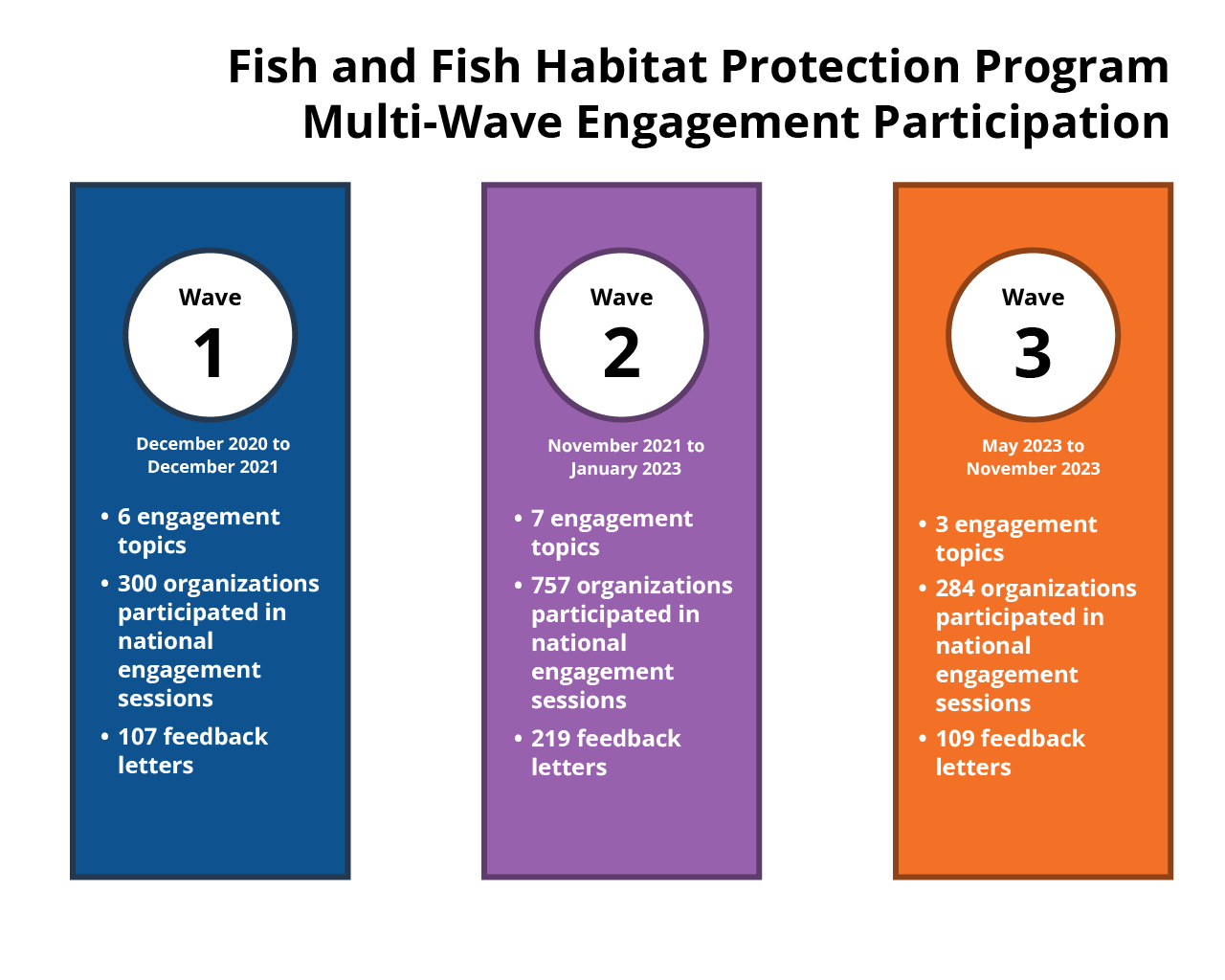
Since 2020, 3 waves of engagement took place on a variety of regulatory, policy and program initiatives to provide essential feedback and input on the implementation of the modernized Fisheries Act. FFHPP engages with:
- Indigenous Peoples
- Provinces and territories
- Industry associations
- Environmental non-governmental organizations
- Other interested parties
Description
Fish and Fish Habitat Protection Program multi-wave engagement participation
Wave 1: December 2020 to December 2021; 300 organizations participated in national engagement sessions; 107 feedback letters
Wave 2: November 2021 to January 2023; 7 engagement topics;757 organizations participated in national engagement sessions;219 feedback letters
Wave 3: May 2023 to November 2024; 3 engagement topics; 284 organizations participated in national engagement sessions; 109 feedback letters
Page details
- Date modified: