
Guidelines for establishing and managing fish habitat banks
2026

Published by
Fish and Fish Habitat Protection Program
Fisheries and Oceans Canada
200 Kent St
Ottawa Ontario K1A 0E6
© His Majesty the King in Right of Canada, as represented by the Minister of the Department of Fisheries and Oceans, 2026.
Cat No. Fs49-23/2026E-PDF
ISBN 978-0-660-97873-4
On this page
- Introduction
- Establishing, managing, and operating fish habitat banks
- Conditions for establishing a fish habitat bank arrangement
- Engagement and consultation with Indigenous Peoples
- Establishment of a fish habitat bank arrangement
- Describing the service area(s)
- Developing and managing habitat bank conservation projects
- Managing habitat credits and applying them to an application for authorization
- Terminating a habitat banking arrangement
- More information
- Information needed for a fish habitat bank arrangement proposal
- Annotated template for a fish habitat bank arrangement
Introduction
Context and purpose of these guidelines
The Guidelines for establishing and managing fish habitat banks (these guidelines) provide guidance on planning, establishing and managing fish habitat banks. They were prepared by Fisheries and Oceans Canada’s (DFO) Fish and Fish Habitat Protection Program (FFHPP) to assist proponents in establishing fish habitat banks and using the habitat credits from these banks to offset the harmful impacts to fish and fish habitat caused by future works, undertakings and activities. These guidelines also provide direction to DFO staff on the administration of fish habitat banks.
These guidelines provide proponents with guidance on the establishment, management and operation of fish habitat banks, including their habitat bank conservation projects, to fulfil their offsetting requirements. They are part of a suite of documents prepared by DFO to implement the fish and fish habitat protection provisions of the Fisheries Act and the relevant provisions of the Species at Risk Act. They build on and should be read in conjunction with the Fish and fish habitat protection policy statement (August 2019)Footnote 1 and the Policy for applying measures to offset harmful impacts on fish and fish habitat (published December 2019; updated March 2025)Footnote 2 (the Offsetting Policy), which applies to fish habitat banks as well as project-specific offsets.
See the glossary of key terms used throughout this guidance document. It includes definitions drawn from the Fisheries Act, which are essential for understanding the regulatory context and terminology related to fish habitat banks. These key terms are hyperlinked in the document to bring your attention to their presence in the glossary.
Disclaimer
These guidelines are not a substitute for the Fisheries Act, the Species at Risk Act or associated regulations. The statutes and regulations will prevail in the event of an inconsistency between these guidelines and the Fisheries Act, the Species at Risk Act or associated regulations. These guidelines were approved by DFO and are in effect as of [final publication date].
About fish habitat banking
The Fisheries Act defines a fish habitat bank as “an area of a fish habitat that has been created, restored or enhanced by the carrying on of one or more conservation projects within a service area and in respect of which area the Minister has certified any habitat credit under paragraph 42.02(1)(b).” A fish habitat bank may be established by a proponent who anticipates the need for an authorization under the Fisheries Act for future works, undertakings, and activities and the requirement to implement offsetting measures.
Certified habitat credits are issued to the proponent once it is demonstrated that the intended fish habitat benefits (expected outcomes) have been achieved. The proponent may then withdraw certified habitat credits from the habitat credit ledger to satisfy the requirement under the Authorizations Concerning Fish and Fish Habitat Protection Regulations to offset the harmful impacts to fish and fish habitat resulting from the carrying on of works, undertakings or activities within the service area. No more withdrawals can be made when the balance of habitat credits in the habitat credit ledger reaches zero.
A fish habitat bank can provide numerous benefits:
- Fish habitat banks may be useful for proponents who are considering multiple projects or project phases that may result in harmful impacts to fish and fish habitat. Constructing a larger conservation project can provide more ecological benefits and could be more efficient for the proponent than multiple smaller offsetting projects.
- An established bank may help reduce the time and resources required to issue authorizations. Rather than providing an offsetting plan, the proponent can state the number of habitat credits that they plan to use to offset the harmful impacts of their project when it is within the habitat bank’s service area.
- Proponents who have a fish habitat bank can avoid the time delays that can occur in establishing an offsetting project, including the time to design, engage and consult on, obtain approval for, and implement an offsetting project.
- Since the bank is established in advance of future works, undertakings or activities, the risk of failure in implementing an offsetting plan is eliminated. This also reduces uncertainty related to the effectiveness of the offsetting measures and time before the habitat becomes functional (this benefit also applies to project-specific offsets that are done in advance).
- A financial guarantee (for example, a letter of credit) is usually not required since credits are only certified when the conservation project is shown to be functioning as expected.
- Meaningful consultation with Indigenous Peoples during the development of habitat banks helps to identify how conservation projects can be developed to align with their use of aquatic resources and their associated rights. Consultation also creates valuable opportunities to take into account Indigenous Peoples’ knowledge and lived experience. This process also supports a clearer understanding of the conditions under which certified credits may be used, which can help with the authorization process.
Legislative context for fish habitat banks
Schedule 1 of the Authorizations Concerning Fish and Fish Habitat Protection Regulations set out what must be included in an application for authorization under 34.4(2)(b) or 35(2)(b) of the Fisheries Act under non-emergency conditions. Section 15 of Schedule 1 specifies that the proponent state the number of habitat credits from a fish habitat bank that they plan to use to offset any harmful impacts of their project.
Sections 42.01 to 42.04 of the Fisheries Act provides authorities related to fish habitat banks:
- Section 42.01 contains definitions of the terms “conservation project”, “fish habitat bank”, “habitat credit”, “proponent”, and “service area”.
- Subsection 42.02(1) empowers the Minister to establish a system for the creation, allocation and management of a proponent’s habitat credits in relation to a conservation project, and to issue certificates for habitat credits.
- Subsection 42.02(2) empowers the Minister to enter into fish habitat banking arrangements with proponents.
- Subsection 42.02(3) specifies what needs to be included in a habitat banking arrangement.
- Section 42.03 states that a proponent may only use their certified habitat credits to offset adverse effects on fish or fish habitat within the service area. The credits must be used by the same proponent who established the bank and cannot be sold or traded to a third party.
These guidelines provide more details on how DFO implements these provisions.
Principles
Proponents and DFO are expected to adhere to the principles established in the Offsetting Policy when developing habitat banks or using habitat credits. These principles are:
- Principle 1. Offsetting (or the use of habitat credits) is last in a hierarchy of measures.
- Principle 2. There are limits to what can be offset.
- Principle 3. The benefits from offsetting measures (in this case, the benefits from the habitat bank conservation projects) counterbalance the harmful impacts, including time lags and uncertainties.
- Principle 4. Indigenous Peoples are involved in the planning, design, implementation and monitoring of measures to offset (see Engagement and consultation with Indigenous Peoples).
- Principle 5. Measures to offset (in this case, habitat bank conservation projects) are in addition to what would have otherwise occurred.
- Principle 6. Offsetting measures are located to optimize ecological outcomes, taking into account the needs of rights holders and resource users.
- Principle 7. Measures to offset generate benefits that last over the long term (at least as long as the harmful impacts).
- Principle 8. Time lags between the impact and offsetting measures are avoided or minimized.
Establishing, managing, and operating fish habitat banks
A proponent establishes a fish habitat bank when they anticipate future works, undertakings or activities may require a Fisheries Act authorization, including a requirement to implement offsetting measures. The fish habitat bank can only be used by the proponent who established it under a fish habitat bank arrangement with DFO.
The habitat banking process involves:
- engagement and consultation with Indigenous Peoples;
- establishing a fish habitat bank arrangement;
- defining the service area(s);
- building and managing one or more conservation projects; and,
- managing habitat credits and applying them to application(s) for authorization.
These phases and associated steps involved in the establishment, management and operation of a fish habitat bank are described below (see Figure 1).
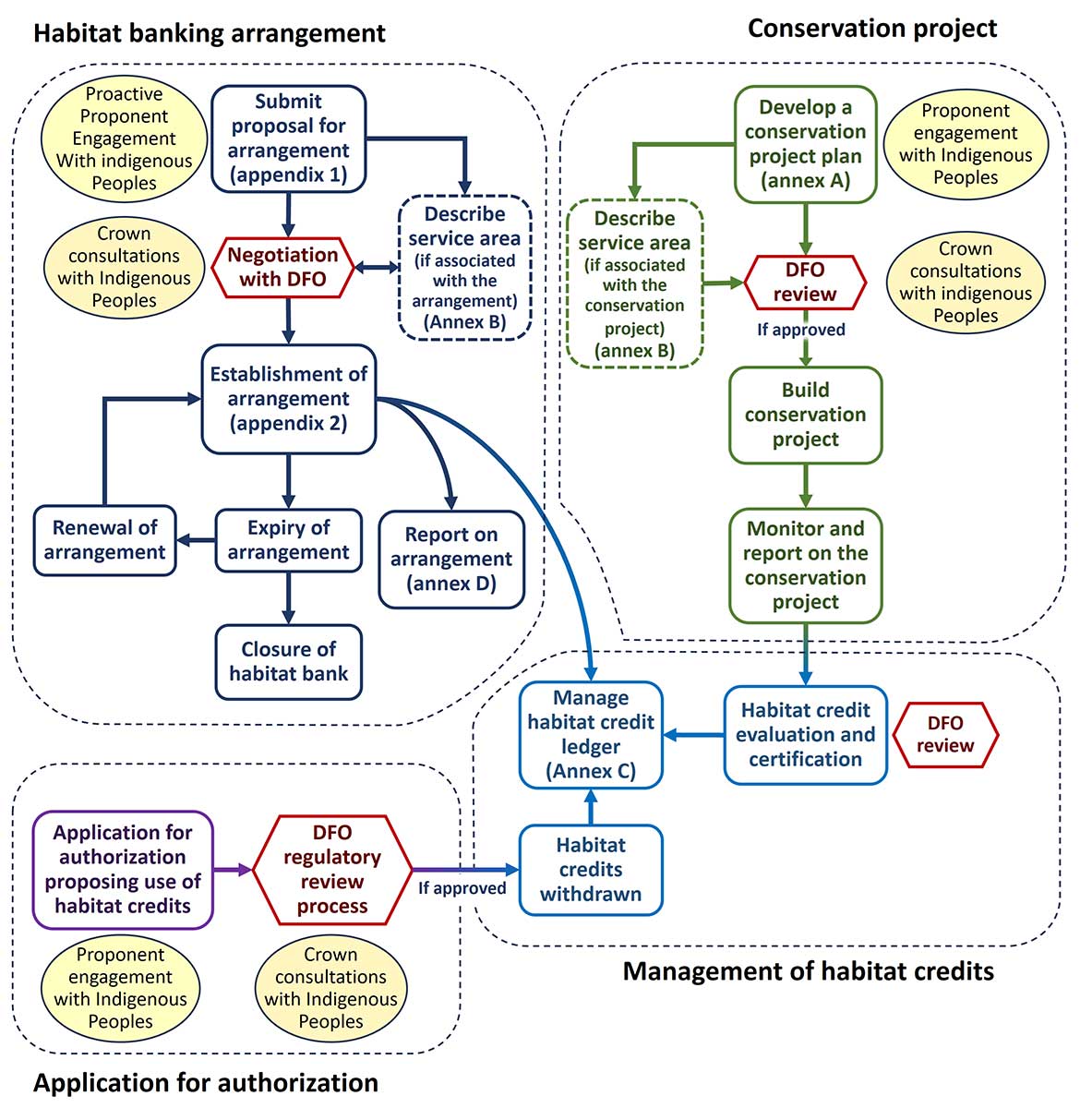
Figure 1: General overview of the habitat banking process including consultation and engagement with Indigenous Peoples (yellow), the habitat banking arrangement process (dark blue), the conservation project process (green), the application for authorization process, and management of habitat credits (medium blue). DFO involvement is in red.
Figure 1 - Text version
This is a flowchart showing how the habitat banking process works. There are four main parts of the process:
- The habitat banking arrangement
- Conservation project
- Application for authorisation
- Management of habitat credits
The flowchart for the Habitat banking arrangement starts with a box saying, “Submit Proposal for Arrangement (Appendix 1). Beside it is a circle stating “Proactive proponent engagement with Indigenous Peoples” to show that these processes go together. The next boxes are “Negotiation with DFO”, and “Describe Service area (if associated with the arrangement) (Annex B)”. A two-way arrow connects these two boxes to indicate that describing the service area is part of the negotiation, (if associated with the arrangement). A circle is to the left of the “Negotiation with DFO” says “Crown consultations with Indigenous Peoples” indicating Crown consultations will also be part of the negotiation process. The next box is “Establishment of arrangement (appendix 2)”. Three arrows go from this box indicating that once the arrangement is established, there are three activities that follow: One is “Report on arrangement (annex D)”. Another is “Manage habitat credit ledger (annex C)”. The third is “expiry of arrangement”
The flowchart for the Conservation project process starts with a box saying, “Develop a conservation project plan (annex A)”. Beside it is a circle stating “Proponent engagement with Indigenous Peoples” to show that these processes go together. The next boxes are “Describe Service area (if associated with the conservation project) (Annex B)” and “DFO review”. An arrow indicates that if the service area is associated with the conservation project, it should be described prior to going for DFO review. A circle is next to “DFO review” saying “Crown consultations with Indigenous Peoples” indicating Crown consultations will also be part of DFO’s review process. The next box is “Build conservation project”, which is followed by “Monitor and report on the conservation project”. The words “If approved” are on the arrow between “DFO review” and “Build Conservation Project.
The flowchart for the Application for authorization process starts with a box saying,” Application for authorization proposing use of habitat credits”. Under it is a circle stating “Proponent engagement with Indigenous Peoples” to show that these processes go together. Next is “DFO regulatory review process”. A circle under it says, “Crown consultations with Indigenous Peoples” indicating Crown consultations will also be part of DFO’s regulatory review process.
The flowchart for the Management of habitat credits feeds from the other three processes. An arrow from “Establishment of arrangement (appendix 2)” to a box saying “Manage habitat credit ledger (Annex C)” indicates that the establishment of the arrangement leads to the establishment of a habitat credit ledger. From the box “Monitor and report on the conservation project ” is an arrow to a box saying “Habitat credit evaluation and certification”. From the box “DFO regulatory review process” is an arrow to a box saying “Habitat credits withdrawn”. Two arrows point to the box “Manage habitat credit ledger (Annex C)” one from “Establishment of the arrangement (Appendix 2)”, and the other from “Habitat credits withdrawn”, indicating that the habitat credit ledger is based on habitat credits being both evaluated and certified and being withdrawn.
Conditions for establishing a fish habitat bank arrangement
A habitat bank arrangement sets out the terms and conditions for creating and managing a fish habitat bank. It establishes a working relationship between DFO and the proponent (the parties) based on accountability, transparency and certainty. A fish habitat bank arrangement between DFO and the proponent is subject to the following conditions:
- The existence of an arrangement does not automatically obligate DFO to authorize any particular future work, undertaking or activity under paragraphs 34.4(2)(b) and 35(2)(b) of the Fisheries Act or subsection 73(1) or section 74 of the Species at Risk Act. All applications will be reviewed on a case-by-case basis using the same approach that is used for applications with project-specific offsetting plans.
- Any adverse impacts on Indigenous rights are to be avoided and mitigated to the extent possible and when appropriate, Indigenous peoples must be accommodated. DFO’s consultation obligations under the Duty to Consult include evaluating the potential impacts of the proposed banking arrangements and related conservation projects on asserted or established Indigenous rights. Where proposed activities may adversely affect section 35 rights or associated interests, DFO will undertake consultation and, where appropriate, provide accommodation.
- The use of habitat credits will depend on the suitability of those credits and the extent to which their use meets the principles established in the Offsetting Policy. If proponents wish to withdraw credits to offset an impact to one or more species at risk, the credits must represent habitat created, restored or enhanced for those species at risk.
- The hierarchy of measures described under Principle 1 in the Offsetting Policy will be respected when the use of banking credits is proposed. This means options for avoiding and mitigating risks to fish and fish habitat must be exhausted before using credits.
- A proponent may only use certified habitat credits associated with a habitat bank arrangement between that proponent and DFO, and only to offset adverse effects on fish or fish habitat in the service area covered by that arrangement.
- Habitat credits cannot be sold or traded to a third party to meet their offsetting requirements. A proponent may choose to subcontract the construction or monitoring of a conservation project to another party (for example, an environmental group specializing in restoration or an Indigenous group). However, this subcontract is between the proponent and the other party. The proponent remains responsible for achieving the objectives set out in the conservation project plan.
- Credits are granted based on the achievements of the conservation project. Clear, measurable fish habitat benchmarks, targets and indicators (see Monitoring and reporting on habitat bank conservation projects) will be used to demonstrate when the conservation project provides benefits to fish and fish habitat, including aquatic species at risk, where appropriate. If the conservation project does not meet (or exceeds) expectations, credits will be managed accordingly (see Managing habitat credits and applying them to an application for authorization).
Engagement and consultation with Indigenous Peoples
Role of the proponent
Fish habitat banks, service areas and conservation projects are to be transparently developed by proponents, taking into account the perspectives of Indigenous Peoples. The legal duty to consult and accommodate remains with the Crown, but proponents are expected to engage early and often with any potentially affected Indigenous Peoples on all phases of habitat banking, including:
- the design and planning of a habitat bank;
- the proposed service area;
- anticipated works, undertakings or activities that may occur in the service area and whose harmful impacts would need to be offset according to the level of potential impact to rights.
A number of benefits to proponents can come from establishing positive working relationships with Indigenous Peoples upon whose traditional territories they will be working. Habitat banks that are designed (or co-designed) from the start to take into account and accommodate Indigenous interests and rights, and that respect the concept of free, prior and informed consent, will have better outcomes for fish and fish habitat, aquatic ecosystems, Indigenous Peoples and the proponent. It sets up a foundation for an efficient consultation process when DFO fulfils its duty to consult. Conversely, a proponent who fails to engage Indigenous Peoples risks having to substantially redesign their proposal as a result of Crown consultations.
Indigenous Peoples may possess Indigenous KnowledgeFootnote 3 that is relevant to the design and implementation of the proposed habitat bank and, in particular, its conservation projects. If Indigenous Knowledge holders choose to share it, they will set the terms and conditions under which the proponent may use it. The proponent must have approval from the Indigenous Knowledge holders to share Indigenous Knowledge with DFO as part of their engagement record. Proponents should also seek clarification about the confidential nature of the Indigenous Knowledge being provided by each Indigenous community. The Indigenous Knowledge may not be primarily focused on fish and fish habitat, but may also provide information on Indigenous rights, treaty rights and potential adverse impacts on those rights.
It is not the role of this document to provide proponents with detailed guidance on engaging with Indigenous Peoples. Each Indigenous Nation will have their own processes and protocols governing their relationships with industry and the Crown. It is important that proponents develop a relationship with Indigenous Nations, learn about any potential concerns and respond to their questions. Proponents should maintain the relationship throughout the process and respond to any adverse impacts or concerns, including what kind of capacity support (funding) they might need. For more information on best practices, see Project planning: Engaging with Indigenous Peoples.
Proponents should contact their DFO Regional office to identify the communities in the area of a proposed project with whom DFO has a duty to consult. Proponents can also go to the consult the Aboriginal and Treaty Rights Information System (ATRIS), a web-based system that shows the location of Indigenous groups and provides information about their potential or established Aboriginal and treaty rights. ATRIS can also provide information on consultation protocol agreements between Canada, Indigenous groups and provinces or territories. The details of all engagement with Indigenous Peoples should be documented and shared with DFO to inform the development of the fish habitat bank arrangement.
Role of DFO
Canadian courts have affirmed that when the Crown contemplates actions that could adversely affect Indigenous rights, it has a constitutional duty to consult with, and where appropriate, accommodate Indigenous Peoples.
This duty includes any decision on whether to:
- enter into an arrangement respecting a fish habitat bank
- approve conservation projects and their associated defined service area;
- authorize any work, undertaking or activity proposing to use habitat credits to offset the harmful impacts to fish and fish habitat in whole or in part
- issue a permit authorizing a person to engage in an activity affecting an aquatic species at risk, or any part of its critical habitat or its residence (subsection 73(1) of the Species at Risk Act)Footnote 4.
DFO will carry out consultation with Indigenous Peoples about proposed fish habitat banks and their proposed related conservation projects when there is potential to adversely impact established or potential Aboriginal or treaty rights, as affirmed and protected under Section 35 of the Constitution Act, 1982.
Establishment of a fish habitat bank arrangement
The formal habitat banking process begins with a proponent submitting a proposal to DFO to establish a habitat bank, which will form the basis for negotiating a fish habitat bank arrangement. Proponents should refer to Appendix 1 for more details on the information that should be submitted.
Once a proposal is received, the proponent and DFO negotiate the fish habitat bank arrangement. This document defines the roles and responsibilities of DFO and the proponent. It also identifies how the habitat bank will be established, managed and operated.
An annotated fish habitat bank arrangement template is available in Appendix 2. It can serve as a starting point for negotiating an arrangement, though DFO and the proponent may choose to tailor the arrangement to their needs.
In addition to the legal requirements in subsection 42.02(3), the arrangement can include:
- an introduction describing the purpose and context of the arrangement and the mutual intentions of the proponent and DFO;
- roles and responsibilities of both DFO and the proponent;
- location(s) of any planned conservation project site(s);
- other administrative provisions such as amendment provisions, dispute resolution, financial responsibilities.
The arrangement may allow for one or more conservation projects, including the consideration of future conservation projects during the term of the fish habitat bank. Each conservation project plan will be attached to the arrangement as it is proposed and approved. It is not necessary to have a conservation project in mind when an arrangement is being negotiated, but having one that is at least in the planning stages may help determine what needs to be in the arrangement.
The arrangement must also include details of the habitat credit accounting procedures regarding the habitat credit ledger. The habitat credit ledger is an annex to the fish habitat bank arrangement and is the official accounting record for all habitat banking transactions for the fish habitat bank. Both DFO and the proponent are responsible for managing the habitat credit ledger. The habitat credit ledger tracks:
- the dates on which habitat credits are certified and added to the ledger
- the documentation used to certify the habitat credits
- the type and number of habitat credits that are certified
- and habitat credit use and balance.
Indigenous Peoples may be included as a party to these negotiations, particularly if they raised concerns about the habitat bank during proponent engagement or Crown consultations, or if they expressed an interest in being involved in the implementation of the habitat bank. Only DFO and the proponent are parties to the fish habitat bank arrangement, and only the proponent can use the credits. However, any agreements between the proponent and Indigenous Peoples (for example, subcontracting the development of conservation projects) could be recognized within the arrangement.
Reporting on fish habitat bank arrangements
Proponents should provide DFO with a brief annual report on the administration and management of the habitat bank arrangement. This report includes:
- a summary of progress on conservation projects
- an accounting of transactions on the habitat credit ledger
- reporting on any other objectives or challenges that occurred since the last report
The annual report can also be accompanied by detailed monitoring reports on conservation projects, or these can be provided separately, depending on what is specified in the arrangement. These reports must be shared with Indigenous Peoples who have requested to be kept informed of the progress of the arrangement.
Find a Template for the annual report on the performance of the fish habitat bank arrangement below. DFO and the proponent may choose a different reporting period, which will be indicated in the arrangement.
Renewing a fish habitat bank arrangement
Arrangements must have an expiry date. There is no set standard for the duration of an arrangement, but it should be long enough for:
- building the proposed conservation project(s),
- the benefits to manifest,
- the credits to be certified, and
- the credits to be used as offsetting.
At the end of this period, the arrangement can be renewed for an additional defined term. The proponent should provide DFO with one year’s written notice of their intention to renew the arrangement. DFO has a legal duty to consult with and accommodate Indigenous Peoples if the decision to renew a fish habitat bank arrangement may adversely affect Indigenous rights.
Describing the service area(s)
A fish habitat bank’s service area is the area to which the benefits of a fish habitat bank extend. It is the area within which future projects requiring a Fisheries Act authorization should take place in order to use credits generated by the bank. The service area should be based on the geographical extent to which fish can benefit from the conservation project, This extent will be influenced by the species or ecological attributes that the conservation project aims to address. For example, if the conservation project benefits a migratory fish population (for example, salmon), the service area could be larger than if it were to benefit mainly species or populations with a more limited range.
Service areas should encompass a spatially connected area with similar environmental attributes. In inland waters, they will likely be watershed-based. In coastal and marine environments, they may be defined based on factors such as salinity (freshwater, brackish, marine), vegetation (for example, eelgrass) or fish communities. The boundaries of the service area must be justified based on scientifically sound principles and Indigenous Knowledge. Proponents are expected to engage potentially affected Indigenous Peoples on the boundaries of the service area.
The service area can be associated with either the arrangement or with the conservation project, depending mostly on the geographical area that the arrangement covers. If the arrangement covers a specific locale where the ecological features of the habitat are consistent (for example, a municipality or port authority), then a service area can be tied to the arrangement and encompass one or more conservation projects. See Figure 2 for an example.
If the arrangement covers a large area that encompasses several different watersheds or ecological units, it is more appropriate to describe a service area for each conservation project and track associated credits separately. An example is a fish habitat bank whose primary purpose is to offset the harmful impacts of a linear project (for example, highway projects, power transmission lines) that involve numerous small-scale stream crossings. For an illustration, see Figure 3.
There can be an overlap between service areas, but the credit accounting system must clearly track which conservation project and service area the credits came from. If the work, undertaking, or activity occurs in the overlap area, credits can be drawn from either or both service areas, provided that the type of credit being used is appropriate for the impact being offset. Service areas can overlap geographically with the service areas of other conform to its arrangement (that is, credits cannot be exchanged between banks). For more details on credit tracking and accounting, see Habitat credit value.
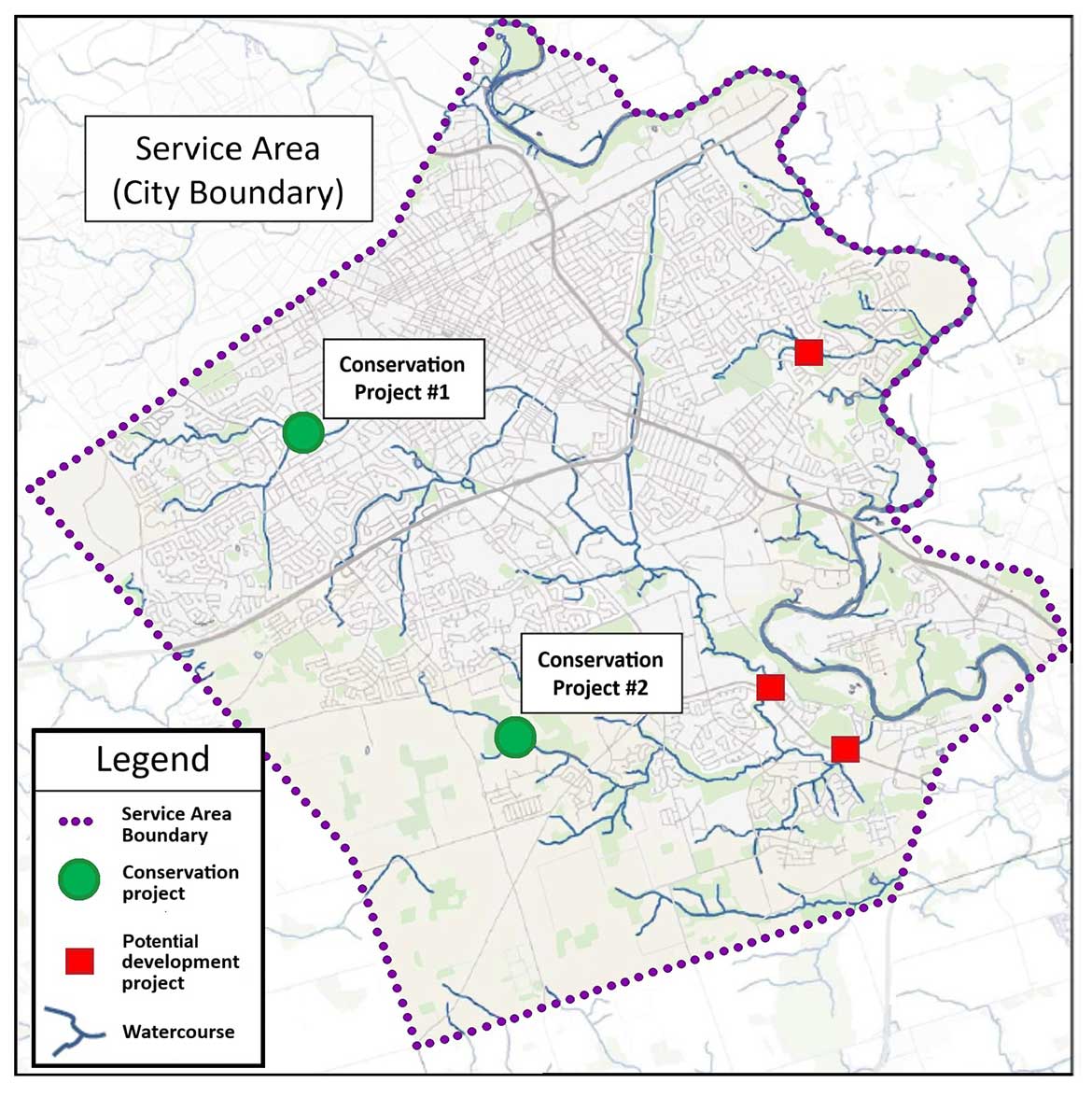
Figure 2: Example map of a service area for a fish habitat bank. The service area is tied to the arrangement and defined using municipal boundaries, which are within a single watershed, and subject to the same fisheries and watershed management objectives. All conservation projects are located within the service area, and the habitat credits generated are used to offset harmful impacts to fish and fish habitat of the municipality’s future works, undertakings, or activities.
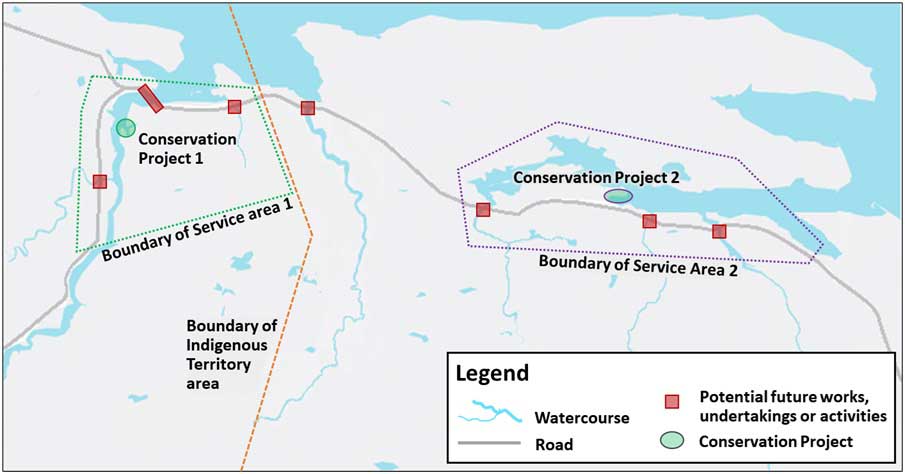
Figure 3: An example of a map of a service area for a fish habitat bank. In this example, the service area is tied to the conservation project. The proponent is planning to upgrade an existing road with multiple water crossings and has entered into a habitat banking arrangement with DFO. The two conservation projects have service areas defined according to the extent of their anticipated benefits. The service area boundary of conservation project 1 also takes into account the boundary of an Indigenous territory area.
Figure 3 - Text version
This map shows a road along a coastline that crosses several rivers. At the intersection of the road and each river is a red square indicating a potential future work undertaking, or activity. Along one of the rivers in the left half of the map is a green dot with a green outline that is conservation project 1. A polygon depicting an area around the conservation project is outlined with a green dotted line and is labelled as the boundary of service area 1. This area encompasses three of the potential future works, undertakings, or activities. A dashed orange line representing the boundary of an Indigenous Territory area aligns with one of the boundaries of the service area. In the right half of the map along the coastline is a green dot with a purple outline representing conservation project 2. A polygon depicting an area around conservation project 2 is outlined with a purple dotted line and is labelled as the boundary of service area 2. There are three potential future works, undertakings, or activities in this area. There is one potential future work, undertaking, or activity on the map that is in neither service area.
Developing and managing habitat bank conservation projects
A functioning habitat bank arrangement must include at least one habitat bank conservation project, to be constructed after the arrangement is established. Each fish habitat banking arrangement will include a Conservation Project Plan, which will be included as an annex to the arrangement (see Figure 1).
Additional conservation project plans can be added at a later point in accordance with the provisions of the arrangement. The development of a conservation project plan must follow the same principles and processes as those outlined in the Offsetting Policy. See Annex A for a list of requirements for a conservation project plan.
Habitat bank conservation projects are undertaken by a proponent to restore, enhance, or construct fish habitat within a service area, with the objective of generating habitat credits. They are designed to result in defined fish and fish habitat benefits, including to the conservation, survival or recovery of aquatic species at risk. The goal of the habitat bank conservation project is to contribute directly to the restoration of fish habitat and enhance specific habitat functions.
Conservation projects should be aligned with:
- local, regional, provincial and federal restoration priorities
- the restoration priorities and fisheries management objectives of Indigenous Peoples in particular
- fisheries management objectivesFootnote 5
- watershed planning initiatives
Regional restoration priorities developed under DFO's Framework to identify fish and fish habitat restoration priorities can be a source of ideas for conservation plans. Ideally, conservation plans will address threats and limiting factors to the productive capacity of fish and fish habitat. It is essential to prioritize the needs of aquatic species at risk when conservation projects take place in areas where they are likely present. A conservation project should be designed with the specific goal of supporting and enhancing the status of aquatic species at risk. This includes adhering to applicable prohibitions and following guidance from recovery strategies and action plans for species listed as threatened, endangered or extirpated and from management plans for species listed as special concern. Projects must avoid causing harm to these species, and contribute to their long-term sustainability.Footnote 6
When developing their conservation project plan, proponents should consider how climate change may affect the long-term effectiveness of the conservation project. Proponents are not expected to counterbalance the harmful impacts of climate change or conduct modelling to account for the many uncertainties associated with climate change; rather, conservation plans should consider the most well-known effects such as warmer water, sea level rise, loss of permafrost, and more frequent drought and extreme storms. Conservation projects that enhance habitat resilience to climate change are likely to increase the long-term effectiveness of the project.
Conservation projects could be selected to address cumulative effects of past and ongoing pressures in the service area. DFO is required to consider cumulative effects when making a decision to authorize a work, undertaking or activity. For more information, see the document The Consideration of cumulative effects in support of decision making on Fisheries Act authorizations concerning fish and fish habitat protection.
Proponents are expected to engage early and often with potentially affected Indigenous Peoples throughout the planning, design, implementation and monitoring of conservation project(s) and to support their restoration priorities and fisheries management objectives where possible. This includes adequate notice and funding in order to allow for meaningful preparation and participation in engagement processes. Proponents are particularly encouraged to explore developing partnerships with Indigenous groups to co-design and co-implement conservation projects. This collaboration would help advance reconciliation and allow Indigenous groups to build capacity and further their conservation and restoration objectives.
Proponents are also encouraged to collaborate with resource users, landowners and other interest holders in order to develop a plan that is compatible with the needs of the local community. Potential conflicts, risks and trade-offs between the development goals of the proponent and other management objectives should be identified in advance of decisions and investments.
Proponents may require permits from other federal, provincial, municipal or Indigenous jurisdictions. For example, they may need provincial fishing licences or water diversion permits. A Fisheries Act authorization will only be needed if implementing the conservation plan will result in death of fish or the harmful alteration, disruption or destruction of fish habitat. A Species at Risk Act permit would also be needed if implementing the conservation project(s) could result in prohibited effects to an aquatic species at risk listed as threatened, endangered or extirpated; any part of its critical habitat; or the residence (as applicable) of its individuals. Obtaining these approvals are the proponent’s responsibility.
Conservation project site ownership or land tenure
Proponents are responsible for the construction, monitoring, maintenance, and protection and stewardship of their conservation project sites in accordance with the conservation project plan. The lands, water sources or waterbodies needed to implement the conservation project plan must either be owned by the proponent, or the proponent must have permission to access and use those resources. In all cases, the proponent must ensure DFO has access to the land to conduct monitoring activities. Any other parties collaborating with the proponent on monitoring must also be granted access.
If implementing the plan requires access to lands, water sources or waterbodies that are not owned by the proponent or a government, the proponent should describe how they will obtain permission for them, DFO, and anyone authorized to act on DFO’s behalf, to access those areas. This information is not required in some circumstancesFootnote 7.
If access is required on lands covered by treaty or comprehensive land claims agreements, the proponent may need to obtain permission from the Indigenous governing body.
Habitat credit value
DFO and the proponent should agree upon the value of a habitat credit, the unit of measure and the accounting procedure. A variety of metrics or units of measure may be used, but it will typically consist of two parts:
- the amount of physical fish habitat restored, enhanced or constructed (for example, surficial area measured in m2)
- the type of habitat, as defined by the functions and attributes of that habitat and the life cycle processes it supports for the fish community (for example, nursery habitat for salmonids)
The unit of measure and the value of the credits are described in the arrangement or the conservation project plan, and identified when posted to the habitat credit ledger.
Publications by DFO’s Canadian Science Advisory Secretariat provide an overview of equivalency analysesFootnote 8 Footnote 9 and offer useful advice on quantifying the benefits to fish and fish habitat across fish life stages, species and habitat types, which in turn can be used in describing habitat credits. A proponent may also propose their own approach.
The habitat credits may be categorized to be used only for offsetting harmful impacts to certain habitat types in order to ensure sufficient equivalence between the impacted habitat and the habitat constructed for the conservation project.
A proponent may wish to use habitat credits to offset harmful impacts to listed aquatic species at risk as part of an application for a Fisheries Act authorization acting as a permit under the Species at Risk Act. In these cases, any credits for habitat designed and managed to contribute to the survival or recovery of a listed aquatic species at risk should be tracked independently from habitat designed to benefit fish in general.
These credits may be used to benefit another aquatic species at risk when monitoring data demonstrates that the conservation project is also supporting that other species. The proponent may request to apply aquatic species at risk habitat credits to offset harmful impacts on non-at-risk fish and fish habitat, provided the credits are appropriate and align with the nature of the harmful impacts from the proposed works, undertakings, or activities.
Ecosystem functions and features that could be considered interchangeable from an ecological perspective may have unique values for Indigenous Peoples or local resource users. If so, this should be reflected in the habitat credit accounting procedure. Proponents are expected to engage Indigenous Peoples on establishing the credit system as part of their overall engagement on the habitat bank arrangement. Engaging with local resource users will also provide the proponent with a better understanding of the value placed on the fish and fish habitat, and this can be reflected in the credit accounting system.
Monitoring and reporting on habitat bank conservation projects
A monitoring plan outlines the process used to monitor, evaluate and report on progress, and is a critical component of the conservation project plan. Proponents are responsible for developing and implementing a comprehensive monitoring plan to demonstrate that their conservation project is delivering measurable benefits to fish and fish habitat.
Monitoring plans have several key features, including a statement of the objective of the conservation project, expected outcome statements for each offsetting measure, and a monitoring timeframe. Expected outcome statements support the objective of the conservation project and must include benchmarks, targets and indicators.Footnote 10Footnote 11 Each expected outcome should be specific, measurable, achievable, realistic, and time-related / time-bound (SMARTFootnote 12). Fisheries management plans, restoration priorities, recovery strategies or action plans for relevant aquatic species or species at risk may be helpful sources of information for the development of expected outcomes and their associated benchmarks, targets and indicators.
An essential component of a monitoring plan is the monitoring timeframe, which defines the frequency and duration of data collection, analysis, and reporting activities. The timeframe should be tailored to reflect the scale and level of uncertainty associated with the conservation project. The timeframe may include pre-construction monitoring and it must extend for a sufficient period post-construction to determine that the conservation project is well-established, self-sustaining and has met its expected outcomes. Longer monitoring periods may be required for large or complex conservation projects or projects with a high level of uncertainty.
Monitoring and reporting should be done at time intervals (frequencies) that are aligned with the benchmarks or targets specified in the expected outcome statements. The monitoring timeframe is essential for tracking progress of the measures and identifying problems or delays requiring the implementation of contingency measures.
A well-prepared monitoring plan creates a roadmap for data collection and reporting of results throughout the life of a conservation project. It ensures that the project’s performance is tracked against expected outcomes and that any necessary adjustments can be made in a timely manner. Engagement with Indigenous Peoples during the development of the monitoring plan is expected to be part of a proponent’s Indigenous engagement process.
The proponent is required to submit monitoring reports according to the schedule outlined in the conservation project plan. The reports allow DFO to assess the development and condition of the conservation project and will form the basis for certifying habitat credits. These monitoring reports are subject to DFO verification, which may include site inspections, and review of the monitoring report information to verify conformity, compliance and effectiveness of the conservation project.
Banking excess benefits from project-specific offsetting measures
In some cases, a proponent undertaking project-specific offsetting measures may pursue a restoration opportunity that generates benefits exceeding what is needed to counterbalance the harmful impacts of a work, undertaking or activity (including time lags and uncertainties). Subject to DFO approval, the proponent may request the excess benefits be converted into habitat credits if they have an existing habitat banking arrangement with DFO or are willing to enter into one by the time the habitat credits are ready to be certified. The anticipated benefits should be sufficiently greater than those needed to offset the original harmful impacts.
The project-specific offsetting plan must clearly state the intent to generate excess benefits for use as habitat credits, and DFO will cross-reference this plan with the proponent’s habitat banking arrangement. DFO will confirm the service area for the credits being generated and define when harmful impacts of the original project have been counterbalanced according to expected outcomes as defined by benchmarks, targets and indicators. DFO will then determine whether subsequent habitat credits may be certified.
As with standard offsetting projects, the proponent must provide a financial guaranteeFootnote 13 sufficient to cover the entirety of the planned offsetting measures. The secured amount can be reduced over time as specified benchmarks are reached. The final installment will be held until the credits for excess benefits are certified.
Managing habitat credits and applying them to an application for authorization
Habitat credit evaluation and certification
Habitat credit certification refers to the process by which habitat credits are “deposited” into the habitat bank and are available for use as an offsetting measure for future harmful impacts on fish and fish habitat, as appropriate. The habitat credits are logged on the habitat credit ledger as being available for use. This occurs when:
- monitoring of the fish habitat indicators has demonstrated that the conservation project has achieved or exceeded its expected outcomes (see chapter 2.5.3); and,
- DFO has evaluated and verified that the conservation project is providing the intended fish and fish habitat benefits.
Habitat credit certification may occur in phases, allowing habitat credits to be allocated as specific benchmarks or targets are met. For example, 25 per cent of the credits could be certified when construction is complete, another 50 per cent certified in stages as certain benchmarks are achieved, and the final 25 per cent certified when long-term monitoring is complete, and the conservation project is stable and self-sustaining. This approach must be established in the conservation project plan.
If monitoring indicates that the conservation project is not meeting its expected outcomes, the proponent may choose one of two options:
- implement contingency measures and develop a plan for monitoring those contingency measures, as they would for a project-specific offset
- accept that the conservation project will generate fewer credits than originally anticipated
If the project exceeds expectations, the proponent may be eligible to receive additional credits, if the conservation project plan includes provisions for such an event.Footnote 14
Applying (withdrawing) habitat credits
When habitat credits are used to offset the harmful impacts of a work, undertaking, or activity, they are considered “withdrawn” from the habitat credit bank and deducted from the balance. Once withdrawn, these credits are no longer available for future use.
To apply habitat credits, a proponent submits an application for a Fisheries Act authorizationFootnote 15 and requests the use of the certified habitat credits as the offsetting measure. If the credits are accepted for all or part of the offsetting requirements and the authorization is issued, DFO logs the habitat credit transaction in the habitat credit ledger when issuing the authorization. The proponent may propose an approach where some credits are applied when the authorization is issued based on the expected harmful impacts of the work, undertaking, or activity, and a certain number of credits are reserved for use as a contingency measure should the harmful impacts be more than expected. Circumstances that require the application of the contingency credits will be specified in the authorization and be based on monitoring data.
While habitat banks represent a significant investment, the availability of habitat credits within a fish habitat bank does not guarantee that DFO will authorize any future work, undertaking or activity. All applications will be reviewed on a case-by-case basis using the same criteria applied to project-specific offsetting plans. The suitability of the credits will be evaluated the same way as the suitability of an offsetting plan. For example, if a work, undertaking or activity may result in the loss of irreplaceable fish habitat, an authorization will likely be refused even if sufficient credits exist in a habitat bank.
If circumstances change throughout the course of implementing the authorization and the amount of allocated credits is no longer inappropriate, the proponent may apply for an amendment to the authorization to adjust the amount of credits needed.
DFO has a legal obligation to consult and accommodate Indigenous Peoples if the decision to issue an authorization and use habitat credits may adversely affect Indigenous rights. Prior to applying for a Fisheries Act authorization, proponents are expected to have already engaged with Indigenous Peoples early on in the planning of the work, undertaking, or activity , including their intentions to use credits from their habitat bank.
Early application of habitat credits
In some cases, a proponent may wish to use credits that the conservation project is to generate, but that have not yet been certified because the expected outcomes have not yet been met. DFO may allow the use of habitat credits in advance of certification as part of an application for authorization under the following conditions:
Construction of the conservation project is complete;
- The proponent commits to completing all remaining obligations with regards to the conservation project (monitoring, etc.);
- A contingency plan is developed that describes what the proponent will do if the conservation project does not meet its expected outcomes and the harmful impacts of the work, undertaking, or activity are not counterbalanced;
- As part of the application for authorization, a financial guarantee is provided to DFO for an amount adequate to cover the cost of implementing the contingency plan and all remaining maintenance and monitoring obligations, administrative and inflationary costs, and any additional expenses that could be incurred by DFO taking over the process; and
- The harmful impacts due to time lags between the impact occurring and the expected outcomes of the conservation being met are counterbalanced, either by using extra credits, or by implementing extra offsetting measures.
If DFO accepts the proposal, these conditions will be formally incorporated into the authorization, similar to how conditions are applied for offsetting measures.
Terminating a habitat banking arrangement
A habitat banking arrangement is terminated when:
- the arrangement has expired;
- the proponent has discharged all of their obligations (for example, monitoring of conservation projects);
- all credits have been applied;
- the proponent no longer wishes to build conservation projects under that arrangement.
The proponent may terminate the arrangement prior to the expiry date by providing six months’ written notice to DFO. Upon receiving such notice, DFO will review the status of the arrangement to confirm that all obligations have been met before formally closing the arrangement.
Following termination, the conservation project site(s) will be protected under the Fisheries Act against projects that result in harmful impacts, in the same way as natural or pristine fish habitat. A Fisheries Act authorization would be required for any new projects that cause harmful impacts to the conservation project site, which would include a new offsetting plan to counterbalance those harmful impacts.
If species at risk begin to inhabit the conservation project site, then the Species at Risk Act will apply, including the prohibitions against harming, harassing or killing a species listed as threatened, endangered or extirpated, or damaging or destroying their residences (as applicable). If the conservation project site is later designated as critical habitat, its destruction will also be prohibited. For any proposed project that will subsequently affect the species, its residences or its critical habitat, the proponent must undergo the permitting process under the Species at Risk Act.
More information
The following departmental guidance documents are available from DFO’s Projects near water website:
- Project planning: Engaging with Indigenous Peoples
- Applicants Guide Supporting the Authorizations Concerning Fish and Fish Habitat Protection Regulations
- Fish and fish habitat protection policy statement
- Policy for applying measures to offset harmful impacts to fish and fish habitat
These documents provide context for this policy and specific guidance on the authorization process, including applying for a Fisheries Act authorization. For more information, the Projects Near Water website provides contacts to your regional DFO office.
Glossary
Section 42.01 of the Fisheries Act provides the following definitions of terms used in relation to fish habitat banking.
- Fish habitat bank arrangement
- An administrative agreement between a proponent and the Minister that establishes a system for the creation, allocation and management of habitat credits in relation to one or more habitat bank conservation projects to be undertaken with the intention of being applied to offset harmful impacts to fish or fish habitat from the carrying on of a work, undertaking or activity. Also referred to as an “arrangement respecting fish habitat banks”.
- Fish habitat bank
- An area of fish habitat that has been restored, enhanced or constructed by the carrying on of one or more conservation projects within a service area and in respect of which area the Minister has certified habitat credits. May also be referred to in this document as a “habitat bank”.
- Habitat bank conservation project
- A work, undertaking or activity that is carried on by a proponent for the purpose of constructing, restoring or enhancing fish habitat within a service area in order to acquire habitat credits. May be abbreviated to “conservation project” if the context is specifically related to habitat banking.
- Habitat credit
- A unit of measure that is agreed to between any proponent and the Minister under section 42.02 of the Fisheries Act that quantifies the benefits of a conservation project.
- Proponent
- A person who proposes the carrying on of a conservation project and any other work, undertaking or activity within a proposed service area.
- Service area
- The geographical area that encompasses a fish habitat bank and one or more habitat bank conservation projects, and within which area a proponent carries on a work, undertaking or activity.
Information needed for a fish habitat bank arrangement proposal (Appendix 1)
The formal habitat banking process begins with a proponent submitting a proposal to DFO to establish a habitat bank arrangement. This proposal can be in the form of a letter to DFO indicating an interest in entering into a habitat bank arrangement. The following information, to be provided by the proponent, will form the basis of negotiating a habitat banking arrangement.
- Contact information
- Proponent’s full legal name and primary mailing address. Note that the name on the arrangement must be the same as the name that is anticipated to be on future Fisheries Act authorizations for which the credits will be applied.
- If the proponent is a government agency, corporation or company, provide the full legal registered name of the organization.
- If applicable, also provide the contact information of the duly authorized representative of the proponent.
- Habitat bank administration, management and operation
- An overview of the goals of the fish habitat bank arrangement and why the proposal is being pursued.
- Affirmation that the proponent understands the laws they will need to abide by, and that only they can use the credits within the service area generated under this arrangement.
- A description of the proposed approach for the administration, management and general operation of the fish habitat bank arrangement including:
- a procedure and approval process for habitat bank conservation projects;
- habitat credit valuation approach (what will habitat credits be based on);
- habitat credit evaluation and certification process;
- habitat credit accounting procedures respecting the habitat credit ledger;
- the date on which the proponent would like the arrangement for the fish habitat bank to come into force, and anticipated duration of the arrangement.
- If the service area will be associated with the arrangement, provide a general description of the location of the service area including a map.
- Proposed conservation projects
- A general description of each proposed conservation project, including:
- the size and type of project (habitat construction, enhancement, restoration, etc.);
- If the service area is associated with the conservation project, provide a map and a general description of the location of the service area.
- the fish habitat benefits to be achieved by the conservation project(s), and the fish species that will benefit as a result; and
- The anticipated number and type(s) of habitat credits that will be generated (based on the structure and function of the habitat). If credits for aquatic species at risk are being proposed, the particular species or aggregate of species must be identified.
- A general description of each proposed conservation project, including:
- Engagement with Indigenous Peoples and interested parties
- A list of potentially affected Indigenous Peoples, and a description of how they were involved in the development of this fish habitat bank arrangement proposal, including the service area, and how they will be involved in the development and implementation of the conservation project plan(s).
- A description and the outcome of any engagement activities undertaken with interested parties or the public in relation to the proposed habitat bank arrangement, service area and conservation project(s); and, how this influenced the proposal.
Annotated template for a fish habitat bank arrangement (Appendix 2)
Fish Habitat Bank Arrangement:
[INSERT NAME OF THE FISH HABITAT BANK (INCLUDING THE BANK LOCATION)]
Between
[INSERT FISH HABITAT BANK PROPONENT NAME]
[The full and legal names must be listed correctly]
AND
HIS MAJESTY THE KING IN RIGHT OF CANADA, as represented by the Minister of Fisheries, Oceans on behalf of Fisheries and Oceans Canada
[INSERT THE DATE THE ARRANGEMENT COMES INTO EFFECT]
PATH Number: [INSERT PATH NUMBER]
1. Introduction
This document sets out the principles of the mutual understanding between [INSERT FISH HABITAT BANK PROPONENT NAME] (hereafter referred to as “the Proponent”) and Fisheries and Oceans Canada (hereafter referred to as “the Department”) for the [INSERT NAME OF FISH HABITAT BANK].
Whereas the Department is responsible for the administration of the Fisheries Act; and the purpose of the Fisheries Act is to provide a framework for the proper management and control of fisheries, and the conservation and protection of fish and fish habitat, including by preventing pollution;
Whereas the fish and fish habitat protection provisions as set out in sections 34 to 42.5 of the Fisheries Act provide a holistic approach to conserving and protecting fish and fish habitat, supported by policies and programs that provide for the long-term sustainability of freshwater and marine resources;
Whereas sections 42.01 to 42.04 of the Fisheries Act establish key definitions and rules for all parties of arrangements respecting fish habitat banks;
Whereas the Department is responsible for the administration of the Species at Risk Act with respect to aquatic species other than those individuals in or on federal lands administered by the Parks Canada Agency and, in that capacity, the Minister of Fisheries and Oceans has powers and duties with respect to protecting aquatic species listed under that Act and providing for their survival, recovery or conservation;
Whereas the Department provides a suite of guidance documents in support of the implementation of the fish and fish habitat protection provisions of the Fisheries Act, the Guidelines for establishing and managing fish habitat banks, 2026 provides guidance on planning, establishing and managing fish habitat banks that builds on the general policy guidance provided in the Fish and fish habitat protection policy statement (August 2019) and the Policy for applying measures to offset harmful impacts to fish and fish habitat (publiée en décembre 2019 ; mise à jour en mars 2025).
[INSERT OTHER RELEVANT ‘WHEREAS’ STATEMENTS FROM THE PROPONENT]
Therefore, the Proponent and the Department (hereafter referred to as “the Participants”) agree to the following arrangement and mutually commit to delivery of the scope of this arrangement:
2. Purpose
To establish the principles for the establishment and management of a fish habitat bank by:
- establishing a working relationship between the Participants based upon trust, accountability and transparency;
- establishing a clear, understandable approach for managing a fish habitat bank; and,
- increasing certainty in the administration of the fish habitat bank.
3. Other general Information
The activities carried out under this arrangement must be consistent with:
- the Fisheries Act and its regulations;
- the Species at Risk Act;
- the Fish and Fish Habitat Protection Policy Statement;
- the Policy for Applying Measures to Offset Harmful Impacts on Fish and Fish Habitat;
- the Guidelines for Establishing and Managing Fish Habitat Banks;
- treaties and land claims agreements; and,
- other applicable federal, provincial and territorial legislation.
4. Scope
The scope of this arrangement is limited to the establishment and administration of a fish habitat bank, named above, and including habitat bank conservation project(s) described in Annex A.
5. Regulatory requirement
Section 42.03 of the Fisheries Act requires that a proponent may only use their certified habitat credits in respect of a fish habitat bank within a service area to offset the adverse effects on fish or fish habitat from the carrying on of a work, undertaking or activity authorized or permitted to be carried on in that service area.
6. Disclaimer
This arrangement does not commit the Department to the authorization of any future work, undertaking or activity requiring authorization under paragraphs 34.4(2)(b) and 35(2)(b) of the Fisheries Act, or under subsection 73(1) or section 74 of the Species at Risk Act. All future works, undertakings or activities requiring authorizations or permits will be reviewed on their own merits and a decision on whether to authorize or permit a future work, undertaking or activity will be made independent of the existence of an arrangement for a fish habitat bank. This arrangement, and any related communications between the Department and the Proponent, do not constitute a representation or commitment of any kind to the Proponent regarding the authorization of any future works, undertakings or activities by the Department. This arrangement, and any related communications, moreover, does not constitute a commitment that any habitat credits that may be issued to (Proponent) will be acceptable in the context of future applications for Fisheries Act authorizations or Species at Risk Act permits.
The Fisheries Act establishes a set of key definitions (section 42.01) and statutory requirements for all parties of arrangements respecting fish habitat banks pursuant to sections 42.02 to 42.03 of the Fisheries Act. In the event of an inconsistency between this arrangement respecting fish habitat banks and the Fisheries Act and its Regulations, or the Species at Risk Act, the legislation will prevail.
7. Roles and responsibilities
The roles and responsibilities of the Proponent are:
- Jointly (with the Department) managing the performance of the arrangement;
- Designing, constructing, monitoring and maintaining habitat bank conservation project(s);
- Ongoing engagement with potentially affected Indigenous groups to address their concerns and recommendations related to this arrangement, associated conservation project(s), and the use of habitat credits from this bank;
- Considering and safeguarding any Indigenous Knowledge, should it be shared with the proponent, in accordance with the terms and conditions set by the Indigenous Knowledge Holder;
- Reporting on progress of habitat bank conservation projects as specified in the conservation project plan(s);
- Accurately maintaining a copy of the habitat credit ledger;
- Preparing and submitting annual reports for the arrangement; and,
- Obtaining all permissions, approvals or permits required to construct, implement and monitor the habitat bank conservation project.
The roles and responsibilities of the Department are:
- Jointly (with the Proponent) managing the performance of the arrangement;
- Consulting with Indigenous Peoples on the establishment, operation and management of the fish habitat bank, and addressing concerns and recommendations from Indigenous Peoples about potential adverse impacts to Aboriginal and treaty rights and interests;
- Considering and safeguarding any Indigenous Knowledge, should it be shared with the Department during the consultation process, ensuring the application of Section 61.2 of the Fisheries Act to Indigenous Knowledge provided in confidence, and following the Department guidance related to the Indigenous Knowledge provisions of the Fisheries Act;
- Reviewing, providing advice and processing habitat bank conservation project plans, including the amount of credits they are expected earn and their type (for example, habitat credits for a particular aquatic species at risk);
- Certifying habitat credits, accurately maintaining a copy of the habitat credit ledger, and ensuring accurate and timely processing of habitat credit ledger transactions;
- Reviewing and verifying the results of habitat bank conservation project monitoring and progress reports;
- Including habitat bank conservation project sites on their Regional Strategic Monitoring Plan, and when appropriate carry out direct monitoring (a site visit to gather and analyse samples or information in order to directly verify compliance and effectiveness) and indirect monitoring (an assessment of information provided in progress reports to verify compliance and effectiveness) to verify that the implementation of the habitat bank conservation project is following the established process and producing the expected outcomes;
- Managing the arrangement following departmental policies, and track arrangement activity in the Program Activity Tracking for Habitat (PATH) following the Data Entry Procedure in PATH for Habitat Bank Arrangements and their Projects; and,
- Reviewing and processing annual reports of the arrangement.
[If Indigenous Peoples are party to this arrangement, add their roles and responsibilities here.]
The Participants shall fulfill their responsibilities under this arrangement in accordance with the provisions of federal, provincial and territorial laws and regulations that govern their activities. Should a participant not be able to perform a function under this arrangement, the affected participant will immediately contact the other signatories of this arrangement so that early resolution can be reached.
8. Management provisions
This arrangement establishes the following management provisions for the administration of the arrangement:
- The accountability lies with the office of signatories of the arrangement, [INSERT FISH HABITAT BANK PROPONENT ACCOUNTABLE OFFICE HERE] and Regional Director, Ecosystems Management, of [INSERT NAME OF DEPARTMENTAL REGION HERE].
- The day-to-day administration of the arrangement will be carried out by: [INSERT FISH HABITAT BANK PROPONENT ACCOUNTABLE OFFICE HERE] (for example, Project Manager); and, Regional Fish and Fish Habitat Protection Program Manager/Team Leader of [INSERT NAME OF DEPARTMENTAL REGION HERE] Departmental Region.
9. Submission and approval process for habitat bank conservation project plans
The Proponent may at any time submit a conservation project plan to the Department. The proposed plan must include the information in Annex A.
10. Evaluation and certification of habitat bank credits
DFO and the proponent will mutually agree upon the value of a habitat credit, the unit of measure and the overall accounting procedure.
Each conservation project plan will describe the amount and type of habitat credits that are anticipated to be generated, and the habitat credit certification schedule in terms of the fish habitat benchmarks, targets and indicators, including a break-down by phases if a phased approach to habitat credit certification is proposed.
The habitat credit evaluation and certification process is as follows:
- The Proponent shall submit conservation project progress reports to the Department that indicate which benchmarks, targets and indicators have been achieved or surpassed and how many credits should be certified, based on the Conservation Project Plan.
- Upon receiving information from the Proponent requesting the certification of credits, the Department will evaluate and verify the supporting data indicating that expected outcomes have been met within [ENTER PERIOD OF TIME].
- Once verified, the Department will promptly enter the credits into their copy of the ledger and confirm to the Proponent that the credits have been entered. The Proponent will enter the credits into their own copy of the ledger.
- The Proponent can request a re-evaluation process if subsequent progress reports indicate a change in circumstances. The proponent will submit supporting data with their request.
- The Department reserves the right to re-evaluate credits if subsequent progress reports indicate a change in circumstances.
11. Using habitat bank credits
The process for using (withdrawing) certified habitat credits is as follows:
- The Proponent shall propose the use of habitat credits as part of their application for a Fisheries Act authorization, consistent with section 15 of Schedule 1 of the Authorizations Concerning Fish and Fish Habitat Protection Regulations.
- If the Department accepts a proposal to use certified credits as an offsetting measure under an application for a Fisheries Act authorization, the Department will withdraw the credits from their copy of the ledger when the authorization is granted and confirm to the Proponent that the credits have been applied. The Proponent will update their own copy of the ledger.
The Department and the Proponent may negotiate the advance of uncertified habitat credits where:
- Construction of the conservation project is complete;
- The proponent commits to completing all remaining obligations with regards to the conservation project (monitoring, etc.);
- The Proponent provides a contingency plan that will be exercised if the conservation project does not meet its expected outcomes and the harmful impacts of the work, undertaking, or activity are not counterbalanced;
- The harmful impacts due to time lags are counterbalanced, either by using extra credits, or by implementing extra offsetting measures.
- The Proponent provides to the Department an irrevocable letter of credit issued by a recognized Canadian financial institution, or another equivalent financial guarantee, to cover the costs of implementing the contingency plan and all remaining maintenance and monitoring obligations, administrative and inflationary costs, and any additional expenses that could be incurred by DFO taking over the process; and
- The terms and conditions associated with the advance of uncertified habitat credits will be incorporated into the Fisheries Act authorization associated with the work, undertaking or activity to which the credits will be applied.
12. Sharing of information
While this arrangement is in effect, and at all times thereafter, each of the Department’s and [NAME OF FISH HABITAT BANK PROPONENT HERE] and any officers, employees or agents of each of them shall treat all information, data, documents, reports and materials acquired or to which access have been given in the course of, or incidental to, the performance of this arrangement as confidential, subject to the federal Access to Information Act and the Privacy Act. The Participants shall not disclose or permit to be disclosed such information, data, documents, reports and materials, unless:
- the participants agree to the disclosure;
- the disclosure is required by law;
- the information was obtained from the public; or
- the information is available to the public.
13. Differences in interpretation and application
The Participants will endeavour to resolve issues regarding the implementation of this arrangement in a timely manner using mechanisms available to the Participants. Where an issue remains unresolved, the Department will make the final determination and inform [INSERT FISH HABITAT BANK PROPONENT ACCOUNTABLE OFFICE HERE] in writing in a timely manner.
14. Annual report on the arrangement
The Proponent will prepare an Annual Report on the performance of the arrangement. The Annual Report should include a summary of:
- the status of the conservation project(s) under the arrangement (for example, started, under construction, monitoring);
- the transactions on the fish habitat credit ledger including the current balance(s);
- any notable achievements and challenges encountered during the reporting period of this arrangement; and
- plans for the next year.
The Annual Report should be submitted within 90 calendar days from the conclusion of each year. A year will be considered to run from April 1 to March 31. The Proponent may use the template in Annex D.
The Annual Report will be submitted to the Office of signatories of the arrangement, [INSERT FISH HABITAT BANK PROPONENT ACCOUNTABLE OFFICE HERE] and Regional Director, Ecosystems Management, of [INSERT NAME OF DEPARTMENTAL REGION HERE] Region, for their concurrence.
15. Review
After the first [INSERT THE NUMBER OF YEARS FOR THE REVIEW PERIOD] -year term that this arrangement is in effect and every [INSERT THE NUMBER OF YEARS FOR THE REVIEW PERIOD] -year term after that, the Regional Director, Ecosystems Management, of [INSERT NAME OF DEPARTMENTAL REGION HERE] may establish a review team consisting of [INSERT FISH HABITAT BANK PROPONENT ACCOUNTABLE OFFICE HERE] and Regional Fish and Fish Habitat Protection Program Manager/Team Leader of [INSERT NAME OF DEPARTMENTAL REGION HERE] Region or a qualified third party to review the effectiveness of activities under this arrangement. This review team will report to the Regional Director, Ecosystems Management, of [INSERT NAME OF DEPARTMENTAL REGION HERE] Region within six months of being established.
16. Amendments
The arrangement may be amended at any time in writing by mutual consent of the Participants, setting out the amendment and the date that it comes into force. It is important to note that decisions to approve amendments are considered Crown conduct and requires consultation with Indigenous Peoples when Aboriginal or treaty rights may potentially be adversely impacted by the proposed amendments.
17. Financial responsibilities
This arrangement will not impose any additional financial responsibilities on the Participants, except that each participant will be responsible for the staff and funding costs it incurs in its own interests, related to the support of the arrangement and compliance with legislative and regulatory requirements.
18. Duration and renewal
The arrangement will expire one year after all the credits in the ledger have been used [or insert the number of years after the arrangement comes into effect]. The Proponent may request a renewal of the arrangement for an additional defined term by providing one year’s written notice to the other Participant. Habitat credits that have not been used at the time of renewal will be carried over to the renewed arrangement.
19. Withdrawal and termination
The proponent may terminate this arrangement by providing adequate written notice to DFO.
If this arrangement is terminated while construction is in progress for any conservation projects, the proponent will complete construction or will remediate the site to a condition similar to when this arrangement was made, or will provide adequate funds to the Department for the completion of construction or remediation of the site. [INCLUDE DETAILS, for example, removal of equipment, clean-up of the site, or if funds are committed, how they will be calculated].
If the arrangement is terminated while other obligations remain on the part of the proponent (for example, monitoring), then the proponent will [ENTER HERE]. The proponent may opt to assign the work or forfeit credits.
Certified credits that have not been used at the time of termination will be forfeit.
The [INSERT NAME OF FISH HABITAT BANK] will be deemed to be abandoned by the proponent if [ENTER HERE, for example, the arrangement has expired and DFO has not been able to reach the proponent to discuss the continuation of the habitat banking arrangement]. Certified credits that have not been used will be forfeit.
20. Contacts
[FULL NAMES AND POSITION OF THE CONTACT PERSONS OF THE PARTICIPANTS]
21. Effective date and signature
This arrangement has been signed by the Regional Director of Ecosystems Management [INSERT NAME OF REGION] Region of Fisheries and Oceans Canada on behalf of His Majesty the King in Right of Canada and by the [NAME OF FISH HABITAT BANK PROPONENT] on the dates noted below.
SIGNED IN THE PRESENCE OF:
FOR HIS MAJESTY THE KING IN RIGHT OF CANADA
[INSERT NAME]
Regional Director,
Ecosystems Management,
of [INSERT NAME OF DEPARTMENTAL REGION HERE]
of Fisheries and Oceans Canada
Witness
Regional Director,
Ecosystems Management,
of [INSERT NAME OF DEPARTMENTAL REGION HERE]
of Fisheries and Oceans Canada
[INSERT DATE]
Date
FOR Fish Habitat Bank Proponent [NAME OF FISH HABITAT BANK PROPONENT]
President of [NAME OF FISH HABITAT BANK PROPONENT]
Witness
[INSERT NAME]
President of [NAME OF FISH HABITAT BANK PROPONENT]
[INSERT DATE]
Date
This arrangement comes into effect on the date noted above.
Information required for a fish habitat bank conservation project plan (Annex A)
This list sets out in detail the information and documentation required as part of a conservation project plan under a fish habitat banking arrangement.
Location of the proposed conservation project
- Describe the location of the proposed habitat bank conservation project, including:
- geographic coordinates (Latitude and Longitude or Universal Transverse Mercator (UTM) grid co-ordinates with zone);
- a small-scale site plan identifying the overall location and boundaries. It would be helpful to include access routes to the site (for example, via road, water, air) and, if applicable, the nearest communities; and,
- a map showing the general location of conservation project sites and the service area.
Objectives of the conservation project
- Describe the objectives of the conservation project, referencing to how the objectives:
- contribute to the productivity of fisheries and fish and fish habitat;
- support fisheries management objectives;
- support regional or local restoration objectives;
- contribute to Indigenous restoration or ecological management priorities;
- are aligned with recovery strategies, action plans, management plans or similar documents for aquatic species at risk (if relevant);
- support marine protected area objectives (if relevant);
Conservation project to be implemented
- Describe the conservation project, making reference to any:
- relevant engineering specifications and drawings,
- construction methodologies,
- building materials,
- machinery and other equipment that will be used.
- Explain how these conservation measures will meet the objectives described above.
- Provide the timeline for the implementation of the conservation project plan including the start and end dates.
- Describe the anticipated phases, including the sequencing of the phases, of the proposed habitat bank conservation project.
- Describe when the conservation project is likely to become fully functional, and how long their benefits are expected to last.
Benefits to fish and fish habitat resulting from the proposed conservation project
- Describe the predicted effects of the proposed conservation project on fish and fish habitat found at that location, including the changes in the structure and function of the fish assemblage or the fish habitat (for example, in terms of physical, chemical and biological characteristics), as well as potential indirect effects (for example, downstream and upstream effects). These should be described relative to what would occur in the absence of the conservation project.
- Describe the methods and techniques, evidence and assumptions used to predict the outcome of the proposed conservation project.
- If the habitat bank conservation project is anticipated to benefit aquatic species at risk, indicate which species will benefit and describe the structure and the function of the habitat that will benefit that species, including whether any activities or measures identified in the Species at Risk Act recovery strategy, action plan or management plan will be implemented.
Fish and fish habitat found at the location of the proposed conservation project (benchmark for the freshwater or marine environment)
- Describe the fish and fish habitat found at the location of the proposed habitat bank conservation project site and within the area likely to be affected by the proposed conservation project, including:
- the type of water source or water body (for example, groundwater, river, lake, marine, estuary, etc.);
- the characteristics of the water source or water body and how those characteristics directly or indirectly support fish in carrying out their life processes;
- the fish species that are present and an estimate of the abundance of those species and their life-cycle stages (for example, juvenile, yearling, adult, etc.);
- any aquatic species at risk in the area and their status, and any residences or critical habitat;
- the aquatic invasive species (including non-indigenous species) that are present in the proposed habitat bank conservation project site and its vicinity; and,
- any seasonal variations in any of the above characteristics.
- Describe if any significant terrestrial, riparian or wetland habitat that will be impacted by the conservation project.
- Describe how the information provided above was derived, including the sources, methodologies and sampling techniques used and their limitations.
Harmful impacts that could result from the implementation of the offsetting plan
- If the conservation project is likely to result in the death of fish or the harmful alteration, disruption or destruction of fish habitat, provide a description of the impacts and their extent.
- If any listed species at risk are affected by the conservation project, including their residences and critical habitat, provide a description of the impacts and their extent.
Measures and standards to avoid or mitigate harmful impacts to fish and fish habitat when implementing the proposed conservation project
- Describe the measures and standards that will be implemented to avoid or mitigate any harmful impacts to fish and fish habitat while building and maintaining the proposed habitat bank conservation project.
- Describe the monitoring measures to assess the effectiveness of these measures and standards referred to above.
Monitoring and maintenance measures for the proposed conservation project
- Describe in detail the monitoring measures that will be put in place to assess the effectiveness of the conservation project in meeting their objectives. Include:
- expected outcomes that support the objective; and
- benchmarks, targets and indicators, including the associated sampling methodology,
- monitoring frequency and schedule.
- Describe the monitoring measures that will be used to ensure the habitat bank conservation project continues to achieve fish and fish habitat benefits over the long-term.
Contingency measures
- If the habitat bank conservation project is not successful in achieving the expected outcomes, describe the approach that will be taken (for example, describe the contingency measures and associated monitoring measures that will be put into place, or indicate that the proponent accepts that less credits will be certified)
Engagement and consultation with Indigenous Peoples and interested parties
- Describe how Indigenous Peoples were involved in the development of the conservation project plan and explain how they will be involved in its implementation.
- Describe any engagement or consultation activities undertaken with interested parties and the public, and how the results influenced the offsetting plan.
Habitat credits that will be established by the proposed conservation project
- Provide a general description of the habitat credits that will be generated by the habitat bank conservation project in terms of:
- the unit of measure (for example, square metres or hectares),
- the general ecological structure and function
- how it will support the fish community, aquatic species at risk or both to carry out their life processes
- the types of habitat credits (for example, for a particular aquatic species at risk).
- Describe the types of harmful impacts to fish and fish habitat that those habitat credits are designed to offset.
- Identify the maximum number of habitat credits the conservation project could generate (for example, the extent in square metres).
Fish habitat credit certification schedule for the proposed conservation project
- Describe how habitat credits will be evaluated, and the habitat credit certification schedule in terms of the fish habitat benchmarks, targets and indicators. If a phased approach to habitat credit certification is proposed, details of the benchmarks, targets and indicators for each phase of the habitat bank conservation project should be included.
Land ownership/tenure for the proposed conservation project
- Describe the land ownership/tenure status of the lands, water sources or water bodies that are necessary for the implementation of the habitat bank conservation project.
- If the land, water sources or waterbodies are treaty lands, then the proponent, including Crown proponents, must obtain authorization from the treaty Nation.
- If the implementation of the plan requires access to lands, water sources or water bodies that are not owned by the proponent or a federal, provincial, or territorial government, then describe how the proponent will obtain the authorization for them, DFO and anyone authorized to act on DFO’s behalf to access the lands, water sources or waterbodies in question.
- List any permits and approvals, specific to land tenure / ownership necessary to implement the habitat bank conservation project.
Information required to describe the fish habitat bank service area(s) (Annex B)
- Provide a description of where the (or each) service area is located, which should include a map that illustrates the following:
- delineation of the fish habitat bank service area boundaries;
- the location of planned habitat bank conservation project(s) sites within the service area; and
- the conservation project to which the service area is connected, if the service area is not connected to the arrangement as a whole.
Habitat credit ledger template (Annex C)
| Trans-action date | PATH Identifier (for example, PATH #; action log date) |
Habitat bank conservation project or W/U/A subject to application for authorization | Supporting documents | Habitat credit type | Amount of habitat credits certified (deposit) (m2) | Amount of habitat credits applied (withdrawal) (m2) | Habitat credit balance (m2) |
|---|---|---|---|---|---|---|---|
| - | - | - | - | - | - | - | - |
| - | - | - | - | - | - | - | - |
| - | - | - | - | - | - | - | - |
Template for the annual report on the performance of the fish habitat bank arrangement (Annex D)
Annual Report on the Performance of the Fish Habitat Bank Arrangement
[INSERT NAME OF FISH HABITAT BANK (INCLUDING THE BANK LOCATION)]
Background
To establish the terms and conditions for the creation and management of a fish habitat bank by: establishing a working relationship between the Participants based on trust, accountability and information sharing; establishing a transparent process for managing a fish habitat bank; and, increasing certainty in the administration of a fish habitat bank. The arrangement came into effect on [insert comes in force date]
Covered period from: April 1, [insert the year of the beginning of reporting period]
To: March 31, [insert the year of the end of reporting period]
Achievements
- [Describe the achievements during the reporting period of this arrangement as they relate to the purpose statement outlined in section 2 of the arrangement.]
- [Summarize the status of the habitat bank conservation project(s) undertaken, (for example, started, under construction, monitoring), with reference to any conservation project monitoring reports produced during reporting period.]
- [Summary of the transactions on the fish habitat credit ledger including the current balance(s)]
- [Provide a summary of any notable achievements and challenges encountered during the reporting period of this arrangement]
- [Summarize plans for the next year]
Conclusion
[An assessment of the performance to date and the relevance of the arrangement]
Page details
- Date modified: