
Sarvarjuaq Marine Protected Area (MPA)
Note:
Charts, diagrams and contact information on this website are provided for information purposes only and should not be used for fishing, navigation or other purposes. Please refer to the MPA Regulations or contact your regional Fisheries and Oceans Canada office for official coordinates.
Meaning of MPA name
Sarvarjuaq is the Inuktitut name that the Qikiqtani Inuit gave the Canadian side of the North Water Polynya. Sarvarjuaq means the “place that never freezes” in reference to the polynya as an area of year-round open water that is surrounded by ice.
On this page
- At-a-glance
- Ecosystem
- Management and conservation
- Research
- Contact us
- Publications
- Related information
At-a-glance
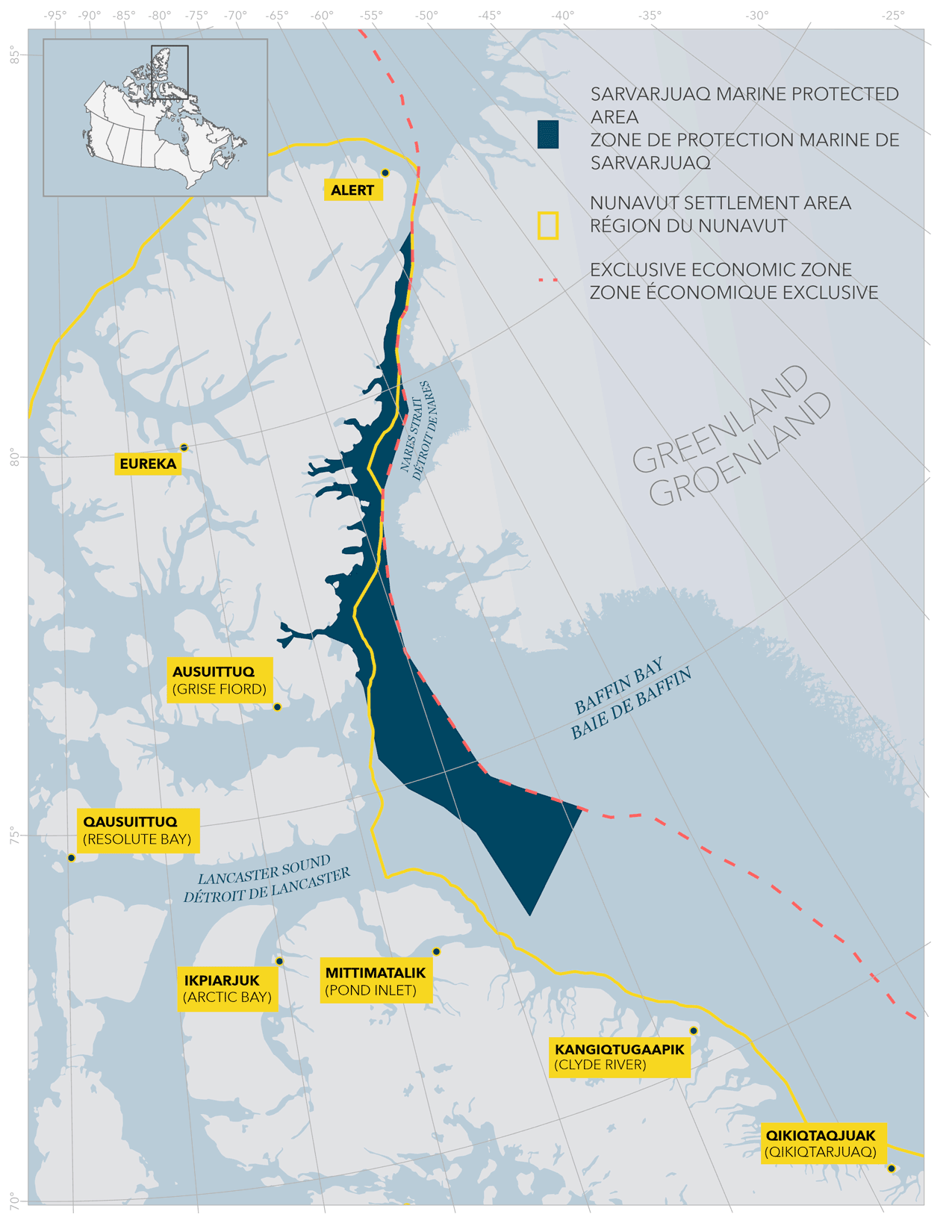
Map of Sarvarjuaq MPA
Location
Sarvarjuaq is on the Canadian side of the North Water Polynya, which is located in northern Baffin Bay, between Canada's Arctic Archipelago and Greenland. The polynya is also referred to as Pikialasorsuaq in Kalaallisut (West Greenlandic dialect) and is one of the largest recurring polynyas in the Arctic.
Size (km2) contribution to Marine Conservation Targets
About 73,700 km2
% coverage contribution to Marine Conservation Target
About 1.28%
Date of designation
March 2026
Objectives
- To support the conservation, protection and understanding of Sarvarjuaq (the North Water Polynya) and its unique biologically productive ecosystem that is of immense value to Inuit and Inuit culture.
- To support Inuit leadership in the conservation of Sarvarjuaq to ensure the continuity of Inuit culture, values and practices, including accumulating and passing down Inuit knowledge, as well as Inuit stewardship and governance.
Prohibitions
The Sarvarjuaq ministerial order MPA prohibits any human activity that is likely to disturb, damage, destroy or remove the following from within the designated boundaries of the MPA:
- any unique geological or archeological features
- any living marine organism
- any part of a marine organism’s habitat
These restrictions do not apply to certain activities, including:
- Inuit activities provided for in the Nunavut Agreement
- ongoing activities, meaning activities lawfully taking place within the year prior to designation, or activities that were otherwise authorized to occur by applicable federal, provincial or territorial laws
- exempted foreign activities
- marine scientific research
- activities carried out for purposes of national security, public safety or in response to an emergency
- national defence
The following classes of ongoing activities are also allowed to occur within the Sarvarjuaq MPA:
- hunting and trapping (including sport hunting)
- fishing (including sport fishing)
- harvesting of marine plants
- constructing, dismantling, maintaining, repairing and using temporary structures on sea ice
- marine navigation
- national defence activities carried out by the Department of National Defence
- Canadian Coast Guard activities carried out by the Canadian Coast Guard
- tourism activities
- recreational activities
- educational activities
- travelling over sea ice using motorized vehicles and non-motorized methods
- Inuit Qaujimajatuqangit and community-based research activities (including stewardship activities)
- scientific research activities
- filming and media content development
Environmental context
The North Water Polynya is an area of thin ice and open water surrounded by thicker pack ice, which returns on a periodic basis. Sea ice originating from the north, in Lincoln Sea, is pushed south through the narrow mountainous channels of Nares Strait by strong winds and currents. This sea ice gets forced into the narrowest choke points of the strait, most often just south of Kane Basin in Smith Sound, creating an ice bridge. The passage of sea ice is then blocked by the ice bridge(s), creating an area of open water (or very thin ice) in northern Baffin Bay.
Sarvarjuaq and the surrounding area have regionally unique physical features and is a hotspot for marine biodiversity. The polynya's open water provides a critical habitat for a diverse range of marine animals. The availability of open water in an otherwise icy environment allows for increased primary productivity. Sunlight can penetrate the water more deeply than through thick sea ice and support the growth of phytoplankton. Phytoplankton is the base of the marine food web. The polynya serves as a crucial feeding and breeding ground for many Arctic marine species, including:
- fish (such as Arctic char, Greenland halibut and others)
- seals (such as ringed seal, harbour seal and others)
- walrus (such as Atlantic walrus)
- whales (such as narwhals, belugas and bowheads)
- seabirds (such as dovekies, thick-billed murres, kittiwakes, common eiders and others)
Ecosystem
Marine mammals (whales, seals and walrus) use this region seasonally and some species will remain in the open waters throughout the winter months. Millions of seabirds arrive to the North Water Polynya in the spring and use the coastal-fiord regions surrounding the polynya for breeding, foraging and nesting. These animal species often migrate long distances to reach the polynya, highlighting its importance in their life cycles.
The North Water Polynya has changing oceanographic features, which includes sea ice and icebergs from glaciers in the region. Fresh water flows into the region, fed by the melting ice caps in Canada and Greenland.
The effects of climate change and increased meltwater on the North Water Polynya are uncertain. Recently, the ice bridges that support the formation of the polynya are becoming less stable and forming with less predictability. Further research is required to understand these changes. Like many other Arctic regions, the polynya is vulnerable to the effects of climate change, such as:
- shifts in ice cover
- altered ocean currents
- impacts on species that rely on it
Sarvarjuaq and the Pikialasorsuaq are both socially and culturally important. For millennia, this region has been home to some of the northern-most human settlements. The polynya has connected communities across Canada and Greenland and supported many of these settlements through:
- hunting grounds for food
- clothing and tool materials
- social networks formed by traveling through the region
- travel routes
It is important to understand and preserve this unique ecosystem for those who rely on the region and for global climate change research and conservation efforts.
Management and conservation
A ministerial order MPA is designated under the Oceans Act to protect areas in the short-term (up to five years) by freezing the footprint of activities that have occurred during the 12 months prior to establishment or that were otherwise authorized to occur by applicable federal laws or by laws of a province/territory. This means that activities already underway (or that were authorized) within that 12-month period may continue within the MPA, but no new activities are allowed. This also provides more time to develop our understanding of the ecosystem and community priorities for the region while ensuring no new impacts caused by human activities are introduced to the area. Most importantly, a ministerial order MPA provides more time to learn how Inuit want to conserve, protect and manage the area for the long-term.
Sarvarjuaq is located partially within the Nunavut Settlement Area. As required by the Nunavut Agreement, the Government of Canada and the Qikiqtani Inuit Association have negotiated an Inuit Impact and Benefit Agreement for the establishment of the Qikiqtait and Sarvarjuaq MPAs. As the responsible federal authority for the Sarvarjuaq MPA, Fisheries and Oceans Canada (DFO) has overall responsibility for ensuring compliance with and enforcement of, the ministerial order. Enforcement activities are undertaken through the Department’s legislated mandate and responsibilities under the Oceans Act, the Fisheries Act and other legislation applicable to:
- fisheries conservation
- environmental protection
- habitat protection
- marine safety
Enforcement officers designated by the Minister, pursuant to section 39 of the Oceans Act, will enforce the ministerial order for this area. Anyone contravening the order commits an offence and can be subject to the punishments listed in section 37 of the Oceans Act.
Conservation milestones
In 2013, the Inuit Circumpolar Council and Oceans North hosted a workshop called Pikialasorsuaq: Bridging the Bay. Inuit from Canadian and Greenlandic communities and researchers from both countries came together to discuss conservation. Following this workshop, the Pikialasorsuaq Commission was established to provide an informed Inuit vision for the future of this region.
Over the course of 2016, the Pikialasorsuaq Commission led a consultation tour to 11 communities in Canada and Greenland. This tour resulted in a report titled People of the Ice Bridge: The Future of the Pikialasorsuaq (PDF, 4.3MB), which recommended Inuit-led conservation and management to ensure the long-term health of this important ecosystem.
In September 2021, representatives from the Qikiqtani Inuit Association, the Government of Nunavut and the Government of Canada (represented by DFO, Environment and Climate Change Canada and Transport Canada) formed a working group to discuss potential approaches towards marine conservation for the Qikiqtait and Sarvarjuaq MPAs. The Working Group advanced the processes required to establish short-term protection of Qikiqtait and Sarvarjuaq.
In 2022, the Qikiqtani Inuit Association published the Regional Conservation Approach 2022 (PDF, 10.1 MB), which named Sarvarjuaq as a Marine Area for Conservation.
In December 2022, the Government of Canada announced up to $800 million to support up to four Indigenous-led conservation initiatives as part of the Project Finance for Permanence (PFP) conservation finance model. The Qikiqtani Region in Nunavut was selected as one of the four initiatives advancing a PFP due to its important ecological and cultural features. The SINAA Agreement, signed in 2025 by the Government of Canada, the Qikiqtani Inuit Association, The Pew Charitable Trusts, and the Aajuraq Conservation Fund Society advances Inuit-led conservation and self-determination by supporting Inuit stewardship and governance. The Sarvarjuaq MPA is an integral aspect of the SINAA Agreement.
Members of the Qikiqtait and Sarvarjuaq Working Group visited six communities to conduct consultations and seek feedback on the Sarvarjuaq MPA. Following these consultations support for the establishment of the MPA was given from all six communities’ Hunters and Trappers Associations and Hamlet Councils.
Research
In collaboration with international experts, academia and other government departments, DFO continues to conduct multidisciplinary research in Sarvarjuaq. Collaborative research programs collect physical, chemical and biological data from the water column to study the marine ecosystem and to better understand how climate change impacts species, habitats and the availability of marine resources for communities in the Arctic. These research programs include ship-based studies such as:
- those coordinated by Amundsen Science on board the Canadian Coast Guard Ship (CCGS) Amundsen
- aerial marine mammal surveys
- long-term observations from moorings programs or other monitoring programs
Contact us
DFO.ArcticMPC-ArctiquePCM.MPO@dfo-mpo.gc.ca
Publications
- Identification of ecological significance, knowledge gaps and stressors for the North Water and adjacent areas. CSAS 2021/052.
- Proceedings of the regional peer review on the biophysical and ecological overview of the North Water polynya and adjacent areas. CSAS 2021/011.
- People of the Ice Bridge: The Future of the Pikialasorsuaq (PDF, 4,3KB).
- Ecologically and biologically significant areas in Canada's Eastern Arctic Biogeographic Region, 2015 / Canadian Science Advisory Secretariat - Catalogue - Federal Science Libraries Network. CSAS 2015/049.
- Identification of ecologically and biologically significant areas (ESBAs) in the Canadian Arctic/ Donald G. Cobb - Catalogue - Federal Science Libraries Network. CSAS 2011/055.
Related information
Page details
- Date modified: