
Qikiqtait Marine Protected Area (MPA)
Note:
Charts, diagrams and contact information on this website are provided for information purposes only and should not be used for fishing, navigation or other purposes. Please refer to the MPA Regulations or contact your regional Fisheries and Oceans Canada office for official coordinates.
Meaning of MPA name
Qikiqtait is the Inuktitut name Sanikiluarmiut (people of Sanikiluaq) give to this region, referencing the Belcher Islands Archipelago that define the area.
On this page
- At-a-glance
- Ecosystem
- Management and conservation
- Research
- Contact us
- Publications
- Related information
At-a-glance
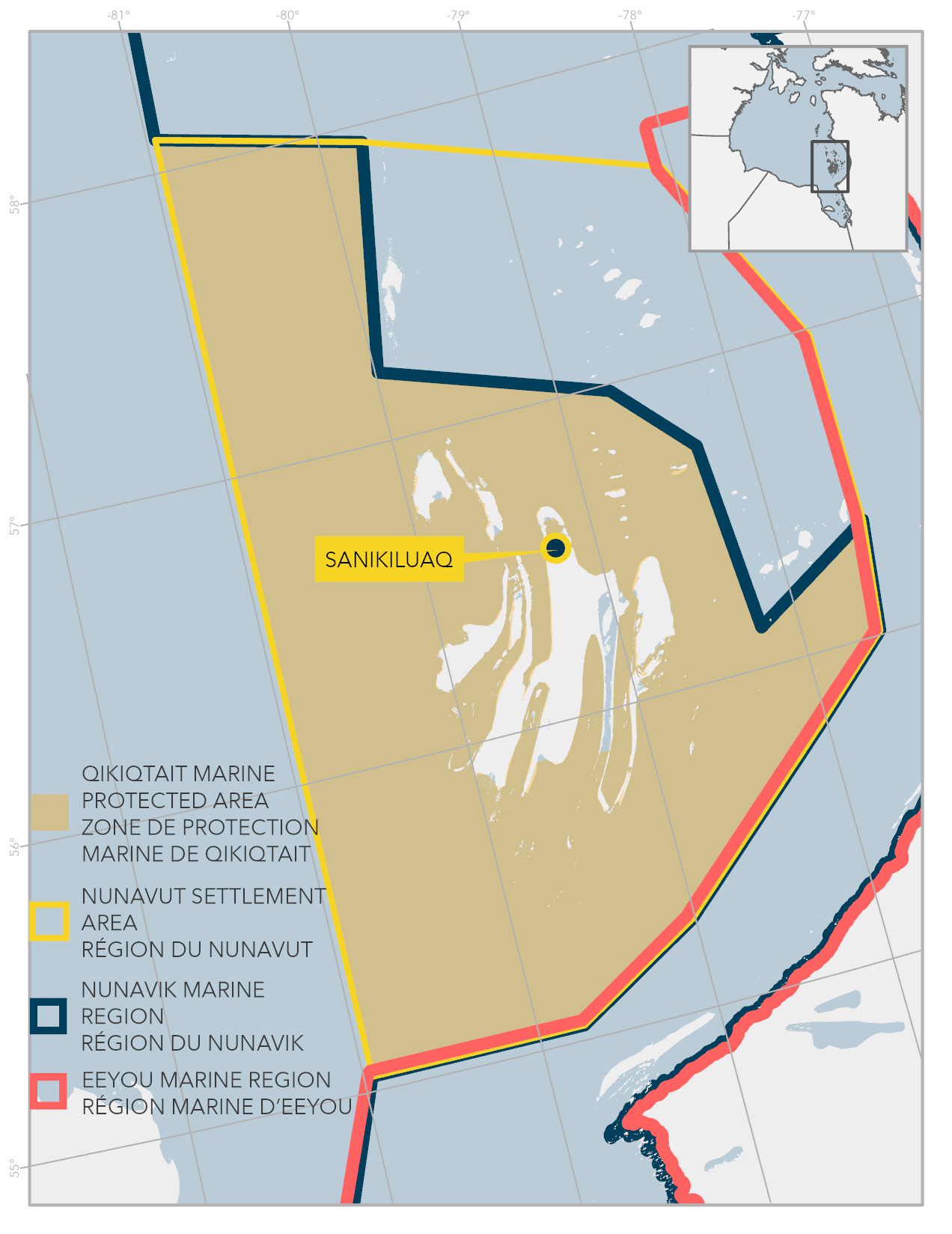
Map of Qikiqtait MPA
Location
Qikiqtait covers the waters surrounding the Belcher Islands of southeastern Hudson Bay. The entire boundary of the Qikiqtait ministerial order MPA falls within the Nunavut Settlement Area (NSA). The boundaries of Qikiqtait are adjacent to the community of Sanikiluaq. Sanikiluaq is the most southern community within the Qikiqtani region of Nunavut, Canada.
Size (km2) contribution to Marine Conservation Targets
About 42,700 km2
% coverage contribution to Marine Conservation Target
About 0.74%
Date of designation
March 2026
Objectives
- To support the conservation, protection and understanding of Qikiqtait and its unique biologically productive ecosystem that is of immense value to Inuit and Inuit culture.
- To support Inuit leadership in the conservation of Qikiqtait to ensure the continuity of Inuit culture, values and practices, including accumulating and passing down Inuit knowledge, as well as Inuit stewardship and governance.
Prohibitions
The Qikiqtait Ministerial Order MPA prohibits any human activity that is likely to disturb, damage, destroy or remove the following from within the designated boundaries of the MPA:
- any unique geological or archeological features
- any living marine organism
- any part of a marine organism’s habitat
These restrictions do not apply to certain activities, including:
- Inuit activities provided for in the Nunavut Agreement and the Nunavik Agreement
- ongoing activities, meaning activities lawfully taking place within the year prior to designation, or activities that were otherwise authorized to occur by applicable federal, provincial or territorial laws
- marine scientific research
- activities carried out for purposes of national security, public safety or in response to an emergency
- national defence
The following classes of ongoing activities are also allowed to occur within the Qikiqtait MPA:
- hunting and trapping (including sport hunting)
- fishing (including sport fishing)
- harvesting of marine plants
- constructing, dismantling, maintaining, repairing and using temporary structures on sea ice
- marine navigation
- national defence activities carried out by the Department of National Defence
- Canadian Coast Guard activities carried out by the Canadian Coast Guard
- tourism activities
- recreational activities
- educational activities
- travelling over sea ice using motorized vehicles and non-motorized methods
- Inuit Qaujimajatuqangit and community-based research activities (including stewardship activities)
- scientific research activities
- filming and media content development
Environmental context
This culturally and historically significant marine area is considered globally, nationally and regionally unique due to the presence of a recurrent polynya system and a diverse array of marine species, such as:
- migratory birds
- marine mammals
- important bottom-dwelling invertebrates
A polynya is an area of thin ice and open water surrounded by thicker pack ice, which returns on a periodic basis. Qikiqtait is an area of particular ecological importance due to the presence of up to 35 recurrent polynyas. The presence of a recurrent biologically important polynya system occurring during the winter months ensures that Inuit always have a place to fish and hunt year-round. Source: A Regional Conservation Approach 2022 (PDF, 10,3 MB)
These polynyas are key habitats for polar bears, sea birds, seals, beluga and Atlantic walrus populations and are vital for feeding during winter when other areas are frozen over.
Ecosystem
The waters in Qikiqtait are nutrient-rich and can sustain marine mammals while feeding and calving, with a large influx of nutrient-filled water from nearby river plumes and estuaries. Qikiqtait has some of the coldest summer sea-surface temperatures in coastal Hudson Bay south of Southampton Island. This temperature difference promotes strong vertical mixing of the water column, which sustains high primary productivity.
Arctic temperatures are rising faster than the global average and the marine environment surrounding Qikiqtait is entering a new state where the open water season is greatly increasing in duration. Effective protection of areas supporting unique Arctic biodiversity, such as the one found in the Qikiqtait MPA, will maximize the resilience of Arctic ecosystems and help maintain critical habitat for a number of important species, such as:
- common eider
- migratory Arctic char
- Atlantic walrus
- bearded seal
- beluga whale
- polar bear
- ringed seal
- benthic invertebrates
The Hudson Bay subspecies of Common Eiders (S.m. sedentaria) are known to almost exclusively breed, forage and overwinter within the Qikiqtait MPA, making them unique to the area. Within the community of Sanikiluaq, a large sustainably-managed fall harvest of Common Eiders provides community members with eider down which is used to insulate hand-made clothing.
The seafloor of the Qikiqtait MPA supports a diverse benthic community, heavily influenced by river runoff and seasonal ice cover. The polynyas in the Belcher Islands have amongst the highest abundance and biodiversity in the Hudson Bay Complex (Pierrejean et al., 2020) particularly for scallops, sea urchins and sea cucumbers.
Management and conservation
A ministerial order MPA is designated under the Oceans Act to protect areas in the short-term (up to five years) by freezing the footprint of activities that have occurred during the 12 months prior to establishment or that were otherwise authorized to occur by applicable federal laws or by laws of a province/territory. This means that activities already underway (or that were authorized) within that 12-month period may continue within the MPA, but no new activities are allowed. This also provides more time to develop our understanding of the ecosystem and community priorities for the region while ensuring no new impacts caused by human activities are introduced to the area. Most importantly, a ministerial order MPA provides more time to learn how Inuit want to conserve, protect and manage the area for the long-term.
Qikiqtait is located within the Nunavut Settlement Area. As required by the Nunavut Agreement, the Government of Canada and the Qikiqtani Inuit Association have negotiated an Inuit Impact and Benefit Agreement for the establishment of the Qikiqtait and Sarvarjuaq MPAs. As the responsible federal authority for the Qikiqtait MPA, Fisheries and Oceans Canada (DFO) has overall responsibility for ensuring compliance with and enforcement of, the ministerial order. Enforcement activities are undertaken through the Department’s legislated mandate and responsibilities under the Oceans Act, the Fisheries Act and other legislation applicable to:
- fisheries conservation
- environmental protection
- habitat protection
- marine safety
Enforcement officers designated by the Minister, pursuant to section 39 of the Oceans Act, will enforce the ministerial order for this area. Anyone contravening the order commits an offence and can be subject to the punishments listed in section 37 of the Oceans Act.
Conservation milestones
Sanikiluaq is the only Nunavut community adjacent to the Qikiqtait MPA. In 2019, the community of Sanikiluaq established the Sanikiluaq Qikiqtait Steering Committee. The committee’s primary focus is to develop marine and terrestrial environmental protection in the region.
In September 2021, representatives from the Qikiqtani Inuit Association, the Government of Nunavut and the Government of Canada (represented by DFO, Environment and Climate Change Canada and Transport Canada) formed a working group to discuss potential approaches towards marine conservation for the Qikiqtait and Sarvarjuaq MPAs. The Working Group advanced the processes required to establish short-term protection of Qikiqtait and Sarvarjuaq.
In 2022, the Qikiqtani Inuit Association published A Regional Conservation Approach 2022 (PDF, 10.3 MB), which named Qikiqtait as a Marine Area for Conservation.
In December 2022, the Government of Canada announced up to $800 million to support up to four Indigenous-led conservation initiatives as part of the Project Finance for Permanence (PFP) conservation finance model. The Qikiqtani Region in Nunavut was selected as one of the four initiatives advancing a PFP due to its important ecological and cultural features. The SINAA Agreement, signed in 2025 by the Government of Canada, the Qikiqtani Inuit Association, The Pew Charitable Trusts, and the Aajuraq Conservation Fund Society advances Inuit-led conservation and self-determination by supporting Inuit stewardship and governance. The Qikiqtait MPA is an integral aspect of the SINAA Agreement.
Members of the Qikiqtait and Sarvarjuaq Working Group visited Sanikiluaq in October 2023 and April 2024 to conduct consultations and seek feedback on the Qikiqtait MPA. Following these consultations support for the establishment of the MPA was given from the Sanikiluaq Qikiqtait Steering Committee, the Sanikiluaq Hunters and Trappers Association and the Sanikiluaq Hamlet Council.
Research
In collaboration with international experts, academia and other government departments, DFO continues to conduct multidisciplinary research in Canada’s Arctic. For example, DFO researchers study the benthic organisms in Qikiqtait and how they are impacted by environmental factors such as:
- sea bottom type
- primary production
- oceanographic parameters
SIKU, an Indigenous Knowledge App, was developed by the Arctic Eider Society and Sanikiluaq community members to help monitor changes in the environment. This innovative approach is used by the community of Sanikiluaq along with Inuit organizations and researchers to better understand the distribution and abundance of important species such as sea cucumbers, mussels and scallops.
Contact us
DFO.ArcticMPC-ArctiquePCM.MPO@dfo-mpo.gc.ca
Publications
- Biophysical and ecological overview summary of the Qikiqtait study area and adjacent waters (2023)
- Arctic climate and ecosystem linkages: impacts and feedback (Chapter 6) (2021)
- Spatial distribution of epifaunal communities in the Hudson Bay system: Patterns and drivers
- Nunavut Land Claims Agreement Act
- McDonald, M., L. Arragutainaq and Z. Novalinga. 1997. Voices from the Bay: traditional ecological knowledge of Inuit and Cree in the Hudson Bay bioregion. Canadian Arctic Resources Committee; Environmental Committee of Municipality of Sanikiluaq, Ottawa, ON. xiii + 98 p.
Related information
Page details
- Date modified: