
Spiny Water Flea
Bythotrephes longimanus
Report it
If you think you have found an aquatic invasive species:
- take photos
- note:
- the exact location (GPS coordinates)
- the observation date
- identifying features
- contact us to report it
Learn about the Spiny Water Flea, including its identifying features, distribution, habitat, spread, similar species, impacts and our response.
On this page
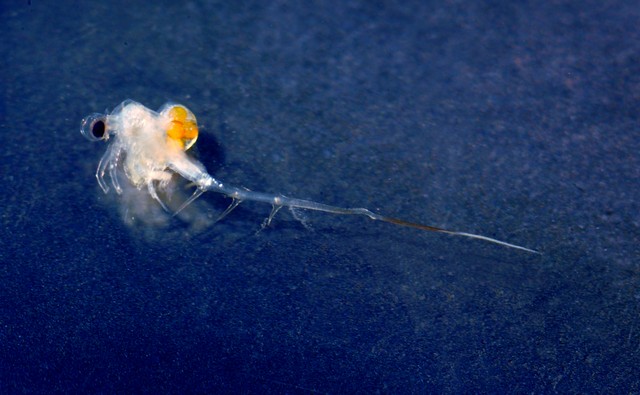
Spiny Water Flea (Photo credit : Michigan Sea Grant)
Identifying features
- between 1 cm to 1.5 cm long
- tail is dotted with spines and makes up more than 50% of the total length
- females have a balloon-shaped bag containing the eggs on their back
If you think you have seen Spiny Water Flea, report it.
Where is the species invasive
The Spiny Water Flea was introduced to North America via ballast water released from commercial shipping vessels. The Spiny Water Flea was found for the first time in Lake Ontario in 1982. It dispersed in the interior waters of Northeast America, including the five Great Lakes, more than 100 inland waterbodies in Ontario, the St. Lawrence River, Lake Champlain and, since 2019, the Richelieu River. The Spiny Water Flea was first found in the Manitoban portion of the Winnipeg River in 2009 and can now be found in Lake Winnipeg and some connected waterways (Cedar Lake, Manitoba). It is also found in Lake Témiscamingue in Québec. It was reported in Lake McConnell area in the Ottawa River in 2021.
Distribution
The Spiny Water Flea is native to the region of the North Sea and to central Europe and Asia.
Habitat
The Spiny Water Flea lives in all types of water bodies (fresh and salt waters). Although it prefers large and deep lakes with temperate and well-oxygenated waters, it can also be found in less oxygenated waters rich in organic matter.
Similar species
The Spiny Water Flea looks similar to another invasive species, the Fishhook Water Flea, and some native water flea species, such as Daphnia. However, the drop shaped body of Daphnia only measures up to 0.5 cm and it has a very short tail, accounting for only a quarter of the total length.
Daphnia longispina
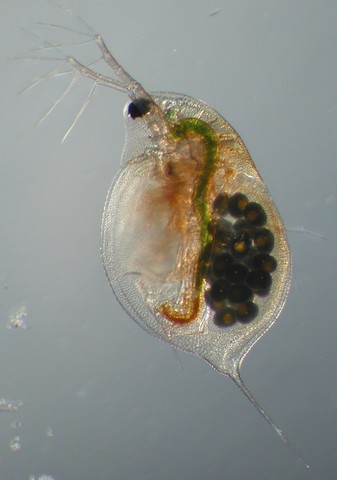
Photo credit: Dieter Ebert Basel Switzerland
Spiny Water Flea (bottom) and Fishhook Water Flea (top)
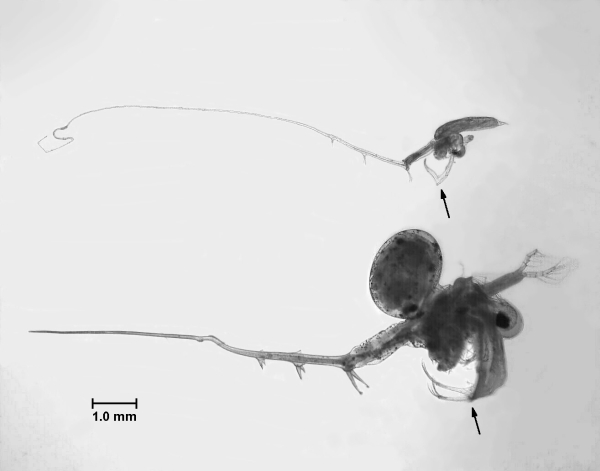
Photo credit: National Oceanic and Atmospheric Administration, Great Lakes Environmental Research Laboratory
Impacts
Ecological impacts
The Spiny Water Flea reproduces quickly and has few predators as its long thorny tail is a rather effective deterrent. It preys on zooplankton such as native Daphnia. Despite its small size, it can significantly modify zooplankton communities, not only reducing their richness, abundance and biomass, but also causing the disappearance of some species. By attacking herbivorous zooplankton and causing their concentration to drop, it can alter the balance between phytoplankton and herbivorous zooplankton. This situation can promote an overproduction of microscopic algae and cause eutrophication (enrichment) of the water body.
The Spiny Water Flea can have a negative effect on the survival of native fish that feed on zooplankton. The spines on the tail of the Spiny Water Flea can injure small fish and juveniles when ingested. Fish are then unable to feed adequately, thus affecting their growth and survival.
Socio-economics impacts
The Spiny Water Flea can affect recreational, Indigenous and commercial fisheries by fouling fishing lines and nets, and impacting fish populations.
Response
The Identification Booklet of Freshwater Invasive Species in Quebec from DFO is available to make the detection of the Spiny Water Flea easier.
There is currently no effective way to eradicate the Spiny Water Flea. Prevention remains the best way to prevent its spread into new areas. Eggs, juveniles or adults of this species may be found on equipment and boats that have been used in water bodies in which this AIS is present. The best way to protect water bodies from this invader is to properly clean, drain and dry boats and other equipment used in nautical activities and recreational fishing. Follow the clean-up steps described on the DFO Aquatic Invasive Species Prevention page. Always check and follow your provincial laws when planning to move water-based craft and equipment.
Photo gallery
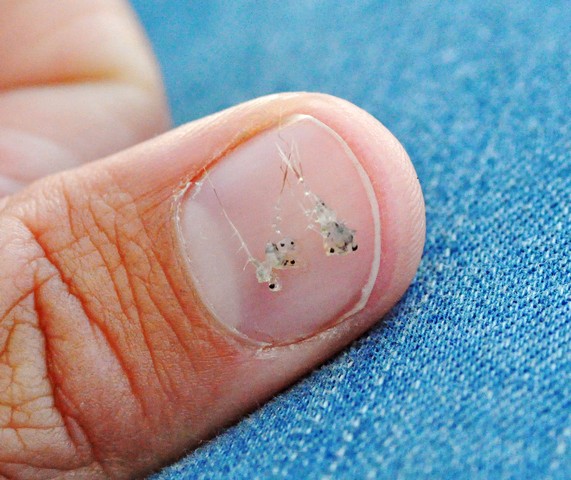
Spiny Water Fleas (Photo credit : Emily DeBolt)
Related links
- Spiny Water Flea and Fishhook Water Flea identification photos and characteristics
- Science Advice on “Clean, Drain, Dry and Decontaminate” treatments and protocols to prevent the introduction and spread of aquatic invasive species (PDF, 632 KB)
- Research Document “Clean, Drain, Dry, and Decontaminate” treatments and protocols to prevent the introduction and spread of aquatic invasive species
- Date modified: