
Rusty Crayfish
Faxonius rusticus
Report it
If you think you have found an aquatic invasive species:
- take photos
- note:
- the exact location (GPS coordinates)
- the observation date
- identifying features
- contact us to report it
Learn about the Rusty Crayfish, including their identifying features, distribution, habitat, spread, similar species, impacts and our response.
On this page
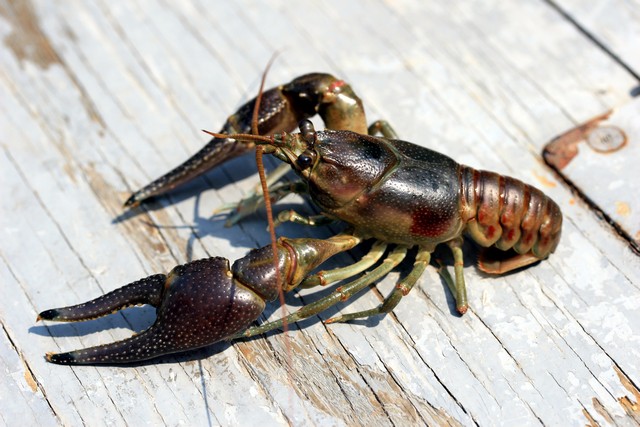
Rusty Crayfish (Photo credit: Doug Watkinson, Fisheries and Oceans Canada)
The Rusty Crayfish is a freshwater crustacean that resembles a small lobster and belongs to the order Decapoda (ten legs).
Identifying features
- between 7.5 to 13 cm long
- black bands at the tips of the claws and oval gap when closed
- rust coloured patches on each side of the shell (near the tail)
- colour of the shell varies between a grey-blue and a dark brown-greenish
If you think you have seen a Rusty Crayfish, report it.
Where is the species invasive
The Rusty Crayfish is believed to have been spread by either live-bait for recreational fishing or the aquarium industry. It was first observed in Ontario in the early 1960s and can now be found in many of the province's southcentral and southeastern waters (Kawartha Lakes Basin). In Quebec, it was only present in the Outaouais region up to the early 2000s. It has since been observed in Montérégie. The Rusty Crayfish was first observed in the Manitoban portion of Lake of the Woods in 2021.
Distribution
The Rusty Crayfish is native to the Ohio River basin in the United States.
Habitat
Due to its ability to adapt to weak or strong currents, the Rusty Crayfish can live in ponds, streams, and lakes as well as in rivers, on bottoms strewn with rocks, gravel and objects that provide shelter. It can also be seen on sandy or loamy bottoms and in areas covered with aquatic plants. This species can tolerate a wide range of water temperature (0°C to 39°C).
Similar species
Several species of crayfish look alike, making it is easy to confuse the Rusty Crayfish with native crayfish species. The two native species it resembles are: the Virile Crayfish (Faxonius virilis) and the Northern Clearwater Crayfish (Faxonius propinquus). Besides the rusty patches on its body, the Rusty Crayfish is larger than the others and its claws have black tips.
Virile Crayfish
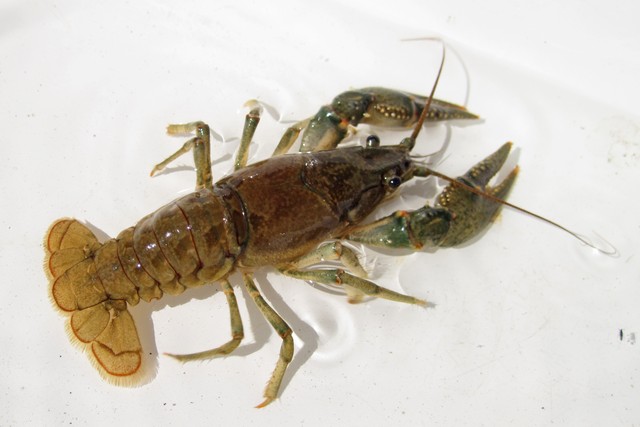
Photo credit: Larry Clarfeld
Impacts
Ecological impacts
The Rusty Crayfish is a very aggressive species that reduces native biodiversity in the aquatic environments where it becomes established. It out competes native crayfish species and fish species, by feeding on clams, snails, small crustaceans, aquatic insects, leeches, and fish eggs. It also affects them by consuming and reducing the abundance of aquatic plants that serve as invertebrate habitats and refuges for fish.
Introducing a single female carrying eggs into a suitable environment may result in a new population. Also, the possibility of hybridization between the Rusty Crayfish and the Northern Clearwater Crayfish poses an additional threat to native species.
Socio-economics impacts
By helping to decrease the abundance of fish populations, the Rusty Crayfish has the potential to affect the recreational, Indigenous and commercial fisheries.
Response
The Identification Booklet of Freshwater Invasive Species in Quebec from DFO is available to make the detection of the Rusty Crayfish easier.
Like numerous aquatic invasive species, preventing its accidental or intentional release remains the best way to stop its spread in the environment. Rusty Crayfish are usually released in the environment because they are used as fish-bait or found in live-wells. Don't let it loose and follow the steps described on the DFO Aquatic Invasive Species Prevention page.
Photo gallery

Rusty Crayfish - rusty patches on each side of the shell (Photo credit: Doug Watkinson, Fisheries and Oceans Canada)
Related links
- Rusty crayfish identification photos and characteristics
- Science Advice on the Potential of Introducing Live Organisms by the Aquarium, Water Garden, and Live Food Trades in Canada (PDF, 1192 KB)
- Date modified: