
Marbled Crayfish
Procambarus virginalis
Report it
If you think you have found an aquatic invasive species:
- take photos
- note:
- the exact location (GPS coordinates)
- the observation date
- identifying features
- contact us to report it
Learn about the Marbled Crayfish, including their identifying features, distribution, habitat, spread, similar species, impacts and our response.
On this page
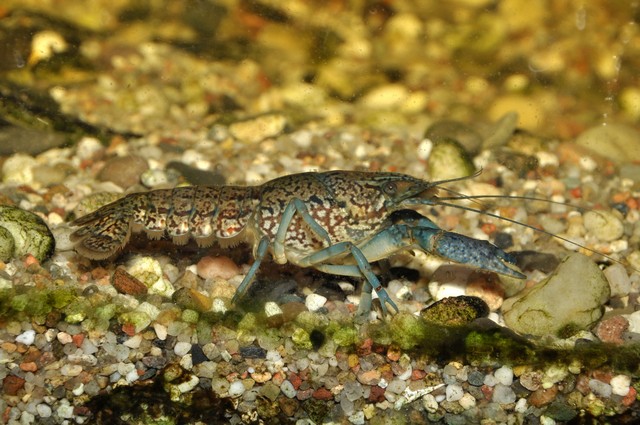
Marbled Crayfish (Photo credit: Klaus Rudloff)
The Marbled Crayfish, also known as Marmorkreb, is a freshwater crustacean that resembles a small lobster. It belongs to the order Decapoda (10 legs).
Identifying features
- usually less than 10 cm, can be up to 13 cm long
- narrow pincers, like claws
- brown or green mottling on the shell, darker on wild individuals and lighter on captive individuals
If you think you have seen a Marbled Crayfish, report it.
Where is the species invasive
Its existence was first reported in 1995 by a German aquarium hobbyist, it was introduced deliberately to Madagascar for food. It is now found in several European countries and Japan. Although wild Marbled Crayfish have not yet been observed in North America, the species is considered to be high-risk for introduction due to it being sold online as food, live bait and in the aquarium trade.
Distribution
The Marbled Crayfish is thought to have originated from captive breeding. Therefore, it is not indigenous to any territory.
Habitat
Due to its ability to adapt to weak or strong currents, the Marbled Crayfish can live in ponds, streams, and lakes as well as in rivers. Optimal water temperature for this species is around 20°C, but the species has now adapted to the cooler waters of temperate zones. During a drought, it also can survive out of water for up to three days.
Similar species
It is easy to confuse the Marbled Crayfish with native crayfish species such as the Spinycheek Crayfish (Faxonius limosus), and the Calico Crayfish (Faxonius immunis), native to Ontario, but introduced elsewhere in Canada. However, the mottling on the carapace is unique to the Marbled Crayfish and can be used to differentiate it from native crayfish species.
Spinycheek Crayfish
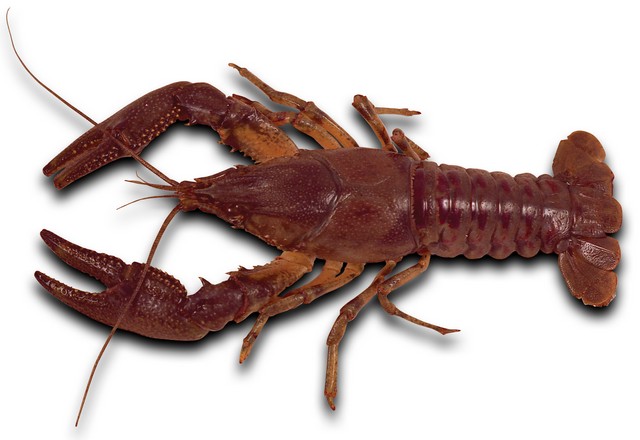
Photo credit: Ministère de l'Agriculture, des Pêcheries et de l'Alimentation du Québec
Impacts
Ecological impacts
The Marbled Crayfish is a species that disrupts the ecological balance of the aquatic environments into which it is introduced. Omnivorous, it feeds on plants and plant debris, algae, invertebrates, and small fishes. It competes with native crayfish species and may reduce their numbers or extirpate native species. This species can impact native fish populations by reducing their food supply and disturbing substrates that provide invertebrate habitat and fish refugia.
The Marbled Crayfish also has the ability to clone itself by parthenogenesis (division of an unfertilized female gamete). Since the species can asexually reproduce in this way, the introduction of a single female into a body of water can establish a new population.
Socio-economics impacts
By decreasing the abundance of fish populations, the Marbled Crayfish has the potential to affect recreational, Indigenous and commercial fisheries.
Response
The Identification Booklet of Freshwater Invasive Species in Quebec from DFO is available to make the detection of the Marbled Crayfish easier.
Both in Europe and North America, the Marbled Crayfish is the most common crayfish in the aquarium trade. Its mode of reproduction by parthenogenesis implies that aquarists will sooner or later have to deal with an increasing number of crayfish. It is essential that aquarium owners do not release these specimens and any other aquarium pets or plants into the natural environment or into public sewer systems. Prevention and education remain the best way to stop the spread of this species. Don't let it loose and follow the steps described on the DFO Aquatic Invasive Species Prevention page.
Photo gallery
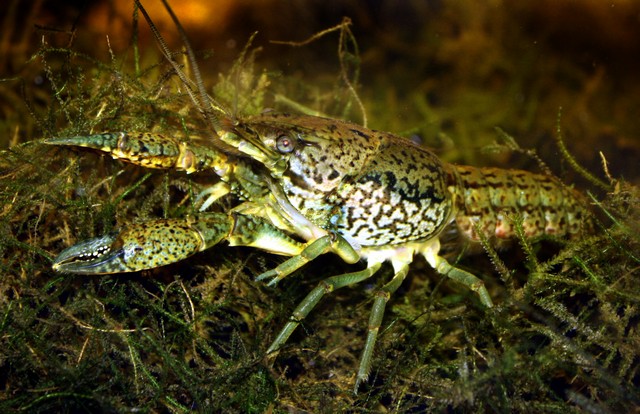
Marbled Crayfish (Photo credit: C. Chucholl)
Related links
- Marbled crayfish identification photos and characteristics
- Science Advice on the Potential of Introducing Live Organisms by the Aquarium, Water Garden, and Live Food Trades in Canada (PDF, 1192 KB)
- Date modified: