
Corals and sponges, Scotian Shelf-Bay of Fundy
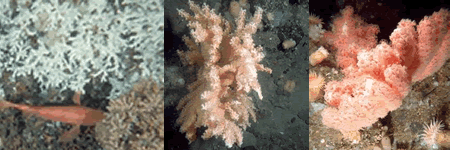
Cold-water (deep-sea) corals have attracted significant scientific and conservation interest in recent years. Over 50 coral species live in waters off Atlantic Canada, most of them in depths of 150 metres and greater. Several of these species are long-lived, grow to a large size (> 1 m) and can form dense concentrations while at least one can form reefs. These large, habitat-forming species are generally found along the edge of the continental shelf and in deeper channels and canyons.
Scientists and the fishing industry have known about the occurrence of cold-water corals in Atlantic Canada for many decades. Government and university scientists have conducted visual surveys and collected specimens in several areas of the Scotian Shelf in several priority areas for research. Coral concentrations have been confirmed and include areas such as the Northeast Channel Marine Refuge, the Gully Marine Protected Area, Corsair and Georges Canyons Marine Refuge and Eastern Canyons Marine Refuge. Scientific studies are ongoing and there are likely other areas of importance in Atlantic Canada.
On Canada’s Atlantic coast, over 140 species of sponge have been identified, including a new species of carnivorous sponge that was discovered by DFO scientists near the Grand Banks. They can be found in shallower depths throughout the inter-tidal zone and globally, can be found as deep as 8 kilometres. Species such as Vazella pourtalesii form complex, three-dimensional biogenic structures on the sea floor that are believed to directly and indirectly influence the occurrence and abundance of other invertebrates and fish. Generally speaking, sponge-dominated communities modify bottom currents and create habitat. Fish use them for feeding, reproduction and resting. Sponges also filter vast amounts of water on a daily basis and serve broader roles in energy flow linking pelagic and benthic systems. Much of the historic information on the distribution of sponges in Atlantic Canada has been collected by fishery observers on-board commercial fishing vessels and by the annual DFO multispecies research vessel surveys. Remotely Operated Vehicles (ROVs), as well as drop and tow cameras, have helped to identify sponge communities on the Scotian Shelf. Some of the organisms commonly associated with sponge grounds include several species of marine worms, rockfish, crab, shrimp and prawns.
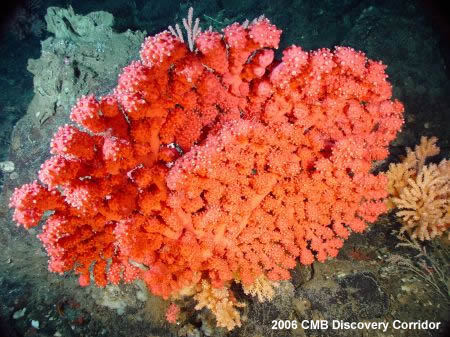
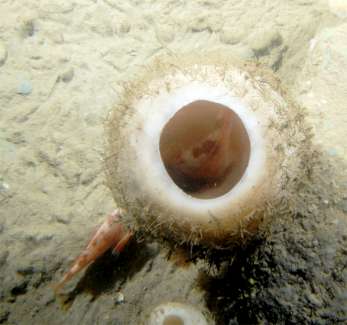

Fisheries and Oceans Canada (DFO) has implemented conservation measures to protect coral and sponge habitats. In 2002 and 2004, DFO established fisheries closures in two areas to protect high concentrations and rare occurrences of corals; the Northeast Channel Marine Refuge and the Lophelia Coral Conservation Area which has now been absorbed by the Eastern Canyons Marine Refuge. Later in 2013, Emerald Basin and Sambro Bank Marine Refuge were established to protect sponge concentrations. Corsair and Georges Canyons Marine Refuge and Jordan Basin Marine Refuge were established in 2016, followed by the establishment of Eastern Canyons Marine Refuge in 2022 to protect coral concentrations. The Gully Marine Protected Area, established in 2004, protects a submarine canyon with a high diversity of corals. Fundian Channel-Browns Bank Area of Interest includes areas of importance to both corals and sponges.
The conservation and protection of corals and sponges and their habitats is a key component of meeting integrated management objectives. In 2015, the Coral and Sponge Conservation Strategy for Eastern Canada was prepared to provide a long-term strategy for protecting and understanding these important benthic habitats. The Coral and Sponge Strategy is currently in the process of being updated and will help guide future conservation and research for these species throughout Eastern Canadian waters.
Scientists wishing to conduct research in marine refuges and Marine Protected Areas (MPAs) are encouraged to contact Marine Planning and Conservation to request an application (Marine Refuges - DFO.MARRefuges.MPO@dfo-mpo.gc.ca / MPAs - DFO.MaritimesMPAs-ZPMMaritimes.MPO@dfo-mpo.gc.ca).
Related information
- Biological Characteristics and Ecological Functions Served by Corals, Sponges and Hydrothermal Vents (PDF, 263 KB)
- Climate-Change Refugia for Bubblegum Coral in the Northwest Atlantic
- Predicted distribution of Vazella pourtalesii on the Scotian Shelf and it’s persistence in the face of climate variability
- Glass sponge grounds on the Scotian Shelf and their associated biodiversity
- OECMs promote recovery in a cold-water coral reef
- Exploring Atlantic Canyons and Seamounts of the United States and Canada
- 2015 Eastern Canadian Coral and Sponge Conservation Strategy
- Coral and Sponge Conservation Measures in the Maritimes
- A review of carnivorous sponges (Porifera: Cladorhizidae) from the Boreal North Atlantic
- Date modified: