
Goldfish, Grass Carp and Green Sunfish

Table of contents:
- Aquatic invaders
- Pathways of invasion
- Threats to the environment, the economy and society
- Focus on an invader
- What you can do
Aquatic invasive species in Quebec
- Crustaceans
- Molluscs
- Fish
Goldfish
(Carassius auratus)
Photo credit: Dat doris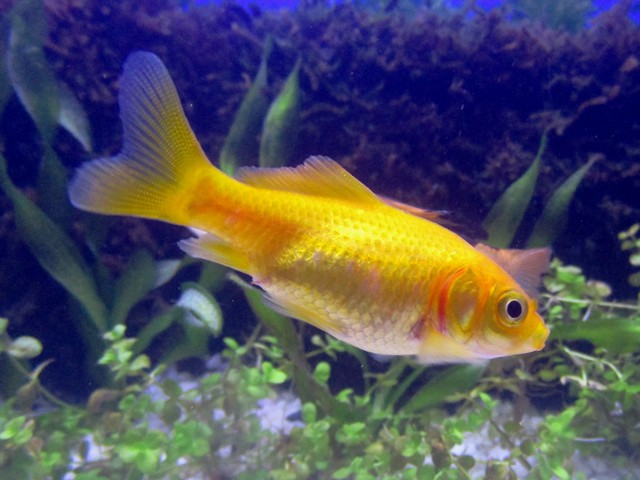
Characteristics
- between 13 cm and 25 cm, up to 50 cm
- small mouth, no barbels
- caudal fin (tail) forked
- long dorsal fin (2/3 of the body)
- colour may vary from gold to olive green in wild populations
Photo credit: Ontario Freshwater Fishes Life History Database, R. J. Eakins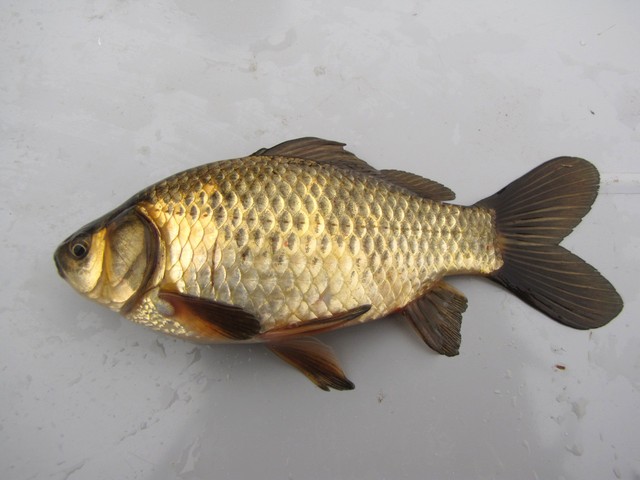
Origin
Goldfish is native to central and eastern Asia. This fish arrived in Quebec at the end of the 19th century for the aquarium trade and the ornamentation of water gardens. It ended up in the waterways following the accidental or intentional release of aquarium fish.
Habitat
In the wild, Goldfish is found in ponds, rivers, and lakes where the current is weak, and there is plenty of aquatic vegetation. It tolerates turbid waters (containing suspended matter), with low oxygen concentrations. It has adapted to harsh climates and cold waters by hiding in the mud and reducing its energy consumption to survive Canadian winters.
Similar species
Goldfish are very similar to Common Carp (Cyprinus carpio). However, Common Carp have a pair of barbels on each side of their mouth and can be from 45 cm to 100 cm. Goldfish can also look like Koi Fish, an ornamental variety of carp with different colours and patterns (gold, orange, silver, white and black). However, Koi Fish have a pair of barbels at the corner of their mouth, their body is more elongated than Goldfish or Common Carp and they range in size from 30 cm to 120 cm.
Koi Fish
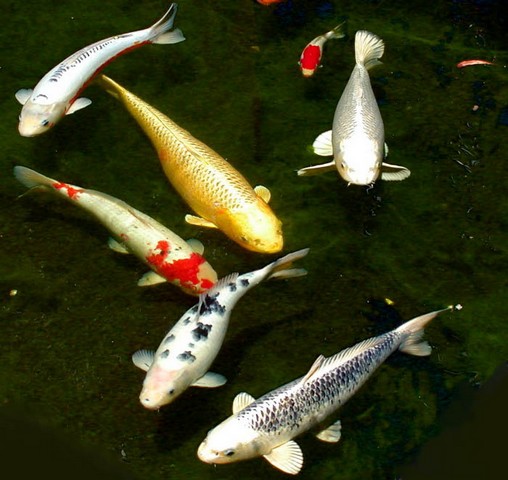
Photo credit: Stan Shebs
Common Carp
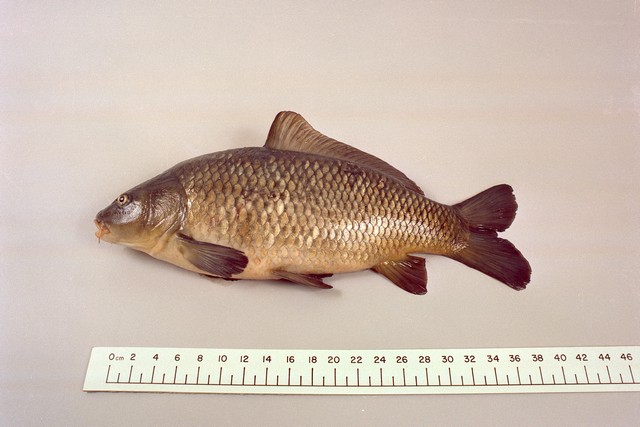
Photo credit: Ministère de l'Agriculture, des Pêcheries et de l'Alimentation du Québec
Grass Carp
(Ctenopharyngodon idella)
Photo credit: Ryan Hagerty, U.S. Fish and Wildlife Service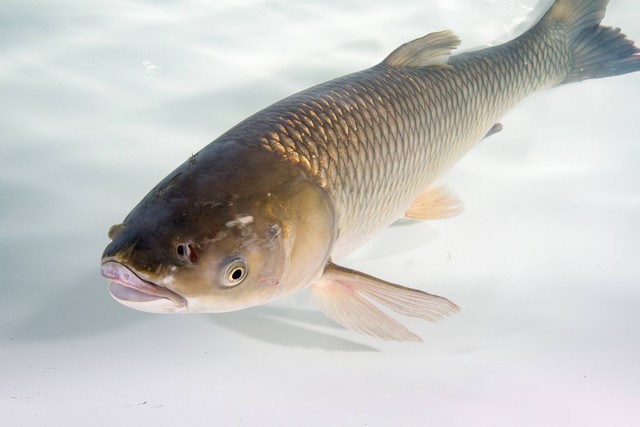
Characteristics
- between 50 cm and 90 cm, can be up to 130 cm
- short head, no barbels
- dorsal fin short and rounded
- long and slender body, covered with large scales with dark edges, making a crosshatched appearance
- dark grey back, white to yellow sides with a slightly golden shine, blending to white towards the belly
Photo credit: Dan O'Keefe, Michigan Sea Grant 
Origin
Grass Carp is native to rivers stretching from southern Russia to northern Vietnam. It is one of four invasive carp species introduced to North America in the 1960s and 1970s. Intentional releases, and their escape from aquaculture centers as well as live fish markets, have resulted in them being found in rivers of the northeastern United States. In Canada, Grass Carp was first captured in Lake Erie in 1985. In Quebec, a few reports have been recorded in the St. Lawrence and Richelieu rivers since 2016.
Habitat
Grass Carp prefers large bodies of water where currents are weak and where the bottom is covered with grass beds, which are food for adults. It can typically be found near shorelines in depths of 3 m or less. It tolerates a wide range of water temperatures (0°C to 38°C) as well as low oxygen concentrations.
Similar species
Grass Carp resembles several species found in Canadian waters, including Fallfish (Semotilus corporalis), Common Carp (Cyprinus carpio) and a species at risk, Copper Redhorse (Moxostoma hubbsi). Fallfish differ in size with Grass Carp, ranging from 15 cm to 30 cm. Common Carp have a pair of barbels near the mouth and a long dorsal fin. Copper Redhorse have a sucker-shaped mouth with fleshy lips, a trait unique to redhorses and suckers, a group of fish often misidentified as carp.
Fallfish
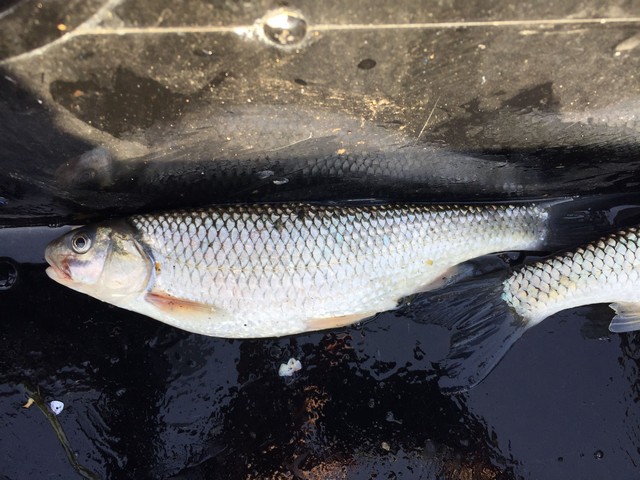 Photo credit: Marc Bourret
Copper Redhorse
 Photo credit: N. Vachon Ministère des Forêts, de la Faune et des Parcs du Québec
Green Sunfish
(Lepomis cyanellus)
Photo credit: S. Normand, Ministère des Forêts, de la Faune et des Parcs du Québec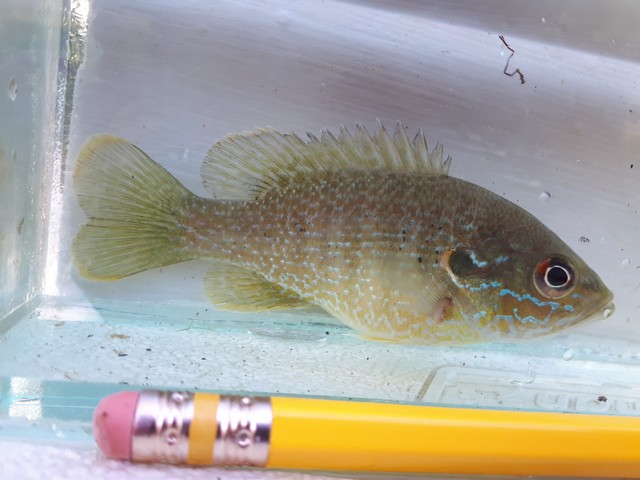
Characteristics
- between 12 cm and 20 cm
- large mouth that extends to the middle of the eye
- iridescent blue lines on cheeks and blue speckles arranged in rows on the body
- black operculum (covering the gills), sometimes surrounded by a white or orange border
- dorsal and anal fins often marked with black spots at their junction with the body
Photo credit: Fredlyfish4 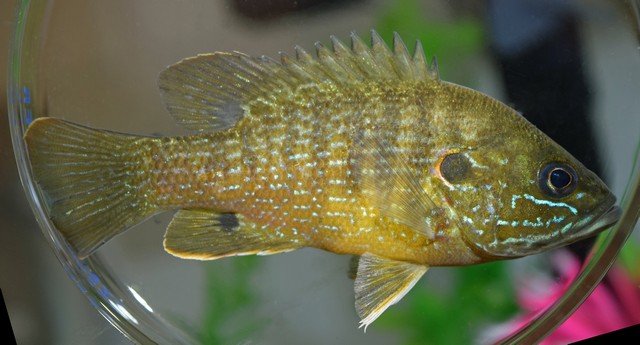
Origin
Green Sunfish is a freshwater fish native to the central and northeastern United States. It has been introduced into many countries (Asia, Africa, Europe) through various means such as aquaculture, aquarium trade, and live bait. In Canada, Green Sunfish is native to Ontario (Great Lakes-Hudson Bay basins) and is considered non-indigenous everywhere else in the country. It was found for the first time in Quebec in 2007 in the Yamaska River.
Habitat
Green Sunfish lives in calm or still waters, such as ponds and shallow lakes. It can be found in clear waters as well as in murky waters, often being the only species of sunfish caught in muddy waters.
Similar species
Green Sunfish can be confused with other species of sunfish, including Pumpkinseed (Lepomis gibbosus), which is very widespread in Quebec. It is also similar to Bluegill (L. macrochirus) and Northern Sunfish (L. peltastes), which are both less common in Quebec but present in southern Ontario. Northern Sunfish is also a species at risk in the Great Lakes and Upper St. Lawrence. All these sunfish species are similar in appearance, but their opercula differ in colour.
Pumpkinseed
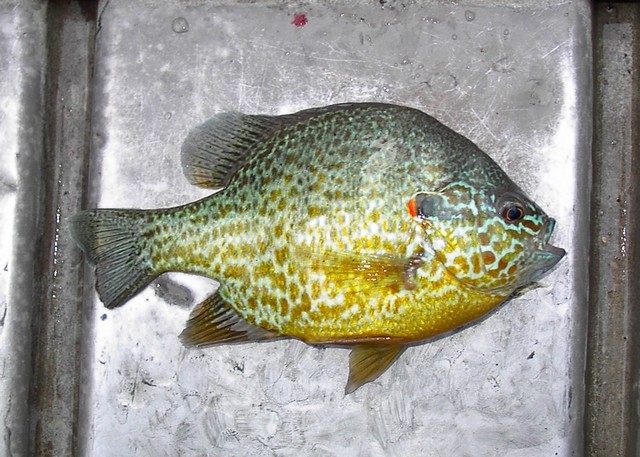
Photo credit: Ontario Freshwater Fishes Life History Database, R. J. Eakins
Bluegill

Photo credit: Fredlyfish4
Northern Sunfish, a species at risk
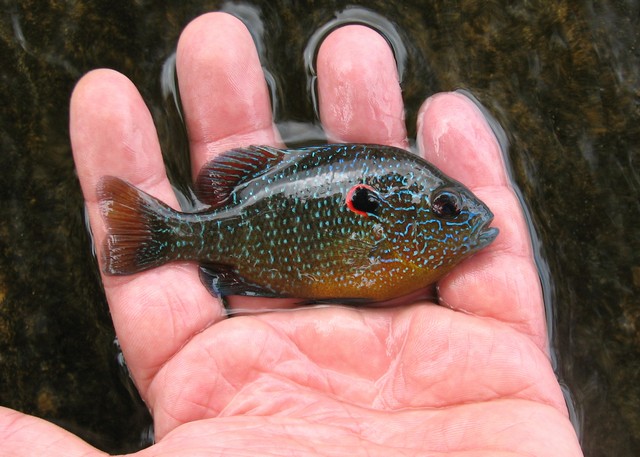
Photo credit: Ontario Freshwater Fishes Life History Database, R. J. Eakins
- Date modified: