
Overview of Federal Ocean Acidification Activities
On this page
- Foreword
- Ocean acidification in Canada
- Science activities and collaborations
- Science guidance, international engagement, and data access
- Ongoing and future work
- Acknowledgements
- References
- Related links
Foreword
Ocean acidification is a pressing challenge for Canada’s oceans. Fisheries and Oceans Canada (DFO) is committed to keeping Canadians informed about the state of the oceans. The Overview of Federal Ocean Acidification Activities was created by DFO, with input from Environment and Climate Change Canada (ECCC). It highlights current federal science activities and commitments to advance understanding of ocean acidification.
Ocean acidification in Canada
Ocean acidification and changing climate
Ocean acidification is happening in all three of Canada’s oceans. To understand it, we first need to understand how climate change, which includes ocean acidification, is occurring.
Human activities such as energy production, transportation, and agriculture rely heavily upon fossil fuels. Burning these fuels releases greenhouse gases like carbon dioxide into the atmosphere. These gases build up and trap heat, causing Earth’s climate to become warmer over time. This in turn changes weather patterns and ocean conditions, affecting the regions in which humans and other living things live. This long-term change to our world is known as climate change.
Oceans play a very important role in maintaining Earth’s climate. They have helped buffer some of the effects of climate change. So far, the oceans have absorbed more than 90% of excess heat, and have likely stored more than 30% of the carbon dioxide released from the burning of fossil fuelsFootnote 1. Absorbing excess heat has made the oceans warmer over time and is changing how the ocean waters mix.
As excess carbon dioxide from human activities continues to dissolve in the oceans, they are becoming increasingly acidic (lower in pH). This process is called ocean acidification. Ocean acidification, warmer ocean temperatures, and other climate change-related effects like lower oxygen levels in seawater are happening at the same time. This can negatively affect marine life, as well as the people who depend upon the oceans for food, livelihood and community.
Impact on marine life
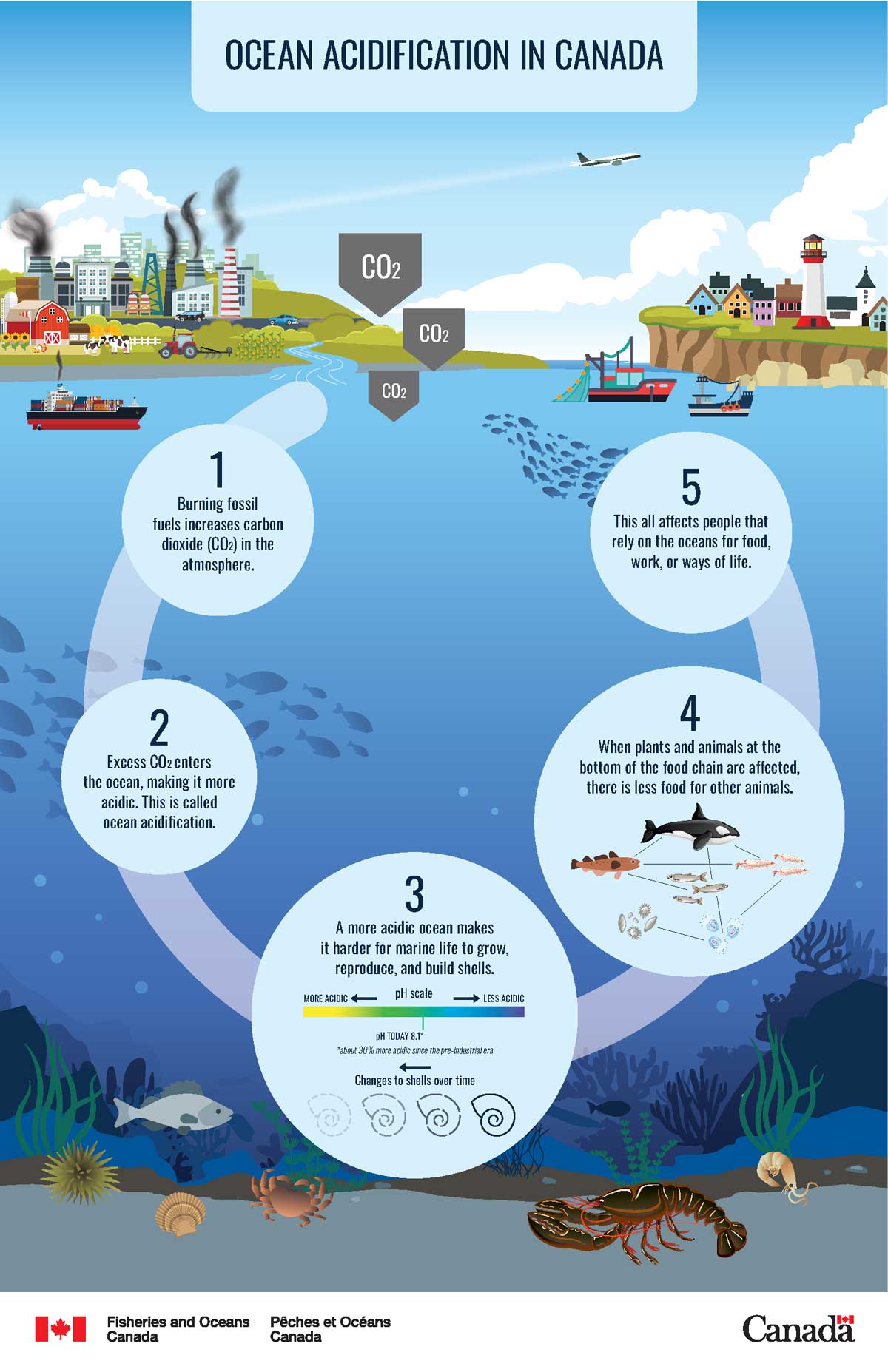
Ocean acidification can have negative effects on marine life, including algae, corals, fish, plants, and shellfish, and can especially affect the early life stages of animals. It can also affect all levels of the food web, and can cause ripple effects throughout marine ecosystems.
Ocean acidification can affect:
- calcification
- growth and development
- survival
- reproduction
- ability to deal with other stresses in their environment, such as warmer temperatures or diseases
- ability to turn food into energy
What is calcification?
Calcification is when living things make their shells (for example, oyster and crab) or other hard body parts such as bones and skeletons (for example, corals). Calcification happens throughout their lives as they grow, and as they maintain and repair their bodies.
A more acidic ocean makes it harder for marine life to build shells, grow, and reproduce.
Shellfish, such as mussels, clams, oysters, and scallops, are especially affected by ocean acidification. These are important animals that are harvested recreationally, and as part of fisheries and aquaculture activities in CanadaFootnote 2.
Shellfish are among many other marine species that are also important as sources of food and employment for Indigenous peoples and coastal communities. When these species are negatively affected by ocean acidification, there are knock-on effects for these people and their local economies.
Factors influencing ocean acidification in Canada
Canada has the world’s longest coastline, bordering the Arctic, Atlantic, and Pacific Oceans. Each ocean region has its own unique conditions and drivers, which means that the level and the impact of ocean acidification can vary from one region to another. For example, areas with colder waters are more vulnerable to acidification, because they absorb carbon dioxide more readily. Some regions — such as coastal areas, and where rivers meet the sea — may see greater, more rapid changes in acidification (called coastal acidification), due to local factors. These factors are not yet fully understood.
For simplicity, in this document the term “ocean acidification” will be used for all declines in pH across marine environments. This includes coastal acidification.
Condition: Coastal acidification
Coastal acidification can result in faster and greater changes in acidification around shorelines and areas where rivers and oceans meet.
Levels of coastal acidification can be affected by:
- fresh water from rivers
- plants and soil from the shore entering the water
- wastewater from treatment plants
- nutrient runoff from farming, or watersheds
The main factors influencing acidification levels in Canada’s oceans
Along the outer coast of the Pacific Ocean, seasonal upwelling from northwest winds brings subsurface ocean waters to the surface. These waters from below are rich in nutrients but are also naturally more acidic. When this natural process combines with climate change, it can amplify ocean acidification in the region.
Cold waters absorb carbon dioxide more readily. This means that areas with colder water, like those in the Arctic, are more vulnerable to ocean acidification. In the Canadian Arctic, rising air temperatures are leading to more ice-free days on the ocean, as well as more fresh water from rivers and melting ice. All these factors, along with the addition of more acidic water from the Pacific Ocean, worsens the state of acidification in the Arctic Ocean.
In the Canadian Atlantic, many factors affect acidification levels. These factors include the inflow of cold, acidic water from the Arctic; fresh water from rivers; and winter mixing in the deep waters of the Labrador Sea. Together, they contribute to the lower pH levels observed in this region.
Government initiatives to reduce impact
Recognizing the risk of climate change to ecosystems, the Government of Canada is committed to mitigating its impact through a number of initiatives. Federally, many initiatives that help reduce greenhouse gas emissions, which is the primary cause of ocean acidification are led by Environment and Climate Change Canada (ECCC). Because carbon dioxide is a greenhouse gas, reducing these emissions will help reduce future levels of ocean acidification.
Some initiatives are national and some are international:
- Canadian Net-Zero Emissions Accountability Act
- 2030 Emissions Reduction Plan
- Canada’s Climate Plan
- Pan-Canadian Framework on Clean Growth and Climate Change
- Paris Agreement (under the United Nations Framework Convention on Climate Change)
- United Nations 2030 Agenda for Sustainable Development and its Sustainable Development Goals
The Department of Fisheries and Oceans Canada (DFO) manages Canada’s oceans, aquatic ecosystems and associated resources. This includes leading national scientific efforts to monitor changes in ocean acidification, and how marine life may be affected by it. This document highlights some of DFO’s scientific research and commitments on ocean acidification.
Aquatic Climate Change Adaptation Services Program
Within DFO, the Aquatic Climate Change Adaptation Services Program helps coordinate knowledge, advice, and progress related to climate change science. Ocean acidification is one of the topics they coordinate through their themes of monitoring, vulnerability assessments and modelling.
Science activities and collaborations
Monitoring ocean conditions
Across Canada, DFO scientists study chemical changes in Canada’s oceans, both near and far from the shore, by collecting a wide variety of important measurements from seawater samples, including:
- pH
- carbon dioxide and oxygen levels
- temperature
- salinity
The seawater samples that are collected can be tested on ships at sea, or taken back to the laboratory and analysed in laboratories on land. These measurements also provide information on regional changes or short-term localized events that might be affecting seawater properties and, subsequently, local ecosystems. Data collected on these long-term monitoring programs are critical to understand how oceans are changing over time, and provide valuable data that are used in science-informed decision making at DFO and other organizations.
Scientists collect and analyse seawater using different methods:
- Instruments that are lowered into the ocean from ships sailing along a designated route
- Instruments attached to moorings or buoys that stay in place in the ocean
- Facilities along the coast, such as laboratories
- Underwater robotic vehicles or gliders that move through the water to collect information
DFO has two of the longest-running ocean chemistry programs in the world. The records they provide include information on ocean acidification. They are the Atlantic Zone Monitoring Program, and the Line P program.
Atlantic Zone Monitoring Program
The Atlantic Zone Monitoring Program takes measurements along set routes near Canada’s Atlantic Coast, and from stations near the shore, as indicated on the map. It began in 1998, making it one of the oldest DFO monitoring programs. Monitoring of ocean acidification began in 2014. Offshore regions of the Atlantic Ocean are monitored by the Atlantic Zone Off-Shelf Monitoring Program.
Reports containing the data collected by this program are available to the public.
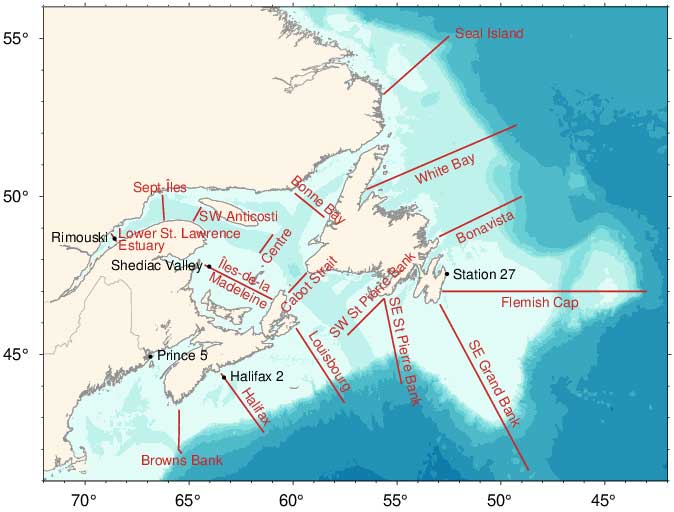
Atlantic Zone Monitoring Program - Text version
Map of the East Coast of Canada showing the 17 sampling routes and 5 high-frequency monitoring stations that make up the Atlantic Zone Monitoring Program. They are found in an area that extends from Rimouski, Quebec in the west to the Grand Bank and Flemish Cap off Newfoundland in the east, and from Labrador Sea in the north to Browns Bank off southwestern Nova Scotia.
Line P Program
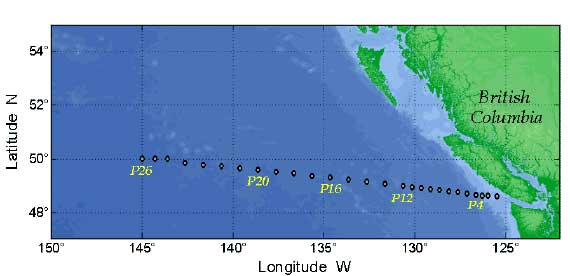
Line P Program - Text version
Map of the west coast of Canada showing stations for the Line P Program. A series of dots representing the sampling stations extends in a line from the southwest coast of Vancouver Island westward 1425 km into the Pacific Ocean.
The Line P Program takes samples of seawater from a set of stations in the Pacific Ocean. It started in 1956, making it one of the oldest ocean monitoring programs in the world. Sampling to study ocean acidification began in the 1970s.
This sampling program is a collaboration between scientists from DFO and other organizations. They work together to collect the samples and analyse them based on their area of expertise or research need. The high-quality data that have been generated over several decades makes this program a very important resource for studying changes in the oceans.
The importance of monitoring
Ocean monitoring programs, especially long-term ones, are valuable resources for understanding how the oceans work, change, and affect Earth’s climate. These programs support science-informed decision making. They help show trends in ocean acidification and provide information needed to project future conditions. They also help scientists to determine if there are areas of the oceans that may be more vulnerable to ocean acidification than others in the future.
Global and Canadian trends in ocean acidification
Since industrialization began in the 1760s, carbon dioxide emissions from fossil fuels have been increasing. Measurements show that this has led to seawater becoming more acidic around the world.
Ocean acidification is often described in terms of units on the pH scale. As the numbers on the scale go down, it means that the liquid being measured is more acidic (refer to infographic above for pH scale).
Since the Industrial Revolution, the surface layer of ocean water around the world has declined from pH 8.2 to pH 8.1Footnote 3. Although this change may seem small, it means that seawater is about 30% more acidic than it was beforeFootnote 4.
From long-running monitoring programs such as the Atlantic Zone Monitoring Program and the Line P Program, scientists have discovered that the rate of decline in pH in Canada varies from region to region, and with water depth. See image below for a quick summary of acidification trends in Canada’s oceans.Footnote 3Footnote 5Footnote 6Footnote 7Footnote 8Footnote 9
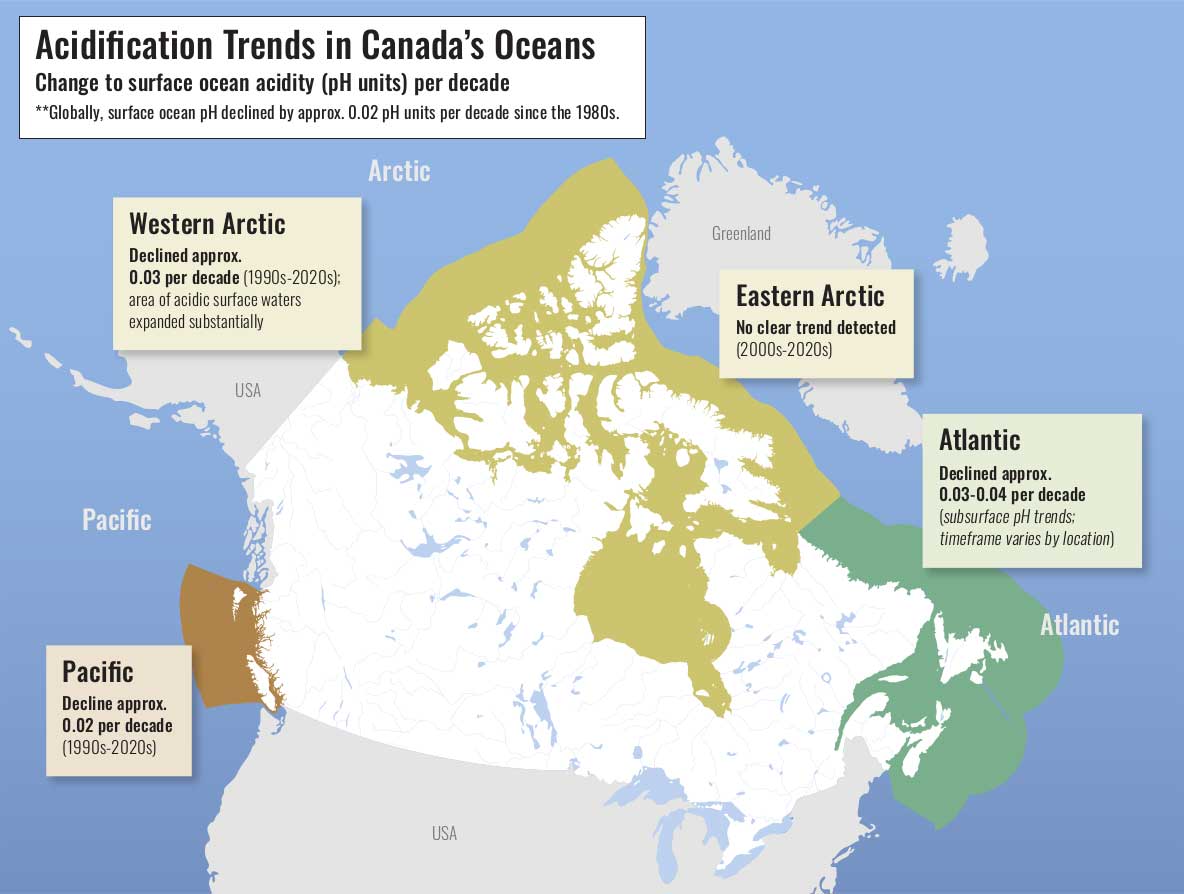
Acidification trends in Canada's oceans - Text version
An infographic titled “Acidification Trends in Canada’s Oceans.” It shows a map of Canada with three highlighted sections and four text boxes. Below the title, there is additional text that states that globally, surface ocean pH declined by approximately 0.02 pH units per decade since the 1980s. The first text box is located near a highlighted section of the Pacific Ocean, extending along the coastline of British Columbia from the southern border with the USA north to Graham Island and westward into the ocean. The text box is titled “Pacific” and states that the area has seen a surface pH decline of approximately 0.02 pH units per decade from the 1990s to the 2020s. The second text box is located near a highlighted section of the Arctic Ocean from the border with Alaska in the west to the border between Quebec and Labrador in the east, and from Ellesmere Island in the north to James Bay in the south. It is titled “Western Arctic” and states that the area has seen a surface pH decline of approximately 0.03 pH units per decade between the 1990s and the 2020s, and that the area of acidic surface waters has expanded substantially. The third text box is also located by the highlighted area of the Arctic Ocean. It is titled “Eastern Arctic” and states that there is no clear trend of surface pH decline detected between the 2000s and the 2010s. The fourth text box is located near a highlighted section of the Atlantic Ocean extending from the border between Quebec and Labrador in the north to the border with the USA in the south and from Gulf of St Lawrence in the west to the waters off Newfoundland in the east. It is titled “Atlantic” and states that the area has seen a subsurface pH decline of approximately 0.03 to 0.04 pH units per decade depending on the location.
Vulnerability research
Across DFO laboratories in Canada, scientists study how ocean acidification may affect marine life, specifically assessing the vulnerability of marine species to changes in their environment. These studies focus on how marine life might be affected, both now and in the future.
Their research focuses on marine species at different life stages, including very young life stages (babies or eggs), juveniles, and adults. During the experiments, species are exposed to laboratory environments that mimic current and future ocean conditions, including ocean acidification, often along with other environmental factors (such as warming or diseases). Using a variety of tests and methods, scientists track species responses such as:
- How many survive
- How fast they grow
- Whether they develop normally
These experiments help scientists understand which species are more at risk due to ocean acidification and other changes in the environment. They can help scientists identify whether a species might struggle, which might adapt and survive, and which might thrive as the oceans change in response to climate change.
The results are then used in vulnerability assessments, which are studies that summarize how sensitive a species is to various threats (such as increasingly acidic waters), and how serious the impact could be. These assessments help inform decisions about managing Canada’s fisheries, aquaculture, and marine conservation.
Understanding future ocean conditions
Ocean acidification is expected to keep increasing around the world, making conditions difficult for marine species that cannot adapt.
Faced with this challenge, scientists use computer models to better understand what this means for Canada’s oceans, both now and in the future. These ocean models help project how ocean acidification levels could change over time with different levels of carbon dioxide in the atmosphere. These models are built and tested using measurements collected from Canada’s oceans.
DFO scientists contribute to global ocean-climate models and projections that are produced and managed by ECCCFootnote 10. Data collected by DFO are used to evaluate and inform the models.
Large-scale models are useful for showing general trends, but they do not provide enough detail to indicate how ocean conditions might affect local fish populations or habitats, at a scale that can be used for decision making. To meet DFO’s needs, scientists downscale ECCC’s global ocean-climate models to create more detailed, regionally-relevant models.
When these computer models include chemical information such as acidification and lower levels of the food web, such as plankton (refer to Ocean Acidification in Canada infographic for food web), they are called biogeochemical models. Information from these models is used to support laboratory studies, to test a range of future scenarios, and to inform climate-vulnerability assessments and decision making related to fisheries and aquaculture.
Downscaling
Downscaling is when scientists run localized models that allow details to emerge that are smoothed out by large-scale models. This helps make the results more accurate and relevant for smaller areas, which is important when providing scientific advice.
Climate and biogeochemical computer models have been developed for Canada’s Pacific, Arctic, and Atlantic OceansFootnote 11 Footnote 12.
These computer models tell us that some regions of the Arctic and Atlantic Oceans are already at risk from ocean acidification, and that some shallow nearshore areas of the Pacific Ocean are experiencing accelerating ocean acidification.
These models also suggest that, in the future, ocean acidification will continue in all of Canada’s oceans which, in turn, increases the risks for sensitive species.
Learning about ocean acidification together
DFO does not work alone on advancing scientific understanding of ocean acidification. There are a number of partnerships and committees that coordinate and share scientific information about ocean acidification and other climate change effects. Whether within government, with national and international organizations, between foreign governments, or with people who live in Canada, these collaborations help spread knowledge and understanding about ocean acidification, and guide adaptation planning.
Indigenous Knowledge and collaborations
Knowledge gained through partnerships, engagement, and collaboration with Indigenous communities helps scientists develop a better understanding of how ocean acidification is affecting marine species and ecosystems. This exchange benefits all involved, and plays a key role in shaping DFO’s scientific research, planning, and decision making for sectors such as fisheries and aquaculture, or marine conservation. In remote, understudied regions such as the Arctic, knowledge-sharing and partnerships are important for gaining insights into past events and recent observations, and to advance current understanding.
DFO scientists and collaborators improve understanding of ocean acidification and its impact by sharing observations and resources, and by collecting biological, physical, and chemical data (such as pH, temperature, and salinity) through a range of initiatives and programs. Examples include:
- Canadian Rangers Ocean Watch program
- Coastal Environmental Baseline Program
- Aquatic Climate Change Adaptation Services Program
- co-management of marine protected areasFootnote 13
- collaborations with local governments and community organizations such as the Nunatsiavut Government and Haida First NationFootnote 14, and local hunters and trappers’ organizations
This exchange can help guide science and decision making that weaves together all perspectives and knowledge systems.
Non-Governmental organizations, university, industry and more
Federal departments work with many partners and organizations that focus on the topic of ocean acidification. These organizations are located both within and outside of Canada. Examples include, but are not limited to, universities, industry, non-profit organizations, provincial groups and governments, and local groups.
Working with these organizations, such as the Canadian Ocean Acidification Community of Practice, helps improve everyone’s understanding of the impact of climate change on marine ecosystems. These initiatives aim to increase understanding, knowledge-sharing, and collective action on ocean acidification.
North American
DFO also plays a leading role in advancing ocean acidification research on the continent. DFO scientists are part of the Global Ocean Acidification Observing Network’s North American Hub , which supports continental collaboration and shared approaches. Knowledge-sharing and scientific advancement also occur with other international federal agencies — such as the Ocean Acidification Collaboration between DFO and National Ocean and Atmospheric Administration (NOAA).
International
Federal departments also contribute ocean acidification knowledge to international assessments and advisory reports administered by international organizations. These include: the
- Arctic Monitoring and Assessment ProgramFootnote 15
- Intergovernmental Panel on Climate Change (IPCC) Assessment ReportsFootnote 16
- Intergovernmental Platform on Biodiversity and Ecosystem ServicesFootnote 17
Science guidance, international engagement, and data access
Science informs decision making
DFO provides scientific expertise to inform federal government priorities for current and emerging aquatic climate change research, including ocean acidification. This ensures that federal climate change research is aligned with the science advice needed to inform government decision making in aquatic environments. The 2025 DFO Climate Change Science Needs Evaluation Technical ReportFootnote 18 provides an analysis of the science needed to support climate resilient planning.
Scientific information, such as ocean observations, modelling studies and climate-vulnerability assessments, is used to generate advice, including through the science advisory processFootnote 19 to support science-informed decisions about managing oceans, fisheries and aquaculture in Canada.
Federal Departments also provide information on ocean acidification status in for national climate reports such as the State of Canada’s Oceans reports and Canada’s Changing Climate Report.
Federal scientists have also provided advice and contributed to related initiatives such as the development of the British Columbia Ocean Acidification and Hypoxia Action PlanFootnote 20, and a publication titled: "Ocean acidification in Canada: the current state of knowledge, and pathways for action"Footnote 21.
Ocean acidification action plans can explain the steps needed to better understand the issue and respond to its impact. These Action Plans can be used to focus on how ocean acidification can affect a particular region, while also providing avenues and steps to take to enable more detailed adaptation and resilience planning. British Columbia is the first province or territory in Canada to develop an ocean acidification action plan: the British Columbia Ocean Acidification and Hypoxia Action PlanFootnote 20.
On the international stage
DFO advances understanding of ocean acidification around the world by being a part of many international efforts. DFO scientists and policymakers contribute to several multidisciplinary collaborations. Some of the projects and initiatives are undertaken as part of the United Nation’s (UN) Ocean Decade: Ocean Acidification Research for Sustainability ProgramFootnote 22. This program aims to coordinate science and knowledge mobilization on ocean acidification.
With national coordination, DFO also contributes acidification data from each of Canada’s oceans to the UN Sustainable Development Goal (SDG) Indicator 14.3.1. This Indicator supports SDG Target 14.3: “Minimize and address the impact of ocean acidification, including through enhanced scientific cooperation at all levels.”
In addition, Canada adopted the Kunming-Montreal Global Biodiversity Framework, which includes a target that calls upon countries to reduce the effects of climate change and ocean acidification on biodiversity, and to strengthen ecosystems using nature-based solutions and climate actions.
DFO also participates in the OA Alliance (International Alliance to Combat Ocean Acidification)Footnote 23 Leadership Circle. This initiative brings together governments and organizations from around the world to discuss efforts towards minimizing ocean acidification.
DFO Ocean acidification data
The Open Data Policy of the Government of Canada promises that the federal government will make scientific data accessible and usable. As part of this, DFO is committed to widely sharing ocean acidification information with the public.
Information related to the impact of ocean acidification on marine life can often be found in scientific publications and synthesis reports, such as those on the DFO Publications website.
Ocean acidification data can also be found on various Canadian and international platforms, such as:
- Canada’s federal Open Data PortalFootnote 24
- DFO — Biological and chemical marine data: BioChem databaseFootnote 25
- DFO — Marine Environmental Data ProgramFootnote 26
- Canadian Integrated Ocean Observing SystemFootnote 27
- Ocean Carbon and Acidification Data SystemFootnote 28
- Surface Ocean CO2 AtlasFootnote 29
- Global Ocean Acidification-Observing NetworkFootnote 30
- Global Ocean Data Analysis ProjectFootnote 31
Ongoing and future work
DFO is committed to supporting healthy and productive oceans through sound science including conducting research on factors that affect ocean health such as climate change and ocean acidification.
Monitoring and research on climate change and ocean acidification help Canadians understand how Canada’s oceans are changing, and how these changes affect marine life. It also helps us to understand how changes to Canada’s oceans can affect people who live, work, or spend time around the ocean.
There are many data gaps that remain on ocean acidification, and areas that can be advanced include:
- Continued measurements of seawater conditions in the Pacific, Atlantic and Arctic Oceans. Consistent collection of these long-running measurements is critical to understanding changes in the environment
- Measurements of coastal acidification along Canada’s three coasts. This is important because coastal acidification differs from place to place along Canada’s extensive coastline
- Increased knowledge about special-interest areas. Examples include ecologically- and biologically-significant areas, conservation areas, key fisheries-recruitment areas, and aquaculture-production areas
- Research on how ocean acidification, when combined with other climate change factors such as warming and climate extremes, affect marine species. This includes understanding how well the species can tolerate changes to their environments, the ranges where they can live, and how species composition in an ecosystem may change
- Research on the vulnerability of marine species, at their various life stages, to ocean acidification and ocean extremes, including species that are socially, culturally, or economically important. This information can help provide advice on marine management
- Continued work with Environment and Climate Change Canada to update and improve ocean biogeochemical models, when new climate data are available. This work will include models for coastal areas. Well-informed and better biogeochemical models will result in better assessments of future risks to ecosystems
- Continued collaboration with other scientists and partners to increase collective knowledge about the impact of ocean acidification. These collaborations can include scientists from within DFO, in Canada, or around the world
- Investigation of how known and emerging ocean carbon-mitigation activities may affect marine life and ocean chemistry at small and large scales
Ocean carbon and climate mitigation approaches include blue carbon ecosystems and marine carbon dioxide removal and storage strategies such as:
- Ocean alkalinity enhancement
- Ocean nutrient fertilization
- Seaweed cultivation and sinking
- Direct ocean carbon capture and storage
- Artificial upwelling and downwelling
- Offshore carbon capture and storage
Acknowledgements
This document was created by the National Ocean Chemistry Working Group, and by the National Climate Change Science team, both of which are part of DFO. This effort was co-led by DFO Maritimes Region researcher Dr. Helen Gurney-Smith and National Capital Region Climate Change Science Advisor Jie Yuen Ong. We are thankful for all the contributors from across the regions for their knowledge and partnership.
We are grateful for the input from colleagues at Environment and Climate Change Canada.
Related links
- ECCC - Canadian Centre for Climate Modelling and Analysis
- Collaborative framework for joint DFO/NOAA ocean acidification research and monitoring
Page details
- Date modified: