
Tuvaijuittuq Marine Protected Area (MPA) annual report 2024
On this page
At-a-glance
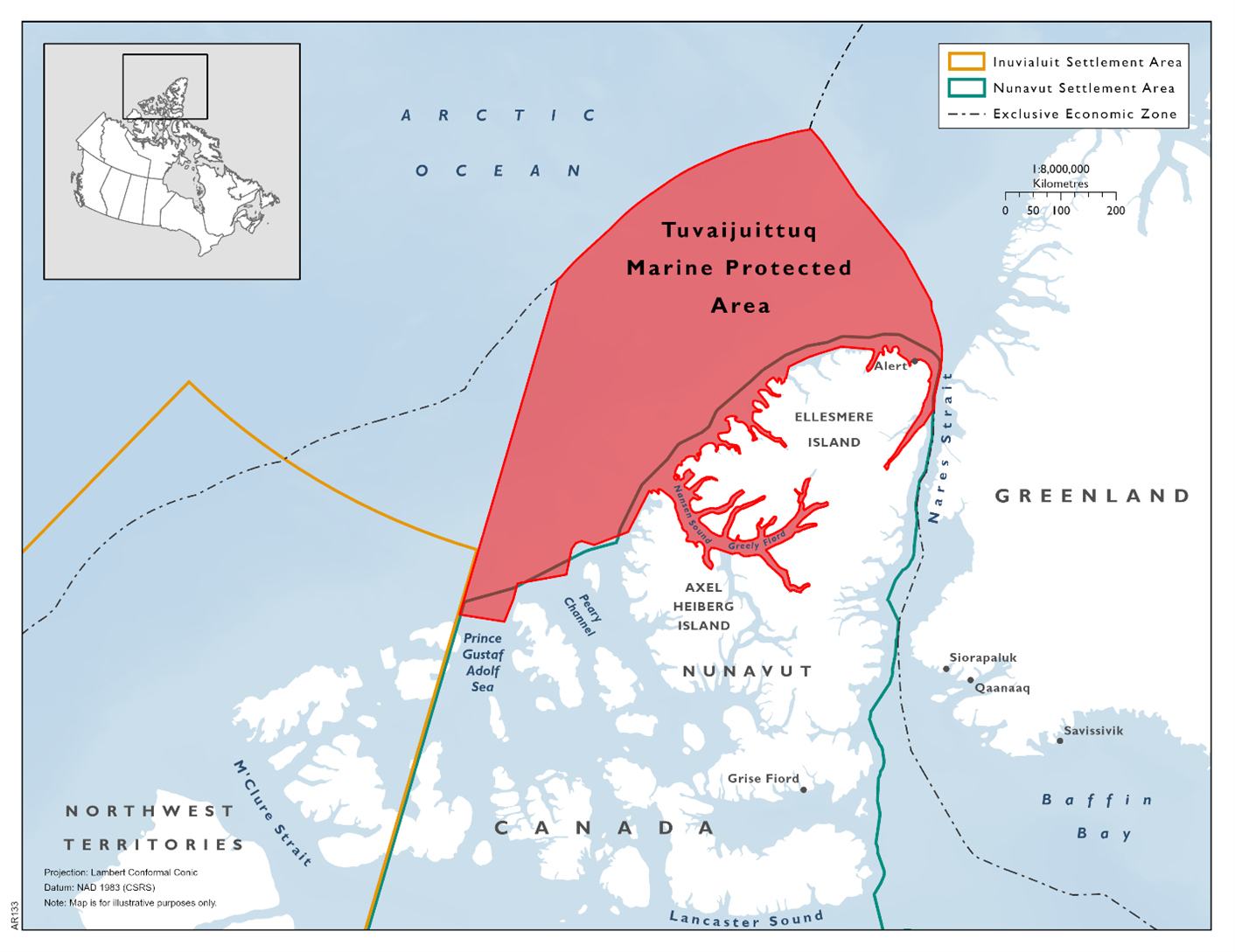
Map of Tuvaijuittuq Marine Protected Area.
Date of designation:
This MPA was first designated by ministerial order in 2019 and a second ministerial order was used in 2024.
Size:
319,411 km2
Contribution towards the marine conservation targets:
5.55%
Location:
This MPA is northwest of Ellesmere Island, Nunavut and it overlaps both the Arctic Basin and Arctic Archipelago bioregions in the Arctic Ocean.
Co-managed by:
This MPA is co-managed by the Aulattiqatigiit Board, with representatives from:
- Qikiqtani Inuit Association (QIA)
- Fisheries and Oceans Canada (DFO)
- Parks Canada (PC)
- Transport Canada (TC)
Acknowledgement:
The Tuvaijuittuq MPA is partially located within the Nunavut Settlement Area. The Nunavut Land Claim Agreement (or Nunavut Agreement) applies.
Zones:
There are no management zones within the Tuvaijuittuq MPA and Ministerial Order regulations apply throughout the entire area.
Conservation objectives
- Contribute to the conservation, protection and understanding of the natural diversity, productivity and dynamism of the High Arctic sea ice ecosystem.
This conservation objective remains relevant today given the ongoing information gaps for the area and the need to better understand its significance in the context of marine Arctic systems.
Management and governance
Tuvaijuittuq MPA was established by ministerial order under the Oceans Act in 2019, in collaboration with the QIA. A second ministerial order was established in 2024 in partnership with the QIA to allow this vulnerable area to remain protected as partners consider long-term protection options for the area, including an Inuit Protected and Conserved Area (IPCA).
The consideration of long-term protection options is led by QIA and includes partners at the Government of Canada (represented by DFO and PC) and the Government of Nunavut (GN). QIA partners shared the following: QIA’s vision for Tuvaijuittuq includes Inuit-led governance where Inuit Qaujimajatuqangit plays a role in decision making and the expansion of the Nauttiqsuqtiit Program.
In 2019, the Inuit Impact and Benefit Agreement (IIBA) negotiated with the QIA for the establishment of the Tallurutiup Imanga National Marine Conservation Area (TINMCA) included a commitment to co-establish protection in Tuvaijuittuq. The joint Inuit/Government of Canada Aulattiqatigiit Board continues to co-manage the Tuvaijuittuq MPA in alignment with the IIBA.
In 2024, 4 meetings were held, consistent with the Board’s mandate to meet quarterly. A whole-of-government approach will continue as work advances for this site.
The current ministerial order freezes the footprint of ongoing activities in the area for up to 5 years. There is no active management plan nor a process to authorize activities within a ministerial order MPA, therefore activity plans are not possible. Activities that occurred over the 12 months prior to the 2019 designation or were authorized to occur, are allowed to continue, while new activities are prohibited, with some exceptions. The order does not impact Inuit harvesting rights provided for under the Nunavut Agreement.
Collaborative agreements remain in place between DFO, the QIA and the GN to support involvement in Tuvaijuittuq. QIA has an additional contribution agreement with DFO to advance Article 16 (Exploring Fisheries Potential) under the TINMCA IIBA.
Feature habitat
Tuvaijuittuq means “the place where the ice never melts” in Inuktitut. It forms part of the “Last Ice Area”, which contains the oldest and thickest multi-year ice in the Arctic Ocean. Multi-year ice is sea ice that forms and lasts more than one summer and in the Canadian Arctic it has declined by 7% in the past 10 years. Summer sea ice is still expected to remain in this area the longest of anywhere in the Canadian Arctic and will continue to provide habitat for ice-dependent species into the future.
Research and monitoring
In 2024, 2 research projects were conducted by DFO out of the Eureka research base.
In spring 2024, DFO (L. Matthes) documented baseline conditions of the marine ecosystem by gathering data on:
- physical ocean and biochemical parameters of the carbon system
- light and nutrient availability
- diversity and abundance of microalgae and fish
Environmental DNA samples were also collected, providing the first assessment of the presence of under-ice fish communities in the Nansen Sound and in Greely Fjord. The oceanographic and sea ice data collected will be used to characterize physical and biochemical conditions during the ice-covered period.
In June 2024, DFO (D. Yurkowski) completed an aerial survey across several areas in Tuvaijuittuq. Data collected from approximately 62 hours of flying time will be used to quantify habitat use and the temporal/spatial densities of marine mammals, such as ringed seals.
In August 2024, a ship-based ecosystem survey onboard CCGS Amundsen was conducted in collaboration with the Refuge Arctic research consortium. The survey continued efforts to characterize the marine ecosystem in Tuvaijuittuq and assessed its connectivity and influence on the Canadian Arctic. Sampling focused on:
- physical oceanography
- marine inorganic carbon system
- cycling of greenhouse gases (D. Capelle)
- marine productivity
- diversity and abundance of microalgal communities (L. Matthes)
Moorings were a key component to the ArcticCORE program in 2024 and they recorded measurements of:
- conductivity
- temperature
- light
- turbidity
- carbon dioxide
- ocean currents
Tag receivers placed near the bottom of the moorings were used to track migration patterns of tagged fish. Sediment traps were used to take physical samples of sinking organic matter and both phytoplankton and zooplankton. This work will provide a better understanding of the marine systems temporal changes and interannual variability, helping to tease apart natural variability and climate related changes within the marine ecosystem.
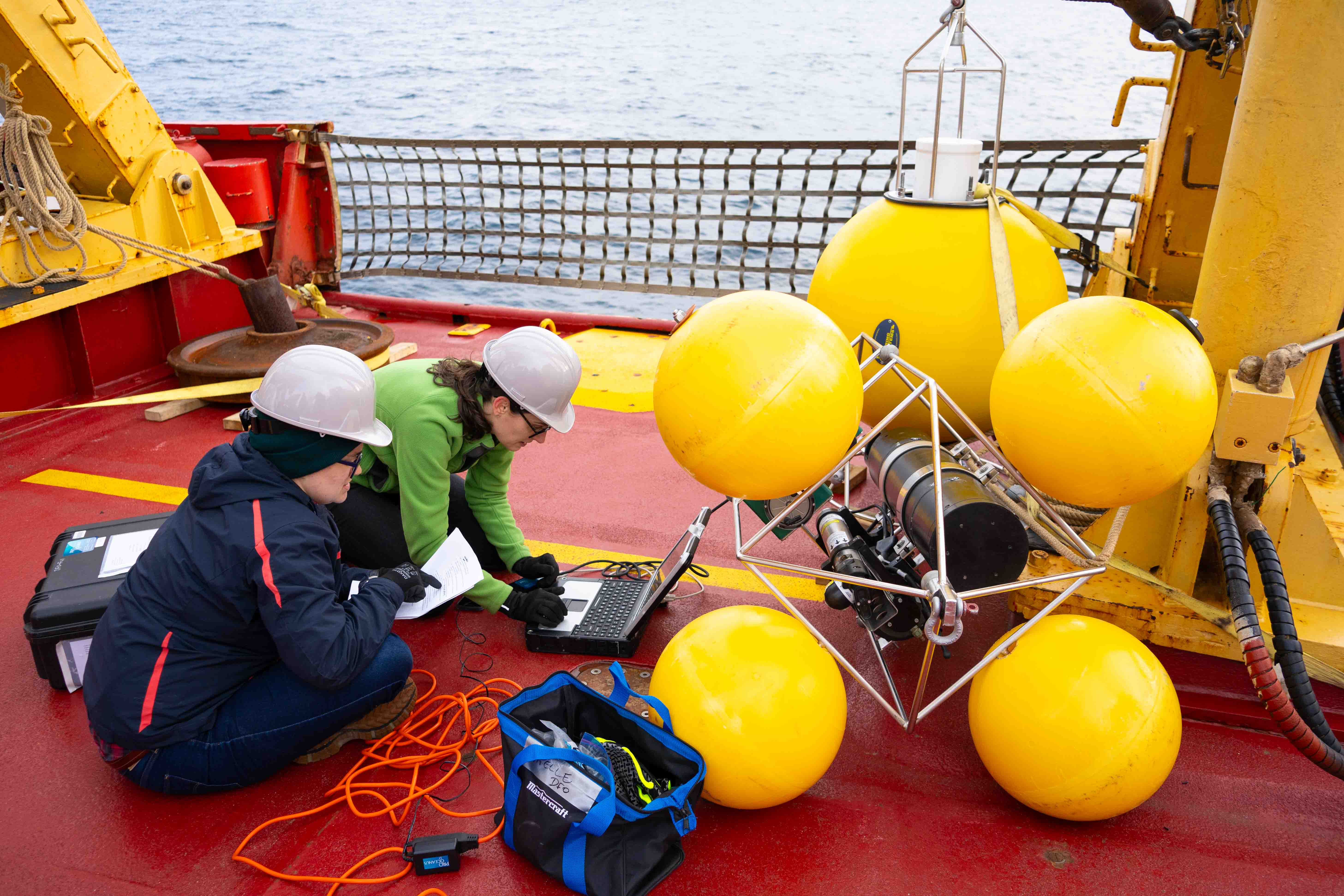
DFO scientists Elizabeth Kitching and Tonya Burgers (from left to right) programming mooring sensors prior to deployment during the 2024 ArcticCORE marine survey onboard CCGS Amundsen. Photo credit: Fatma Dhifallah.
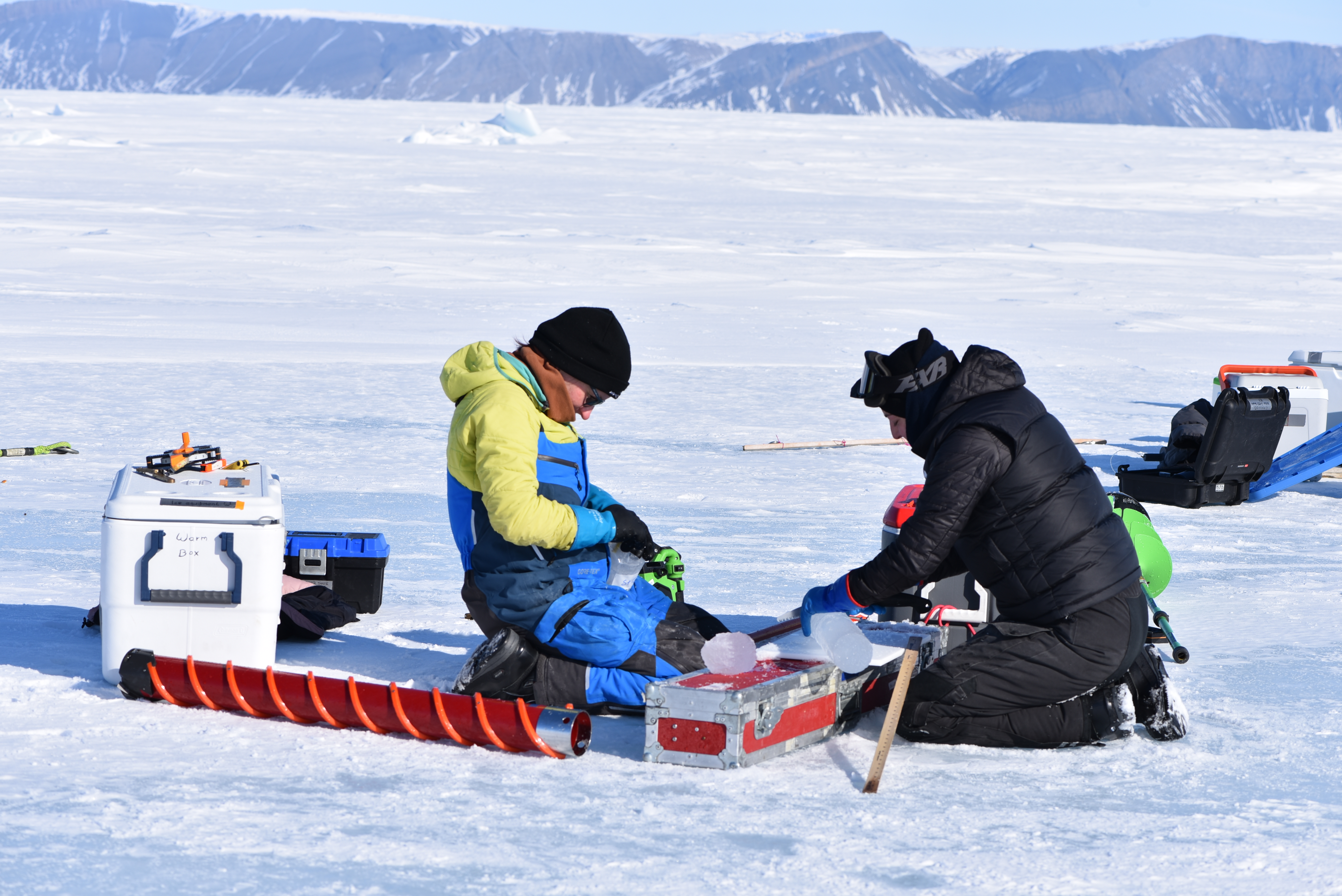
DFO scientists Lisa Matthes and Jillian Riemer (from left to right) section ice cores in Nansen Sound for physical and biological assessment of the ice conditions during the 2024 spring survey. Photo credit: Sheila Atchison.
Collaboration and partnerships
The Government of Canada (represented by DFO, TC and PC) and the QIA co-manage the Tuvaijuittuq MPA through the Aulattiqatigiit Board. This collaborative management is done in alignment with the TINMCA IIBA. In addition, the consideration of long-term protection of Tuvaijuittuq is guided by the Memorandum of Understanding signed by the Government of Canada, the QIA and the GN in 2019.
DFO and its partners continue to seek input and advice on this area to ensure that local knowledge and Inuit Qaujimajatuqangit inform decision-making. They consult with the High Arctic communities of:
- Arctic Bay
- Clyde River
- Grise Fiord
- Pond Inlet
- Resolute Bay
Consultation with key stakeholders (for example, environmental non-government organizations, industry) is also an important component of considering long-term protection in Tuvaijuittuq.
The 2024 ArcticCORE marine survey onboard CCGS Amundsen was conducted in collaboration with Amundsen Science and the Refuge Arctic research consortium. This international team included researchers from:
- France (LOCEAN, LSCE, LEGOS, Roscoff)
- Denmark (Aarhus)
- Germany (AWI)
- United States of America (NASA-JPL, Stanford)
- Canadian universities:
- Laval University
- Université du Québec à Rimouski
- Memorial University of Newfoundland
- University of New Brunswick
- University of Manitoba
- University of British Columbia
- University of Victoria
DFO scientists are also key collaborators, with research interests aligning to collect critical baseline data and better understand the drivers of productivity, biodiversity and species habitat use in Tuvaijuittuq.
In the spotlight: benefits
Ecological
This MPA protects an area of the Arctic Ocean that is globally, nationally and regionally unique due to the presence of multi-year pack ice. It prohibits additional activities that may exacerbate the impacts of climate change, such as the loss and/or disruption of multi-year pack ice. As sea ice continues to decline, the area is expected to become a critical refuge for ice-dependent species, including:
- walrus (aiviit)
- seals (ringed – nattiit, bearded - ugjuit)
- polar bears (nanuit)
Socio-cultural
Tuvaijuittuq has great cultural significance and Inuit have been the stewards of this region for millennia. The area has been used as a travel corridor between Greenland and Canada and conditions there impact culturally significant resources and activities near Qikiqtani communities and beyond. The ongoing work to conserve this area supports capacity-building within Hunters and Trappers Organizations and for potential Inuit-led research and monitoring programs in the future.
Economic
Tuvaijuittuq MPA is covered under the 2019 TINMCA IIBA, which provides funding for meaningful job creation in the 5 associated High Arctic communities through the Nauttiqsuqtiit Program (Inuit Stewards) and to explore new fisheries opportunities around Tallurutiup Imanga. While the stewards don’t currently work in the Tuvaijuittuq MPA due to severe remoteness, it is anticipated that the stewards may be involved in research related to the MPA in the future.
Surveillance and enforcement
Because the Tuvaijuittuq MPA is located in the remote High Arctic Ocean, its vast size, extreme environmental conditions and remote location present significant challenges for conducting on-site patrols to support surveillance and enforcement. Additionally, the high cost of conducting patrols in the Arctic further complicates enforcement efforts.
Given these limitations, DFO’s Conservation and Protection (C&P) Officers primarily monitor activities within the MPA remotely. This includes tracking vessel traffic using the Automatic Identification System (AIS) and monitoring online open-source materials for any northern adventurers intending to pass through the area. Officers are also exploring the use of satellite-based dark vessel detection technology to identify unreported vessel traffic that is not transmitting AIS signals.
The MPA Enforcement Plan was last updated in 2021 and remains unchanged in 2024, given the remoteness of the area and the lack of any identified need for revisions. To date, there have been no charges or convictions related to violations within the Tuvaijuittuq MPA.
From 2024-2025, C&P Officers dedicated approximately 52 hours to remote monitoring—averaging about 1 hour per week. However, numerous false alerts of ship activity within the MPA have been noted. The Marine Security Operations Centre (MSOC) provides enhanced desktop surveillance using various tools to detect and report marine activity. This includes monitoring vessel movements in and around the Tuvaijuittuq MPA to help ensure compliance with MPA regulations.
Outreach and engagement
DFO undertook a community engagement tour between February 23 - March 31, 2024 with visits to several communities, including:
- Clyde River
- Pond Inlet
- Grise Fiord
- Arctic Bay
- Resolute Bay
The community tour was an opportunity to share information about the scientific research activities that have occurred and are ongoing, within the Tuvaijuittuq MPA and adjacent marine areas in the Qikiqtani Region of Nunavut. It also provided the forum to seek input from communities about their interests in involvement and direction of research efforts moving forward. School visits and radio presentations were included where possible to ensure all ages and the general public were included in these discussions.
During the visits, communities emphasized their interest in becoming more involved in research and monitoring of Tuvaijuittuq, as well as the importance of including Inuit Qaujimajatuqangit and input from elders in the management and monitoring of the area.
DFO will continue to support Qikiqtani Inuit in advancing marine conservation and research in Tuvaijuittuq in alignment with the TINMCA IIBA and the Sinaa Agreement.
Related link
- Date modified: