
Integrated Fisheries Management Plan: Gulf of St. Lawrence Groundfish Fisheries in the NAFO Divisions 4RST and Subdivisions 3Pn and 4Vn
Foreword
The purpose of this Integrated Fisheries Management Plan (IFMP) is to identify the main objectives for the groundfish fishery in the Gulf of St. Lawrence (GSL) North Atlantic Fishing Organization (NAFO) Divisions 4RST, and Subdivisions 3Pn and 4Vn, as well as the management measures that will be used to achieve the objectives. Groundfish in NAFO Subdivision 4Vn is also covered in the IFMP for “4VWX5 Groundfish - Maritimes (MAR) Region.” This document also serves to communicate basic information about the fishery and its management to Fisheries and Oceans Canada (DFO) staff, legislated co-management boards and any stakeholders. This IFMP provides a common understanding of the basic “rules” for the sustainable management of the fisheries resource. It has been developed as an evergreen document, meaning that it is written in such a way as to be relevant over a long period of time, with no fixed end date. All IFMPs require regular updating to address current developments, new information, and varying pressures on the fishery resource.
The previous GSL groundfish fisheries IFMP was published in 2017. Several important changes have been made since the last publication. These include the health status of some stocks, and new legal obligations under the renewed Fisheries Act (which received royal assent and became law on June 21, 2019; see Annex A for details). The modernized Act includes new Fish Stocks Provisions (FSP), which strengthen its ability to manage stocks within the critical zone of the Precautionary Approach (PA) framework. Of the ten groundfish stocks initially covered in the previous IFMP, five stocks (American plaice 4T, Atlantic cod 4RS, 3Pn, Atlantic cod 4TVn, white hake 4T and winter flounder 4T) are prescribed to the FSP and are scheduled for management through rebuilding plans starting in 2024. This approach marks a departure from the traditional IFMP management. Additionally, the yellowtail flounder 4T stock is also under consideration for management through a rebuilding plan. The remaining stocks, namely Atlantic halibut 4RST, Greenland halibut 4RST and witch flounder 4RST will continue to be managed through the present IFMP for the foreseeable future. It should be noted that the Greenland halibut 4RST fishery in Quebec (QC) is governed by a separate IFMP, and another distinct IFMP will be developed for the Unit 1 redfish fishery (see Annex B for details).
This IFMP is not a legally binding instrument which can form the basis of a legal challenge. The IFMP can be modified at any time and does not fetter the Minister's discretionary powers set out in the Fisheries Act. The Minister can, for reasons of conservation or for any other valid reasons, modify any provision of the IFMP in accordance with the powers granted pursuant to the Fisheries Act.
Where DFO is responsible for implementing obligations under land claims agreements, the IFMP will be implemented in a manner consistent with these obligations. In the event that an IFMP is inconsistent with obligations under land claims agreements, the provisions of the land claims agreements will prevail to the extent of the inconsistency.
On this page
- 1. Fishery overview
- 1.1 Historic, socio-economic and cultural importance of the groundfish fisheries
- 1.2 Overview of legislative, regulatory and policy framework
- 1.3 Types of fisheries and participants
- 1.4 Commercial fisheries management measures
- 1.5 Safety at sea
- 1.6 Compliance and enforcement plan
- 1.7 Governance
- 1.8 Indigenous knowledge
- 1.9 Precautionary approach framework and rebuilding plans
- 2. Science and stock assessment
- 2.1 Data collection and assessment
- 2.2 Scientific peer review and science advice
- 2.3 Impacts of climate change on ecosystems and fisheries
- 2.4 Ecosystem interactions
- 3. Management strategy: Moving forward
- 3.1 Key management issues and considerations
- 3.2 Management objectives and expected results
- 3.3 Management objectives and expected results review
- 4. References
- Annex A. New fish stocks provisions and requirements
- Annex B. Major changes between the 2017 and 2024 versions of the Integrated Fisheries Management Plan‘s Limit Reference Point and Upper Stock Reference
- Annex C. Number of licence giving access to commercial groundfish fisheries in the Gulf of St. Lawrence
- Annex D. Fleet shares
- Annex E. Overview of key monitoring measures, by fishing fleet and fishery, in place in 2023 to 2024
- Annex F. Aquatic species assessed by COSEWIC and/or listed under the Species at Risk Act (SARA), and potentially interacting with groundfish
- Annex G. Fishery specific closed areas in the Gulf of St. Lawrence
- Annex H. Compliance and Enforcement Plan
- Annex I. Gulf Groundfish Advisory Committee
- Annex J. Summary of the Precautionary Approach Framework Reference Points and Committee on the Status of Endangered Wildlife in Canada/Species at Risk Act
- Annex K. Atlantic halibut (May 2024)
- Annex L. Greenland halibut (May 2024)
- Annex M. Witch flounder (May 2024)
- Abbreviations and acronyms
- Glossary
1. Fishery overview
The GSL groundfish fishery primarily involves 10 groundfish stocks or 9 commercially valuable species. Although Atlantic cod is one species in the GSL, it is made up of two stocks.
Management of the fishery is generally divided into the northern Gulf of Saint Lawrence (nGSL) consisting of the NAFO Divisions 4RS and Subdivision 3Pn, and the southern Gulf of Saint Lawrence (sGSL) with NAFO Division 4T and Subdivision 4Vn (Figure 1).
The most commonly harvested groundfish stocks in the GSL are listed below. The stocks specifically addressed in this IFMP are bolded:
- American plaice1 (Hippoglossoides platessoides) in NAFO division 4T
- Atlantic cod1 (Gadus morhua) in NAFO divisions and subdivisions 4RS and 3Pn (nGSL)
- Atlantic cod1 (Gadus morhua) in NAFO divisions and subdivisions 4T and 4Vn (sGSL)
- Atlantic halibut (Hippoglossus hippoglossus) in NAFO divisions 4RST
- Greenland halibut (Reinhardtius hippoglossoides) in NAFO divisions 4RST
- redfish3 (Sebastes fasciatus and Sebastes mentella) in NAFO divisions and subdivisions Unit1: 4RST and 3Pn, 4Vn (January to May)
- white hake1 (Urophycis tenuis) in NAFO division 4T
- winter flounder1 (Pseudopleuronectes americanus) in NAFO division 4T
- witch flounder (Glyptocephalus cynoglossus) in NAFO divisions 4RST
- yellowtail flounder2 (Pleuronectes ferrugineus) in NAFO division 4T
Notes:
- 1 - Stocks identified under section 6.2 of the Fish Stocks Provisions in the amended Fisheries Act (2019) and managed as of 2024 through rebuilding plans. Details of the management plan for these stocks are/will be made available in their respective rebuilding plans rather than in this IFMP.
- 2 - Stock identified as a candidate in the next list (second batch) of stocks under section 6.2 of the Fish Stocks Provisions in the modernized Fisheries Act (2019). Since both the yellowtail and winter flounder fisheries were closed due to their critical status and overlapping distribution, rebuilding plans for these stocks are being developed separately from the IFMP.
- 3 - An IFMP for this stock (two species of redfish) will be developed separately.
1.1 Historic, socio-economic and cultural importance of the groundfish fisheries
Groundfish fisheries have historically been a cornerstone of Eastern Canadian society, supporting the establishment of the first coastal colonies and developing as one of the initial industries on the Atlantic coast.
The initial exploitation of the region by European nations—including the English, French, Spanish, Portuguese, and Basques—began in the 16th century, driven by the abundant and accessible cod stocks (Kurlansky 1997; McGuire 1997). The high commodity value of cod, especially as a product that could be transported long distances when dried or salted, solidified its status as a foundation of the regional fishing industry.
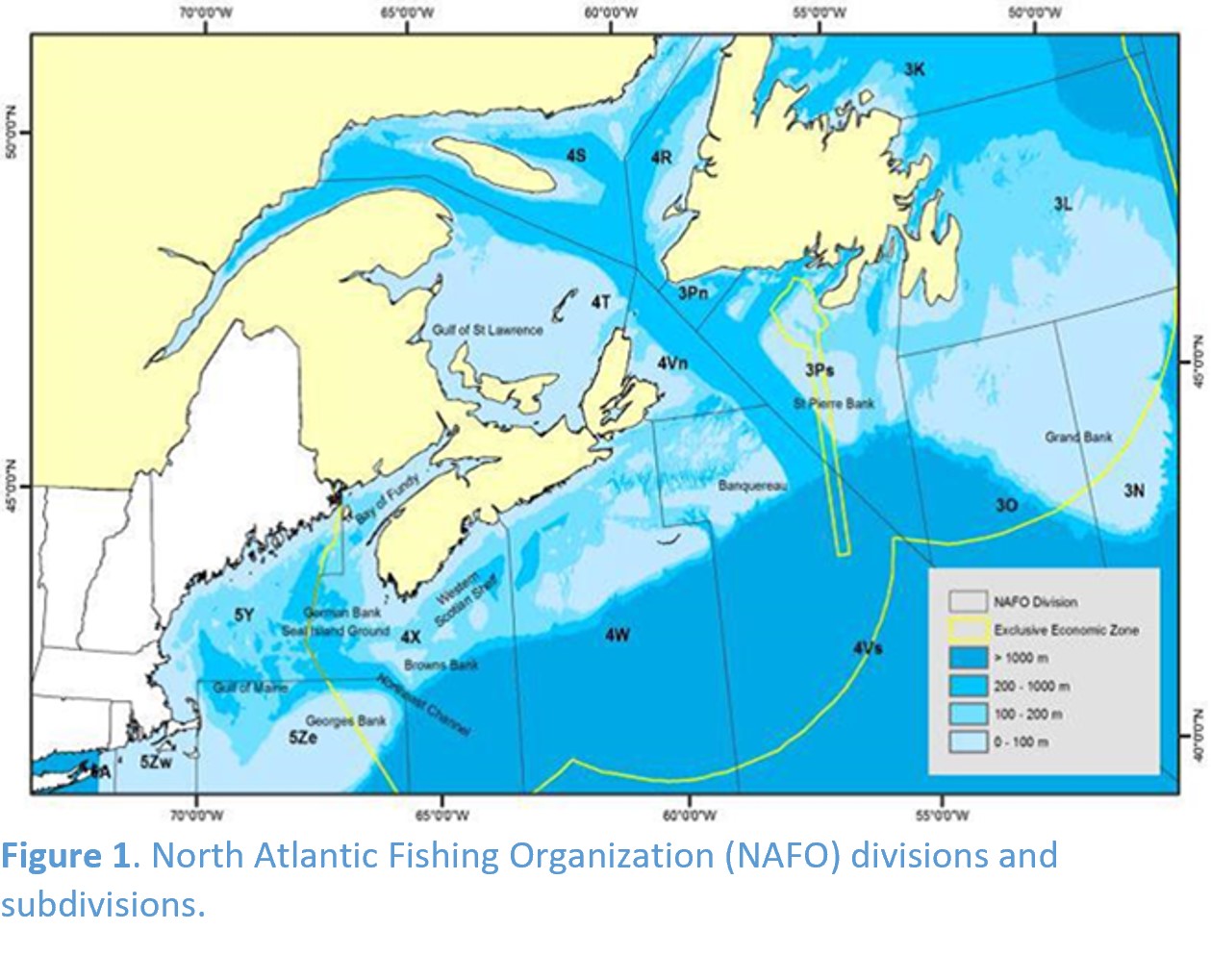
Text version: North Atlantic Fishing Organization (NAFO) divisions and subdivisions
Map showing the North Atlantic Fishing Organization (NAFO) divisions and subdivisions along the Canadian Atlantic coast from Newfoundland to Nova Scotia. Division 4T is used to define the boundaries of the southern Gulf of St. Lawrence white hake stock.
In the early 20th century, technological innovations in fishing such as steam- and diesel-powered ships, advancements in refrigeration and storage capabilities, along with rising prosperity and a growing demand for frozen fish, transformed the groundfish industry (Holm 2005). During the 1920s and 1930s, the cod fishing industry was a major employer in Newfoundland, engaging over 65,000 individuals in activities related to catching and processing fish (Rosano 2022). After World War II, the fishing industry saw significant changes with the introduction of large factory trawlers along the Grand Banks and the adoption of radar and sonar technology. Canadian and Newfoundland companies, unable to afford factory trawlers, built larger long-line vessels to fish further offshore as near-shore catches declined (Taylor 1995). These changes led to increased fishing pressure from both domestic and international fleets, resulting in a worrying decline in cod landings. This overfishing, exacerbated in certain areas, led to depleted fish stocks, highlighting persistent industry issues of low income and instability.
The 1970s saw further intensification of fishing pressure on groundfish stocks due to technological advancements that saw smaller fishing boats equipped with advanced fish-tracking technology (Taylor 1995). Key species such as Atlantic cod, American plaice, white hake, and Atlantic halibut were notably affected. The absence of effective regulatory measures at the time contributed to the accelerated depletion of stocks and exacerbated instability within the industry. The introduction of quotas in the late 1970s aimed to create a sense of ownership and to mitigate competition for fishing resources.
In 1977, the extension of Canadian fisheries jurisdiction to 200 nautical miles significantly restricted foreign vessel access to the Atlantic zone, which was a crucial step in conserving groundfish stocks (Parsons and Beckett 1998). This change was supported by heightened enforcement and the implementation of strict quotas, contributing to the gradual recovery of several groundfish species. However, despite these efforts, the groundfish industry faced severe challenges in the early 1980s due to cost and market pressures. By the early 1990s, groundfish, especially Atlantic cod, which had long been a staple of seafood landings in Eastern Canada, were in a dire state. The commercial value of these fisheries was substantial; in 1990, the landed value of the commercial fishery in Eastern Canada was $956 million, with groundfish landings accounting for $388 million, or 41% of this total. Landings of Atlantic cod alone were valued at $244 million, making up 63% of the groundfish total landed and 26% of all species landed.
The declining fish populations led to decisive actions in the early 1990s, with a moratorium imposed on the Northern cod fishery in 1992 to halt further declines (Schrank 2005) causing significant economic distress and job losses across whole communities and the fishing industry in Eastern Canada with 40,000 people being impacted, and 30,0000 being laid off in Newfoundland alone (Berry 2020). This was followed by the closure of the redfish (Unit 1) and white hake 4T commercial fisheries in 1995. In less than a decade, groundfish catches had plummeted from 734,000 tonnes in 1988 to just 96,000 tonnes by 1995. In response to these challenges, The Atlantic Groundfish Strategy (TAGS) was introduced in 1994, injecting over $4 billion into the sector to alleviate economic dependence on fishing.
Despite the 1990s moratoria on groundfish, a rise in the value of shellfish significantly increased the overall landed value of all species fished in Eastern Canada during the same period.
With the new millennium, the focus of fisheries management shifted towards establishing criteria for opening and closing commercial fisheries, signaling a new phase in resource management. In 2003, Cod Action Teams were formed to develop recovery strategies for Atlantic cod stocks, a key part of which involved implementing the PA to assess and manage the fishery based on stock health status: A Federal-Provincial Strategy for the Rebuilding of Atlantic Cod Stocks.
Climate change has also become a significant factor influencing all fisheries, introducing uncertainties and risks through changes in marine ecosystems. These changes, driven by warming waters and ocean acidification, lead to unpredictable shifts in the distribution and abundance of groundfish species, complicating the management and sustainability of these fish stocks (Cheung et al. 2013). This situation underscores the need for increased caution and adaptability in fisheries management.
Alongside environmental challenges, the fishing industry is also navigating socio-economic transformations. Shifts in societal expectations around sustainability, greater recognition of Indigenous rights, and evolving economic conditions in rural coastal communities, which traditionally depend on fishing, are redefining the industry's landscape (Stephenson et al. 2019).
Furthermore, the global seafood market's dynamic and competitive nature adds another layer of complexity. Fluctuating demand patterns for groundfish, influenced by changing consumer preferences and international trade agreements, present challenges that, although beyond the control of fisheries management, significantly impact the industry's sustainability (Asche et al. 2015).
In 2015, the total landed value of Atlantic cod was estimated to be $18 million, comprising 8% of the total value of groundfish landings, and only about 1% of the total landed value of all species. About 8% of all groundfish landings in Eastern Canada originated from the GSL. Exports of groundfish from Eastern Canada totaled $342 million in 2023, a significant decrease from $824 million in 1990. Over 90% of this 2023 export value was contributed by the provinces of Nova Scotia (NS) and Newfoundland and Labrador (NL), with major markets including the United States, China, United Kingdom, Spain, and Japan.
1.2 Overview of legislative, regulatory and policy framework
The management of groundfish in the GSL is regulated under a comprehensive legislative and policy framework, primarily guided by the Fisheries Act. This foundational legislation governs the conservation and sustainable use of fish resources throughout Canada, providing a structured approach to protect fish stocks and their habitats, ensuring the ongoing vitality of commercial, recreational, and Indigenous fisheries.
To support the Fisheries Act, specific regulations such as the Fishery (General) Regulations and Atlantic Fishery Regulations specify detailed rules for fishing practices, gear types, quotas, and seasons. These regulations are crucial for the tailored management of groundfish fisheries, ensuring that fishing activities are conducted in a manner that supports conservation objectives.
Additionally, the Oceans Act enhances the management and protection of Canada's marine environments, supporting sustainable development and the establishment of marine protected areas (MPA), which may include habitats for various species. The Species at Risk Act (SARA) complements this by providing a framework for the protection and recovery of endangered or threatened species, including specific measures for habitat protection and recovery planning.
The Sustainable Fisheries Framework (SFF), a body of policies under the Fisheries Act, provides the foundation for a rigorous and comprehensive approach to managing Canada’s fisheries, factoring in ecosystem considerations and precaution. This includes the adoption of the Precautionary Approach (PA) framework, which requires cautious management decisions in the face of scientific uncertainty about stock status and ecosystem impacts. This approach aims to establish biological reference points and implement management actions should these thresholds be exceeded.
Recent amendments to the Fisheries Act have introduced Fish Stocks Provisions, emphasizing the necessity to maintain fish stocks at sustainable levels and actively rebuild depleted stocks (see Annex A for details). The Fishery Monitoring Policy complements this by ensuring that catch monitoring programs in place provide reliable, timely, and accessible information on fisheries, which is essential for the sustainable management of fishing activities, maintaining transparency, and promoting accountability. The Policy on Managing Bycatch and the Policy for Managing the Impacts of Fishing on Sensitive Benthic Areas further enhance the SFF by addressing the reduction of bycatch and the protection of seabed environments critical to groundfish survival, embedding ecosystem considerations into fisheries management.
On the international stage, Canada's participation in treaties such as the United Nations Agreement on Straddling and Highly Migratory Fish Stocks, and its membership in the NAFO, align domestic fisheries policies with global conservation standards. These international agreements support Canada's commitments under the SFF, ensuring that the management of groundfish not only meets national objectives but also contributes to global efforts to sustain marine resources. Through these frameworks, Canada ensures that its groundfish management strategies are comprehensive, integrated, and aligned with both national conservation goals and international sustainable practices.
1.3 Types of fisheries and participants
1.3.1 Commercial fisheries
Commercial fishing licences are primarily issued for economic activities where the harvest of fish and other marine resources is intended for commercial sale and profit. Commercial groundfish fishing, for example, involves registered fish harvesters operating under licences issued under section 7 of the Fisheries Act. The terms and conditions of these licences, defined in the Atlantic Fishery Regulations, specify the type of gear that can be used, as well as designated fishing areas, target species, and fishing seasons.
Under the conditions of a licence, a harvester may be authorized to capture and retain one or more specific species as part of a directed fishery. These directed fisheries are regulated through allocations and size limits that are crucial for the sustainable management of fish stocks. Additionally, commercial fisheries are characterized by defined fishing seasons and areas, tailored to the biology and lifecycle of the target species. The licence may also permit the retention of incidental captures (i.e. bycatch) of certain groundfish species while targeting other specific species. This aspect of commercial fishing is also regulated under the Fisheries Act and its regulations, where bycatch allocations set limits on the amount and type of non-target species that can be incidentally caught and/or retained. These allocations and protocols aim to minimize the impact on non-target species, including those that are potentially vulnerable or endangered.
The regulatory framework for commercial licences is rigorous, involving detailed reporting requirements, adherence to quotas, size limits, and seasonal restrictions.
In the GSL, most groundfish harvesters also hold licences for commercially significant species such as snow crab and lobster, with only a limited number focusing exclusively on groundfish. In 2022 to 2023, about 40% of approximately 3,500 groundfish licence holders were active in the groundfish fisheries (i.e. had reported landings; Annex C).
1.3.2 Indigenous fisheries
Indigenous participation in Canadian fisheries is broadly categorized into communal commercial fisheries; and food, social and ceremonial (FSC) fisheries.
Communal commercial fisheries
The 1999 Supreme Court Marshall Decision, affirmed the treaty rights of the Mi'kmaq, Maliseet, and Peskotomuhkati peoples to fish in pursuit of a moderate livelihood (i.e. economic benefit) provided that conservation is not compromised. Operating under a unique framework, communal commercial fisheries allow Indigenous communities to engage in commercial fishing activities through licences issued to an Indigenous organization, and authorized via a Communal Commercial Licence, issued by DFO under the Aboriginal Communal Fishing Licences Regulations. This not only promotes economic development within Indigenous communities but also fosters sustainable resource management. Indigenous participation in communal commercial fisheries is notably diverse across different DFO regions (Annex C).
Food, social and ceremonial fisheries
Section 35 of the Canadian Constitution Act recognizes, and the Supreme Court of Canada clarified through the 1990 Sparrow Decision, that Indigenous people have the right to fish for FSC purposes. This right can only be limited or infringed if justified in specific circumstances, such as for conservation purposes, and takes priority over other uses of the resource. To authorize and support the exercise of the Aboriginal right within an integrated fisheries management and regulatory framework, DFO issues FSC licences to Indigenous communities for a variety of species, including groundfish; however, FSC licences do not define an Aboriginal right to fish or its scope.
FSC licences are issued according to the Aboriginal Communal Fishing Licences Regulations. Given that the Aboriginal right is collective, not individual, FSC licences are issued to a First Nation or Indigenous organization, which may then designate its members to fish under the communal licence. These licences authorize designated Indigenous harvesters to fish for themselves and/or their communities for FSC purposes. Unlike commercial or communal commercial fisheries, FSC fisheries do not allow for the sale of the catch and may operate at different times of the year, not necessarily aligned with commercial fishery seasons or areas.
To ensure that FSC licences remain aligned with community needs and conservation goals, DFO conducts regular evaluations and engages in consultations with the respective Indigenous communities and organizations regarding any proposed changes. DFO is actively working to collaborate with Indigenous communities to better understand their needs and objectives related to FSC fisheries, so that these needs can be accounted for in the department’s IFMPs.
1.3.3 Recreational fisheries
Recreational groundfish fisheries in the GSL are managed by the Fisheries Act, the Atlantic Fisheries Regulations, and the Maritime Provinces Fishery Regulations. Management measures may vary depending on the region and sector, but generally, recreational groundfish fishing is subject to restrictions regarding the allowable catch quantity (typically through a daily catch limit per individual or per boat), the type of gear used, and the targeted species. Recreational fishing in the GSL is also conducted aboard chartered boats.
As stated in section 15(2)(a) of the Atlantic Fishery Regulations and section 4(3)(a) of the Maritime Provinces Fishery Regulations, no license is required for recreational groundfish fishing using hand lines and fixed lines (in the MAR region). There is no official catch reporting mechanism. Although the economic impact of recreational fishing is more localized than that of commercial fishing, it helps stimulate tourism and the activities of related businesses in coastal communities adjacent to GSL.
1.4 Commercial fisheries management measures
This section provides an overview of some of the key management measures in place for the groundfish fisheries in the GSL at the time of the present IFMP publication. Many of these measures have been in place for a long time and are defined under the authority of regulations, licence conditions and policies (Annex E). Some measures are however subjected to regular or frequent adjustments to address conservation or other immediate management issues. Announcements and details of these measures are communicated as required in Conservation Harvesting Plans (CHP) and published on DFO’s regional Notice to Fish Harvesters websites:
1.4.1 Location and seasonality of the fisheries
This IFMP encompasses groundfish fisheries located in the GSL, specifically within NAFO Divisions 4RST and Subdivisions 3Pn and 4Vn. The Northern Gulf primarily falls under Divisions 4RS and Subdivision 3Pn, whereas the Southern Gulf is mainly situated within Division 4T and Subdivision 4Vn. These NAFO Divisions are further subdivided into smaller subareas or Groundfish Fishing Areas (GFA), as illustrated in figure 2.
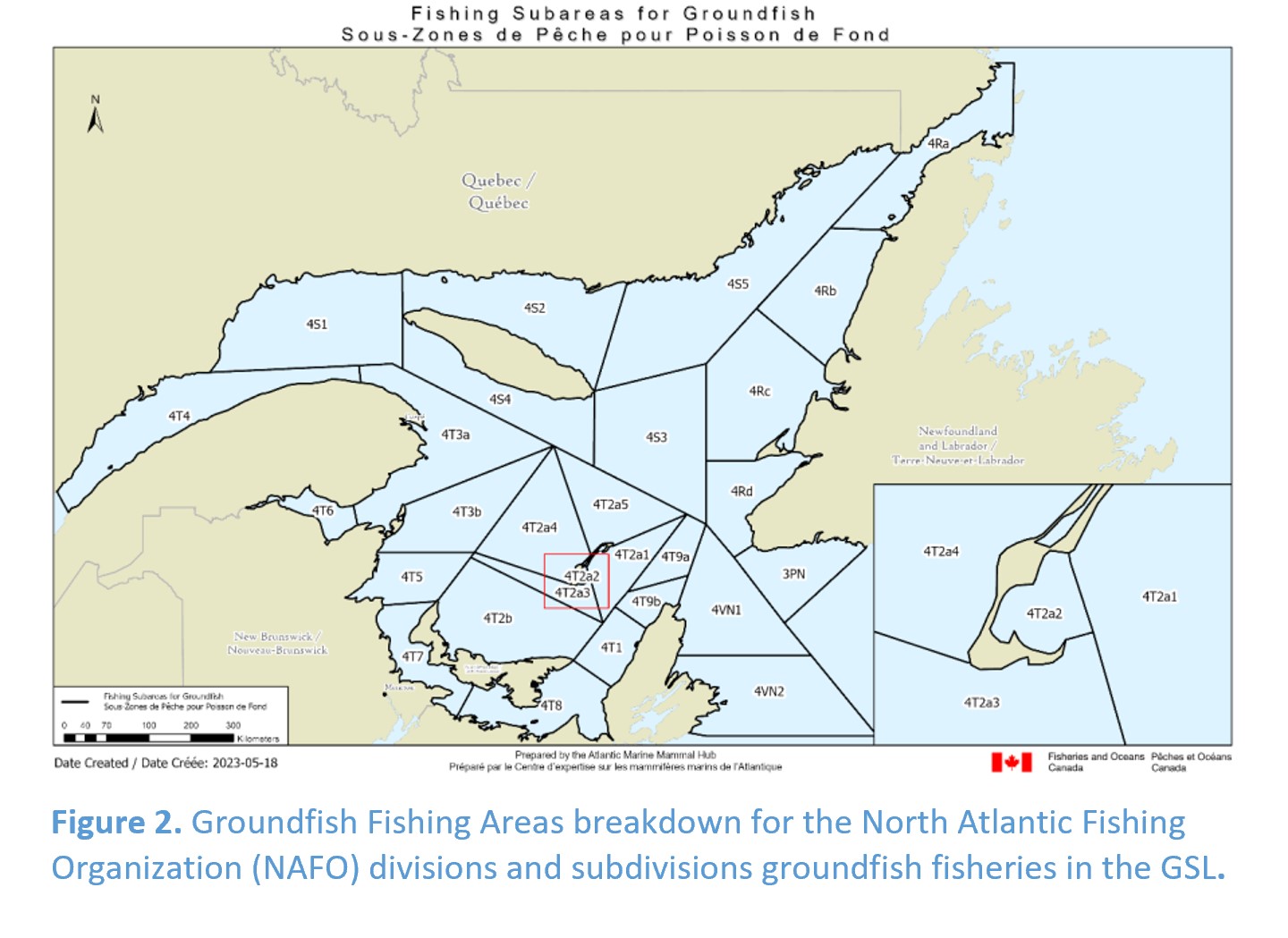
Text version: Groundfish Fishing Areas breakdown for the North Atlantic Fishing Organization (NAFO) divisions and subdivisions groundfish fisheries in the GSL
Map showing the Groundfish Fishing Areas (GFA) in the North Atlantic Fishing Organization (NAFO) divisions and subdivisions for groundfish fisheries in the Gulf of Saint Lawrence. The bottom right corner of the map also shows a closer view of the GFA 4T2a’s subdivisions.
The management cycle for groundfish stocks in the GSL extends from May 15 of one year to May 14 of the following year. However, closures for conservation purposes may delay the opening of specific fisheries.
1.4.2 Methods of fishing and primary harvesting controls
Gear types and regulations
Two main types of gear are allowed in groundfish fisheries: fixed and mobile (Table 2). The GSL's groundfish fisheries currently predominantly employ fixed gear—including gillnets, longlines and handlines—as well as mobile gear like otter trawls and Danish/Scottish seines. Following the 1992 cod moratorium, mobile gear usage for the directed cod fishery has been restricted in the GSL.
While mobile gear is still permitted for other groundfish species in the Gulf, its utilization has significantly diminished due to limited quotas for targeted fisheries. Since 1994, directed fishing for Greenland halibut using mobile gear has been prohibited in the GSL. In 2013, a ministerial decision paved the way for the gradual re-entry of mobile gear fleets into the 4RST Greenland halibut fishery. This re-entry is contingent upon the 4RST Total Allowable Catch (TAC) exceeding 4,500 t. Further, mobile gear use among fish harvesters in the GSL is expected to increase with the re-opening of the redfish Unit 1 commercial fishery in 2024.
In addition to these gear-specific restrictions, the fisheries management authorities also provide explicit directives regarding the configuration and quantity of gear permitted. Such rules may regulate the size of the mesh used in nets or the size of hooks, and limit the amount of gear allowed, such as the number of hooks. These regulations aim to ensure the selectivity of fishing operations, reducing bycatch and minimizing the impact on juvenile fish and non-target species.
Fleet specifications
The fixed gear fleet primarily comprises vessels under 19.2 m (65 ft). The mobile gear fleet features a diverse range of vessel sizes, from less than 13.7 m to over 30.4 m (100 ft) (Annex C).
Access and allocations
The Minister can, for conservation reasons or for any other valid reason, modify the access, allocations and sharing arrangements outlined in the IFMP in accordance with the powers granted to the Minister pursuant to the Fisheries Act. The groundfish fisheries covered in this IFMP are quota-based and are each subject to a TAC.
TACs are set for commercially harvested groundfish stocks and are based on a decision-making framework incorporating the PA that considers the current status of each stock and, where available, implements a risk analysis of different TAC options. This is a central component of sustainable fisheries management, helping to ensure that fishing activities do not lead to over-exploitation of the stocks.
TACs are determined based on scientific research and data, including stock assessments, fish age composition and growth studies. Other factors such as ecological considerations, including species interactions and ecosystem impacts, may also inform the decision-making process.
Once TACs are established, they are subdivided into allocations for various fleets. This division is based on factors such as historical shares, type of gear used (fixed or mobile), vessel class (inshore, midshore, offshore), geographic location (taking into account the distribution of the stocks and traditional fishing grounds), and management regime (whether it's a competitive fishery or managed under an Individual Quota (IQ) system). Access for some groundfish fisheries may also be regulated by a number of policies to promote independent core fish harvesters, the owner/operator, the fleet separation, etc. More information about these and other policies:
- Commercial Fisheries Licensing Policy for Eastern Canada 1996
- Commercial Fisheries Licensing Policy for the Gulf Region
- Fisheries Licensing Policy Newfoundland and Labrador Region
IQs, in particular, allocate a specific portion of the TAC to individual fishers or companies. This allows fishers to have a guaranteed share of the catch, helps prevent the 'race to fish', and provides an incentive for responsible fishing practices as fishers can benefit directly from maintaining healthy fish stocks (Arnason 2005).
Annex D provides information about how some of the TACs are divided and allocated to various fleets. Annual information about access and allocations is provided on DFO’s Fisheries Management Decisions and Atlantic Sharing Arrangements websites.
1.4.3 Reporting and monitoring programs
A summary of the main monitoring measures in place for the groundfish fishery is presented in annex E. Thanks to technological advancements, DFO is intensifying efforts to implement near real-time monitoring and data collection systems for the entire groundfish fishery, thereby contributing to more effective enforcement of regulations and the promotion of responsible fishing practices (Plet-Hansen et al. 2017).
Dockside Monitoring Program
The Dockside Monitoring Program (DMP) provides independent third-party verification of landings. Commercial fishing licences require participation in the program for all groundfish species (for all or a portion of fleets and landings).
The program supports fisheries management by providing accurate and timely harvest data, including the weight and species landed. The program is paid for by the fishing industry. Commercial fishers make agreements with service providers qualified by the Canadian General Standards Board and designated by DFO.
At-Sea Observer Program
The At-Sea Observer (ASO) Program provides independent third-party verification of harvesting activities. The program provides accurate and timely information on harvests. It also provides scientific catch and sampling data. The fishing industry and the department use this information for fisheries management and scientific research purposes.
Commercial harvesters make agreements with service providers qualified by the Canadian General Standards Board and designated by DFO.
Logbook
Maintaining an accurate and up-to-date logbook is a legal obligation under section 61 of the Fisheries Act, in addition to being required under the conditions of licence. Harvesters must record their fishing catch and effort and submit this data to the department as specified in their licence conditions.
Electronic logbooks
Electronic Logbooks (ELOGs) are a digital solution that make catch reporting faster and more efficient for harvesters. With ELOGs, harvesters can submit their data in near-real time, helping DFO to get accurate, effective, and consistent catch and effort data from across the country.
Vessel Monitoring System
Vessel Monitoring Systems (VMS) track the positions and movements of vessels and are mandatory under licence conditions for certain fisheries. With advancements in technology, DFO is increasing its effort to implement near real-time monitoring and data collection systems for the entire groundfish fishery; contributing to more effective regulation enforcement and promoting responsible fishing practices (Plet-Hansen et al. 2017). In the groundfish fishery, VMS is required in all vessels greater than 65 feet, and some vessels from the less than 65 feet fleets may also need to carry a VMS onboard.
Hailing-in and hailing-out
Harvesters’ pre-departure and pre-arrival notifications (also referred to as hailing-in/hailing-out) refer to communication between a commercial fishing vessel and a third-party monitoring company, fishery managers, or enforcement officials prior to commencing a fishing trip and at the end of a fishing trip (often prior to reaching port). Conditions of licence may require harvesters to communicate before leaving port, before returning to port, at the end of a fishing day, or all three. A main purpose of the tool is to assist in planning further monitoring and enforcement activities. Harvesters’ pre-departure notifications are typically provided within a mandated pre-departure timeframe to allow observer companies to plan deployment of ASOs. Harvesters’ pre-arrival notifications are typically provided to dockside monitoring companies to allow them to plan their dockside verification activities; this could be to plan the arrival of dockside monitors or to plan the requested sampling scheme if coverage is not 100%. In some fisheries, harvesters’ pre-arrival notifications are used to report daily catches on multi-day (extended) trips, which allow area or individual quotas to be closely regulated. Information conveyed in harvesters’ pre-arrival notifications can include fishing area, retained species (targeted and bycatch), and approximate amounts of catch (see Beauchamp et al. 2019 for more information about catch monitoring tools used in Canadian fisheries).
1.4.4 Small fish and by-catch protocols
Protocols have been put in place to maintain catches of small (undersized) fish and incidental catch of species (other than directed) at minimum levels (Annex E). Designated areas may be closed for specified fleets when the number of undersized fish reaches or exceeds 15% of the catch of any species, or when incidental catches of a closed fishery for a particular species reaches or exceeds the established level for the fleet (refer to the corresponding CHP for the fleet/region).
The term “by-catch” means the incidental or unintentional capture of non-targeted species while fishing for directed species as authorized under a licence; this includes species not regulated.
Small fish and by-catch fishing closures will be of a minimum duration of 10 days. A test fishery must be completed prior to re-opening a closed fishing area. The cost of conducting all test fisheries must be borne by industry (i.e. ASO program). If a fishery is closed, it may re-open if the number of small fish is below 15% of the total catch for the test fishery and incidental catches are within the acceptable levels for the fleet. If any particular fishery is closed twice during the fishing season because of high levels of small fish or incidental catch, the fishery may remain closed for the remainder of the fishing season.
1.4.5 Discarding for conservation purposes
Selective discarding of fish for conservation reasons may occur when authorized by a licence condition. Species such Atlantic halibut less than 85 cm, skate, dogfish and lumpfish, as well as species at risk shall forthwith be returned to the place from which it was taken in a manner that causes it the least harm. All other groundfish species must be retained and landed.
1.4.6 Quota reconciliation
Quota reconciliation was implemented for all Gulf groundfish fisheries managed through quotas starting in the 2010 season. Under quota reconciliation, any quota overrun in a given year—whether within an Individual Transferable Quota (ITQ) regime or in a competitive fishery—is deducted on a one-for-one basis from the quota established for the following season.
It is not a penalty or sanction for overfishing; rather it represents an accounting of overruns from one fishing period to the next so that removals respect established quotas over time. Quota reconciliation facilitates the management of all fisheries and promotes compliance with harvest limits. It contributes to achieving resource conservation objectives, ensures that quota overruns by one fleet or fisher do not affect others, and holds the industry accountable for conservation goals.
1.4.7 Quota carry-forward
Quota carry-forward guidelines for Atlantic Canada were developed and put into effect on February 15, 2016. The maximum percentage of quota that can be carried over for each fishery is 15%; although special arrangements may be considered for fleets receiving very small allocations in order to support optimal fishery planning. At this time quota carry-forward only applies to the Atlantic halibut fishery in the GSL.
The ability to carry forward quota provides participants with increased flexibility to manage quota from one fishing year to the next. This mechanism will allow industry to adapt to resource and market fluctuations and remove the incentive to overexploit due to fear of losing quota at year end. The guideline reflects biological factors identified in the appropriate Science Advisory Reports (SAR) and other relevant factors and must be based on acceptable PA principles.
1.4.8 Species at Risk Act (SARA) requirements
SARA-compliant licences
A number of Canada’s wildlife species are considered to be at risk. Ensuring protection and promoting recovery of at-risk species is a national priority. To this end, the Government of Canada developed the SARA and a number of complementary programs to promote recovery and protection of species at risk. The purposes of SARA are to:
- prevent wildlife species from being extirpated or becoming extinct
- provide for the recovery of wildlife species that are extirpated, endangered or threatened as a result of human activity
- manage species of special concern to prevent them from becoming endangered or threatened
The Committee on the Status of Endangered Wildlife in Canada (COSEWIC) is an independent body of experts responsible for identifying and assessing wildlife species in Canada. Wildlife species that have been assessed by COSEWIC as special concern, threatened, endangered, or extirpated can be listed under SARA for legal protection and recovery planning. The COSEWIC assessment and status report, science information, consultation feedback and results, as well as social and economic factors are used to inform a ministerial listing decision. The protection and recovery of species at risk involves the development and implementation of recovery strategies, action plans, and management plans. Further information on SARA and the SARA listing process can be found on the Species At Risk Public Registry.
Of the 10 groundfish stocks originally covered by this IFMP, 5 have been assessed by the COSEWIC as at risk (i.e. special concern, threatened, or endangered). Furthermore, numerous non-commercial species assessed as at risk by COSEWIC or listed under SARA need to be considered in the overall GSL groundfish fisheries management strategy and decision-making (Annex F).
Fishing activities (e.g. commercial fisheries) can violate prohibitions under SARA if they have the potential to incidentally capture, take, kill, harm, or harass species listed as threatened or endangered under SARA. When authorizations are required under both SARA and the Fisheries Act, fishing licences adhering to SARA's regulations can be issued via its section 74, provided those licences (and thus the fishery) meet the criteria outlined in section 73. SARA-compliant (section 74) fishing licences then have the same effect as a section 73 permit, allowing for the incidental capture, take, kill, harm, or harassment of specific species listed under the Act. Additional conditions can be added to SARA-compliant fishing licences, through section 75, to protect the listed wildlife species, any part of the critical habitat or the residences of its individuals. Section 74 fishing licences are currently being issued to commercial fixed and mobile groundfish fisheries that have the potential to incidentally capture, take, kill, harm, or harass white sharks.
If a fishing activity is carried out for scientific research related to the conservation of a species at risk, a fishing activity that benefits species at risk, or a fishing activity that has an incidental impact on a species at risk, a section 73 SARA permit may be issued. However, the fishing activity must meet all of the pre-conditions of section 73(3), in that all reasonable alternatives to the activity that would reduce the impact on the species have been considered and the best solution has been adopted, all feasible measures will be taken to minimize the impact on the species, and that the fishing activity does not jeopardize the survival or recovery of the species.
Mandatory Species at Risk logbook submission
All groundfish licence holders are required to submit a Species at Risk (SAR) logbook at the end of each fishing season, regardless of whether interactions with species at risk have occurred. Data from the SAR logbooks are instrumental in monitoring incidental interactions between fishing activities and species at risk and supporting adaptive management strategies. SAR logbooks also provide valuable insights for future conservation efforts aimed at the protection and recovery of species-at-risk. The rate of return of SAR logbooks is often factored into the sustainability and ecocertification of fisheries.
1.4.9 Habitat protection measures
Recognizing the ecological and biological value of benthic ecosystems and their role in supporting aquatic species that Canadians depend on, numerous measures have been implemented to help DFO manage fisheries to mitigate impacts of fishing on sensitive benthic areas or avoid impacts of fishing that are likely to cause serious or irreversible harm to sensitive marine habitat, communities and species. Marine Protected Areas across Canada and Marine refuges across Canada are examples of such area-based conservation measures which can have a positive impact on fish habitat and the conservation of species.
There are also specific area-based management measures in place for the protection of different species of groundfish and invertebrate species. These measures are implemented through CHPs or licence conditions. An overview of the area closures in the GSL is presented in annex G. In addition, a permanent no-fishing zone is in place around the area defined as the Irving Whale exclusion zone, so as to prevent potential contamination from the consumption of fish caught in the surrounding environment as well as the risk of Polychlorinated Biphenyls (PCB) entering the food chain through species like the snow crab (DFO and EC 1997; Gilbert et al. 1998).
1.4.10 International matters
Marine Mammal Protection Act
The United States (US) is implementing the import provisions of the Marine Mammal Protection Act (MMPA) following court direction. The import rule requires countries exporting fish and fish products to the US to demonstrate that they have regulatory measures in place that are comparable in effectiveness to those of the US for prohibiting intentional marine mammal mortality and reducing incidental marine mammal mortality and serious injury in commercial fisheries. Fisheries that fail to demonstrate such comparability measures to the US by December 31, 2025, will be prohibited from entering the US market starting January 1, 2026. More information can be found on the following website: Implementation of Fish and Fish Product Import Provisions of the Marine Mammal Protection Act.
Since 2019, the GSL has been designated a dynamic area for fishing management measures when North Atlantic right whales are present. All past and present fishing management measures regarding North Atlantic right whales can be found online on the North Atlantic right whale site. Those measures are applicable to all fisheries using vertical lines in the water when the fishing gear is not tended starting in April with the opening of the first fishery using vertical lines in the water, until November 15.
A suite of management measures have been implemented that focus on preventing vessel strikes and entanglements. These measures are aligned with the requirements of the US MMPA with respect to marine mammal by-catch.
The management measures put in place include:
- mandatory lost and retrieved gear reporting
- tended gear in closed in areas closed due to the presence of North Atlantic right whales
- mandatory reporting of interactions between vessels or fishing gear and marine mammals
- notification of presence of North Atlantic right whales
- gear marking requirements for non-tended fixed gear fisheries
It is now mandatory to report all lethal and non-lethal marine mammal interaction including bycatch, collision and all sightings of marine mammals entangled in fishing gear. Canada is currently working towards demonstrating appropriate measures are in place in all Canadian fisheries.
Catch certification
The European Union (EU) introduced regulations in January 2010 that require Canadian fish and seafood products to have a government validated catch certificate attesting that the product is not from an Illegal, Unreported, and Unregulated (IUU) fishery. This program requires that fish exports to the EU are accompanied by a catch certificate issued in the country of origin. Since its inception, the Program's scope has expanded to include certification schemes for Chile, Japan, and Ukraine. DFO is responsible for the administration of Canada’s Catch Certification Program.
Ecolabelling and rating schemes of sustainability fisheries
Major retailers in critical markets for Canadian fish and seafood are increasingly demanding evidence of sustainable fishing practices. Assessments of sustainability can take many forms and vary in their ability to provide evidence-based conclusions. The two most prevalent in the Canadian context are third party ecocertifications (e.g. Marine Stewardship Council) and non-governmental sustainability rating schemes (e.g. Seafood Watch).
Seeking ecocertification is a market-driven business decision, and it represents a private contractual process between fisheries clients and certifiers. Ecocertification is a third party, independent review and assessment of the sustainability of a given fishery (specific fleet, fishing area, gear type, etc.) against a private standard that leads to permission to use a designated eco-label.
Although DFO is not responsible for requesting ecocertification, it collaborates with a certification requester to facilitate the certification process by providing all available information that may be asked by the organization issuing the certification. In very recent years, DFO has been able to provide some input for rating schemes assessments, by verifying if DFO produced information used for rating are complete and applied in the appropriate context of the species being rated.
In recent years, fisheries clients have also requested DFO assistance in the establishment of Fishery Improvement Projects (FIPs). These projects aim to improve and prepare fisheries not currently ready for third-party evaluation.
In contrast to the voluntary nature of ecocertification, rating schemes are designed by non-governmental environmental organizations to influence consumer buying habits by proactively assessing fisheries against a standard developed by the campaign regime. They are no third party, independent review and assessment. Rating schemes are mainly based on species, regardless of gear, fleet, and management measures, and applied to very broad zone of combined fishing areas.
Gear
In order to get a better understanding of potential impacts of lost gear, mandatory reporting was introduced in 2020. The licence holder must report any lost fishing gear within 24 hours of returning to port at the end of the fishing trip.
The licence holder must also report the retrieval of any of their own previously reported lost gear within 24 hours of returning to port at the end of a fishing trip. The reporting of lost gear requirement is managed as a condition of licence.
Gear marking was implemented in 2020 for all non-tended fixed gear fisheries, as well as lobster and crab fisheries in Eastern Canada. This requirement is part of the Government of Canada’s continuing effort to improve tracking of gear, address ghost gear and further identify management measures threats to marine mammals, in particular North Atlantic right whales. It was implemented to recognize gear origin, specifically country, region species as well as fishing areas.
1.5 Safety at sea
Marine safety and the safety of fish harvesters are priorities for DFO. Commercial fishing is recognized as one of the most dangerous occupations in the world and with over 45,000 fish harvesters in Canada, the fishing industry has one of the highest fatality rates with an average of 10 commercial fishing deaths every year. Safety at sea is a shared responsibility between DFO and Transport Canada (TC). These organizations have established a framework for cooperation through a Memorandum of Understanding (MOU) to address this issue. The MOU outlines the development of safety goals, facilitates the exchange of information, and promotes a safety culture among commercial fish harvesters. All fishing vessels are required to be registered with TC under the Canada Shipping Act (2001) as TC is responsible for regulations and enforcement related to the safety of all vessels and marine personnel.
1.6 Compliance and enforcement plan
The management of Canadian fisheries requires an integrated approach to monitoring, control and surveillance that involves the deployment of Fishery Officers to conduct land-based, vessel-based and aerial patrols; DMP audits, as well as plant and harvester inspections. A summary of the key elements of the Conservation and Protection (C and P) compliance and enforcement plan is presented in annex H.
1.7 Governance
The governance of groundfish fisheries in the GSL, specifically in NAFO divisions 4RST, 3Pn and 4Vn is a multi-tiered system involving various jurisdictional entities. Each entity operates within its own legislative framework and contributes to the overall management and conservation of these fish stocks.
1.7.1 Federal government
DFO is the principal federal agency responsible for the management and conservation of groundfish stocks. DFO's mandate encompasses policy direction, scientific research, and enforcement, thereby providing a comprehensive governance framework for sustainable fisheries management.
The approval process for fisheries management decisions, plans and actions is determined by the level of decision-making authority. For overarching matters concerning conservation and management, the ultimate authority rests with the Minister of Fisheries and the Canadian Coast Guard. For region-specific fisheries, particularly those with geographical fleets, the Director of Resource Management for each respective region is responsible for decision-making. In cases involving competitive fisheries that span multiple regions, the Regional Director General (RDG) for the Gulf Region collaborates with the RDGs for QC, MAR, and NL Regions to make coordinated decisions.
1.7.2 Multi-stakeholder governance
Effective management of groundfish fisheries also requires collaborative approaches. The Gulf Groundfish Advisory Committee (GGAC) serves as the primary consultative body for the development of fishery management measures. It comprises representatives from First Nations, provincial governments, DFO, groundfish harvesters' organizations and processing company associations. GGAC convenes every two years (or annually, as circumstances require) to advise on a wide range of issues, including regulatory amendments, enforcement strategies, departmental policies, fishing seasons, gear restrictions, conservation measures, and development activities. The Gulf Region Fisheries Resources Management Branch coordinates GGAC's activities in collaboration with DFO administrative regions, including QC, NL, and MAR. The terms of reference and membership information of the GGAC are presented in annex I.
1.8 Indigenous knowledge
Indigenous Knowledge (IK) is knowledge held by, and unique to, Indigenous peoples. IK provides a valuable understanding of species, their local environment, and the characteristic ecological relationships between them. Recognizing the importance of this unique knowledge, DFO aims to incorporate IK into fisheries management planning whenever it is provided through consultation and engagement processes.
Subsection 2.5(d) of the Fisheries Act empowers the Minister to consider IK of the Indigenous peoples of Canada that has been provided to the Minister and the department. This consideration may be made alongside other factors, such as scientific data and socio-economic considerations.
In addition to the legal framework, DFO is committed to fostering meaningful relationships and partnerships with Indigenous communities and organizations regarding the management of federal fisheries. This collaboration can involve engaging Indigenous peoples in decision-making processes, collaborative management arrangements, and incorporating IK in stock assessments, monitoring, policy development and other aspects of fishery’s management.
1.9 Precautionary approach framework and rebuilding plans
1.9.1 Precautionary approach
Canada has domestic and international commitments to implement the PA into its fisheries decision-making framework. Domestically, these commitments include the 2003 guiding principles for the application of precaution to science-based decision making in the federal government (PDF, 134 KB) and the 2004 Atlantic Fisheries Policy Review (PDF, 826 KB). Internationally, this includes the United Nations Fish Stocks Agreement, the Food and Agriculture Organization (FAO) Code of Conduct for Responsible Fishing (PDF, 332 KB) and the FAO associated guidelines on applying the PA in fisheries.
In 2009, DFO published the SFF and several associated policies. A key policy under the PA Framework is “A Fisheries Decision-Making Framework Incorporating the Precautionary Approach,” which outlines the departmental methodology for applying the PA when making decisions regarding harvest levels in Canadian fisheries.
The concept of PA in fisheries management is to be cautious when scientific knowledge is uncertain, and not using the absence of adequate scientific information as a reason to postpone action or failure to take action to avoid serious harm to fish stocks or their ecosystem. Applying the PA to fisheries management decisions entails establishing a harvest strategy that:
- identifies three stock status zones - healthy, cautious, and critical
- sets the removal rate at which may be harvested within each stock status zone
- adjusts the removal rate according to fish stock status variations (i.e. spawning stock biomass (SSB) or another index/metric relevant to population productivity), based on harvest control rules (HCR)
Annex J summarizes the development of reference points and PA-compliant HCR for the various GSL groundfish stocks at the time of the publication of the present IFMP. According to the PA framework, the Atlantic halibut 4RST stock is in the healthy zone (DFO 2023, DFO 2025), whereas the witch flounder and Greenland halibut 4RST stocks are in the cautious zone (DFO 2022d, DFO 2025). All other stocks are in the critical zone:
- yellowtail flounder 4T
- white hake 4T
- cod 4RS, 3Pn
- cod 4TVn
- American plaice 4T
- winter flounder 4T
1.9.2 Rebuilding plans
With the passing of Bill C-68 in 2019, the renewed Fisheries Act now dictates that when a fish stock has declined to or below its reference limit point, a plan must be developed to rebuild the stock above the Limit Reference Point (LRP), unless the stock is already listed under the Species at Risk Act. If the stock is already listed in the Species at Risk Act, the rebuilding of the stock will be guided by provisions under the Species at Risk Act.
Of the 10 groundfish stocks initially covered in the previous IFMP, 5 stocks (American plaice 4T, Atlantic cod 4RS, 3Pn, Atlantic cod 4TVn, white hake 4T and winter flounder 4T) are prescribed under the Fishery (General) Regulations with more information from the First Batch of 30 Major Stocks Prescribed to the Fish Stock Provisions and are now managed through rebuilding plans, in line with section 6.2 of the Fish Stocks Provisions (FSP). Additionally, the yellowtail flounder 4T stock is also under consideration for management through a rebuilding plan.
The remaining three stocks, namely Atlantic halibut 4RST (Annex K), Greenland halibut 4RST (Annex L) and witch flounder 4RST (Annex M) will continue to be managed through the present IFMP.
With the re-opening of the redfish fishery, a separate IFMP will be developed to address the management of the Unit 1 stock (NAFO 4RST and 3Pn, 4Vn (January to May)), comprised of both Sebastes fasciatus and Sebastes mentella species.
2. Science and stock assessment
This section of the document provides a general overview of scientific activities and issues related to the stock assessment and status of the various groundfish stocks in the GSL, as well as the state of the ecosystem. For detailed and up-to-date information on specific species or stocks (such as assessments, trends and forecasts), readers are encouraged to visit and search the Canadian Science Advisory Secretariat (CSAS) website.
2.1 Data collection and assessment
Scientific data used in stock assessments can come from a variety of sources that are grouped into two categories. Data are either collected from outside fisheries (fishery-independent) or directly from fisheries (fishery-dependent). Groundfish stock assessments and research programs are using both categories of data, depending on the species or stock being assessed and the location.
2.1.1 Fishery-independent data sources
The fishery-independent multi-species standardized bottom-trawl surveys provide the main estimates of relative abundance that are essential to the assessment and management of numerous groundfish (demersal) stocks in Atlantic Canada, including the GSL. By employing standardized and statistically-sound sampling schemes, and ideally covering large geographical areas that contain almost all of the stock’s spatial distribution, these surveys minimize the impact of factors that may confound the interpretation of abundance trends, as is common for fishery-dependent indices like catch per unit of effort (CPUE) and landings (Hilborn and Walters 1992).
In Atlantic Canada, annual research vessel (RV) bottom-trawl surveys have been in place since the early 1970s or 1980s, depending on the area (Chadwick et al. 2007; Benoît et al. 2020). Two main RV surveys are conducted annually in the GSL, one covering the sGSL and one covering the nGSL and Estuary. The sGSL survey has been conducted annually each September since 1971. The nGSL survey has been conducted annually each August since 1984.
Some stocks are also monitored with fishery-independent sampling programs contracted or conducted in conjunction with harvesters (i.e. sentinel fisheries). These sampling programs operate under strict scientific protocols, consistent with the objective and methodology of the targeted stock to assess.
2.1.2 Fishery-dependent data sources
Some stock assessments also involve the use of fishery-dependent data. These sources of data include information on the catch of each species, including fish that are brought to shore, fish that are released at sea, and fishing effort (e.g. the number of nets or hooks and hours spent fishing). Fish sampled from the catches can also provide biological information on the stock; including fish size, age and maturity, and helps DFO Science understand how the characteristics of the stock might be changing over time. It is important to recognize that data from commercial fishing may exhibit spatial and temporal biases. These data are considered fishery-dependent because they are not based on a rigorous statistical sampling plan. In other words, their collection is influenced by the choices of fishers, who target areas and times where they believe they have the best chance of catching desired species, while avoiding those that are not wanted. This preferential approach leads to distortions in the representativeness of the data. These biases are well known and are taken into account in stock assessments, notably through the integration of statistical methods that help correct or mitigate their effects.
2.2 Scientific peer review and science advice
The CSAS coordinates the scientific peer review and science advice for DFO. The CSAS publishes departmental scientific advice and information on issues such as fish stock dynamics, species at risk, invasive species, ecology of marine and freshwater ecosystems, MPAs, aquaculture, and the use of living aquatic resources.
In partnership with the Centres for Science Advice (CSA), located in each DFO administrative region, scientific assessments are conducted independently, tailored to regional, zonal (more than one region) or national needs. These peer review processes are conducted according to the following principles:
- providing timely, responsive and flexible to client needs
- employing the most appropriate and credible scientific methods
- involving a range of expertise and perspectives along with scientific experts from within and external to DFO in the review process
- providing publicly accessible documentation
The CSAS also coordinate the publication of the peer review meeting products that are linked to the Science Advisory Schedule, a dynamic online calendar that includes information on past and upcoming peer reviews. Meeting products include SARs and Science Responses (SR) which summarize the advice generated at the meetings. Research Documents contain the technical basis for advice and proceedings reports document the meeting discussions.
The GSL groundfish stocks are managed with the collaboration of four DFO Regions (i.e. Gulf, QC, MAR and NL Regions). The stock assessment process and the consultative process with Indigenous groups and stakeholders are following the schedule presented below.
Expected timetable for the regional science assessment process (RAP) for each stock from 2025 to 2030 (the expected frequency in years is shown in brackets).
- Atlantic halibut 4RST (2 yrs): 2025, 2027, 2029
- Greenland halibut 4RST (2 yrs): 2025, 2027, 2029
- White hake 4T (10 yrs): 2025
- Cod 4RS, 3Pn (2 yrs): 2025, 2027, 2029
- Cod 4TVn (4 yrs): 2028
- American plaice 4T (5 yrs): 2027
- Witch flounder 4RST (5 yrs): 2027
- Winter flounder 4T (5 yrs): 2027
2.3 Impacts of climate change on ecosystems and fisheries
Canada’s marine ecosystems are undergoing significant changes. These changes are related to a combination of climate change, natural variability, and other human pressures, such as fishing.
Climate change is especially impacting our oceans and coastal communities. Changing ocean conditions could favor some species in the future while others will not be able to adapt to the new conditions. If climate change alters the environment where a species lives, it may change their location to follow food sources or to remain at the optimal water temperature for their survival. In some cases, climate change can allow unwanted species (i.e. invasive species) to establish themselves in new areas.
DFO is presently monitoring and studying the effects that changing oceans conditions are having on Canada’s ecosystems and commercial fisheries. Some of the research and/or modelling activities are addressing the knowledge gaps associated with climate changes impacts and the vulnerability of fisheries and coastal ecosystems, identifying which marine species or stocks are the most vulnerable to changing climate and oceans conditions, and identifying changes in habitats and species distributions.
2.4 Ecosystem interactions
The ecosystem in the GSL has changed dramatically in recent decades. Abundances of many large-bodied demersal fishes (e.g. Atlantic cod, white hake, American plaice, and skates) have declined to very low levels, and continue to decrease. These fishes currently have elevated natural mortality at adult sizes. In contrast, some fishes such as alligator fish, capelin and sculpins have increased in abundance (Benoît and Swain 2008). Short term prospect for redfish stocks in Unit 1 are also positive due to the large cohorts from 2011, 2012 and 2013 that are now mostly larger than the minimum regulatory size of 22 cm. Given the low levels of recruitment and growth observed in recent years, even in the absence of fishing, redfish biomass is expected to decrease in upcoming years due to natural mortality (DFO 2025b, Senay et al. 2023).
More recently, pelagic forage fish species such as herring (Hammill et al. 2023, DFO 2022a) and mackerel (DFO 2021) have also declined. Grey seals (year-round residents) and harp seals (present in winter and early spring) are also at high levels of abundance (DFO 2020) and have contributed to important increase of natural mortality of several other bottom-dwelling species (Neuenhoff et al. 2019 and Rossi et al. 2021). In conjunction with climate change research activities, DFO’s science continues to conduct monitoring programs and research to better understand and incorporate ecosystem interactions in their assessments.
3. Management strategy: Moving forward
This section of the IFMP provides an overview of key management objectives, and expected results for elements that will require additional actions and resources beyond ongoing management measures. Although the issues are applicable to most GSL groundfish stocks, attention is given to the 3 stocks (Atlantic halibut 4RST, Greenland halibut 4RST, and witch flounder 4RST) that are the focus of this IFMP.
3.1 Key management issues and considerations
3.1.1 Adaptation to climate changes and changing stock productivity
Climate change and ecosystem perturbations are affecting the GSL groundfish fishery, with multiple impacts on many species and their productivity. Rising ocean temperatures recorded in recent decades may lead to changes in the distribution of certain groundfish populations, shifting their distribution northward or into deeper waters in search of more suitable habitat. This change in spatial distribution may alter the location and accessibility of traditional fishing grounds in the GSL. Climate change can also affect the productivity of groundfish stocks by altering the availability of prey, thereby affecting their growth and reproductive success. For example, changes in plankton communities or the distribution of forage fish species could affect the overall health and abundance of groundfish stocks. Finally, climate change can lead to changes in the structure and function of marine ecosystems, which can affect groundfish populations as well as their predators and prey.
Natural mortality for most groundfish stocks in the sGSL has increased substantially over the past 30 years, with grey seal predation identified as the primary cause of this increased mortality. Studies have shown that the increasing grey seal population has resulted in increased predation on commercially valuable species, leading to conflicts with fisheries and calls for some form of predator control (Neuenhoff et al. 2019; Rossi et al. 2021). The grey seal population is now present year-round in the sGSL and continues to negatively impact the status and economic viability of many groundfish stocks.
The situation is somewhat different in the northern part of the GSL, where the harp seal is the dominant population. Grey seals are not nearly as abundant in the northern Gulf as they are in the southern Gulf. Although the population of harp seals has also increased, their predation on adult groundfish is not considered to be a significant factor in limiting the productivity of fish stocks. The increasing natural mortality of groundfish species in the nGSL is not consistent with the increasing abundance of harp seals. This species is only seasonally present in the GSL during the pupping season. Changes in ecosystem conditions are thought to be the driving factors. Although predation by grey seals is not believed to be overly significant in the nGSL at this time, density-dependent expansion and a range shift into the northern Gulf due to less winter ice could increase the presence of grey seals in the ecosystem.
Shifting stock distributions can lead to changes in the location and accessibility of fishing grounds, requiring harvesters to modify their fishing strategies, gear configurations, and operations. In addition, changes in stock distributions may reduce the effectiveness of existing management measures, such as closed areas, bycatch management, or gear restrictions. Fishery managers must regularly consider the latest scientific information on stock distributions when developing or evaluating management strategies to ensure the conservation of species and the long-term sustainability of groundfish stocks.
The department will continue to explore how to better integrate ongoing changes in the ecosystem into fisheries management decisions and will continue to work with stakeholders and Indigenous organizations in the coming years to advance the ecosystem approach to fisheries management (EAFM) in federally managed fisheries.
3.1.2 Improving fisheries monitoring
Federal audits by the Commissioner of the Environment and Sustainable Development (2016, 2023) have identified gaps with DFO’s fishery monitoring regime. The ASO program for instance faces challenges in ensuring adequate coverage and data quality, leading to gaps in monitoring and data collection. Reliance on paper-based logbooks has led to delays in data submission and processing. There is also a lack of consistency across regions, leading to variations in data quality and availability, which poses challenges in creating a comprehensive and consistent national picture of fishery stocks and activities. Finally, some gaps have been noted in DFO’s approach to managing non-compliance issues within third-party observer programs (e.g. conflicts of interest, insufficient vessel coverage, timeliness and quality of data submitted).
To address challenges in its fishery monitoring programs, DFO is implementing its Fishery Monitoring Policy which includes assessing existing programs to identify gaps and establish new monitoring objectives and/or requirements, in collaboration with industry and Indigenous organizations. DFO also aims to implement a mandatory VMS for all commercial groundfish fishing vessels in NAFO 4T by 2026 (where feasible and in consultation with stakeholders) to provide near real-time tracking and improved management. Other key actions include the implementation of electronic logbooks for certain commercial groundfish fisheries to improve data accuracy and timeliness, and the development of comprehensive guidelines and training for DFO staff and third-party observers to standardize practices and improve the quality of monitoring.
3.1.3 Bycatch reduction and mitigation
Bycatch, of non-target species in other directed fisheries, is a significant challenge in groundfish fisheries. Excessive bycatch can not only lead to overfishing of non-target species, but may also negatively affect marine ecosystems, and reduce the overall sustainability of the fishery. Commercial bycatch is monitored by DFO through DMPs (by independent third-parties), daily hails, logbooks, and ASOs. Additionally, management objectives must have and should implement effective bycatch mitigation strategies to minimize these impacts. Such strategies can include the use of more selective fishing gear, near real-time monitoring and reporting of bycatch, as well as maintaining existing and introducing new spatial or temporal closures to protect vulnerable species or habitats. Marine Refuges are examples of existing spatial closures intended to provide marine biodiversity conservation benefits to species, their habitats and ecosystems. Close collaboration between harvesters, managers, and scientists is essential for developing and implementing effective measures to reduce bycatch of non-targeted species in groundfish fisheries.
3.1.4 Preventing stock collapses and promoting recovery
Groundfish fisheries have suffered stock collapses in the past, with the most notable example being the collapse of the Atlantic cod stocks in the early 1990s. Since, unique management measures have been put in place to address the serious decline of many groundfish populations, and in the worst cases their collapse, resulting in the introduction of moratoria, significant quota reductions and fishery closures. The outlooks for many of these stocks remain precarious, with 6 out of 9 stocks currently in the critical zone. Of these, 5 are prescribed in the Fishery (General) Regulations (section 69) and are therefore subject to section 6.2 of the Fisheries Act and regulatory requirements (see Table 1).
Preventing future stock collapses and promoting the recovery of depleted stocks are critical for the long-term sustainability and viability of groundfish fisheries. This requires the implementation of precautionary and adaptive management measures, such as setting conservative catch limits to respect the PA framework, establishing closed areas or seasons to protect spawning or nursing grounds, and closely monitoring stock abundance and trends. Preventing future stock collapses also requires robust, timely and accurate scientific assessments and advice. Engaging stakeholders and Indigenous groups in the decision-making process and promoting a culture of compliance with fisheries regulations are also crucial for preventing stock collapses and ensuring the recovery/rebuilding of depleted groundfish stocks.
3.1.5 Socio-economic considerations in groundfish fisheries management
Section 2.5 of the Fisheries Act states that the decision-making process may consider the application of the PA and ecosystem approach; IK; the sustainability of fisheries; scientific information; community knowledge; cooperation with any government of a province, and any Indigenous governing body—including a co-management body—established under a land claims agreement; social, economic and cultural factors in the management of fisheries.
While supporting economic growth, conservation of fish stocks remains the department’s first priority, with consideration given to ensuring that decisions taken will promote the long-term viability of the fishing industry. Formal science advice, socio-economic impact analysis, and feedback from consultation and engagement sessions with harvesters and Indigenous organizations, are carefully reviewed by departmental officials, and are considered when making management decisions. Engaging stakeholders and Indigenous organizations in the decision-making process can help identify and address socio-economic issues.
3.1.6 Fishery governance
DFO is committed to maintaining open and transparent working relationships with Indigenous groups and other stakeholders of the GSL groundfish fishery, and build a collaborative approach between and among all. To achieve this objective, DFO engages Indigenous groups and stakeholders on the management of the fishery through a number of committees. Furthermore, the mandate and terms of reference for the GGAC (Annex I) will be reviewed every 3 years.
3.1.7 Impact of the resurgence of the redfish stocks
The redfish fishery in Unit 1 (NAFO Divisions 4RST, 3Pn, 4Vn) consists of 2 redfish species that occur in the GSL and Laurentian Channel areas; the deepwater redfish (Sebastes mentella) and Acadian redfish (Sebastes fasciatus). Short-term prospects for redfish stocks in Unit 1 are generally positive (DFO 2022c) and high biomass of S. mentella allows for increased harvests, while caution is warranted for S. fasciatus and bycatch species. However, given the low levels of recruitment and growth observed in recent years (DFO 2024), redfish biomass is expected to decrease in upcoming years due to natural mortality, even in the absence of fishing.
Increase in redfish populations may lead to changes in ecosystem dynamics that could affect the abundance and distribution of other groundfish species (e.g. white hake, Roland et al. 2022a). For example, competition for food sources or predation on juveniles of other species may affect the overall health and sustainability of other groundfish stocks.
Ecological and management considerations must be taken into account in developing strategies to promote and help maintain a healthy ecosystem where in which GSL groundfish populations can be productive. Adaptive monitoring programs and management measures that incorporate the best available science need to be developed through close collaboration between the department, Indigenous partners and the fishing industry.
3.2 Management objectives and expected results
Fisheries management strategy and planning in the GSL are centered around 2 themes and 4 overarching goals. Each management goal is divided into priorities, objectives and expected results, which are guided by numerous regulations, policies and initiatives common to all groundfish stocks.
Management goals need also to be consistent with conservation objectives, the constitutional protection afforded to Indigenous and treaty rights, and the relative contributions that various uses of the resource make to Canadian society, including socio-economic benefits to communities.
Theme 1: Conservation
- Productivity: Ensure that management measures do not lead to a significant decline in fish population productivity, so that they can continue to play their essential role in the dynamics and stability of aquatic ecosystems
- Biodiversity and benthic ecosystem: Do not cause unacceptable reduction in biodiversity or modification to the benthic ecosystem in order to safeguard the structure and natural resilience of the marine ecosystem
Theme 2: Social, cultural and economic
- Culture and sustenance: Advance Indigenous participation in fisheries and foster sustainable recreational harvesting opportunities for Canadians
- Stewardship and prosperity: Foster participation of industry and Indigenous organizations in the development of management measures and decisions, creating the conditions for sustainable and economically prosperous fisheries
3.2.1 Theme 1 - Conservation
A) Productivity
Do not cause unacceptable reduction in productivity so that fish populations can maintain their role in the functioning of the ecosystem.
Priority - Continue implementing the Sustainable Fisheries Framework which is based on scientific evidence, the precautionary approach (PA) principle, and considers ecosystem variables when making decisions affecting fish stocks and ecosystem management.
Management objectives and expected results:
- continue implementing the PA framework when setting TAC and harvest rates. Additionally, when reference points and HCR have not been set for a stock, use the generic methodology described in the PA framework (DFO 2009)
- develop PA compliant HCR for all stocks, prioritizing stocks that are not in the critical zone (i.e. Atlantic halibut 4RST and witch flounder 4RST)
- implement an ecosystem approach to fisheries management to incorporate ecosystem variables (including climate, oceanographic, and ecological factors) more broadly and systematically into management decisions
- key indicators:
- scientific surveys and fishery dependent monitoring programs are conducted regularly and collect adequate information for assessing the abundance and trends of the different groundfish stocks
- percentage/number of fish stocks that have PA-based reference points and HCR
- percentage/number of fish stocks in the cautious and healthy zone
Priority - Consistent with regulations and policies under a renewed Fisheries Act, continue implementing and monitoring management measures to maintain major fish stocks at levels necessary to promote sustainable, stable, and prosperous fisheries.
Management objectives and expected results:
- develop and implement within the regulatory timeframe rebuilding plans and associated management measures for groundfish stocks in the critical zone of the PA:
- cod 4TVn
- cod 4RS
- 3Pn
- American plaice 4T
- white hake 4T
- winter flounder 4T
- yellowtail flounder 4T
- evaluate the effectiveness of measures implemented as part of a rebuilding plan and adjust as necessary to ensure objectives are met
- achieve restored and sustainably managed groundfish stocks, with established processes for continuous monitoring and evaluation and adaptation of fishery management plans
- key indicators:
- percentage/number of fish stocks in the critical zone of the PA with a rebuilding plan
Priority - Continue implementing the Fishery Monitoring Policy and DFO’s response to the federal audit on catch monitoring (2023) for improved monitoring and control of all groundfish removals, strengthened compliance with fishing regulations and sustainable management of stocks.
Management objectives and expected results:
- implement mandatory ELOGs for commercial groundfish fisheries
- introduce mandatory VMS for vessels participating in all commercial groundfish fisheries by 2026, where feasible and in consultation with stakeholders
- assess existing fishery monitoring programs for gaps; improve and/or identify new fishery monitoring objectives and requirements; work with industry and Indigenous organizations to make improvements
- develop guidelines, protocols, criteria and training for DFO staff and third-party observers
- leverage technology where possible to address gaps in monitoring, ensuring effective compliance and improved catch data
- in accordance with the compliance plan, promote fisheries that operate in an efficient and orderly manner, and respect applicable legal and regulatory elements
- key indicators:
- frequency of surveillance activities, inspections, violations and major cases/special investigations in relation to complex compliance issues
- objectives for VMS implementation, guidelines and protocol development are achieved
- objectives for ELOGS implementation, guidelines and protocol development are achieved
B) Biodiversity and benthic ecosystem
Do not cause unacceptable reduction in biodiversity or modification to the benthic ecosystem in order to safeguard the structure and natural resilience of the marine ecosystem.
Priority - Continue implementing the Policy on Managing Bycatch for retained and non-retained bycatch.
Management objectives and expected results:
- assess bycatch levels of retained groundfish species in commercial fisheries, with focus on species that are in the critical zone and covered by a rebuilding plan, and where warranted reduce bycatch levels by revising the bycatch percentages/protocol
- mitigate unintended incidental mortality of all groundfish species; and unintended incidental harm and mortality of listed species at risk
- implement management actions identified in listed species at risk recovery strategies
- continue implementing spatio-temporal fisheries closures by prohibiting fishing when and where there is a higher risk of capturing groundfish species that are in the critical zone of the PA or species protected under other policies or regulations (including parts of their life cycle or migration path)
- key indicators:
- inclusion of bycatch data in regional systems (e.g. GFIS)
- compliance/violations of the bycatch protocols, including listed species at risks
- compliance/violations of the small fish protocol defined for each groundfish stock
Priority - Continue implementing the Policy for Managing the Impacts of Fishing on Sensitive Benthic Areas.
Management objectives and expected results:
- continue to protect vulnerable benthic areas from proposed or ongoing fishing activity that could degrade ecosystem functions or impair productivity by prohibiting bottom contact gears in specific sectors, including coral and sponge conservations areas, and monitoring the risk to these areas from human activities
- key indicators:
- compliance/violations of harvesters in closed fishing areas
Priority - Continue to conserve and protect Canada’s oceans and other aquatic ecosystems and species from human impact and invasive species.
Management objectives and expected results:
- manage existing MPAs and marine refuges based on ecosystem monitoring and information on human activities
- provide information on fisheries and resource use to guide the sustainable management of marine activities, and identify emerging conservation concerns or potential ocean use conflicts
- key indicators:
- compliance/violations of MPAs regulation and fisheries variation orders relevant to Marine Refuges
- the quality of information on groundfish fisheries available for the Canadian Marine Spatial Planning Atlas-East
3.2.2 Theme 2 - Social, cultural and economic
C) Culture and sustenance
Advance Indigenous participation in fisheries and foster sustainable recreational harvesting opportunities for Canadians.
Priority - Continue advancing enhanced collaboration on the management of fishing access and activity, both for food, social and ceremonial purposes and for commercial purposes, with roles and responsibilities articulated through formal arrangements and agreements.
Management objectives and expected results:
- enhanced collaboration and joint development in managing fishing activities, both FSC purposes and for communal commercial purposes, with roles and responsibilities articulated through formal arrangements and agreements
- consult with First Nations and Indigenous organizations on their FSC needs and harvesting objectives and include more licensing flexibilities. Amend current FSC licences to reflect community needs/objectives or issue new FSC licences, where applicable
- where Indigenous organizations are able to share traditional knowledge, DFO will consider it within the context of the management frameworks
- key indicators:
- formal arrangements/agreements for access, communal commercial fisheries and FSC are achieved
Priority - Continue supporting recreational fisheries.
Management objectives and expected results:
- allow recreational access to some groundfish species with management measures such as seasons and bag limits, pursuant to the Atlantic Fishery Regulations. Management measures will consider the best available scientific information and status of the stock
- key indicators:
- notices to harvesters are issued in a timely manner
- the coordination and consideration of scientific data and knowledge has been improved, in order to strengthen the management of the recreational fishery
D) Stewardship and prosperity
Foster participation of industry, First Nations and Indigenous organizations in the development of management measures and decisions, creating the conditions for sustainable and economically prosperous fisheries.
Priorities:
- supporting and improving harvesters’ participation in identifying management measures and decisions related to groundfish fisheries
- supporting sustainability certification processes
- continue ensuring management measures meet US Marine Mammal Protection Act requirements
Management objectives and expected results:
- revise/update the Terms of Reference of the Gulf Groundfish Advisory Committee (GGAC) every three years
- ensure that management decisions are transparent and communicated clearly to the public (e.g. Notice to Harvesters, DFO communications) with opportunities for industry, First Nations and Indigenous organizations, and stakeholder input and feedback
- ensure that fishery management decisions are communicated in a timely manner, in advance of the fishing season
- provide data and documents as needed and where available
- apply management measures in the fisheries to meet US Marine Mammal Protection Act requirements, in order for seafood products from the Gulf of St. Lawrence to continue to be exported to the United States
- key indicators:
- at a minimum, hold GGAC meetings every two years
- level of participation by Indigenous organizations and stakeholders in any consultative process (including GGAC meetings)
- TACs for the different groundfish stocks are set in a transparent manner and following the precautionary approach
- groundfish products continue to be allowed in the US market
Fishery management decisions are made on a single or multi-year basis, and include information on: quotas, allocations, TAC, amongst other things. For more information, please visit DFO’s Fishery Management Decisions website. The site also includes annual and multi-year fishery management plans implemented by DFO.
Directed fisheries under moratoria or fishery closures, as identified (i.e. prescribed) in section 6.2 of the Fish Stocks Provisions of the amended Fisheries Act (2019), are addressed in this IFMP only as sources of bycatch in other authorized groundfish fisheries. Management objectives and measures will be specifically addressed in the rebuilding plans developed for these prescribed stocks:
- American plaice 4T
- Atlantic cod 4RS, 3Pn
- Atlantic cod 4T, 4Vn
- white hake 4T
- winter flounder 4T
- yellowtail flounder 4T
The 4T yellowtail flounder is not listed in the 2022 list of major stocks prescribed to the Fish Stocks Provisions. However, given that the stock is in the critical zone of the PA, a rebuilding plan is required.
3.3 Management objectives and expected results review
Following the closure of the fishing season, DFO undertakes a post-season review, carried out annually, usually between November and the end of March. This review which initiates a new cycle of scientific advice and management planning is important for assessing the alignment of a season's outcomes with management objectives. The post-season review typically involves a series of internal discussions where issues such as bycatch, discards, size limit, catch monitoring, gear, compliance, licence conditions, etc. are raised and potential solutions or mitigation measures for the upcoming season or the longer term are identified.
Data from standardized surveys and catch monitoring programs are used to inform stock assessments and stock updates which are presented through a consultative, science peer review process, whose aim is to make recommendations for the upcoming season on harvest levels, bycatch and other aspects of the fishery in light of productivity, biodiversity and habitat objectives.
Another component of the review process involves discussions with industry, Indigenous organizations, governments and ENGOs at advisory committees, such as the GGAC meetings where science, socio-economic advice and fisheries management sustainability issues and objectives get addressed and recommendations for the upcoming season are formulated.
4. References
Arnason, R. 2005. Property Rights in Fisheries: Iceland’s Experience with ITQs. Rev Fish Biol Fisheries 15, 243–264.
Asche, F., Bellemare, M. F., Roheim, C., Smith, M. D., and Tveteras, S. 2015. Fair enough? Food security and the international trade of seafood. World Development, 67, 151-160.
Beauchamp, B., Benoît, H., and Duprey, N. 2019. Review of catch monitoring tools used in Canadian fisheries. DFO Can. Sci. Advis. Sec. Res. Doc. 2019/010. vi + 49 p.
Benoît, H.P., and D. P. Swain. 2008. Impacts of environmental change and direct and indirect harvesting effects on the dynamics of a marine fish community. Can. J. Fish. Aquat. Sci. 65: 2088-2104.
Benoît, H.P., Dunham, A., Macnab, P., Rideout, R., Wareham, V., Clark, D., Duprey, N., Maldemay, É.-P., Richard, M., Clark, C., and Wilson, B. 2020. Elements of a framework to support decisions on authorizing scientific surveys with bottom contacting gears in protected areas with defined benthic conservation objectives. DFO Can. Sci. Advis. Sec. Res. Doc. 2020/011. ix + 98 p.
Berry, D. 2020. Cod Moratorium of 1992. In The Canadian Encyclopedia. Retrieved from “Article: Cod Moratorium of 1992” website.
Chadwick, E.M.P., Brodie, W., Clark, D., Gascon, D., and Hurlbut, T.R. 2007. History of annual multi-species trawl surveys on the Atlantic coast of Canada. Atlantic Zonal Monitoring Program Bull. 6: 25–42.
Cheung, W. W., Watson, R., and Pauly, D. 2013. Signature of ocean warming in global fisheries catch. Nature, 497(7449), 365-368.
DFO 2009. A fishery decision-making framework incorporating the precautionary approach (April 2009).
DFO. 2020. 2019 Status of Northwest Atlantic Harp Seals, Pagophilus groenlandicus. DFO Can. Sci. Advis. Sec. Sci. Advis. Rep. 2020/020.
DFO. 2021. Assessment of the northern contingent of Atlantic Mackerel (Scomber Scombrus) in 2020. DFO Can. Sci. Advis. Sec. Sci. Advis. Rep. 2021/029.
DFO. 2022a. Assessment of the southern Gulf of St. Lawrence (NAFO Division 4TVn) spring and fall spawner components of Atlantic Herring (Clupea harengus) with advice for the 2022 and 2023 fisheries. DFO Can. Sci. Advis. Sec. Sci. Advis. Rep. 2022/021.
DFO. 2022b. Development of a precautionary approach for the Gulf of St. Lawrence (4RST) Greenland halibut stock. DFO Can. Sci. Advis. Sec. Sci. Resp. 2022/002.
DFO. 2022. Redfish (Sebastes mentella and Sebastes fasciatus) Stocks Assessment in Units 1 and 2 in 2021. DFO Can. Sci. Advis. Sec. Sci. Advis. Rep. 2022/039.
DFO. 2024. Unit 1 Redfish (Sebastes mentella and S. fasciatus) Update in 2023. DFO Can. Sci. Advis. Sec. Sci. Resp. 2024/008.DFO. 2025. Stock assessment of Gulf of St. Lawrence (4RST) Atlantic halibut in 2024. DFO Can. Sci. Advis. Sec. Sci. Advis. Rep. 2025/028.
DFO. 2025b. Redfish (Sebastes mentella and Sebastes fasciatus) Stocks Assessment in Units 1 and 2 in 2024. DFO Can. Sci. Advis. Sec. Sci. Advis. Rep. 2025/014.
DFO and EC. 1997. Scientific assessment of the PCB contamination in sediments and biota around the site of the sinking of the barge Irving Whale: status report. Fisheries and Oceans Canada and Environment Canada.
Gilbert, M., R. Alexander, J. Arsenault, W.R. Ernst, W. Fairchild, P. Hennigar, G. Julien, T. King, M. Lebeuf and D. Lefaivre. 1998. PCB contamination of sediments and snow crab (Chionoecetes opilio) around the site of the sinking of the Irving Whale barge after its recovery. Can. Tech. Rep. Fish. Aquat. Sci. 2204: x + 28 p.
Hammill, M.O., Rossi, S.P., Mosnier, A., den Heyer, C.E., Bowen, W.D., and Stenson, G.B. 2023. Grey Seal Abundance in Canadian Waters and Harvest Advice. DFO Can. Sci. Advis. Sec. Res. Doc. 2023/053. iv + 40 p.
Hilborn, R., and Walters, C.J. 1992. Quantitative fisheries stock assessment: choice, dynamics and uncertainty. Chapman and Hall, New York.
Holm, P. 2005. Human impacts on fisheries resources and abundance in the Danish Wadden Sea, c1520 to the present. Helgol Mar Res 59, 39–44.
Kurlansky, M. 1997. Cod: A Biography of the Fish that Changed the World. New York: Walker and Company.
McGuire, T. R. 1997. The last northern cod. Journal of Political Ecology, 4(1), 41-54.
Neuenhoff, R.D., Swain, D.P., Cox, S.P., McAllister, M.K., Trites, A.W., Walters, C.J., and Hammill, M.O. 2019. Continued decline of a collapsed population of Atlantic cod (Gadus morhua) due to predation-driven Allee effects. Can. J. Fish. Aquat. Sci. 76: 168–184.
Parsons, L. S. and Beckett, J. S. 1998. The NAFO model of international collaborative research, management and cooperation. Journal of Northwest Atlantic Fishery Science, 23.
Ricard, D. 2022. Assessment of Witch Flounder (Glyptocephalus cynoglossus) in the Gulf of St. Lawrence (NAFO Divisions 4RST), March 2022. DFO Can. Sci. Advis. Sec. Res. Doc. 2022/054. v + 125 p.
Rolland, N., McDermid, J.L., Swain, D.P., Senay, C. 2022. Impact of an expanding Redfish (Sebastes spp.) fishery on southern Gulf of St. Lawrence White Hake (Urophycis tenuis). DFO Can. Sci. Advis. Sec. Res. Doc. 2022/005. viii + 69 p.
Rosano, M. 2022. Cod moratorium: How Newfoundland’s cod industry disappeared overnight. Canadian Geographic (July 11).
Rossi, S.P., Cox, S.P., Hammill, M.O., den Heyer, C.E., Swain, D.P., Mosnier, A., and Benoît, H.P. 2021. Forecasting the response of a recovered pinniped population to sustainable harvest strategies that reduce their impact as predators. ICES J. Mar. Sci. doi:10.1093/icesjms/fsab088.
Schrank, W. E. 2005. The Newfoundland fishery: ten years after the moratorium. Marine Policy, 29(5), 407-420.
Senay, C., Ouellette-Plante, J., Bourdages, H., Bermingham, T., Gauthier, J., Parent, G., Chabot, D., and Duplisea, D. 2021. Unit 1 Redfish (Sebastes mentella and S. fasciatus) stock status in 2019 and updated information on population structure, biology, ecology, and current fishery closures. DFO Can. Sci. Advis. Sec. Res. Doc. 2021/015. xi + 119 p.
Stephenson, R. L., Wiber, M., Paul, S., Angel, E., Benson, A., Charles, A., Chouinard, O., Edwards, D., Foley, P., Lane, D., McIsaac, J., Neis, B., Parlee, C., Pinkerton, E., Saunders, M., Squires, K., and Sumaila, U. R. 2019. Integrating diverse objectives for sustainable fisheries in Canada. Canadian Journal of Fisheries and Aquatic Sciences, 76(3), 480-496.
Taylor, G.D. 1995. The Collapse of the Northern Cod Fishery: A Historical Perspective. 18:1, Dalhousie Law Journal pp.13-22.
Annex A. New fish stocks provisions and requirements
The overall format and content of this IFMP have been changed recently, in part to better reflect new departmental legal requirements. The most important changes in the last decade have been the health status of some stocks and the new legal obligations under the renewed Fisheries Act (which received royal assent and became law on June 21, 2019). The modernized Act (Bill C-68, amendments to the Fisheries Act) included new, modern safeguards, making it stronger than ever to better manage stocks in the critical zone of the precautionary approach (PA) framework. These amendments include new Fish Stocks Provisions (FSP) and requirements to:
- maintain major fish stocks at levels necessary to promote sustainability (section 6.1)
- develop and implement rebuilding plans for stocks that have declined to their critical zone (section 6.2)
- prescribe the list of major stocks to which sections 6.1 and 6.2 apply (section 6.3)
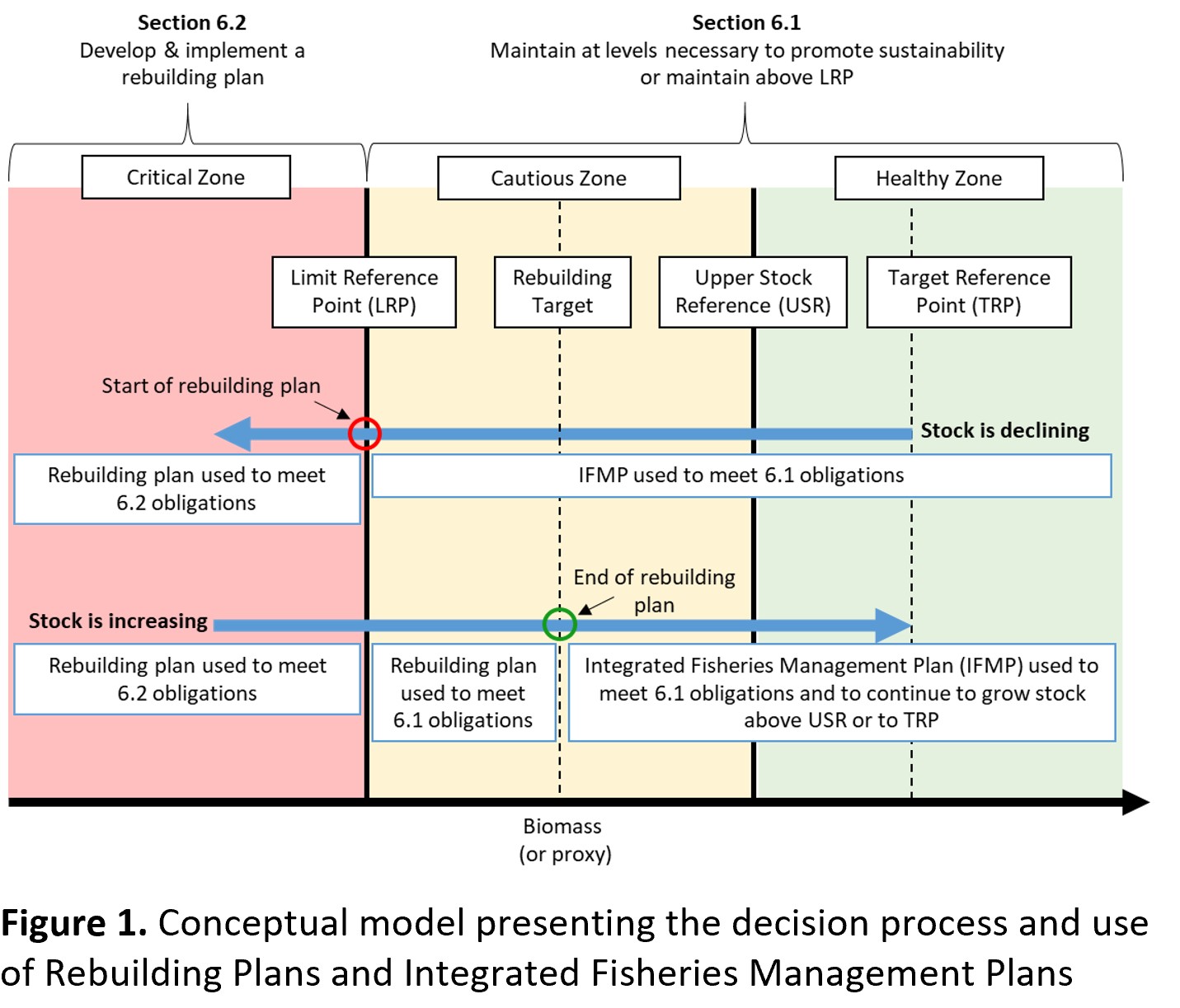
Text version: Conceptual model presenting the decision process and use of Rebuilding Plans and Integrated Fisheries Management Plans (IFMP) in relation to the Fish Stocks Provisions (FSP)
Diagram showing the Fisheries Decision Framework with three stock status zones—Critical, Cautious, and Healthy—and how rebuilding plans and Integrated Fisheries Management Plans (IFMPs) apply as fish biomass decreases or increases relative to reference points.
Once rebuilding is complete, an IFMP ensures compliance with section 6.1 and continued stock growth. If stock declines, the IFMP remains in effect until it drops below the LRP, triggering a rebuilding plan.
For a prescribed fish stock subject to the Fish Stocks Provisions, the legal obligation of section 6.2 to implement a rebuilding plan to rebuild the stock above its LRP only applies while the stock is at or below its LRP (i.e. in the critical zone). In incidences where a current IFMP exists, a rebuilding plan (PDF, 351 KB) may be added as an annex to the IFMP and draw upon the content of the IFMP where appropriate.
The primary objective of a rebuilding plan is to promote growth of the stock out of the critical zone with a high likelihood (≥75%), by ensuring that removals from all fishing sources are kept to the lowest possible level until the stock has cleared this zone and reached a predefined rebuilding target stock level. If the rebuilding target can be reached, the long-term management objective will transition back to an IFMP or other form of management plan, with the main objective to continue the stock’s growth toward the healthy zone and to maintain the stock’s SSB in that zone.
Annex B. Major changes between the 2017 and 2024 versions of the Integrated Fisheries Management Plan’s Limit Reference Point and Upper Stock Reference
American plaice 4T
- IFMP (2017 version):
- LRP = 64,000 t
- IFMP (2024 version, information at the time of publication):
- revised LRP = 139,000 t
- stock under moratorium and identified under section 6.2 of the Fish Stocks Provisions in the modernized Fisheries Act (2019) and for which a rebuilding plan has been developed separately from the IFMP
Atlantic halibut 4RST
- IFMP (2017 version):
- reference points and stock status not available
- IFMP (2024 version, information at the time of publication):
- LRPs were developed and estimated biomass of the commercial-sized stock was deemed to be in the healthy zone in 2024 (DFO 2025b). LRP = 21,721 t and USR = 43,442 t (Note: USR value was proposed as 80% of the BMSY value and needs to be validated through a consultation process)
Atlantic cod 4RS, 3Pn
- IFMP (2017 version):
- LRP = 116,000
- USR = 180,000 t (proposed)
- IFMP (2024 version, information at the time of publication):
- revised LRP = 71,970 t and USR = 143,939 t (Note: USR value was proposed as 80% of the BMSY value and needs to be validated through a consultation process)
- stock under moratorium and identified under section 6.2 of the Fish Stocks Provisions in the modernized Fisheries Act (2019) and for which a rebuilding plan has been developed separately from the IFMP
Atlantic cod 4TVn
- IFMP (2017 version):
- USR = 165,000 to 185,000 t (proposed)
- IFMP (2024 version, information at the time of publication):
- revised LRP = 210,000 t and USR = 336,000 t (DFO 2024a, DFO 2024b)
- stock under moratorium and identified under section 6.2 of the Fish Stocks Provisions in the modernized Fisheries Act (2019) and for which a rebuilding plan has been developed separately from the IFMP
Greenland halibut 4RST
- IFMP (2017 version):
- LRP = 10,056 t
- stock status zone unknown
- IFMP (2024 version, information at the time of publication):
- revised LRP = 10,000 t and USR = 37,740 t
- stock in the cautious zone as of 2024 assessment (DFO 2025a)
White hake 4T
- IFMP (2017 version):
- N/A
- IFMP (2024 version, information at the time of publication):
- stock under moratorium and identified under section 6.2 of the Fish Stocks Provisions in the modernized Fisheries Act (2019) and for which a rebuilding plan has been developed separately from the IFMP
Winter flounder 4T
- IFMP (2017 version):
- reference points and stock status not available
- IFMP (2024 version, information at the time of publication):
- LRP = 10,700 t and USR = 295,700 t
- stock in critical zone since 2006
- directed commercial fishery closed in 2023 until further notice
- stock under moratorium and identified under section 6.2 of the Fish Stocks Provisions in the modernized Fisheries Act (2019) and for which a rebuilding plan has been developed separately from the IFMP
Witch flounder 4RST
- IFMP (2017 version):
- USR = 21,400 t (proposed)
- stock in critical zone
- IFMP (2024 version, information at the time of publication):
- USR = 21,400 t (Note: USR value was proposed as 80% of the BMSY value and needs to be validated through a consultation process)
- stock in cautious zone as of 2022 assessment (DFO 2022) - improvement in stock status
Yellowtail flounder 4T
- IFMP (2017 version):
- reference points not available
- IFMP (2024 version, information at the time of publication):
- LRP = 5,710 t and USR = 11,420 t
- stock in critical zone since 2009
- directed commercial fishery closed in 2023 until further notice
- stock identified as candidate in the next list (second batch) of stocks under section 6.2 of the Fish Stocks Provisions in the modernized Fisheries Act (2019). Since both the yellowtail and winter flounder fisheries were closed due to their critical status and overlapping distribution, a rebuilding plan for this stock is being developed separately from the IFMP
Redfish Unit 1
- IFMP (2017 version):
- included in the 2017 edition
- IFMP (2024 version, information at the time of publication):
- an IFMP for this stock (two species of redfish) will be developed separately
References - Annex B
DFO. 2022. Stock assessment of Witch Flounder (Glyptocephalus cynoglossus) in the Gulf of St. Lawrence (NAFO Divisions 4RST) to 2021. DFO Can. Sci. Advis. Sec. Sci. Advis. Rep. 2022/028.
DFO. 2025a. Assessment of the Gulf of St. Lawrence (4RST) Greenland halibut stock in 2024. DFO Can. Sci. Advis. Sec. Sci. Advis. Rep. 2025/012.
DFO. 2025b. Stock assessment of Gulf of St. Lawrence (4RST) Atlantic halibut in 2024. DFO Can. Sci. Advis. Sec. Sci. Advis. Rep. 2025/028.
DFO. 2024a. Science Advice to Support the Rebuilding Plan for Atlantic Cod (Gadus morhua) in the Southern Gulf of St. Lawrence, NAFO Division 4T-4Vn (November-April). DFO Can. Sci. Advis. Sec. Sci. Advis. Rep. 2024/033.
DFO. 2024b. Southern Gulf of St. Lawrence, NAFO Division 4T-4Vn (November-April), Atlantic Cod (Gadus morhua) Stock Assessment to 2023. DFO Can. Sci. Advis. Sec. Sci. Advis. Rep. 2024/026.
Annex C. Number of licence giving access to commercial groundfish fisheries in the Gulf of St. Lawrence
| Fleet | Gulf Region | Maritimes Region | Quebec Region | Newfoundland and Labrador Region |
|---|---|---|---|---|
| Fixed gear <19.8 m (65 ft) | 1,271 | 239 | 5742 | 6932 |
| Mobile gear <19.8 m (65 ft) | 188 | 3 | 762 | 473 |
| Fixed and mobile gear<19.8 m (65 ft)2 | 278 | 26 | 0 | 0 |
| Mobile gear 19.8 m (65 ft) - 30.5 m (100 ft) | 301 | 301 | 301 | 301 |
| Fixed Gear 19.8 m (65 ft) - 30.5 m (100 ft) | 91 | 91 | 91 | 91 |
| Mobile gear >30.5 m (100 ft) | 251 | 251 | 251 | 251 |
Note: Only a portion of the licences issued are actually active during a given fishing year.
- 1 - The number of licences is divided amongst the Gulf, Maritimes, Quebec and Newfoundland and Labrador Regions.
- 2 - If a fish harvester has access to two types of gear, the licence is counted as a fixed and also as mobile gear licence.
- 3 - Thirty-nine mobile gear and 2 fixed gear licence holders also hold shrimp licences and are eligible to register vessels less than 27.4m (90 ft).
| Fleet | Gulf Region | Maritimes Region | Quebec Region | Newfoundland and Labrador Region |
|---|---|---|---|---|
| Fixed gear <19.8 m (65 ft) | 444 | 49 | 479 | 514 |
| Mobile gear <19.8 m (65 ft) | 0 | 0 | 20 | 9 |
| Fixed and mobile gear<19.8 m (65 ft)1 | 0 | 0 | 0 | 2 |
| Mobile gear 19.8 m (65 ft) - 30.5 m (100 ft) | 11* | 11* | 11* | 11* |
| Fixed Gear 19.8 m (65 ft) - 30.5 m (100 ft) | 0 | 0 | 0 | 0 |
| Mobile gear >30.5 m (100 ft) | 0 | 0 | 0 | 0 |
Note:
- 1 - The number of licences is divided amongst the Gulf, Maritimes, Quebec and Newfoundland and Labrador Regions.
Active licences: Meaning with at least one reported landing.
Number of Indigenous communal commercial fishing licences by DFO Regions in 2023
- Gulf: 89 licences are held by 16 distinct First Nations
- NL: 49 licences specific to the area addressed by this IFMP
- MAR: 1 licence specific to the area addressed by this IFMP
- QC: 34 licences held by 10 distinct Indigenous communities or organisations
Annex D. Fleet shares
| Fish Stock | Fixed Gear (FG) <65' | Mobile Gear (MG) <65' | FG 65'-100' | MG 65'-100' | All >100' | Total |
|---|---|---|---|---|---|---|
| Atlantic Halibut - 4RST | 69.7143 | 11.714 | 3.429 | 3.429 | 11.714 | 100.000 |
| Greenland halibut - 4RST | 76.2004 | 14.2675 | 0.000 | 8.6005 | 0.9335 | 100.000 |
| Yellowtail flounder7 - 4T | 0.000 | 100.000 | 0.000 | 0.000 | 0.000 | 100.000 |
| White hake 4T8 | N/A | N/A | N/A | N/A | N/A | N/A |
| Cod9 - 4RS, 3Pn1 | 46.09 | 43.018 | 0.000 | 3.305 | 7.590 | 100.003 |
| Cod10 - 4T | N/A | N/A | N/A | N/A | N/A | N/A |
| Cod10 - 4Vn | N/A | N/A | N/A | N/A | N/A | N/A |
| American plaice11 – 4T | 14.800 | 82.2006 | 0.000 | 5.000 | 0.000 | 10.000 |
| Witch flounder - 4RST | 0.000 | 88.000 | 0.000 | 7.000 | 5.0002 | 100.000 |
| Winter flounder7 - 4T | 50.000 | 50.000 | 0.000 | 0.000 | 0.000 | 100.000 |
Notes:
- 1 - The MG <65' share of 43.02% includes 1.54% for Danish Seiners.
- 2 - Bycatch only. The >100' (offshore quota) will be re-established to its share of 53.13% when the TAC increases to 3,500t.
- 3 - See Atlantic halibut for further fleet share details.
- 4 - See Greenland halibut for further fleet share details.
- 5 - 50% of the Greenland halibut mobile gear fleets share is currently transferred to the fixed gear < 65’ fleets. Re-entry of mobile gear fleets in this fishery will occur on a progressive scale once the 4RST TAC goes higher than 4,500t, as per a 2013 DFO decision.
- 6 - The MG <65’ share includes 42% for the MG <65’ and 38.2% for the MG 45’-64’.
- 7 - No directed commercial fishery (fishery closed in 2023).
- 8 - No directed commercial fishery (moratorium in 1995).
- 9 - No directed commercial fishery in 2022 to 2023 and 2023 to 2024.
- 10 - No directed commercial fishery (moratorium in 2009).
- 11 - No directed commercial fishery (moratorium in 2017).
Atlantic halibut - Shares of each of the 4RST Atlantic halibut inshore fixed gear fleet by DFO region and by province
- Gulf1:
- NB: 5.17
- NS: 2.01
- PEI: 1.46
- Quebec2:
- North Shore: 8.24
- Gaspé Peninsula: 44.03
- Magdalen Islands: 5.44
- Newfoundland and Labrador: 32.03
- Maritimes: 1.63
Notes:
- 1 - Total Shares in Gulf region is 8.63%.
- 2 - Total Shares in Quebec region is 57.71%.
Greenland halibut 4RST - Geographical Shares for Fixed Gear Fleet <65'
- Quebec: 82
- Newfoundland and Labrador: 18
Cod 4RS, 3Pn - Geographical Shares for Fixed Gear Fleet <65’
- Quebec: 28
- Newfoundland and Labrador: 72
Annex E. Overview of key monitoring measures, by fishing fleet and fishery, in place in 2023 to 2024
The following information is a representation for the At-sea observer, dockside monitoring minimum requirements, and bycatch limits* by fleet, fishing gear and target species in 2023 to 2024.
- Atlantic halibut 4RST – Gaspé fleet, fixed gear, vessels < 13.71m (<45 ft)
- ASO: 10%
- DMP: 100%
- VMS: 100%
- Bycatch (Greenland halibut harvesters and the ATMG group)
- Cod 4RS1: must not exceed 30% or 45kg per fishing trip
- Cod 4T1: must not exceed 30% or 45kg per fishing trip
- Greenland halibut: 10% per fishing trip (3% per fishing trip for harvesters without ITQ for this species)
- White hake1: 5% per fishing trip
- Shark: the lesser of 10% or 500 kg (with licence condition)
- Other groundfish: 10% per fishing trip
- Bycatch (other groups)
- Cod 4RS1: must not exceed 10% or 15kg per fishing trip
- Cod 4T1: must not exceed 30% or 45kg per fishing trip
- Greenland halibut: 3% per fishing trip for harvesters without an ITQ for this species
- White hake1: 5% per fishing trip
- Shark: the lesser of 10% or 500 kg (with licence condition)
- Other groundfish: 10% per fishing trip
- Atlantic halibut 4RST – Gaspé fleet, fixed gear, vessels < 13.71m (<45 ft) - Lobster harvesters’ group
- ASO: 10%
- DMP: 100%
- VMS: none
- Bycatch
- Cod 4RS1: must not exceed 30% or 45kg per fishing trip
- Greenland halibut: 3% per fishing trip for harvesters without an ITQ for this species
- White hake1: 5% per fishing trip
- Shark: must not exceed 10% or 500 kg (with licence condition)
- Other groundfish: 10% per fishing trip
- Atlantic halibut 4RST - North Shore fleet with ITQ, fixed gear, vessels < 19.81m (<65 ft) (Upper, Middle and Lower North shore)
- ASO: 10%
- DMP: 100%
- VMS: 100% for Upper and Middle North Shore
- VMS: None for Lower North Shore (mandatory in 2025 to 2026)
- Bycatch
- Cod 4RST1: must not exceed 30% or 45kg per fishing trip
- Greenland halibut: 3% per fishing trip
- White hake1: 5% per fishing trip
- Shark: must not exceed 10% or 500 kg (with licence condition)
- Other groundfish: 10% per fishing trip
- Atlantic halibut 4RST – Gaspé fleet, fixed gear, vessels => 13.71m (>45 ft)
- ASO: 20%
- DMP: 100%
- VMS: 100%
- Bycatch
- Cod 4RS, 3Pn1: 30% per fishing trip
- Cod 4T1: 30% per fishing trip
- Greenland halibut: 5% per fishing trip for harvesters without an ITQ for this species
- White hake1: 5% per fishing trip
- Other groundfish: 10% per fishing trip
- Atlantic halibut 4RST – MAR 4Vn fleet, fixed gear, vessels < 15.24m (<50 ft) – Longliners
- ASO: 5-10%
- DMP: 100%
- VMS: none
- Bycatch
- Cod 4T 1: max daily limit 45kg or 30% per fishing trip
- White hake 4T 1: 10% per fishing trip
- American plaice 4T 1: 10% per fishing trip
- Other groundfish 4T: 25% per fishing trip
- Atlantic halibut 4R, 3Pn - Fixed and mobile gears, vessels <27.4m (<90 ft) - Longliners and other groups
- ASO: 5-10% for vessels less than 13.71m, 15% for vessels =>13.71m
- DMP: 100%
- VMS: 100% (with exception for fixed gear in 4R, 3Pn)
- Bycatch
- Cod 4RS, 3Pn1: must not exceed 30% or 45kg per fishing trip
- Cod 4T1: 30% per fishing trip
- Greenland halibut: 5 (10% or 90.7 kg, whichever is greater for NL) per fishing trip for harvesters without an ITQ for this species
- White hake1: 5-10% per fishing trip
- Other groundfish: 10% per fishing trip
- Atlantic halibut 4T – Eastern New-Brunswick fleet - Fixed gear, vessels <19.81m (<65 ft) – Longliners\
- ASO: 5-10% for vessels less than 13.71m, 15% for vessels =>13.71m
- DMP: 100%
- VMS: none (will be mandatory in 2026)
- Bycatch
- Cod 4Tvn1: Maximum daily limit 45 KG or 30%, whichever is greater
- White hake1: 10% per fishing trip
- American plaice1: 10% per fishing trip
- Other groundfish: 25% per fishing trip
- Atlantic halibut 4T – Gulf Nova Scotia fleet - Fixed gear, vessels <13.71 (<45 ft) – Longliners
- ASO: 10%
- DMP: 100%
- VMS: none (will be mandatory in 2026)
- Bycatch
- Cod 4Tvn1: Maximum daily limit 45 KG or 30%, whichever is greater
- White hake1: 10% per fishing trip
- American plaice1: 10% per fishing trip
- Other groundfish: 25% per fishing trip
- Atlantic halibut 4T – Prince Edward Island - Fixed gear, vessels <13.71 (<45 ft) – Longliners
- ASO: 10%
- DMP: 100%
- VMS: none (will be mandatory in 2026)
- Bycatch
- Cod 4Tvn1: Maximum fishing period limit of 50 KG
- White hake1: Maximum daily limit of 10%
- Other groundfish: 25% per fishing trip
- Greenland halibut 4RST – Gaspé fleet, fixed gear, vessels => 13.71m (<45 ft) - Longliners and other groups
- ASO: 20%
- DMP: 100%
- VMS: 100%
- Bycatch
- Cod 4RS1: 10% per fishing trip
- Cod 4T1: 10% per fishing trip
- Atlantic halibut: Longlines = 5% per fishing trip; Nets = 3% per fishing trip
- White hake1: 5% per fishing trip
- Other groundfish: 10% per fishing trip
- Greenland halibut 4RST, 3Pn - Fixed gears, vessels < 19.81 (<65 ft) - Gillnets and longlines
- ASO: 5-10% (except longliner fleet and the fleet =>13.71m under ITQ from the Gaspé (others) = 20%)
- DMP: 100%
- VMS: 100% (with exception for fixed gear in 4R, 3Pn)
- Bycatch (see Gaspé fleet, fixed gear, vessels =>13.71m under ITQ for by-catch limits)
- Cod1: 10% daily
- Atlantic halibut: Gillnets = In QC Region is 3% daily; in NL Region is 10% or 90.7 kg, whichever is greater
- White hake1: In QC Region is 5 per fishing trip, 10% per fishing trip
- Shark: must not exceed 10% or 500 kg (with licence condition)
- Other groundfish: 10% per fishing trip
- Witch flounder 4RST – Mobile gear, vessels < 19.81m (<65 ft)
- At sea observer: 25-30%
- DMP: 100%
- VMS: none
- Bycatch
- Cod 4ST1: 20% per fishing trip
- Cod 4R1: 10% weekly
- Atlantic halibut - 10% or 90.7 kg, whichever is greater
- Greenland halibut - 10% or 90.7 kg, whichever is greater
- American plaice 4RST1: 10% per fishing trip
- White hake 4T1: 10% per fishing trip
- Winter flounder 4T1: 25% per fishing trip
- Other groundfish 4RST: 10% per fishing trip
Notes:
- *All weights are expressed as round weight.
- 1 - Stocks identified under section 6.2 of the Fish Stocks Provisions in the modernized Fisheries Act (2019) and for which rebuilding plans are approved.
The following Small Fish Protocol applies which indicates the species type and minimum size lengths. Areas could be closed for specified fleet sectors when the number of undersized fish reaches or exceeds 15% of the catch of any of the species below.
- Atlantic halibut: 85 cm for 4RST and 3Pn and 81 cm elsewhere
- Greenland halibut: 44 cm
- Yellowtail flounder: 25 cm
- White hake: 45 cm
- Atlantic cod: 43 cm
- American plaice: 30 cm
- Witch flounder: 30 cm
- Winter flounder: 25 cm
- Redfish: 22 cm
Annex F. Aquatic species assessed by COSEWIC and/or listed under the Species at Risk Act (SARA), and potentially interacting with groundfish
These species may be encountered in groundfish fisheries (either through interactions or bycatch, in both historical and contemporary contexts). More information, including SARA recovery strategies and action plans where applicable, is available on the Species at risk public registry.
| Aquatic species1 | Status | Assessment Dates | SARA Conservation Actions and Decisions |
|---|---|---|---|
| Acadian Redfish (Sebastes fasciatus), Atlantic population | COSEWIC: Threatened, SARA: No Status | COSEWIC: 2010-04-25, SARA: N/A | No schedule, Under consideration for Addition: Pending |
| Acadian Redfish (Sebastes fasciatus), Bonne Bay population | COSEWIC: Special Concern, SARA: No Status | COSEWIC: 2010-04-25, SARA: N/A | No schedule, Under consideration for Addition: Pending |
| American Plaice (Hippoglossoides platessoides), MAR population | COSEWIC: Threatened, SARA: No Status | COSEWIC: 2009-04-26, SARA: N/A | No schedule, Under consideration for Addition: Pending |
| American Plaice (Hippoglossoides platessoides), NL population | COSEWIC: Threatened, SARA: No Status | COSEWIC: 2009-04-26, SARA: N/A | No schedule, Under consideration for Addition: Pending |
| Atlantic Bluefin Tuna (Thunnus thynnus) | COSEWIC: Endangered, SARA: No Status | COSEWIC: 2011-05-06, SARA: 2017-04-13 | No schedule, Decision: Not to list |
| Atlantic Cod (Gadus morhua) | COSEWIC: Non-active, SARA: No Status | COSEWIC: 2003-05-01, SARA: N/A | N/A |
| Atlantic Cod (Gadus morhua), Laurentian North population | COSEWIC: Endangered, SARA: No Status | COSEWIC: 2010-04-25, SARA: N/A | No schedule, Under consideration for Addition: Pending |
| Atlantic Cod (Gadus morhua), Laurentian South population | COSEWIC: Endangered, SARA: No Status | COSEWIC: 2010-04-25, SARA: N/A | No schedule, Under consideration for Addition: Pending |
| Atlantic Cod (Gadus morhua), MAR population | COSEWIC: Non-active, SARA: No Status | COSEWIC: 2010-04-25, SARA: 2006-04-06 | No schedule, Decision: Not to list |
| Atlantic Cod (Gadus morhua), NL population | COSEWIC: Endangered, SARA: No Status | COSEWIC: 2010-04-25, SARA: N/A | No schedule, Under consideration for Addition: Pending |
| Atlantic Cod (Gadus morhua), Southern population | COSEWIC: Endangered, SARA: No Status | COSEWIC: 2010-04-25, SARA: N/A | No schedule, Under consideration for Addition: Pending |
| Atlantic Halibut (Hippoglossus hippoglossus) | COSEWIC: Not at Risk, SARA: No Status | COSEWIC: 2011-11-25, SARA: N/A | No schedule |
| Atlantic Walrus (Odobenus rosmarus rosmarus), Northwest Atlantic population | COSEWIC: Non-active, SARA: Extirpated | COSEWIC: 2006-04-29, SARA: 2003-06-05 | Schedule 1, Added to list |
| Atlantic Walrus (Odobenus rosmarus rosmarus), NS - Newfoundland - Gulf of St Lawrence population | COSEWIC: Extinct, SARA: No Status | COSEWIC: 2017-04-28, SARA: N/A | No schedule |
| Atlantic White-sided Dolphin (Lagenorhynchus acutus) | COSEWIC: Not at Risk, SARA: No Status | COSEWIC: 1991-04-01, SARA: N/A | No schedule |
| Atlantic Wolffish (Anarhichas lupus) | COSEWIC: Special Concern, SARA: Special Concern | COSEWIC: 2012-11-25, SARA: 2003-06-05 | Schedule 1, Added to list |
| Barndoor Skate (Dipturus laevis) | COSEWIC: Not at Risk, SARA: No Status | COSEWIC: 2010-11-26, SARA: N/A | No schedule |
| Basking Shark, Atlantic population (Cetorhinus maximus) | COSEWIC: Special Concern, SARA: No Status | COSEWIC: 2009-11-27, SARA: N/A | No schedule, Consideration for Addition: Pending |
| Bearded Seal (Erignathus barbatus) | COSEWIC: Data Deficient, SARA: No Status | COSEWIC: 2007-04-22, SARA: N/A | No schedule |
| Beluga Whale, St. Lawrence Estuary population (Delphinapterus leucas) | COSEWIC: Endangered, SARA: Endangered | COSEWIC: 2014-11-28, SARA: 2017-04-13 | Schedule 1, Uplisted: Threatened to endangered |
| Blainville's Beaked Whale (Mesoplodon densirostris) | COSEWIC: Not at Risk, SARA: No Status | COSEWIC: 1989-04-01, SARA: N/A | No schedule |
| Blue Shark, North Atlantic population (Prionace glauca) | COSEWIC: Not at Risk, SARA: No Status | COSEWIC: 2016-11-27, SARA: N/A | No schedule |
| Blue Whale (Balaenoptera musculus), Non-active | COSEWIC: Non-active, SARA: No Status | COSEWIC: 2002-05-01, SARA: N/A | N/A |
| Blue Whale, Atlantic population (Balaenoptera musculus) | COSEWIC: Endangered, SARA: Endangered | COSEWIC: 2012-05-04, SARA: 2005-01-12 | Schedule 1, Added to list |
| Blueback Herring (Alosa aestivalis) | COSEWIC: Not at Risk, SARA: No Status | COSEWIC: 1980-04-01, SARA: N/A | No schedule |
| Common Bottlenose Dolphin (Tursiops truncatus) | COSEWIC: Not at Risk, SARA: No Status | COSEWIC: 1993-04-01, SARA: N/A | No schedule |
| Common Minke Whale, North Atlantic subspecies (Balaenoptera acutorostrata acutorostrata) | COSEWIC: Not at Risk, SARA: No Status | COSEWIC: 2006-04-29, SARA: N/A | No schedule |
| Cusk (Brosme brosme) | COSEWIC: Endangered, SARA: No Status | COSEWIC: 2012-11-25, SARA: N/A | No schedule, Under consideration for Addition: Pending |
| Cuvier's Beaked Whale (Ziphius cavirostris) | COSEWIC: Not at Risk, SARA: No Status | COSEWIC: 1990-04-01, SARA: N/A | No schedule |
| Deepwater Redfish (Sebastes mentella), Gulf of St. Lawrence - Laurentian Channel population | COSEWIC: Endangered, SARA: No Status | COSEWIC: 2010-04-25, SARA: N/A | No schedule, Under consideration for Addition: Pending |
| Deepwater Redfish (Sebastes mentella), Northern population | COSEWIC: Threatened, SARA: No Status | COSEWIC: 2010-04-25, SARA: N/A | No schedule, Under consideration for Addition: Pending |
| Fin Whale (Balaenoptera physalus), Atlantic population | COSEWIC: Special Concern, SARA: Special Concern | COSEWIC: 2019-05-03, SARA: 2006-08-15 | Schedule 1, Added to list |
| Fin Whale (Balaenoptera physalus), Non-active | COSEWIC: Non-active, SARA: No Status | COSEWIC: 2005-05-05, SARA: N/A | N/A |
| Grey Seal (Halichoerus grypus) | COSEWIC: Not at Risk, SARA: No Status | COSEWIC: 1999-04-01, SARA: N/A | No schedule |
| Grey Whale (Eschrichtius robustus), Atlantic population | COSEWIC: Extinct, SARA: Extirpated | COSEWIC: 2022-05-11, SARA: 2003-06-05 | Schedule 1, Added to list |
| Harbour Porpoise (Phocoena phocoena), Northwest Atlantic population | COSEWIC: Special Concern, SARA: Not listed | COSEWIC: 2022-05-11, SARA: 2006-04-06 | Refer back |
| Harbour Seal Atlantic and Eastern Arctic subspecies (Phoca vitulina concolor) | COSEWIC: Not at Risk, SARA: No Status | COSEWIC: 2007-11-30, SARA: N/A | No schedule |
| Hooded Seal (Cystophora cristata) | COSEWIC: Not at Risk, SARA: No Status | COSEWIC: 1986-04-01, SARA: N/A | No schedule |
| Humpback Whale (Megaptera novaeangliae), Western North Atlantic population | COSEWIC: Not at Risk, SARA: No Status | COSEWIC: 2003-05-01, SARA: N/A | N/A |
| Killer Whale (Orcinus orca), Northwest Atlantic / Eastern Arctic population | COSEWIC: Special Concern, SARA: No Status | COSEWIC: 2023-12-01, SARA: N/A | No schedule, Under consideration for Addition: Pending |
| Leatherback Sea Turtle (Dermochelys coriacea), Non-active | COSEWIC: Non-active, SARA: No Status | COSEWIC: 2012-05-04, SARA: 2017-04-13 | No schedule, Struck - WS reassignment |
| Leatherback Sea Turtle, Atlantic population (Dermochelys coriacea) | COSEWIC: Endangered, SARA: Endangered | COSEWIC: 2022-12-03, SARA: N/A | Schedule 1 |
| Loggerhead Sea Turtle (Caretta caretta) | COSEWIC: Endangered, SARA: Endangered | COSEWIC: 2010-04-25, SARA: 2017-04-13 | Schedule 1, Added to list |
| Long-finned Pilot Whale (Globicephala melas) | COSEWIC: Not at Risk, SARA: No Status | COSEWIC: 1994-04-01, SARA: N/A | No schedule |
| Lumpfish (Cyclopterus lumpus) | COSEWIC: Threatened, SARA: No Status | COSEWIC: 2017-11-01, SARA: N/A | No schedule, Under consideration for Addition: Pending |
| North Atlantic Right Whale (Eubalaena glacialis) | COSEWIC: Endangered, SARA: Endangered | COSEWIC: 2013-11-01, SARA: 2005-01-12 | Schedule 1, Added to list |
| Northern Bottlenose Whale (Hyperoodon ampullatus), Non-active | COSEWIC: Non-active, SARA: No Status | COSEWIC: 1996-04-01, SARA: N/A | N/A |
| Northern Bottlenose Whale (Hyperoodon ampullatus), Scotian Shelf population | COSEWIC: Endangered, SARA: Endangered | COSEWIC: 2011-05-06, SARA: 2006-04-06 | Schedule 1, Added to list |
| Northern Wolffish (Anarhichas denticulatus) | COSEWIC: Threatened, SARA: Threatened | COSEWIC: 2012-11-25, SARA: 2003-06-05 | Schedule 1, Added to list |
| Porbeagle (Lamna nasus) | COSEWIC: Endangered, SARA: No Status | COSEWIC: 2014-05-02, SARA: N/A | No schedule, Under consideration for Addition: Pending |
| Pygmy Sperm Whale (Kogia breviceps) | COSEWIC: Not at Risk, SARA: No Status | COSEWIC: 1994-04-01, SARA: N/A | No schedule |
| Right Whale (Eubalaena glacialis), Non-active | COSEWIC: Non-active, SARA: No Status | COSEWIC: 2003-05-01, SARA: N/A | N/A |
| Ringed Seal (Pusa hispida) | COSEWIC: Special Concern, SARA: No Status | COSEWIC: 2019-11-29, SARA: N/A | No schedule, Under consideration for Addition: Pending |
| Risso's Dolphin (Grampus griseus) | COSEWIC: Not at Risk, SARA: No Status | COSEWIC: 1990-04-01, SARA: N/A | No schedule |
| Roughhead Grenadier (Macrourus berglax) | COSEWIC: Not at Risk, SARA: No Status | COSEWIC: 2018-11-01, SARA: N/A | No schedule |
| Roundnose Grenadier (Coryphaenoides rupestris) | COSEWIC: Endangered, SARA: No Status | COSEWIC: 2008-11-28, SARA: N/A | No schedule, Under consideration for Addition: Pending |
| Sea Mink (Mustela macrodon) | COSEWIC: Extinct, SARA: No Status | COSEWIC: 2000-05-01, SARA: N/A | No schedule |
| Sei Whale, Atlantic population (Balaenoptera borealis) | COSEWIC: Endangered, SARA: No Status | COSEWIC: 2019-05-03, SARA: N/A | No schedule, Under consideration for Addition: Pending |
| Short-beaked Common Dolphin (Delphinus delphis) | COSEWIC: Not at Risk, SARA: No Status | COSEWIC: 1991-04-01, SARA: N/A | No schedule |
| Shortfin Mako, Atlantic population (Isurus oxyrinchus) | COSEWIC: Endangered, SARA: No Status | COSEWIC: 2019-05-03, SARA: N/A | No schedule, Under consideration for Addition: Pending |
| Smooth Skate, Funk Island Deep population (Malacoraja senta) | COSEWIC: Endangered, SARA: No Status | COSEWIC: 2012-05-04, SARA: N/A | No schedule, Under consideration for Addition: Pending |
| Smooth Skate, Hopedale Channel population (Malacoraja senta) | COSEWIC: Data Deficient, SARA: No Status | COSEWIC: 2012-05-04, SARA: N/A | No schedule |
| Smooth Skate, Laurentian-Scotian population (Malacoraja senta) | COSEWIC: Special Concern, SARA: No Status | COSEWIC: 2012-05-04, SARA: N/A | No schedule, Under consideration for Addition: Pending |
| Sowerby's Beaked Whale (Mesoplodon bidens) | COSEWIC: Special Concern, SARA: Special Concern | COSEWIC: 2019-05-03, SARA: 2011-06-23 | Schedule 1, Added to list |
| Sperm Whale (Physeter macrocephalus) | COSEWIC: Not at Risk, SARA: No Status | COSEWIC: 1996-04-01, SARA: N/A | No schedule |
| Spiny Dogfish, Atlantic population (Squalus acanthias) | COSEWIC: Special Concern, SARA: No Status | COSEWIC: 2010-04-25, SARA: N/A | No schedule, Under consideration for Addition: Pending |
| Spotted Wolffish (Anarhichas minor) | COSEWIC: Threatened, SARA: Threatened | COSEWIC: 2012-11-25, SARA: 2003-06-05 | Schedule 1, Added to list |
| Striped Dolphin (Stenella coeruleoalba) | COSEWIC: Not at Risk, SARA: No Status | COSEWIC: 1993-04-01, SARA: N/A | No schedule |
| Thorny Skate (Amblyraja radiata) | COSEWIC: Special Concern, SARA: No Status | COSEWIC: 2012-05-04, SARA: N/A | No schedule, Under consideration for Addition: Pending |
| True's Beaked Whale (Mesoplodon mirus) | COSEWIC: Not at Risk, SARA: No Status | COSEWIC: 1989-04-01, SARA: N/A | No schedule |
| White Hake, Atlantic and Northern Gulf of St. Lawrence population (Urophycis tenuis) | COSEWIC: Threatened, SARA: No Status | COSEWIC: 2013-11-01, SARA: N/A | No schedule, Under consideration for Addition: Pending |
| White Hake, sGSL population (Urophycis tenuis) | COSEWIC: Endangered, SARA: No Status | COSEWIC: 2013-11-01, SARA: N/A | No schedule, Under consideration for Addition: Pending |
| White Shark, Atlantic population (Carcharodon carcharias) | COSEWIC: Endangered, SARA: Endangered | COSEWIC: 2021-05-05, SARA: 2011-06-23 | Schedule 1, Added to list |
| White-beaked Dolphin (Lagenorhynchus albirostris) | COSEWIC: Not at Risk, SARA: No Status | COSEWIC: 1998-04-01, SARA: N/A | No schedule |
| Winter Skate, Eastern Scotian Shelf - Newfoundland population (Leucoraja ocellata) | COSEWIC: Endangered, SARA: No Status | COSEWIC: 2015-05-01, SARA: N/A | No schedule, Under consideration for Addition: Pending |
| Winter Skate, Eastern Scotian Shelf population (Leucoraja ocellata) | COSEWIC: Non-active, SARA: No Status | COSEWIC: 2015-05-01, SARA: 2010-02-23 | No schedule, Decision: Not to list |
| Winter Skate, Gulf of St. Lawrence population (Leucoraja ocellata) | COSEWIC: Endangered, SARA: No Status | COSEWIC: 2015-05-01, SARA: N/A | No schedule, Under consideration for Addition: Pending |
| Winter Skate, Northern Gulf-Newfoundland population (Leucoraja ocellata) | COSEWIC: Non-active, SARA: No Status | COSEWIC: 2015-05-01, SARA: N/A | No schedule |
| Winter Skate, sGSLpopulation (Leucoraja ocellata) | COSEWIC: Non-active, SARA: No Status | COSEWIC: 2015-05-01, SARA: 2010-02-23 | No schedule, Decision: Not to list |
Note:
- 1 - Aquatic species listed initially by alphabetical “Common Name” followed by (Latin Name) and finally by “Population Name.”
Annex G. Fishery specific closed areas in the Gulf of St. Lawrence
The following areas within the GSL are closed for the protection of different species of fish. Some fisheries may have closed in recent years, leaving some area closure requirements redundant (e.g. yellowtail and witch flounders).
- Closure of all groundfish fisheries from April 1 to June 23 in part of the NAFO Division 4R offshore from St. Georges Bay and Port au Port Bay to protect cod during the spawning period
- Closure of all groundfish fisheries from January 1 to December 31 in part of GFAs 4T3a and 4T3b known as Miscou Bank, which is recognized as a cod concentration area. When authorized, a small section is opened from June 24 to December 31 during the Atlantic halibut fishery
- Closure of all groundfish fisheries (except for Atlantic halibut) from January 1 to December 31 in GFA 4T5 known as Shediac Valley, to protect juvenile Atlantic cod
- Closure of all groundfish fisheries (except for Atlantic halibut) from January 1 to December 31 in GFA 4T7 known as Northumberland Strait, to protect juvenile Atlantic cod, white hake and winter skate
- Closure of GFA 4T8 to all mobile gear groundfish fishing for the protection of white hake
- Closure to the mobile gear groundfish fishery in waters shallower than 10 fathoms in the Baie of Chaleurs for the protection of lobster
- Closure of the commercial fishery of Atlantic halibut in portion of GFA 4T3a east of Gaspé due to excessive by-catch of cod
- Closure of the of the commercial groundfish mobile gear fishery in portion of GFA 4T3a due to excessive by-catch of cod, Greenland halibut and Atlantic halibut
- Closure in the Laurentian Channel in portions of GFAs 4T3a, 4T3b and 4T2a to the commercial groundfish mobile gear fishery due to excessive by-catch of Greenland halibut
- Closure of GFA 4T4 to all commercial mobile gear fisheries
- Closure of the commercial yellowtail flounder mobile gear fishery in portions of GFA 4T2a to aquaculture sites and due to high by-catch of lobster
- Closure of the witch flounder fishery on June 30 for the protection of white hake spawners
Annex H. Compliance and Enforcement Plan
Introduction
The Fisheries Act is the main federal statute for managing Canadian fisheries resources, as well as for managing, conserving and protecting Canadian fish and fish habitat. The C and P program of DFO is mandated to enforce the Act and its associated regulations, such as the Marine Mammal Regulations, Aquaculture Activities Regulations and the Aquatic Invasive Species Regulations.
It is important to note that C and P works with a variety of partners, such as the Coast Guard, the Royal Canadian Mounted Police, Canadian Border Services Agency, Environment and Climate Change Canada, Parks Canada and provincial conservation departments, to enforce the Fisheries Act. Our partners play a key role in ensuring safe and orderly fisheries and we will continue to work collaboratively with them going forward.
Overview of C and P
As the enforcement and compliance organization of the department, C and P is a large and complex program. It is comprised of the National Fisheries Intelligence Service, Enforcement Operations and Program and Operational Readiness.
Fishery officers are the face of the department and are often the only federal presence in many remote coastal communities. As federal peace officers, fishery officers are required to complete intensive training, which is administered jointly with the Royal Canadian Mounted Police, before they are armed and operational. Once in the field, they undertake a broad range of compliance and enforcement activities in support of the department’s program objectives, based on intelligence from our National Fisheries Intelligence Service and C and P’s “three pillar” approach, which focuses on:
- Pillar 1 – education, stewardship and stakeholder engagement
- Pillar 2 – monitoring, control and surveillance
- Pillar 3 – major cases and special investigations
Under Pillar 1, education and outreach is an important component of compliance and enforcement, and C and P makes an effort to engage and liaise with fishers, Indigenous communities, unions, industry groups and the public more generally at events such as conferences, fish and wildlife shows, and schools. This outreach has proven to be very effective in encouraging compliance as most people will voluntarily comply with rules when they have a good understanding of them.
Monitoring, control and surveillance activities under Pillar 2 are the traditional core of the program, and include activities such as land-based and at-sea patrols, air surveillance, ongoing fishery monitoring, inspections and the issuance of tickets, citations or other enforcement action. As noted earlier, fishery officers are designated as peace officers under the Criminal Code of Canada for the administration of the Fisheries Act, and as such they have the power to undertake inspections, including entering private property, and they can search persons, vehicles, vessels or buildings. They are also authorized to seize such things as fish, vehicles, vessels or other goods, and execute warrants, and arrest and detain offenders.
As part of their Pillar 2 activities, fishery officers play an active role in commercial and recreational fisheries, patrolling inland and coastal waters, and inspecting fishing vessels to ensure compliance with quota allocations or catch limits, licence conditions, fishing times and gears, and reporting requirements. C and P activities in support of fish and fish habitat protection may include regular and targeted habitat patrols of coastline, river, road networks and terrain, and ensuring compliance with section 35 of the Fisheries Act and any habitat authorizations issued by the department.
Pillar 3 in C and P’s enforcement approach is major cases and special investigations, where the emphasis is on intelligence-led enforcement directed to key priorities and risk areas. Activities include more in-depth investigations and intelligence assessments and analysis to mount major investigations into severe violations of the law, typically involving large scale non-compliance, collusion between multiple players and sometimes linked to organized criminal activity.
International enforcement of Illegal, Unreported and Unregulated (IUU) Fishing
Canada is a signatory to the international Port State Measures Agreement (PSMA), which was ratified on July 20, 2019. The overall objective of the PSMA is to prevent fish products that have been obtained illegally from getting to market; it sets global minimum standards for actions that signatories must take when a foreign vessel, known or suspected to have engaged in or supported illegal fishing, seeks to enter a port or use port services.
Combatting IUU fishing was a priority of Canada’s 2018 G7 presidency agenda on healthy oceans, and the Charlevoix Blueprint included a number of related actions. Canada is actively involved in supporting high seas enforcement through counter IUU sea and air patrols, including joint inspector exchanges and ship rider opportunities to leverage resources in a collaborative multi-national effort. DFO is also exploring a number of new technologies and initiatives through public-private partnerships to support the detection and tracking of IUU fishing activity, and has emerged as a leader in the use of digital forensics (the practice of extracting and examining electronic evidence) in the fight against IUU fishing.
Annex I. Gulf Groundfish Advisory Committee
Terms of reference - Gulf Groundfish Advisory Committee (GGAC)
Mandate
The purpose of the Gulf Groundfish Advisory Committee (GGAC) is to provide an open, transparent and collaborative consultative process to address matters related to the management of the Gulf of St. Lawrence groundfish fishery in NAFO Divisions 4RSTVn, 3Pn.
Role
The committee will provide advice and recommendations to DFO in support of the development of annual and/or multi-year management plans for the conservation, protection and sustainable use of the groundfish resource. The terms of reference set out the principles, powers and guidelines under which the GGAC shall operate.
Guiding principles
The following principles will be used to guide decisions on the structure and operations of the GGAC:
- transparent: the advisory process is transparent with open lines of communication and the provision of timely, accurate, accessible, clear and objective information that will be made available to all participants. DFO organizers will provide access to agendas and necessary information in advance of meetings
- accountable: participants who represent an entity are expected to bring forward the general views, knowledge and experience of those they represent, and report back about deliberations of the consultation activity and reasons for decisions taken. All participants share accountability for the success of the process. The department is accountable to participants for explaining how their advice/input was used and why and how decisions are taken
- balanced and inclusive membership: membership of stakeholders on the GGAC should relate to the committee’s mandate and function, and should be balanced and reflect the broad range of interests in the Gulf groundfish fisheries, to the extent possible, so that a diversity of perspectives is considered
- effective: all participants should be satisfied that the process can achieve the goals of the mandate. This does not mean that participants will always agree with the final advice, outcome or recommendation
- efficient: the size of the advisory committee will reflect a balance between the diversity of interests of all stakeholders and a participant number that will facilitate productive discussion
- consensus: no formal voting procedures will be established. The GGAC will strive to reach consensus, however, where consensus cannot be reached, the views of all members will be reflected in the minutes of the meeting
Administration
- Advisory committee meetings will be chaired by DFO
- The GGAC general meetings will occur every two years, either in person or virtually, with the option to hold meetings in interim years when deemed necessary by the Chair or requested by the GGAC to address specific topics or issues
- Ad hoc working groups comprised of GGAC members can be established to review and assess specific issues and report their findings to the advisory committee
- DFO will prepare meeting agenda and minutes, in consultation with GGAC members; only those topics or issues for which the meeting has been convened and which are consistent with the mandate will be addressed
- DFO will commit to reviewing and updating the terms of reference with the collaboration of GGAC members every three years
- DFO will provide GGAC members with a copy of a detailed summary of the recommendations made by the GGAC within two weeks of the meeting. The meeting minutes will follow within 2 months of the meeting
- All members are expected to review minutes provided prior to the meeting and be aware of the discussion and outcome of the previous meeting in preparation for subsequent meetings. Further discussion of issues dealt with at previous meetings will generally be limited to correction or clarification of issues discussed
- Expenses by designated representatives and alternates to attend committee meetings are the responsibility of the organization, department, or company that they represent
Membership
The GGAC is comprised of representatives from DFO, the harvesting and processing sectors, Indigenous organizations, representatives of the four Atlantic provincial governments and QC, and environmental non-governmental organizations.
Requests for nomination to the GGAC will be reviewed annually. Changes to the membership will be at the discretion of the Chair. Further, the Chair reserves the right to limit membership to maintain the committee’s efficiency.
Departmental representation is provided by the Resource Management, C and P, Science, Policy and Economics and Communications sectors. Staff from other DFO sectors may attend the committee meeting at the request of members or based on their role within the department.
Meeting procedures
Non-member stakeholders who are not members of the GGAC but request to participate in its meetings may be granted Observer status, at the discretion of the Chair. Observers will be provided an opportunity to provide perspectives on matters discussed by the committee at the end of the meeting.
Members may be accompanied by up to four delegates, and as such each committee member shall inform DFO in advance of the number of delegates who will attend the advisory meeting.
Operating principles
- Members agree to share all relevant information where possible, and to accept the concerns and goals of others as legitimate
- Participants agree to act in “good faith” in all respects of the process, including respecting confidentiality in relaying information to others
- Participants (members and observers) will maintain a professional manner and refrain from discussions of a personal nature
- Both the Chair and GGAC members must ensure that a collaborative and respectful atmosphere is maintained during meetings
- Participants (members and observers) may not speak until recognized by the Chair
- All remarks must be addressed to the Chair as no cross debate is permitted
- Members or observers may not disrupt the assembly
- Members will be asked to provide any proposals to DFO in advance of the meeting for distribution to GGAC members. Proposals received by DFO will be shared with both members and observers in advance of the meeting
- Summary minutes of each meeting will be distributed by DFO after they are reviewed and accepted by the Chair
GGAC Membership
Fisheries Sector Organizations
- Maritime Fishermen’s Union: 3 seats
- Fisheries Food Allied Workers: 3 seats
- Prince Edward Island Fishermen’s Association: 3 seats
- Atlantic Groundfish Council: 1 seat
- Gulf Nova Scotia Fleet Planning Board: 1 seat
- Regroupement des pêcheurs professionnels sud de la Gaspésie: 1 seat
- Regroupement des pêcheurs professionnels nord de la Gaspésie: 1 seat
- Regroupement des palangriers et pétoncliers uniques madelinots: 1 seat
- Rassemblement des pêcheurs et pêcheuses des côtes des Îles: 1 seat
- Regroupement des pêcheurs professionnels de la Haute et Moyenne Côte-Nord: 1 seat
- Association des pêcheurs de la Basse-Côte-Nord: 1 seat
- Association of Inshore Fishermen of the Magdalen Islands: 1 seat
- Fédération des pêcheurs semi-hauturiers du Québec: 1 seat
- Prince Edward Island Trawlermen’s Association: 1 seat
- North Cape Breton Fishing Vessel Association: 1 seat
- Association des capitaines propriétaires de la Gaspésie: 1 seat
- Association des pêcheurs du poisson de fond acadiens: 1 seat
- Fédération régionale acadienne des pêcheurs professionnels: 1 seat
Indigenous Partners
- Listuguj Mi’gmag First Nation Council: n/a
- The MAWIW Council: n/a
- The Native Council of PEI: n/a
- The New Brunswick Aboriginal Peoples Council: n/a
- The "Netukulimkewe" Commission: n/a
- The Nova Scotia MicMac Fish and Wildlife Commission: n/a
- The Union of New Brunswick Indians: n/a
- Lennox Island First Nation: n/a
- Abegweit First Nation: n/a
Additional delegates
- North of Smokey Fishermen's Association: 1 seat
- Southwest Nova Scotia Fishermen’s Association: 1 seat
- 4VN Management Board Society: 1 seat
Provincial government
- Ministère de l’Agriculture, des Pêcheries et de l’Alimentation du Québec: 1 seat
- New Brunswick Department of Agriculture, Aquaculture and Fisheries: 1 seat
- Newfoundland and Labrador Department of Fisheries, Forestry and Agriculture: 1 seat
- Nova Scotia Department of Fisheries and Aquaculture: 1 seat
- Prince Edward Island Department of Fisheries and Communities: 1 seat
Processors associations
- Association québécoise de l’industrie de la pêche (QC): 1 seat
- Association of Seafood Processors (NL): 1 seat
- PEI Seafood Producers Association (PEI): 1 seat
- NS Seafood Producers Association: 1 seat
- NB Seafood Processors: 1 seat
Other
- Environmental non-governmental organization: 2 seats
Gulf Region’s Code of Conduct for Fisheries Management Advisory Committee Meetings
Communications
In order to maximize the exchange of information among parties and minimize misunderstandings, DFO and Advisory Committee members should:
- speak clearly, listen carefully and ask for clarification if a point is not understood
- share information related to the issues at hand
- clearly explain what is important to them, what their interests are and why
- state their perspective as concisely and briefly as possible
- not knowingly provide misleading or inaccurate information
The Committee Chair shall ensure that all Committee members have the opportunity to speak and all perspectives and interests are heard by:
- seeking the active participation of all members
- providing opportunities for all members to be heard
Mutual respect
DFO and Advisory Committee members shall maintain a respectful atmosphere, by:
- respecting each other’s values and interests
- separating issues from people
- avoiding accusatory or critical language, rude behavior, and stereotyping
- listening to what others have to say without interrupting
- beginning meetings on time
- seeking a better understanding of other perspectives with an open mind
- recognizing the legitimacy of all interests
- allowing members the freedom to be creative, brainstorm, and test ideas without prejudice to future discussions
Civility
During all discussions or meetings, participants are asked to demonstrate civility. Harassing or violent language or behavior will not be tolerated and may result in immediate sanctions as described in the section Failure to respect the code of conduct.
Observers
Observers must respect the need for orderly management of the business before the Committee and the rights of others in the meeting. Observers must follow any directions made by the chairperson.
Failure to respect this Code of Conduct
The intent of this Code of Conduct is to allow for Advisory Committee meeting to occur in a respectful and civilized manner. Failure to comply with this Code of Conduct may lead to some of the following outlined Administrative Sanctions being applied:
- the non-compliant individual(s) may be asked to leave the meeting
- the meeting may be terminated
- the individual(s) may be prohibited from attending the next meeting
- the individual(s) may be prohibited from attending all meetings with the department for a period of time, such as up to one year
Annex J. Summary of the Precautionary Approach Framework Reference Points and Committee on the Status of Endangered Wildlife in Canada/Species At Risk Act Status for Various Gulf of St. Lawrence Groundfish Stocks
| Species/stock | SSB1 | LRP | USR | Stock status zone | PA-compliant HCR | COSEWIC status | SARA status |
|---|---|---|---|---|---|---|---|
| American plaice 4T2 | 55,000 t in 2015
Ricard et al. 2016 |
139,000 t
icard et al. 2016 |
Not available | Critical zone (since 1993) |
Not available
(moratorium 2017) |
Threatened | Pending |
| Atlantic halibut 4RST | 81,392 t in 2024 | 21,721 t | 43,442 t | Healthy zone | Not available | Not at risk | - |
| Cod 4RS, 3Pn | 42,906 t in 2022 | 71,970 t | 143,939 t | Critical zone
(since 1990) |
Not available | Endangered | Pending |
| Cod 4TVn2 | 13,900 t in 2018
DFO 2019, Swain et al. 2019 |
210,000 t
Turcotte et al. 2024 |
336,000 t
Turcotte et al. 2024 |
Critical zone (since 1990) |
Not available
(moratorium 2009) |
Endangered | Pending |
| Greenland halibut 4RST | 11,240 t in 2024 | 10,000 t | 37,740 t | Cautious zone | Available | - | - |
| White hake 4T 2 | 7,396 t in 2019
DFO 2021a, Rolland et al. 2022a |
12,800 t
Swain et al. 2016 |
Not available | Critical zone (since 1995) |
Not available
(moratorium 1995) |
Endangered | Pending |
| Winter flounder 4T2 | 76,270 t in 2016
Surette and Rolland 2019 |
147,800 t
Surette and Rolland 2019 |
295,700 t
Surette and Rolland 2019 |
Critical (since 2006) |
Not available
(commercial directed fishery closed 2023) |
- | - |
| Witch flounder 4RST | 17,770 t in 2021 | 10,700 t | 21,400 t | Cautious zone | Not available | - | - |
| Yellowtail flounder 4T | 2,227 t in 2020
Rolland et al. 2022b |
5,710 t
Rolland et al. 2022b |
11,420 t
Rolland et al. 2022b |
Critical zone (since 2009) |
Not available
(commercial directed fishery closed 2023) |
- | - |
| Redfish Unit 1 : 4RST and 3Pn, 4Vn (Jan to May) | See DFO 2024 | 44.000 t - S. mentella
30,000 t - S. fasciatus DFO 2024 |
265.000 t - S. mentella
168,000 t - S. fasciatus DFO 2024 |
Healthy zone - S. mentella
Uncertain - S. fasciatus: |
Not available | Endangered - S. mentella
Threatened and special concern - S fasciatus |
Pending |
Notes:
- 1 - From latest stock assessment.
- 2 - Stocks identified under section 6.2 of the Fish Stocks Provisions in the amended Fisheries Act (2019) and for which rebuilding plans are being developed. Therefore, details of the management plan for these stocks are to be presented in their respective rebuilding plans instead of the present IFMP.
- 3 - As of 2024, the indicators are suggesting that the status of the stock is currently at a historically high level (DFO 2023b). USR proposed at the last assessment (DFO 2023b, 2023d). Discussions with Indigenous organizations and stakeholders will be necessary to determine the USR.
- 4 - Considering the new model for assessing the stock and predation-driven Allee effect or predator-pit observed for this population (Swain and Benoit 2015, Swain et al. 2019), it was suggested that the reference points should be revised to higher values (Swain et al. 2019).
References - Annex J
COSEWIC. 2009. COSEWIC assessment and status report on the American plaice Hippoglossoides platessoides, Maritime population, Newfoundland and Labrador population and Arctic population, in Canada. Committee on the Status of Endangered Wildlife in Canada. Ottawa. x + 74 pp.
COSEWIC. 2010a. COSEWIC assessment and status report on the Atlantic Cod Gadus morhua in Canada. Committee on the Status of Endangered Wildlife in Canada. Ottawa. Xiii + 105 pp.
COSEWIC. 2010b. COSEWIC assessment and status report on the Deepwater Redfish/Acadian Redfish complex Sebastes mentella and Sebastes fasciatus, in Canada. Committee on the Status of Endangered Wildlife in Canada. Ottawa. X + 80 pp.
COSEWIC. 2011. COSEWIC assessment and status report on the Atlantic Halibut Hippoglossus hippoglossus in Canada. Committee on the Status of Endangered Wildlife in Canada. Ottawa.ix + 48 pp.
COSEWIC. 2013. COSEWIC assessment and status report on the White Hake Urophycis tenuis in Canada. Committee on the Status of Endangered Wildlife in Canada. Ottawa. xiii + 45 pp.
DFO. 2016. Stock Assessment of American plaice (Hippoglossoides platessoides) of the southern Gulf of St. Lawrence (NAFO Div. 4T) to 2015. Assessed by DFO Gulf Region. DFO Can. Sci. Advis. Sec. Sci. Advis. Rep. 2016/031.
DFO. 2019. Assessment of Atlantic cod (Gadus Morhua) in the southern Gulf of St. Lawrence (NAFO Div. 4T-4Vn (Nov. – April)) to 2018. Assessed by DFO Gulf Region. DFO Can. Sci. Advis. Sec. Sci. Advis. Rep. 2019/021.
DFO. 2021a. Impact of an expanding Redfish (Sebastes spp.) fishery on southern Gulf of St. Lawrence White Hake (Urophycis tenuis). DFO Can. Sci. Advis. Sec. Sci. Advis. Rep. 2021/033.
DFO. 2021b. Stock Assessment of Yellowtail Flounder (Limanda ferruginea) of the southern Gulf of St. Lawrence (NAFO Div. 4T) to 2020. DFO Can. Sci. Advis. Sec. Sci. Advis. Rep. 2021/022.
DFO. 2022a. Development of a precautionary approach for the Gulf of St. Lawrence (4RST) Greenland halibut stock. DFO Can. Sci. Advis. Sec. Sci. Resp. 2022/002.
DFO. 2022b. Redfish (Sebastes mentella and Sebastes fasciatus) Stocks Assessment in Units 1 and 2 in 2021. DFO Can. Sci. Advis. Sec. Sci. Advis. Rep. 2022/039.
DFO. 2022c. Stock assessment of Witch Flounder (Glyptocephalus cynoglossus) in the Gulf of St. Lawrence (NAFO Divisions 4RST) to 2021. DFO Can. Sci. Advis. Sec. Sci. Advis. Rep. 2022/028.
DFO. 2025a. Assessment of the Gulf of St. Lawrence (4RST) Greenland halibut stock in 2024. DFO Can. Sci. Advis. Sec. Sci. Advis. Rep. 2025/012.
DFO. 2025b. Stock assessment of Gulf of St. Lawrence (4RST) Atlantic halibut in 2024. DFO Can. Sci. Advis. Sec. Sci. Advis. Rep. 2025/028.
DFO. 2023c. Assessment of the Northern Gulf of St. Lawrence (3Pn, 4RS) Atlantic Cod Stock in 2022. DFO Can. Sci. Advis. Sec. Sci. Advis. Rep. 2023/035.
DFO. 2024. Unit 1 Redfish (Sebastes mentella and S. fasciatus) Update in 2023. DFO Can. Sci. Advis. Sec. Sci. Resp. 2024/008.
Ricard, D. 2022. Assessment of Witch Flounder (Glyptocephalus cynoglossus) in the Gulf of St. Lawrence (NAFO Divisions 4RST), March 2022. DFO Can. Sci. Advis. Sec. Res. Doc. 2022/054. v + 125 p.
Ricard, D., Morin, R., Swain, D.P., and Surette, T. 2016. Assessment of the southern Gulf of St. Lawrence (NAFO Division 4T) stock of American plaice (Hippoglossoides platessoides), March 2016. DFO Can. Sci. Advis. Sec. Res. Doc. 2016/057. ix + 43 p.
Rolland, N., McDermid, J.L., Swain, D.P., Senay, C. 2022a. Impact of an expanding Redfish (Sebastes spp.) fishery on southern Gulf of St. Lawrence White Hake (Urophycis tenuis). DFO Can. Sci. Advis. Sec. Res. Doc. 2022/005. viii + 69 p.
Rolland, N., Swain, D. and Ricard, D. 2022b. The Status of Yellowtail Flounder (Limanda ferruginea) in NAFO Division 4T to 2020. DFO Can. Sci. Advis. Sec. Res. Doc. 2022/041. v + 82 p.
Surette, T., and Rolland, N. 2019. Assessment of the winter flounder (Pseudopleuronectes americanus) stock of the southern Gulf of St. Lawrence (NAFO Div. 4T) to 2016 and advice for the May 2017 to May 2022 fisheries. DFO Can. Sci. Advis. Sec. Res. Doc. 2019/026. x + 94 p.
Swain, D.P., Ricard, D., Rolland, N., and Aubry, É. 2019. Assessment of the southern Gulf of St. Lawrence Atlantic Cod (Gadus morhua) stock of NAFO Div. 4T and 4Vn (November to April), March 2019. DFO Can. Sci. Advis. Sec. Res. Doc. 2019/038. iv + 105 p.
Turcotte, F., McDermid, J.L., Ricard, D. 2024. Scientific Requirements for the Rebuilding Plan of Southern Gulf of St. Lawrence (NAFO Division 4T and 4Vn November to April) Atlantic Cod (Gadus morhua). DFO Can. Sci. Advis. Sec. Res. Doc. 2024/053. v + p.51.
Annex K. Atlantic halibut (May 2024)
General overview
The Atlantic halibut (Hippoglossus hippoglossus) commercial fishery in the GSL has a long history, dating back to the late 19th century. Throughout the first half of the 20th century, both American and Canadian fleets heavily exploited this valuable resource. However, in the latter half of the 20th century, the Canadian fleet from the four Atlantic Provinces and QC became the primary exploiter of the species. Over time, landings fluctuated, starting at 650 tons in the 1960s, declining to a low of 91 tons in 1982. Since the late 1990s, they have risen to nearly 2,000 tons, the highest level in the past 60 years.
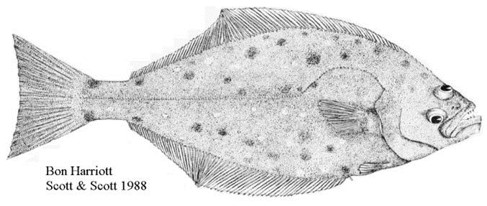
Text version: Atlantic halibut (Hippoglossus hippoglossus)
The image is a scientific illustration of an Atlantic halibut (Hippoglossus hippoglossus). It shows a large, flat, oval-shaped fish with both eyes on the right side of its head. The body is speckled with small dark spots, and it has a long dorsal fin along the top, a matching anal fin on the bottom, and a broad, slightly forked tail. The drawing is labeled “Bon Harriott, Scott and Scott 1988.”
To manage the Gulf Atlantic halibut stock, the Northwest Atlantic Fisheries Organization (NAFO) established the current management unit (Figure 1) in 1987. Subsequently, in 1988, Fisheries Management introduced the first TAC, which has become an important tool in the management of the stock to achieve sustainability, protect ecosystems, and maintain the long-term viability of the fishery. The Atlantic halibut directed fishery is now conducted by longlines through competitive or ITQ.
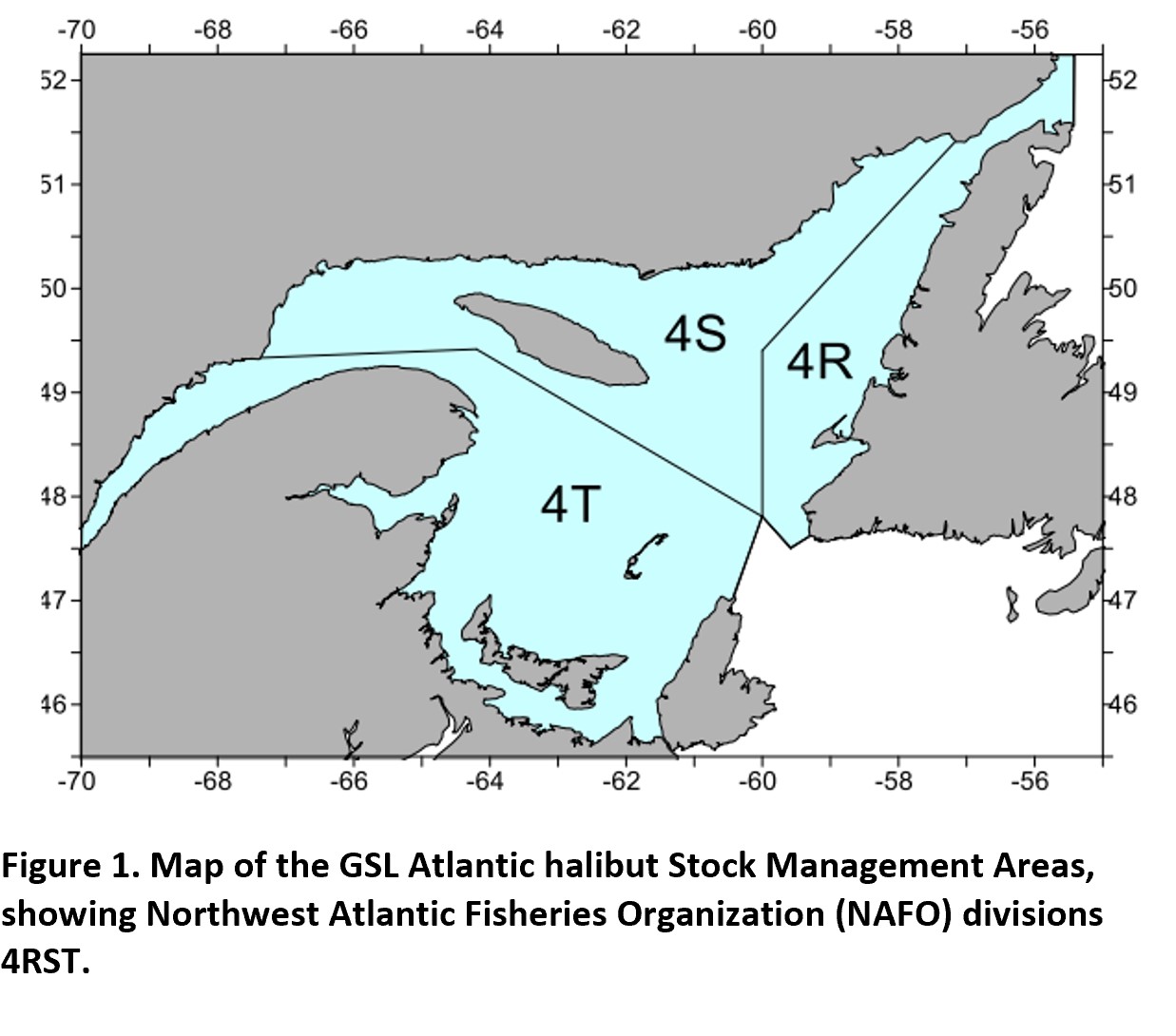
Text version: Map of the GSL Atlantic halibut Stock Management Areas, showing Northwest Atlantic Fisheries Organization (NAFO) divisions 4RST
Map of the Gulf of St. Lawrence showing Greenland halibut stock management areas divided into Northwest Atlantic Fisheries Organization (NAFO) divisions 4R, 4S, and 4T. Division 4R is near Newfoundland, 4S covers the central Gulf, and 4T includes the southern Gulf near New Brunswick and Prince Edward Island. Latitude and longitude grid lines are shown.
Atlantic halibut can be found throughout the lower estuary and GSL (DFO 2023). Figure 2 shows the distribution of catches made during fishery-independent mobile gear surveys which took place between July and September from 1985 to 2020. The probability of capture is higher on the channel banks at depths near 200 m, and around the 35 m isobath. Atlantic halibut generally seem to avoid the cold intermediate layer (CIL) where temperatures are less than 1oC, typically located between 50 m and 100 m depth. Some Atlantic halibut have been observed to undertake seasonal migrations, moving from shallow areas in the summer (less than 50 m) to deeper channels in the winter. Potential breeding areas were identified through geolocation by modelling locations where tagged fish made rapid vertical migrations likely associated with spawning. These behaviours were observed between mid-January and mid-March at depths greater than 300 m in the GSL channels.
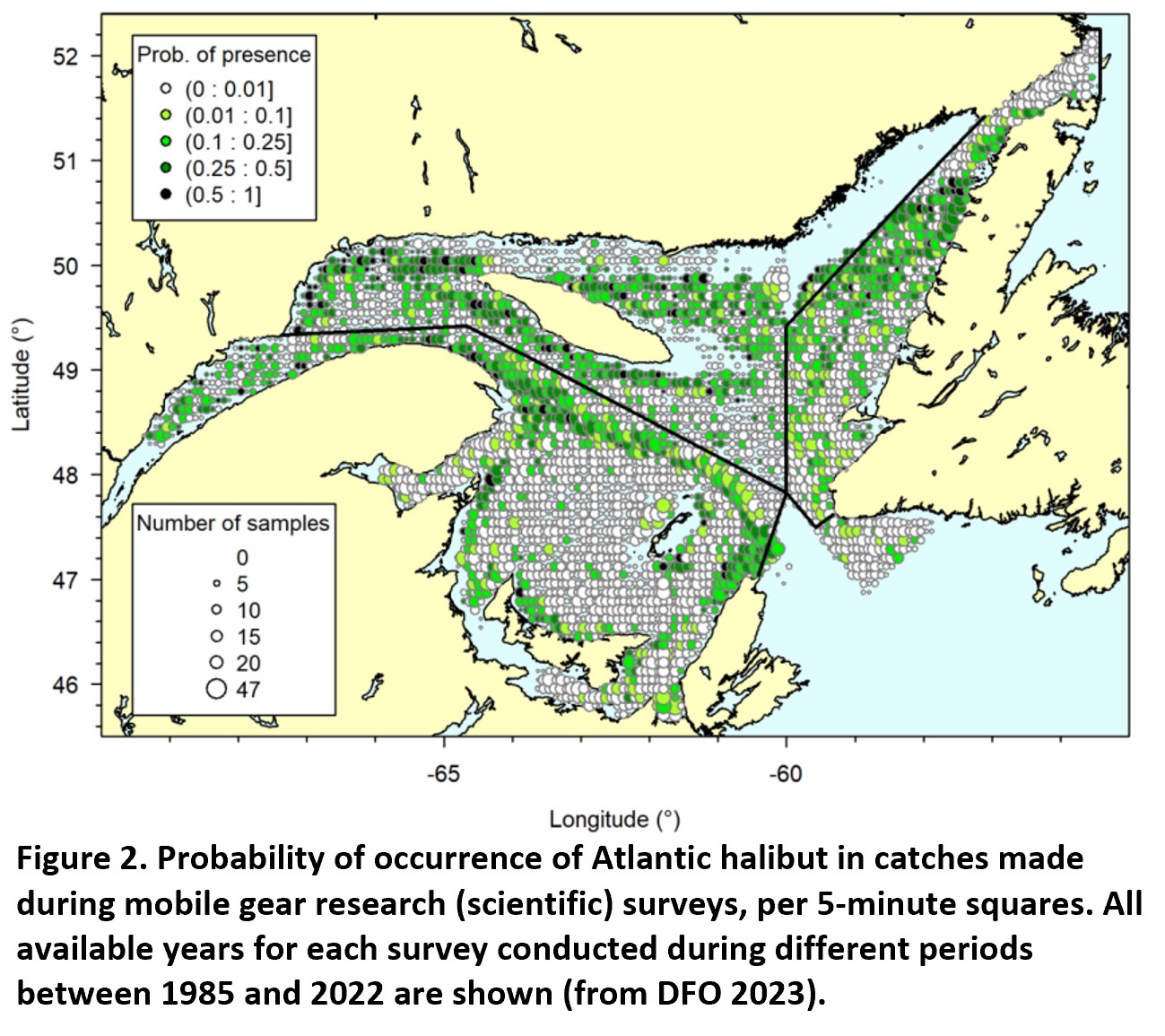
Text version: Probability of occurrence of Atlantic halibut in catches made during mobile gear research (scientific) surveys, per 5-minute squares. All available years for each survey conducted during different periods between 1985 and 2022 are shown (from DFO 2023)
Map of eastern Canadian waters showing the probability of Atlantic halibut occurrence in research survey catches from 1985 to 2022, with higher probabilities concentrated along the channels within the Gulf of St. Lawrence, such as the Laurentian Channel.
Annual landings of Atlantic halibut were on the order of 600 t in the early 1960s (Figure 3, Table 1). Landings then decreased to a historical low of 91 t in 1982. TACs were established in 1988 and were reached on only four occasions between 1988 and 2004. Annual landings reached their highest level in 60 years in 2021 and 2022 at around 1,500 t. Since 2017, a 50 t to 60 t allocation has been taken from the TAC and set aside under section 10 of the Fisheries Act to support the longline survey project and the annual tagging conducted by DFO in partnership with the industry. The remaining quota is distributed among 12 fleets in QC and the four Atlantic provinces, including eight inshore fixed-gear fleets involved in the directed fishery.
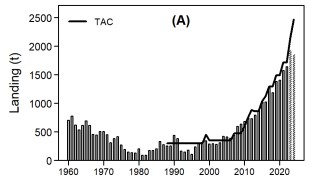
Text version: Landings and total allowable catches (TACs) by management year, preliminary data in 2023 and 2024
Bar chart showing Atlantic halibut landings and total allowable catch (TAC) from approximately 1960 to 2025. Landings generally declined until the 1980s, then increased steadily after 2005, with TAC rising sharply in recent years.
| Year | TAC | Catch level |
|---|---|---|
| 2008 | 475 | 599 |
| 2009 | 475 | 638 |
| 2010 | 600 | 674 |
| 2011 | 720 | 748 |
| 2012 | 720 | 728 |
| 2013 | 865 | 802 |
| 2014 | 865 | 863 |
| 2015 | 1,036 | 1,024 |
| 2016 | 1,036 | 950 |
| 2017 | 1,297 | 1,269 |
| 2018 | 1,297 | 1,192 |
| 2019 | 1,492 | 1,383 |
| 2020 | 1,492 | 1,229 |
Atlantic halibut are caught as bycatch by other fleets; mostly by the Greenland halibut (Reinhardtius hippoglossoides) gillnet fleet. Over the past five years, landings of Atlantic halibut by Greenland halibut gillnet fleet accounted for 2.6% of overall landings, on average, in comparison with 96.2% for the directed longline fishery for Atlantic halibut.
Stock assessment and trends
In March 2023, a comprehensive scientific assessment was conducted for 4RST Atlantic halibut. During this assessment, a LRP was adopted, and an USR point was proposed, placing the stock in the healthy zone of the PA. However, the results of the model are sensitive to the adjustment parameters chosen (DFO 2023).
The assessment indicates positive signs for the halibut fishery. Both commercial-sized and pre-recruit halibut populations are at high levels, which suggest good recruitment in the future. Catch per unit effort in the directed halibut fishery has also increased and stabilized to it highest observed value. This stock is on a 2-year assessment cycle.
The ecosystem of the GSL has undergone significant changes in recent decades, including warming of deeper waters, where record high temperatures were observed in 2022, and the return of high redfish (Sebastes sp.) abundances. The temperatures observed in deeper waters are not expected to negatively impact the survival or development of Atlantic halibut, as they do not exceed the documented preferred temperatures for the species. Research on the prey of Atlantic halibut and redfish in the estuary and nGSL has shown that the diet of Atlantic halibut older than three years differs from that of redfish. The impact of competition for prey between redfish and Atlantic halibut younger than three years still needs to be assessed.
Commercial fisheries management measures
A number of management measures have been implemented over the years to protect Atlantic halibut. A TAC was implemented in 1988. In 1997, a minimum legal size (MLS) of 81 cm was incorporated into commercial fishing licence conditions. The MLS was increased to 85 cm in 2010. All Atlantic halibut smaller in size must be returned to the water. Most of the standard management measures described in this IFMP are applicable to Atlantic halibut, such as a dockside commercial catch monitoring program (100%), at-sea coverage by observers (percentage varies by fleet), mandatory logbooks (except for vessels < 10.67 m in Newfoundland), predetermined fishing periods, limits on the size and maximum number of hooks allowed per line, small fish and bycatch protocols and, for the majority of QC fleets, a VMS. A quota reconciliation program has been in effect since the 2011 fishing season. Any quota overruns in a given year are counted toward the established quota for the following season(s). The carry forward of uncaught quotas of Atlantic halibut from the previous year may be authorized for up to 15% of the initial quotas.
Any details and management specifics can be found in the Conservation and Harvesting Plans (CHPs) that are published on the DFO web site.
Commercial access and allocation
The TAC for this stock is divided between eight inshore fixed gear fleet sectors (69.714%) from the Atlantic provinces and QC, one Atlantic-wide mid-shore fixed gear fleet (3.429%) and three mobile gear fleets (one each of inshore, mid-shore and offshore) sectors (26.857%). Directed fishing for Atlantic halibut is only permitted for the fixed-gear fleet sectors (eight inshore and one mid-shore), whereas the mobile gear fleet sectors can only use their allocations for bycatch needs in other groundfish fisheries.
From 2017 to 2023, 92.5% of the mobile gear sector quota had been transferred annually to the inshore fixed gear sector and is distributed equally amongst the eight inshore fixed-gear fleets. This decision was made because the bycatch levels of the groundfish mobile gear fleets have been well below their allocated quota. Following the re-opening of the commercial Unit 1 redfish fishery, the transfer arrangement was adjusted to better align with the bycatch requirements of the mobile gear sector. In 2024, approximately 61% of the mobile gear sector's quota was reallocated to the inshore fixed gear fleets, reflecting a reduction from previous years to accommodate the mobile gear sector's increased bycatch needs.
| Region | Fleet | Share (%) |
|---|---|---|
| Gulf1 | NB | 5.17 |
| Gulf1 | NS | 2.01 |
| Gulf1 | PEI | 1.46 |
| QC2 | North Shore | 8.24 |
| QC2 | Gaspé Peninsula | 44.03 |
| QC 2 | Magdalen Islands | 5.44 |
| NL | NL | 32.03 |
| MAR | MAR | 1.63 |
Notes:
- 1 – Total Shares in Gulf region is 8.63%.
- 2 – Total Shares in QC region is 57.71%.
Management objectives and expected results
The overall approach aims to stabilize TAC fluctuations and maximize catch levels while ensuring a healthy SSB in the long run. The department's strategy involves implementing effective fishery management measures with the following objectives:
- minimize by-catch levels of Atlantic halibut in non-target fisheries
- reduce discards of Atlantic halibut
- implement Harvest Control Rules to ensure sustainable harvesting practices
- enhance monitoring and surveillance coverage to better track fishery activities
- maintain collaboration with First Nations and Indigenous organizations to include their input in Atlantic halibut management decisions
By implementing these measures, the department seeks to maintain a balanced ecosystem, protect Atlantic halibut populations, and secure the long-term viability of the fishery.
References - Annex K
DFO. 2023. Stock assessment of Gulf of St. Lawrence (4RST) Atlantic halibut in 2022. DFO Can. Sci. Advis. Sec. Sci. Advis. Rep. 2023/036.
DFO. 2025. Stock assessment of Gulf of St. Lawrence (4RST) Atlantic halibut in 2024. DFO Can. Sci. Advis. Sec. Sci. Advis. Rep. 2025/028.
Annex L. Greenland halibut (May 2024)
General overview
Before the mid-1970s, the Greenland halibut (Reinhardtius hippoglossoides) landings in the GSL occurred mainly in the form of bycatch from trawlers in the shrimp and cod fisheries. Some inshore harvesters with groundfish licences were also capturing large individuals with gillnets and longlines for local market and food.
In the mid-1970s, a market for fresh Greenland halibut developed, raising the interest for harvesting this species. By the end of the 1970’s a fixed gear fishery (i.e. gillnets and longlines), was taking shape and expanding, in addition to the existing mobile gear fishery.
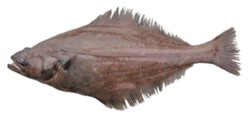
Text version: Greenland halibut (Reinhardtius hippoglossoides)
The image is a scientific illustration of a Greenland halibut (Reinhardtius hippoglossoides). It shows a flat, oval-shaped fish with both eyes on one side of its head. The body is dark brown and smooth, with long fins running along the top and bottom edges. Its shape and color help it blend into the ocean floor.
Management of the GSL Atlantic halibut stock, involves the NAFO involves management divisions 4R, 4S and 4T, with most of the stock being in 4RS (Figure 1). The TAC fluctuated over the years, reaching its highest in 1987 before declining sharply (Table 1).
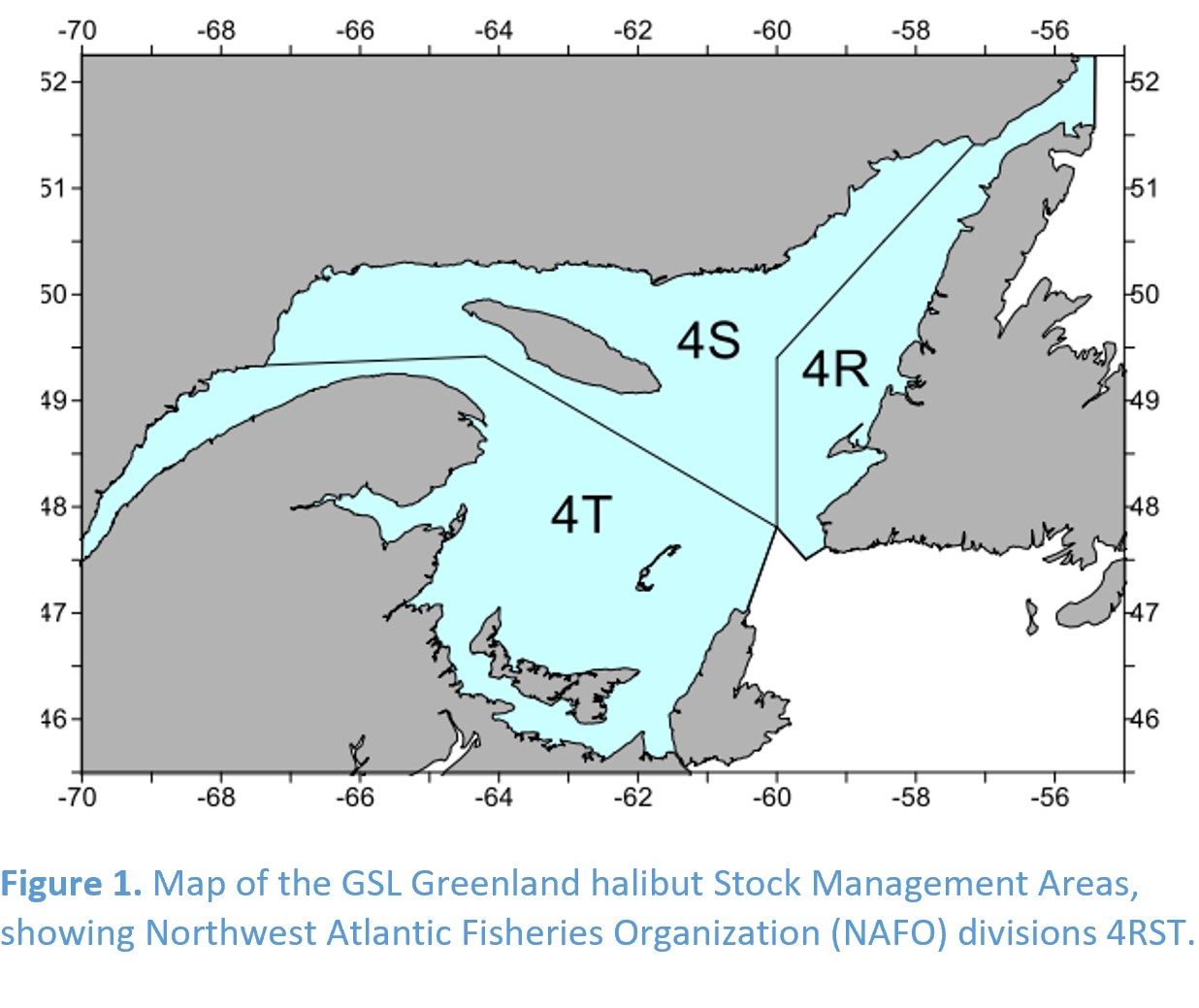
Text version: Map of the GSL Greenland halibut Stock Management Areas, showing Northwest Atlantic Fisheries Organization (NAFO) divisions 4RST
Map of the Gulf of St. Lawrence showing Greenland halibut stock management areas divided into Northwest Atlantic Fisheries Organization (NAFO) divisions 4R, 4S, and 4T. Division 4R is near Newfoundland, 4S covers the central Gulf, and 4T includes the southern Gulf near New Brunswick and Prince Edward Island. Latitude and longitude grid lines are shown.
The mobile gear fishery once accounted for over 30% of landings but has since been closed. After the mobile gear fishery closure, only a small portion of its previous TAC allocation has been transferred to the fixed gear fleet, resulting in some of the TAC no longer being utilized. The fishing allocation is now divided between QC and Newfoundland. The TAC remained stable from 2004 to 2018, but due to declining stock indicators, it was reduced by 25% in 2018 and further reduced to 2,000 t for the 2024 to 2025 season. Most landings now come from gillnet catches, primarily in NAFO divisions 4R, 4S, and 4T, with a shift in fishing effort from 4S to 4T in recent years (Figure 2, Table 1).
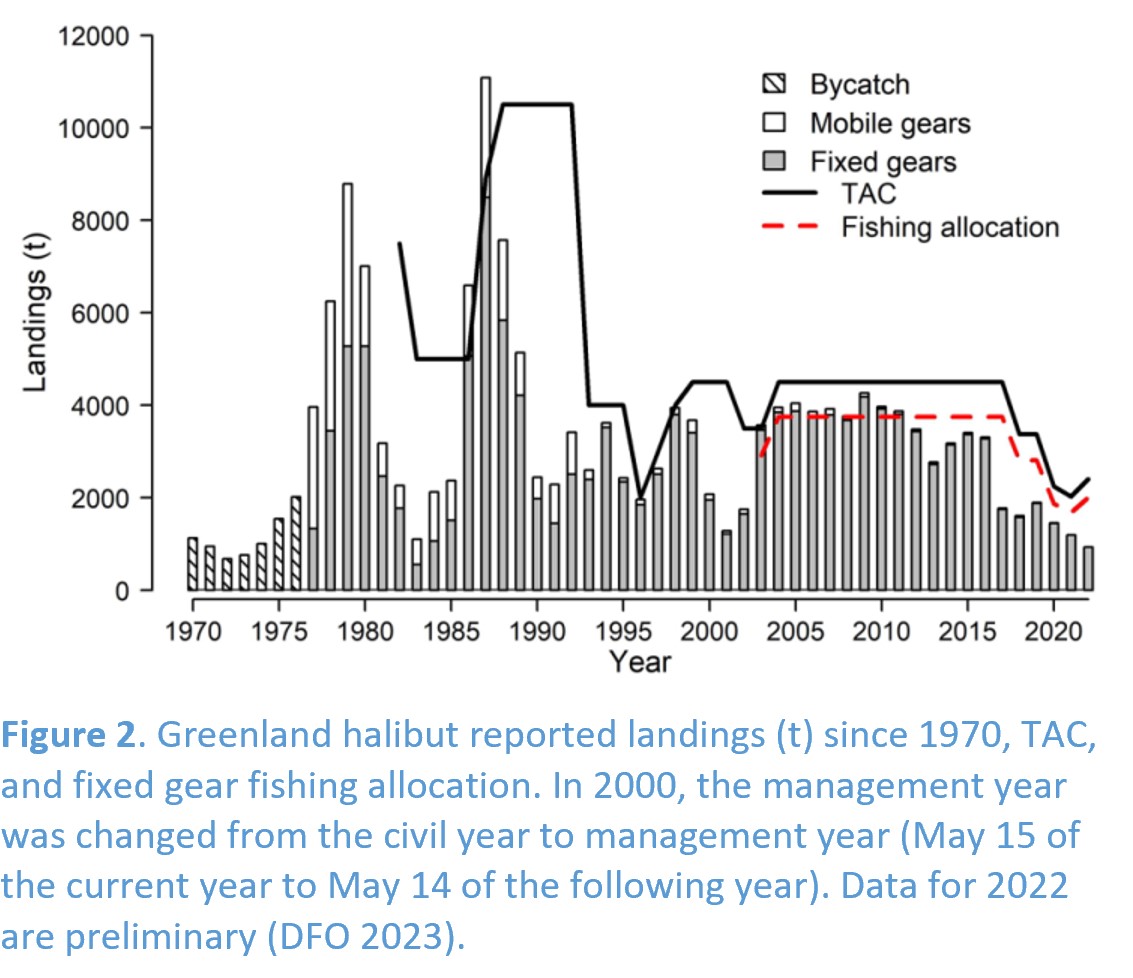
Text version: Greenland halibut reported landings (t) since 1970, TAC, and fixed gear fishing allocation. In 2000, the management year was changed from the civil year to management year (May 15 of the current year to May 14 of the following year). Data for 2022 are preliminary (DFO 2023)
Line chart and bar chart showing Greenland halibut reported landings from 1970 to 2022, with landings measured in tonnes on the y-axis and year on the x-axis. Bars represent catches by gear type and bycatch; a line shows total allowable catch (TAC), and line shows fishing allocation. Landings increased sharply in the late 1970s and late 1980s, peaked around 11,000 tonnes, then generally stabilized between about 3,000 and 4,500 tonnes from the mid-2000s before declining after 2018.
Stock assessment and trends
According to our current knowledge of the GSL stock, spawning occurs in winter (between January and March), in the deep part of the Laurentian Channel southwest of Newfoundland (Templeman 1973, Ouellet et al. 2011 and text describing the biology is taken from Gauthier et al. 2021). In this low-fecundity species, the female lays large eggs (3.4-4.7 mm in diameter) (Kennedy et al. 2009, Dominguez-Petit et al. 2012).
The Greenland halibut spawns only once a year and some individuals may not reproduce every year (Kennedy et al. 2009). Recent histological studies (Kennedy et al. 2011, Rideout et al. 2012) conclude to an unusual reproduction strategy for Greenland halibut in which the simultaneous development of two cohorts of oocytes is observed. A cohort of larger oocytes develops for the upcoming spawning season and a second cohort of smaller oocytes develops for the next year's spawning. This strategy allows Greenland halibut to spawn annually although each cohort requires more than a year to complete vitellogenesis.
The eggs, owing to their specific density, are mesopelagic; during most of their development, they are found at depths of around 300 m but, in the final days before hatching, rise to shallower depths to hatch due to a substantial change in specific density (Ouellet et al. 2011). After the yolk sac is resorbed, the pelagic larvae are primarily found in the surface layer at depths of 0 m to 50 m, where larval development occurs. When development has been completed, which takes up to four months, the larvae settle on the bottom to undergo metamorphosis.
The main nursery area for Greenland halibut in the GSL is in the lower estuary, with a secondary nursery area north of Anticosti Island (Youcef et al. 2013). One- and two-year old juveniles appear to be fairly sedentary in these two areas and are generally found at shallower depths than adults. Growth is continuous in juveniles and length increments between ages 1 and 2 are affected by temperature, oxygen levels and fish density (Youcef et al. 2015). The species is considered a strong swimmer; it makes significant daily migrations and spends nearly 25% of its time in the water column (Albert et al. 2011).
The most recent full scientific assessment for 4RST Greenland halibut was conducted in February 2023 (DFO 2023), with an update of the stock status indicator in 2024 (DFO 2024). The stock is currently in the cautious zone based on fish biomass index, but uncertainty remains due to observed ecosystem changes and decreased condition indicators in 2022 (Figure 3). Commercial fishing performance varied across regions, with the average length of landed fish below average, and a high proportion of fish below the minimum legal size. The recruitment for 2023 to 2024 ranges from low to high abundance, with the 2018 cohort showing promise. However, low recruitment from 2020 to 2022 will negatively impact fish biomass for future fishing. The recommended annual landings for 2023 to 2025 are not to exceed 2,002 t according to the Harvest Control Rules (DFO 2023).
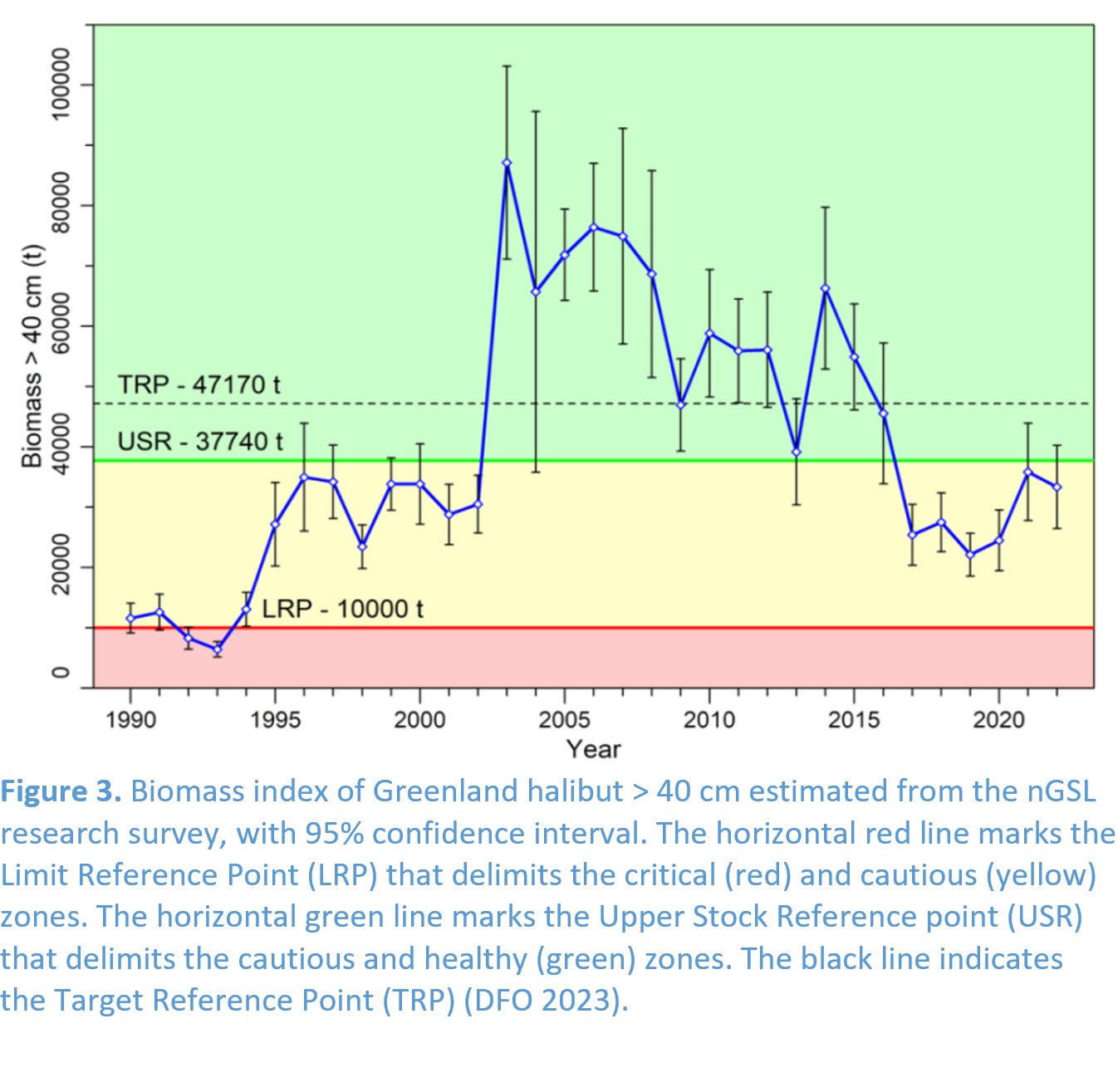
Text version: Biomass index of Greenland halibut > 40 cm estimated from the nGSL research survey, with 95% confidence interval. The horizontal red line marks the Limit Reference Point (LRP) that delimits the critical (red) and cautious (yellow) zones. The horizontal green line marks the Upper Stock Reference point (USR) that delimits the cautious and healthy (green) zones. The black line indicates the Target Reference Point (TRP) (DFO 2023)
Line graph showing the biomass index of Greenland halibut greater than 40 cm from 1990 to 2022, with 95% confidence intervals. Biomass increased from about 10,000 tonnes in the early 1990s to a peak near 87,000 tonnes in 2003, remained mostly above the Target Reference Point through the 2000s and early 2010s, then declined after 2016 and remained below the Upper Stock Reference but above the Limit Reference Point through 2022.
Commercial fisheries management measures
Various fishery management and conservation measures are employed, including fishing area closures, restricted fishing periods, gear limitations (mesh and hook size), fleet quotas, and minimum size requirements for groundfish species. A maximum number of gillnets is allowed, with varying limits across regions. Currently, harvesters must keep a logbook and weigh their catches at dockside. They may also be required to carry an ASO upon DFO's request. QC fleets have mandated the use of the VMS since 2017, while it's not required for all Newfoundland fleets.
Any details and management specifics can be found in the CHPs that are published on the DFO web site.
| Management year | TAC | Fixed gear allocation1 | Mobile gear allocation2 | Fixed gear landings | Mobile gear landings | Total landings | % reached TAC |
|---|---|---|---|---|---|---|---|
| 2007-08 | 4,500 | 3,751 | 750 | 3,711 | 131 | 3,842 | 85% |
| 2008-09 | 4,500 | 3,751 | 750 | 3,579 | 83 | 3,662 | 81% |
| 2009-10 | 4,500 | 3,751 | 750 | 4,070 | 58 | 4,128 | 92% |
| 2010-11 | 4,500 | 3,751 | 750 | 3,877 | 33 | 3,910 | 87% |
| 2011-12 | 4,500 | 3,751 | 750 | 3,728 | 47 | 3,773 | 84% |
| 2012-13 | 4,500 | 3,751 | 750 | 3,437 | 41 | 3,476 | 77% |
| 2013-14 | 4,500 | 3,751 | 750 | 2,731 | 25 | 2,755 | 61% |
| 2014-15 | 4,500 | 3,751 | 750 | 3,149 | 14 | 3,161 | 70% |
| 2015-16 | 4,500 | 3,751 | 750 | 3,372 | 25 | 3,397 | 75% |
| 2016-17 | 4,500 | 3,751 | 750 | 3,287 | 21 | 3,308 | 74% |
| 2017-18 | 4,500 | 3,751 | 750 | 1,751 | 15 | 1,766 | 39% |
| 2018-19 | 3,375 | 2,813 | 562 | 1,590 | 14 | 1,604 | 48% |
| 2019-20 | 3,375 | 2,813 | 562 | 1,888 | 9 | 1,897 | 56% |
| 2020-21 | 2,250 | 1,875 | 375 | 1,447 | 4 | 1,451 | 65% |
| 2021-22 | 2,025 | 1,688 | 337 | 1,088 | 4 | 1,091 | 54% |
Notes:
- 1 - Fixed gear fleet allocation (FG) including the transfer of 50% of the allocation of the mobile gear fleet (MG) under 65 feet to the fixed gear fleet. This transfer is the result of a ministerial decision to allocate a share of the less than 65 feet MG allocation to the FG fleet until such time as the MG fleet is reintegrated into the directed Greenland halibut fishery when the TAC exceeds 4,500 t.
- 2 - Combined allocations of fleets with mobile gear (MG) < 65 feet, 65 to 100 feet, and > 100 feet.
Commercial access and allocation
The TAC is divided between the inshore (less than 19.81m) fixed gear fleet (76.2%) and the mobile gear fleet (23.8%) for inshore, midshore and offshore vessels. Directed fishing of Greenland halibut is practiced only by the fixed gear fleets from QC and NL according to their respective allocation shares of 82% and 18%. Directed fishing has been banned for mobile gear fleets since 1993. A ministerial decision allows the temporary transfer of 50% of the allocation of mobile gear fleets of less than 65 feet to the fixed gear fleet. Once the TAC will surpass 4,500 tonnes, mobile gear fleets will be able to participate in the directed commercial fishery of Greenland halibut in a progressive manner.
| Region | Fleet | Share (%) |
|---|---|---|
| NL | NL | 18 |
| QC | QC | 82 |
Management objectives and expected results
The overall approach aims to stabilize TAC fluctuations and maximize catch levels while ensuring a healthy SSB in the long run. The department's strategy involves implementing effective fishery management measures with the following objectives:
- minimize by-catch levels of Greenland halibut in non-target fisheries
- reduce discards of Greenland halibut
- implement Harvest Control Rules to ensure sustainable harvesting practices
- enhance monitoring and surveillance coverage to better track fishery activities
- maintain collaboration with First Nations and Indigenous organizations to include their input in Greenland halibut management decisions
By implementing these measures, the department seeks to maintain a balanced ecosystem, protect Greenland halibut populations, and secure the long-term sustainability of the fishery.
References - Annex L
Albert, O. T., Lambert, Y., Vollen, T., Freitas, C. and Heggebakken, L. 2011. Distinguishing Pelagic and Demersal Swimming of Deepwater Flatfish by Recording of Body Angles. Am. Fish. Soc. Symposium 76, 2011.
DFO. 2023. Assessment of the Gulf of St. Lawrence (4RST) Greenland halibut stock in 2022. DFO Can. Sci. Advis. Sec. Sci. Advis. Rep. 2023/022.
DFO. 2024. Update of the Stock Status Indicator for Greenland Halibut in the Gulf of St. Lawrence (4RST) in 2023. DFO Can. Sci. Advis. Sec. Sci. Resp. 2024/002.
Dominguez-Petit, R., Ouellet, P. and Lambert, Y. 2012. Reproductive strategy, egg characteristics and embryonic development of Greenland halibut (Reinhardtius hippoglossoides). ICES J. Mar. Sci., 70: 342–351.
Gauthier, J., Marquis, M.-C., and Isabel, L. 2021. Gulf of St. Lawrence (4RST) Greenland Halibut Stock Status in 2020: Commercial Fishery and Research Survey Data. DFO Can. Sci. Advis. Sec. Res. Doc. 2021/059. v + 135 p.
Kennedy, J., Gundersen, A. C. and Boje, J. 2009. When to count your eggs: Is fecundity in Greenland halibut (Reinhardtius hippoglossoides W.) down-regulated? Fish. Res. 100: 260– 265.
Kennedy, J., Gundersen , A. C. Høines, Å. and Kjesb, O. S. 2011. Greenland halibut (Reinhardtius hippogolossoides) spawn annually but successive cohorts of oocytes develop over two years, complicating correct assessment of maturity. Can. J. Fish. Aquat. Sci. 68:201–209.
Ouellet, P., Bui, A. O. V. and Bernier, B. 2011. Greenland halibut (Reinhardtius hippoglossoides Walbaum, 1792) early stage distribution in the Gulf of St. Lawrence. J. Northw. Atl. Fish. Sci. 43: 121–129.
Rideout, R. M., Morgan, M. J., Lambert, Y., Cohen, A. M., Banoub, J. H. and Treble, M. 2012. Oocyte development and vitellogenin production in Northwest Atlantic Greenland halibut Reinhardtius hippoglossoides. J. Northw. Atl. Fish. Sci., Vol. 44: 15–29.
Templeman, W. 1973. Distribution and Abundance of the Greenland Halibut, Reinhardtius hippoglossoides (Walbaum), in the Northwest Atlantic. ICNAF Res. Bull. No. 10:83-99.
Youcef, W. A., Lambert, Y. and Audet, C. 2013 Spatial distribution of Greenland halibut Reinhardtius hippoglossoides in relation to abundance and hypoxia in the estuary and Gulf of St. Lawrence. Fish. Oceanogr. 22:1, 41–60.
Youcef, W. A., Lambert, Y. and Audet, C. 2015. Variations in length and growth of Greenland Halibut juveniles in relation to environmental conditions. Fish. Res. 167, 38–47.
Annex M. Witch flounder (May 2024)
General overview
In 1977, witch flounder (Glyptocephalus cynoglossus) commercial fisheries in the nGSL (NAFO divisions 4RS) were placed under quota management, with a set quota of 3,500 t. Two years later, in 1979, the TAC for NAFO divisions 4RS was increased to 5,000 t. This step was taken to eliminate an older and slow-growing segment of the stock, resulting in a more balanced age composition. However, despite this positive outcome, landings began to decline, prompting a reduction in the TAC to 3,500 t by 1982.
During the 1980s, the witch flounder landings from NAFO division 4T started to dominate the GSL, shifting the focus away from NAFO divisions 4RS. An initial comprehensive assessment of witch flounder in NAFO Divisions 4RS was conducted in 1978 and continued annually until 1981. Subsequent assessments were postponed until 1991, following the Fisheries Resource Conservation Council's recommendation in 1994 (FRCC 1994), which eventually led to the extension of the management unit to NAFO divisions 4RST in 1995 (Figure 1).
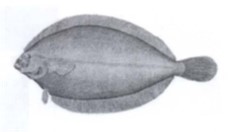
Text version: witch flounder (Glyptocephalus cynoglossus)
The image is a scientific illustration of a witch flounder (Glyptocephalus cynoglossus). It shows a flat, oval-shaped fish with both eyes located on the right side of its body. The body tapers toward a small, rounded tail. A long dorsal fin runs along the top edge, and an anal fin runs along the bottom edge, both appearing thin with fine rays. The mouth is slightly curved, and the head is narrow compared to the body. The illustration is simple, with no background details, focusing entirely on the fish’s shape and anatomical features.
Stock assessment and trends
Witch flounder is a species of low productivity and is vulnerable to overexploitation. Growth is slow and maturation is at a late age. In the 1974 to 1981 period, the mean length at 12 years was estimated to have been only 40 cm for males and 41 cm for females. For this same period, estimated ages at 50% maturity were 7.5 years for males and 10.4 years for females. An apparent shift towards earlier maturation in the 4RST stock between the 1970s and the 2000s suggests that this stock has experienced relatively high adult mortality.
In March 2022, a stock assessment was conducted for NAFO divisions 4RST witch flounder using data up to 2021 (Ricard 2022). The assessment used a surplus production population model to evaluate the stock. The 2021 median estimate of fish larger than 30 cm (proxy for SSB) placed the stock in the cautious zone of the PA at 160% of its LRP, with a 23% chance of being below the LRP.
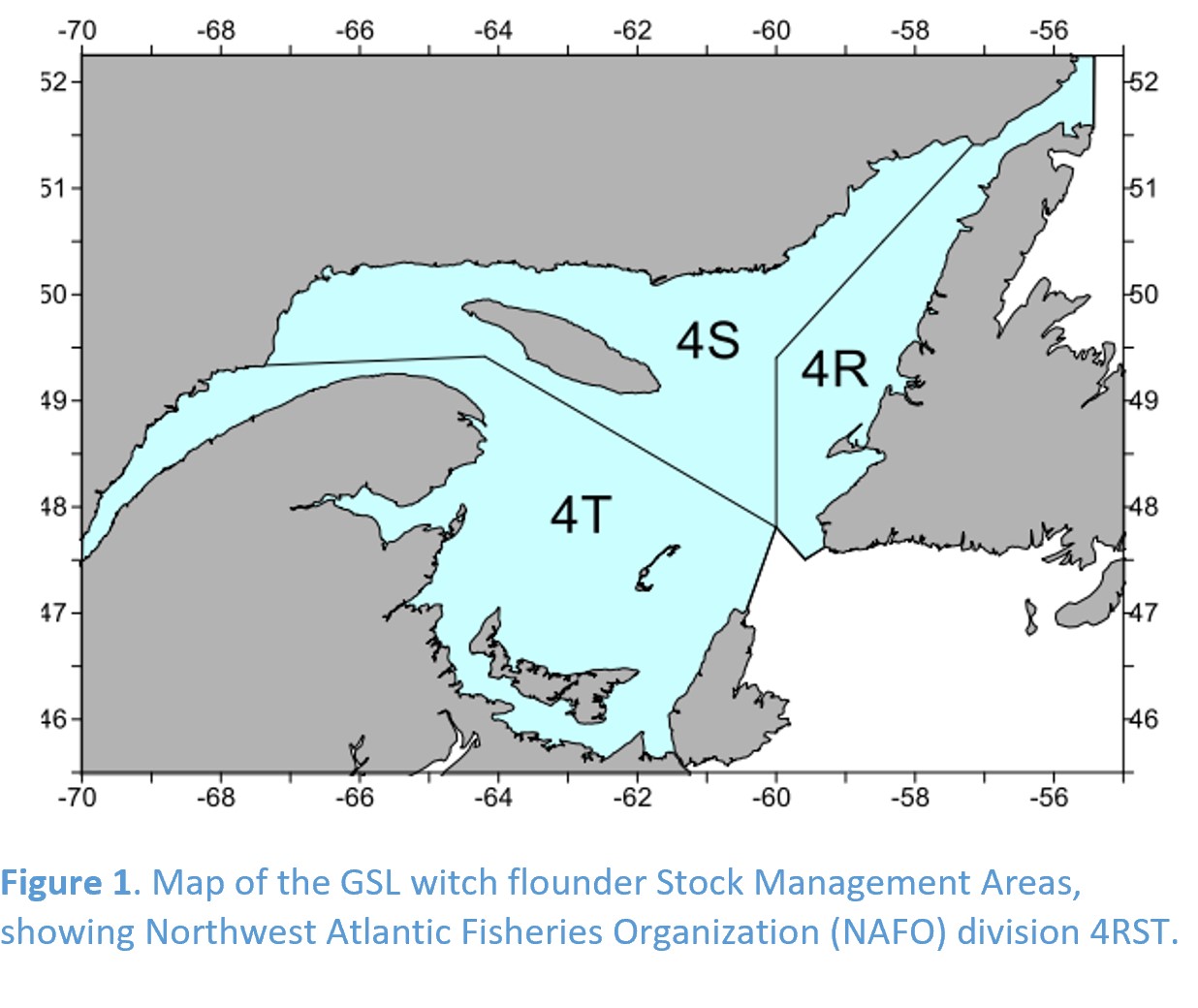
Text version: Map of the GSL witch flounder Stock Management Areas, showing Northwest Atlantic Fisheries Organization (NAFO) division 4RST
Map of the Gulf of St. Lawrence showing Greenland halibut stock management areas divided into Northwest Atlantic Fisheries Organization (NAFO) divisions 4R, 4S, and 4T. Division 4R is near Newfoundland, 4S covers the central Gulf, and 4T includes the southern Gulf near New Brunswick and Prince Edward Island. Latitude and longitude grid lines are shown.
Since 2012, the stock has shown an upward trend, with recent removal levels kept below 500 t annually. Projections of stock biomass after fishing for 2022 to 2026 indicate that the biomass is expected to increase for examined annual catch options to 1,000 t. The probability of the biomass after fishing being below the LRP in 2026 is 13% in the absence of fishing, 16% at an annual catch of 500 t and 22% at a catch option of 1,000 t. The probability that the stock biomass will be in the healthy zone, i.e. at or above USR, in 2026 after fishing is 60% with no catch, 52% at an annual catch of 500 t and 44% at an annual catch of 1,000 t (Ricard 2022, Figure 2). Caution is advised as the available evidence indicates that incoming recruitment of witch flounder < 30 cm is not as strong as the recruitment noted in 2009 and 2010.
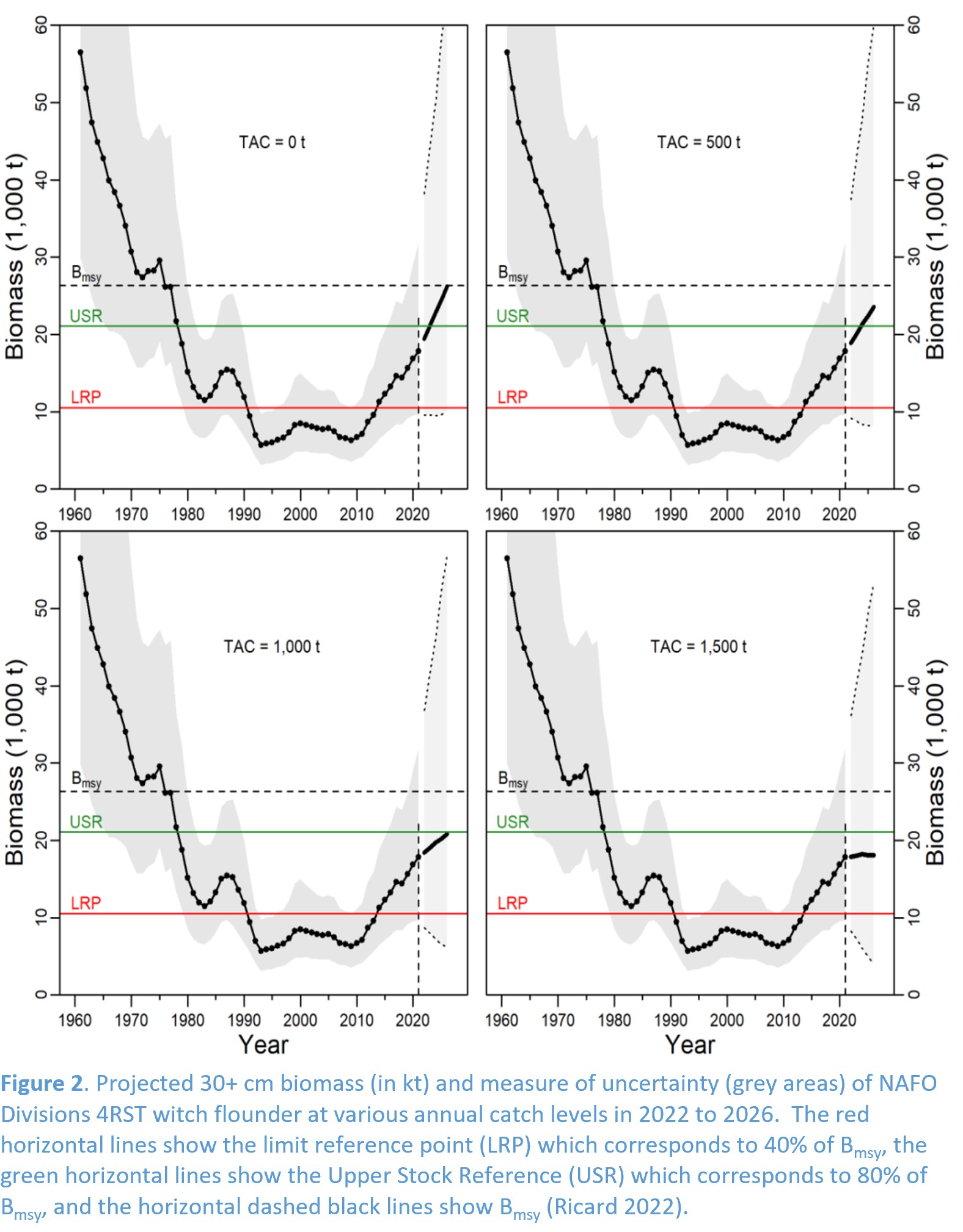
Text version: Projected 30+ cm biomass (in kt) and measure of uncertainty (grey areas) of NAFO Divisions 4RST witch flounder at various annual catch levels in 2022 to 2026. The red horizontal lines show the limit reference point (LRP) which corresponds to 40% of Bmsy, the green horizontal lines show the Upper Stock Reference (USR) which corresponds to 80% of Bmsy, and the horizontal dashed black lines show Bmsy (Ricard 2022)
Four-panel line graph showing projected biomass of NAFO Divisions 4RST witch flounder from 2022 to 2026 under total allowable catches (TACs) of 0, 500, 1,000, and 1,500 tonnes. Historical biomass declined from the 1960s to the 1990s and then increased after 2010. Projections indicate biomass continues to rise under lower TACs and levels off at lower values under higher TACs. All projected scenarios remain above the Limit Reference Point but below the Upper Stock Reference by 2026.
This stock is evaluated on a 5-year cycle; next stock assessment is scheduled for 2027. An interim year indicator update could be provided mid-way in the five-year assessment cycle to determine if the indicator signals that a re-assessment is warranted. This indicator is based on the combined RV surveys in NAFO divisions 4RST.
Like many other marine ecosystems, the GSL is experiencing warming trends in both surface and bottom water temperatures (Galbraith et al. 2022). The diet of witch flounder mainly consists of small benthic organisms and it is unclear what effects a warming trend in water temperature would have. The species is distributed as far south as Cape Hatteras and is likely able to withstand warmer temperatures, but the energetic costs associated are unknown. Similarly, the prey field could be altered by warming temperatures but the overall effects on the population dynamics of witch flounder in the GSL are unknown (Ricard 2022).
Unlike a number of other groundfish stocks in the GSL that have failed to rebuild despite large reductions in fishing mortality, the witch flounder stock has been rebuilding since 2010. The most probable reason for the lack of rebuilding of others stocks is the increased natural mortality imposed by grey seals. In the case of Atlantic cod, the last stock assessment indicated an increase in natural mortality on older fish (Swain et al. 2019). Similar situations have been observed for American plaice (Ricard et al. 2016), white hake (Swain et al. 2016), yellowtail flounder (Limanda ferruginea, Rolland et al. 2022), winter flounder (Pseudopleuronectes americanus, Surette and Rolland 2019) and winter skate (Leucoraja ocellata, Swain and Benoît 2016).
In the GSL, witch flounder are found in deeper waters than other groundfish species. This distribution makes it less likely that they would be a prey for grey seals, whose foraging behaviour based on telemetry data was found to be restricted to water above 150 m (Breed et al. 2009). The other stock that is showing clear signs of rebuilding is redfish in Unit 1 (Senay et al. 2021), which is another stock whose distribution is in deep waters.
Management measures
The PA framework outlines that when dealing with stocks in the cautious zone, the focus of management measures should be on facilitating the growth of the stock towards the healthy zone within a reasonable timeframe. Simultaneously, the level of risk tolerance for preventable decline should remain at a low to moderate level if it is already high within this zone.
Despite the positive findings in the scientific assessment of this particular stock, indicating an increase in stock biomass and projected continued growth under the scenario of total annual removals ranging from 500 to 1,000 t, there is a significant reason for caution. This is due to the fact that there is a 23% probability that the stock might actually be in the critical zone.
Any details and management specifics can be found in the CHPs that are published on the DFO web site.
Commercial access and allocation
The management of 4RST Witch flounder follows a five-year cycle. Out of the TAC, 88% is designated for the inshore mobile-gear sector. Among the remaining TAC, 7% is allocated to the midshore mobile gear fleet (vessels between 65-100') operating in NAFO 4T, while 5% is reserved for bycatch across all other fleets. Should the TAC increase to 3,500 tonnes, a new offshore quota for 4RST witch flounder would be established. This quota would be determined based on its former proportional share of 53 percent of the Canadian quota from 1984.
Initially set at 1,000 tonnes between 2000 and 2011, the TAC underwent reductions in subsequent years. It was lowered to 500 tonnes in 2012 and further decreased to 300 tonnes in 2013. Following a scientific assessment that categorized the stock within the cautious zone of the PA but on an upward trend towards the healthy zone, the TAC was reinstated at 500 tonnes in 2017 and increased to 650 t in 2022 for the next five-year management cycle (Table 1, Figure 3).
| Year | TAC | Catch level |
|---|---|---|
| 2011 | 1000 | 416 |
| 2012 | 500 | 330 |
| 2013 | 300 | 274 |
| 2014 | 300 | 286 |
| 2015 | 300 | 253 |
| 2016 | 300 | 286 |
| 2017 | 500 | 338 |
| 2018 | 500 | 299 |
| 2019 | 500 | 297 |
| 2020 | 500 | 183 |
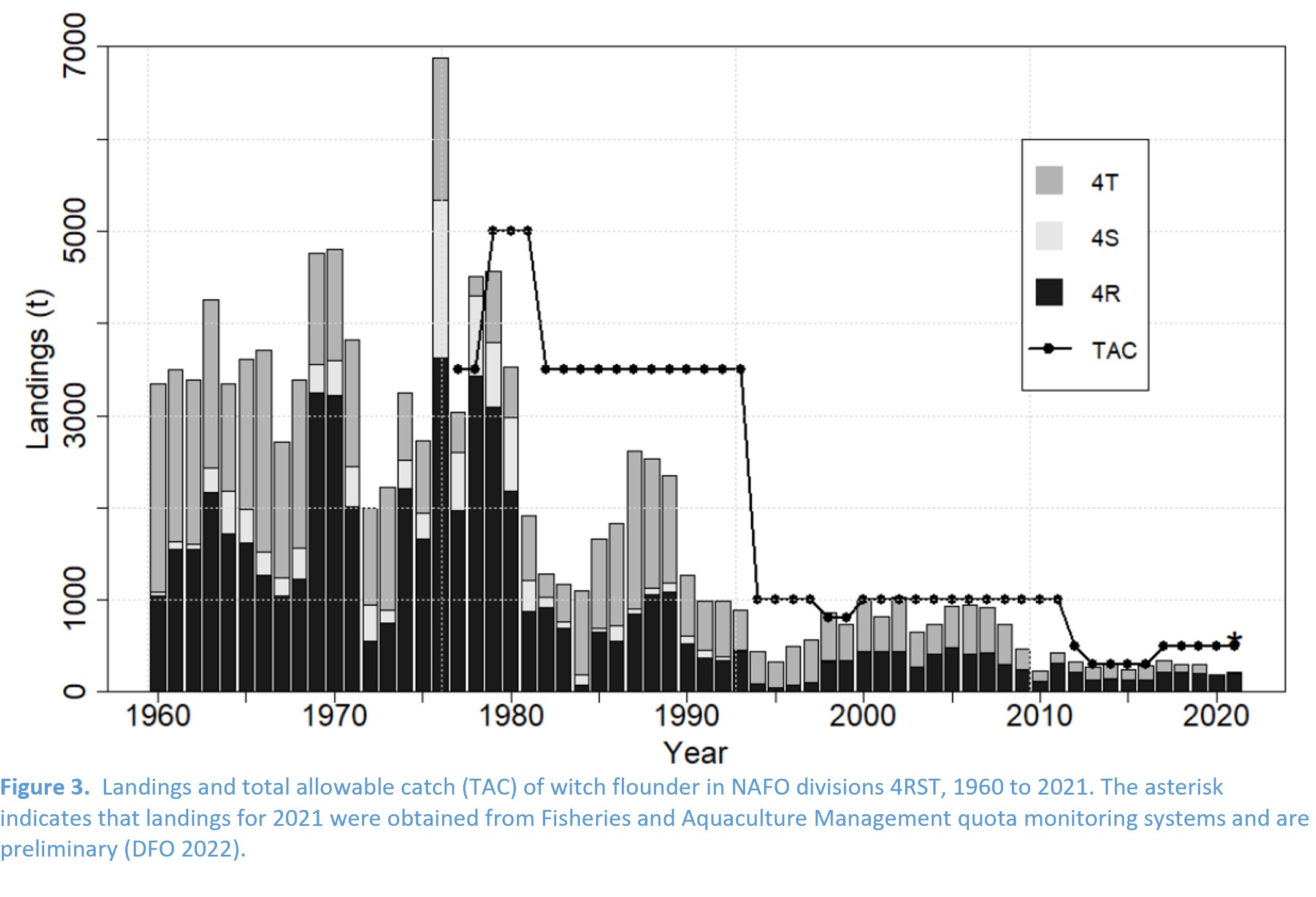
Text version: Landings and total allowable catch (TAC) of witch flounder in NAFO divisions 4RST, 1960 to 2021. The asterisk indicates that landings for 2021 were obtained from Fisheries and Aquaculture Management quota monitoring systems and are preliminary (DFO 2022)
Stacked bar chart showing witch flounder landings in NAFO Divisions 4RST from 1960 to 2021, separated by divisions 4R, 4S, and 4T, with a line showing total allowable catch (TAC). Landings were highest during the 1960s and 1970s, reaching nearly 7,000 tonnes, then declined sharply after the early 1980s. Since the mid-1990s, annual landings have generally remained below 1,000 tonnes. TAC declined from about 5,000 tonnes in the late 1970s and early 1980s to 500 tonnes by 2012 and remained at low levels through 2021.
Management objectives and expected results
The overall approach aims to stabilize TAC fluctuations and maximize catch levels while ensuring a healthy SSB in the long run. The department's strategy involves implementing effective fishery management measures with the following objectives:
- minimize by-catch levels of witch flounder in non-target fisheries
- reduce discards of witch flounder
- implement Harvest Control Rules to ensure sustainable harvesting practices
- enhance monitoring and surveillance coverage to better track fishery activities
- maintain collaboration with First Nations and Indigenous organizations to include their input in witch flounder management decisions
By implementing these measures, the department seeks to maintain a balanced ecosystem, protect witch flounder population, and secure the long-term viability of the fishery.
References - Annex M
Breed, G.A., Jonsen, I.D., Myers, R.A., Bowen, W.D., and Leonard, M.L. 2009. Sex-specific, seasonal foraging tactics of adult grey seals (Halichoerus grypus) revealed by state–space analysis. Ecology 90(11): 3209–3221.
DFO. 2022. Stock assessment of Witch Flounder (Glyptocephalus cynoglossus) in the Gulf of St. Lawrence (NAFO Divisions 4RST) to 2021. DFO Can. Sci. Advis. Sec. Sci. Advis. Rep. 2022/028.
FRCC. 1994. Conservation: Stay the course. 1995 conservation requirements for Atlantic groundfish. Report to the Minister of Fisheries and Oceans. Fisheries Resource Conservation Council, Ottawa. Cat. num. Fs1-61/1995E.
Galbraith, P.S., Chassé, J., Shaw, J.-L., Dumas, J., Caverhill, C., Lefaivre, D., and Lafleur, C. 2022. Physical Oceanographic Conditions in the Gulf of St. Lawrence during 2021. DFO Can. Sci. Advis. Sec. Res. Doc. 2022/034: iv + 83 p.
Ricard, D. 2022. Assessment of Witch Flounder (Glyptocephalus cynoglossus) in the Gulf of St. Lawrence (NAFO Divisions 4RST), March 2022. DFO Can. Sci. Advis. Sec. Res. Doc. 2022/054. v + 125 p.
Ricard, D., Morin, R., Swain, D.P., and Surette, T. 2016. Assessment of the southern Gulf of St. Lawrence (NAFO Division 4T) stock of American plaice (Hippoglossoides platessoides), March 2016. DFO Can. Sci. Advis. Sec. Res. Doc. 2016/057. ix + 43 p.
Rolland, N., Swain, D. and Ricard, D. 2022. The Status of Yellowtail Flounder (Limanda ferruginea) in NAFO Division 4T to 2020. DFO Can. Sci. Advis. Sec. Res. Doc. 2022/041. V + 82 p.
Senay, C., Ouellette-Plante, J., Bourdages, H., Bermingham, T., Gauthier, J., Parent, G., Chabot, D., and Duplisea, D. 2021. Unit 1 Redfish (Sebastes mentella and S. Fasciatus) stock status in 2019 and updated information on population structure, biology, ecology, and current fishery closures. DFO Can. Sci. Advis. Sec. Res. Doc. 2021/015. xii + 127 p.
Swain, D.P., and Benoît, H.P. 2016. Recovery potential assessment of the Gulf of St. Lawrence Designatable Unit of Winter Skate (Leucoraja ocellata mitchill), January 2016. DFO Can. Sci Advis. Secr. Res. Doc. 2016/119. xviii. + 131 p.
Abbreviations and acronyms
- Bmsy
- Biomass at maximum sustainable yield
- ASO
- At-Sea Observer
- C and P
- Conservation and Protection
- CHP
- Conservation Harvesting Plan
- CIL
- Cold Intermediate layer
- COSEWIC
- Committee on the Status of Endangered Wildlife in Canada
- CSA
- Centres for Science Advice (located in each DFO Region)
- CSAS
- Canadian Science Advisory Secretariat
- CPUE
- Catch per unit of effort
- DFO
- Fisheries and Oceans Canada
- DMP
- Dockside Monitoring Program
- ELOG
- Electronic Logbooks
- F
- Estimated Fishing Mortality
- FG
- Fixed Gear
- FSC
- Food, social and ceremonial
- GFA
- Groundfish Fishing Area
- GFIS
- Gulf Fishery Information System
- GGAC
- Gulf Groundfish Advisory Committee
- GSL
- Gulf of St. Lawrence
- HCR
- Harvest Control Rules also called Harvest Decision Rules
- IFMP
- Integrated Fishery Management Plan
- IK
- Indigenous Knowledge
- ITQ
- Individual transferable quota
- IUU
- Illegal, Unreported and Unregulated
- kt
- kiloton or 1,000 metric tons
- LRP
- Limit Reference Point
- M
- Natural mortality
- MAR
- Maritimes region
- MPA
- Marine Protected Areas
- NAFO
- Northwest Atlantic Fisheries Organization
- NB
- New Brunswick
- NL
- Newfoundland and Labrador
- NGO
- Non-Governmental Organization
- nGSL
- northern Gulf of St. Lawrence
- NS
- Nova Scotia
- p
- Preliminary
- PA
- Precautionary Approach
- PEI
- Prince Edward Island
- QC
- Quebec
- RAP
- Regional Assessment Process (science)
- RDG
- Regional Director General
- RV
- Research Vessel
- SAR
- Science Advisory Report
- SARA
- Species at Risk Act
- sGSL
- southern Gulf of St. Lawrence
- SSB
- Spawning Stock Biomass
- t
- Metric ton, which is 1,000 kg or 2,204.6 lbs
- TAC
- Total Allowable Catch
- USR
- Upper Stock Reference
- VMS
- Vessel Monitoring System
Glossary
- Abundance
- Number of individuals or total weight of animals in a stock or a population.
- Allocation
- A portion or share of the Total Allowable Catch allocated to a class of vessels.
- Biomass
- Biomass, or the index of biomass, is the total weight of a given species of fish in one area at a specific time. This can be for a full population or a defined portion of it. The time periods are usually the time of the survey or measurement.
- Bycatch
- Bycatch is the unintentional catch of a species when meaning to catch another. In many fisheries, it’s not possible to directly fish for one species without also capturing others.
- Catch per Unit Effort (CPUE)
- The amount caught for a given fishing effort.
- Cautious zone
- A stock is considered to be in the cautious zone if the biomass, or the index of biomass, is higher than the limit reference point but lower than the upper stock reference point.
- Communal Commercial Licence
- Licence issued to Indigenous organizations pursuant to the Aboriginal Communal Fishing Licences Regulations for participation in the commercial fishery.
- Conservation harvesting plan (CHP)
- Conservation harvesting plans are fishing plans that identify harvesting methods aimed at minimizing the harvest of small fish and bycatch of groundfish. Plans typically include measures to control and monitor - gear restrictions; time and area closures; both target and bycatch species; bycatch and discarding protocols; monitoring and logbook requirements.
- Critical zone
- A stock is considered to be in the critical zone if the mature biomass, or its index, is less than the limit reference point.
- Dockside Monitoring Program (DMP)
- A monitoring program that is conducted by a company that has been designated by DFO, which verifies the species composition and landed weight of all fish landed from a commercial fishing vessel.
- F0.1
- The fishing mortality rate at which the marginal yield-per-recruit (i.e. the increase in yield-per-recruit in weight for an increase in one unit of fishing mortality) is only 10 percent of the marginal yield-per-recruit on the unexploited stock.
- Fishing effort
- Quantity of effort using a given fishing gear over a given period of time.
- Fishing mortality
- Death caused by fishing, often symbolized by the mathematical symbol F.
- Fish stock
- Fish stock is a population of individuals of a species found in a particular area. The term is used as a unit for fisheries management, such as the Northwest Atlantic Fisheries Organization (NAFO) area 4T winter flounder.
- Fixed gear
- A type of fishing gear that is set in a stationary position or fixed to the vessel while drifting. These include traps, weirs, gillnets, longlines and handlines.
- Ghost fishing
- Situation in which lost fishing gear continues to catch and kill fish.
- Gillnet
- Fishing gear - netting with weights on the bottom and floats at the top used to catch fish. Gillnets can be set at different depths and are either anchored to the seabed or attached to the fishing vessel and drifted. Fish are captured by meshing.
- Harvest control rule
- A harvest control rule is also called a harvest decision rule. This is a set of defined management actions for each precautionary approach stock status zone that:
- include biologically based reference points
- are implemented in response to changes in the status of a stock
- Healthy zone
- A stock is considered to be in the healthy zone if its biomass, or the index of the biomass, is higher than its upper stock reference point.
- Individual Quota (IQ)
- The further division of fleet quotas to individual enterprises or vessels. Where such allocations are transferrable under established guidelines, they are referred to Individual Transferable Quotas (ITQs).
- Indigenous knowledge
- Is a complex knowledge system based on the views of Indigenous peoples. It reflects the unique culture, languages, values, histories, governance and legal systems of Indigenous peoples. It is built upon the experiences of earlier generations, inform the practices of current generations, and evolve in the context of contemporary society.
- Landings
- Quantity of a species caught and landed.
- Limit Reference Point (LRP)
- Marks the boundary between the cautious and critical zones. When a fish stock level falls below this point, there is a high probability that its productivity will be so impaired that serious harm will occur. The limit reference point is established based on the best available scientific information.
- Limited entry
- A fishery management policy in place to limit fishing effort and to support economic viability of enterprises. No new licences are issued, although, normally, licences are re-issuable to new entrants upon the departure of those leaving the fishery, subject to broader licensing policy rules.
- Marshall Response Initiative
- In response to the Supreme Court of Canada decision in the Marshall (1999) case on the commercial aspects of Indigenous fishing rights, DFO introduced a series of initiatives to support the participation by First Nations in commercial fisheries.
- Mesh size
- Size of the mesh of a net. Different fisheries have different minimum mesh size regulation.
- Midwater trawl
- Fishing gear - cone-shaped net towed within the water column.
- Mobile gear
- A type of fishing gear that is drawn through the water by a vessel to entrap fish. These include otter trawls, mid-water trawls, purse seines and Danish/Scottish Seines.
- Observer coverage
- When a licence holder is required to carry a designated at-sea-observer onboard the vessel for a specific period of time to verify the amount of fish caught, the area in which it was caught and the method by which it was caught.
- Population
- Group of individuals of the same species, forming a breeding unit, and sharing a habitat.
- Precautionary Approach
- Set of measures and actions, including future guidelines, which ensures prudent foresight, reduces or prevents risk to the resource, the environment and the people, to the extent possible, taking explicitly into account existing uncertainties and the potential consequences of being wrong.
- Quota
- Portion of the total allowable catch that a unit such as vessel class, country, etc. is permitted to take from a stock in a given period of time.
- Recruitment
- Quantity or weight of individuals becoming part of the exploitable stock, that is, that can be legally caught and kept in a fishery.
- Shared stewardship
- Fisheries management approach in which participants will be effectively involved in fisheries management decision-making processes at appropriate levels; they will contribute specialized knowledge and experience, and share in accountability for outcomes.
- Species at Risk Act (SARA)
- The Act is a federal government commitment to prevent wildlife species from becoming extinct and secure the necessary actions for their recovery. It provides the legal protection of wildlife species and the conservation of their biological diversity.
- Spawning stock
- Sexually mature individuals in a stock.
- Spawning Stock Biomass (SSB)
- The total weight of all the sexually mature individuals in a stock.
- Stock
- Population of individuals of one species in a specific area.
- Stock assessment
- Scientific evaluation of the status of a species belonging to a same stock within a particular area in a given time period.
- Sustainability
- Sustainability means a species can survive and meet the needs of their present population without weakening the chances of future generations to meet their own needs. Sustainability reflects the capacity to thrive over the long term.
- Total Allowable Catch (TAC)
- The amount of catch that may be taken from a stock over a given period of time as indicated in the Notice to Harvesters.
- Upper Stock Reference (USR)
- Marks the boundary between the cautious and healthy zones. Management action, whether during a fishery development or stock rebuilding process, should aim at maintaining the stock abundance above this level. The USR is developed by fishery managers informed by consultations with harvesters and other interests, and with advice and input from Science.
- Year-class
- Individuals of a same stock born in a particular year. Also called "cohort".
Page details
- Date modified: