
Introduction to stock assessment
Unit 1.3: Stock status and reference points
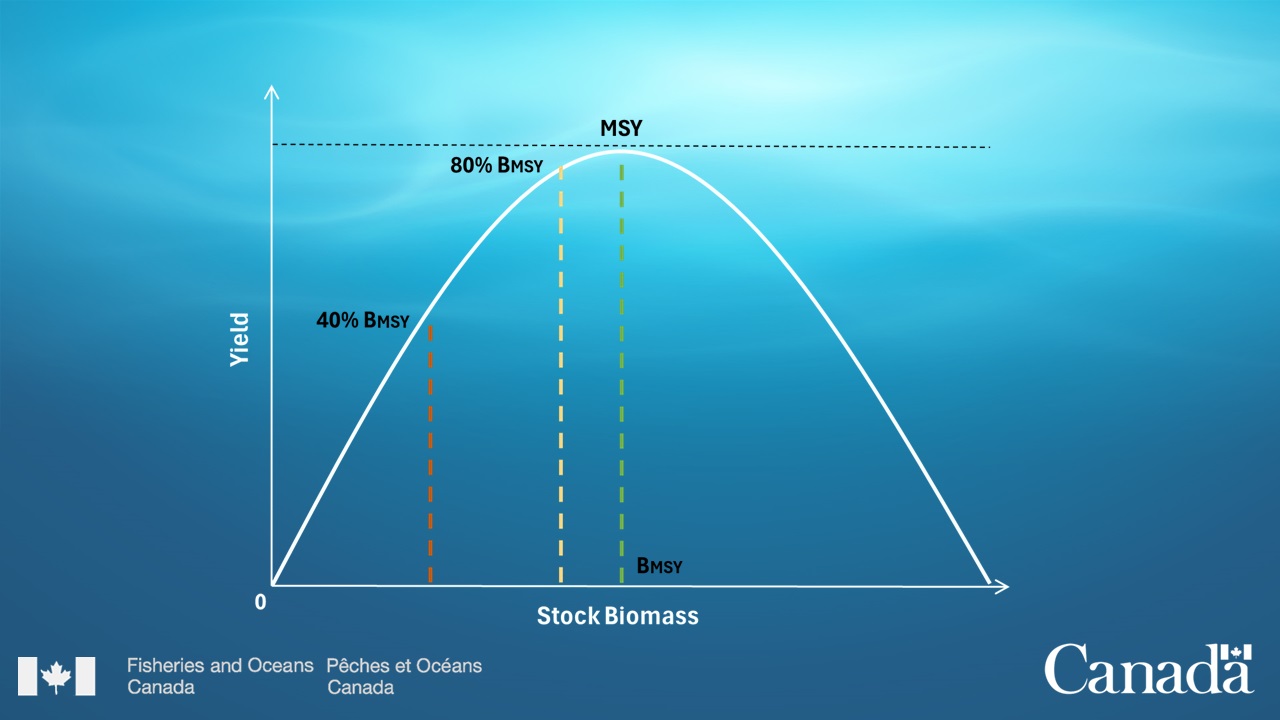
A common approach used to define reference points is to estimate them based on a stock's maximum sustainable yield.
The stock biomass that produces the maximum sustainable yield is referred to as BMSY.
BMSY is commonly used to inform reference points. For example, a stock may be considered in the:
- critical zone if the biomass is less than 40% of BMSY
- cautious zone if the biomass is above 40% but less than 80% of BMSY
- healthy zone if the biomass is higher than 80% of BMSY
Reference points for a stock may use other metrics and be set lower or higher than this example, depending on the biology of the stock and the objectives for the fishery. In any case, reference points should be suitably robust to uncertainty and appropriate for the stock and the fishery to be consistent with DFO's Precautionary Approach Policy.
Long description
This figure shows yield on the y-axis versus stock biomass on the x-axis. The yield in biomass is shown by the solid white curved line. The peak of the curve, shown as MSY, is the point at which the maximum average annual catch that can be removed from a stock over an indefinite period of time under current environmental conditions occurs. The dotted black line shows the point at which MSY is reached. The red and yellow dashed lines show the points at which the stock biomass produces 40% and 80% of MSY, respectively. The green dashed line shows the point at which the stock biomass produces MSY.
- Date modified: