
What we heard report: Wave 1 Fish and Fish Habitat Protection Program
On this page
- Executive summary
- Introduction
- Engagement approach
- Feedback analysis
- Modernizing offsetting and fish habitat banking
- Cumulative effects on fish and fish habitat
- Fisheries Act Registry
- Proposed Prescribed Works and Waters Regulations
- Interim codes of practice
- Draft engagement framework concepts
- Conclusion
Executive summary
On February 6, 2018, the Government of Canada introduced proposed amendments to restore lost protections and incorporate modern safeguards to the Fisheries Act. On June 21, 2019, Bill C-68, an Act to amend the Fisheries Act and other acts in consequence, received royal assent. The modernized Fisheries Act provides stronger protections to support the sustainability of Canada’s aquatic resources for future generations.
On August 28, 2019, the fish and fish habitat protection provisions came into force. As such, Fisheries and Oceans Canada (DFO) has launched multi-wave engagement with Indigenous Peoples, partners and key stakeholders on the development of products that support the implementation of these provisions to reinforce DFO’s commitment to govern with openness, effectiveness and transparency.
DFO is also committed to achieving reconciliation with Indigenous Peoples through a renewed, nation-to-nation, government-to-government, and Inuit-Crown relationship based on recognitions of rights, respect, co-operation and partnership as the foundations for transformative change.
Wave 1 engagement
In the fall of 2020, DFO’s Fish and Fish Habitat Protection Program (FFHPP) began a multi-wave engagement process. In Wave 1, DFO engaged Indigenous Peoples, provinces and territories, and stakeholders with interests in the conservation and protection of fish and fish habitat from December 2020 through December 2021.
Throughout the 12-month period, FFHPP engaged on 6 subject areas by encouraging interested parties to submit their feedback in writing to DFO, or by taking part in online surveys, activities and virtual presentations.
Specifically, DFO sought input on:
- modernizing offsetting and fish habitat banking
- cumulative effects on fish and fish habitat
- Fisheries Act Registry
- proposed Prescribed Works and Waters Regulations
- interim codes of practice
- draft engagement framework concepts
Engagement approach
To support Wave 1 engagement and align with FFHPP’s multi-year engagement plan, DFO distributed a survey to Indigenous Peoples, partners and stakeholders to better understand participants’ interest and capacity to engage during the COVID-19 pandemic, as well as their preferred modes of communication. This feedback helped shape the approach to Wave 1 engagement and ensure interested participants were empowered to engage as they chose.
FFHPP’s engagement process was designed to support a variety of engagement methods to solicit as much feedback as possible. This included:
- online activities
- virtual meetings and workshops
- complementary regional engagement with local participants
The Talk Fish Habitat platformFootnote 1 provides a virtual environment to:
- better understand DFO products under development
- collaborate, share views, and provide insights to DFO on materials
- participate in virtual events and learn about other activities
- seek participants’ input
Indigenous Peoples, partners and stakeholders were invited to participate; nearly 500 individuals registered an account on the platform, representing upwards of 200 organizations from across Canada.
In addition, DFO facilitated virtual meetings with participants and FFHPP subject matter experts to solicit feedback and invite participants to share comments and expertise. Subject matter experts were available to answer questions and provide clarification on engagement materials.
The primary focus of these meetings was to listen to participants’ comments. During these meetings, participants were introduced to the Talk Fish Habitat platform and encouraged to use it to find information on the content of Wave 1 engagement. Also, DFO regional teams engaged with Indigenous Peoples, partners and key stakeholders within their regions.
DFO held 12 national virtual engagement sessions, 44 regional virtual multi-interest engagement sessions, and 52 virtual engagement sessions with Indigenous Peoples.
The feedback gathered will be used to inform the development of new regulations, policies and guidance to support the implementation of the fish and fish habitat protection provisions of the Fisheries Act.
Key findings
Several key themes emerged from the Wave 1 feedback:
- Participants requested clarity on how some of the products would interact with each other once implemented.
- Specifically, participants questioned how cumulative effects on fish and fish habitat would be considered relative to works under the Prescribed Works and Waters Regulations, or codes of practice.
- Additionally, perceived overlaps between the Regulations and codes of practice were a source of confusion.
- Respondents frequently commented on the need to improve and clarify wording within the Participants noted that phrasing was too general or vague and that, without clear definitions, it was difficult to give effective feedback.
- A common concern expressed among Indigenous participants was that there is a higher potential of impacts to fish and fish habitat in Indigenous They suggested that FFHPP undertake a specific, concerted effort to work with Indigenous Peoples and organizations to develop a better understanding of the fish and fish habitat objectives in their communities.
- Many participants advocated that FFHPP should partner with Indigenous communities to help monitor projects and incorporate Indigenous Knowledge to understand cumulative effects on fish and fish habitat.
- FFHPP’s capacity to monitor projects was a common It was suggested that FFHPP provide training to Indigenous community members to support monitoring and establish baseline conditions. Discussion often circled around which monitoring standards would be used and how targets would be assessed.
Introduction
On February 6, 2018, the Government of Canada introduced proposed amendments to restore lost protections and incorporate modern safeguards into the Fisheries Act. On June 21, 2019, the amendments to the Fisheries Act received royal assent. The new provisions and stronger protections will better support the sustainability of Canada’s aquatic resources for future generations. On August 28, 2019, the modernized fish and fish habitat protection provisions of the new Fisheries Act came into force.
The modernized Fisheries Act:
- strengthens the role of Indigenous Peoples in project reviews, monitoring and policy development as part of early steps to advance reconciliation
- recognizes that decisions can be guided by principles of sustainability, precaution and ecosystem management
- promotes restoration of degraded habitat and depleted fish stocks
- allows for the better management of all projects impacting fish and fish habitat through new policy and regulatory frameworks, including codes of practice
- creates new fisheries management tools to enhance the protection of fish and ecosystems
- strengthens marine refuges to ensure the long-term protection of biodiversity
- helps ensure that the economic benefits of fishing remain with the license holders and their communities by providing clear ability to enshrine current inshore fisheries policies into regulations
New regulations, policies and guidance are needed to support implementation of the fish and fish habitat protection provisions. DFO has launched multi-year engagement with Indigenous Peoples, partners and key stakeholders on the development of products that support the implementation of these provisions. Additionally, this multi-year engagement reinforces DFO’s commitment to govern with openness, effectiveness and transparency.
DFO is committed to achieving reconciliation with Indigenous Peoples through a renewed, nation-to-nation, government-to-government, and Inuit-Crown relationship based on recognition of rights, respect, co-operation and partnership as the foundations for transformative change.
In the fall of 2020, DFO’s FFHPP initiated a multi-wave engagement process and engaged on 6 products with Indigenous Peoples, partners and stakeholders.
Specifically, FFHPP sought input on:
- modernizing offsetting and fish habitat banking
- Offsetting is a measure to counterbalance the death of fish and the harmful alternation, disruption or destruction of fish Offsetting is used only after measures to avoid and mitigate any unresolved effects have been exhausted.
- Habitat banking allows a proponent to create conservation projects to offset anticipated adverse impacts to fish and fish The positive benefits for fish and fish habitat that have accumulated as result of the conservation project are then deposited as habitat credits in the fish habitat bank.
- cumulative effects on fish and fish habitat
- Cumulative effects occur where the impact of multiple pressures overlap and a system does not have adequate time to The Fisheries Act sets out factors that the Minister must consider when issuing authorizations for a project that could lead to the death of fish, and the harmful alteration, disruption or destruction of fish and fish habitat. One of those factors is the consideration of cumulative effects on fish and fish habitat.
- Fisheries Act Registry
- The Fisheries Act Registry is an accessible online public registry established to provide information to The Fisheries Act Registry is now accessible on the Common Project Search platform, a common registry where Canadians can search and browse through projects and assessments submitted to multiple Government of Canada departments. Updated automatically as projects progress, it includes project-specific information on authorizations that have been issued since the amended Fisheries Act came into force on August 28, 2019.
- proposed Prescribed Works and Waters Regulations
- The proposed Prescribed Works and Waters Regulations would provide another tool for FFHPP to manage potential impacts to fish and fish habitat in This regulation could “prescribe” conditions for routine projects or projects in minor waterbodies. The prescribed works and waters would be limited to those which have the potential to cause the death of fish or adverse impacts to fish habitat, but where impacts are predictable, localized in nature and/or short in duration.
- interim codes of practice
- Standards and codes of practice are one of a suite of instruments used by FFHPP to manage impacts to fish and fish They are intended to:
- conserve and protect fish and fish habitat
- provide clear, nationally consistent advice for the design of projects
- ensure transparency
- streamline the regulatory review process
- Standards and codes of practice are one of a suite of instruments used by FFHPP to manage impacts to fish and fish They are intended to:
- draft engagement framework concepts
- FFHPP drafted key engagement concepts to support the development of an engagement The framework builds upon existing approaches, Indigenous engagement considerations, modern treaty requirements and the Government of Canada Engagement Principles and Guidelines. It provides a standardized engagement approach that will contribute to strong, inclusive and effective policies, regulations, guidance and associated actions, and, in turn, conserve and protect fish and fish habitat.
Engagement approach
FFHPP used multiple engagement methods to provide participants with the opportunity to engage in a manner that suited their needs, including the Talk Fish Habitat platform to provide a virtual platform for consistent, effective learning and collaboration on DFO products under development. It hosted a variety of online engagement tools including discussion forums and surveys. Invitations to join the platform were sent to targeted partners and stakeholders.
FFHPP’s engagement activities undertook 2 distinct paths:
- public engagement with interested Indigenous Peoples, partners and stakeholders
- complementary engagement exclusively with Indigenous Peoples, communities and organizations
As seen in Figure 1, Wave 1 engagement followed a prescribed timeline. Engagement began in December 2020 with an introductory engagement webinar that informed interested parties on the scope of the engagement and the subject-matters that would be discussed. Product-specific webinars were scheduled in January 2021 to offer more specific details on each product.
Engagement materials included product-specific discussion papers, fact sheets and presentations available online from January 2021 onwards. Online activities and surveys ran on the platform from January 2021 through May 2021. Throughout March and April 2021, open house brainstorming sessions took place to allow participants to gather and offer their thoughts on the engagement products. Written submissions from stakeholders and Indigenous participants were welcomed until June 30, 2021, and December 17, 2021, respectively.
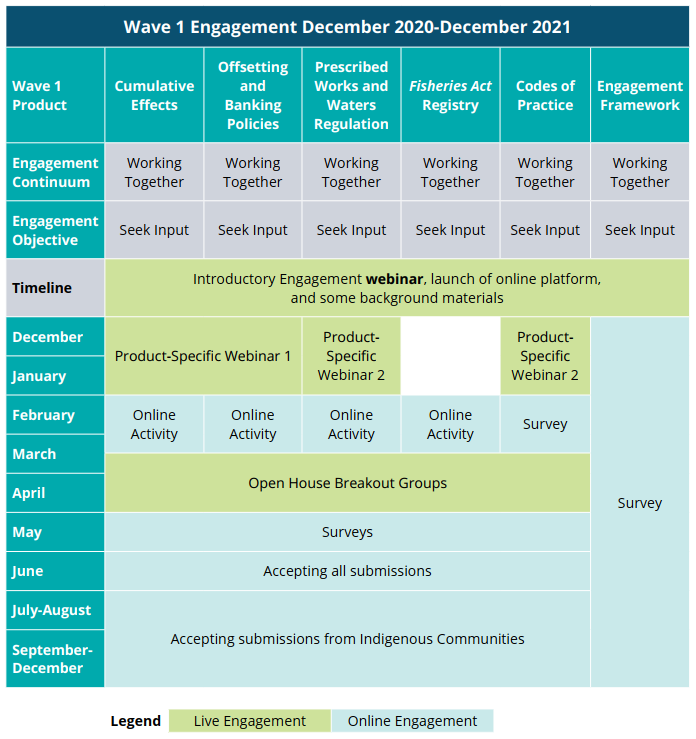
Figure 1. Wave 1 engagement timeline
Long description
Timeline for FFHPP Wave 1 engagement. Live and online engagements ran from December 2020 to December 2021. An introductory engagement webinar, online platform, and some background materials were made available in December 2020. Product-specific webinars on Cumulative Effects, Offsetting and Banking Policies, Prescribed Works and Waters Regulation, and Codes of Practice were held in December 2020 and January 2021. Online activities for Cumulative Effects, Offsetting and Banking Policies, Prescribed Works and Waters Regulation, and the Fisheries Act Registry ran from February to March 2021. A survey on Codes of Practice was available from February to May 2021. A survey on the Engagement Framework ran from December 2020 to December 2021. A survey on Cumulative Effects, Offsetting and Banking Policies, Prescribed Works and Waters Regulation, Fisheries Act Registry, and Codes of Practice was available in May 2021. Feedback from stakeholders was accepted through June 2021. Feedback from Indigenous Communities was accepted through December 2021.
FFHPP’s regions also undertook accompanying engagement processes to support regional participation. Regional echo sessions with FFHPP regional subject matter experts supported conversations with interested parties and provided opportunities to discuss the products. The input gathered through these national and regional engagement sessions was shared with FFHPP subject matter experts and is reflected in this report.
Feedback analysis
All feedback received through online engagement and written submissions was compiled and organized by engagement product. FFHPP’s analysis included:
- the identification of general themes and key messages
- the exploration of conflicting viewpoints and comments
Feedback was assessed relative to the scope of the engagement and the specific questions posed. Although the review and consideration of comments were not limited by the specific questions posed, comments outside of the scope of Wave 1 engagement activities cannot necessarily be addressed in the next phases of the development of Wave 1 products. Rather, these comments may influence future policy and program development in FFHPP.
Feedback from Indigenous Peoples was analysed separately from feedback received from other sources. This allowed FFHPP to consider the specific rights, interests and perspectives of Indigenous Peoples, and to weigh input accordingly.
Who we heard from
Approximately 300 national and regional organizations from across Canada participated in Wave 1 engagement. Engagement sessions were held with:
- Indigenous Peoples
- provinces and territoriesFootnote 2
- industry associations
- environmental non-governmental organizations
- other interested parties
Participation during the facilitated meetings was high and many of the attendees participated actively during the breakout sessions to share their insights. Participation on the engagement platform was geographically dispersed across Canada from coast to coast to coast.
Disclaimer
This report provides a summary of key messages heard through written submissions, online participation, and discussions held at virtual workshops and sessions from January 2021 to December 2021.
No personal information is being disclosed in this report. All information collected remains anonymous outside of FFHPP use. The high-level summaries presented in this report do not fully capture the richness of input received.
Modernizing offsetting and fish habitat banking
Background
FFHPP started the conversation on the offsetting and habitat banking policies in Wave 1 with the intention of trying to shape an approach to the modernization of the offsetting and fish habitat banking policies. Modernization of the policies should better achieve conservation and protection goals, and improve regulatory certainty and efficiency in service delivery.
Through the modernization process, FFHPP will review what has been learned from the application of its existing approach to offsetting and banking, and leverage lessons learned from international best practice.
The purpose of Wave 1 engagement on the offsetting and fish habitat banking policies was to solicit feedback on:
- offsetting principles (for example, hierarchy of measures, additionality, limits)
- enhancing the performance-based approach
- expanding and promoting fish habitat banking
- improving the single window regulatory review approach
- encouraging reconciliation with Indigenous Peoples by better considering their rights and perspectives on offsetting plans and fish habitat banks
Participants were asked to engage on these policies through virtual meetings, breakout sessions and regional echo sessions. FFHPP received lots of feedback through virtual engagement sessions and written submissions.
Feedback from Indigenous participants
Monitoring
It was suggested that quantitative, performance-based metrics should be used to judge the success of offsetting and be adaptable to different habitat types. How the success of offsetting would be assessed during post-project monitoring was a common question received.
Location
Many participants advocated for offsetting to be located near the project impacts that they were intended to counterbalance. Participants noted offsetting should represent an equal or greater habitat quality improvement than was impacted by the project.
Communication with Indigenous Peoples
Participants noted that the explicit involvement of affected Indigenous communities is needed, from early project planning through the implementation of the project and its offsetting plan to the monitoring of offsetting performance. Strengthened collaboration between FFHPP and Indigenous communities is needed when reviewing specific offsetting plans to incorporate Indigenous Knowledge and consider Indigenous rights and values earlier in the planning process.
General feedback
Monitoring
Many participants indicated that a modernized offsetting and banking policy needs to emphasize the importance of monitoring to determine whether offsetting is effective and to ensure offsetting is meeting targets. It was also suggested that monitoring programs should meet Canadian Science Advisory Secretariat or equivalent scientific standards.
Third-party work and incentivizing habitat banking
A desire was expressed to see the Habitat Banking Policy expanded to include third-party banking agreements. Many participants advocated for the ability to sell credits to incentivize the use of habitat banking. These comments were received despite the explicit note in the engagement materials that third-party banking was not within the scope of the current modernization process.
It was also suggested that more could be done to incentivize habitat banking, in general. Currently, habitat bank agreements are complex to establish, and there are not enough assurances that the credits can be used.
Location
Participants noted that approaches need to be developed to overcome difficulties finding offsetting opportunities in certain areas (for example, pristine northern areas). Participants also requested further clarity on where offsetting could occur relative to the project location.
Cumulative effects on fish and fish habitat
Background
Cumulative effects occur when an aquatic ecosystem does not have adequate time to recover from previous or ongoing pressures before being subjected to new, overlapping impacts. Even seemingly unrelated minor pressures can sometimes work together to create larger impacts on fish and fish habitat. The Fisheries Act requires that the Minister consider the cumulative effects on fish and fish habitat in decision making.
In 2021, the Department sought to engage the public on the development of a guidance document for the consideration of cumulative effects on fish and fish habitat. This document would provide direction to FFHPP staff on interpreting legislative obligations. The document would also provide clarity to Indigenous Peoples, partners and stakeholders on how cumulative effects on fish and fish habitat, relative to each decision, would be considered.
The purpose of Wave 1 engagement on cumulative effects on fish and fish habitat was to solicit feedback on:
- how the FFHPP could meet its requirements under the Fisheries Act to consider cumulative effects on fish and fish habitat
- the types of measures (including collaboration with Indigenous Peoples, provinces and territories) that could be identified to reduce a proposed project’s contribution towards cumulative effects on fish and fish habitat
Participants were asked to engage on the guidance through virtual meetings, breakout sessions and regional echo sessions. Participants had many questions about this subject and how it interacted with other FFHPP policies and with environmental effects that fall outside of DFO’s specific mandate. Overall, there was interest in scoping cumulative effects more clearly in relation to fish and fish habitat protection provisions under the Fisheries Act.
Feedback from Indigenous participants
Scale and scope
The scale at which cumulative effects will be assessed needs to be clearly defined. Indigenous participants advocated for the need to consider watershed or regional effects to assess the impact works would have on natural systems and the values they support.
Baselines and thresholds
Indigenous participants advocated for the use of Indigenous Knowledge to establish baseline conditions to better understand potential cumulative effects. The establishment of monitoring thresholds is needed to provide measurable criteria to ensure that the impacts of the projects are within the predicted range.
General feedback
Scale and scope
The need for further clarity on scale and scope of cumulative effects considerations was the most common comment received. In particular, the need to define the timeframe and area that will be used when assessing cumulative effects.
Baselines and thresholds
There was a recognition that identifying baselines and thresholds for assessing cumulative effects will be extremely complex and could result in increased regulatory burden.
Works, undertakings and activities
It was often expressed that comprehensive consideration of cumulative effects must address all ecosystem stressors, including proposed/future projects or works, undertakings or activities. How the cumulative effects of smaller projects will be monitored was a common comment from participants.
Inclusion of ‘other threats’ to an ecosystem
Many participants noted the need to incorporate external threats when considering cumulative effects. Other threats, such as climate change and aquatic invasive species, can be the greatest contributor to cumulative effects in some areas. Many comments received identified the need for climate change to be assessed when considering cumulative effects.
Clarity
Participants had many questions about the FFHPP’s approach to cumulative effects and how it interacted with other policies and with environmental effects that fall outside of DFO’s specific mandate. There was interest for FFHPP to define cumulative effects more clearly, with many participants noting that without a clear definition it was difficult to give effective feedback.
Fisheries Act Registry
Background
The 2019 amended Fisheries Act contains a provision that requires the Minister to establish a public-facing Registry (the FA Registry) to provide public access to records relating to fish and fish habitat protection, including Ministerial agreements, standards and codes of practice, Ministerial orders, Fisheries Act authorizations, permits for designated projects, and fish habitat restoration plans. This work supports the Government’s goals around transparency, access and accountability in federal decision making.
Feedback was received on the FA Registry both through the online engagement platform, as a topic in breakout sessions, and in a standalone meeting that introduced participants to the FA Registry and demonstrated the platform. At the time of engagement, the FA Registry was still under development. The ideas shared on what participants would like to do and see were included with release 2.0 of the FA Registry on April 15, 2021.
Feedback from Indigenous participants
Information transparency
The question of what information is set to be stored and accessed through the FA Registry was top of mind for many Indigenous participants. Many advocated for detailed notifications of project information, request for review forms, and compliance monitoring reports so that communities could be informed of projects. Many requested notifications of non-regulatory decisions (such as letters of advice, codes of practice, and Prescribed Works and Waters Regulation projects) be shared on the FA registry.
Functionality
There was less feedback on functionality than on information transparency requirements. Participants expressed a strong desire for a user-friendly website including search features and a geospatial mapping tool for finding projects.
General feedback
Functionality and mapping
There were several requests asking to consider the navigation and functionality of the platform, including tools that would make searching for data easy and effective, mapping tools to better visualize data, and keeping the registry up to date and relevant. The functionality of the platform and the need for interactive mapping were frequent comments from non-Indigenous participants.
Accessibility and transparency
In general, feedback indicated that, at the time of engagement, the FA Registry website did not have enough information to be useful. Participants hoped the FA Registry would be expanded to include many more of the documents and approvals that DFO manages. Participants suggested that the FA Registry is a way for DFO to remain transparent with the decisions made and can also give potential project proponents a better idea of what they can expect to have approved, and the measures and proposals that DFO prioritizes.
Proposed Prescribed Works and Waters Regulations
Background
The proposed Prescribed Works and Waters Regulations (PWWR) would provide FFHPP with a new tool for managing routine, low-risk projects in or near water that have the potential to cause limited death of fish, or the harmful alteration, disruption or destruction of fish habitat. This regulation could establish, or “prescribe”, classes of routine works that could proceed without FFHPP review, subject to mandatory fish and fish habitat protection conditions. This regulation is intended to support a shift in FFHPP efforts towards a more regulatory approach for managing potential impacts on fish and fish habitat.
The purpose of Wave 1 engagement on the PWWR was to:
- provide details/information to a broad range of stakeholders on the approach FFHPP is considering for the development of a prescribed works and waters regulation
- solicit feedback on:
- the proposed regulatory approach
- potential classes of works to be considered for inclusion in the regulation
- ideas on how prescribed waterbodies can be incorporated into the regulation
Much of the feedback received took the form of questions. These questions were considered and updates to the frequently asked questions were made in advance of Wave 2 engagement.
Feedback from Indigenous participants
General regulatory approach
There was recognition of the importance of FFHPP doing more monitoring and enforcement, and taking part in more strategic initiatives such as watershed planning and climate change adaptation, but many participants wanted assurances that the regulation would support those activities. The need for monitoring and enforcement was a common theme in feedback from Indigenous participants, as there was a general concern that regulatory oversight could be compromised by the self-assessment process and might lead to a higher potential for death of fish.
Cumulative effects
Many participants expressed concerns that fewer site-specific reviews could contribute to increased cumulative effects, while competing views suggested that the only way to address cumulative effects was to move away from “one-at-a-time” project reviews and provide watershed-scale ecosystem-based management planning.
General feedback
General regulatory approach
Many comments received were supportive of the idea of FFHPP exploring new, regulatory approaches to managing impacts to fish and fish habitat. However, many participants felt that more clarity on specific classes was needed to fully understand the regulation and ensure it meets the various stakeholder expectations. General comments about the clarity of the regulatory approach were a common theme.
Potential future classes and prescribed waterbodies
Many participants advocated for adding classes and waterbodies to the regulation. While there was a strong trend towards adding many classes in the regulation, it was noted that some routine activities, such as dewatering and fish salvage, are currently managed as simple mitigation measures in a Letter of Advice. Requiring notifications for each instance of dewatering was seen as far too burdensome. Participants supported the idea of prescribing minor waters in regulation to differentiate those waterbodies that contribute significantly to fisheries from those that do not. There was general support for the list of proposed minor waters that FFHPP included in the engagement materials.
Overlap between PWWR and codes of practice
Many participants noted the similarity between PWWR classes and the classes of works being considered for codes of practice, and requested clarification on how these 2 products were being differentiated. Environmental groups liked the fact that conditions of the PWWR would be mandatory and enforceable and that post-project notifications were being considered.
Increased regulatory burden
Participants expressed concerns that the requirement for pre- and post-project notifications would be an increased regulatory burden, especially when compared to codes of practice or letters of advice which do not require post-project reporting. Proposed notification requirements were not provided in the engagement materials, so it was not possible to assess the amount of burden associated with this component without knowing the information needs. There was a strong sentiment provided by participants that any future regulatory initiatives must be focused on reducing red tape.
Regional flexibility
It was noted that in many parts of the country, there are several arrangements in place that support one-window project review between the provincial and federal governments. Participants felt that federal/provincial alignment, cooperation and equivalency is the biggest opportunity to reduce the regulatory burden on industry and the workload on FFHPP. It was suggested that provincial, territorial, and federal governments should work together to integrate and avoid duplication and that the ideal proponent process will include one step, one stop approvals and oversight, with consistency across Canada.
Implementation timeline
Participants expressed concerns that the timeframe for developing a regulation was too long to address existing workload/regulatory approval challenges. Participants noted that the Fisheries Act was amended over 2 years ago and there has been no meaningful progress on updating existing regulatory tools.
Interim codes of practice
Background
Codes of practice (CoPs) are one of a suite of tools used by FFHPP to manage impacts to fish and fish habitat. They are intended to:
- conserve and protect fish and fish habitat by avoiding the harmful alteration, disruption or destruction of fish habitat and death of fish through the application of recognized avoidance and mitigation measures
- provide clear, nationally consistent advice for the design and implementation of common, low-risk works, undertakings or activities
- ensure transparency about what is needed to comply with the Fisheries Act and the Species at Risk Act
- streamline the regulatory review process for low-risk works, undertakings or activities where potential impacts and associated avoidance and mitigation measures are well understood
The Department received feedback on 6 interim CoPs and on priorities for the development of future CoPs. The 6 interim CoPs are scheduled to be finalized later in 2022, including:
- beaver dam removal
- culvert maintenance
- end-of-pipe fish protection screens for small water intakes in freshwater
- routine maintenance dredging
- temporary cofferdams and diversion channels
- temporary stream crossings
The purpose of Wave 1 engagement was to seek feedback on:
- the content and scope, including management measures and biological considerations outlined in the interim CoPs
- priorities for future development of CoPs
Participants were asked to engage through:
- virtual meetings
- breakout sessions
- regional echo sessions
- written submissions
Questions were focused on how the CoPs would interact with other legislation and FFHPP products.
Feedback from Indigenous participants
Monitoring and compliance
Some participants expressed concerns about the lack of FFHPP presence in some areas of the country, including for compliance monitoring and enforcement. Suggestions were made that DFO could train community members to support monitoring. A recurring theme among Indigenous participants was how CoPs would contribute to cumulative effects and how monitoring would be used to assess this contribution.
Risk to Indigenous communities
Participants suggested that risk tolerance criteria should include precautions for the potential impacts on Indigenous communities that rely on fish and fish habitat. Many Indigenous participants noted there was a higher risk profile in Indigenous communities and that more coordination with impacted communities is needed.
Scale
Respondents suggested that the codes should focus on habitat protection and conservation, rather than protecting specific fish species. There was a general sense that nationally-based codes were too broad, and that CoPs need to be locally and regionally relevant.
General feedback
Clarity
Many participants noted confusion over the CoP specific to beaver dam removal, and a general sense that the interim codes were out of touch with work being done on the ground. Additionally, it was noted that the phrasing of CoPs is too general, vague or open-ended, and needs to be better defined.
Interactions with other legislation and jurisdictions
There was a general concern that CoPs are inefficient due to regulatory overlap with other jurisdictions, resulting in confusion and an administrative burden for proponents. How CoPs would interact with other federal legislation (for example, Species at Risk Act) was a theme expressed, and it was suggested that greater flexibility was needed to deal with these interactions.
Draft engagement framework concepts
Background
To support its multi-year engagement plan, the FFHPP drafted an engagement framework that builds upon current modes of communication to formulate an approach to engage more meaningfully.
In Fall 2020, FFHPP distributed a survey to plan meaningful engagement activities. The survey was distributed to Indigenous Peoples, partners and stakeholders, and asked organizations to provide feedback on:
- past engagement efforts
- level of interest by product
- ability to engage due to COVID-19
- preferred methods of engagement
A total of 165 responses were received and considered in the development of the approach and initial concepts.
The first engagement wave began in December 2020 and introduced proposed concepts that would be core elements to the framework. A pre-engagement survey was used to gauge the effectiveness and appeal of the engagement approach and platform. Participants evaluated the effectiveness of engagement materials and activities to determine what would work well for them. Participants preferred meetings and interactive sessions to learn and provide input; however, participants favoured discussion papers and fact sheets to receive background information. Participants also suggested the framework should consider:
- relationship building including one-on-one regional engagement and meetings
- the use of designated DFO regional liaison staff for Indigenous communities
Accordingly, FFHPP’s engagement will be designed and implemented according to the complexity, importance and timeline of a given topic. Based on these elements, each topic will fit into one of 3 engagement “intensities” (sharing, working together, entrusting) along an engagement “continuum”. Depending on the engagement intensity, FFHPP will engage at various stages of a product’s development, allowing for input and feedback earlier in the process. Each intensity will have:
- predictable points of engagement throughout the product development cycle
- standardized yet customizable combinations of engagement tools
- standard feedback or follow-up
This is a fundamental shift to an open, effective and transparent engagement approach. A second online survey on the draft engagement framework concepts was available for participants to share feedback on their Wave 1 engagement experiences and preferred modes of communications. The feedback received has been considered in the development of the framework and continues to improve the multi-wave engagement approach.
Feedback was received on the engagement framework through the online engagement platform and written submissions. Participants expressed an interest to be more involved with the engagement process and a desire to build relationships with FFHPP.
Feedback from Indigenous participants
Engagement process
Participants prefer FFHPP guided sessions, with complementary information available for their self-directed follow-up. Written submissions, multi-interest meetings and technical sessions were found to be useful tools; interactive meetings were shown to be participants’ ideal way to give feedback. Indigenous participants expressed concern there was an over-emphasis on the information being given and that not enough emphasis was being put on interactive engagement. Indigenous participants indicated the need for more direct nation-to-nation interactions that promote relationship building instead of using webinars to broadcast information.
Indigenous engagement
Participants stated there should be greater emphasis placed on Indigenous Knowledge, and a strong effort on the part of DFO to work with Indigenous Peoples, communities and organizations to develop a better understanding of fish and fish habitat in their areas. Most importantly, DFO should partner with Indigenous Peoples across the country to help monitor, protect and advocate for fish and fish habitat. Participants suggested the framework should consider the use of designated DFO liaison staff for Indigenous communities.
General feedback
Engagement process
Participants indicated that discussion papers and product fact sheets were the preferred ways to get background information. They suggested the framework should consider relationship building, including one-on-one engagement sessions and meetings. Participants also expressed interest in being more involved in the engagement process.
Webinars
Participants valued the clarity offered through virtual meetings and the opportunity for back-and-forth discussion. Many participants spoke positively about being able to provide written submissions. This was a popular method for conveying different thoughts and sharing ideas on the various products. Many participants felt that the online exercises were simplistic and did not allow them to capture their input effectively. Technical challenges with the platform also occurred.
Conclusion
FFHPP appreciates the time taken by Indigenous Peoples, partners and stakeholders to contribute feedback on the new regulations, policies and guidance to support implementation of the modernized fish and fish habitat protection provisions. What we heard through the technical sessions, online activities and written submissions will be used to shape the direction of the 6 topics discussed through Wave 1.
FFHPP has launched Wave 2 and will continue the conversation on 4 topics from Wave 1 as well as start new conversations on more topics throughout 2022. FFHPP is committed to ongoing engagement with Indigenous Peoples, partners and stakeholders, striving for transparency and cooperation to build trusting, long-term relationships.
Page details
- Date modified: