
Tang.ɢwan — ḥačxʷiqak — Tsig̱is Marine Protected Area
Memorandum of understanding between
Haida Nation, as represented by the Council of the Haida Nation
Nuu-chah-nulth Tribal Council
Quatsino First Nation, as represented by Quatsino First Nation Council
Pacheedaht First Nation
and
His Majesty the King in right of Canada as represented by the Minister of Fisheries, Oceans and the Canadian Coast Guard (“Canada”)
(Each a Party and collectively the “Parties”).
Whereas:
- The Parties confirm their commitment to a relationship based on mutual respect and understanding.
- Canada is committed to a renewed, nation-to-nation and government-to-government relationship with Indigenous Peoples, based on recognition of rights, respect, co-operation, and partnership and to implementing the United Nations Declaration on the Rights of Indigenous Peoples in accordance with the Constitution Act, 1982.
- The Haida Nation, Nuu-chah-nulth Nations, Quatsino First Nation and Pacheedaht First Nation seek to protect and continue their way of life.
- The Parties affirm the importance of recognizing and safeguarding Indigenous rights.
- Canada has identified the area in Appendix A for potential designation as a Marine Protected Area under Canada’s Oceans Act.
- The Council of the Haida Nation, Nuu-chah-nulth Tribal Council, Quatsino First Nation Council and Pacheedaht First Nation intend to designate under their respective authorities the area identified in Appendix A as a Protected Area.
- Canada is a party to various international agreements and conventions that will inform Canada’s implementation of this MOU including but not limited to the United Nations Convention on the Law of the Sea (UNCLOS), the International Convention on the Safety of Life at Sea, and the United Nations Convention on Biological Diversity.
- From Canada’s perspective, the Protected Area is situated in Canada’s Exclusive Economic Zone (EEZ). Under UNCLOS and customary international law, Canada has limited authority to regulate activities in its EEZ.
- From the First Nations’ perspective, the Protected Area lies within the marine territories of the Haida Nation, the First Nations belonging to the Nuu-chah-nulth Tribal Council, the Quatsino First Nation and the Pacheedaht First Nation.
- The Parties have a common interest in the long term conservation and protection of the Protected Area including its marine life and other ecologically significant features, and the benefits the area’s continued protection may afford to present and future generations.
- The Parties intend to establish a Management Board and advisory process to facilitate their cooperative management and planning of the Protected Area.
- The Parties acknowledge that each Party brings their respective authorities and mandates to this MOU and that each make decisions in accordance with their respective laws, customs and traditions.
- The Haida Nation, Nuu-chah-nulth Nations, Quatsino First Nation and Pacheedaht First Nation view the continuity of their culture and recognition and incorporation of their cultural values, laws, traditional knowledge and distinct cultures in Protected Area governance and management as essential to maintaining, strengthening and nurturing their relationship with the ocean, all living creatures and their spiritual well-being.
- Canada acknowledges the importance of supporting the First Nations’ cultural values and benefits afforded therefrom that align with the conservation and protection of the Protected Area and the consideration of relevant Indigenous traditional knowledge when managing the area.
Together, as signatories to this agreement, we agree as follows:
1. Definitions
“CHN” refers to the Council of the Haida Nation.
“Management Board” means the Tang.ɢwan — ḥačxʷiqak — Tsig̱is Marine Protected Area Management Board described herein.
“Minister” means the Minister of Fisheries, Oceans and the Canadian Coast Guard. “MOU” refers to this Memorandum of Understanding.
“NTC” refers to the Nuu-chah-nulth Tribal Council. “PFN” refers to the Pacheedaht First Nation.
“Protected Area” refers to the area identified as Tang.ɢwan — ḥačxʷiqak — Tsig̱is Marine Protected Area in Appendix A including associated boundary adjustments that may be specified within eventual regulations made under the Oceans Act and named by:
- the Haida Nation as Tang.ɢwan, meaning “deep ocean”;
- the Nuu-chah-nulth Nations and Pacheedaht First Nation as ḥačxʷiqak, meaning “deepest part of the ocean”; and
- Quatsino First Nation as Tsig̱is, meaning “monster of the deep”. “QFN” refers to the Quatsino First Nation Council.
2. Purpose and objectives
2.1 The Parties are committed to the honourable implementation of this MOU.
2.2 This MOU provides for the establishment of the Management Board with roles and responsibilities with respect to the planning, operation, management and use of the Protected Area.
2.3 The Parties wish to affirm that they share the following objectives for the management of the Protected Area:
- To conserve and protect healthy and productive ecosystems within the Protected Area;
- To promote research and monitoring opportunities that might contribute to a better understanding of the marine environment within the Protected Area;
- To make best efforts to support cultural values of the Haida, Nuu-chah-nulth, Quatsino and Pacheedaht First Nations that align with the Protected Area’s conservation objective by:
- Reflecting Haida, Nuu-chah-nulth, Quatsino and Pacheedaht cultural values in management planning;
- Identifying and recognizing Indigenous names for seamounts;
- Developing communication materials acknowledging contributions of Nations to the designation and management of the Protected Area;
- Incorporating cultural context and consideration of Indigenous traditional knowledge in the Management Plan;
- Developing relevant school curriculum for community-based educational programs;
- Continuing efforts to coordinate respective Parties’ participation in deep sea science expeditions led by one or more of the Parties within the Protected Area’s boundaries; and
- Taking other actions as agreed to by the Parties.
- To promote the ecologically sustainable use of the Protected Area’s marine resources taking into account relevant factors including the economic wellbeing of coastal communities; and
- To promote an understanding and appreciation of ocean environments within the Protected Area and contribute to public education and awareness.
3. Management board
3.1 Membership in the Management Board will include two (2) representatives of the CHN, two (2) representatives of the NTC, two (2) representative of QFN, one (1) representative of PFN, and two (2) representatives of Canada for a total of nine (9) members. The total number of members may be increased or decreased by mutual agreement among the Parties.
3.2 Canada will designate one of its members as a co-chairperson.
3.3 The CHN, NTC, QFN and PFN will jointly designate one of their members as a co-chairperson, this designation will rotate on an annual basis.
3.4 The two co-chairpersons will, unless otherwise agreed, jointly call and conduct meetings and authenticate minutes. The co-chairpersons may agree that the referenced responsibilities of the chair may alternate between co-chairpersons.
3.5 Each of the Parties may designate an alternate member to the Management Board as needed, who may fully participate in meetings when a regular member is absent.
3.6 Each of the Parties may replace regular Management Board members from time to time, on notice to the other Parties.
3.7 The Management Board will meet as often as necessary to carry out its responsibilities under this MOU and will establish its procedures for carrying out those responsibilities. Notwithstanding this, the Management Board will meet no less than twice per annum unless otherwise agreed by all Parties.
4. Roles and responsibilities of the management board
4.1 The Management Board will have the following responsibilities in the planning, operation, management and use of the Protected Area. The Management Board:
- Will develop and recommend advice to the Parties regarding the management of the Protected Area;
- Will develop and recommend to the Parties, a Protected Area Management Plan;
- Will periodically review and evaluate the Protected Area Management Plan and may recommend changes to the Parties;
- May provide advice to the Parties regarding human activities that may threaten conservation and protection within the Protected Area and its associated unique features, fishery resources, and relevant marine areas of high biodiversity and biological productivity;
- May provide advice to the Parties regarding the coordination and delivery of research, monitoring and surveillance, fisheries activities, stewardship, public outreach programs and enforcement programs that are directly related to conservation and protection within the Protected Area;
- Advice to the Parties regarding fisheries activities shall relate to those activities that pose an unacceptable risk to the Protected Area’s conservation objective;
- Will prepare a budget for its operations and may seek external sources of funding to carry out its activities;
- Will establish an Advisory Committee to provide advice to the Management Board concerning the Protected Area;
- May provide advice to the Parties regarding issues of particular concern to one or more of the Parties, that directly impact the conservation and protection of the Protected Area; and
- Will carry out other responsibilities as agreed to in writing by the Parties.
4.2 Each of the Parties may seek advice from other places as they so choose and, subject to disclosure required by law, will respect any confidentiality agreements made between the Parties.
5. Decision making and dispute resolution
5.1 The Management Board will make best efforts to operate on a consensus basis and will submit its advice to the Parties.
5.2 The CHN, NTC, QFN, PFN and the Minister will consider and respond to advice received from the Management Board in a timely manner.
5.3 The CHN, NTC, QFN, PFN and the Minister will take into account the advice of the Management Board, including advice received in section 5.6, when making decisions relating to the Protected Area.
5.4 If a dispute arises between the Parties regarding the advice to be provided by the Management Board, subject to the special circumstances referred to in sections 5.7 and 5.8, the Parties may, after receiving written notice of the dispute and reasons, appoint representatives to meet as soon as practical to consider and attempt to resolve the dispute within 30 days.
5.5 (a) In the event the appointed representatives are unable to resolve the dispute, the Parties may request that the identified matter be referred to an agreed upon neutral third party to mediate and try to reach a non-binding resolution on the advice to be provided by the Management Board.
(b) All Parties involved in the dispute must agree with the request contemplated in paragraph 5.5(a) before the matter can be referred to the neutral third party.
5.6 If the appointed representatives are not able to resolve the dispute, and neutral third party mediation is either not pursued or is unsuccessful, each Party will convey their position on the dispute and rationale, and may include reference to attempts to reach a mediated solution in writing to the CHN, NTC, QFN, PFN, and the Minister, and for the purpose of sections 5.2 to 5.3 that advice will be treated as advice of the Management Board.
5.7 If special circumstances, such as matters requiring urgent attention, make it impracticable for the Minister to receive advice from the Management Board, the Minister:
- May make the decision or take the action that the Minister considers necessary, without receiving advice from the Management Board; and
- Will provide written reasons to the Management Board, as soon as practicable, of the special circumstances and the decision made or action taken.
5.8 If special circumstances, such as matters requiring urgent attention, make it impracticable for the CHN, NTC, QFN or PFN to receive advice from the Management Board, the Nations:
- May, pursuant to their respective authorities, separately or together make the decision or take the action that they consider necessary, without receiving advice from the Management Board; and
- Will provide written reasons to the Management Board, as soon as practicable, of the special circumstances and the decision made or action taken.
6. Funding
6.1 The Parties will seek to reach agreement on a regular basis for operating budgets and contribution agreements to support activities identified in this MOU.
7. Amendment, review and termination
7.1 This MOU may be amended from time to time upon written agreement of the Parties. All amendments to this MOU must be made in writing and signed by the Parties.
7.2 The Parties will jointly review this MOU two years after the date of commencement of this MOU and every five years thereafter, and at such other times as the Parties may agree.
7.3 A Party may terminate their participation in the MOU by thirty (30) days advance notice with reasons for termination in writing to the other Parties.
7.4 Other First Nations may become a Party to this MOU:
- Upon prior written agreement of the Parties to this MOU; and
- By signing this MOU.
8. General provisions
8.1 This MOU is not legally binding and is not intended to define, create, recognize, deny, alter or amend any of the rights of the Parties including existing Aboriginal title or rights, or treaty rights, within the meaning of sections 25 and 35 of the Constitution Act, 1982. For greater certainty, this MOU is not intended to be a treaty or a land claims agreement within the meaning of sections 25 and 35 of the Constitution Act, 1982 or to alter or affect the legal status of lands and resources or the existing authorities of the Parties with respect to lands, resources and governance.
8.2 Neither this MOU, nor any acts performed in connection with it, are to be used, construed or relied on by anyone as evidence, acceptance or admission of the existence, nature, scope or content of any treaty or Aboriginal rights or title and Crown rights or title. Crown and First Nations’ involvement in planning does not replace the Crown duty to consult and accommodate individual Nations on specific issues.
8.3 For greater certainty, and without limiting the generality of section 8.1, this MOU does not prevent, change, add or derogate from any current or future negotiations, discussions, arrangements or agreements between Canada and either the CHN, NTC, QFN or PFN.
8.4 For greater certainty, nothing in this MOU obliges the Parties to act in a manner inconsistent with their legislative or regulatory jurisdictions or authorities; or their laws, customs, and traditions. Furthermore, the MOU shall not be interpreted or implemented in a manner that fetters the decision-making authorities of any of the Parties.
8.5 This MOU, including the negotiations leading up to its creation and its implementation, shall not be construed as an admission of fact or liability and is without prejudice to any legal positions which have been or may be taken by any Party in any court proceeding or any other forum, or the negotiation of a treaty or agreement among some or all of the Parties.
8.6 Each Party will support the work done under this MOU by sharing information and knowledge that relates to the planning, operation, management and use of the Protected Area and will at the time of disclosure:
- Assist the other Parties in understanding the information;
- Confirm any restrictions on the current and future use of the information;
- Confirm whether the information is confidential; and
- Confirm whether it may be reproduced or shared, in whole or in part, including with others that are not a party to this MOU.
8.7 Materials relating to the Protected Area including meeting records and materials that are not already publicly available are, subject to the Privacy Act and Access to Information Act and other Acts as applicable, to be kept confidential unless the Management Board agrees otherwise.
8.8 Subject only to applicable law, the Parties will maintain the confidentiality of information identified as confidential pursuant to section 8.7, and refuse its disclosure.
8.9 No Party will use information obtained under this MOU other than to further the purpose of this MOU, except with the prior approval of the Party who has provided the information.
8.10 Section 8.9 does not apply to information that is in the public domain.
8.11 Except as otherwise provided in the MOU, where any notice, request, information, or other communication is to be given, it shall be in writing and delivered by courier, mail or facsimile transmission or electronic transmission, and unless notice to the contrary is given, shall be addressed to the Party at the address or number set out below:
Council of the Haida Nation: Marine planning manager
Telephone: 250-559-4468
Facsimile: 250-559-8951
E-mail: mpp.pm@haidanation.com
Nuu-Chah-Nulth Tribal Council: Fisheries program manager, UU-A-THLUK
Telephone: 250 724-5757
Facsimile: 250 724-2172
E-mail: Jim.Lane@nuuchanulth.org; Danielle.Burrows@nuuchahnulth.org
Quatsino First Nation Council: Fisheries manager
Telephone: 250-230-2977
Facsimile: 250-949-6249
E-mail: fisheries@quatsinofn.ca
Pacheedaht First Nation: Fisheries manager
Telephone: 250-647-5521 (ext 2205)
Facsimile: 250-647-5561
E-mail: research@pacheedaht.ca
Canada: Regional manager
Marine Conservation Program, Fisheries and Oceans Canada, Pacific Region
Telephone: 250-363-6417
Cell: 250-618-2059
Facsimile: 604-666-1847
E-mail: joy.hillier@dfo-mpo.gc.ca
8.12 This MOU may be signed in counterparts; each counterpart may be transmitted by courier, mail, facsimile transmission or electronic transmission and each will constitute an original instrument and such counterparts, taken together, will constitute one and the same document.
8.13 This MOU will come into effect on the date that it is signed and will remain in effect unless it is terminated by all Parties in accordance with section 7.3.
In Witness Whereof, the Parties have executed this MOU by their proper officers duly authorized on their behalf.
By our signature below we hereby affirm the above commitments:
Nuu-chah-nulth Tribal Council
Cloy-e-iis Judith Sayers
President, Nuu-chah-nulth Tribal Council
6th day of January 2024
Haida Nation
Gaagwiis Jason Alsop
President, Council of the Haida Nation
9th day of January 2023
Pacheeedaht First Nation
Jeff Jones
Pacheedaht First Nation Chief Councillor
11th day of January 2023
Quatsino First Nation Council
Tom Nelson
Quatsino First Nation Chief Councillor
24th day of January 2024
Canada
Rebecca Reid
Regional Director General
Fisheries and Oceans Canada, Pacific Region
30th day of January 2023
Appendix A. Proposed Tang.ɢwan — ḥačxʷiqak — Tsig̱is Marine Protected Area
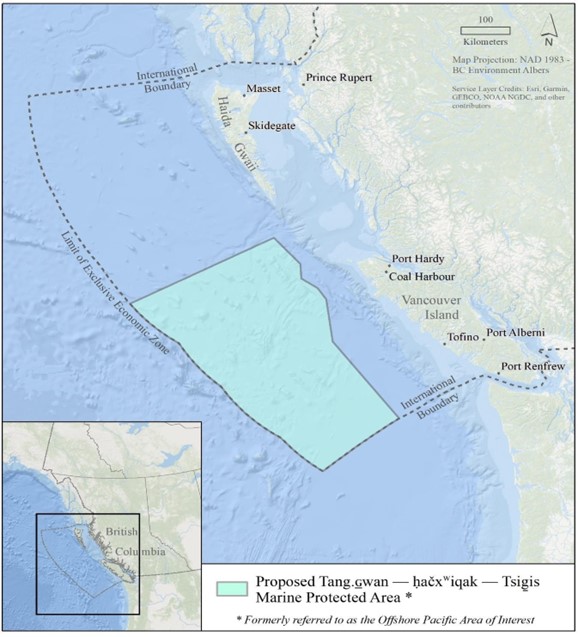
Map of the proposed Tang.ɢwan — ḥačxʷiqak — Tsig̱is Marine Protected Area, formerly referred to as the Offshore Pacific Area of Interest
Page details
- Date modified: