
Tarium Niryutait Marine Protected Area (MPA) Annual Report 2024
On this page
At-a-glance
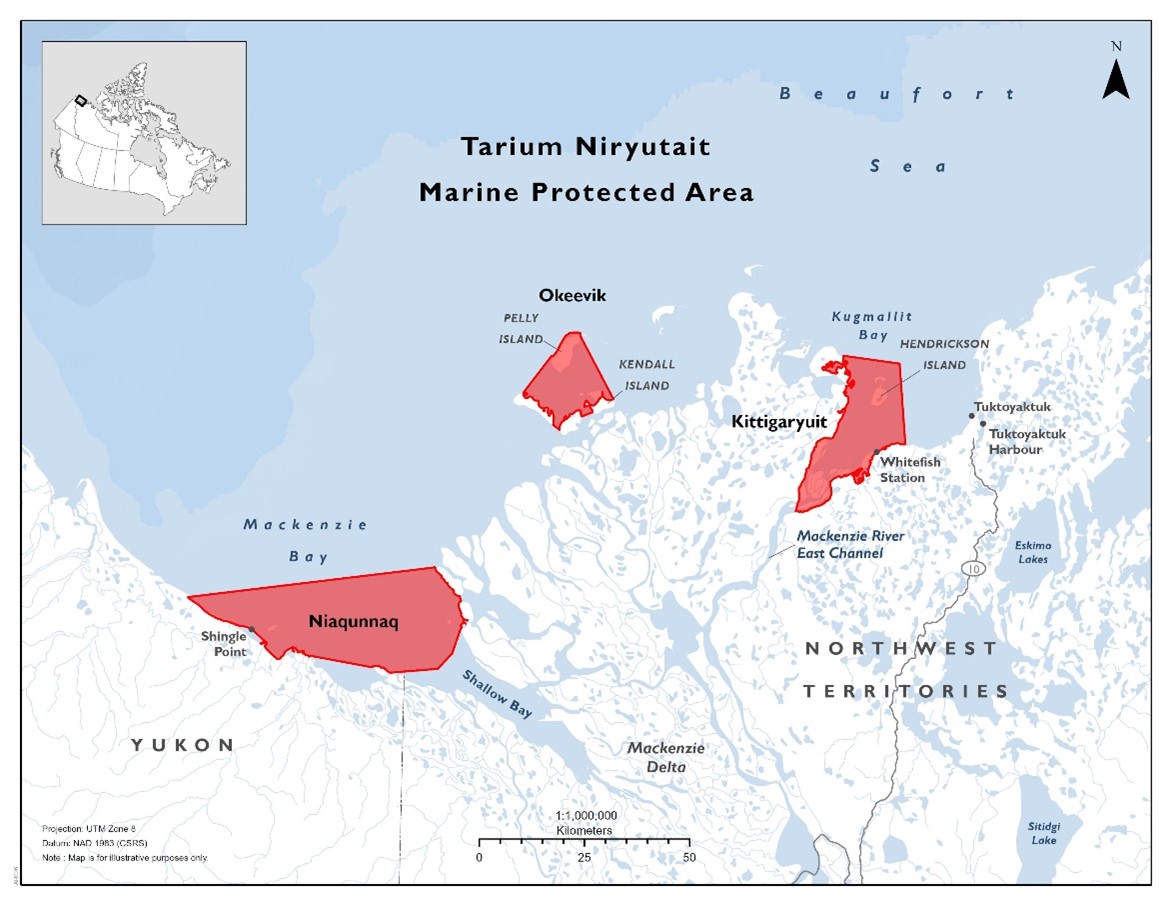
Map of Tarium Niryutait Marine Protected Area.
Date of designation:
August 26, 2010
Size:
1,750 km2
Contribution towards the marine conservation targets:
0.03%
Location:
This MPA is comprised of 3 areas (Niaqunnaq, Okeevik and Kittigaryuit) in the Mackenzie River estuary in the Beaufort Sea. They are all within the Inuvialuit Settlement Region (ISR) in the Northwest Territories, within the Western Arctic Bioregion.
Co-managed by:
The Tarium Niryutait (TN) MPA is co-managed by:
- Inuvik Hunters and Trappers Committee (HTC)
- Aklavik HTC
- Tuktoyaktuk HTC
- Fisheries Joint Management Committee (FJMC)
- Inuvialuit Game Council (IGC)
- Inuvialuit Regional Corporation (IRC)
- Fisheries and Oceans Canada (DFO)
See more details on structure in the Management and governance section of this report.
Acknowledgement:
The MPA is within the ISR and it is co-managed and co-governed by the Inuvialuit and DFO. It originated out of areas designated as Zone 1 in the Beaufort Sea Beluga management plan developed by the FJMC, which was established under the Inuvialuit Final Agreement.
Zones:
There are 2 zones in the MPA:
- Primary Protection Zone – 99%
- Special Management Zone – 1%
Conservation objectives
- To conserve and protect beluga whales and other marine species (anadromous fish, waterfowl and seabirds), their habitats and their supporting ecosystem.
In addition to the above conservation objective, a conservation priority was identified in 2016 in the State of the TN MPA Report:
- To conserve beluga and fish species important to Inuvialuit subsistence and prey of beluga and their habitat within the TN MPA.
Management and governance
The management and governance of this MPA is led by the TN MPA Working Group and the Western Arctic MPA (WAMPA) Steering Committee.
Tarium Niryutait MPA Working Group:
- Inuvik HTC
- Aklavik HTC
- Tuktoyaktuk HTC
- FJMC
- DFO Marine Planning and Conservation
WAMPA Steering Committee:
- DFO Marine Planning and Conservation
- DFO Fisheries Management
- DFO Science
- IGC
- IRC
- FJMC
- TN MPA Working Group Chair
- AN MPA Working Group Chair
In 2024, the TN MPA Working Group met 4 times (in January, March, June and October) and the WAMPA met 3 times (in January, July and November). There were also numerous meetings among researchers and community HTCs to develop and implement approved research and monitoring projects within the MPA.
This was the fourth year in a 5-year contribution agreement with the Inuvialuit Joint Secretariat. This agreement provides funding for several activities in the 2 Western Arctic MPAs (Tarium Niryutait and Anguniaqvia Niqiqyuam), including:
- governance and administration
- research and monitoring
- stewardship and outreach
- database development
Similar to last year, work to update both the TN MPA management and monitoring plans from 2012 continued to be led by the TN MPA Working Group through a collaborative process involving all MPA partners.
In 2024, there were 0 activity plans as the TN MPA Regulations do not include a requirement for Activity Plans. Similar to last year, the TN MPA Working Group would like to see this added in a future update to this MPA’s regulations.
Feature creatures
The primary focus of Inuvialuit harvesting and the conservation objective of the TN MPA is qilalugaq or beluga whales. Iqaluk (fish) are important as food for Inuvialuit and prey for qilalugaq. Inuvialuit have harvested qilalugaq along the coast for generations and they have been and remain the most revered socio-cultural species to the Inuvialuit. The annual summer harvest is essential for food and culture.
Research and monitoring
The TN MPA monitoring plan (2012) has guided monitoring in the TN MPA for 12 years, though beluga monitoring programs by the FJMC and DFO have been running for much longer (30+ years). WAMPA has established a working group with representatives from all management and governance partners to develop recommended governance indicators and the IRC is undertaking work to develop recommended socio-cultural indicators.
In 2024, DFO conducted a Canadian Science Advisory Secretariat (CSAS) meeting to review and recommend ecological monitoring indicators. All the Inuvialuit members of the TN MPA Working Group attended the CSAS and the meeting was a success. Outcomes from these 3 processes will guide the update of the TN MPA management and monitoring plans.
Similar to last year, the TN MPA Working Group and WAMPA continued to review, provide feedback and approve projects that have applied for TN MPA monitoring funding. Other projects occurring in the MPA were also reviewed by the TN MPA Working Group and all projects continue to require HTC support before they can be conducted in the TN MPA as it is within the ISR. This review process ensures that research and monitoring addresses new concerns as well as the impacts of climate change (for example, increased erosion, changing weather patterns, longer open water season).
In 2024, TN MPA research and monitoring funding supported 11 projects. Most research and monitoring projects in the TN MPA are long-term monitoring programs for important subsistence and conservation species, especially beluga. These programs will be described in more detail in the Collaboration and partnerships section.
Other programs focused on fish and ecosystem monitoring. It was the pilot year of Arctic Coast in the TN MPA region, a community-led coastal monitoring program focusing on fish biodiversity, ecosystem health and capacity building. The Arctic Coastal Ecosystem Studies (ACES) and Dolly Varden Char monitoring programs, based out of Shingle Point, continued to monitor coastal ecosystems and char populations using community-based methodologies.
The Bathymetry Mapping project used off-the-shelf sonars to collect data about water depth, which will contribute to updated hydrographic charts and community safety while travelling. This project was a partnership between Natural Resources Canada (NRCan), DFO, HTCs and other local organizations.
Collaboration and partnerships
One of the most important aspects of research in the TN MPA is getting Inuvialuit involved at all stages of research and responding to community and co-management concerns. Inuvialuit knowledge holders and scientists from DFO and academic institutions work together to ensure research and monitoring are informed by both science and Inuvialuit knowledge, as per the Inuvialuit Final Agreement.
All research that takes place in the TN MPA is collaborative and most projects within the TN MPA are codeveloped by research leads and the relevant HTC or by the HTC themselves. All projects in the ISR must follow established processes and have the support of local and regional Inuvialuit organizations, including co-management committees (for example, Environmental Impact Screening Committee, community HTCs). The MPA-funded research is reviewed by the TN MPA Working Group and WAMPA, whose membership is outlined in the Management and governance section.
The Beluga Health Research program continued to monitor beluga health through tissue samples obtained through the FJMC beluga monitoring program. It was the second of 2 years of the in-depth beluga health assessment, where veterinarians from the University of Montreal necropsied harvested whales alongside DFO researchers and FJMC beluga monitors hired by the Tuktoyaktuk HTC to provide a more detailed assessment of Eastern Beaufort Sea beluga health. It was the first year of a project looking at beluga genetics to identify potential sub-populations and answer community questions about different groups of whales. Over 1500 samples were identified for processing and analysis this year. The Beluga Habitat program continued to use coastal observatories to monitor climate-driven environmental changes affecting beluga habitats and local ecosystems.
Several projects focused on community-based monitoring of belugas in collaboration with the FJMC beluga monitoring program, including the Aklavik HTC Beluga Monitors, which stationed monitors at key coastal areas for harvest support and sample collection and the Inuvik HTC Junior Beluga Monitors. The Tuktoyaktuk HTC piloted the Husky Lakes Beluga Guardian program, where community members stationed at a narrow entrance to Husky Lakes monitored beluga whale movement to prevent whales from getting trapped in the lakes over the winter.
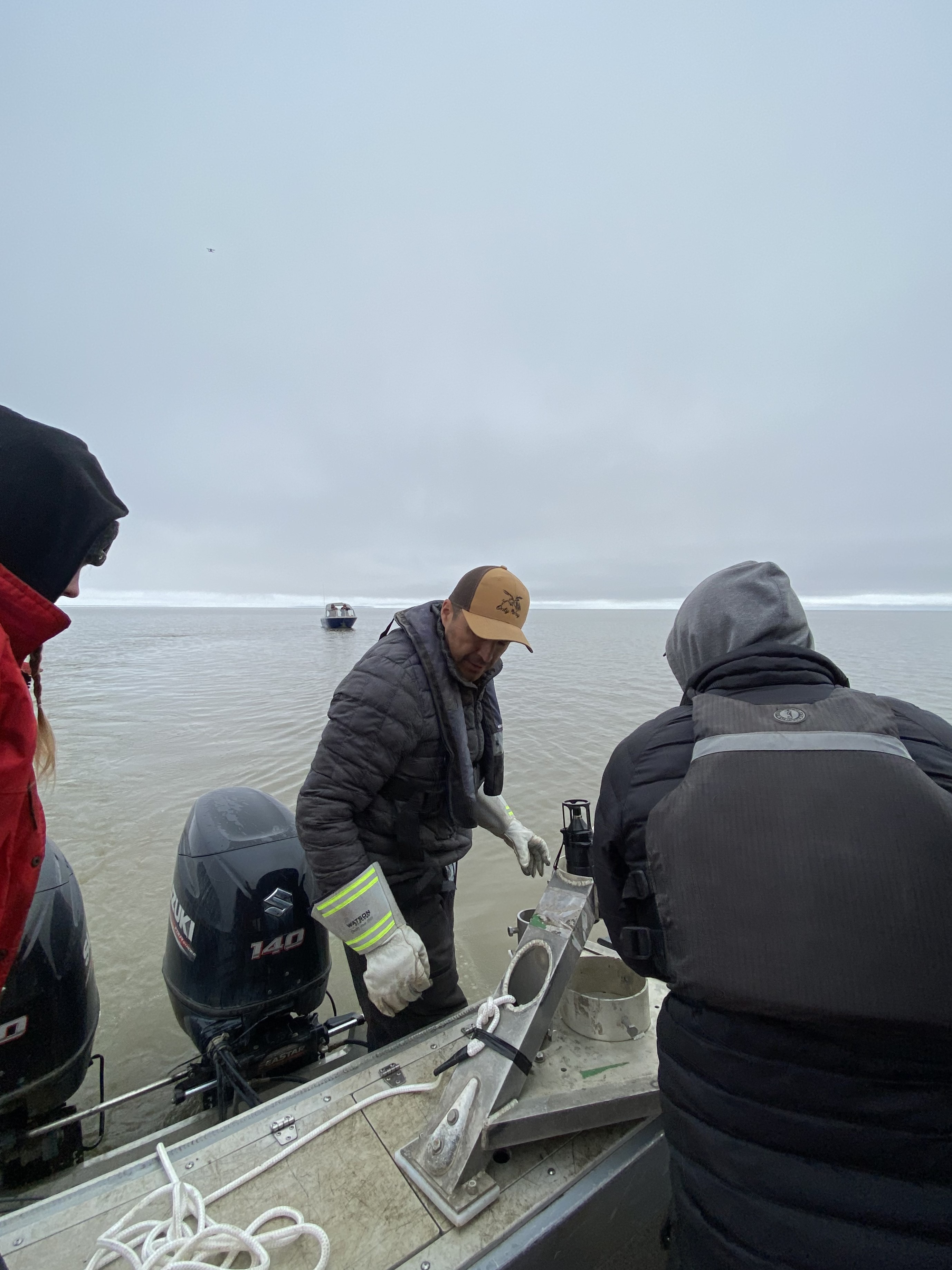
Deployment of a passive acoustic monitoring mooring in the Okeevik subregion for the beluga habitat monitoring program. Photo credit: Cara Rankin.
In the spotlight: benefits
Ecological
Management and monitoring of the TN MPA is collaborative among the Inuvialuit and DFO, ensuring that Inuvialuit Knowledge and Western Science work together to inform how these important species and their habitats are conserved. Ongoing monitoring ensures that up-to-date information regarding the health of beluga and fish populations, habitat and environmental conditions and any stressors, informs management decisions. Ecological monitoring contributes to our understanding of the larger Beaufort Sea ecosystem.
Socio-cultural
The 3 regions of the TN MPA are places where Inuvialuit have harvested since time immemorial and still do. The health and sustainability of the beluga and fish populations protected by the TN MPA contributes to the food security of hundreds of Inuvialuit across the ISR. Inuvialuit Future Leaders are part of management, which promotes knowledge-sharing across generations to support strong Inuvialuit leadership informed by Inuvialuit Knowledge now and into the future. The TN MPA Working Group supports projects that provide training opportunities for community members, supporting the shift to community-led implementation of research and monitoring.
Economic
Inuvialuit are involved in every aspect of monitoring and management of the TN MPA, which provides many opportunities for short-term employment. There were over 20 community members hired in the 2024 field season. The focus on shifting research and monitoring to be fully community-led is also more economically feasible, due to reduced shipping and travel costs. Research and monitoring project budgets must account for increasing costs of living and working in the region.
Surveillance and enforcement
DFO’s Conservation and Protection (C&P) Officers are responsible for monitoring and ensuring compliance with the TN MPA regulations. In 2024, they did not detect or receive any reports of violations of the TN MPA regulations.
In 2024, enforcement efforts conducted in TN MPA included:
- remotely monitoring large vessel traffic using Automatic Identification System (AIS) data
- 2 dedicated air surveillance patrols in August and October
- a joint federal vessel patrol toward Hendrickson Island in September (this was cut short due to weather conditions)
Strengthened collaboration between federal and territorial agencies has improved intelligence sharing and response times. DFO C&P is also evaluating satellite-based dark vessel detection technology to enhance monitoring of non-AIS-reporting vessels within the MPA.
The TN MPA Working Group, along with 3 local communities, continues to advocate for increased enforcement capabilities and education efforts, prioritizing greater DFO Fishery Officer presence. However, officers are based in southern offices, which may result in delayed response times due to travel requirements.
In 2024, DFO C&P Northwest Territories reaffirmed its commitment to expanding joint patrols with federal and territorial partners to enhance enforcement and surveillance in the TN MPA.
Outreach and engagement
The Tuktoyaktuk HTC ran a Stewardship & Outreach program in the TNMPA, which brought Inuvialuit Future Leaders to Hendrickson Island to observe whale harvests and sampling by the DFO-University of Montreal research team and FJMC beluga monitors. The future leaders then learned from host families to prepare muktuk (beluga skin and blubber) and mipku (beluga dry meat). The Aklavik, Inuvik and Tuktoyaktuk HTCs all purchased materials to build cabins to support future stewardship and outreach programs in the TN MPA.
In 2024, the TN MPA Working Group Chair, Jim Elias, attended the Prairie and Northern Region Canadian Marine Advisory Council (CMAC) meeting in Winnipeg in May, as well as the national CMAC meeting in Ottawa in November. At these meetings, Jim Elias was able to share concerns about shipping in the TN MPA, which he describes as his backyard and where his food comes from, directly with members of the shipping industry.
In June 2024, MPA Secretariat staff from DFO and the Joint Secretariat hosted a booth at the Oceans Day celebration in Tuktoyaktuk that invited community members and other attendees to learn more about the ISR MPAs.
In 2024, regional annual reviews for the TN MPA from 2021, 2022 and 2023 were distributed to MPA communities. The 2023 TN MPA Annual Report was also shared online and printed and distributed as well.
There were many research projects in the TN MPA that were presented at conferences throughout 2024, including at ArcticNet in Ottawa in December.
Related link
- Date modified: