
St. Anns Bank Marine Protected Area (MPA) annual report 2024
On this page
At-a-glance
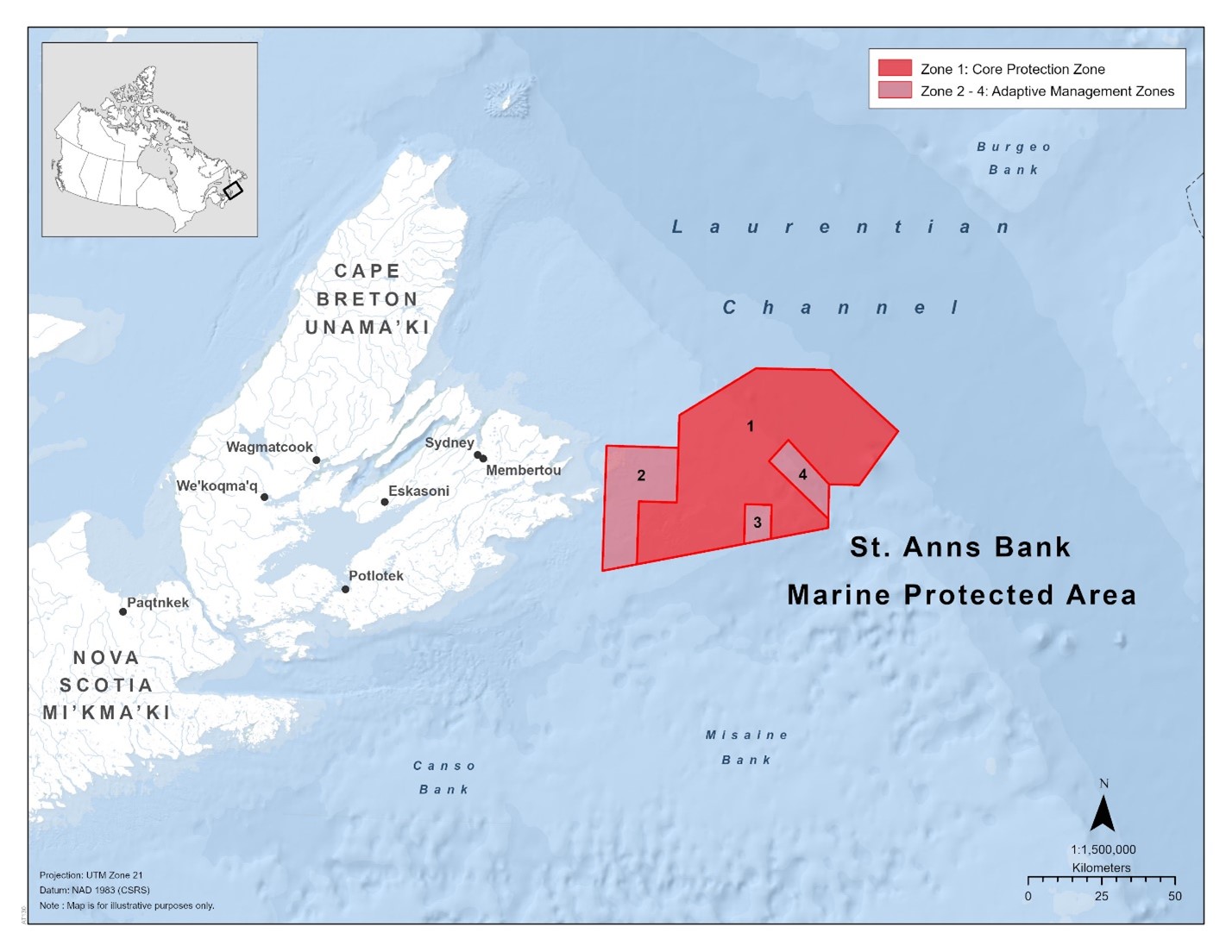
Map of St. Anns Bank Marine Protected Area
Date of designation:
2017
Size:
4,364 km2
Contribution towards the marine conservation targets:
0.08%
Location:
This MPA is located east of Cape Breton Island, Nova Scotia (NS) in the Scotian Shelf Bioregion; Atlantic Ocean.
Managed by:
In 2024, St. Anns Bank MPA was managed by Fisheries and Oceans Canada (DFO), however the Government of Canada is working towards a co-governance arrangement with the Mi’kmaq of Nova Scotia.
Acknowledgement:
St. Anns Bank is located in Unama’ki, 1 of the 7 districts of Mi’kma’ki, the unceded ancestral territory of the Mi’kmaq.
Zones:
There are 4 management zones:
- Zone 1 - The core protection zone where human activities are minimal
- Zone 2, 3 and 4 - Adaptive management zones where low-impact activities may be permitted
Conservation objectives
- Conserve and protect all major benthic, demersal and pelagic habitats within the MPA, along with their associated physical, chemical, geological and biological properties and processes
- Conserve and protect marine areas of high biodiversity at the community, species, population and genetic levels within the MPA
- Conserve and protect biological productivity across all trophic levels so that they are able to fulfill their ecological role in the ecosystems of the MPA
Management and governance
Management of St. Anns Bank MPA is guided by the MPA management plan, which was developed in partnership with the Mi’kmaq of Nova Scotia and the MPA Advisory Committee. The management plan was published in 2023 and it includes objectives for management and stewardship as well as research and monitoring of the MPA. The plan also presents guiding principles from both the Mi’kmaq worldview as well as western MPA guiding principles.
The St. Anns Bank Advisory Committee (SABAC) provides management advice and has representatives from:
- Mi’kmaq and Indigenous organizations
- federal and provincial governments
- fishing and other commercial industries
- conservation organizations
- academic institutions
- local interest groups
SABAC met on December 3rd, 2024 in Unama’ki and the hybrid meeting had 33 participants (some joined virtually). It included updates from SABAC members and from DFO representatives. The meeting showcased activities that took place in the MPA over the past year, including surveillance and enforcement activities as well as science work done by both DFO and external partners like Cape Breton University. An update on the co-governance planning work was shared with the committee. The meeting concluded with future plans and priorities for the St. Anns Bank MPA, which includes research and monitoring partnerships and supporting Mi’kmaw participation in fieldwork.
In 2024, there were 5 activity plans submitted and approved in St. Anns Bank MPA covering a wide variety of activities. One application was for video recording to be used for wildlife documentary. Activities related to fisheries surveys were approved including benthic monitoring and fish tagging as well as passive acoustic monitoring and eDNA sampling. Activity plan applications and review are the most common action’s associated with managing the MPA, so a priority for 2025 is to work towards joint decision making with the Mi’kmaq on activity approvals.
Feature creatures
Scientists have found large numbers of thorny skate or kekunaluej purses (egg capsules) in a part of St. Anns Bank MPA. The MPA is considered to be important habitat for this species. Thorny skate are very slow growing and can live up to 28 years old! The antifreeze in their blood and their heavily armoured skin allows thorny skates to live all the way up to Greenland and as far south as South Carolina in the United States.
Research and monitoring
In 2024, a milestone for St. Anns Bank MPA was reached with the publication of the first review of St. Anns Bank MPA monitoring by the Canadian Science Advisory Secretariat (CSAS). This data review was conducted to examine baseline data and ongoing survey data contributions towards monitoring the MPA’s conservation objectives. Long-term data sources reviewed include the Atlantic Zone Monitoring Program’s (AZMP) oceanographic and biological data survey. Monitoring of animal movement was examined by looking at data from passive acoustic monitoring for cetaceans and data from the Maritimes Region’s Snow Crab Survey. Acoustic telemetry data was used to examine fish movement and diversity in and around the MPA.
In conjunction with the monitoring review, a report was published from a workshop on additional recent and short-term research and monitoring efforts within the MPA. The hybrid workshop served as a forum to communicate current scientific efforts occurring in the MPA and to promote collaboration amongst groups and individuals either working in or with an interest in, the St. Anns Bank MPA.
In 2024, research and monitoring in St. Anns Bank MPA included a combination of long-standing surveys (for example, the halibut longline survey) and newer techniques like environmental DNA (eDNA) sampling. DFO scientists conducted new surveys using both eDNA sampling and benthic imagery to identify different species across different habitats in the MPA, as these tools provide effective and non-invasive ways to monitor biodiversity. To date 14 fish species and nearly 100 invertebrate species, most of which are planktonic, have been detected from eDNA analysis in the MPA. DFO continued partnerships with external groups like Cape Breton University for monitoring in 2024, including deployment of Autonomous Reef Monitoring Structures (ARMS). In the future, partnerships with the Mi’kmaq of Nova Scotia will be prioritized for monitoring activities.
Collaboration and partnerships
The communities around St. Anns Bank and the people who live near and use the area around the MPA are critical for its success. Ensuring that the people and communities with a vested interest in St. Anns Bank have an opportunity to collaborate and partner on the management of the MPA is a priority for DFO.
Work to advance a co-governance arrangement for the management of St. Anns Bank MPA remains ongoing. To enable this work, a planning group was created to discuss management issues and enhance Mi’kmaq collaboration associated with the MPA. The goal of this planning group is to advance discussions on a future co-governance arrangement for St. Anns Bank. The group is comprised of representatives from:
- Kwilmu’kw Maw-klusuaqn (KMK)
- Unama’ki Institute of Natural Resources
- The Confederacy of Mainland Mi’kmaq
- DFO
- Dalhousie University
The full planning group met 5 times in 2024 and developed a terms of reference. Other topics discussed with the group included planning for collaborative science field work and integrating Etuaptmumk or Two-Eyed Seeing, into the MPA Activity Plan Review process. Etuaptmumk is a balanced respect, appreciation and consideration for Indigenous and Western knowledge. Incorporating this principle into the evaluation of activity plan reviews will help to ensure that management decisions in the MPA reflect the perspectives and objectives of those involved in the management of the St. Anns Bank MPA.
In the spotlight: benefits
Ecological
St. Anns Bank comprises a wide variety of habitat types ranging from the shallows of Curdo and Scatarie Bank to the deep waters of the Laurentian Channel. St. Anns Bank is a part of a key migration corridor for marine mammals and fish that travel in and out of the Gulf of St. Lawrence. The MPA provides habitat for several threatened, endangered and depleted species. Protecting this diverse area by reducing pressures such as fishing activities helps to preserve biodiversity.
Socio-cultural
The Mi’kmaq of Nova Scotia were the first people who inhabited and cared for St. Anns Bank, including the area that is now the MPA. The Mi’kmaq of Nova Scotia and the Government of Canada are rebuilding a Nation to Nation relationship through the St. Anns Bank co-governance planning group. Relationship building and co-learning is at the heart of this work. Continuing to strengthen the relationship and focusing on re-connection between communities and St. Anns Bank is a priority for the group.
Economic
The St. Anns Bank MPA allows certain commercial harvesting activities in the adaptive management zones of the MPA (Zones 2, 3 and 4). On average, between 2018 and 2022, fisheries in the MPA provided around $440,000 annually from fish landings. Of those landings, 75% is caught by vessels based in communities in Cape Breton County (within Unama'ki). Five additional counties across Nova Scotia also benefit from these fisheries. Halibut is the most commonly caught species, representing 85% of landings, in the MPA followed by other groundfish species.
Surveillance and enforcement
DFO’s Conservation and Protection (C&P) officers use a variety of platforms and tools to carry out surveillance and enforcement efforts in the St. Anns Bank MPA, including:
- vessel patrols
- aerial surveillance
- remote monitoring tools, such as the vessel monitoring system
In 2024, a total of 82 hours were spent patrolling in the St. Anns Bank MPA, using both aerial and vessel platforms. In total, 1 to 2 aerials patrols occurred each week, averaging 5 flights per month, including flights specifically dedicated to MPA surveillance and enforcement.
Activities continue as outlined in the enforcement plan and efforts are underway to update the St. Anns Bank MPA enforcement plan for 2025-2026.
Following fishing infractions that occurred in 2023, on October 23, 2024 the captain of a fishing vessel was convicted under section 39.6(1) of the Oceans Act for longline fishing in a prohibited area of St. Anns Bank MPA. This is the first conviction under the Oceans Act in DFO Maritimes Region.
DFO’s C&P officers also participate in outreach efforts by attending local events to increase knowledge and promote compliance within and around MPAs.
Outreach and engagement
A promotional video for the St. Anns Bank MPA was released by DFO on YouTube in June 2024. Additionally, St. Anns Bank MPA was featured in an MPA Activity Book which was produced in English and French. Select pages of the activity book were translated into Mi’kmaw with translation by Kji-Wikuom Studios, a Mi’kmaq language lab in the community of Eskasoni.
St. Anns Bank was highlighted at KMK’s 2024 annual Nationhood conference with Chief and Council representatives from 10 of 13 Nova Scotia Mi’kmaq Communities. Attendees learned about the collaborative work being undertaken and the relationship-building success between Nations. St. Anns Bank continues to be featured in conservation outreach events in the Maritimes Region, including annual Oceans Week events in Halifax aimed at sharing information about Canada’s MPAs with the public. As part of the Oceans Day celebrations, DFO and KMK staff attended the Aros Na Mara community event in Iona, Nova Scotia. This community event had a booth to share information about the collaborative work being done towards co-management of the MPA by the Government of Canada and the Mi’kmaq of Nova Scotia.
Related link
- Date modified: