
SG̲áan K̲ínghlas-Bowie Seamount Marine Protected Area (SK̲-B MPA) annual report 2024
On this page
- At-a-glance
- Conservation objectives
- Management and governance
- Feature creatures
- Research and monitoring
- Collaboration and partnerships
- In the spotlight: benefits
- Surveillance and enforcement
- Outreach and engagement
At-a-glance
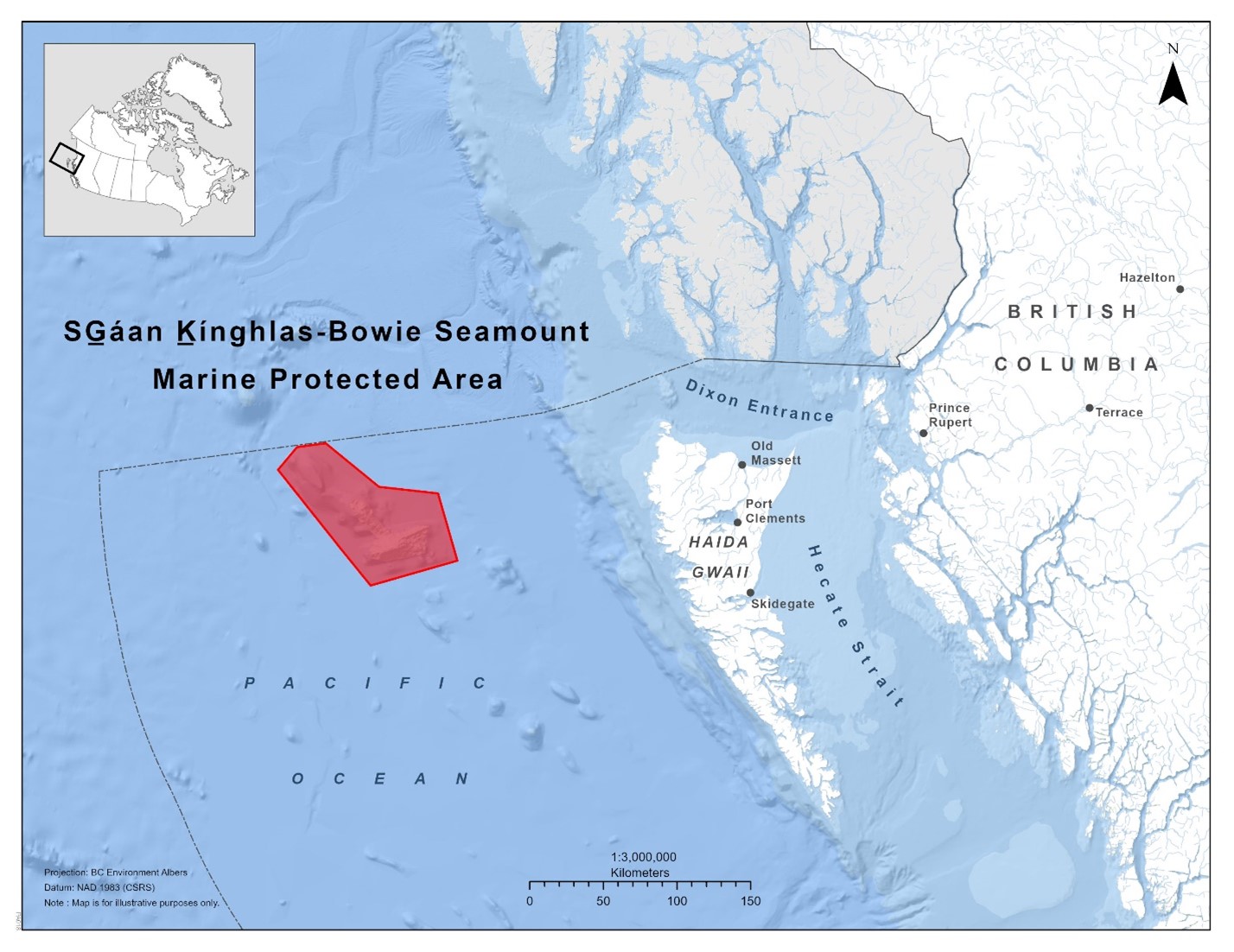
Map of SG̲áan K̲ínghlas-Bowie Seamount Marine Protected Area.
Date of designation:
1997: X̲aads siigée tl’a dámaan tl’a k̲ínggiigangs Haida Marine Protected Area
2008: Oceans Act MPA
Size:
6,103 km2
Contribution towards the marine conservation targets:
0.11%
Location:
This MPA is located 180 km west of Haida Gwaii in the Offshore Pacific Bioregion; Pacific Ocean.
Co-managed by:
Council of the Haida Nation (CHN) and Fisheries and Oceans Canada (DFO)
Acknowledgement:
This MPA is located within the territory of the Haida Nation.
Zones:
This MPA does not have any zones within its boundaries.
Conservation objectives
Conserve and protect the unique biodiversity and biological productivity of the area’s marine ecosystem, including seamounts and the surrounding waters, seabed and subsoil.
Management and governance
The ongoing management and governance of this MPA is led by the SK̲-B Management Board. The management board is comprised of 4 representatives including 2 from CHN and 2 from DFO. In 2024, 2 foundational documents continued to guide the management and governance of the MPA, including the:
- terms of reference (2012), which refines the roles, responsibilities and procedures of the SK̲-B Management Board
- Gin siigée tlʹa dámaan k̲ínggangs gin k̲ʹáalaagangs | Marine Protected Area Management Plan (2019), which outlines the guiding principles, goals and objectives of the MPA
In 2024, one activity plan was submitted and approved for the SK-B MPA. This activity plan was for a scientific research expedition in the MPA, which took place in August 2024. This multi-disciplinary joint expedition was the Northeast Pacific Deep-sea Exploration Project (NEPDEP), which is a partnership between:
- DFO
- CHN
- the Nuu-Chah-Nulth Tribal Council
- Ocean Networks Canada
- Royal BC Museum
- The University of Victoria
In 2024, the SK̲-B Management Board met once. It was a virtual meeting on November 14, 2024. In addition to this management board meeting, the SK̲-B Technical Team met on a bi-weekly basis throughout 2024. The SK̲-B Technical Team supports the ongoing management and governance of the MPA and provides management recommendations to the management board. The Secretariat of Haida Nation currently receives funding through an Aboriginal Aquatic Resource and Oceans Management (AAROM) collaborative management agreement to co-manage the SK̲-B MPA.
Feature creatures
Sablefish or Black cod, Sk̲íl (Old Masset dialect) and Sk̲il (Skidegate dialect) play an important role in the SK̲-B MPA. They migrate between deep and shallow waters, linking different parts of the SK̲-B ecosystem. Haidas have traditionally fished for Sk̲íl/ Sk̲il using special hooks and continue to fish for Sk̲íl/ Sk̲il to this day. Since Sk̲íl/ Sk̲il are highly migratory, tracking their recovery is difficult. SK̲-B MPA provides protection which may support population recovery but due to their migratory nature, broader management is important.
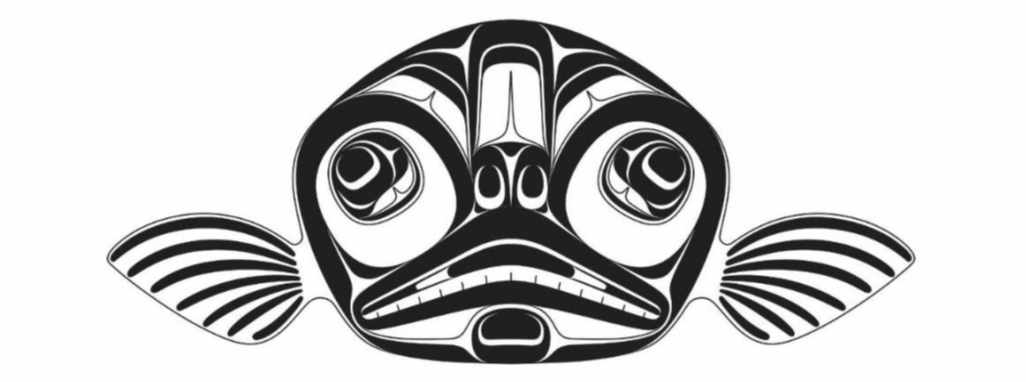
The Haida art of Sk̲íl / Sablefish / Black Cod (Anoplopoma fimbria) was shared by Iljuuwaas Tyson Brown, from the SG̲áan K̲ínghlas-Bowie Seamount Marine Protected Area management plan (CHN and DFO 2019).
Research and monitoring
In 2024, the CHN and DFO published a co-authored Monitoring Framework for SG̲áan K̲ínghlas-Bowie Seamount Marine Protected Area. This framework offers a high-level overview of monitoring options for the MPA’s ecological conservation objectives, linking the objectives outlined in the MPA management plan to relevant indicators, protocols and strategies. It will support the SK̲-B MPA Management Board in determining the most suitable monitoring approach for the development of a monitoring plan.
In 2024, DFO scientists published results of their investigation into ocean current flow around SG̲áan K̲ínghlas-Bowie Seamount. By using the orientation of ancient corals to trace prevailing flow patterns, the authors challenge the conventional understanding of current flow direction in the deep waters of the Northeast Pacific ocean.
DFO scientist (Dr. Cherisse Du Preez) continued to provide supervisory support for 3 graduate students in 2024, whom are:
- investigating how climate change will affect the distribution of invertebrates (Megan Davies)
- looking at the relationship between water chemistry and animal abundance (Pandora Gibb)
- monitoring cold-water coral and sponge diversity over time (Lindsay Clarke)
The 2024 Northeast Pacific Deep-sea Exploration Project (NEPDEP) expedition surveyed the ecology, oceanography and geology of the seamounts within the SK̲-B MPA. In 2024, the team returned to several long-term monitoring sites that were established in 2018. The time series data from these sites are indicating significant effects of climate change on the fauna of these seamounts, such as decreasing oxygen and more acidic waters, despite the data only covering 6 years. For example, at one of the long-term monitoring sites, monitoring efforts have documented a 28% and 33% reduction in healthy and alive corals and sponges, respectively (Du Preez et al. in prep). Together, these 2024 initiatives advanced scientific understanding and monitoring capacity within the SK̲-B MPA providing critical insights to better inform adaptive management for:
- ecosystem change
- oceanographic processes
- impacts of climate change
Collaboration and partnerships
In 2024, CHN and DFO scientists undertook a series of collaborative actions to promote and study the SK̲-B MPA via the NEPDEP. The 2024 NEPDEP expedition was endorsed by the United Nations Decade of Ocean Science and Challenger 150.
For this expedition, CHN and DFO partnered with several organizations, including the:
- Nuu-chah-nulth Tribal Council
- Ocean Networks Canada
- Royal BC Museum
- University of Victoria
- University of Calgary
Together they:
- carried out a long-term ecological monitoring expedition
- increased public awareness by live-streaming videos and hosting online community interactions with the expedition team
- documented the expedition using the Remotely Operated Platform for Ocean Sciences (ROPOS)
In the spotlight: benefits
Ecological
The SK̲-B MPA protects 3 seamounts that provide diverse habitats across a large range of depths. This MPA is protecting the high biodiversity that is driven by unique oceanographic conditions, including:
- open ocean species (for example, migratory whales)
- deepwater species (for example, squat lobsters)
- shallow water species (for example, mussels, kelp)
Socio-cultural
The area holds historical, cultural and spiritual significance to the Haida Nation. In G̲aw Tlagée X̲aad kíl, the Old Massett Haida language dialect, SG̲áan K̲ínghlas means Supernatural Being looking upwards. Haida oral histories holds innumerable stories related to the ocean, including SG̲áan K̲ínghlas, at the time when it was an island. In addition to the important historical significance of the area, ongoing activities such as the 2024 NEPDEP expedition are increasing ocean literacy and stewardship through deep-sea exploration live-streams and by connecting scientists to community events.
Economic
For over 10 000 years, Haidas have been connected to and have relied on SG̲áan K̲ínghlas for fishing and wealth. There was formerly commercial whaling (1905-1967) and fishing (1950-2018). Today, key activities in the MPA include scientific monitoring and vessel traffic. Research contributes to the province’s economy through expenditures on provisions, vessel maintenance and more. As a highly biodiverse refuge and nursery, the SK̲-B MPA may also provide future economic benefits outside its boundaries through supporting fisheries in nearby waters.
Surveillance and enforcement
Since 2019, CHN has partnered in the Oceans Protection Plan pilot project for Enhanced Maritime Situational Awareness System (EMSA) to monitor vessel traffic. EMSA provides near real-time Automatic Identification System (AIS) data via the Department of National Defense’s fused satellite and terrestrial feed. In 2022, the SK̲-B Management Board endorsed the technical team’s use of EMSA to track vessel activity within the SK̲-B MPA and a 50-nautical-mile radius of the seamount pinnacle.
Due to the MPA’s offshore location, DFO’s Conservation and Protection Officers patrol the MPA remotely. In addition, the Fisheries Aerial Surveillance and Enforcement (FASE) Program was able to conduct an aerial surveillance patrol over the MPA for a total of 0.83 hours.
Monitoring efforts to support ongoing surveillance and enforcement of the MPA have been enhanced by satellite Radar Satellite II (RSII) coverage in domestic waters. Polar Epsilon Operations at MDA Space generate DFO MPA reports with vessel contacts and associations for our Marine Security Operations Center – West (MSOC-W). Analysts at MSOC-W monitor these Reports and analyze the acquisitions and detections with AIS associations. In 2024, there were 25 RSII contacts near or inside this MPA and 24 of those were identified by their AIS as fishing vessels. Vessels exhibiting fishing behaviour were triaged for follow-up by a Conservation and Protection Officer.
No fisheries violations were detected from audits to electronic monitoring data aboard fishing vessels
Outreach and engagement
Outreach and engagement activities continue to be guided by the communications protocol and strategy that was developed by the SK̲-B Management Board to increase MPA awareness in 2020.
In 2024, several outreach and engagement activities occurred on Haida Gwaii to raise awareness of the MPA. These included community events such as:
- Hospital Days
- Skidegate Days
- the Tlell Fall Fair
- Edge of the World Music Festival
There was also an episode of Live It Earth, an online educational series, where both CHN and DFO shared their knowledge of SK̲-B, deep-sea ecosystems and expeditions with students from Haida Gwaii and around Canada.
During the 2024 NEPDEP expedition, CHN and DFO conducted valuable research in the MPA and shared those findings with local, national and international communities. In addition to live-streaming all the dives, the partners hosted Ship2Shore events that connected the at-sea team with communities on Haida Gwaii, including G̲aw Tlagée Old Massett and Hlɢ̲aagilda Skidegate.
Related link
- Date modified: