
Hecate Strait/Queen Charlotte Sound Glass Sponge Reefs Marine Protected Area (MPA) annual report 2024
On this page
- At-a-glance
- Conservation objectives
- Management and governance
- Feature creatures
- Research and monitoring
- Collaboration and partnerships
- In the spotlight: benefits
- Surveillance and enforcement
- Outreach and engagement
At-a-glance
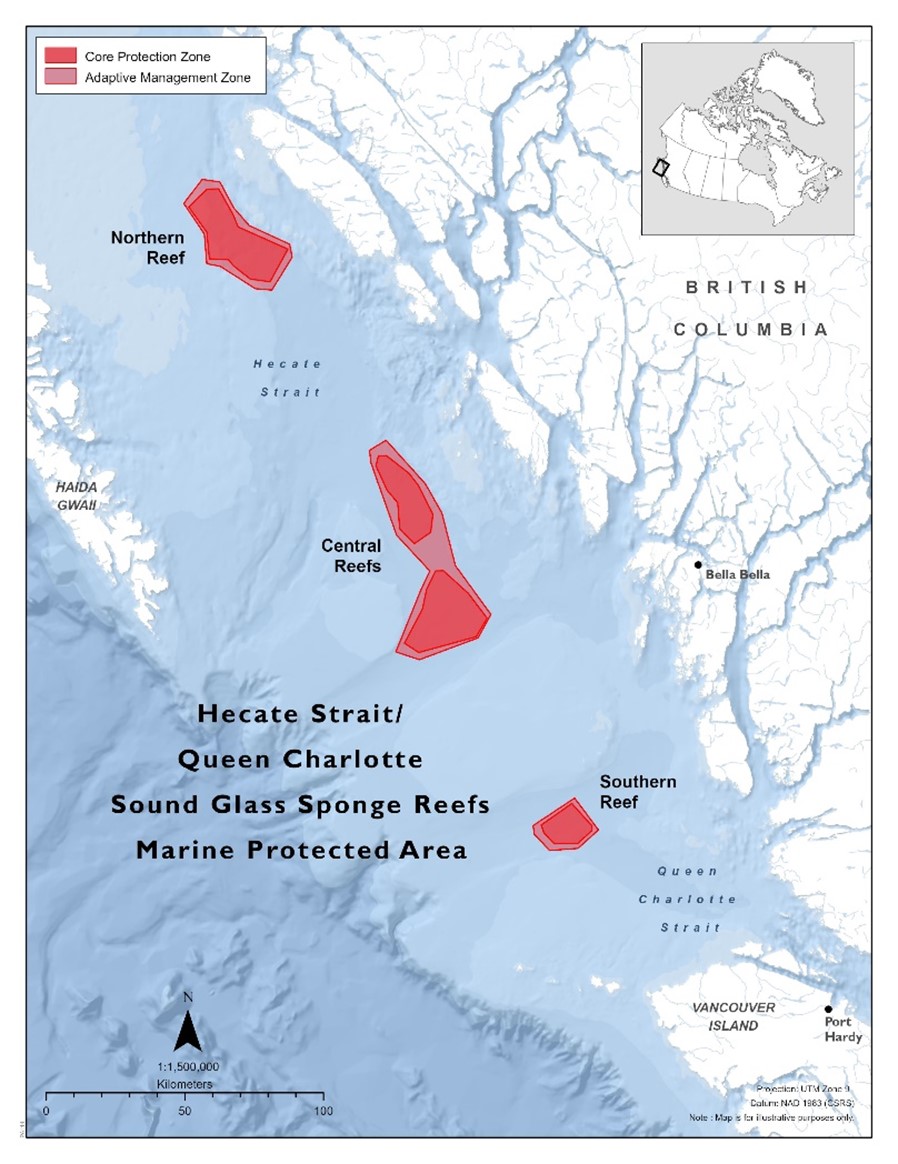
Map of the Hecate Strait/Queen Charlotte Sound Glass Sponge Reefs Marine Protected Area.
Date of designation
2017
Size
2,410 km2
Contribution towards the marine conservation targets
0.04%
Location
This MPA is located in the Northern Shelf Bioregion, Pacific Ocean. There are 3 separate areas:
- Northern Reef
- Central Reefs
- Southern Reef
Co-managed by
This MPA is co-managed by 2 working groups:
- The Kitselas Hecate Working Group, which includes members from Fisheries and Oceans Canada (DFO) and the Kitselas First Nation
- The Pacific North Coast (PNC) Hecate Working Group, which includes members from:
- DFO
- Gitga’at
- Gitxaała
- Heiltsuk
- Kitasoo Xai’xais
- Wuikinuxv
Acknowledgement
This MPA is within the statement of intent area of several First Nations. The MPA is co-managed by 2 working groups, as stated above.
Zones
There are 3 management zones:
- Core Protection Zones (CPZs) – They include the seabed, the subsoil to a depth of 20 metres and the water column above the seabed
- Vertical Adaptive Management Zones (VAMZs) – They include water columns right above the CPZs that extend from that boundary to the sea surface
- Adaptive Management Zones (AMZs) – They consist of the seabed, subsoil and waters that are not a part of the CPZs or VAMZs
Conservation objectives
Conserve the biological diversity, structural habitat and ecosystem function of the glass sponge reefs.
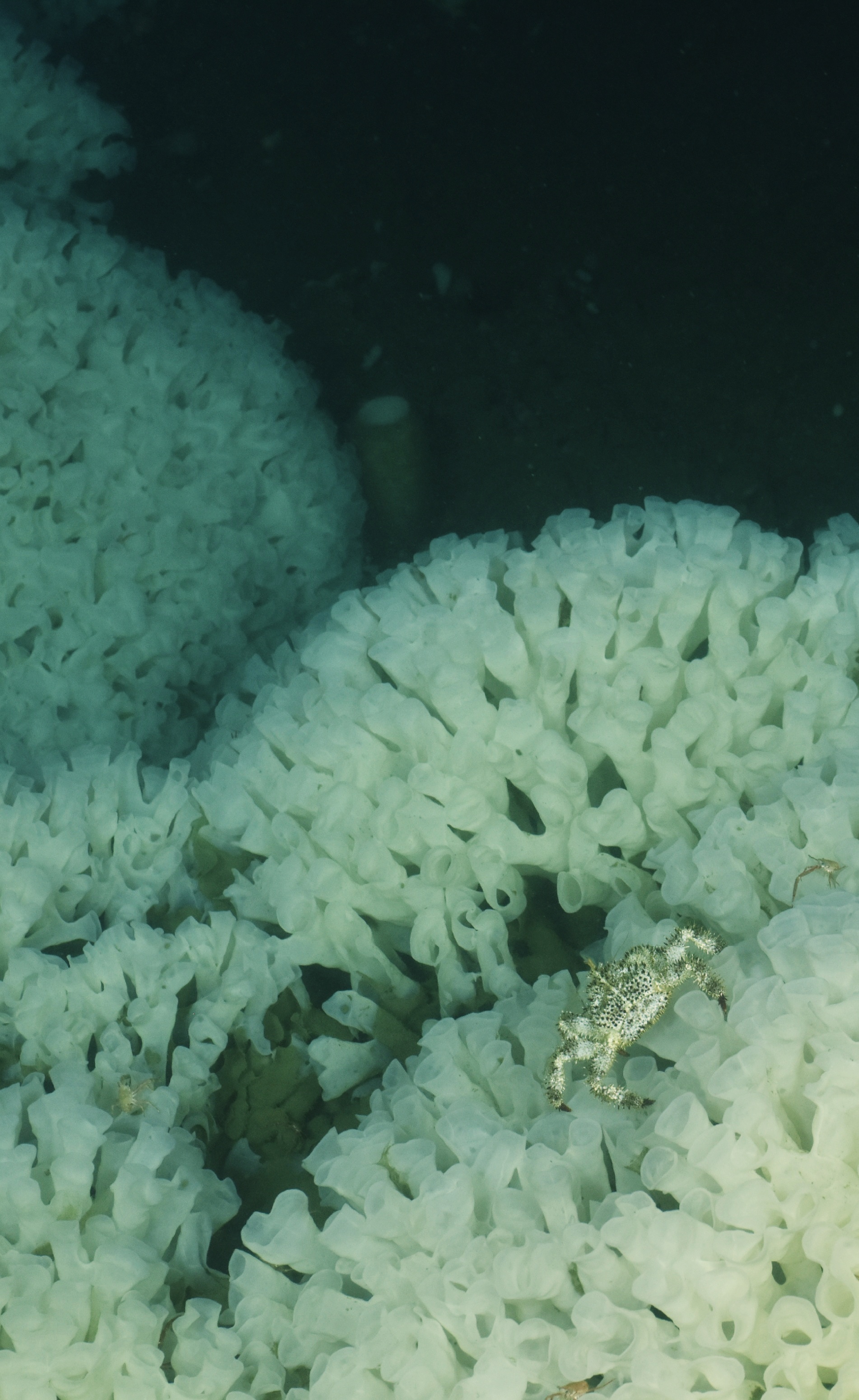
A crab atop the glass sponge reef. Photo credit: DFO, Sally Leys, University of Alberta, CSSF ROPOS.
Management and governance
The governance of the MPA is a collaborative effort, facilitated through 2 working groups: the PNC Hecate Working Group and the Kitselas Working Group. Both groups are guided by a terms of reference. The PNC Hecate Working Group’s terms of reference was updated in the fall of 2024 to include Wuikinuxv Nation as a new member. In 2024, both the PNC Hecate Working Group and the Kitselas Hecate Working Group each met twice.
Both working groups decided to adopt a phased approach to the development of the Hecate MPA Management Plan. The development of the ecological monitoring section of the management plan is being prioritized to allow DFO to meet its regulatory obligations and support thorough and systematic monitoring of the ecosystem. In 2024, these 2 working groups finalized ecological monitoring objectives for the MPA, enabling the drafting of an Ecological Monitoring Plan to commence. These monitoring objectives are in addition to the Regulatory Conservation objective and include:
- populations of rare, localized, endemic and vulnerable species are protected and conserved
- habitats that are essential for life history phases of species within the MPA are protected and conserved
- ecosystem functions are protected and conserved
DFO entered into grants and contributions agreements with several First Nations to support ongoing co-management of the MPA, including:
- Gitga’at
- Gitxaała
- Heiltsuk
- Kitasoo Xai’xais
- Kitselas
In 2024, 2 activity plans were submitted and approved for scientific research and monitoring within the MPA. The first activity was the recovery of an oceanographic mooring and redeployment of 2 new moorings within the MPA. The moorings monitor oceanographic conditions in the Hecate Strait and collect data on:
- ocean currents
- underwater noise
- water temperature
- salinity
- dissolved oxygen concentration
The second activity plan was for a multi-disciplinary joint expedition in August 2024, called the North-East Pacific Deep-Sea Exploration Project (NEPDEP). The expedition surveyed the glass sponge reefs using a remotely operated vehicle (ROV) called the Remotely Operated Platform for Ocean Sciences or ROPOS. The expedition supported the ongoing management of the MPA by providing information on the ecology, oceanography and geology of the area.
Feature creatures
There are 3 species of reef-forming glass sponge in the MPA:
- Heterochone calyx
- Aphrocallistes vastus
- Farrea occa
They create fused silica skeletons that remain rigid after death, enabling new sponges to build on the old. Over 9,000 years, these reefs have become the world’s largest, reaching 25-30m. These huge, intricate structures provide crucial habitat for diverse marine life, including:
- rockfish
- skates
- halibut
Research and monitoring
To support ongoing monitoring, DFO continued to collect oceanographic data within the Hecate MPA in 2024. In the Central Reefs, 1 oceanographic mooring was retrieved and 2 more were deployed. Instruments measuring ocean currents and water properties were attached to one mooring, while hydrophones and suspended sediment sensors were on the other. During deployment, researchers also sampled zooplankton to characterize species and abundances within the MPA.
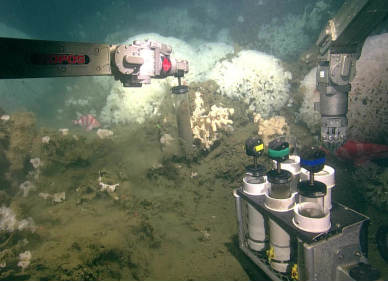
Collection of sediment cores to assess carbon capture. Photo credit: 2024 NEPDEP Expedition partners and CSSF ROPOS.
The NEPDEP 2024 expedition sampled and surveyed the Southern Reefs of Hecate MPA. The 2024 NEPDEP expedition set sail from Aug 13-Sept 2, 2024 on the Canadian Coast Guard Vessel J. P. Tully. The expedition explored deep-sea ecosystems visually using a remotely operated vehicle (ROV) and sampled the waters in and around Ecologically and Biologically Significant Areas (EBSAs) in existing, planned and potential MPAs, including the unique glass sponge reef habitats in Hecate MPA. The expedition focused on 4 objectives:
- collecting video footage from many parts of the reef to document species present and condition of the reef
- collecting images to create a 3D mosaic of a section of the reef for fine-scale long-term monitoring
- extracting cores from on and off the reef for a blue carbon project
- collecting water samples for an eDNA project looking at fish diversity on and off the reef
Video footage for objective 1 is being annotated for the presence of key fish species and for the abundance and condition of reef-forming glass sponges. The presence of fishing gear and other marine debris will also be annotated. One major finding during the survey was the presence of a large derelict trawl net with one loose end being swept around in changing tides. This research informs baseline data for MPA monitoring plan development, contributes to long-term ecological monitoring of the MPA and contributes to the assessment of the ecological monitoring objectives.
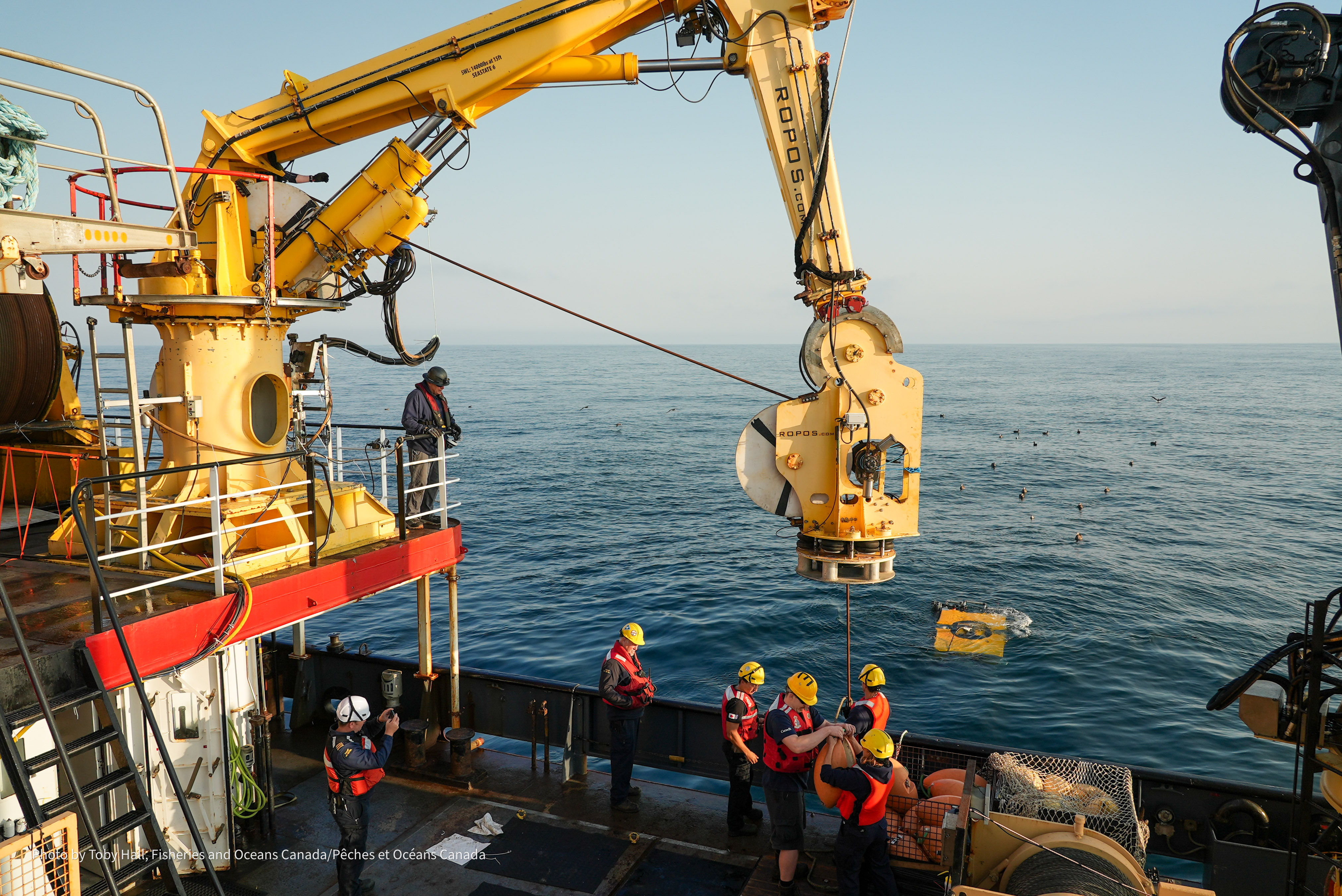
Deployment of ROPOS during the 2024 expedition. Photo credit: Toby Hall (DFO).
A team of DFO Scientists, led by Dr. Josephine C. Iacarella and Dr. Anya Dunham, published a paper exploring the evaluation of ecological integrity in marine protected areas, which included Hecate MPA and the broader Northern Shelf Bioregion.
Collaboration and partnerships
DFO and partner First Nations continue to work collaboratively on the ongoing management of the MPA. Both the PNC Hecate Working Group and the Kitselas Hecate Working Group review materials such as activity plans and meet to discuss the ongoing management of the MPA.
In 2024, the collaborative NEPDEP expedition included scientists, communicators and marine planning professionals. These experts represented Federal and Indigenous governments, non-profit institutions and academia. NEPDEP members are from:
- DFO
- the Council of the Haida Nation
- Nuu-Chah-Nulth Tribal Council
- University of Victoria
- Royal British Columbia Museum
- Ocean Networks Canada
The NEPDEP focuses on partnership, diversity and inclusivity and enhances the collective understanding of the deep sea through different ways of knowing. The knowledge generated through these expeditions guides the cooperative creation, management and monitoring of effective conservation strategies for the region’s diverse habitats, species and ecosystem functions.
In the spotlight: benefits
Ecological
This MPA protects fragile glass sponge reefs that are important “blue carbon” ecosystems. This means they help store carbon while filtering water and processing nutrients. In addition, the MPA bans all bottom-contact fishing, which safeguards socio-cultural and economically-important fish species, such as rockfish, Pacific cod and skates. Areas that are closed to fishing pressure can support recovery of fish stocks, which could lead to overall increased abundance.
Socio-cultural
The MPA supports research, education and environmental awareness while fostering collaboration between DFO and First Nations on developing a management plan. The MPA builds trust, skills and training opportunities while promoting community-based ocean stewardship. Efforts are underway to involve Partner Nations in future expeditions. Live-streaming from the August 2024 NEPDEP expeditions, with real-time public Q&A, helped share knowledge and raise awareness of this unique deep-sea ecosystem.
Economic
The MPA protects habitat for commercially important species like rockfish and prawns. This may benefit fisheries outside the MPA through spillover, supporting food security, social, ceremonial and commercial fishing. Research like the 2024 NEPDEP expedition, can boost the local economy through spending on provisions, vessel repairs, telecommunications and temporary jobs.
Surveillance and enforcement
DFO’s Conservation and Protection Officers conducted numerous patrols in the Hecate Strait and Queen Charlotte Sound Glass Sponge Reefs MPA through the Marine Patrol Program (MPP) and Fisheries Aerial Surveillance and Enforcement (FASE) Program .
The MPP conducted a total of 5 patrols with the CCGS M. Charles and CCGS Captain Goddard patrol vessel inside the Hecate MPA. No violations were detected in 2024. In addition, the FASE Program conducted 39 aerial surveillance missions in and around the MPA.
Monitoring efforts to support ongoing surveillance and enforcement have been enhanced by satellite Radar Satellite II (RSII) coverage in domestic waters. Polar Epsilon Operations at MDA Space generate DFO MPA reports with vessel contacts and associations for our Marine Security Operations Center – West (MSOC-W). Analysts at MSOC-W monitor these Reports and analyze the acquisitions and detections with Automatic Identification System (AIS) associations. In 2024, there were 42 RSII contacts near or inside this MPA and 35 of those were identified by their AIS as fishing vessels. Vessels exhibiting fishing possible behaviour were triaged for follow-up by a Conservation and Protection Officer.
In August 2024, DFO published a news release regarding a decision on a legal case about illegal fishing activity that occurred within the Hecate MPA back in 2020. On May 24, 2024 a commercial halibut vessel master was fined $33,596 for fishing illegally inside of the Hecate Strait Queen Charlotte Sound Glass Sponge Reef MPA near Bella Bella, B.C., and for selling his illegal catch. Harvesters who disregard fishery closures under the Fisheries Act and the Oceans Act MPA regulations pose a risk of causing new damage to the reefs and undermine decades of work to provide protection to these globally unique ecosystems.
Outreach and engagement
During the summer of 2024, the North-East Pacific Deep-sea expedition visited the Southern Reef and live-streamed footage from an ROV survey that occurred over 4 days. Video footage was collected from multiple parts of the reef during the survey. This was an incredible and unique opportunity for people to be able to see the Southern Reef which had previously never been surveyed with visual tools. The imagery of the Southern Reef was collected to learn more about its condition and the diversity of the area. This research also included taking water samples for eDNA research and sampling cores to better understand the carbon cycle in these incredible areas.
Related link
- Date modified: