
Gilbert Bay Marine Protected Area (MPA) annual report 2024
On this page
- At-a-glance
- Conservation objectives
- Management and governance
- Feature creatures
- Research and monitoring
- Collaboration and partnerships
- In the spotlight: benefits
- Surveillance and enforcement
- Outreach and engagement
At-a-glance
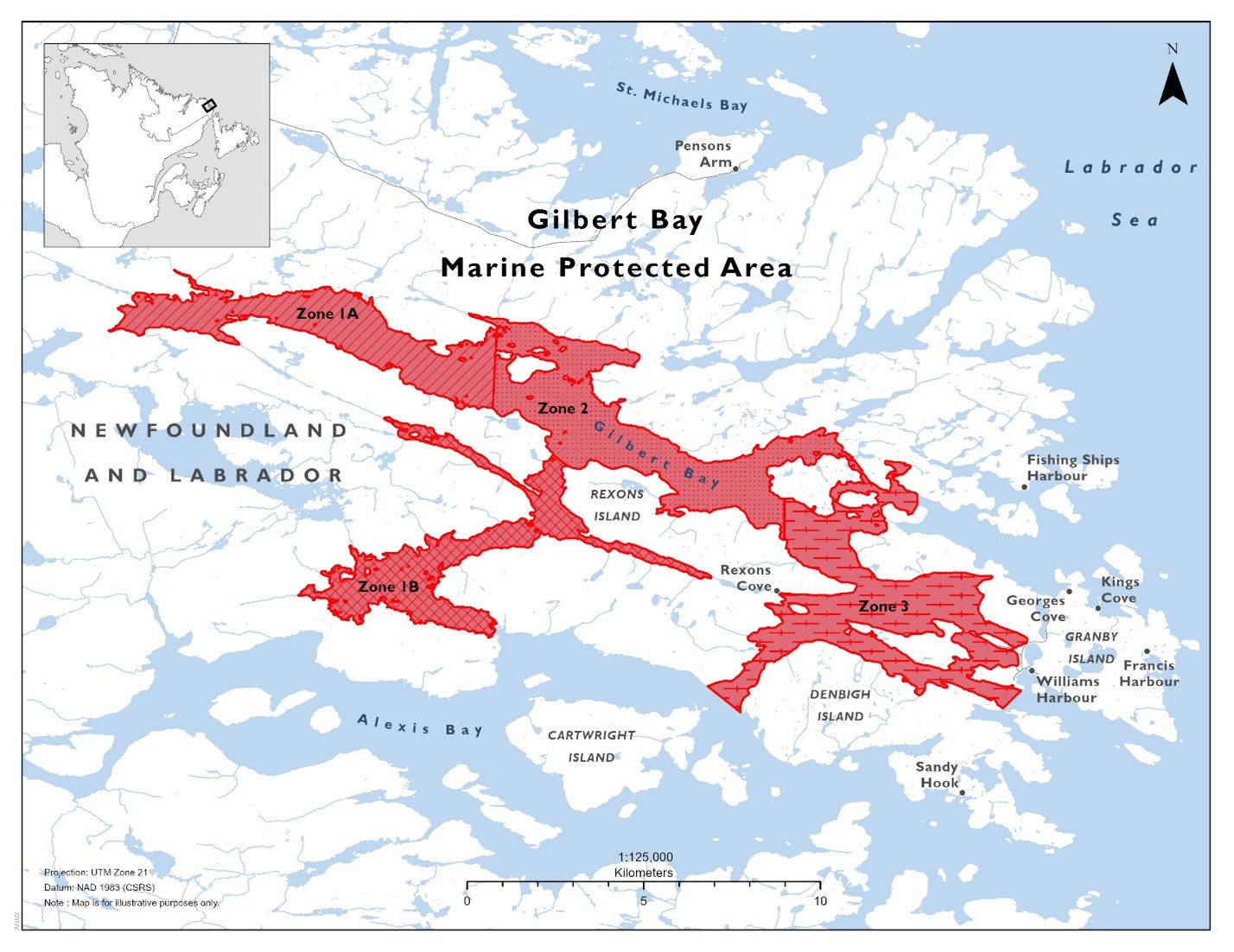
Map of Gilbert Bay Marine Protected Area.
Date of designation:
2005
Size:
62.4 km2
Contribution towards the marine conservation targets:
< 0.01%
Location:
This MPA is located on the southeast coast of Labrador, within the Newfoundland and Labrador (NL) Shelves Bioregion; Atlantic Ocean.
Managed by:
Fisheries and Oceans Canada (DFO), currently working towards co-management with the NunatuKavut Community Council (NCC)
Zones:
There are 3 management zones:
- Zone 1 (28.7 km2) – Contains 2 shallow areas in the upper reaches of the bay (1a and 1b). These are critical areas for cod and for migrating salmon, char and trout and they house pristine maerl beds
- Zone 2 (11.9 km2) – A smaller but important area that cod use for spawning, feeding and migrating between the outer part of the bay in the summer and the inner part in the fall
- Zone 3 (19.5 km2) - The area from the coastal low water mark seaward to where Gilbert Bay meets the Labrador Sea. It is an important feeding area for mature cod and diversity of fin fish species is highest in this zone
Conservation objectives
- Conservation and protection of the Gilbert Bay cod and its habitats.
- Conservation and protection of the Gilbert Bay ecosystem.
- Facilitation of scientific research opportunities in the Gilbert Bay ecosystem.
- Promotion of public awareness, education and support of the Gilbert Bay MPA.
Management and governance
The Gilbert Bay MPA has completed 2 management plan cycles and a third is underway. Management plans have included a strong science-based direction. The first management plan primarily identified goals and the rational for the MPA while the second management plan highlighted some challenges. The third and current management plan delves into co-management and the need for adaptive management changes. The current 3-year management cycle (2023 to 2026) provides the Advisory Committee the ability to adapt to a dynamic environment and to address management concerns in the short-term.
The Advisory Committee was previously represented by communities adjacent to the MPA, but it recently changed to include the NCC as members and co-chair of the Committee. The NCC has taken a greater role in the management of the Gilbert Bay MPA on behalf of its members and this change supports greater inclusion of local knowledge in management decisions. The NCC and DFO co-chair the Advisory Committee and are continuing to move toward co-management of the MPA over the term of this third management cycle. The Advisory Committee did not meet in 2024, as a planned meeting was deferred to 2025.
The NCC continues to receive funding through the Oceans Management Contribution Program to work towards the conservation objectives of the Gilbert Bay cod. The objectives of this project, to be carried out from 2023 to 2026, will focus on monitoring and stewardship of the MPA and capacity building to enhance NCC’s capacity to participate effectively as a partner with DFO in the management of Gilbert Bay MPA.
In 2024, there was one activity plan that was submitted, approved and carried out. This yearly Gilbert Bay MPA monitoring program is a continuation of the longest ongoing Oceans Act MPA science monitoring program in Canada and includes activities such as:
- tagging
- mark-recapture
- acoustic telemetry
- plankton sampling
Ongoing collaborative research activities were also included in the plan, which focused on Greenland cod, sculpin and Striped Bass.
Feature creatures
Gilbert Bay cod, also called ‘golden cod’ due to its distinctive ‘golden’ color, is technically an Atlantic cod. Their unique color is a result of a diet high in shrimp and crab. It is the most genetically distinct cod population in Canada and the most genetically divergent population in the Northwest Atlantic, warranting special protections. Unlike Atlantic cod, Gilbert Bay cod:
- are non-migratory
- have adapted to colder waters
- tolerate environmental fluctuations like salinity
- spawn later in the summer
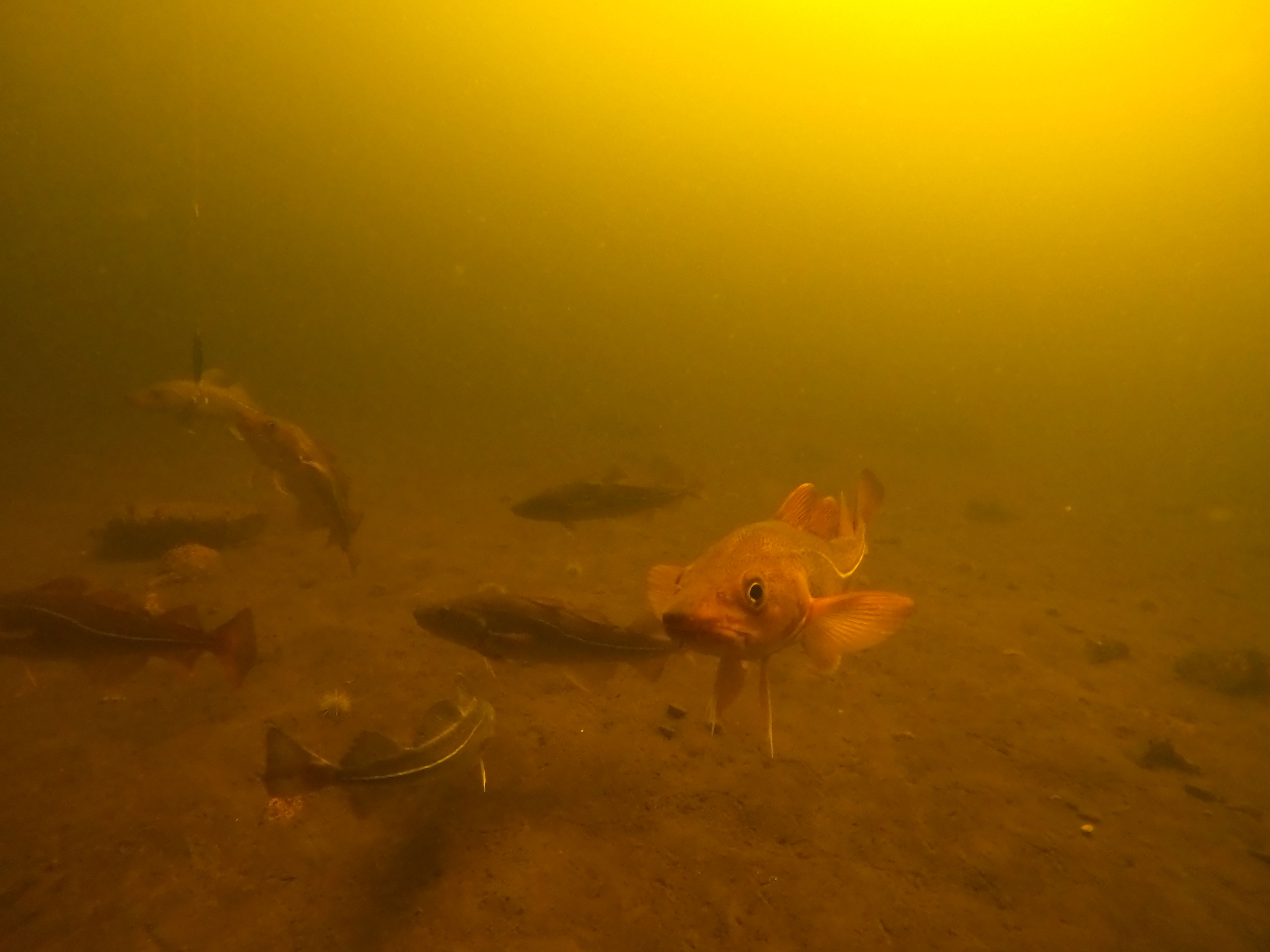
The Gilbert Bay ‘golden’ cod. Photo Credit NCC.
Research and monitoring
In 2024, the ecological science monitoring program that has been ongoing since 1998 continued. The program activities are directly related to the conservation objectives of the MPA and include monitoring of fish movement, abundance, reproduction and environmental conditions. There is a strong collaboration between DFO and the NCC for field work, planning and reporting which feeds into management advice.
The most important new finding from research conducted in 2024 is evidence of climate change impacting Gilbert Bay cod reproductive success, which poses a threat to the MPA. In 2024, winter conditions in Labrador resulted in a significant change in spring freshet (annual high-water event on rivers resulting from snow and river ice melting), which plays an important role in Gilbert Bay cod reproduction. A sufficient volume of freshwater input is needed during the spawning season to retain and protect Gilbert Bay cod eggs in the water column at overwintering and spawning locations. In 2024, this volume of fresh water was not produced because Labrador experienced an extremely warm winter, low snow-pack accumulation and low spring runoff conditions. This resulted in a low abundance of cod eggs and low abundance of juveniles produced.
Dr. Corey Morris, who leads the ecological science monitoring program in Gilbert Bay MPA, has been involved with several recent scientific publications in 2024. Of particular note are:
- Green et al. (2024) examined the unique adaptations of Gilbert Bay cod to its exceptionally cold environment. This paper received an editor’s choice award.
- King et al. (2024) compared the movement of Gilbert Bay cod, Atlantic cod and Greenland cod in Gilbert Bay based on telemetry tracking. It also received an editor’s choice award.
Information gaps include changes to the northern cod fishery and the impact of Indigenous community resettlements on fisheries adjacent to the MPA, which are not well known. Local knowledge could help to address this important information gap.
Collaboration and partnerships
The MPA’s Advisory Committee is co-chaired by NCC and DFO and it is collaborative and community based. It ensures that the interests of all users are considered. Collaborations with NCC and the Aboriginal Fishery Guardians program consistently offer support through coordination and involvement in the summer and fall scientific monitoring initiatives.
As a step further, NCC and DFO are continuing the work towards formalizing co-management of the Gilbert Bay MPA over the period of this management cycle. Under this strategic partnership, management strategies and actions have been identified to help ensure that MPA conservation objectives are achieved. The regulatory conservation objectives will remain the responsibility of DFO, while the non-regulatory conservation objectives will be pursued by community partnerships initiated by NCC and the Advisory Committee with support from DFO as appropriate. By working together, DFO and NCC, with support from the Committee, can continue to explore opportunities to help protect Gilbert Bay cod and its ecosystem, while supporting benefits to local residents.
In addition, an ongoing partnership with scientists from Memorial University, led by Dr. John Green, first began in 1996 to study the Gilbert Bay cod. By 1998, a collaborative monitoring program was established by MUN and DFO with assistance from NCC. DFO Science and NCC continue to regularly work together to carry out the Gilbert Bay MPA ecological science monitoring program.
In the spotlight: benefits
Ecological
The Gilbert Bay MPA provides long-term protection of the Gilbert Bay cod and its habitats. Gilbert Bay cod are a unique resident population of Atlantic cod, characterized by significant differences in the genetics, behavior and physiology compared to other northern cod populations. The Gilbert Bay MPA also protects a variety of marine organisms and plants and a wide range of other marine species including:
- shellfish
- demersal fish
- pelagic fish
- waterfowl
- marine mammals
Socio-cultural
The preservation of Gilbert Bay and Golden cod is very important to the people of NunatuKavut. The NCC has been involved with the MPA since its beginning. The MPA’s objectives are directly intertwined with the NCC’s goals and areas of focus around ice, sea and land. There are many opportunities for education and to incorporate local knowledge (that is, resettlement of Williams harbour and its effect on fisheries and also in gathering information about the northern cod fishery). Building Indigenous capacity is crucial to MPA management and has improved the integration of Indigenous Traditional Knowledge into Fisheries Management Strategies.
Economic
The Gilbert Bay MPA provides economic benefits for the nearby communities. Local harvesters are compensated for monitoring and research projects, like the cod pot pilot program. NCC supports MPA regulations through the Aboriginal Fisheries Guardian Program, employing several guardians. The NCC are building a research-lodge in Williams Harbour, which can be used for training, education and research.
Surveillance and enforcement
DFO Conservation and Protection (C&P) officers and NunatuKavut Aboriginal Fishery Guardians conduct surveillance and enforcement patrols by boat, snowmobile and aircraft. They are occasionally assisted by provincial conservation officers. Since 2007, DFO has been working to include extra patrols within the MPA.
Regular patrols are conducted via program vessel and during winter months via snowmobile when ice conditions allow. When available, the Mid Shore Patrol Vessel and air surveillance platforms also add to patrol time in the MPA. Joint patrols with other local enforcement groups including the NCC Indigenous Fishery Guardians is always encouraged. In 2024, a total of 28 sites were checked. C&P dedicated:
- 82 Fishery Officer patrol hours
- 30 snowmobile hours
- 5 program vessel hours
- 18 MSPV hours
In 2024, there were no violations detected in the MPA during the regular patrols which is likely a result of the increased patrols and monitoring activity of DFO and other agencies such as the NCC Indigenous Fishery Guardians. Fishery Officers strongly believe that this dedicated presence has deterred illegal activity in the MPA. It is common knowledge that Fishery Officers are regularly patrolling the area and this presence continues to be favorably received by most local residents.
Outreach and engagement
For the first time in many years, new promotional materials were created, such as temporary tattoos and stickers featuring MPA-specific species like the golden cod. The Marine Conservation Team also sent activity packages to the NCC for distribution to school-age children in Labrador. These packages included marine conservation-themed activity sheets, puzzles and coloring books. Additionally, 5 “golden cod tickets” were randomly placed in the activity packages, offering small prizes such as:
- t-shirts
- waterproof notebooks
- reusable gloves
- eco-friendly dishcloths
- stickers
- temporary tattoos
In 2024, Oceans Day activities spanned Newfoundland and Labrador. NCC hosted World Oceans Day events in a few communities and coordinated with schools for activities. In St. John’s, the Marine Institute hosted a variety of events, including a DFO-led booth that highlighted conservation areas in the province and addressed public questions. Approximately 2000 people attended this event!
In September 2024, NCC presented on Gilbert Bay MPA at the Environmental Studies Research Fund workshop in Membertou, NS and at their Environmental and Natural Resources Workshop. Dr. Corey Morris (DFO) also presented at the NCC Workshop and his presentation focused on Gilbert Bay cod and observations of climate change impacts.
Related link
- Date modified: