
Anguniaqvia Niqiqyuam Marine Protected Area (MPA) annual report 2024
On this page
At-a-glance
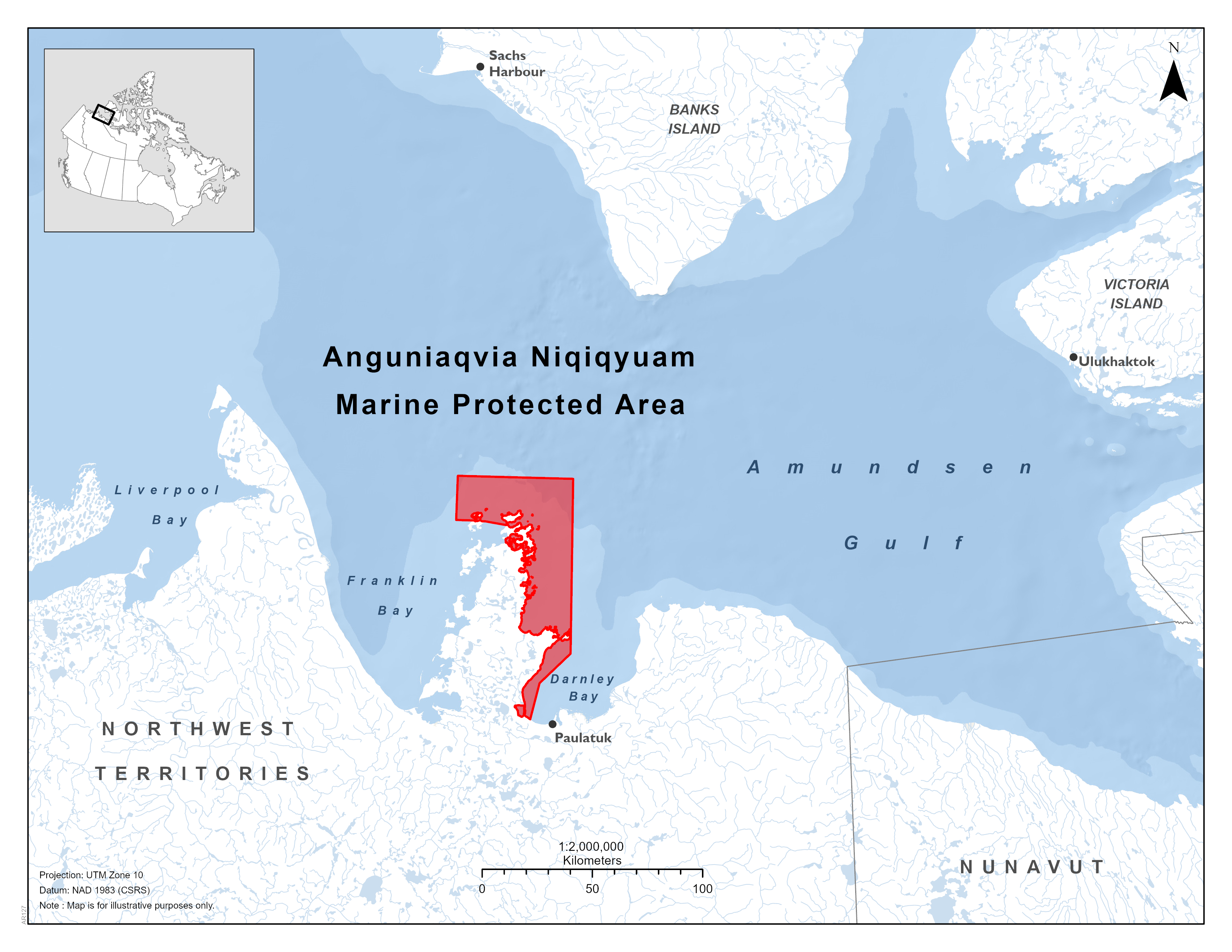
Map of Anguniaqvia Niqiqyuam Marine Protected Area.
Date of designation:
October 28, 2016
Size:
2358 km2
Contribution towards the marine conservation targets:
0.04%
Location:
This MPA is located in Darnley Bay, near the community of Paulatuk, Northwest Territories, which is in the Inuvialuit Settlement Region (ISR). The MPA is within the Western Arctic Bioregion; Arctic Ocean.
Co-managed by:
The MPA is co-managed by:
- Paulatuk Hunters and Trappers Committee (PHTC)
- Fisheries Joint Management Committee (FJMC)
- Inuvialuit Game Council (IGC)
- Inuvialuit Regional Corporation (IRC)
- Fisheries and Oceans Canada (DFO)
Acknowledgement:
The MPA is within the ISR and is co-managed and co-governed by the Inuvialuit and DFO. The PHTC plays an important role in this co-managed space.
Zones:
There are 2 zones in the MPA:
- Zone 1 - in Darnley Bay and Amundsen Gulf in the Beaufort Sea
- Zone 2 - in Kendall Inlet in Amundsen Gulf in the Beaufort Sea
Conservation objectives
- Maintain the integrity of the marine environment offshore of the Cape Parry Migratory Bird Sanctuary, ensuring that it is productive and allows for higher trophic level feeding.
- Maintain the habitat to support the population of key species (such as beluga whales, Arctic char and ringed and bearded seals).
The latter is the first conservation objective of an Oceans Act MPA to be based solely on Indigenous traditional and local knowledge.
Management and governance
The management and governance of this MPA is led by the AN MPA Working Group and the Western Arctic MPA (WAMPA) Steering Committee.
Anguniaqvia Niqiqyuam MPA Working Group:
- PHTC
- DFO Marine Planning and Conservation
- FJMC
WAMPA Steering Committee:
- DFO Marine Planning and Conservation
- DFO Fisheries Management
- DFO Science
- IGC
- IRC
- FJMC
- TN MPA Working Group Chair
- AN MPA Working Group Chair
A management plan for AN MPA is being developed to guide the day-to-day activities in the area, including management and governance, monitoring and reporting. The plan will describe management goals and principles, enforcement and compliance initiatives and both regulatory and non-regulatory measures. The plan addresses conservation priorities and needs identified by the community of Paulatuk and other co-management bodies.
Management related decisions are shared by the PHTC, WAMPA and the AN MPA Working Group. Governance of AN MPA includes equal representation between the Inuvialuit and DFO. In 2024, WAMPA met 3 times and the AN MPA Working Group met 4 times.
Scientific research, monitoring, educational or commercial marine tourism activities can occur in the AN MPA with DFO Ministerial approval following the submission of an activity plan. In 2024, DFO received 11 activity plans for research in the area.
The year (2024 to 2025) marks the fourth year of a 5-year contribution agreement with the Inuvialuit Joint Secretariat. This agreement supports the 2 Western Arctic MPAs (Tarium Niryutait and Anguniaqvia Niqiqyuam) for:
- governance
- administration
- research
- monitoring
- outreach
- database development
Two working groups were established under the agreement.
- The Governance Indicator Working Group aims to recommend governance indicators for future AN MPA's management and monitoring plans.
- The Database Working Group is exploring options for centralizing data, which is currently scattered among principal investigators. This fragmentation makes it difficult to assess MPA management effectiveness.
To support data sharing and respect ownership, co-management partners are working to co-develop and sign a Memorandum of Understanding. Once finalized, the Database Working Group will begin gathering data into a centralized system.
Feature creatures
The beluga whale (qilalugaq) was a focal species in 2024, with community-led research in the AN MPA uncovering signs of stress and changing health patterns through blubber and hormone analysis-vital work that supports long-term monitoring and helps define critical beluga habitat near Paulatuk, guided by Indigenous knowledge and local observations.
Research and monitoring
The 2024 season in the AN MPA was productive, with 9 projects focused on:
- conservation science
- local training
- Indigenous knowledge
Activities aligned with the MPA's conservation objectives, even as the formal monitoring plan is still in progress. The annual regional report, produced by the MPA Secretariat and AN MPA Working Group, provides a comprehensive overview of these initiatives. Below are brief summaries of the 2024 projects.
Key research included the Canadian Beaufort Sea Marine Ecosystem Assessment, which is ongoing since 2012. This ship-based program sampled seawater, plankton, fish and used hydroacoustics to estimate biomass. Key outputs included:
- a journal manuscript
- 2 DFO data reports
- a story map, which can be found in the 2024 Field Expedition
Indigenous employment was fostered with Kaleb Lucas and Nicholas Alonak contributing to science operations. This research enhances understanding of ocean conditions and forage resources, supporting long-term monitoring goals.
The Paulatuk Beluga Health project, in partnership with PHTC and DFO, investigated reports of ‘skinny whales' in southern Darnley Bay. Findings showed that unhealthy belugas had lower blubber thickness and higher cortisol levels compared to those further north. This project builds community capacity to monitor and track beluga health.
The Arctic Coast program, a community-led initiative, monitored fish, invertebrates and habitats in Argo Bay, Bennett Point and Brown's Harbour. Nine technicians collected data on biodiversity, habitat and diet.
The Paulatuk Drone Project, a collaboration between PHTC and DFO, explored beluga activity and mapped coastal areas. Drone technicians and youth were trained and interviews were conducted with knowledge holders to document beluga habitat use. The findings will help define and protect beluga habitat within the AN MPA. Other key activities included:
- seal diet and health monitoring
- marine mammal and ship acoustic monitoring
- migration data on thick-billed murres
Key publications from 2024 that addressed the MPA's conservation objectives by enhancing understanding of species behavior as well as shipping impacts, included:
- AN MPA Coastal Monitoring: Synthesis of 2017-2021, which provides insights into ecosystem health and sustainable management
- Not all maps are equal: Evaluating approaches for mapping vessel collision risk to large baleen whales (Hague et al., 2024)
- Characterization of the ringed seal acoustic repertoire (Barbosa et al., 2024)
- Opportunistic ship source level measurements (Shajahan et al., 2024),
- The Arctic marine soundscape of the Amundsen Gulf (Dingwall et al., 2024)
- Exposure of satellite-tagged bowhead whales to transiting vessels (Martin et al., 2024)
The Cape Parry Murres Survey, conducted aboard the F/V Frosti, monitored seabird populations along the cliffs of East Point to Devon Point. High-resolution photos were taken, including Horned Puffins, an unusual sighting. This contributes to long-term seabird population monitoring.
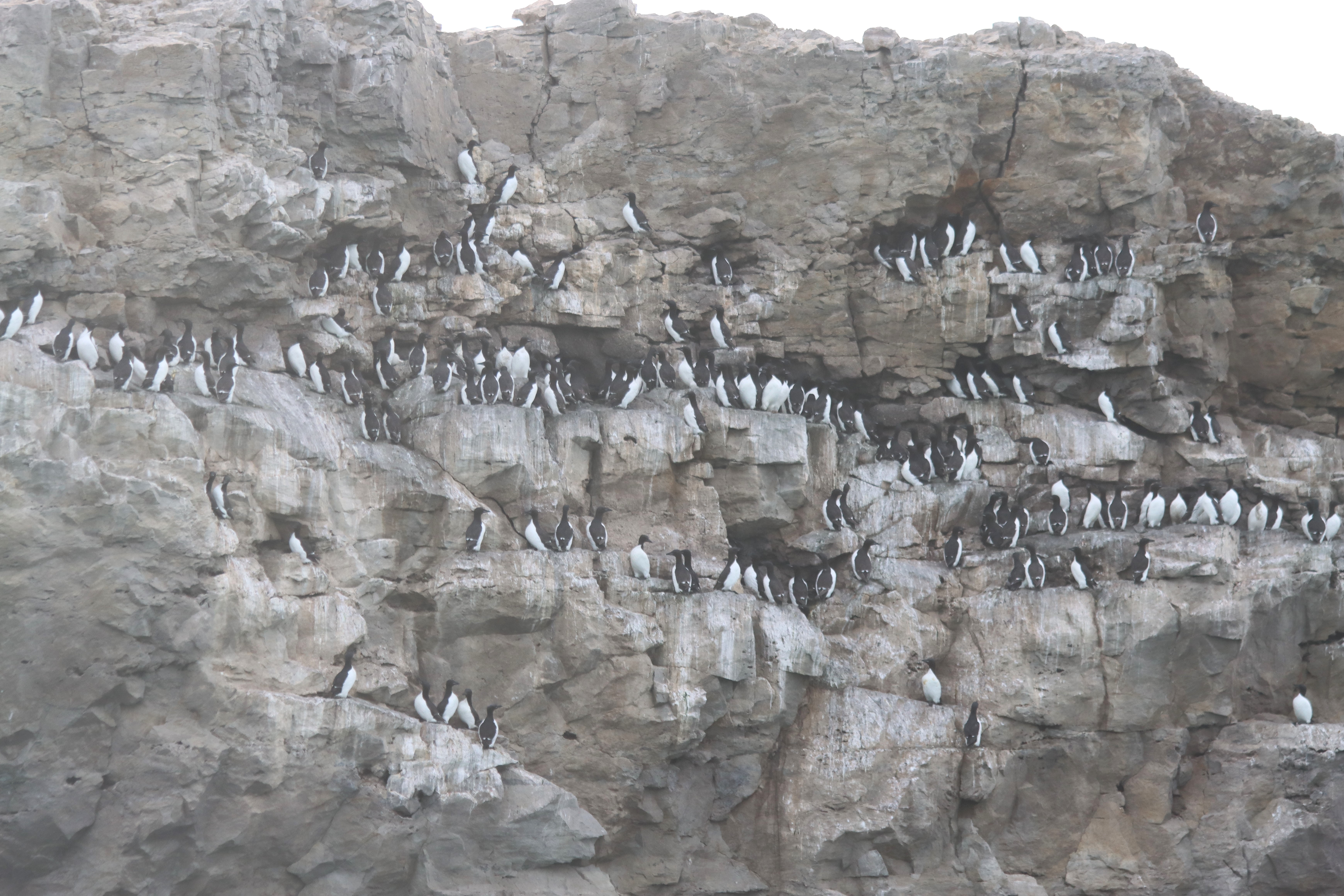
Hundreds of Thick-billed Murres crowd the cliffs at Cape Parry Bird Migratory Bird Sanctuary, within the Anguniaqvia Niqiqyuam Marine Protected Area. Photo credit: Danica Hogan.
The DFO-supported community-based monitoring of Arctic char contributed to the Paulatuk Char Management Plan. A key finding was the recapture of a tagged Dolly Varden, providing evidence of their migration patterns. This work contributes to the 34-year Hornaday Arctic Char Monitoring Program.
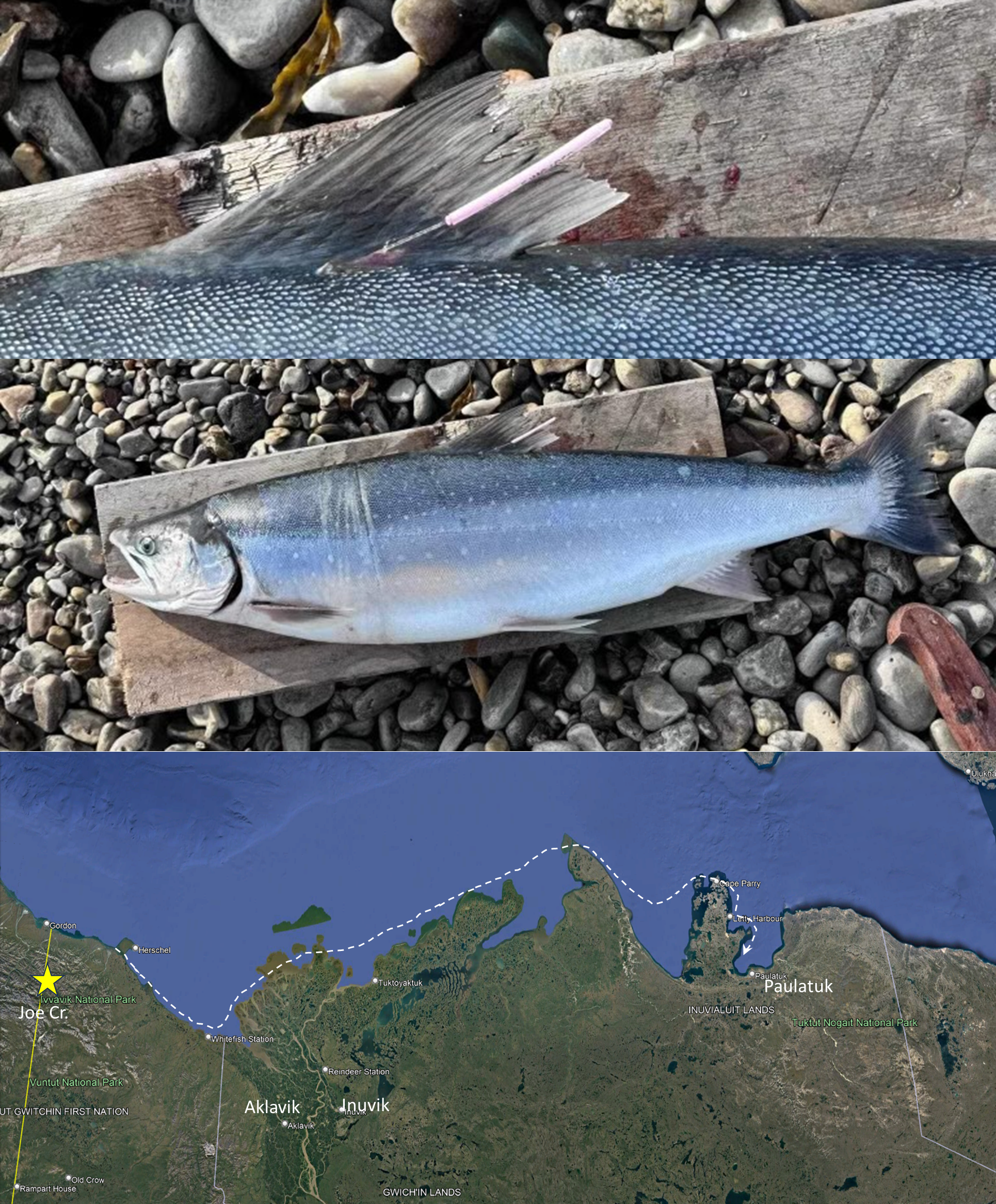
Tagged Dolly Varden in Joe Creek, Alaska, on September 23, 2023, which traveled 750 km to Darnley Bay, providing new evidence of their presence there. Photo credit: Colin Gallagher.
The Coastal Geoscience project by Natural Resources Canada and Paulatuk assessed coastal erosion risks. New data was gathered on coastal vulnerability, providing insight into climate change impacts and risks to ecosystems and community infrastructure.
The Bathymetry and Habitat Mapping Project aimed to map seabed habitats using sonar and cameras. It has mapped 35% of the AN MPA's seabed, contributing to the understanding of habitat protection. Community involvement was central, with PHTC leading boat-based surveys.
The AN MPA Working Group worked on a case study for the Arctic Council's Protection of the Arctic Marine Environment initiative, focusing on integrating Indigenous perspectives in conservation. The case study highlights the importance of Indigenous knowledge in conservation and will be shared internationally.
Collaboration and partnerships
Activities in the AN MPA are done in close partnership with the Inuvialuit. All projects are co-developed with the PHTC and reviewed by the AN MPA Working Group, ensuring community values guide research projects.
In 2024, collaboration with local monitors, youth and Indigenous knowledge holders was key to the success of initiatives like the Paulatuk Beluga Health Project, Paulatuk Drone Project and Arctic Coast Project. These projects employed locals, supported community-based data collection and provided training in scientific and tech methods like drone operation and biological sampling. Partnerships with organizations like Wildlife Conservation Society Canada, Natural Resources Canada and Northumbria University further strengthened the research, combining traditional knowledge with modern science. The Canadian Beaufort Sea Marine Ecosystem Assessment (CBS-MEA) and the Cape Parry Murres Survey contributed valuable insights into marine ecosystems, beluga behavior and seabird populations. Indigenous knowledge was integral throughout, guiding research design and implementation. This approach was highlighted through the AN MPA Working Group's participation in the Arctic Council's Different Ways of Knowing initiative, showcasing Indigenous perspectives globally. These efforts reflect a collaborative approach to Arctic marine conservation, recognizing the critical role of Indigenous partners in shaping the future of the AN MPA.
In the spotlight: benefits
Ecological
In 2024, the AN MPA supported key ecological functions by advancing research on beluga health, seabird populations and coastal habitats. Habitat mapping and ecosystem assessments deepened understanding of marine biodiversity, while drone and acoustic monitoring informed species protection. These efforts, guided by Indigenous knowledge and co-management, help sustain vital Arctic ecosystems amid growing climate and human pressures.
Socio-cultural
The AN MPA offers significant socio-cultural benefits to the local Inuvialuit community by supporting traditional practices and promoting sustainability. It was created to help maintain the subsistence harvesting of vital marine species, such as Arctic Char, Beluga Whales and migratory birds, all of which hold deep cultural and economic importance for the Inuvialuit people. Through established co-management and co-governance processes, the MPA acknowledges and upholds the Inuvialuit's long-standing connection to the marine environment and their traditional harvesting practices. Additionally, the MPA protects other culturally and historically significant sites, including the Cape Parry Migratory Bird Sanctuary.
In 2024, the PHTC hosted an on-the-land Stewardship and outreach program within the AN MPA for local youth. This initiative aimed to raise awareness about the MPA's importance and promote environmental stewardship, fostering a deeper understanding of the area's cultural and ecological significance among the next generation.
Economic
The AN MPA is managed through a true co-management approach that encourages strong community partnerships and sharing of knowledge and resources. It also supports local employment. In 2024, 19 short-term jobs were created through MPA research and monitoring projects. Community-based monitoring plays a key role in this. The AN MPA Working Group also reviews all project proposals to ensure budgets reflect the rising costs of living and working in Paulatuk and the region.
Surveillance and enforcement
As the lead federal authority for the AN MPA, DFO has the overall responsibility for ensuring compliance with and enforcement of, the MPA Regulations. This is undertaken through the Department's enforcement responsibilities under the Oceans Act and Fisheries Act, as well as other departmental legislation regarding:
- fisheries conservation
- environmental protection
- habitat protection
- marine safety
DFO's Conservation and Protection (C&P), with support from the Canadian Coast Guard (CCG), manage compliance and enforcement within the AN MPA, to uphold the MPA Regulations. C&P has 3 pillars that support effective MPA Compliance and Enforcement:
- education and shared stewardship
- monitoring and surveillance
- Major Case management and investigations
In the AN MPA, the first pillar rests on a foundation of:
- community awareness
- consensus around the MPA's Conservation Objectives
- co-management goals
- monitoring strategies
Successful enforcement aims for full voluntary compliance with the rules through education and shared stewardship activities. In 2024, education played a key role, with initiatives like Arctic Oceans Day raising awareness and the Observe, Record, and Report (ORR) Hotline enabling real-time community reporting. Promoting compliance involved continued community outreach and local stewardship efforts. In 2024, there was no DFO sponsored guardianship programs in the ISR, however possibilities for a locally-led guardianship initiative in Paulatuk were explored.
C&P's last 2 pillars address an enforcement regime aimed at managing users, through many platforms. In 2024, aerial surveillance of the AN MPA was conducted 2 times during different months by C&P. C&P also conducted randomized vessel patrols during the open water season and more targeted patrols based on:
- public reports
- partnerships with other federal and local organizations
- data from a federally monitored geofence
The legislated boundaries of the AN MPA are monitored via geofences put into place by Marine Security Operations Centres (MSOCs), an integrated multi-agency collaboration consisting of the:
- Department of National Defense
- Royal Canadian Mounted Police
- Canada Border Service Agency
- Transport Canada
- CCG
- DFO
The CCG provides the majority of maritime vessel traffic information, including data from:
- vessel Automatic Identification System (AIS)
- Long Range Identification and Tracking system (LRIT)
- radar
- CCG's other vessel traffic management systems
Investigations and major case management are handled by C&P when individuals, corporations and ships contravene the Oceans Act MPA regulations and are suspected of non-compliance. Those that contravene the AN MPA Regulations may be liable to a fine as specified in section 39.6 of the Act and also may be subject to requirements specified under other applicable Federal legislation. In 2024, no criminal convictions were reported in the AN MPA, but potential violations were identified through AIS analysis and community reports.
Outreach and engagement
Outreach activities at the Beluga Cultural Camp in Paulatuk from August 14 to 28, 2024, were the highlight of the year. During this event, 14 youth took part in cultural immersion, through learning traditional skills like preparing fish and muktuk from camp host Ray Ruben. The camp also welcomed visitors, strengthening community ties. Additionally, Melannie Wolki, PHTC Resource Person, presented the PHTC Beluga Drone Project results at the ArcticNet Conference, raising awareness of MPA-supported research.
Related link
- Date modified: