
Banc-des-Américains Marine Protected Area (MPA) annual report 2024
On this page
At-a-glance
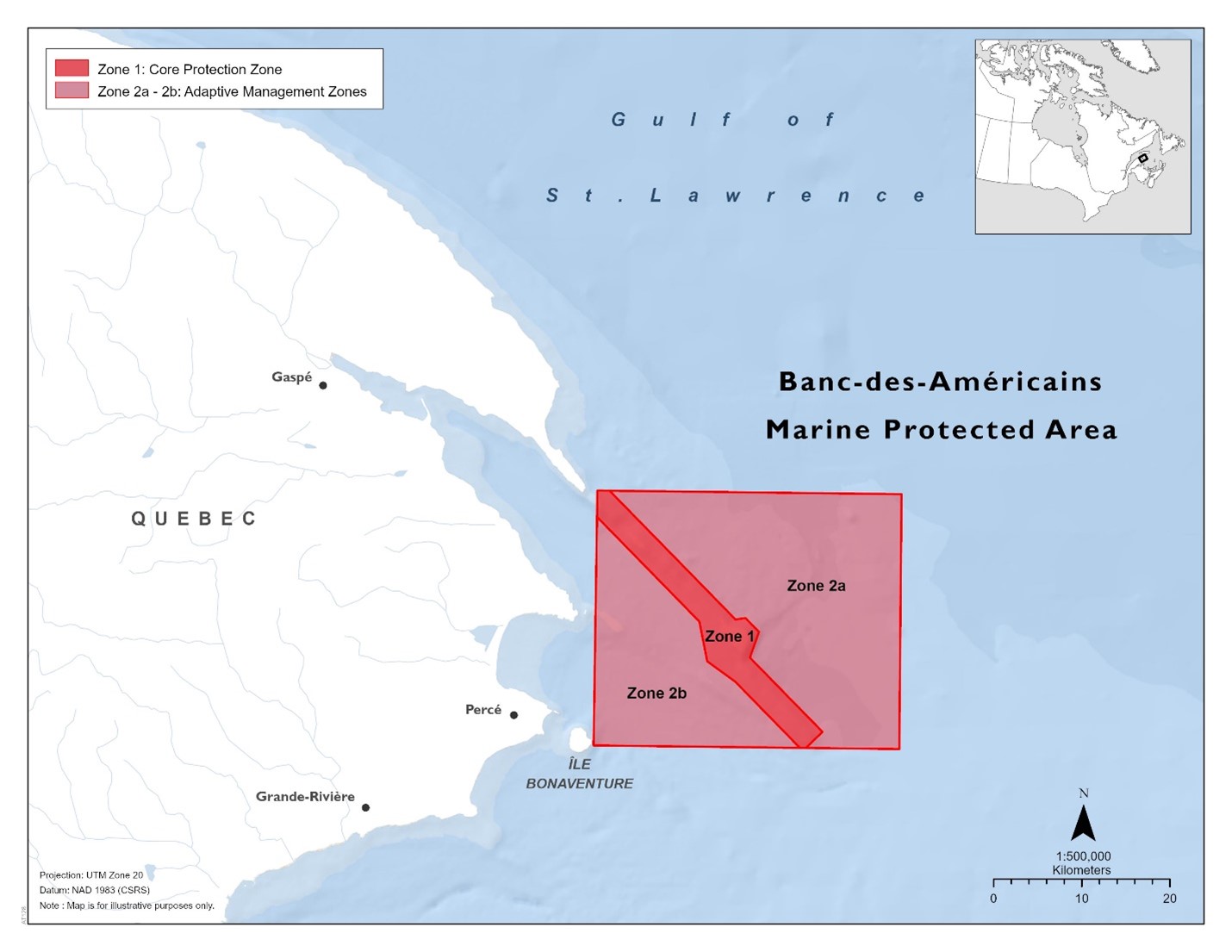
Map of Banc-des-Américains Marine Protected Area.
Date of designation:
2019
Size:
1,000 km2
Contribution towards the marine conservation targets:
0.02%
Location:
The Banc-des-Américains MPA is located to the east of the Gaspé Peninsula, within the Estuary and the Gulf of St. Lawrence bioregion; in the North Atlantic Ocean.
Co-managed by:
The MPA is jointly managed by Fisheries and Oceans Canada (DFO) and the Government of Quebec, including the following partners:
- Ministère de l’Environnement, de la Lutte contre les changements climatiques, de la Faune et des Parcs (MELCCFP)
- Ministère des Ressources naturelles et des Forêts (MRNF)
- Ministère de l’Agriculture, des Pêcheries et de l’Alimentation (MAPAQ)
Acknowledgement:
The MPA is located on Gespe'gewa'gi, the ancestral land of the Mi'gmaq First Nations. The First Nations involved are the Mi’gmaq of Gespeg, Gesgapegiag and Listuguj.
Zones:
There are 2 management zones:
- Zone 1 - The core protection zone
- Zones 2a and 2b - The adaptive management zone
Conservation objectives
- Conserve and protect benthic (seabed) habitats.
- Conserve and protect pelagic (water column) habitats and forage species (prey).
- Promote the recovery of at-risk whales and wolffish.
These objectives promote the productivity and diversity of fisheries resources and the recovery of species at risk.
Management and governance
This area is currently named the Banc-des-Américains Marine Protected Area (BdA MPA). The common name refers to the MPA that is co-managed with the Government of Quebec, where federal Oceans Act MPA and Quebec MPA protection statuses overlap.
This MPA is the first joint project under the Canada–Quebec Collaborative Agreement for the establishment of a Network of Marine Protected Areas in Quebec. A specific agreement, the Canada–Quebec joint project agreement regarding the BdA MPA, was also signed. Thus, this site benefits from a double status of protection, as a MPA under the Oceans Act and as a proposed aquatic reserve under Quebec's Natural Heritage Conservation Act.
The Canada-Quebec management committee met twice in 2024, as did the Advisory Committee, which includes local stakeholders and was set up in 2023.
Discussions are still underway with the 3 Mi'gmaq First Nations communities in the Gaspé region to find out how they would like to be involved in the management of the MPA.
In 2024, 8 new activity plans were submitted and approved by DFO, while 3 multi-year activity plans that had each been approved for 3 years were updated.
In 2024, work continued to develop the first management plan for the Banc-des-Américains MPA. The call for public comments on the draft MPA management plan closed on September 30, 2024. Publication of the first management plan for this MPA is pending.
Feature creatures
The Atlantic wolffish (Anarhichas lupus) is a large-bodied, bottom-dwelling fish and protected under the Species at Risk Act (SARA). In Canadian waters, it occurs from the northern Labrador Sea, through Atlantic Canada, south to the Gulf of Maine. Its population declined rapidly in the 1990s as it is commonly caught as bycatch in groundfish fisheries however, some signs of population recovery have been observed. In 2024, scientific divers counted more than spec Atlantic wolffish were counted in the MPA, on the shallowest part of the Banc-des-Américains ridge.

Atlantic wolffish. Photo credit: DFO/Maurice Lamontagne Institute MCT and divers teams.
Research and monitoring
Monitoring plan
DFO's ecological monitoring plan is currently being developed. An interim monitoring report in the form of a Science Response was published by the Canadian Science Advisory Secretariat in October 2024 and provides an update on the 14 priority ecological indicators.
Research activities
In 2024, more than 50 Atlantic wolffish and other species (that is, lobster, Atlantic cod, American pout) were observed during a scientific scuba-diving expedition to monitor wolffish and benthic habitats on the underwater ridge in the MPA. During this expedition, videos of the habitat and mobile species were captured using a baited camera and water samples were collected near the bottom for environmental DNA analysis. Several high-quality photos of wolffish and other benthic species were also captured. In addition, the analysis of images collected during the last year’s expedition (in 2023) to monitor epibenthic communities through imagery is underway.
In 2024, data from the 6 acoustic moorings deployed in the MPA in 2023 to monitor sharks and seals have been recovered and the receivers were redeployed.
DFO also conducts annual large-scale surveys, such as the ecosystem survey and the Southern Gulf of St. Lawrence (sGSL) snow crab survey, which cover the MPA area. These surveys contribute to the monitoring of commercial species (Atlantic halibut, Atlantic cod and snow crab). In 2024, 2 stations were visited in the MPA by the ecosystem survey and 8 stations by the snow crab survey. The stomach contents collected annually by the sGSL ecosystem survey have been fully analyzed (2020 to 2023) and those collected in 2024 will be analyzed in the near future.
The Viking buoy was deployed from May to October 2024 in the BdA MPA and it provides continuous data on the oceanographic environment, whales presence (passive acoustics) and underwater noise.
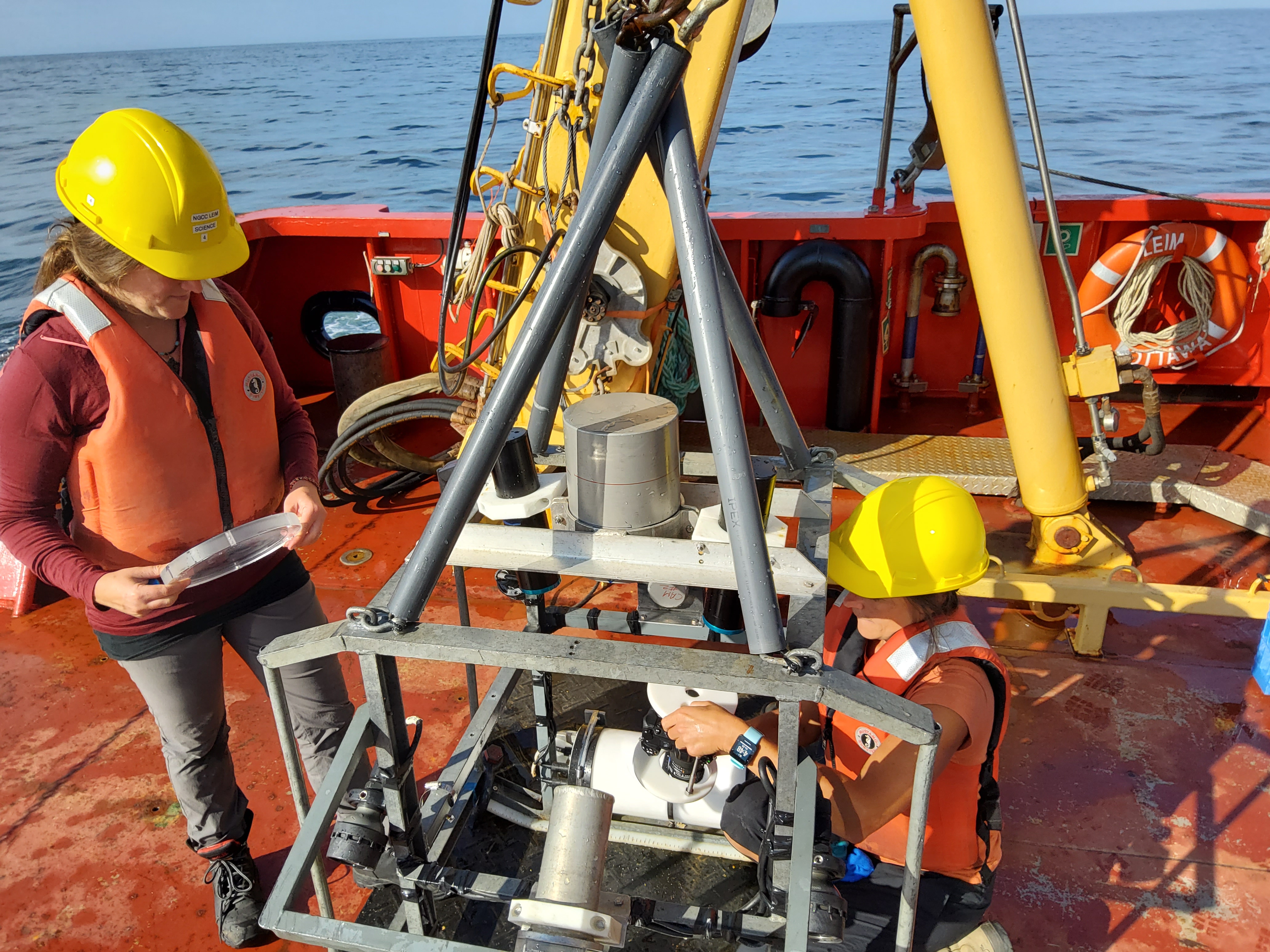
Benthic imagery survey. Photo credit: DFO/ Maurice Lamontagne Institute MCT team.
Collaboration and partnerships
In 2024, actions were carried out under 3 contribution agreements.
- Implementation of a pinniped abundance monitoring plan and a portrait of recreational boating activities in the BdA MPA, with the Mi'gmaq Wolastoqey Indigenous Fisheries Management Association.
The objectives are to produce a portrait of recreational boating activities and seal populations in the vicinity of the BdA MPA and to characterize plastic pollution and identify the presence of microplastics in the digestive systems of Atlantic cod. - Education and awareness activities with the Gaspésie ZIP committee.
- The first activity is the creation of a 4-part podcast on the MPA, financed in collaboration with the Quebec government.
- The second activity is a drawing contest aimed at a younger audience.
- The third activity aims to create an immersive event stimulating all the senses.
- Project to characterize at-sea observation activities and collect data in connection with marine conservation initiatives with the Marine Mammal Observation Network.
Activities include the development and distribution of a training program for cruise operators to use the tool online and offline, as well as the acquisition of smart tablets to enable cruise operators to collect at-sea observation data.
In the spotlight: benefits
Ecological
The specific biophysical formation of the Banc-des-Américains shelters a wide variety of benthic habitats and distinctive hydrodynamics in the area. By ensuring the protection of these benthic ecosystems through sound management of human activities, the MPA is supporting the preservation of key marine resources (for example, forage species). More specifically, the prohibition of bottom-contact fishing and anchoring on the seabed protects sensitive species and maintains the high rates of biodiversity found there.
Socio-cultural
Indigenous food, social and ceremonial fisheries may be permitted throughout the BdA MPA, which supports food security and the preservation of cultural heritage by First Nations communities in the area.
In 2024, research on social and human sciences helped to develop concepts and analytical methodologies to further integrate the consideration of social and human dimensions into DFO's management activities.
Economic
Through contribution agreements under the Oceans Management Program, funding was granted to a First Nations organization and 2 environmental non-profit organizations. The protection of marine ecosystems in the BdA MPA supports eco-tourism activities in the surrounding area, such as marine mammal-watching tours by cruise operators. In addition, the protection of the seabed in the MPA creates a favourable environment for commercially-valued species, such as snow crab and Atlantic halibut.
Surveillance and enforcement
In 2024, surveillance efforts in the BdA MPA continued to ensure compliance with the current regulations. No infractions, offences, prosecutions or convictions were recorded during the 2024 year, demonstrating a good level of compliance with the rules in place.
The Aerial and Sea Surveillance Team conducted 31 air patrols, totaling 65 flight hours and 31 sea patrols to monitor activities in the BdA MPA. These operations provided effective coverage of the area, supported by 41 hours of electronic surveillance via the Vessel Monitoring System.
In the field, DFO’s Conservation and Protection officers carried out 10 hours of land surveillance and 96 hours in zodiacs, enabling them to interact with users and reinforce vigilance over maritime activities. At the same time, 10 hours were devoted to outreach and engagement with fishermen and local communities to promote compliance and good practice.
Thanks to this approach combining active surveillance and prevention, the MPA remains a respected protected area, where collaboration with users plays a key role in preserving marine ecosystems.
Outreach and engagement
DFO and Quebec’s Department of Environment, the Fight Against Climate Change, Wildlife and Parks have funded various education and awareness-raising activities and tools with the Gaspésie ZIP committee for the BdA MPA. Four episodes of podcasts were produced on the following themes:
- general description of the MPA
- biodiversity and climate change
- winter adaptations
- Banc-des-Américains and First Nations
A drawing contest for young people and an immersive event in Gaspé called “Underwater for a Moment” featuring immersive artworks, discovery booths, a tasting of seafood bites and 2 lectures (held in October 2024).
The Canadian and Quebec governments were proud to mark the fifth anniversary of the creation of the BdA MPA. This milestone demonstrates the willingness of the 2 governments to work together to protect the rich biodiversity and aquatic ecosystems of this part of the Gulf of St. Lawrence. To mark the 5 years of protection, a number of activities took place during the week of October 7, 2024, including:
- information booths at the Maurice Lamontagne Institute and the DFO office in Quebec City
- a joint conference on the management and ecological monitoring of the MPA
- the immersive event mentioned above
Related links
- Date modified: