
Bay of Islands Salmon Migration Closure
Note:
Charts, diagrams and contact information on this website are provided for information purposes only and should not be used for fishing, navigation or other purposes. Please refer to the Notices to Mariners or contact your regional Fisheries and Oceans Canada office for official coordinates.
On this page:
At-a-glance
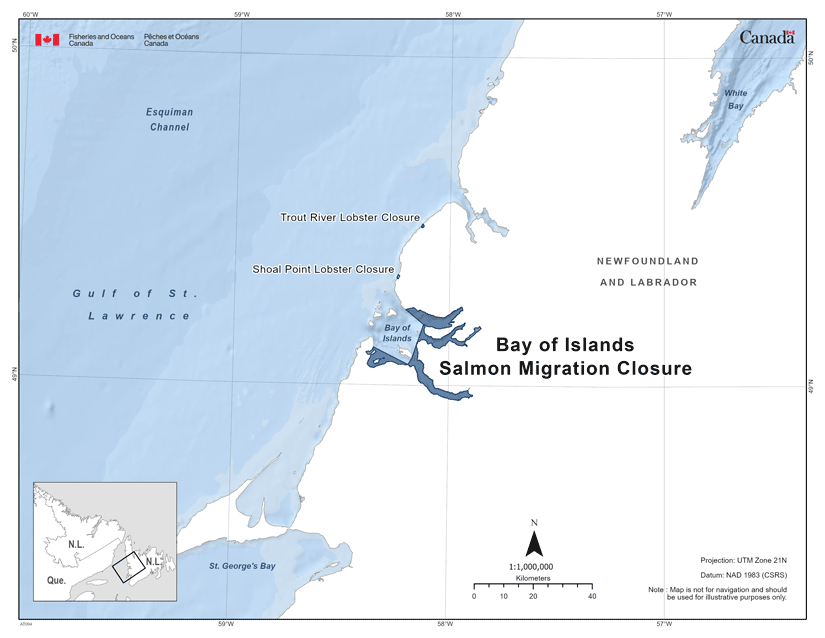
Bay of Islands Salmon Migration Closure
Location
Estuary and Gulf of St. Lawrence Bioregion (Newfoundland and Labrador)
Size (km2)
About 217 km2
% coverage contribution to Marine Conservation Targets
About 0.01%
Date of recognition
January 2018
Establishment mechanism
This Fisheries Act closure was implemented in 1981.
Biodiversity conservation benefits
Important species benefits
Atlantic salmon is an important recreationally fished species in Newfoundland and Labrador. The status of Atlantic salmon populations in the North Atlantic is of concern.
Important habitat benefits
This area is part of an important migration corridor for Atlantic salmon. Salmon migration habitat plays a key role in the salmon’s life cycle.
Prohibitions
The biodiversity conservation benefits are effectively conserved through the prohibition of all pelagic fixed gear fisheries.
OECM Protection Standard
All existing and foreseeable activities are assessed on a case-by-case basis to ensure that the risks they pose to the biodiversity conservation benefits are effectively avoided or mitigated. For more information please visit Other Effective Area-Based Conservation Measures (OECM) Protection Standard.
Ecosystem
This area is part of an important migration corridor for Atlantic salmon. This migration helps link productivity in marine and freshwater environments. Protecting this depleted species and its habitat helps to support this link and the other species which rely on these food.
This closure is managed under the Fisheries Act by prohibiting specific fishing activities.
Publications
The status of the Atlantic Salmon stock of Humber River/Bay of Islands, Newfoundland (Mullins and Reddin, 1994)
- Date modified: