
Northeast Newfoundland Slope Closure
Note:
Charts, diagrams and contact information on this website are provided for information purposes only and should not be used for fishing, navigation or other purposes. Please refer to the Notices to Mariners or contact your regional Fisheries and Oceans Canada office for official coordinates.
On this page
- At-a-glance
- Biodiversity conservation benefits
- Ecosystem
- Research and monitoring
- Activity application
- Publications
At-a-glance
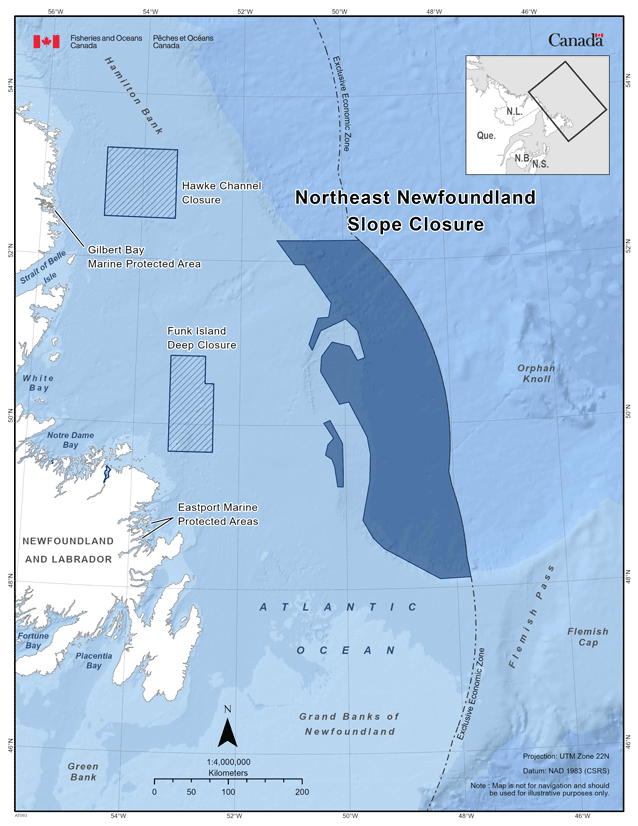
Northeast Newfoundland Slope Closure
Click map to enlarge.
Location
Newfoundland and Labrador Shelves Bioregion (Newfoundland and Labrador)
Size (km2)
About 55,353 km2
% coverage contribution to Marine Conservation Targets
About 0.96%
Date of recognition
January 2018
Establishment mechanism
Fisheries Act closure
Biodiversity conservation benefits
Important species benefits
Cold water corals and sponges play important roles in marine ecosystems, including cycling of organic matter and substrate stabilization. Corals and sponges are fragile, slow-growing organisms with long lifespans, which makes them vulnerable to disturbance.
Important habitat benefits
Cold water corals and sponges provide large- and small-scale habitats for other organisms in their environment. These complex three-dimensional structures provide other marine species, including fish species, with habitats for:
- feeding
- resting
- spawning
- predator avoidance
- nurseries for juveniles
Prohibitions
The biodiversity conservation benefits are effectively conserved through the prohibition of all bottom-contact fishing activities.
OECM Protection Standard
All existing and foreseeable activities are assessed on a case-by-case basis to ensure that the risks they pose to the biodiversity conservation benefits are effectively avoided or mitigated. For more information please visit Other Effective Area-Based Conservation Measures (OECM) Protection Standard.
Ecosystem
Corals and sponges play an important functional role for numerous forms of marine life. For many aquatic species they act as:
- spawning and breeding grounds
- nurseries
- refuges
The dense aggregations created by large, structure-forming cold-water corals can alter bottom currents and provide niche space for other organisms. Areas of high coral species diversity are positively correlated with areas of high fish species richness, density and diversity.
This area overlaps with 32% of the Orphan Spur, an Ecologically and Biologically Significant Area that supports high diversity, including several depleted species (for example, Roundnose Grenadier).
Prohibiting bottom-contact gear protects not only the corals and sponges but also a diversity of other species of fish and invertebrates that use the structural habitat that corals and sponges provide. This area can act as a refuge that may contribute to increased species productivity, which in turn, could potentially lead to increased abundance within and adjacent to the area.
Research and monitoring
DFO’s scientific monitoring approach for the Northeast Newfoundland Slope Closure is based on core and complementary monitoring, which are supplemented as needed by targeted research. Core monitoring uses a set of standardized, minimally invasive survey methods and protocols across all marine refuges in the Newfoundland and Labrador (NL) Region. Complementary monitoring leverages data collected for purposes other than monitoring marine refuges (for example, fish stock assessment surveys). Targeted research addresses methodological and ecological knowledge gaps relevant to marine refuges. Information will be collected over the long-term to assess the status and trends of species listed as biodiversity conservation benefits, as well as overall biodiversity. A formal monitoring plan for this area is currently under development.
Activity application
Activities proposed to occur within the Northeast Newfoundland Slope Closure are assessed on a case-by-case basis to determine compatibility with the biodiversity conservation benefits, and to ensure that any risks have been avoided or mitigated effectively.
Inquiries regarding potential activities within OECMs in the NL Region should be directed to DFO.MarineRefugesNL-RefugesmarinsTN.MPO@dfo-mpo.gc.ca
Publications
Applying ensemble ecosystem model projections to future-proof marine conservation planning in the Northwest Atlantic Ocean (Bryndum-Buchholz et al, 2023)
- Date modified: