
Davis Strait Marine Refuge
Note: Charts, diagrams and contact information on this website are provided for information purposes only and should not be used for fishing, navigation or other purposes. Please refer to the Notices to Mariners or contact your regional Fisheries and Oceans Canada office for official coordinates.
On this page
- At-a-glance
- Biodiversity conservation benefits
- Ecosystem
- Management and conservation
- Research and monitoring
- Activity application
- Outreach and engagement
- Contact us
- Related links
At-a-glance

Davis Strait Marine Refuge
Location
Eastern Arctic Bioregion (Nunavut)
Size (km²)
About 17,298 km²
Percent coverage contribution to Marine Conservation Targets
About 0.30 %
Date of recognition
December 2017
Establishment mechanism
The area is closed to all commercial fishing through variation order and license conditions under the Fisheries Act
Biodiversity conservation benefits
Important species benefits
- Cold-water corals (that is, small gorgonian corals, large gorgonian corals, sea pens)
- Sponges
Important habitat benefits

- Cold-water corals and sponges play an important functional role for numerous forms of marine life. They provide structural habitat for benthic species.
Prohibitions
The biodiversity conservation benefits are effectively conserved by prohibiting all commercial fishing activities.
Other Effective Area-Based Conservation Measures (OECM) Protection Standard
All existing and foreseeable activities are assessed on a case-by-case basis to ensure that the risks they pose to the biodiversity conservation benefits are effectively avoided or mitigated. For more information, please visit Other Effective Area-Based Conservation Measures (OECM) Protection Standard.
Ecosystem
The Davis Strait Marine Refuge is within the Hatton Basin, Labrador Sea, Davis Strait Ecologically and Biologically Significant Area.
The closure protects significant concentrations of:
- small gorgonian corals
- large gorgonian corals
- sea pens
- sponges
Conservation benefits are also conferred to benthic fish species and invertebrates, including those of commercial importance (for example, Greenland halibut, Northern shrimp). Many species use the structural benthic habitat for various purposes, including:
- spawning
- breeding
- nurseries
Prohibiting bottom-contact gear can protect not only the corals, sea pens and sponges but also diverse populations of other species of fish and invertebrates that use the habitat. This area can act as a natural refuge area that may contribute to increased species productivity, which in turn, could potentially lead to increased abundance within and adjacent to the area.
Management and conservation
A management plan is currently being drafted for the three Eastern Arctic Marine Refuges.
Research and monitoring
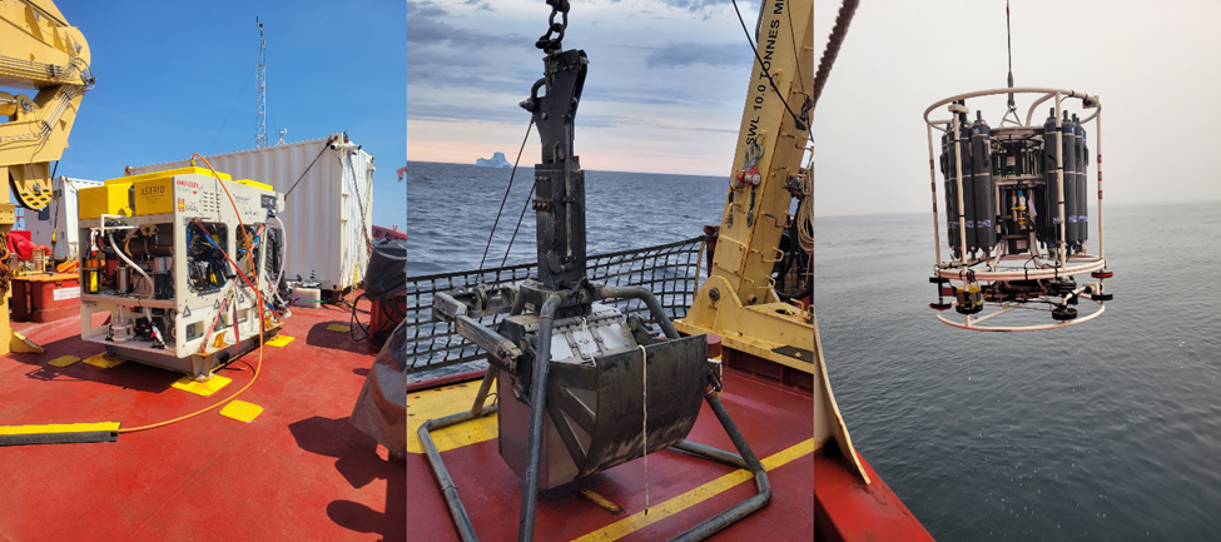
Survey tools used to study Marine Refuges and other sensitive benthic habitats in the Canadian Arctic
including Remotely Operated Vehicle (ROV) ASTRID abord the CCGS Amundsen (left), box core (middle)
and
CTD-Rosette for seawater sampling (right).
Photo credit: John O'brien.
In the Eastern Canadian Arctic Marine Refuges, we are using unintrusive survey tools such as Remotely Operated Vehicles (ROVs) and drop cameras (cameras connected to a cage and rope that take videos and sometimes include water column sensors or water sampling equipment) to collect samples and imagery of the seafloor to evaluate the diversity and abundance of corals and sponges in these areas. Analysis of water samples of the sea floor provide complementary information that helps us understand these habitats, from availability of calcium carbonate, which cold-water corals use to build skeletons, to general biodiversity in the area by analyzing the environmental DNA (eDNA) present.
Sediments collected using box cores allow us to evaluate the quantity, quality and sources of organic material that supply these deep-sea habitats along with the diversity of small, sediment-dwelling invertebrates that play important roles in carbon and nutrient cycling.
Research Spotlight
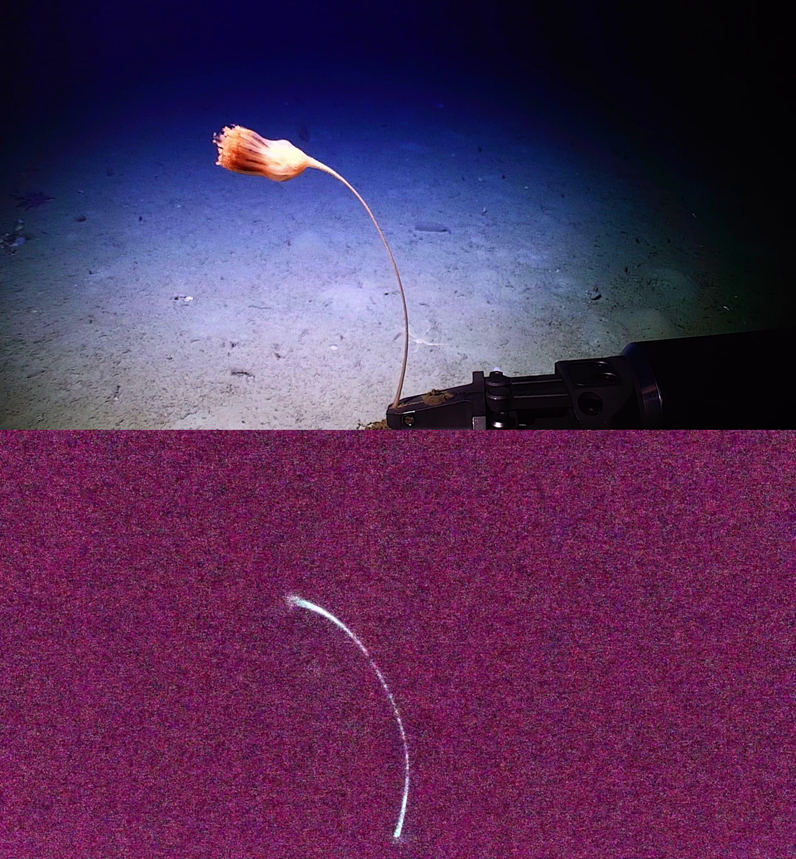
Bioluminescent sea pen, Umbellula, collected in Davis Strait Marine Refuge. Shown is the sea
pen in the ROV manipulator arm with the lights turned on (top) and off (bottom).
Photo credit: DFO-Arctic,
DFO-NL, Amundsen Science.
Have you heard of glowing corals? Many deep-sea fauna are capable of bioluminescence, like this sea pen, Umbellulu, collected during an ROV dive in Davis Strait in 2023. This specimen may represent a species not previously documented in the Canadian Arctic.
Activity application
Please email DFO.EAMarineRefuges-RefugesMarinsAE.MPO@dfo-mpo.gc.ca if you are interested in conducting research or monitoring in the Marine Refuges.
Outreach and engagement
Please refer to our educational worksheet and discussion questions that accompany The Arctic's Marine Refuges animated video:
- The Arctic's Marine Refuges - Discussion questions for teachers
- The Arctic's Marine Refuges - Worksheet
- The Arctic's Marine Refuges - Worksheet answer key
Contact us
EA Marine Refuges / Refuges Marins AE: DFO.EAMarineRefuges-RefugesMarinsAE.MPO@dfo-mpo.gc.ca
Related links
- Date modified: