
2026 Fisheries management measures to protect North Atlantic Right Whales in Canadian waters
March 26, 2026 - This Notice to Fish Harvesters provides information on the 2026 fisheries management measures to protect the North Atlantic Right Whale (NARW).
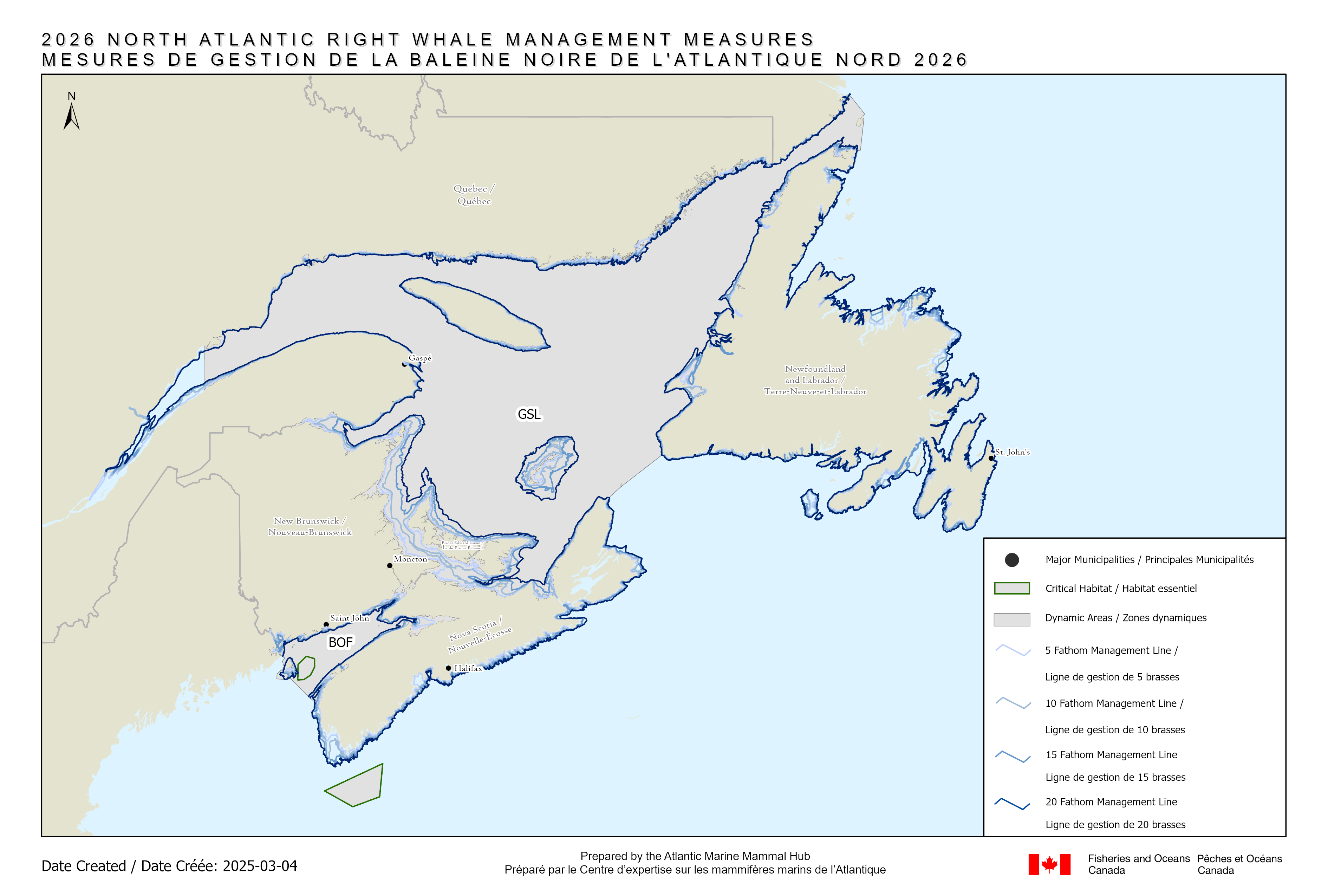
The management measures will take effect as soon as the Gulf of St. Lawrence snow crab fishery opens in Area 12. In other areas where fall/winter fisheries are in progress, measures apply if NARW are detected and where non-tended, fixed gear fisheries and trap/pot fisheries are operating.
The 2026 NARW management measures for shallow waters and waters deeper than the 20-fathom management line remain unchanged from 2025, including the shallow water whalesafe gear pilot. For more details on the shallow water protocol and pilot, please refer to annex 3.
New in 2026: In the Gulf of St. Lawrence the seasonal fishing prohibition protocol will only be invoked after June 1, 2026. Prior to this date, any subsequent detection occurring between Days 9-15 within an affected prohibited grid will result in the prohibition being extended for an additional 15 days. For more details refer to annex 2.
A NARW Vigilance Advisory will be sent to harvesters when NARW are detected in waters outside the dynamic management areas that do not trigger fishing prohibitions. Harvesters will be asked to operate with caution and be vigilant in these areas during these times. The Atlantic Hub will send out a map providing the position of the NARW to regional distribution lists.
Temporary and season-long prohibited fishing in dynamic management areas in 2026
If a NARW is visually or acoustically detected in areas subject to NARW management measures and in waters deeper than the 20-fathom management line, a defined area around the detection position will be prohibited to non-tended fixed gear, trap and pot fisheries for 15 days.
As in 2025, a NARW visual or acoustic detection that occurs during days 1 to 8 of the 15-day prohibited fishing period of a grid will not trigger an extended fishing prohibition. NARW must be visually or acoustically detected again during days 9 to 15 of a prohibited fishing period in order for the fishing prohibition to be extended.
- In the Bay of Fundy dynamic area and Roseway Basin Critical Habitat dynamic area, if a NARW is detected again during days 9 to 15 of a temporary fishing prohibition area, the fishing prohibition for each applicable grid will be extended for an additional 15 days
- In the Gulf of St. Lawrence dynamic area, if a NARW is detected again after June 1, 2026, during days 9 to 15 of a temporary fishing prohibition area, the fishing prohibition for each applicable grid will become seasonal until November 15, 2026
- If no NARW is detected during days 9 to 15 of a temporary fishing prohibition period, the fishing prohibition for each applicable grids will be revoked after day 15. Two clearance flights with no NARW detections are required before a prohibited fishing area can be revoked
Refer to annex 1 for additional details on how the temporary fishing prohibition protocol applies to the Bay of Fundy dynamic area/Roseway Basin Critical Habitat area.
Refer to annex 2 for additional details on how the temporary fishing prohibition and seasonal fishing prohibition protocols apply to the Gulf of St. Lawrence.
Refer to annex 3 for additional details on the shallow water protocol.
In waters outside of the dynamic and critical habitat areas
In waters outside of the dynamic and critical habitat areas (meaning outside of the Gulf of St. Lawrence, Bay of Fundy and critical habitat area of Roseway Basin), fishing prohibitions will continue to be considered on a case-by-case basis. Special consideration will be given for detections of 3 or more NARW, or a mother and calf pair.
A NARW Vigilance Advisory will be sent to harvesters when NARW are detected in waters outside the dynamic management areas that do not trigger fishing prohibitions. Harvesters will be asked to operate with caution and be vigilant in these areas during these times. The Atlantic Hub will send out a map providing the position of the NARW to regional distribution lists. Please note these notices do not require action by harvesters, but intend to increase awareness of NARW presence to allow for vigilance.
Pre-season surveillance
Pre-season surveillance flights will be considered in fishing areas where existing prohibitions pose a significant impact to major upcoming fisheries. The specific fishing areas subject to these measures will be determined during the fishing season. If surveillance flights are required to lift a prohibited area that would impact the fishery’s opening or ability to operate, the Atlantic Marine Mammal Hub will request clearance flights over the affected area from the National Marine Mammal Platform Coordinator. Flight pattern might differ from standard grid clearance flights. For upcoming affected fisheries, these flights will occur in the weeks leading up to the opening. If a NARW is not detected, temporary and/or seasonal prohibitions in the area may be lifted to ensure the full area of the fishery can open on time. If a NARW is detected again, the prohibition protocols will persist.
Prior to the opening of snow crab Area 12 in the Gulf St. Lawrence, Conservation and Protection will conduct a clearance flight to ensure no NARW are present. If a NARW is detected, management measures will be implemented on a case-by-case basis.
Other continued measures related to the protection of NARW in Canada for 2026
DFO will also continue its comprehensive efforts from previous years, such as:
- continuing surveillance efforts on the water, under water and in the air to detect whales, and maintaining science survey efforts to improve knowledge on NARW distribution in Canadian waters, as well as prey availability and factors affecting it
- continuing to monitor vessel locations and movement to ensure compliance with the measures
- maintaining gear marking requirements for all non-tended fixed gear fisheries and trap fisheries (such as lobster, crab and other species) are operating;
- maintaining mandatory reporting for lost gear and interactions with marine mammals
- supporting industry trials of innovative fishing technologies, including authorizing the use of ropeless or on-demand gear in prohibited fishing areas, fishery-specific whalesafe gear pilots, and other methods to prevent and/or mitigate whale entanglement
- holding meetings with the NARW Technical Working Group throughout the year
- holding the annual NARW Advisory Committee meeting with stakeholders to help inform the fisheries management measures for the following season
For additional information
Please visit the interactive map on the latest right whale observations for regular updates.
Annex 1 - Bay of Fundy and Roseway Basin critical habitat 2026 temporary fishing prohibition protocol fisheries management measures to protect NARW
The Bay of Fundy dynamic area and the Roseway Basin critical habitat area are subject to the temporary fishing prohibition protocol.
A temporary fishing prohibition is triggered when one or more NARW are confirmed by either visual or acoustic detection in the Bay of Fundy dynamic area and/or in the Roseway Basin critical habitat area. In waters deeper than 20 fathoms, the temporary fishing prohibitions are in force for a minimum period of 15 days from the date of the NARW detection, including the gear removal period.
Licence holders are provided an advanced notice of a minimum of 48 hours to remove their fishing gear from the prohibited fishing grids. Harvesters will not be permitted to set gear in the water after the notice is issued and are asked to voluntarily slow down when retrieving gear in the prohibited areas.
In the Bay of Fundy dynamic area and Roseway Basin critical habitat area:
- a NARW visual or acoustic detection that occurs during days 1 to 8 of the 15 day temporary fishing prohibition period will not trigger an extended fishing prohibition
- if a NARW is detected again during days 9 to 15 of a temporary fishing prohibition period, the fishing prohibition for each applicable grid will be extended for an additional 15 days
- if no NARW is detected during days 9 to 15 of a temporary fishing prohibition period, the fishing prohibition for each applicable grid will be revoked after day 15. However, two grid clearance flights with no NARW detections continue to be required before a prohibited fishing area can be revoked. If clearance flights are unable to be conducted during days 9 to 15 (e.g. due to poor weather conditions for example), the area will remain prohibited until 2 flights can safely take place. If a NARW is detected after day 15, this will start a new temporary fishing prohibition protocol
The temporary fishing prohibition protocol is implemented using the same fishing grid system as in the past. The defined prohibited fishing area includes the immediate grid of the detection, plus up to eight of the surrounding grids that are within the Bay of Fundy dynamic or Roseway Basin critical habitat areas.
The shallow water protocol (SWP) continues to apply to the temporary fishing prohibition protocol (details of the SWP are provided in annex 3).
NARW related management measures apply to all non-tended fixed gear fisheries, trap and pot fisheries (such as lobster, crab and other species).
Annex 2 - Gulf of St. Lawrence 2026 temporary and seasonal fishing prohibition protocols fisheries management measures to protect NARW
The Gulf of St. Lawrence dynamic area is subject to the temporary and seasonal fishing prohibition protocols. The temporary fishing prohibition protocol comes into force before the seasonal fishing prohibition protocol.
New in 2026: The seasonal fishing prohibition protocol will only be invoked after June 1, 2026. Prior to this date, any subsequent detection occurring between Days 9-15 within an affected prohibited grid will result in the prohibition being extended for an additional 15 days.
A temporary fishing prohibition is triggered when one or more NARW are confirmed by either visual or acoustic detection in the Gulf of St. Lawrence dynamic area. In waters deeper than 20 fathoms, the temporary fishing prohibitions are in force for a minimum period of 15 days from the date of the NARW detection, including the gear removal period.
Licence holders are provided an advanced notice of a minimum of 48 hours to remove their fishing gear from the prohibited fishing grids. Harvesters will not be permitted to set gear in the water after the notice is issued and are asked to voluntarily slow down when retrieving gear in the prohibited areas.
In the Gulf of St. Lawrence dynamic area:
- a NARW visual or acoustic detection that occurs during days 1 to 8 of the 15 day temporary fishing prohibition period will not trigger a seasonal fishing prohibition
- Before June 1, 2026 if a NARW is detected again during days 9 to 15 of a temporary fishing prohibition period, the fishing prohibition for each applicable grid will be extended for an additional 15 days
- On or after June 1, 2026 if a NARW is detected again during days 9 to 15 of a temporary fishing prohibition period, the fishing prohibition for each applicable grid will become seasonal until November 15, 2026
- if no NARW is detected during days 9 to 15 of a temporary fishing prohibition period, the fishing prohibition for each applicable grids will be revoked after day 15. However, two grid clearance flights with no NARW detections continue to be required before a prohibited fishing area can be revoked. If clearance flights are unable to be conducted during days 9 to 15 (e.g. due to poor weather conditions for example), the area will remain prohibited until 2 flights can safely take place. If a NARW is detected after day 15, this will start a new temporary fishing prohibition protocol
Fishing prohibition protocols (temporary and seasonal) are implemented using the same fishing grid system as in the past. The defined prohibited fishing area includes the immediate grid of the detection, plus up to eight of the surrounding grids that are within the dynamic or critical habitat areas.
The shallow water protocol (SWP) continues to apply to the temporary fishing prohibition protocol (details of the SWP are provided in annex 3). The seasonal fishing prohibition protocol continues to be implemented in waters deeper than the 20 fathom shallow water protocol management line only.
NARW related management measures apply to all non-tended fixed gear fisheries, trap and pot fisheries (such as lobster, crab and other species).
Annex 3 - Shallow water protocol fisheries management measures to protect NARW
The provisions for the 5, 10, 15, and 20 fathom shallow water protocol management lines apply to the dynamic areas and outside dynamic areas in Atlantic Canadian waters.
When there is a confirmed NARW detection in waters deeper than the 20 fathom shallow water protocol management line in dynamic zones, the extent of the nine grid prohibition is limited to waters deeper than the 20 fathom shallow water protocol management line.
A temporary fishing prohibition protocol is triggered in shallow waters in dynamic zones when a single NARW is confirmed by either visual or acoustic detection. Exclusive to shallow waters only, the temporary fishing prohibitions are in force for a period of 7 days from the date of the NARW detection, including the gear removal period. Temporary fishing prohibitions of 7 days in shallow waters outside the dynamic zones are only considered on a case-by-case basis. Special consideration will be given for detections of three or more NARW, or a mother and calf pair.
If a subsequent NARW visual or acoustic detection occurs in shallow waters during the 7 day prohibition, the existing fishing prohibition will be extended for an additional 7 days in the affected shallow water grids, starting from the date of the new detection. If no NARW is detected in shallow waters during the 7 days of a temporary fishing prohibition period, the fishing prohibition for each affected shallow water grid will be revoked after day 7. The department will aim to conduct at least one clearance flight before the end of the 7 day prohibition. If a clearance flight cannot be conducted within the 7 day prohibition period, the fishing prohibition in shallow waters will still be revoked after day 7.
The temporary fishing prohibition protocol is only implemented in waters less than the 5, 10, 15, and 20 fathom shallow water protocol management lines in the following circumstances:
- if there is a confirmed detection in waters shallower than the 20 fathom but deeper than the 15 fathom shallow water protocol management lines, the extent of the prohibition is limited to waters deeper than the 15 fathom shallow water protocol management line only. Fish harvesters are allowed to continue to fish in waters shallower than the 15 fathom shallow water protocol management line
- if there is a confirmed detection in waters shallower than the 15 fathom but deeper than the 10 fathom shallow water protocol management lines, the extent of the prohibition is limited to waters deeper than the 10 fathom shallow water protocol management line only. Fish harvesters are allowed to continue to fish in waters shallower than the 10 fathom shallow water protocol line
- if there is a confirmed detection in waters shallower than the 10 fathom but deeper than the 5 fathom shallow water protocol management lines, the extent of the prohibition is limited to waters deeper than the 5 fathom shallow water protocol management line only. Fish harvesters are allowed to continue to fish in waters shallower than the 5 fathom shallow water protocol line
- if there is a confirmed detection in waters shallower than the 5 fathom shallow water protocol management line, the prohibition extends to the shoreline
The department will exercise discretion for shallow water prohibitions to adjust the size of prohibitions in specific cases, such as preventing restrictions on both sides of an island.
As in 2025, DFO will continue to authorize the voluntary whalesafe gear pilot. Eligible harvesters may continue fishing during temporary fishing prohibitions triggered by single NARW detections in shallow waters only in the dynamic zones, if they meet specific gear requirements. These include:
- Vertical line reduction measures specific to that fishery’s conditions of licence (for example, using a maximum of one buoy line per set of traps, with each set containing at least 5 traps)
- Incorporating a low breaking strength modifications in all remaining buoy lines. If 3 or more NARW or a mother-calf pair are detected in shallow waters, a temporary fishing prohibition is enforced for a minimum of 7 days for all harvesters (both pilot and non-pilot harvesters)
Shallow water protocol management lines disclaimer:
The 5, 10, 15, and 20 fathom shallow water management lines created by Fisheries and Oceans Canada serve as a component of the fisheries management measures to protect North Atlantic Right Whales and were designed to facilitate the identification of appropriate sections to close under those measures. It is important to note that these management lines may not align precisely with the actual depth measurements found on various maps and charts. They are intentionally generalized to minimize vertices and complexity in order to implement fisheries management measures for the protection of the North Atlantic Right Whales. These management lines were informed by ecological features identified in DFO's scientific assessment of important habitats of the NARW in Eastern Canadian Waters. The shallow water management lines have undergone rigorous evaluation by the department, to ensure their enforceability and best possible protection for the North Atlantic Right Whale while also minimizing disruptions to the fishing activities of harvesters.
In the event that industry proposes changes to specific positions of the 5, 10, 15, and 20 fathom management lines, the department will evaluate proposals on a case-by-case basis, provided there is sufficient evidence. Where appropriate, the department will conduct a full analysis of the area based on the latest Canadian hydrographic bathymetry data and expert advice at its discretion. If the department confirms that an adjustment to the management lines is appropriate, the department will implement the necessary changes.
- Date modified: