
Identification guide for crabs of Eastern Canada: Wanted invaders
Table of content
- About this guide
- Crab anatomy
- Invasive species
- Native species
- Watchlist species
- Report: What to do if you find aquatic invasive species?
About this guide
This guide is designed to facilitate the identification of crabs in the Gulf of St. Lawrence and Atlantic Canada, to help users report any sightings or capture of invasive species. Prompt reporting of these species is essential in order to act quickly to preserve aquatic ecosystems.
Species described in this guide are those that can be found on the eastern Canadian coasts, in the intertidal zone (i.e., the area between low tide and high tide). Species that live exclusively in deep waters are not included here.
The maps featured in this guide identify the known observations for each species. It is likely that the species’ ranges are more extensive than what is shown on the maps. Areas to monitor are highlighted in yellow on the maps of invasive species and watchlist species. If you observe them in these areas, report them here:
- dfo.queais-eaeque.mpo@dfo-mpo.gc.ca
- 1-877-722-4828
The guide is divided into 3 sections:
Invasive species
Crabs that do not naturally occur in a region, that have been introduced to the region as a result of human activities. They can rapidly establish large populations, displace other species, and even alter their habitat, posing a threat to biodiversity. They can also affect fisheries and aquaculture industries.
Native species
Crabs that naturally occur as an integral part of the ecosystem.
Watchlist species
Crabs that naturally occur on the east coast of the United States and may migrate northward, without human intervention, due to global warming. These species have been observed occasionally but are not yet considered established in eastern Canada. Although they are not considered invasive, you are invited to report them to Fisheries and Oceans Canada.
Crab anatomy

Drawing of a crab showing the different structures that can be used for its identification.
Long description:
Drawing of a crab where the different structures used for identification are pointed out:
- Claw (functional unit made up of the claw fingers and its joint)
- Claw fingers ( 2 mobile parts of the claw)
- Rostrum (rigid extension in the form of a point located at the front of the carapace, between the eyes)
- Antenna (found on the outer sides between the 2 eyes)
- Eye (found on the outer sides of the antennae)
- Spines (the points found on the margin from the lateral side to the front of the carapace)
- Carapace width (distance between the two ends of the outermost spine)
- Walking legs (all pairs of legs)
- Last pair of legs that can be modified for swimming (flattened)
Invasive species
Green crab (Carcinus maenas)

Green crab and its identification criteria. Photo credit: S. Pereira, Fisheries and Oceans Canada
Long description:
Green crab where the different structures used for identification are pointed out:
- Two claws of different sizes
- Five curved spines found on the outer sides of each eye
- Three rounded spines found between the 2 eyes
- Maximum carapace width of 10 cm
- Tips of the back legs pointed, slightly flattened, and bristled
Characteristics
Carapace: bumpy, shaped like a fan
Colour: green, reddish-brown or yellow, marbled
Behaviour: aggressive and vigorous

Green crab under water in its natural habitat. Photo credit: Rémi Daigle, Fisheries and Oceans Canada
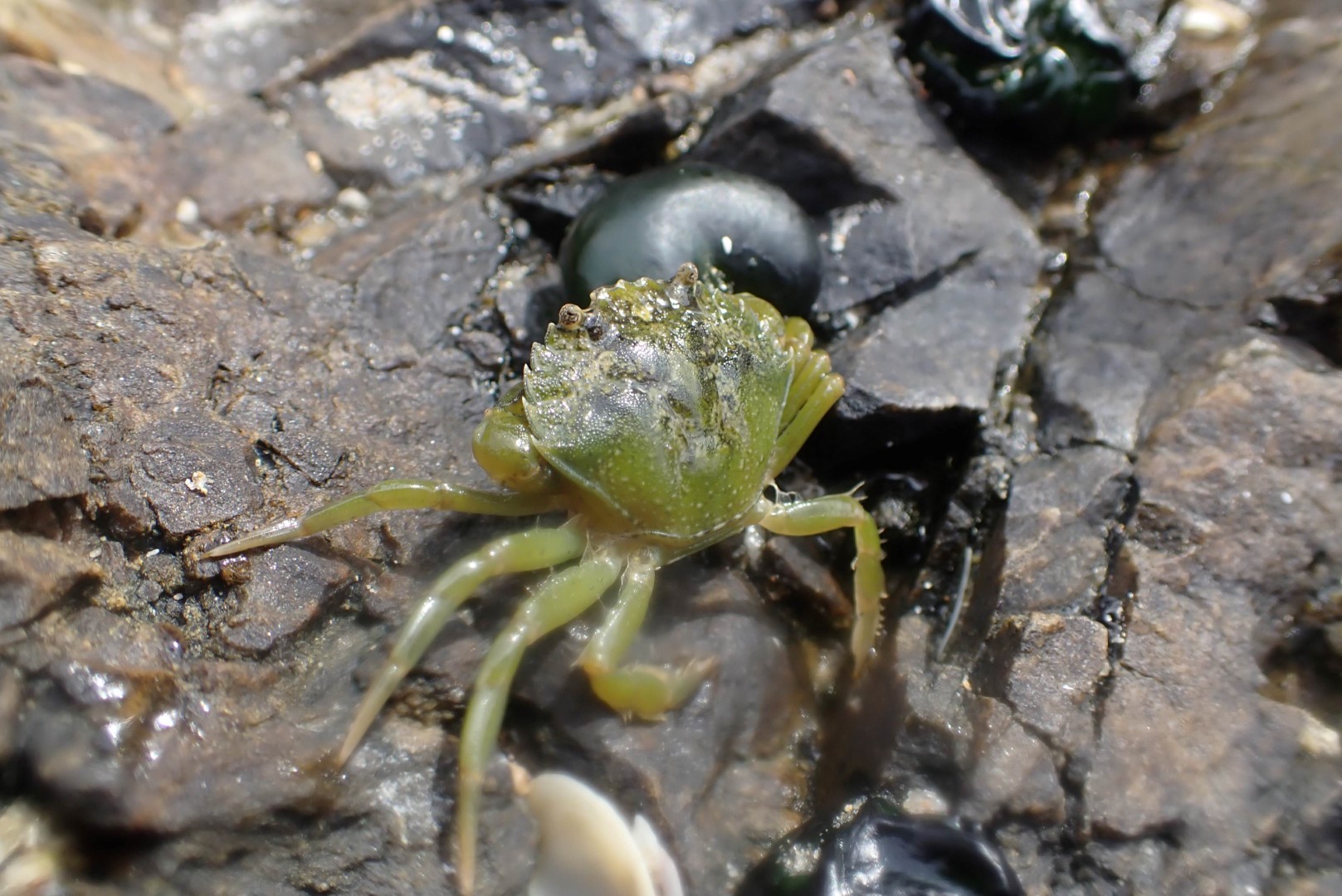
Green crab out of water on rocks. Photo credit: Tim Binns
Native to Europe and North Africa. Now well established on the Atlantic and Pacific coasts of Canada. Found at depths less than 6 m. Can be present in salt marshes, on sandy beaches, on rocky shores, in seagrass beds. Prefers areas well sheltered from wave action.
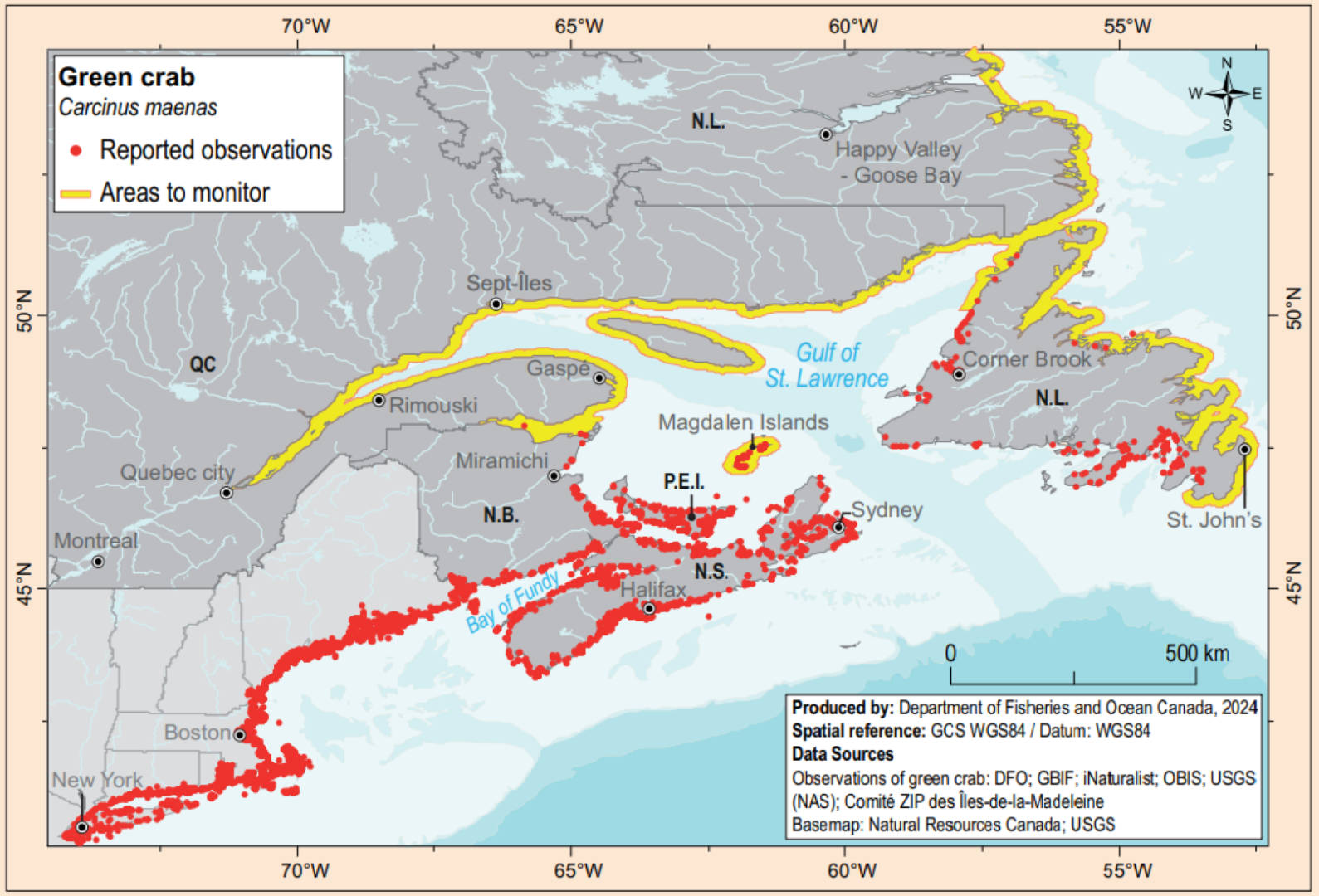
Report sightings in the areas to monitor
Long description:
Map of the green crab reported observations (red dots) and areas to monitor (yellow zones) of eastern Canada
- The presence of the green crab is noted along the U.S. East Coast, starting from the map boundary at New York City, extending almost continuously along the coasts of Bay of Fundy, Nova Scotia, Prince Edward Island, eastern New Brunswick and the Magdalen Islands. The presence of the green crab is also observed on the coasts of Newfoundland.
- Areas to monitoring include all of Quebec’s coastline (St. Lawrence Estuary and Gulf, including the Magdalen Islands) starting from Quebec City, all of Chaleur Bay, as well as the eastern coastline of Newfoundland and Labrador.
Produced by: Department of Fisheries and Ocean Canada, 2024
Spatial reference: GCS WGS84 / Datum: WGS84
Data sources
Observations of green crab: DFO; GBIF; iNaturalist; OBIS; USGS (NAS); Comité ZIP des Îlesde-la-Madeleine
Basemap: Natural Resources Canada; USGS
Mitten crab (Eriocheir sinensis)

Mitten crab and its identification criteria. Photo credit: Ecomare/Sytske Dijksen
Long description:
Mitten crab where the different structures used for identification are pointed out:
- Two claws of the same size
- Four spines found on the outer sides of each eye
- Deep notch between the eyes
- Maximum carapace width of 8 cm
Characteristics
Colour: greenish-brown
Leg length: twice the width of the carapace

Adults of Mitten crab appear to be wearing mittens with white fingers. Photo credit: JPPertersen
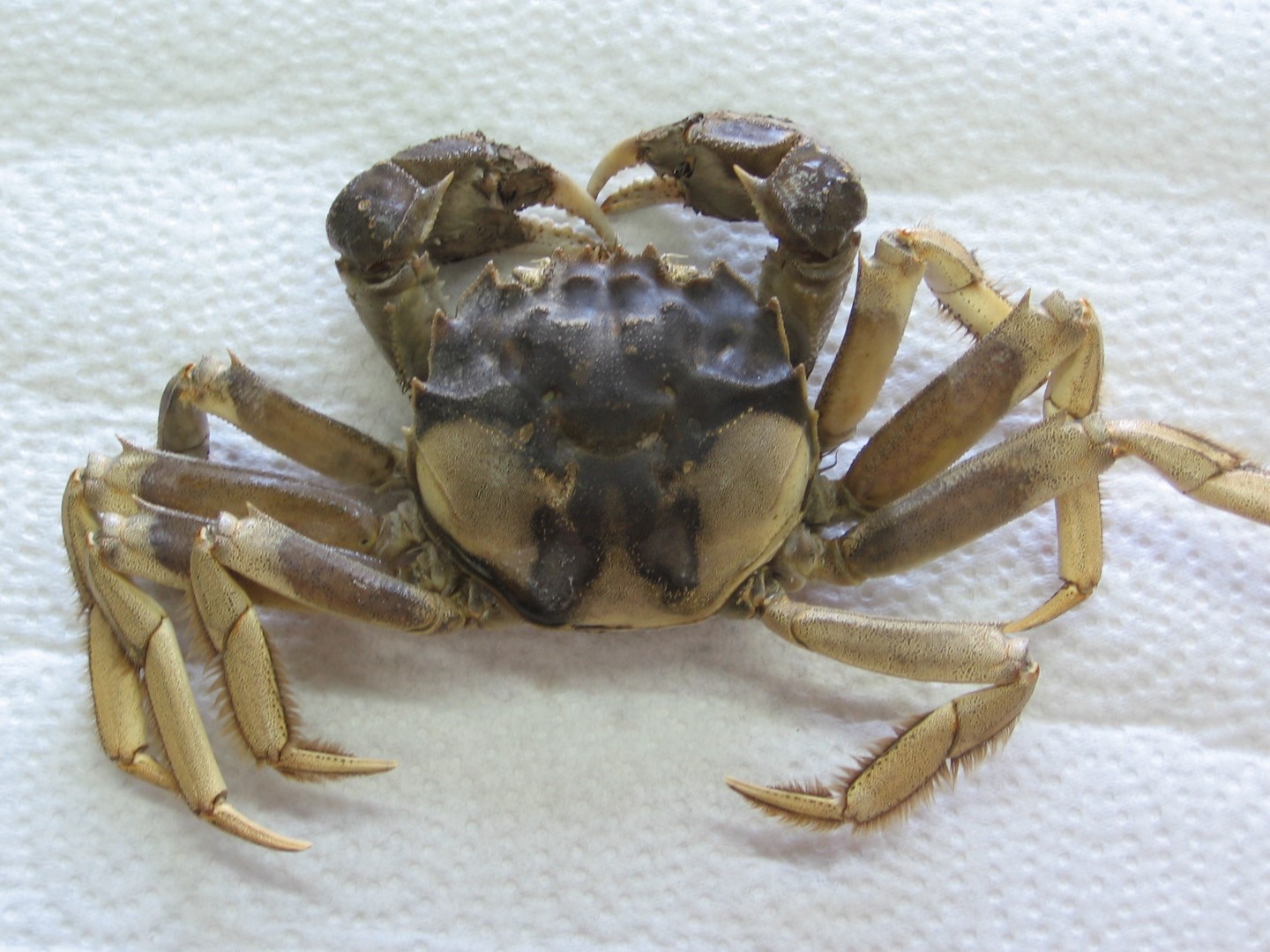
Mitten crab in dorsal view. Photo credit: G. Bourget, Ministère de l’Environnement, de la Lutte contre les changements climatiques, de la Faune et des Parcs du Québec
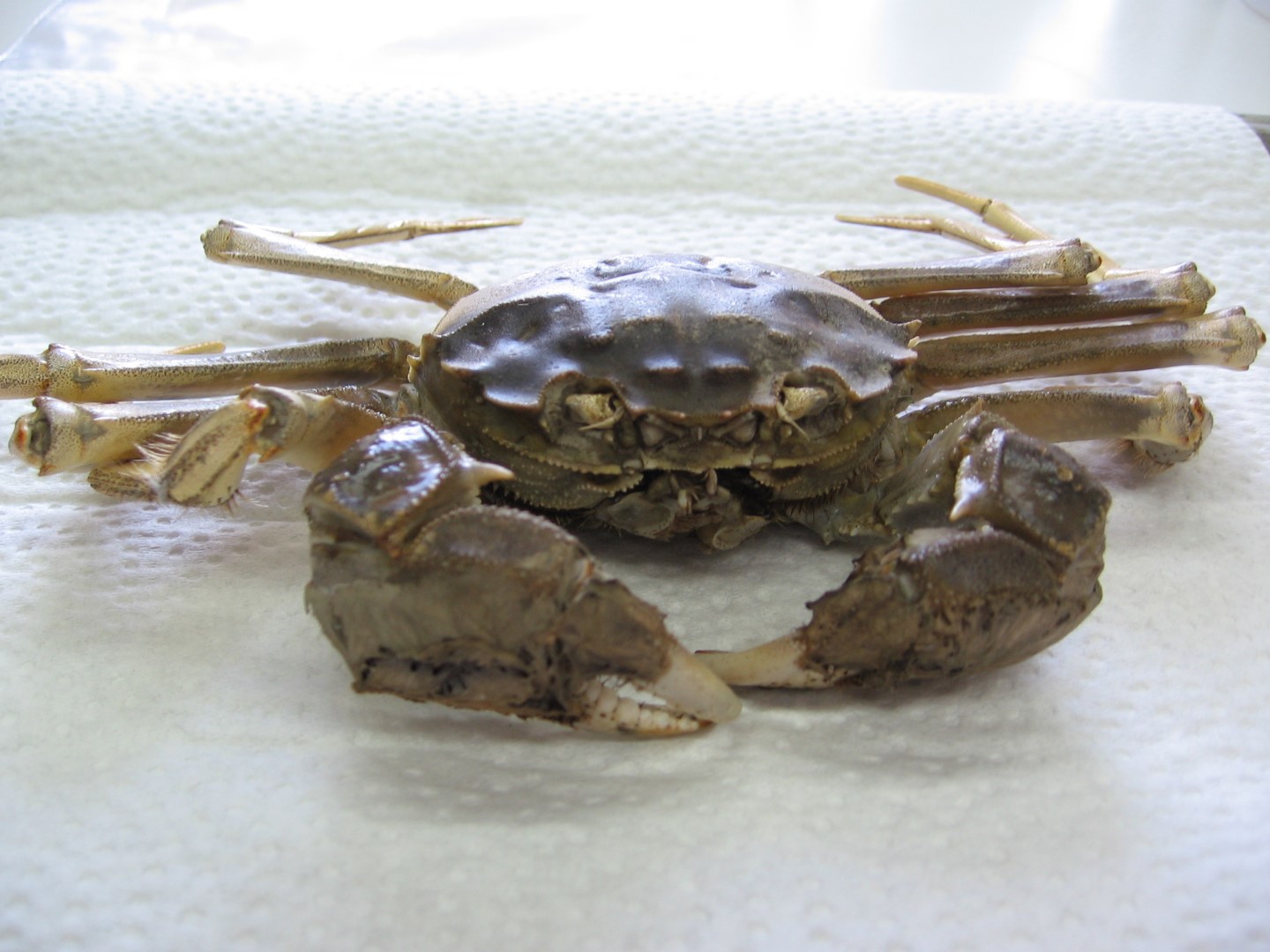
Mitten crab in front view. Photo credit: G. Bourget, Ministère de l’Environnement, de la Lutte contre les changements climatiques, de la Faune et des Parcs du Québec
Native to China and the Korean Peninsula. Occasionally observed in the St. Lawrence River and Estuary. Catadromous species, which lives in freshwater and migrates to saltwater to reproduce. Found at depths of 10 m. Lives in lakes and rivers, in wetlands, near shores, and in the brackish waters of estuaries. Can survive in highly disturbed and polluted environments, such as muddy waters loaded with suspended sediments.
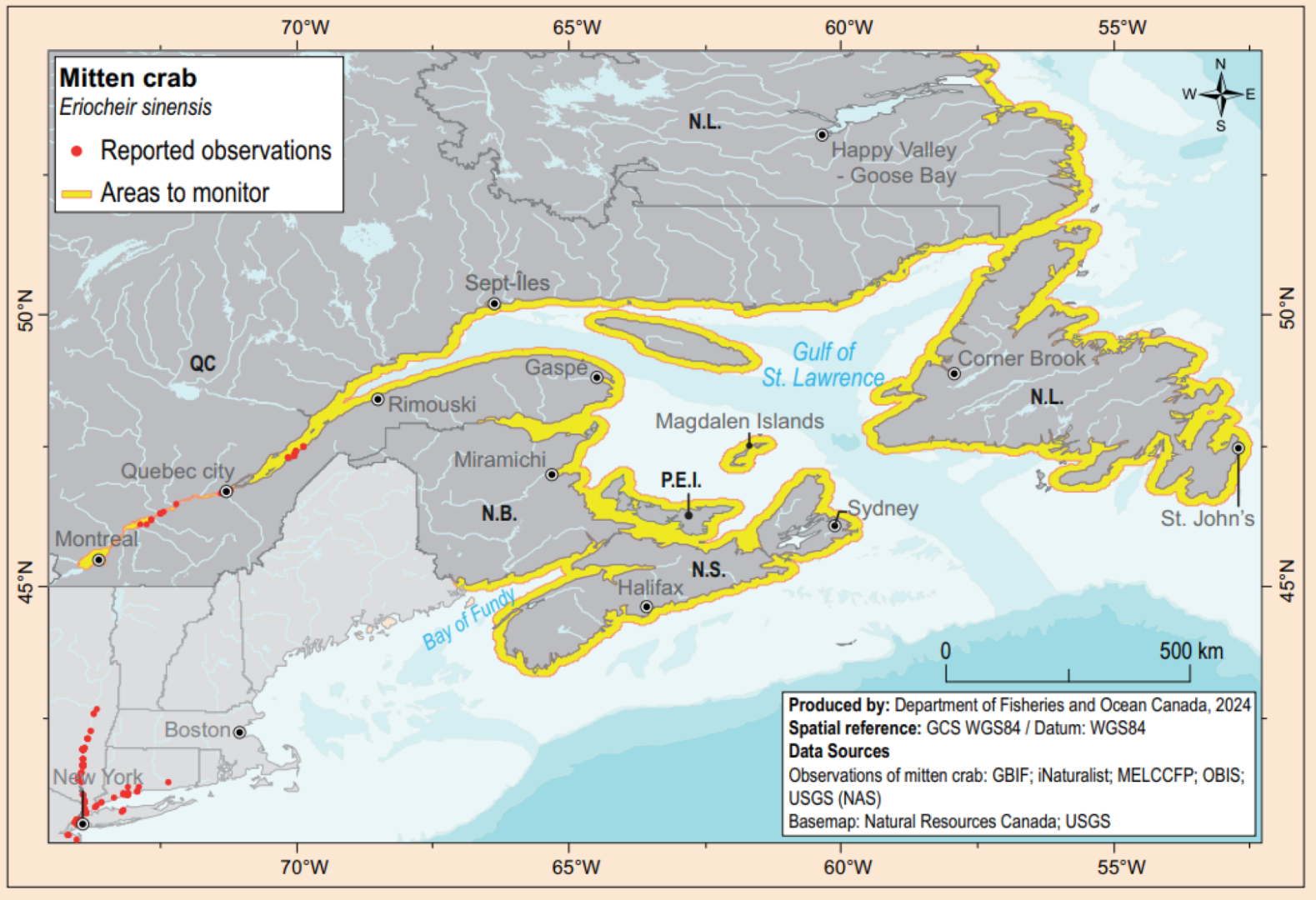
Report sightings in the areas to monitor
Long description:
Map of the mitten crab reported observations (red dots) and areas to monitor (yellow zones) of eastern Canada
- Mitten crab have been recorded in the St. Lawrence River between Montreal and Rimouski. Several sightings have been recorded in the vicinity of New York City and some of the major rivers nearby.
- The areas to be monitored cover the entire coastline of the Estuary and Gulf of St. Lawrence, as well as the Atlantic coast.
Produced by: Department of Fisheries and Ocean Canada, 2024
Spatial reference: GCS WGS84 / Datum: WGS84
Data sources
Observations of mitten crab: GBIF; iNaturalist; MELCCFP; OBIS;
USGS (NAS)
Basemap: Natural Resources Canada; USGS
Asian shore crab (Hemigrapsus sanguineus)

Asian shore crab and its identification criteria. Photo credit: Ansel Oomen, Bugwood.org
Long description:
Asian shore crab where the different structures used for identification are pointed out:
- Three spines found on the outer sides of each eye
- Maximum carapace width of 4.5 cm
- Light and dark bands on the legs
Characteristics
Carapace: roughly square
Colour: marbled or dotted with brownish-red, greenish or dark purple

Bulb in the hollow of the claws of the male Asian shore crab. Photo credit: Nathalie De Somer
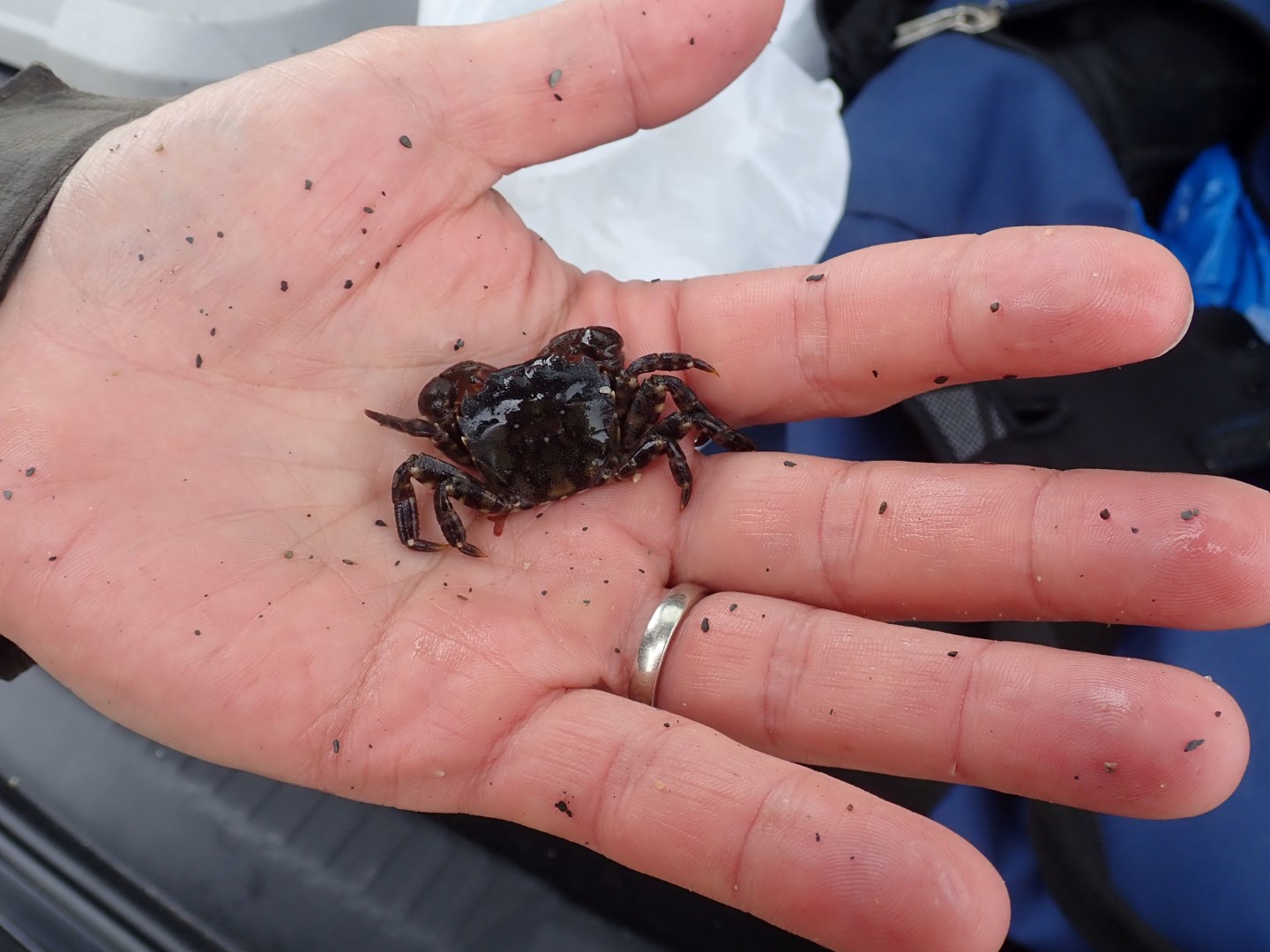
Asian shore crab on a hand in dorsal view. Photo credit: S. Kingsbury, Fisheries and Oceans Canada
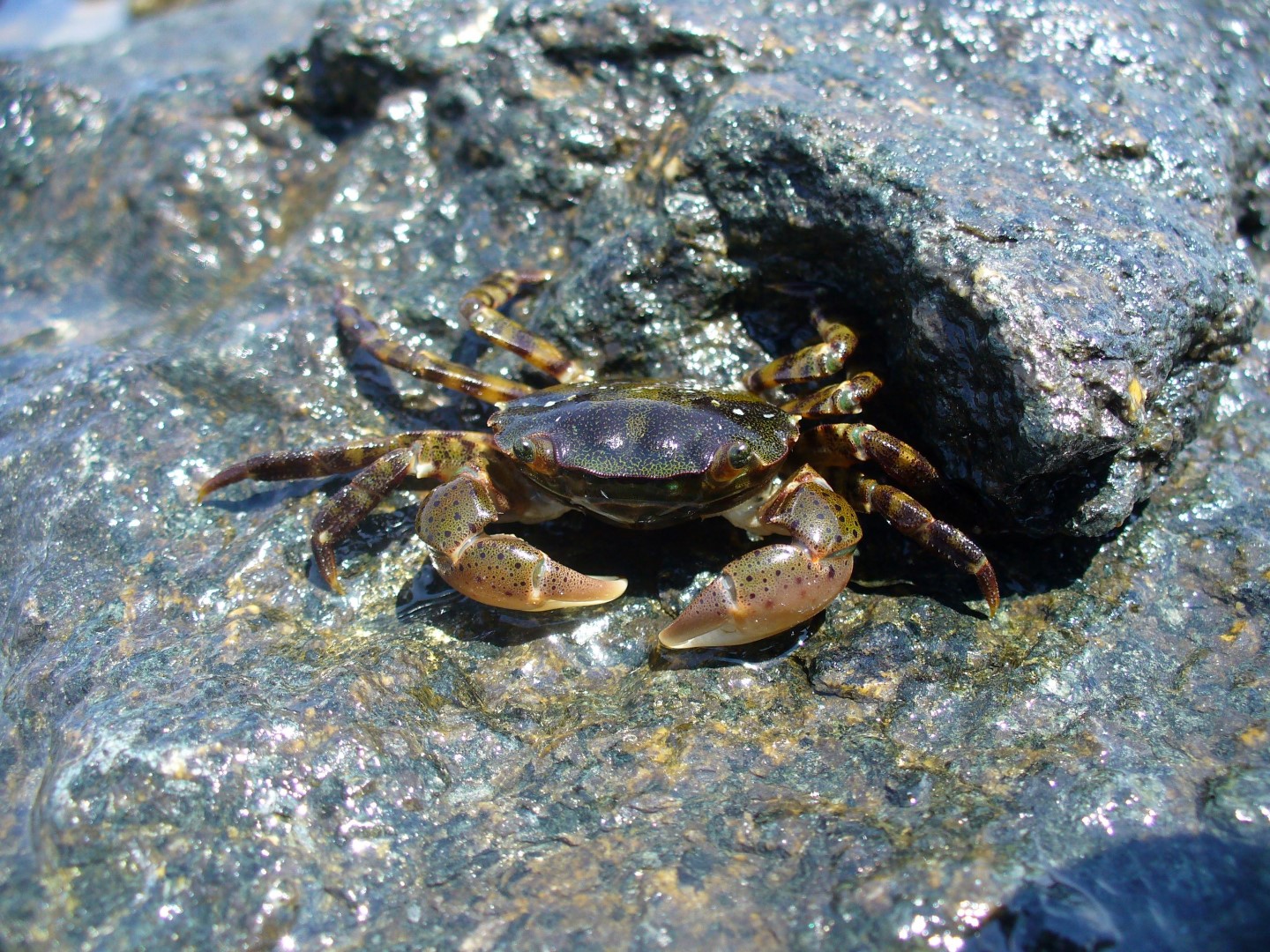
Asian shore crab out of water on rocks, front view. Photo credit: © Molly Jacobson
Native to northern Asia. Lives at depths around 4 m in the intertidal zone, the area between low tide and high tide. Moves to the subtidal zone (area permanently submerged, even at low tide) during winter. Found on sandy and pebble beaches, mussel beds, seagrass beds, salt marshes, rock jetties, and pilings.
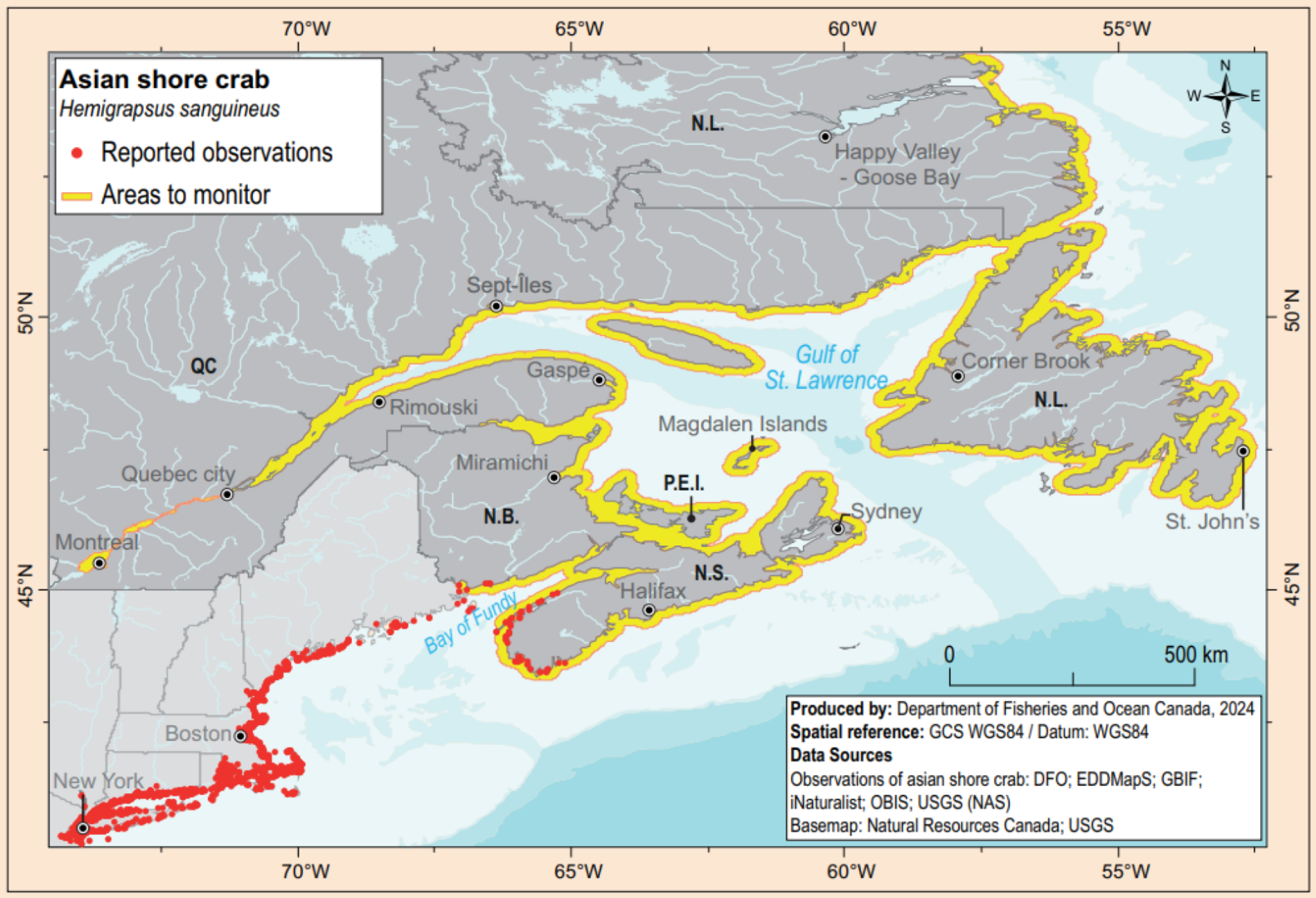
Report sightings in the areas to monitor
Long description:
Map of the Asian shore crab reported observations (red dots) and areas to monitor (yellow zones) of eastern Canada
- Presence of the Asian shore crab is noted on the United States east coast, in the south of Nova Scotia and in New Brunswick, in the Bay of Fundy.
- Areas to be monitored cover the entire coastline of the Estuary and Gulf of St. Lawrence, as well as the Atlantic coast.
Produced by: Department of Fisheries and Ocean Canada, 2024
Spatial reference: GCS WGS84 / Datum: WGS84
Data sources
Observations of asian shore crab: DFO; EDDMapS; GBIF; iNaturalist; OBIS; USGS (NAS)
Basemap: Natural Resources Canada; USGS
Native species
Atlantic rock crab (Cancer irroratus)

Atlantic rock crab and its identification criteria. Photo credit: Eric A. Lazo-Wasem
Long description:
Atlantic rock crab where the different structures used for identification are pointed out:
- Smooth claws without denticles
- Nine smooth spines found on the outer sides of each eye
- Maximum carapace width of 15 cm for males and 10 cm for females
- Walking legs longer than claw-bearing legs
Characteristics
Carapace: smooth, broad, and oval, resembling a rock or sand for camouflage
Colour: yellow-brown to red-violet
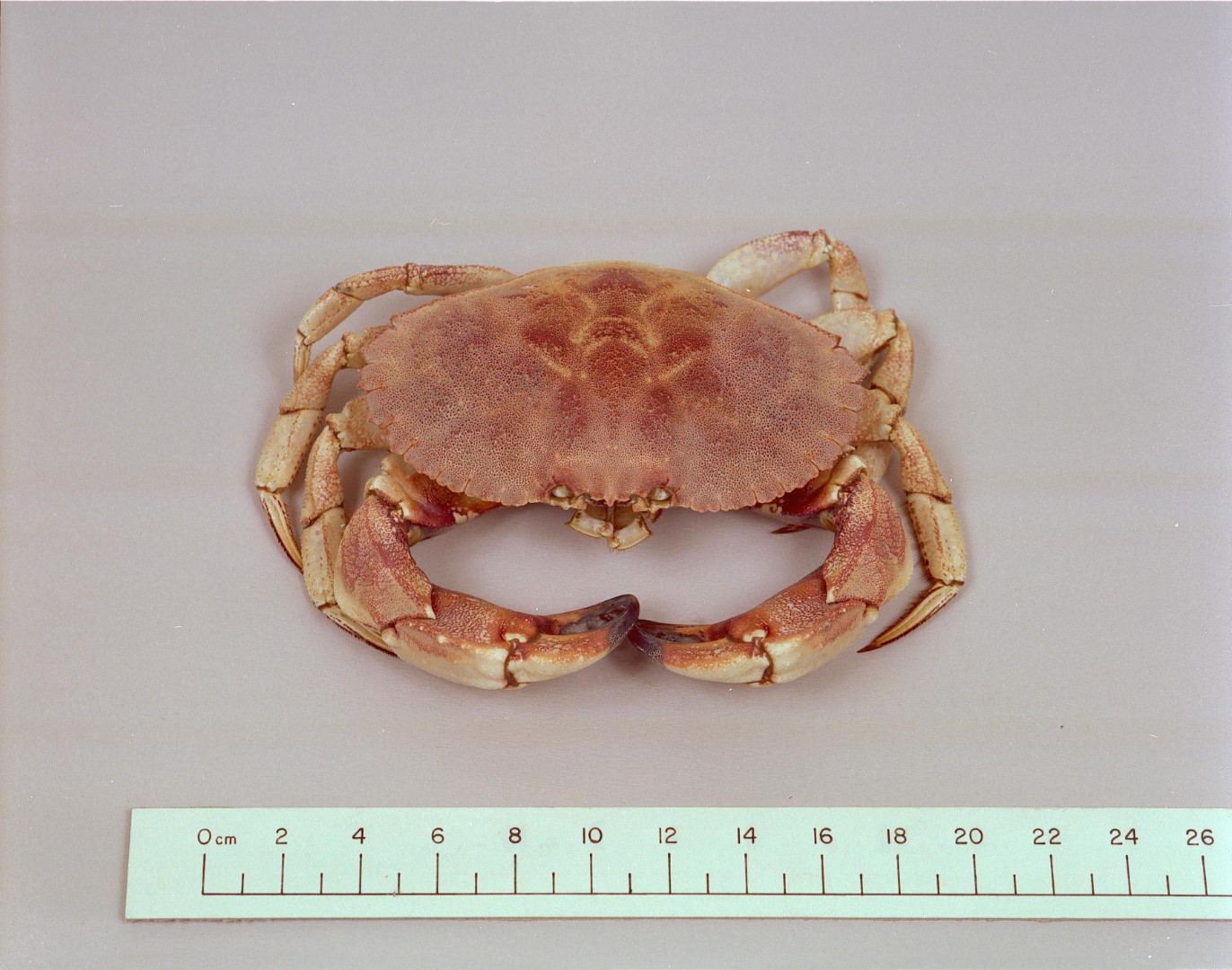
Atlantic rock crab on a table, dorsal view. Photo credit: Ministère de l'Agriculture, des Pêcheries et de l'Alimentation du Québec
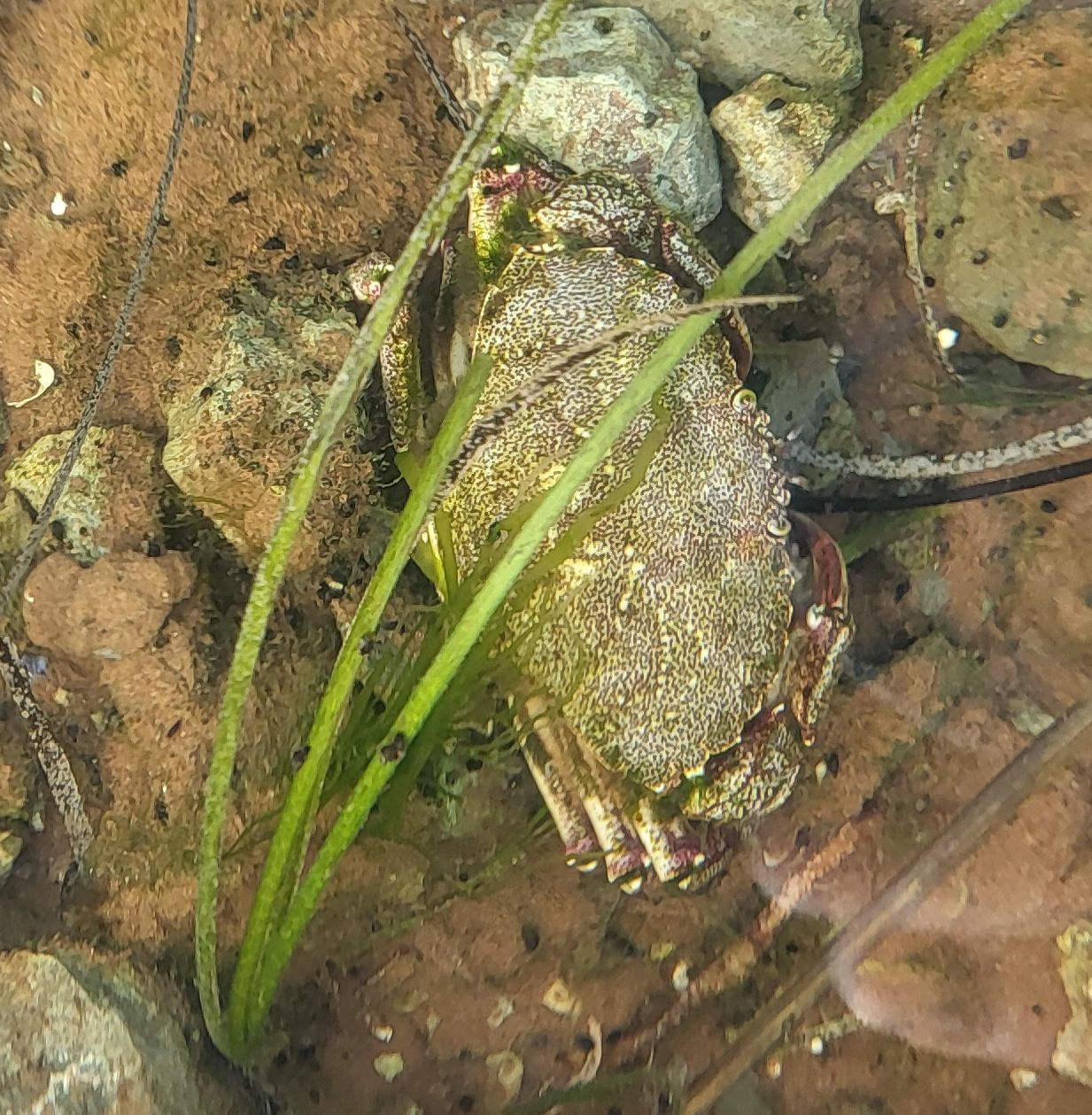
Atlantic rock crab camouflaged in its natural environment, dorsal view.
Can be found from the tide line down to 20 m deep. Lives on a variety of seabed types, but prefers sandy, gravel, or rocky bottoms where it can camouflage more easily. Commercially fished in eastern Canada.
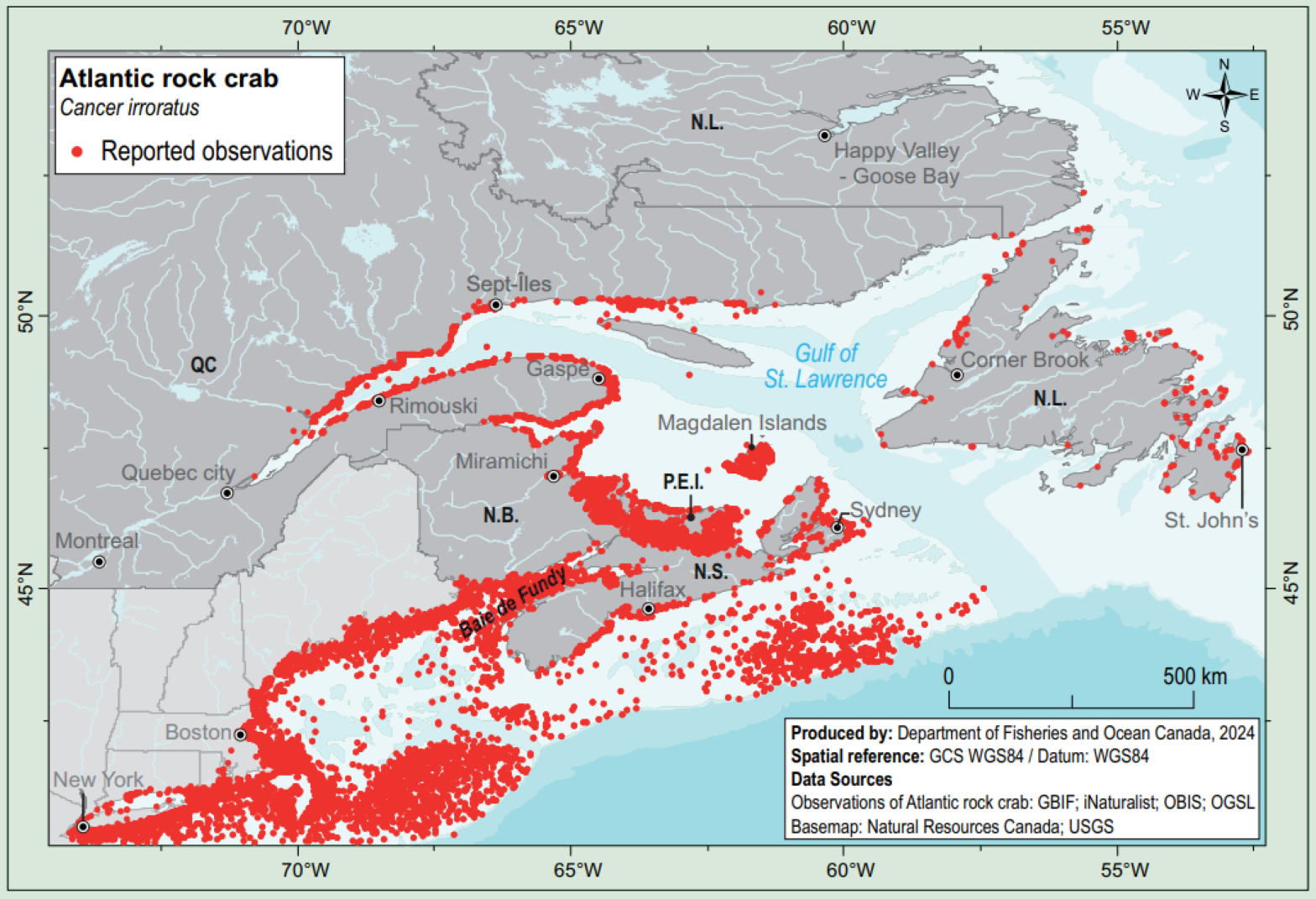
Long description:
Map of the Atlantic rock crab reported observations (red dots) of eastern Canada
- Atlantic rock crab are found throughout the St. Lawrence Estuary and Gulf. Abundant observations are also made along the Atlantic coast, from New York City (the edge of the map) to the Cabot Strait. A few sporadic sightings have been recorded on the Labrador coast.
Produced by: Department of Fisheries and Ocean Canada, 2024
Spatial reference: GCS WGS84 / Datum: WGS84
Data sources
Observations of Atlantic rock crab: GBIF; iNaturalist; OBIS; OGSL
Basemap: Natural Resources Canada; USGS
Jonah crab (Cancer borealis)

Jonah crab and its identification criteria.
Long description:
Jonah crab where the different structures used for identification are pointed out:
- Two large claws with several small teeth
- Nine spines with several small teeth found on the outer sides of each eye
- Maximum carapace width of 18 cm for males and 15 cm for females
- Short walking legs
Characteristics
Carapace: oval-shaped, rough, and serrated
Colour: back is red with 2 lines of yellowish dots while the belly is yellowish

Jonah crab on sand out of the water, dorsal view. Photo credit: mauryal
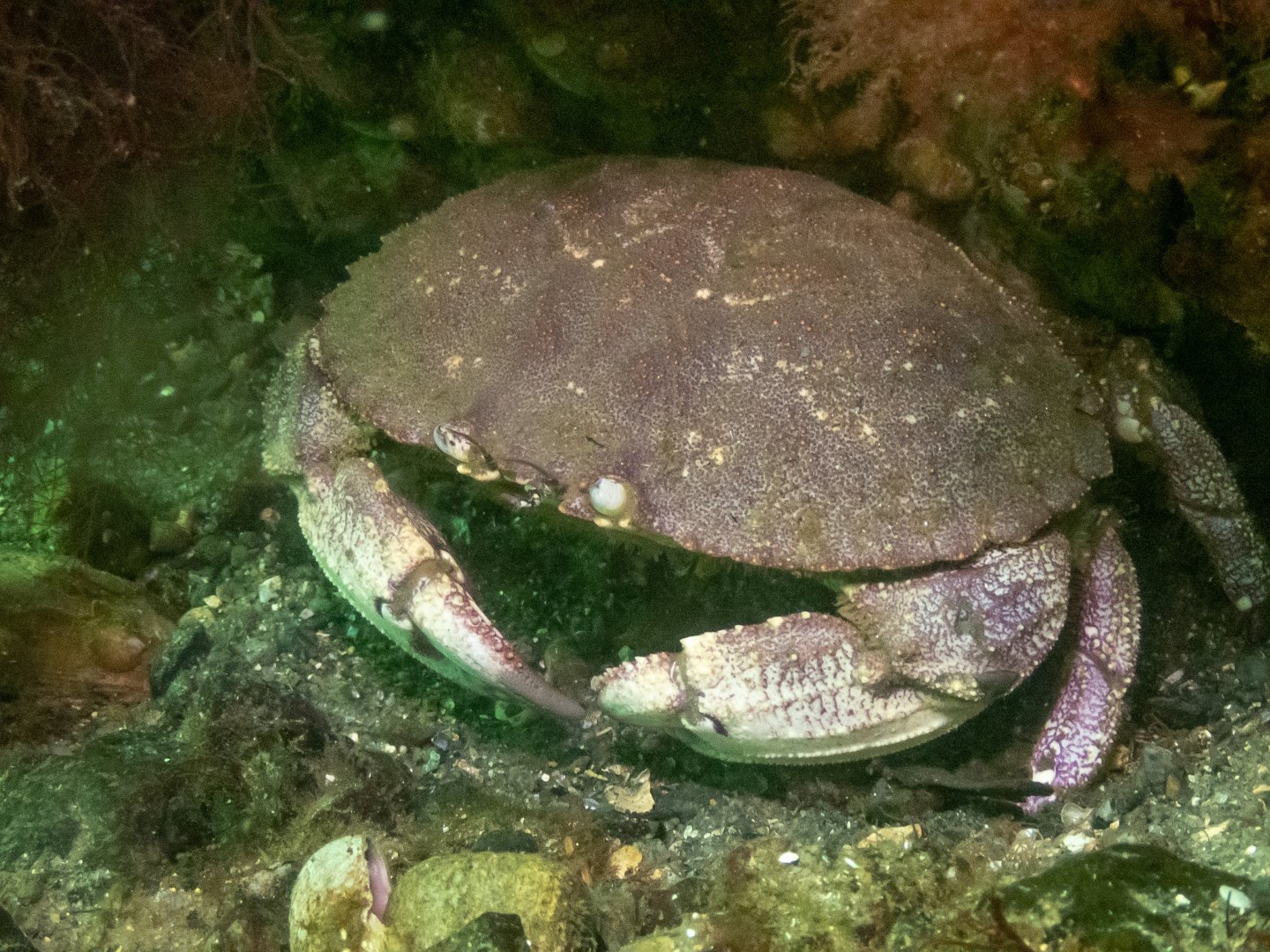
Jonah crab under water in its natural habitat, front view. Photo credit: Neil DeMaster
Found in a wide variety of depths, normally from the intertidal zone (area between low tide and high tide) to 300 m, but as deep as 800 m. Lives on various seabed types: rock, mud, clay, and sand. Commercially fished in eastern Canada.
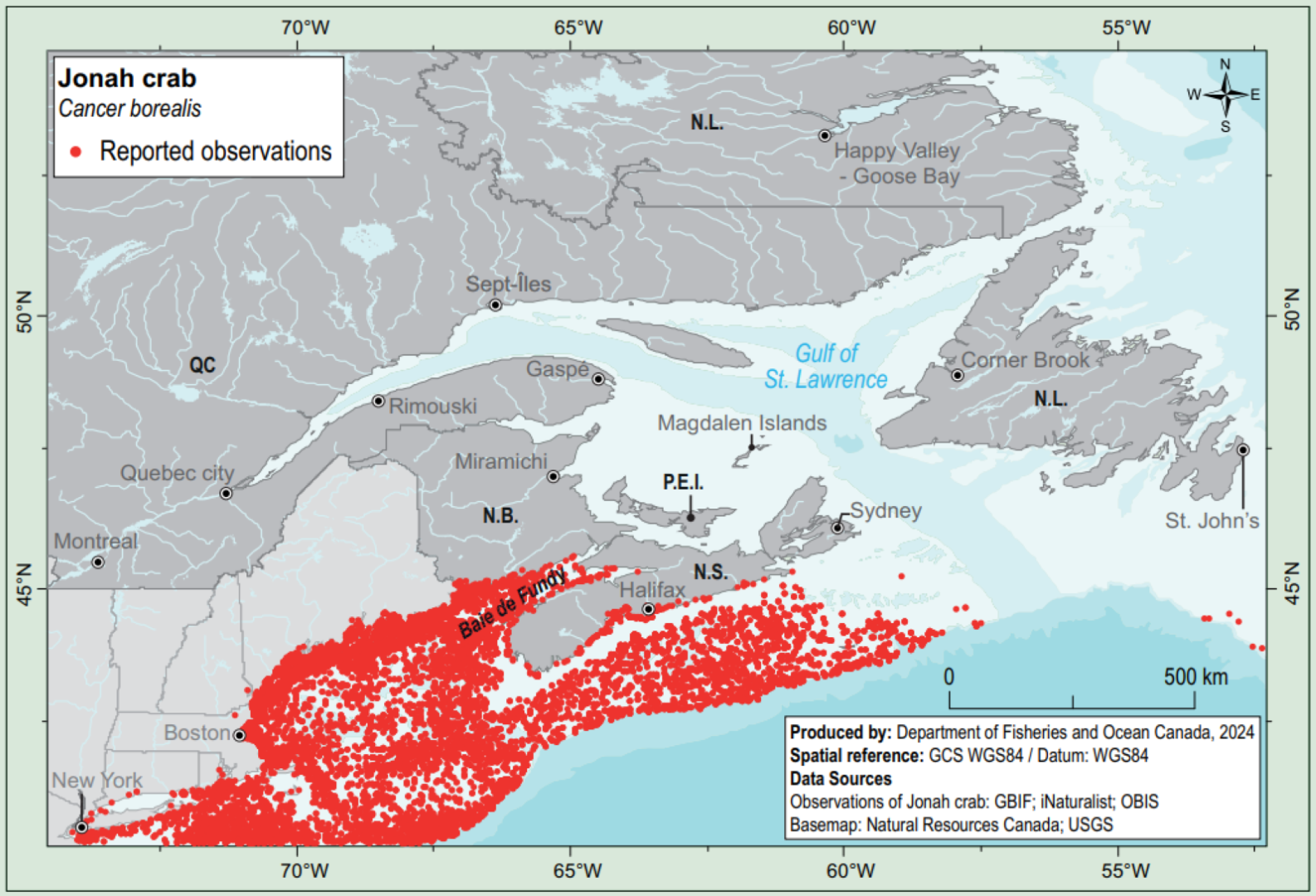
Long description:
Map of the Jonah crab reported observations (red dots) of eastern Canada
- Jonah crab are observed in the Bay of Fundy and along the east coast and off the Atlantic coast of Nova Scotia and as far as New York City (the edge of the map). A few other sporadic sightings have been recorded along the edge of the continental shelf south of Newfoundland.
Produced by: Department of Fisheries and Ocean Canada, 2024
Spatial reference: GCS WGS84 / Datum: WGS84
Data sources
Observations of Jonah crab: GBIF; iNaturalist; OBIS
Basemap: Natural Resources Canada; USGS
Lady crab (Ovalipes ocellatus)

Lady crab and its identification criteria. Photo credit: Jonathan Layman
Long description:
Lady crab where the different structures used for identification are pointed out:
- Five spines found on the outer sides of each eye
- Three sharp spines between the eyes
- Maximum carapace width of 9 cm
- Back legs are oval and webbed (swimming crab)
Characteristics
Colour:
- yellow-grey or pale violet, covered with red-violet spots, similar to a leopard
- light brown claws with bluish tips and purple spots

Lady crab on a hand, dorsal view. Photo credit: Jonathan Layman
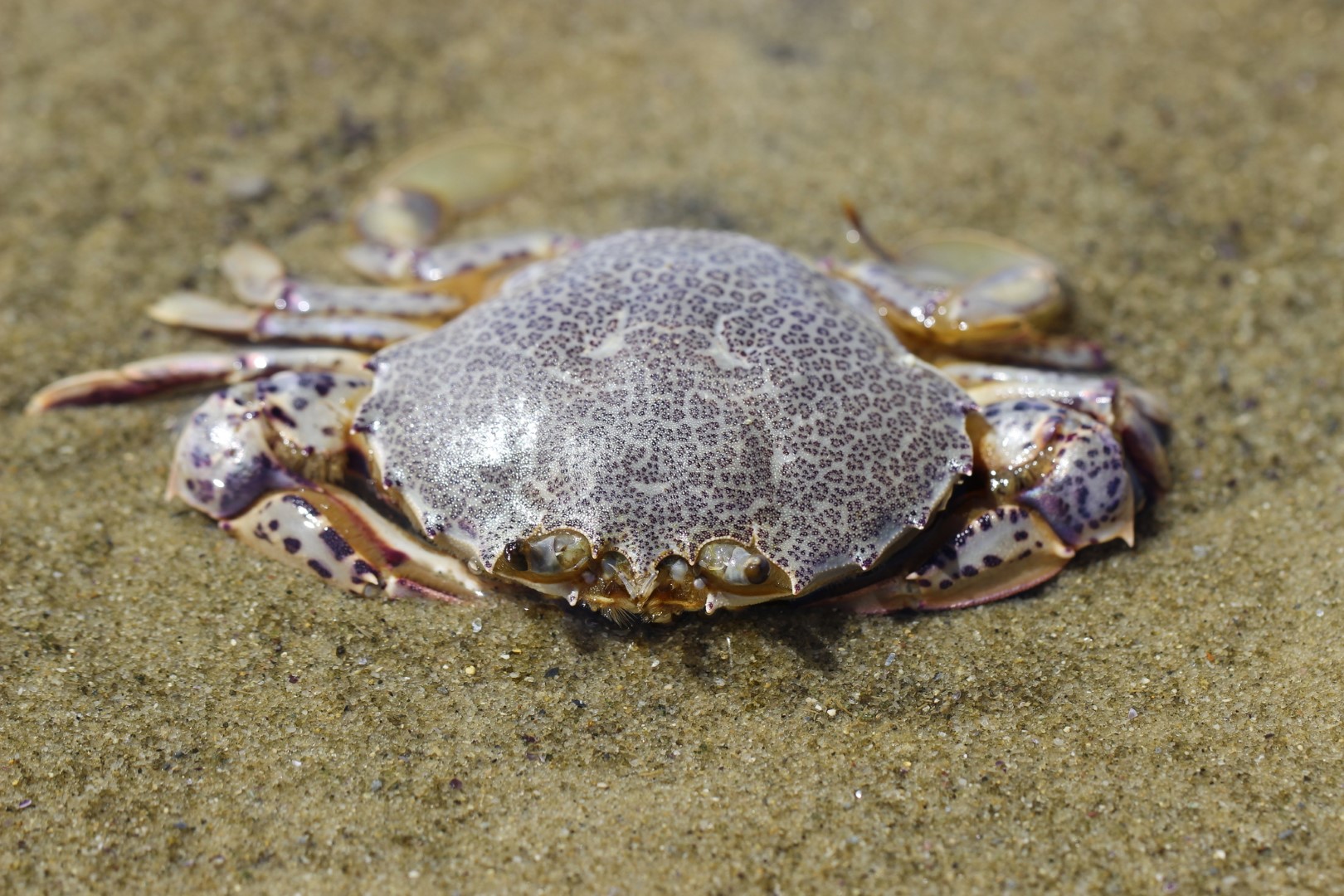
Lady crab out of water on sand, front view. Photo credit: D. Bray
Lives in marine environments but can also be present in estuaries. Can be found to depths of 100 m but prefers the intertidal zone (area between low and high tide). Uses its last pair of webbed legs to swim, to dig, and to bury itself in sandy bottoms for camouflage. Can also be found on rocky or muddy bottoms.
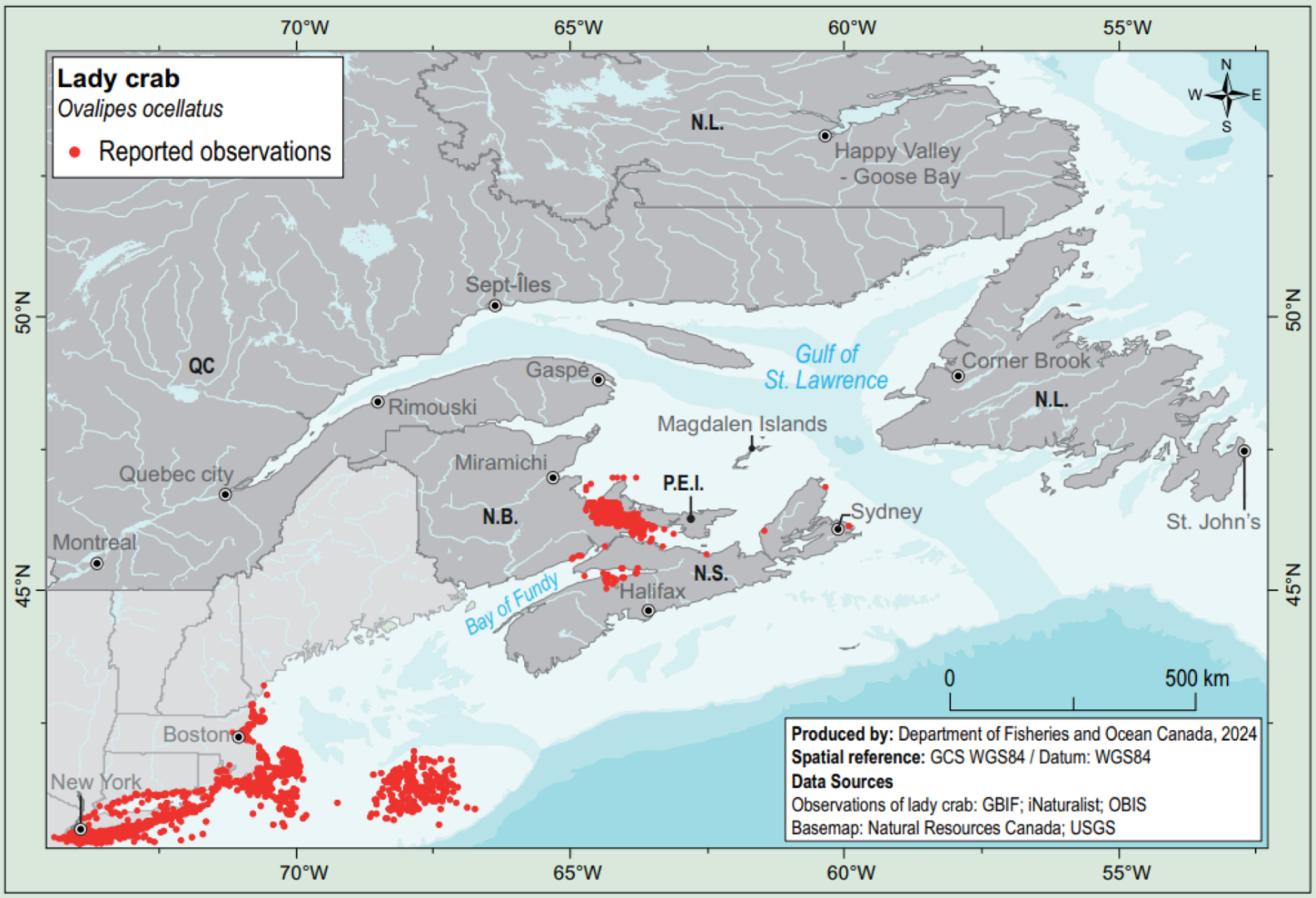
Long description:
Map of the lady crab reported observations (red dots) of eastern Canada
- The lady crab is found offshore and along the United States Atlantic coast from New York (the edge of the map) to Boston. They are also seen in the Northumberland Strait and at the head of the Bay of Fundy. A few other sightings in Nova Scotia were also noted.
Produced by: Department of Fisheries and Ocean Canada, 2024
Spatial reference: GCS WGS84 / Datum: WGS84
Data sources
Observations of lady crab: GBIF; iNaturalist; OBIS
Basemap: Natural Resources Canada; USGS
Say mud crab (Dyspanopeus sayi)
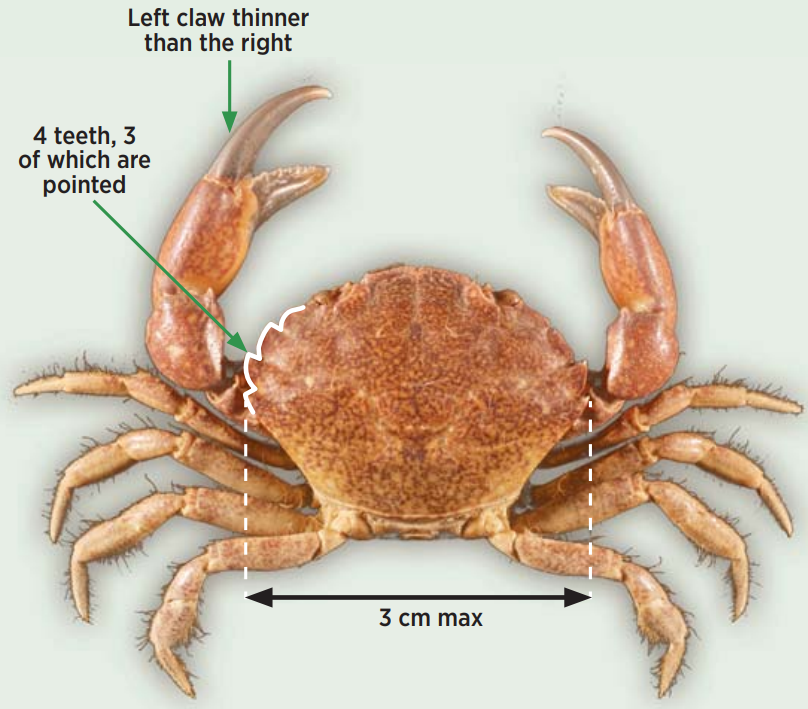
Say mud crab and its identification criteria. Photo credit: Eric A. Lazo-Wasem
Long description:
Say mud crab where the different structures used for identification are pointed out:
- Left claw thinner than the right
- Four spines, 3 of which are pointed, found on the outer sides of each eye
- Maximum carapace width of 3 cm
Characteristics
Carapace: hexagonal and dome-shaped, with granular texture and small hairs on the front and sides
Colour: varies from dark blue-green, to brown, or sand colour with small dark purple-red spots on a yellowish background
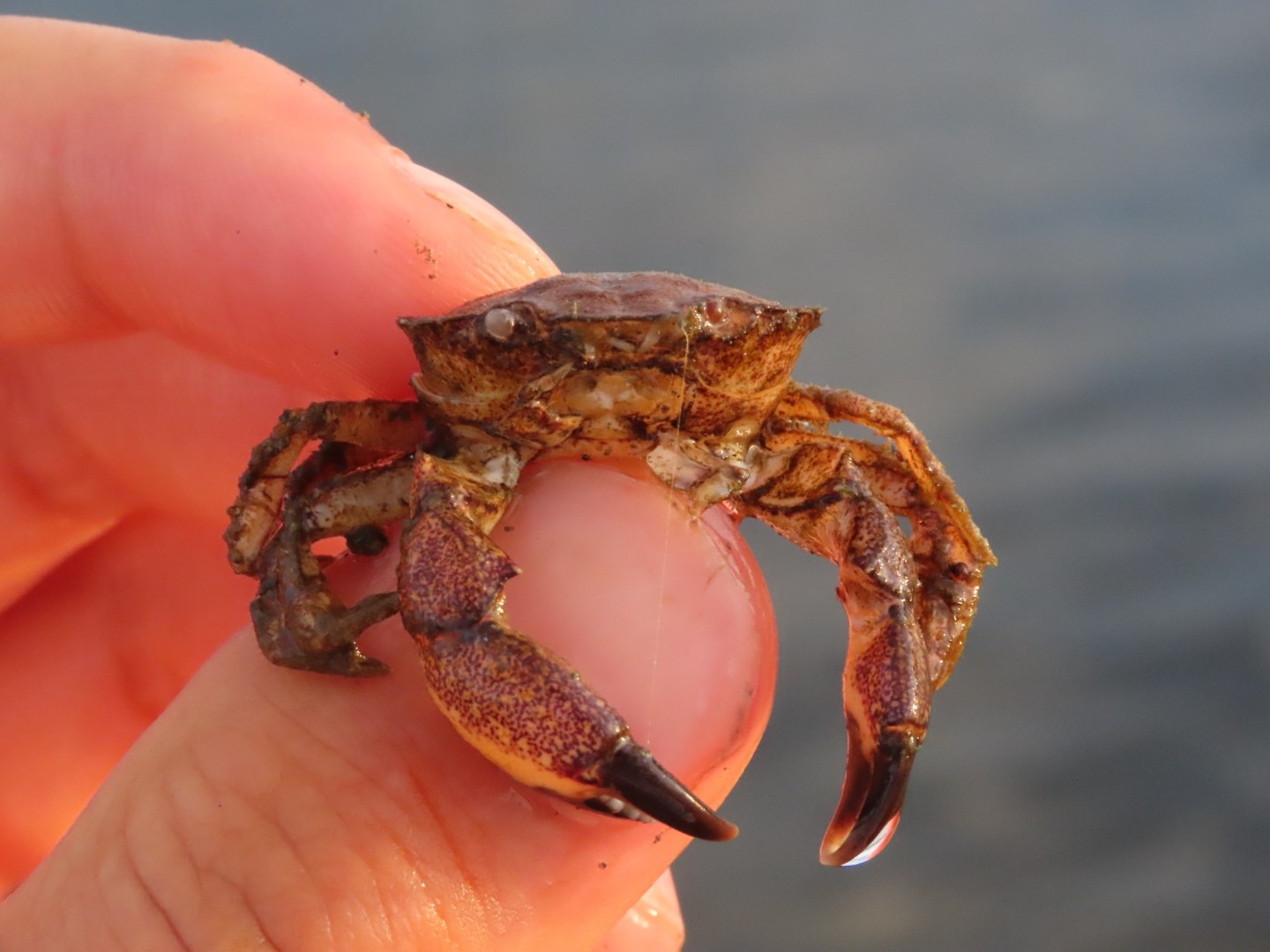
Close-up on the black claw fingers of a Say mud crab. Photo credit: Louis-Philippe Bateman

Say mud crab in a hand, front view. Photo credit: Brian G.
Generally lives in the intertidal zone at depths between 0 and 4 m, but has been found down to 46 m. Lives on mud or oyster shell beds. Can be found in seagrass beds in bays and in the brackish waters of estuaries.
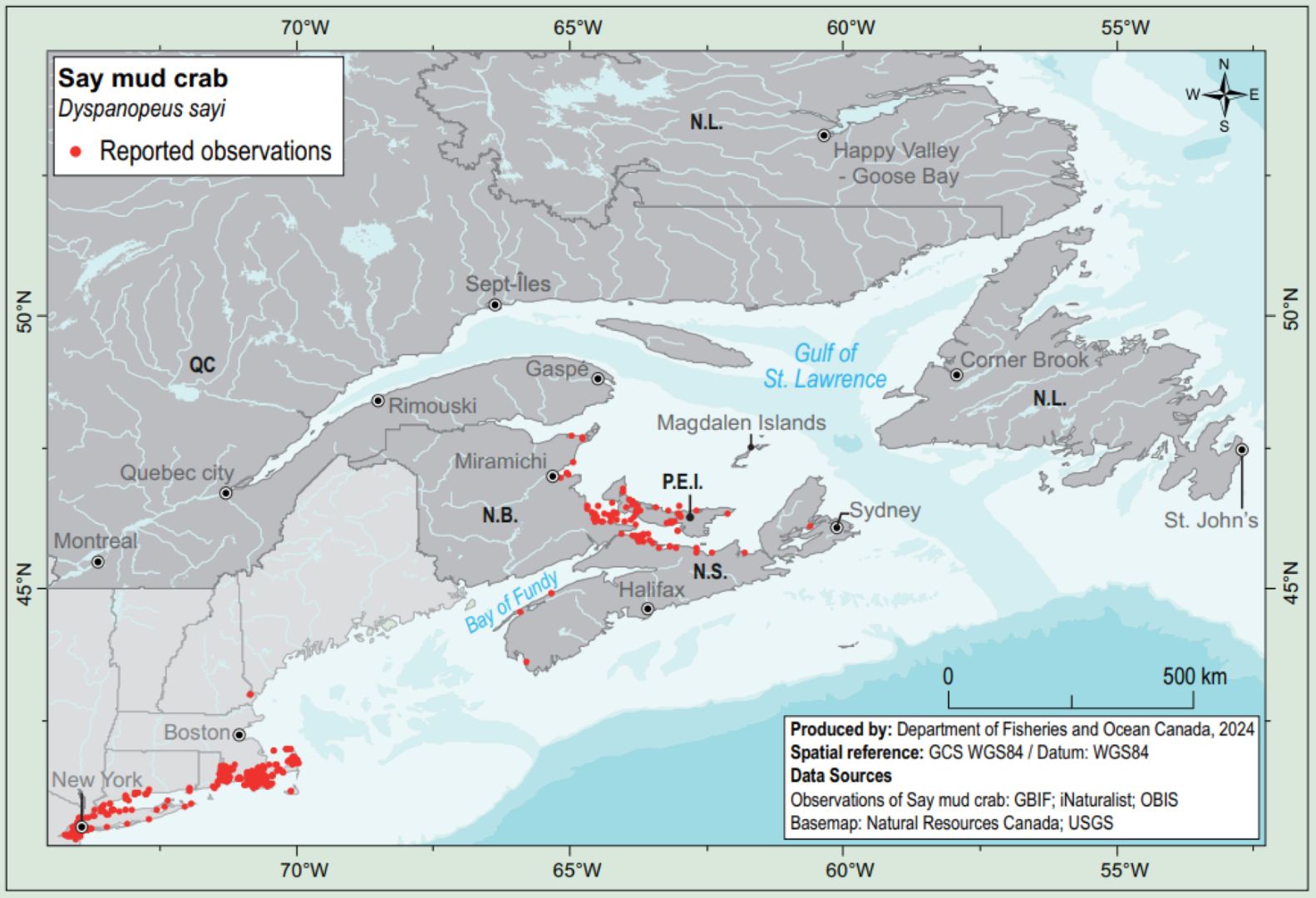
Long description:
Map of the Say mud crab reported observations (red dots) of eastern Canada
- The Say mud crab is found offshore and along the United States coast, from New York (the edge of the map) to Cape Cod Bay. They are also found in the Gulf of St. Lawrence, along the coasts of New Brunswick, Nova Scotia and Prince Edward Island. A few sightings are shown in the Bay of Fundy.
Produced by: Department of Fisheries and Ocean Canada, 2024
Spatial reference: GCS WGS84 / Datum: WGS84
Data sources
Observations of Say mud crab: GBIF; iNaturalist; OBIS
Basemap: Natural Resources Canada; USGS
Harris mud crab (Rhithropanopeus harrisii)
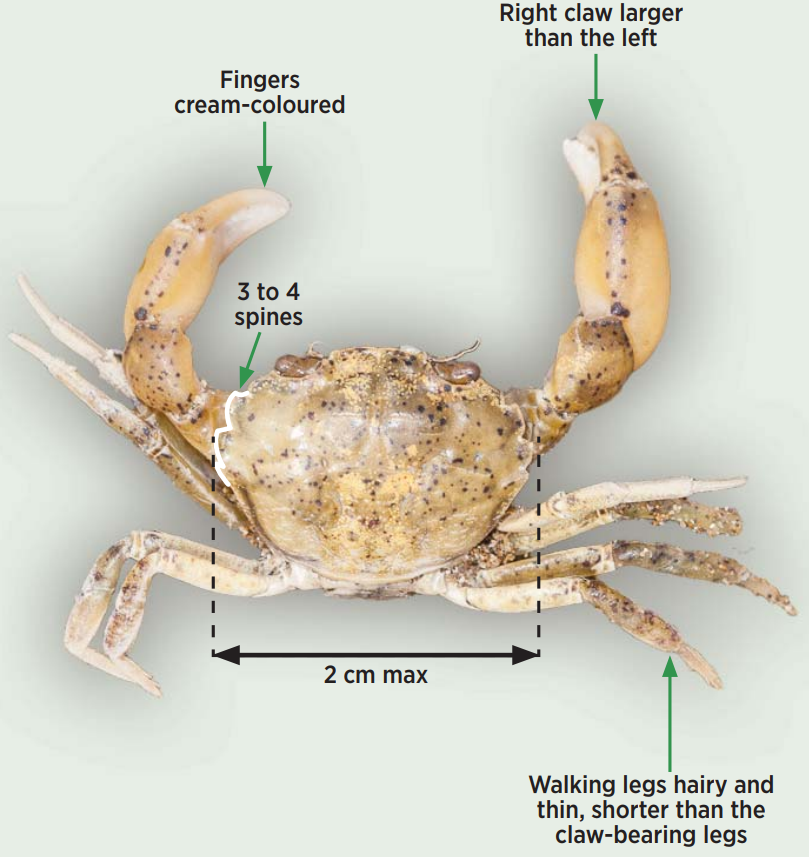
Harris mud crab and its identification criteria. Photo credit: Arnold Wijker
Long description:
Harris mud crab where the different structures used for identification are pointed out:
- Right claw larger than the left
- Fingers cream-coloured
- Four to 3 spines found on the outer sides of each eye
- Maximum carapace width of 2 cm
- Walking legs hairy and thin, shorter than the claw-bearing legs
Characteristics
Carapace: fan-shaped
Colour: brown, sometimes with reddish to black spot
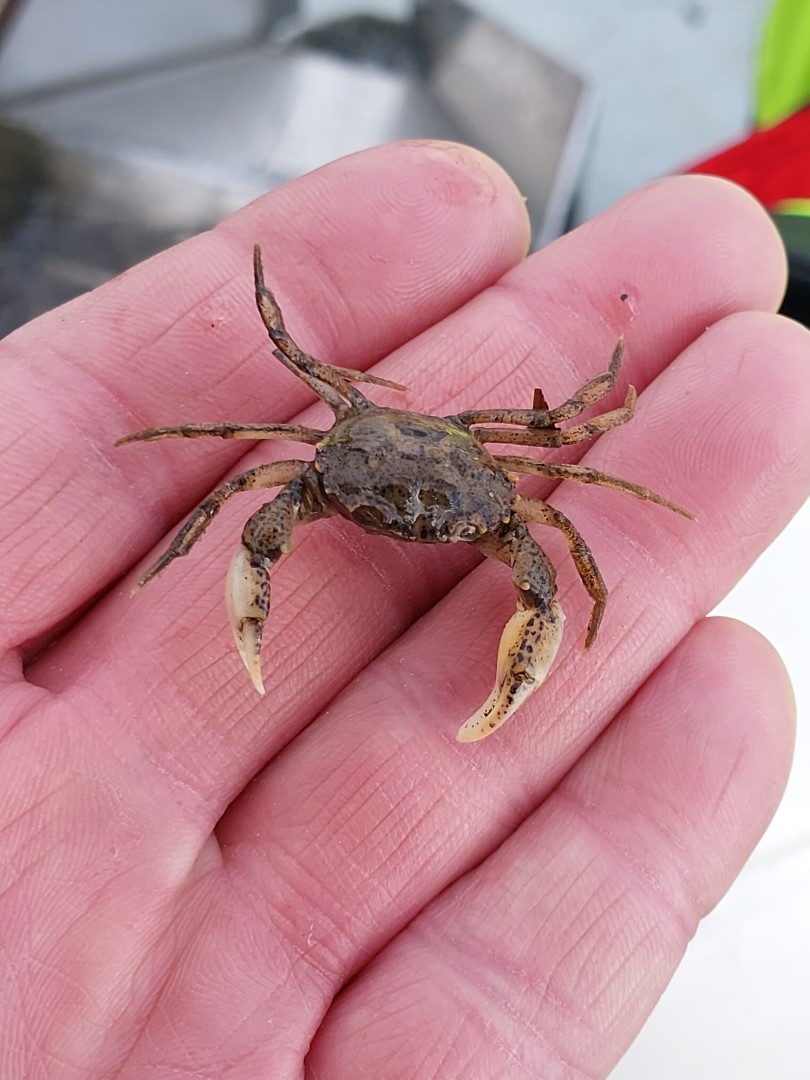
Harris mud crab on a hand. Photo credit: Szymon Bzoma

Harris mud crab out of water in its natural habitat, dorsal view. Photo credit: AWI i Pr.
Accustomed to brackish waters, it can also be present in freshwater and marine environments. Lives at depths between 0 and 10 m. Often found on rocky bottoms or oyster beds, or in muddier places that provide shelter under debris.
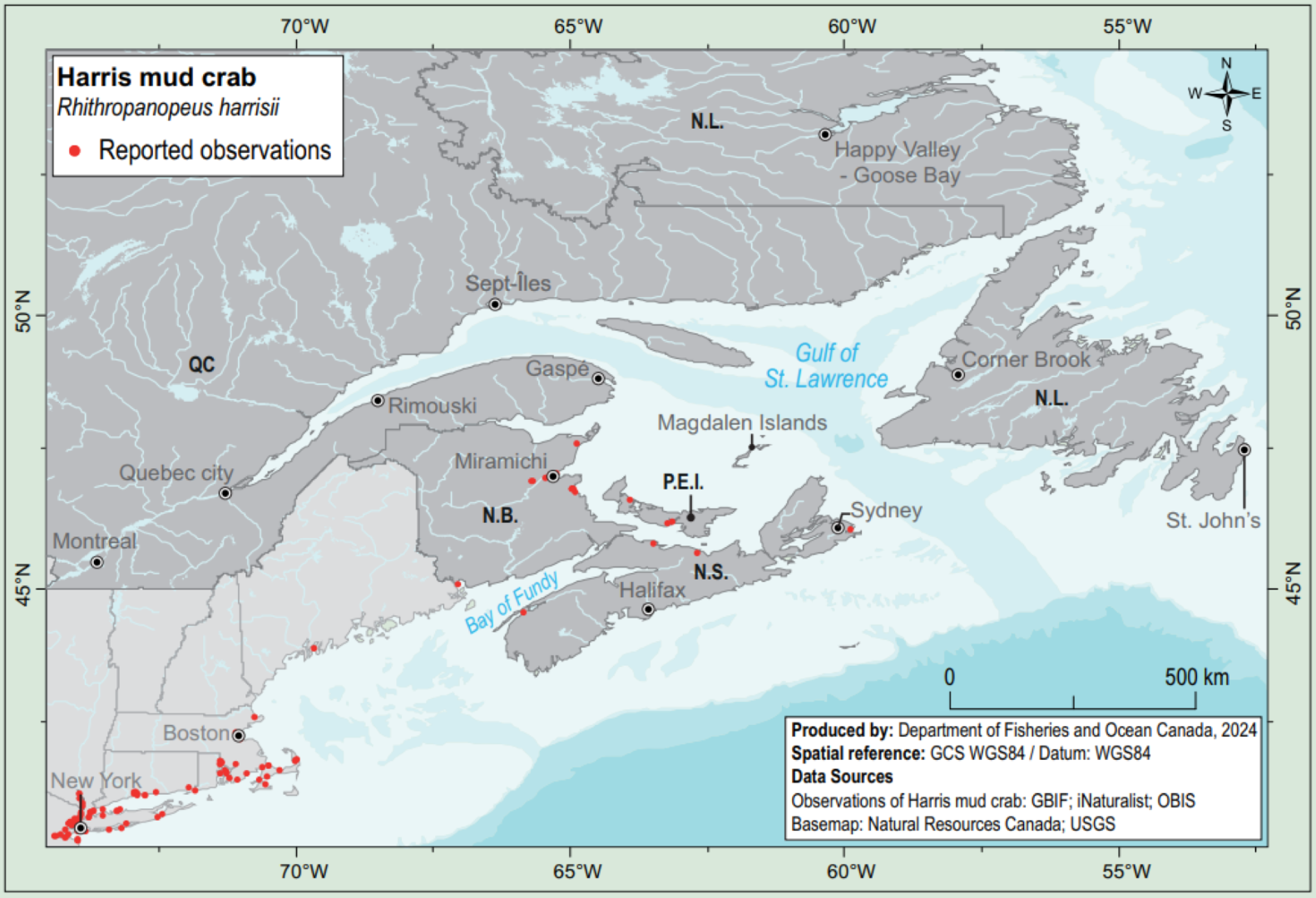
Long description:
Map of the Harris mud crab reported observations (red dots) of eastern Canada
- The Harris mud crab observations are made offshore and along the United States Atlantic coast, in greater numbers around New York City. It is sporadically present on the coasts of New Brunswick, Nova Scotia and Prince Edward Island.
Produced by: Department of Fisheries and Ocean Canada, 2024
Spatial reference: GCS WGS84 / Datum: WGS84
Data sources
Observations of Harris mud crab: GBIF; iNaturalist; OBIS
Basemap: Natural Resources Canada; USGS
Contracted crab (Hyas coarctatus)

Contracted crab and its identification criteria. Photo credit: bathyoporeia
Long description:
Contracted crab where the different structures used for identification are pointed out:
- Claw-bearing legs as long as walking legs
- Maximum carapace width of 4.5 cm
- Walking legs with a final segment that can be hairy
Characteristics
Carapace: contracted first third, giving it a violin shape
Colour: brownish-grey, sometimes reddish, with a white belly

Drawing of a contracted crab shell, showing their long rostrum and the contraction of their shell. Illustration: Pohle 1990. A guide to decapod Crustacea from the Canadian Atlantic: Anomura and Brachyura. Can. Tech. Rep. Fish. Aquat. Sci. 1771
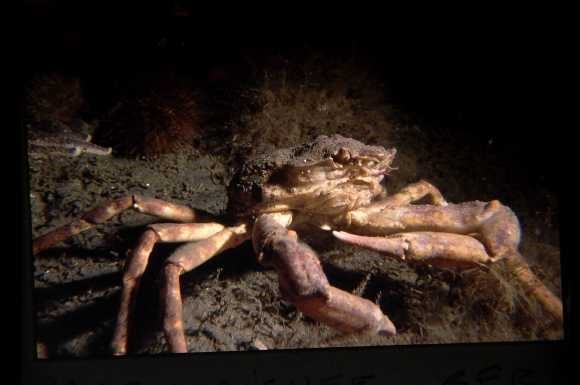
Contracted crab on seabed seen from the side. Photo credit: J. Laliberté
Arctic contracted crab (Hyas alutaceus)

Arctic contracted crab and its identification criteria. Photo credit: Jean-François Rousseau
Long description:
Arctic contracted crab where the different structures used for identification are pointed out:
- Claw-bearing legs as long as walking legs
- Maximum carapace width of 6.5 cm
- Thin walking legs with a final segment that can be hairy
Characteristics
Carapace: contracted first third, giving it a violin shape
Colour: brownish-grey, sometimes reddish, with a white belly

Drawing of an Arctic contracted crab shell, showing its short rostrum and the contraction of its shell. Illustration: Pohle 1990. A guide to decapod Crustacea from the Canadian Atlantic: Anomura and Brachyura. Can. Tech. Rep. Fish. Aquat. Sci. 1771

Arctic contracted crab partially hidden among algae. Photo credit: Laurent Fey
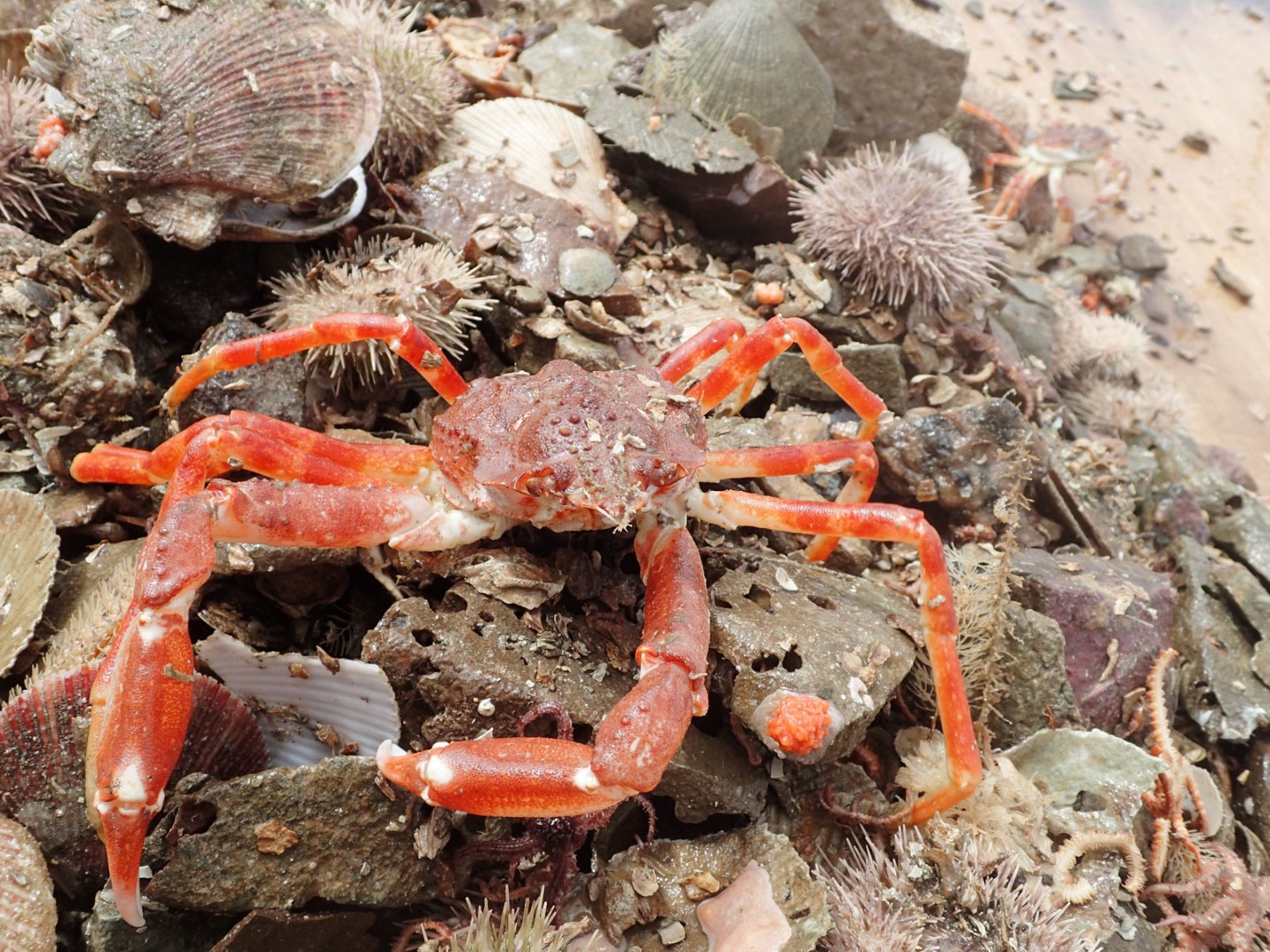
Arctic contracted crab on rocks out of water. Photo credit: Claude Nozères
Toad crab (Hyas Araneus)

Toad crab and its identification criteria. Illustration: Pohle 1990. A guide to decapod Crustacea from the Canadian Atlantic: Anomura and Brachyura. Can. Tech. Rep. Fish. Aquat. Sci. 1771. Photo credit: Claude Nozères
Long description:
Toad crab where the different structures used for identification are pointed out:
- Prominent rostrum tapered with a slit in the middle that meets at the tip
- Claw-bearing legs shorter than as walking legs
- Maximum carapace width of 6.5 cm
- Thin walking legs
At the top of the photo of the toad crab, a drawing close-up of the rostrum points to this part of the crab in the photo.
Characteristics
Carapace: attaches debris and invertebrates to its carapace (algae, anemone, etc.)
Colour: reddish-brown to olive green with reddish-orange legs
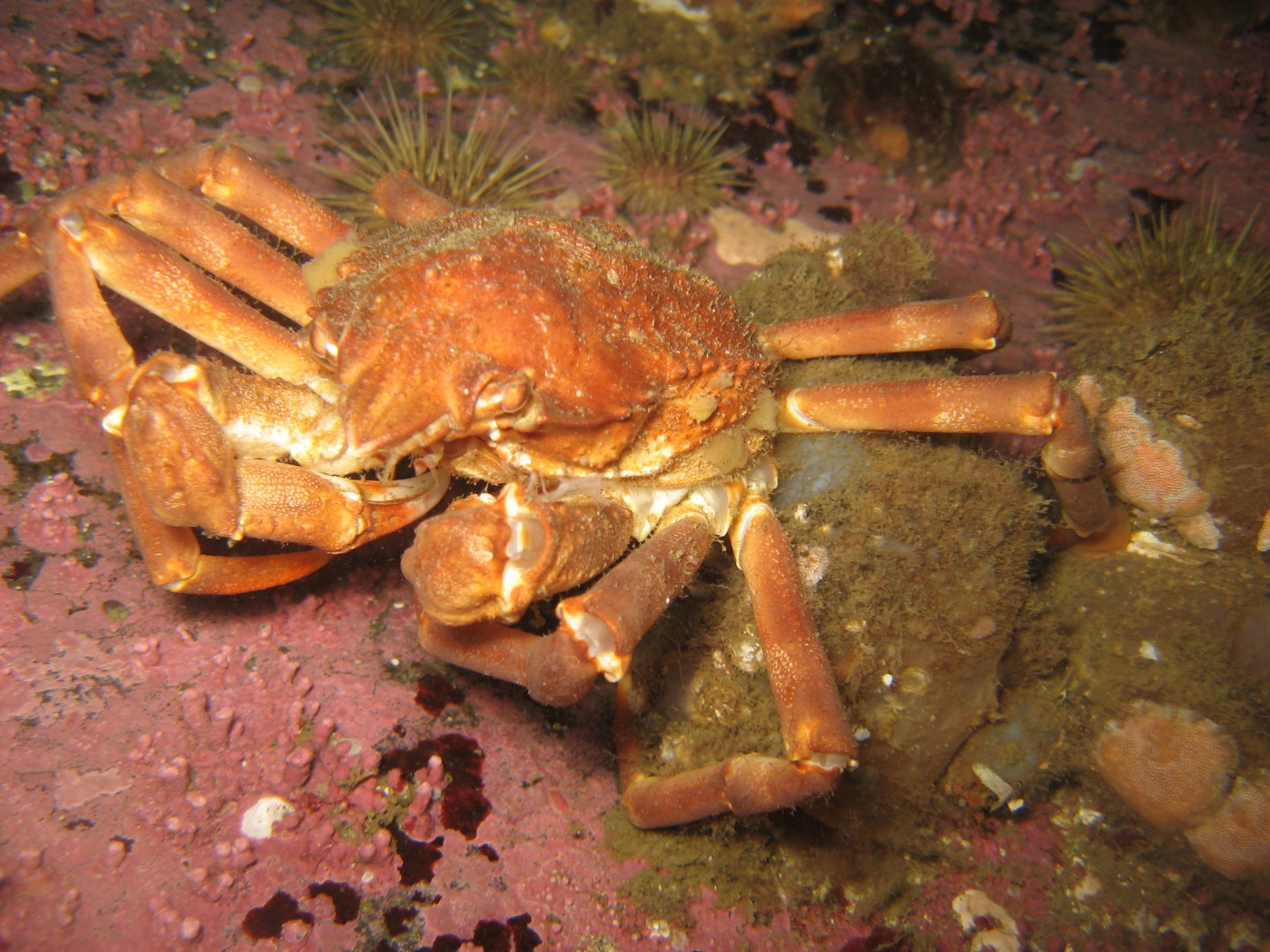
Toad crab on the seabed. Photo credit: Laurent Fey
Crab of Genus Hyas
The 3 species of crabs in the genus Hyas are often confused. This map shows the combined observations recorded for all three species. The toad crab is found throughout eastern Canada. The contracted crab is in the Bay of Fundy and western Nova Scotia, while the Arctic contracted crab lives in the Gulf of St. Lawrence up to the coast of Newfoundland and Labrador. Live below the tide line, generally between 10 and 50 m deep. Can be found on rocky bottoms, but also on sandy bottoms or soft sea beds.
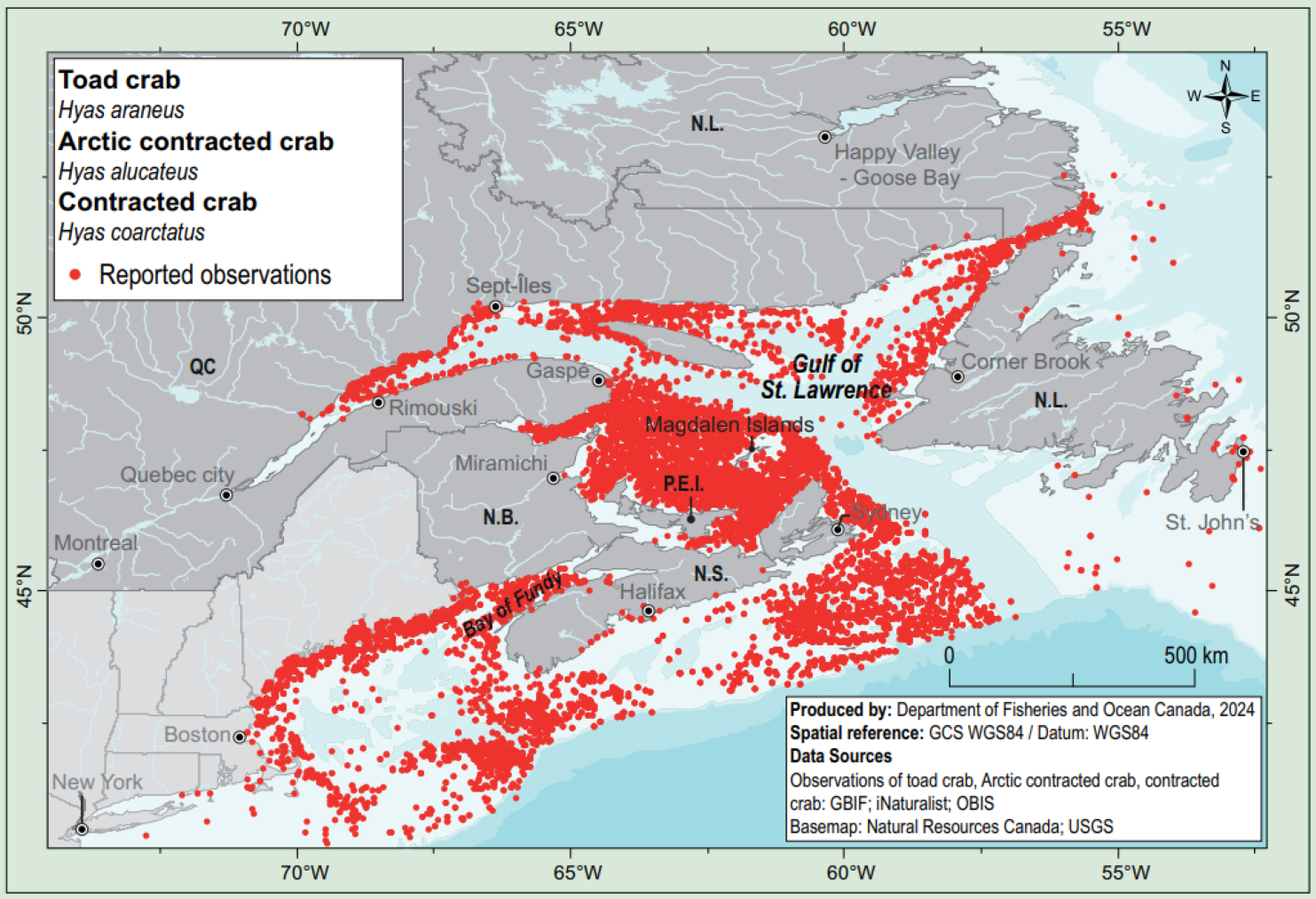
Long description:
Map of the Hyas genus crabs reported observations (red dots) of eastern Canada
- Hyas crabs are found in the St. Lawrence Estuary from the Saguenay Fjord onwards. They are found throughout the Gulf of St. Lawrence, with a higher number of observations in the south. It is found offshore and on the United States coast as far south as New York City. In the north, sightings have been reported off the Atlantic coast of Newfoundland and Labrador.
Produced by: Department of Fisheries and Ocean Canada, 2024
Spatial reference: GCS WGS84 / Datum: WGS84
Data sources
Observations of toad crab, Arctic contracted crab, contracted crab: GBIF; iNaturalist; OBIS
Basemap: Natural Resources Canada; USGS
Portly spider crab (Libinia emarginata)
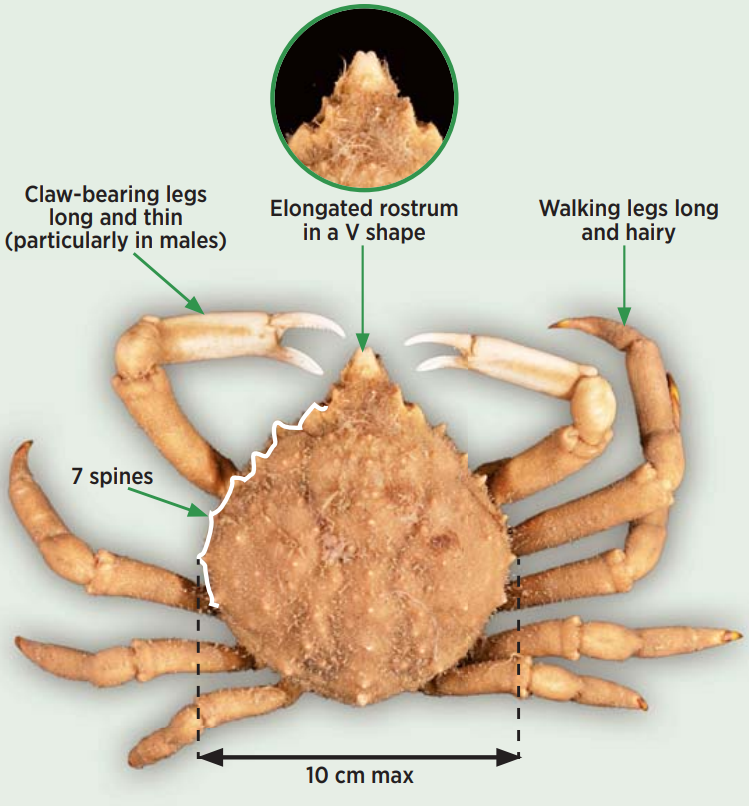
Portly spider crab and its identification criteria. Photo credit: Eric A. Lazo-Wasem
Long description:
Portly spider crab where the different structures used for identification are pointed out:
- Elongated rostrum in a V shape
- Claw-bearing legs long and thin (particularly in males)
- Walking legs long and hairy
- Seven spines found on the outer sides of each eye
- Maximum carapace width of 10 cm
At the top of the photo of the portly spider crab, a close-up on the elongated rostrum in a V shape.
Characteristics
Carapace: round, covered with many spines:
- seven on each side of the carapace
- nine along the central margin of the body
- two in a direct line behind the eyes
Colour: varies from brown to yellowish-grey, can cover itself with debris and small invertebrates for camouflage

Portly spider crab seen from behind on the seabed. Photo credit: Laura Kushner
Lives in saltwater on a wide variety of seabed types. Generally found at depths between 0 and 50 m but can be found down to 120 m.

Long description:
Map of the portly spider crab reported observations (red dots) of eastern Canada
- The portly spider crab is found at the head of the Bay of Fundy. It has also been found along the United State Atlantic coast, from New York City (the edge of the map) to Boston. A few other sightings have been recorded further north on the Maine coast
Produced by: Department of Fisheries and Ocean Canada, 2024
Spatial reference: GCS WGS84 / Datum: WGS84
Data sources
Observations of portly spider crab: GBIF; iNaturalist; OBIS
Basemap: Natural Resources Canada; USGS
Watchlist species
Blue crab (Callinectes sapidus)

Blue crab and its identification criteria. Photo credit: Wendy Kaveney, The Children’s Museum of Indianapolis
Long description:
Blue crab where the different structures used for identification are pointed out;
- Movable finger blue for males and red for females
- Bright blue claws
- Nine spines found on the outer sides of each eye
- Four triangular spines found between the eyes
- Carapace width around 20 cm
- Last pair of legs are paddle-shaped for swimming
Characteristics
Carapace: last spine is very pointed and twice as large as the others
Colour: olive green, bluish, with a bit of grey
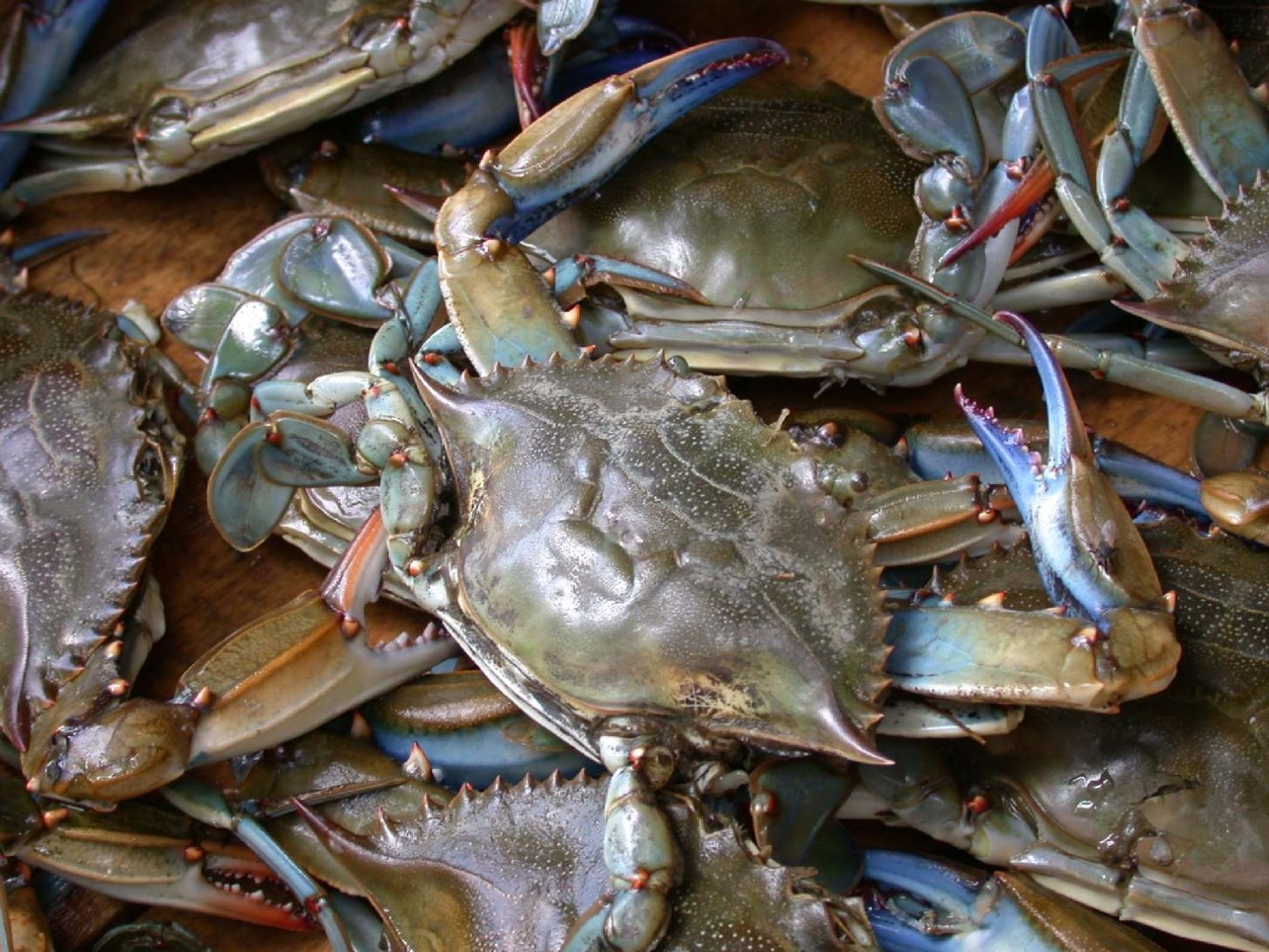
Blue movable fingers of a male blue crabs. Photo credit: wpopp

Red movable fingers of a female blue crab on sand out of water, dorsal view. Photo credit: James St. John
Generally found in marine environments but also tolerates brackish waters of estuaries as well as freshwater. Prefers sheltered coastal waters and lagoons. Generally occurs at depths less than 35 m. Lives both on the seabed and in the water column.
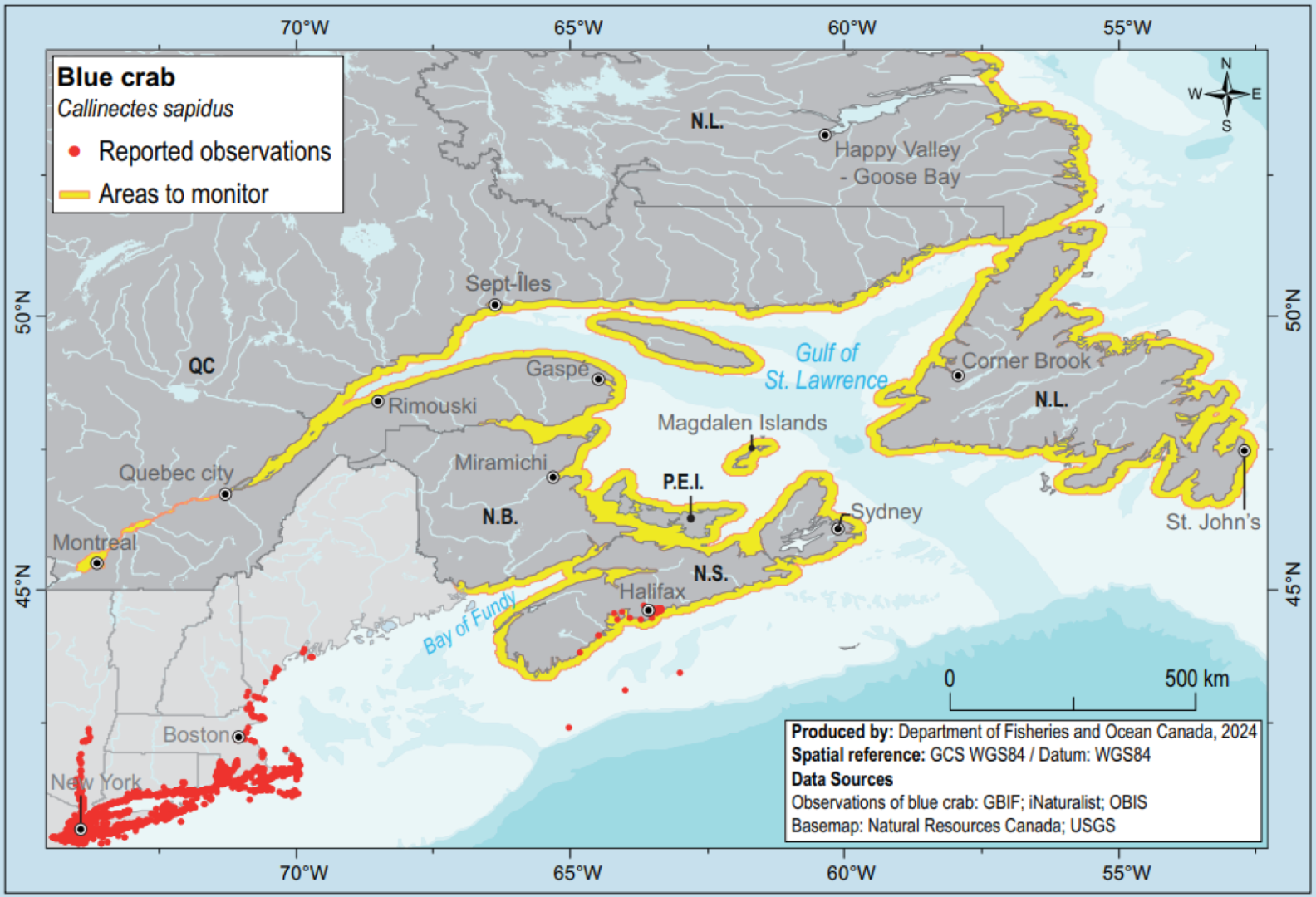
Report sightings in the areas to monitor
Long description:
Map of the blue crab reported observations (red dots) and areas to monitor (yellow zones) of eastern Canada
- The blue crab is found along the United States coast and estuaries, mainly between New York City (the edge of the map) and Boston. Sightings have also been reported around Halifax. A few sightings have been recorded further offshore, on the Scotian Shelf.
- The area to be monitored covers the entire eastern Canadian coastline.
Produced by: Department of Fisheries and Ocean Canada, 2024
Spatial reference: GCS WGS84 / Datum: WGS84
Data sources
Observations of blue crab: GBIF; iNaturalist; OBIS
Basemap: Natural Resources Canada; USGS
Atlantic ghost crab (Ocypode quadrata)

Atlantic ghost crab and its identification criteria. Photo credit: Martin-Lefèvre P. Muséum national d’histoire naturelle
Long description:
Atlantic ghost crab where the different structures used for identification are pointed out:
- Claws of different sizes
- Carapace width around 5 cm
Characteristics
Carapace: square-shaped
Colour: very pale, even white or sand-coloured with yellow leg
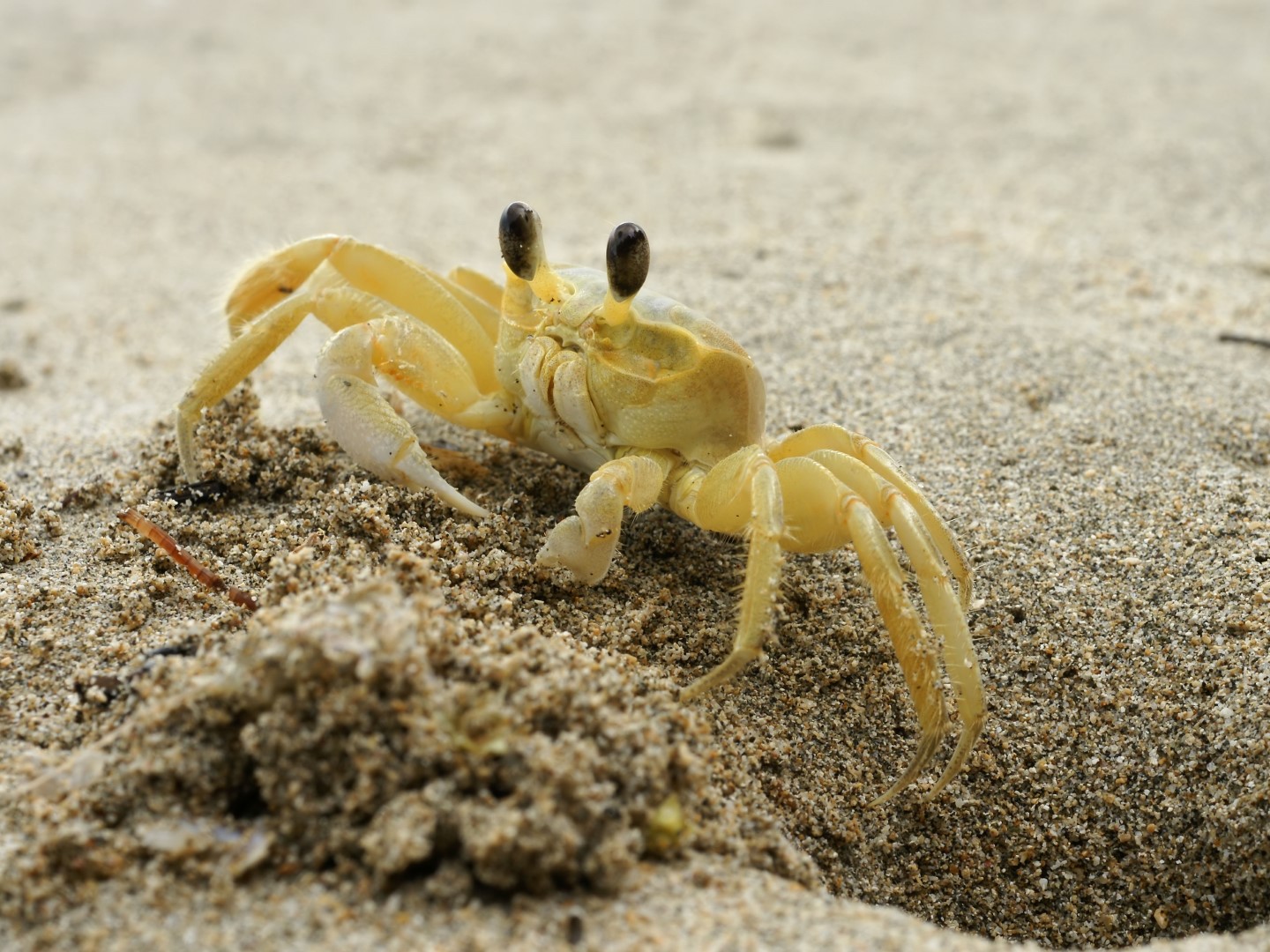
Eyes sticking out of the carapace of an Atlantic ghost crab. Photo credit: Hans Hillewaert
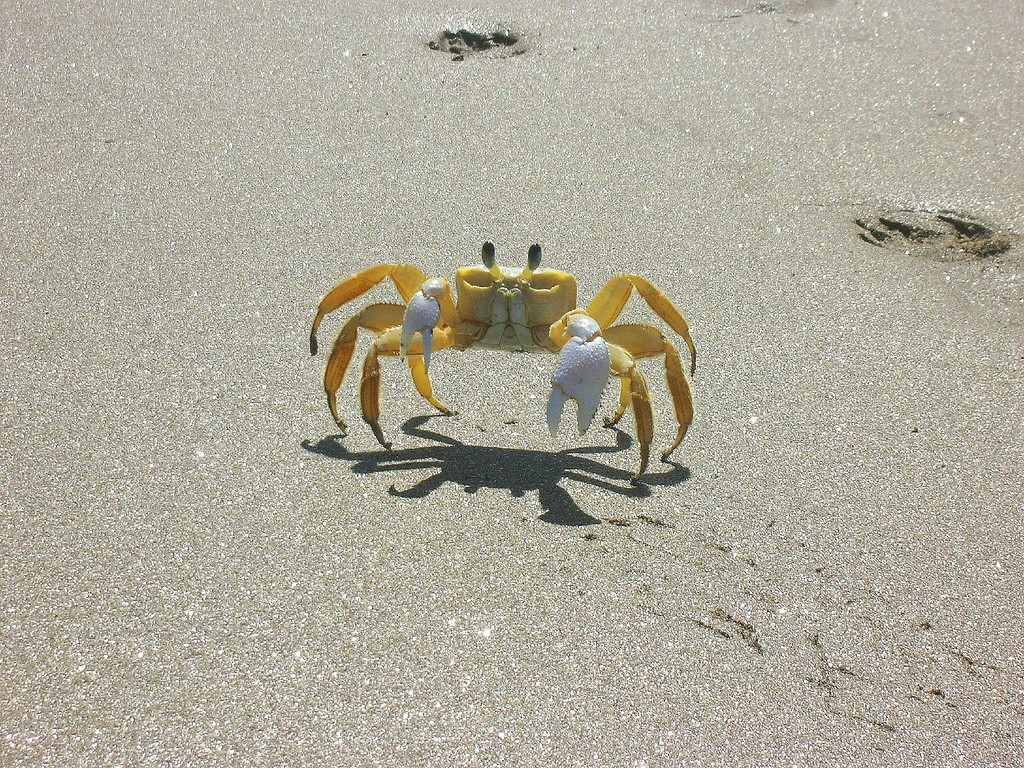
Atlantic ghost crab moving on sand out of water, front view. Photo credit: Marina Campos Vinhal
Found in tropical and subtropical regions as well as on sandy beaches. Occurs in the supralittoral zone, which is the area that is almost always above the waterline but remains wet due to wave action.
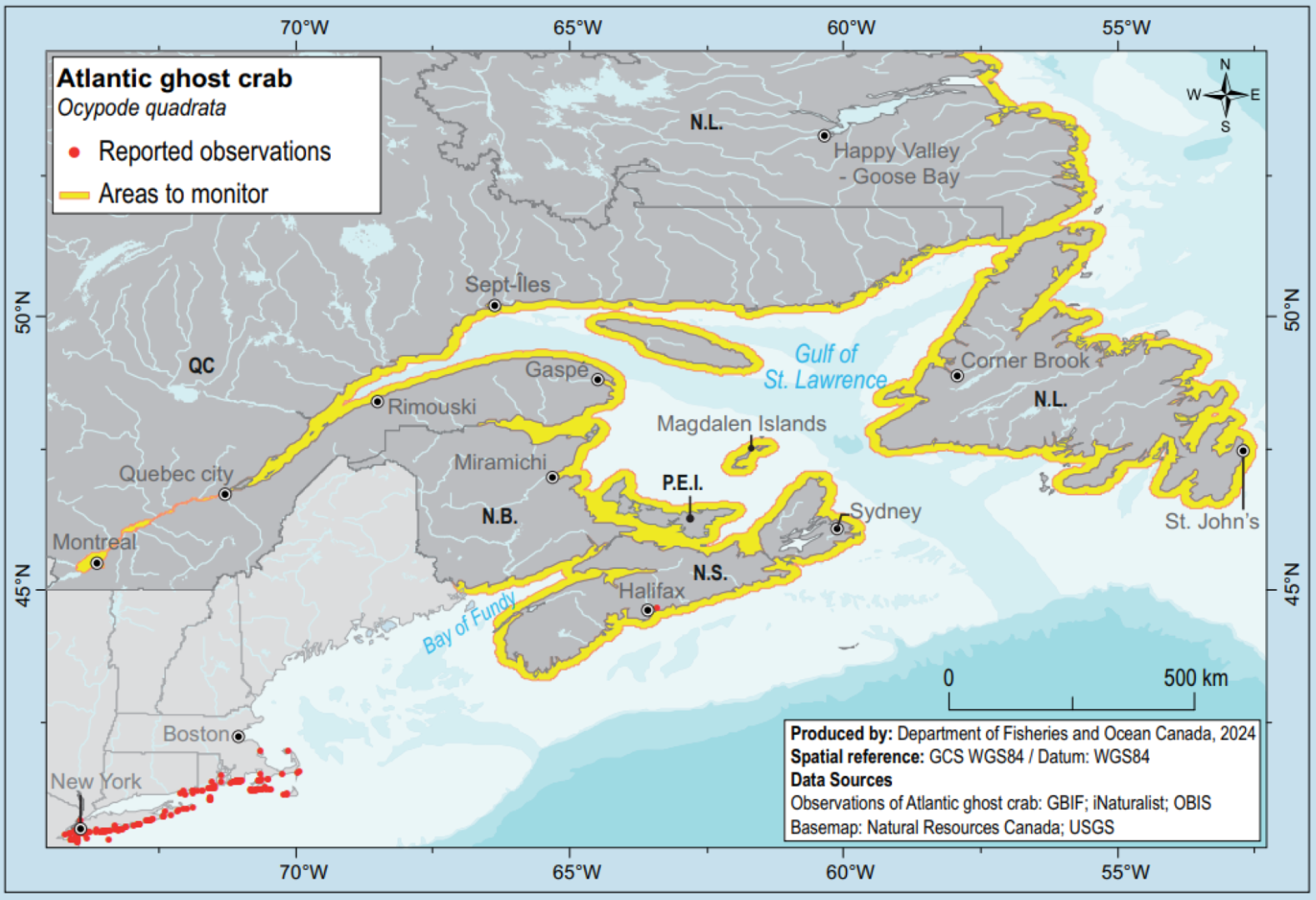
Report sightings in the areas to monitor
Long description:
Map of the Atlantic ghost crab reported observations (red dots) and areas to monitor (yellow zones) of eastern Canada
- The presence of the Atlantic ghost crab has been recorded on the United States Altantic coast between New York City (the limit of the map) and southern Massachusetts. One sighting was made around Halifax.
- The area to be monitored covers the entire Canadian coastline.
Produced by: Department of Fisheries and Ocean Canada, 2024
Spatial reference: GCS WGS84 / Datum: WGS84
Data sources
Observations of Atlantic ghost crab: GBIF; iNaturalist; OBIS
Basemap: Natural Resources Canada; USGS
Gulfweed crab (Planes minutus)

Gulfweed crab and its identification criteria. Photo credit: Duris Z.
Long description:
Gulfweed crab where the different structures used for identification are pointed out:
- Walking legs have blunted spines on one side and dense hairs on the other side
- Carapace width of around 2 cm
Characteristics
Carapace: square-shaped
Colour: variable, enabling camouflage, white spots on the sides or front of the carapace

Gulfweed crab moving out of water on rocks, dorsal view. Photo credit: Paul Tavares
Lives floating on Sargassum algae, far from the seabed and shores. Rarely found on the Atlantic coast of Canada.
Report sightings in the areas to monitor
Long description:
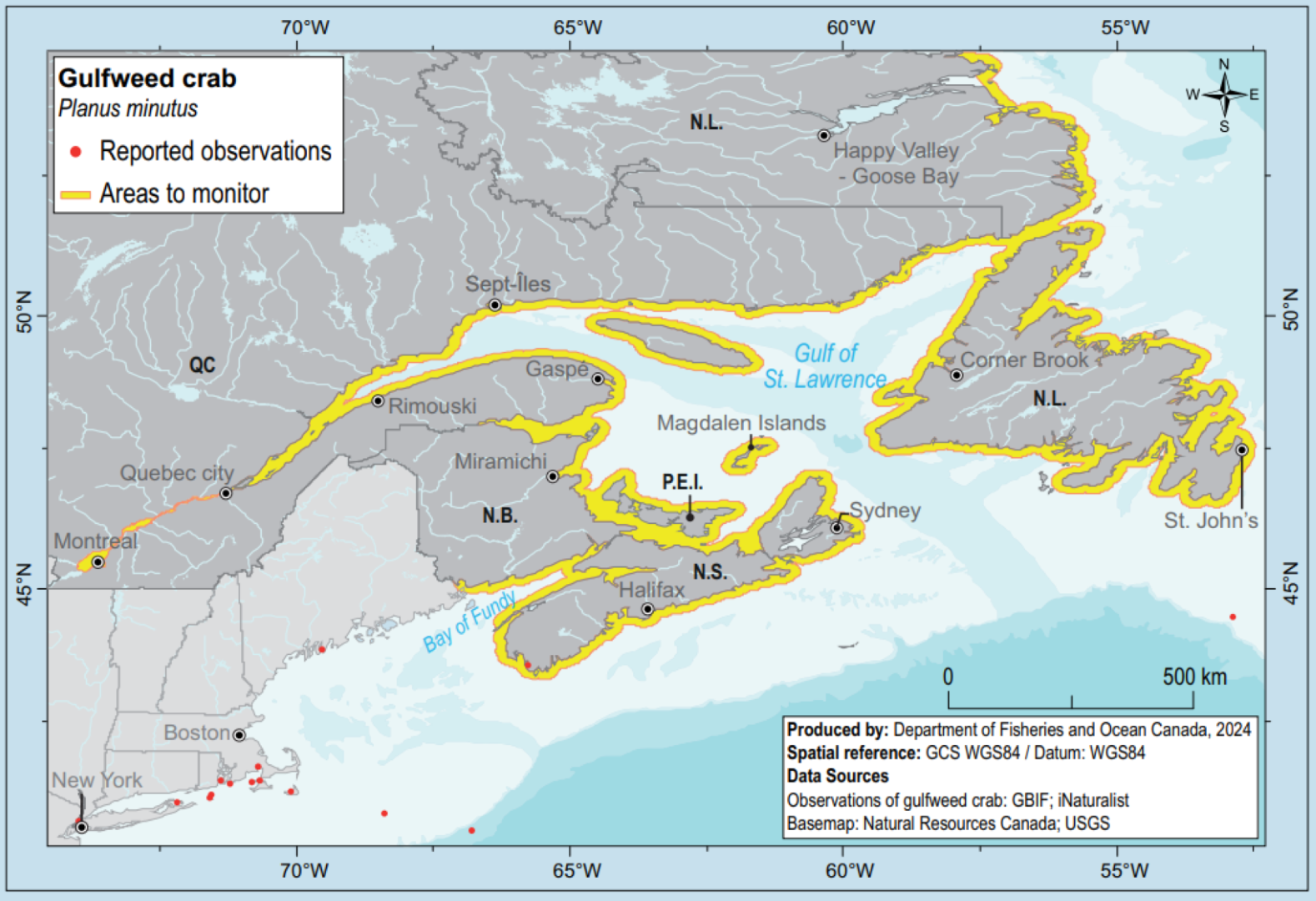
Map of the gulfweed crab reported observations (red dots) and areas to monitor (yellow zones) of eastern Canada
- Gulfweed crabs are sporadically found offshore and on the United States Atlantic coast.
- The area to be monitored covers the entire Canadian coastline.
Produced by: Department of Fisheries and Ocean Canada, 2024
Spatial reference: GCS WGS84 / Datum: WGS84
Data sources
Observations of gulfweed crab: GBIF; iNaturalist
Basemap: Natural Resources Canada; USGS
What to do if you find aquatic invasive species?
- Try to identify them;
- Take pictures, note the location (GPS coordinates), number of individuals (if possible), and observation date;
- Report any aquatic invasive species sightings to Fisheries and Oceans Canada:
- dfo.queais-eaeque.mpo@dfo-mpo.gc.ca
- 1-877-722-4828
Never release aquarium animals, aquatic garden plants, live food, or live bait into rivers, streams, lakes, ponds, sewers, or the ocean. Crabs can only be released into the waters where they were captured and should never be moved from one place to another.
Fisheries and Oceans Canada
© His Majesty the King in Right of Canada, represented
by the Minister of Fisheries and Oceans Canada, 2025.
Fs124-12/2025E-PDF
978-0-660-74674-6
March 2025
Cette publication est également disponible en français.
Page details
- Date modified: