
Petrale Sole (Eopsetta jordani)
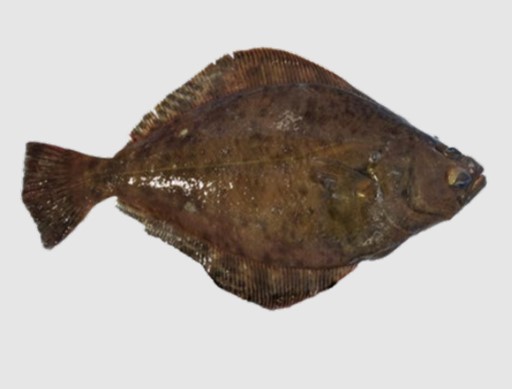
Adult Petrale Sole. Source: Jillian Dunic (DFO)
On this page
- Species overview
- Fishery history
- Ecosystem context
- Science advice and research
- Integrated Fisheries Management Plan
- Sources
- Related links
Species overview
Physical description
Petrale Sole is a flatfish found in British Columbia (BC). It has a smooth, oval-shaped body. Both eyes are on the right side of its body. The top side of its body is light to medium brown. This helps it blend into the ocean floor. The underside of its body is pale or white.
Petrale Sole has a lateral line along its body that helps detect movement in the water. It has a continuous dorsal fin that runs from above the eye to the tail. It has a similar anal fin below. Its fins are soft-rayed.
Petrale Sole can weigh up to 3.7 kilograms (kg). Males can grow 45 centimetres (cm) long. Females are slightly larger, growing up to 55 cm long.
Petrale Sole is also called:
- Sole
- Flounder
- Round-nosed Sole
- Petral
Distribution
Petrale Sole is a groundfish found from Alaska to Mexico. It is well adapted to life on the ocean floor. It prefers sand, silt, or mud at depths between 0 to 500 metres (m). It can tolerate a wide range of bottom temperatures.
Petrale Sole distribution is strongly connected to the seasons. In winter, Petrale Sole migrates south and offshore where it gathers in deeper waters for spawning. In summer, it migrates north and inshore to shallower waters for feeding along the continental shelf.
Life cycle
Petrale Sole can live for up to 35 years. Both males and females reach sexual maturity around 5 years old. Both sexes spawn in deep water (200 to 500 m). They are capable of spawning multiple times in their lives.
Petrale Sole is a broadcast spawner, meaning males and females release eggs and sperm into the water for fertilization. Spawning occurs between November to March. Depending on water temperature, eggs hatch between 6 to 13 days. Larvae spend 5 to 6 months in the water column before settling on the bottom.
Fishery history
In BC, Petrale Sole is caught as part of the multispecies groundfish trawl fishery. The coast-wide Total Allowable Catch (TAC) is 1,500 tonnes (t). The stock is assessed as a single coast-wide stock, including Pacific fishing areas 3CD and 5ABCDE (Figure 1).
Before the 1930s, the commercial fishery was small. Many fish were caught by American boats in Canadian waters. Fishing activity focused on the Strait of Georgia (Area 4B). The fishery grew quickly from the 1930s to 1950s because Petrale Sole was in high demand as a food fish. In 1945, fishers discovered spawning areas in deep waters off of Vancouver Island. This helped keep catch levels stable even as inshore fishing caught fewer fish.
By the late 1950s and 1960s, the number of Petrale Sole in BC had dropped. To protect the population, rules to limit fishing around spawning areas were introduced. These included seasonal limits and restrictions on targeting Petrale Sole. Petrale Sole became a species of secondary importance for the trawl fishery. Between 1996 and 1997, the fishery switched to Individual Transferable Quotas (ITQs). A coast-wide limit on total catch was set.
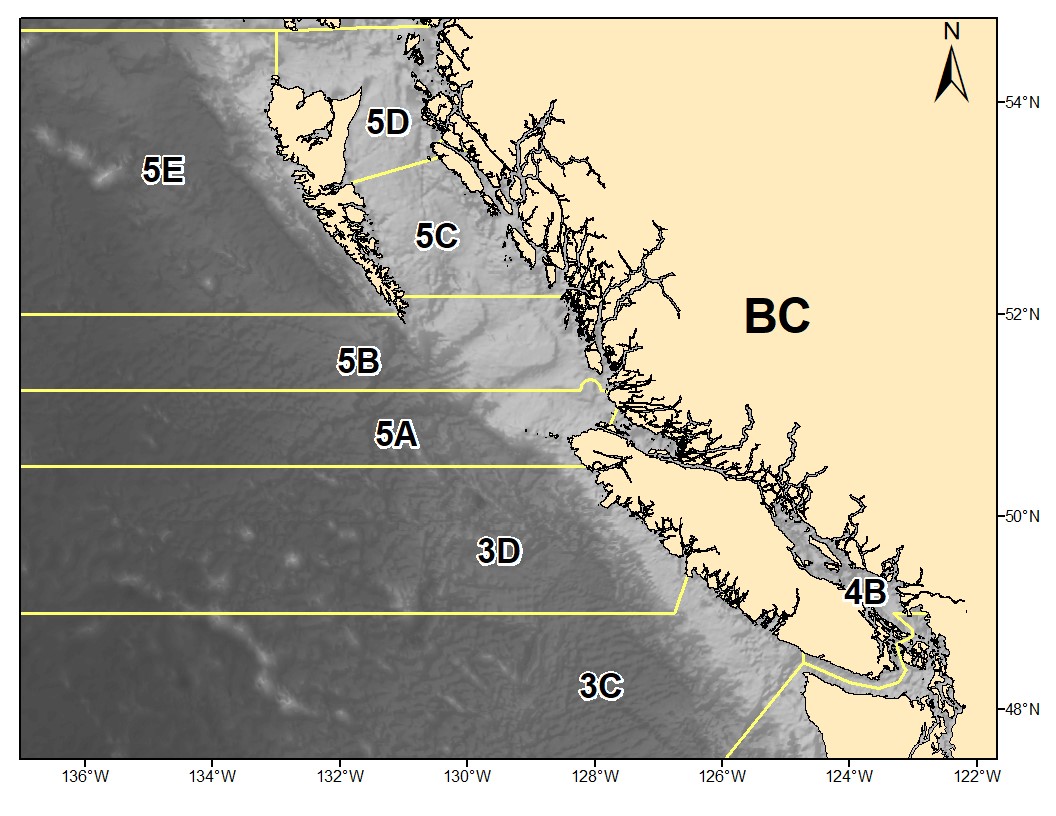
Figure 1. A map of the coastal and offshore waters surrounding British Columbia (BC), divided into Pacific fishing areas (outlined in yellow). The locations of three major underwater canyons along the central coast are located in 5ABC on the map.
Ecosystem context
Petrale Sole larvae feed on plankton. As they grow, their diet shifts to:
- juvenile flatfish
- shrimp
- other crustaceans
Adults feed on fish and pelagic invertebrates, such as:
- krill
- Herring
- Sand lance
- shrimp
Petrale Sole are eaten by:
- larger flatfishes
- sharks
- pelagic fishes
- bottom-feeding marine mammals
Climate change causes changes in temperature, current patterns, and oxygen levels in the ocean. For Petrale Sole, this may affect:
- food availability
- growth rates
- reproductive success
- species distribution
- survival
Research suggests that there may be a positive association between water temperature and productivity for Petrale Sole.
Science advice and research
Science advice and research for Petrale Sole
Integrated Fisheries Management Plan
Integrated Fisheries Management Plan for Petrale Sole
Sources
- DFO. 2025. Assessment of Petrale Sole in British Columbia in 2024. PDF 903KB
- Fisheries and Oceans Canada. 2025. Groundfish Integrated Fisheries Management Plan 2025/26. 23-2470.311 p. PDF 12.2MB
- Ketchen, K. S., and Forrester, C. R. 1966. Population dynamics of the Petrale Sole, Eopsetta jordani, in waters off western Canada (No. 153). Fisheries Research Board of Canada. PDF 3.5MB
- NOAA Fisheries. 2024. Petrale Sole (Eopsetta jordani). NOAA Fisheries Species Directory.
- Powell, A., et al. 2022. First autonomous underwater vehicle observations of a potential Petrale Sole (Eopsetta jordani) spawning aggregation off the US West Coast. Frontiers in Marine Science, 9, 834839.
Related links
- Date modified: