
Pacific Ocean Perch (Sebastes alutus)
On this page
- Species overview
- Fishery history
- Ecosystem context
- Science advice and research
- Integrated Fisheries Management Plan
- Sources
Species overview
Physical description
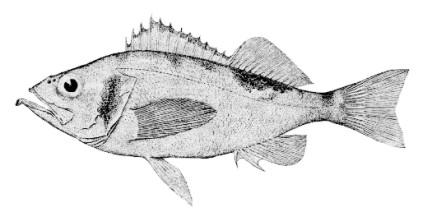
Pacific Ocean Perch is red with olive green to brown or black patches. Colour variants range from brick red to pale red, with varying intensity of patches. Deeper-water dwellers are generally darker red. Pacific Ocean Perch may be confused with other rockfish species, such as Yellowmouth, Sharpchin, and Redstripe.
Pacific Ocean Perch has a short, thin body that narrows towards its tail, and a large mouth with a protruding lower jaw. The lower jaw has a prominent, cone-shaped knob on the end. It has several sharp dorsal spines followed by a flat dorsal fin. Its tail has a slight indent.
Young juveniles resemble adults, although they are longer with paler red upper parts that blend into a white-silver lower body. Juvenile fins have little colour and no patches, however as they age gradually acquire deeper colour. Juveniles are also commonly found higher in the water column.
Pacific Ocean Perch grows slowly to a maximum length of approximately 50 centimetres and a maximum weight of approximately 2.05 kilograms, and can live for almost a century.
Distribution

The distribution of Pacific Ocean Perch forms an arc along the North Pacific rim from Honshu, Japan to Baja California, Mexico. It is most abundant from the northern Kuril Islands, Russia to northern California, USA. In Canada, its range is almost continuous along the coast of British Columbia, with breaks in the upper Hecate Strait and off the southwest coast of Haida Gwaii.
Pacific Ocean Perch lives in deep waters along the edge of the continental shelf. Adults inhabit depths from 90 to 825 metres and prefer sandy and rocky habitat in areas with vertical relief or coral. During the day, they move higher in the water column following the daily migration of their primary food source, krill. Larvae and juveniles can be found near the surface, while sub-adults and adults can both be found near the walls of underwater canyons.
Life cycle
Adult Pacific Ocean Perch migrate to shallow waters (200 to 400 m) in the summer for feeding and spawning. In the fall, females migrate deeper (500 to 700 m) to release larvae near the mouths of submarine canyons. Pacific Ocean Perch do not reproduce until they are about 10 years old. Each female can produce between 10,000 and 500,000 eggs. Eggs develop inside females and hatch internally. The larvae are released in the spring.
Fishery history
Pacific Ocean Perch is a commercially important species that supports the second largest rockfish fishery in British Columbia. It has an important economic and cultural impact on smaller communities in British Columbia like Prince Rupert.
A trawl fishery for slope rockfish has existed in British Columbia since the 1940s. In addition to Canadian trawlers, foreign fleets have targeted Pacific Ocean Perch in British Columbian waters for about two decades. These fleets came from the USA (1950 to 1975), the USSR (1965 to 1972) and Japan (1966 to 1977). Foreign vessels removed large amounts of rockfish biomass, including Pacific Ocean Perch, particularly in Queen Charlotte Sound, where the species is most abundant. There was a steep decline in female spawning biomass from 1965 to 1984. Biomass then increased until 1990, followed by another decline from 1994 to 2007, where it remained low until 2014. After this, the coastwide spawning biomass has increased until present.
Starting in 1979, Fisheries and Oceans Canada (DFO)'s Groundfish Management Unit (GMU) imposed Total Allowable Catches (TACs) on Pacific Ocean Perch. In the 1980s, experimental over-harvesting was attempted in 2 regions along the coast of British Columbia.
- Off the west coast of Vancouver Island, the TAC was set at 500 tonnes (t) in 1980 before returning to 300 t in 1984. The TAC was reduced to 100 t in 1986 and remained low until 1993.
- Off the northwest coast of Haida Gwaii, TACs were removed entirely in 1983 to allow 5 years of unrestricted fishing followed by 5 years of severely limited fishing. A scheduled closure set for 1988 did not occur because the harvesters and the region had become dependent on the higher harvest levels. In 1993, the area was closed to all trawl fishing.
In 1996, an onboard observer program for Pacific Ocean Perch was initiated. The program placed observers aboard all offshore trawl vessels. In 1997, an Individual Vessel Quota system was put in place to allocate tradable rights to each registered vessel for a share of the TAC. In 2001, DFO reduced the 5CD TAC of Pacific Ocean Perch by 300 t, and by 700 t in 2006. After 2010, DFO implemented a conservation-measure TAC reduction in 5AB+5CD of 258 t per year over a 3-year period.
In 2012, measures were introduced to reduce and manage coral and sponge bycatch by the British Columbia groundfish bottom trawl fishery. These measures were developed jointly by industry and environmental non-governmental organizations. Measures included:
- limiting the footprint of groundfish bottom trawl activities
- establishing a combined bycatch conservation limit for corals and sponges
- establishing an encounter protocol for individual trawl tows when the combined coral and sponge catch exceeded 20 kg
These measures have been incorporated into DFO's Pacific Region Groundfish Integrated Fisheries Management Plan and apply to all vessels using trawl gear in British Columbia.
Ecosystem context
Pacific Ocean Perch larvae eat zooplankton. Juveniles eat copepods. Adults eat crustaceans (e.g., krill, shrimp) and small fish.
Species that feed on juvenile Pacific Ocean Perch include:
- Albacore Tuna
- seabirds
- other rockfish
- salmon
- Lingcod
- other large bottom-dwelling fish
Species that feed on adult Pacific Ocean Perch include:
- Sablefish
- Pacific Halibut
- Sperm whales
- Northern Fur Seals
Science advice and research
Science advice and research of Pacific Ocean Perch
Integrated Fisheries Management Plan
Integrated Fisheries Management Plan for Pacific Ocean Perch
Sources
- Leaman 1998. Experimental rockfish management and implications for rockfish harvest refugia. In M. Yoklavich, ed., Marine Harvest Refugia For West Coast Rockfish: A Workshop, p. 17–26. NOAA-TM-NMFS-SWFSC-255
- Leaman and Stanley 1993. Experimental management programs for two rockfish stocks off British Columbia, Canada. In S. J. Smith, J. J. Hunt and D. Rivard, eds., Risk evaluation and biological reference points for fisheries management, p. 403-418. Canadian Special Publication of Fisheries and Aquatic Sciences 120.
- Love et al. 2002. The Rockfishes of the Northeast Pacific. University of California Press, Berkeley and Los Angeles, California.
- Stocker 1981. Groundfish stock assessments off the west coast of Canada in 1981 and recommended total allowable catches for 1982. Can. Manuscr. Rep. Fish. Aquat. Sci. 1626. xxx + 282 p.
- Wallace et al. 2015. Canada's Pacific groundfish trawl habitat agreement: A global first in an ecosystem approach to bottom trawl impacts. Mar. Pol. 60: 240-248.
Page details
- Date modified: