
Dover Sole (Microstomus pacificus)
On this page
- Species overview
- Fishery history
- Ecosystem context
- Science advice and research
- Integrated Fisheries Management Plan
- Sources
- Related links
Species overview
Physical description
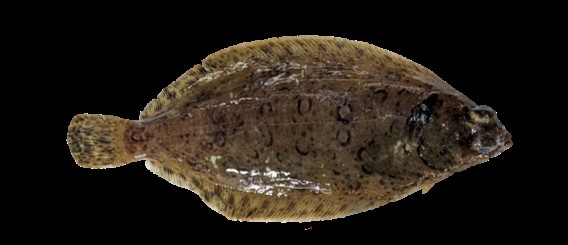
Dover Sole is a flatfish found in British Columbia (BC). It has a smooth, oval-shaped body. Both eyes are on the right side of its body. The top side of its body is greyish-brown. This helps it blend into the ocean floor. The underside of its body is pale or white.
Dover Sole has a lateral line along its body that helps detect movement in the water. It has a continuous dorsal fin that runs from above the eyes to the tail. It has a similar anal fin below.
Dover Sole can grow up to 60 centimetres (cm) long. It can weigh over 3.5 kilograms (kg).
Dover Sole is also called:
- Sole
- Slippery Sole
- Slime Sole
- Lemon Sole
Distribution
Dover Sole is a deep-water groundfish and is found from Alaska to Mexico. It lives between 30 and 1500 metres (m) deep. It moves into deeper waters during the winter for spawning.
Life cycle
Dover Sole can live for over 50 years. Males reach sexual maturity around age 4. Females mature between 5 to 6 years old.
Dover Sole spawns near the ocean floor in waters deeper than 430 m. In BC, spawning occurs between January and March. Dover Sole is a broadcast spawner, meaning males and females release eggs and sperm into the water for fertilization. Females can produce between 52,000 to 266,000 eggs. Eggs are fertilized in shallower waters. Juveniles migrate to deeper water after hatching.
Fishery history
In BC, Dover Sole is caught in the multi-species groundfish trawl fishery. They occur in each of the Pacific fishing areas (Figure 1) within Canada’s Exclusive Economic Zone (EEZ). In late fall and winter, fishing occurs in waters 400 to 1000 m deep off the west coast of Vancouver Island and Haida Gwaii. In spring and summer, fishing occurs in shallower waters 100 to 200 m deep in:
- Hecate Strait
- Queen Charlotte Sound
- west coast of Vancouver Island
The commercial fishery for Dover Sole began in the early 1950s. From 1950 to 1987, coastwide landings were between 500 and 1000 tonnes (t). Coastwide landings increased significantly between 1988 and 1998 with the development of the deepwater trawl fishery off the west coast of Vancouver Island. The fishery was regulated using area quotas until 1996. In 1996, Individual Transferable Quotas (ITQs) were introduced.
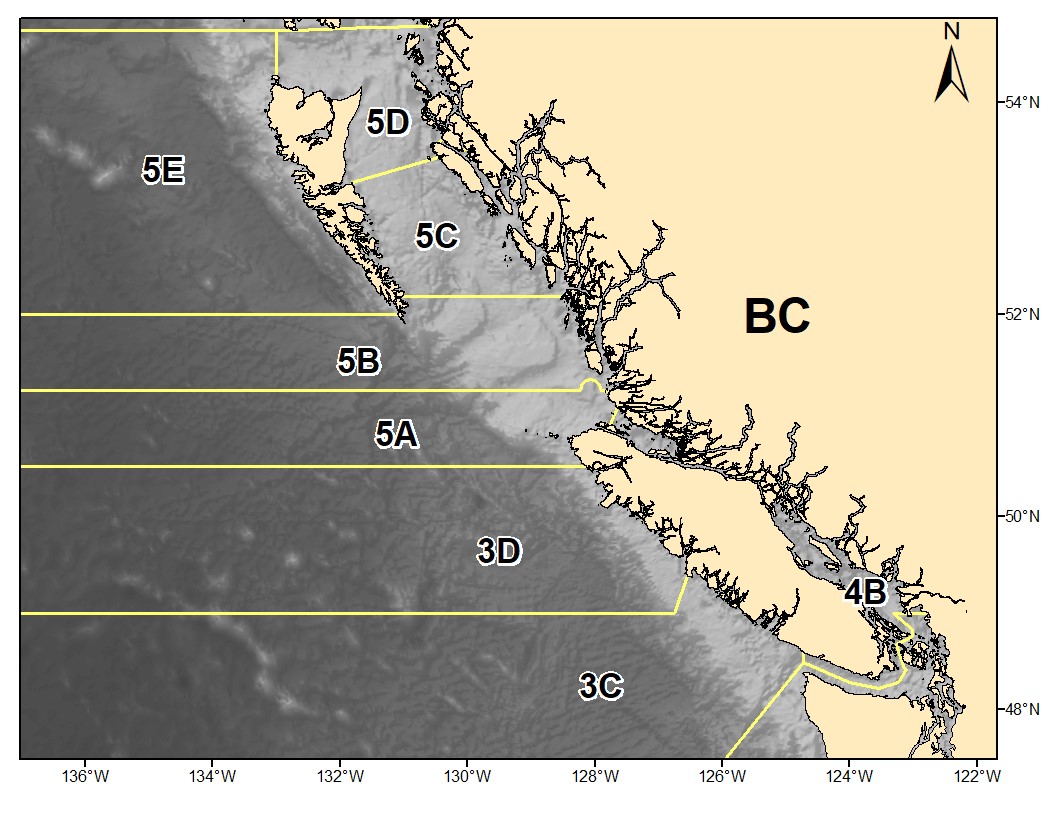
Figure 1. A map of the coastal and offshore waters surrounding British Columbia (BC), divided into Pacific fishing areas (outlined in yellow). The locations of three major underwater canyons along the central coast are located in 5ABC on the map.
Ecosystem context
Dover Sole is adapted to life on the seafloor. It is active mostly at night. Its ability to camouflage and burrow into sediment helps it avoid predators and catch prey. Adult Dover Sole feed on:
- worms
- bivalves
- Brittle stars
- bottom-dwelling crustaceans
Dover Sole is eaten by:
- sharks
- marine mammals
- Pacific Cod
- Arrowtooth Flounder
- Sablefish
Climate change causes changes in temperature, current patterns, and oxygen levels in the ocean. For Dover Sole, this may affect:
- food availability
- growth rates
- reproductive success
- species distribution
- survival
Science advice and research
Science advice and research for Dover Sole
Integrated Fisheries Management Plan
Integrated Fisheries Management Plan for Dover Sole
Sources
- DFO. 1998. Pacific Dover Sole. Canadian Science Advisory Secretariat. Fisheries and Oceans Canada. Retrieved from https://waves-vagues.dfo-mpo.gc.ca/Library/331696.pdf (PDF, 51.3KB)
- DFO. 1999. Pacific Dover Sole. Canadian Science Advisory Secretariat Research Document 1995/045. Fisheries and Oceans Canada. Retrieved from https://waves-vagues.dfo-mpo.gc.ca/Library/331698.pdf (PDF, 161KB)
- Fisheries and Oceans Canada. 2025. Groundfish Integrated Fisheries Management Plan 2025/26. 23-2470.311 p. https://publications.gc.ca/collections/collection_2025/mpo-dfo/Fs143-3-23-2527-eng.pdf (PDF, 12.2MB)
- Hagerman, F. B. 1952. The Biology of the Dover Sole, Microstomus pacificus (Lockington). State of California Department of Fish and Game Bureau of Marine Fisheries. Fish Bulletin No. 85.
- NOAA Fisheries. 2024. Dover Sole (Microstomus pacificus). NOAA Fisheries Species Directory. https://www.fisheries.noaa.gov/species/dover-sole
Related links
- Date modified: