
Butter Clam (Saxidomus gigantea)
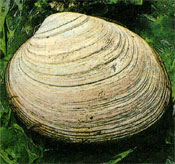
Butter Clam (Saxidomus gigantea). Photo credit: Rick Harbo.
On this page
- Species overview
- Fishery history
- Ecosystem context
- Science advice and research
- Integrated Fisheries Management Plan
- Sources
- Related links
Species overview
Physical description
The Butter Clam is a large intertidal clam. It has 2 thick shells. Its shells are square to oval in shape with large umbones, or raised areas. The shells are attached by a thick hinge on the outside. The shells do not have lunules. The outside of Butter Clam shells has rings that run parallel to the edge. These rings can be used to determine a clam’s age. The outside edge of Butter Clam shells is smooth.
Young Butter Clam shells are yellow on the outside, while older clams are greyish white. The inside of Butter Clam shells is white and smooth, but not glossy. Butter Clam flesh is reddish in colour. Its siphon tip is fused and black.
Butter Clams can grow 18 centimetres (cm) long. They can live for 20 years.
Distribution
Butter Clam is found from Alaska to California. It prefers to burrow in a mixture of:
- sand
- broken shells
- small gravel
Adult Butter Clams live in permanent burrows down to 30 cm deep. It lives in the lower intertidal zone down to a depth of 40 meters (m).
Life cycle
Compared to Manila and Littleneck clams, Butter Clam:
- lives longer
- grows slower
- grows larger
Butter Clam maturity depends on its size, not its age. Butter Clam matures at 33 to 43 millimetres (mm) long. It usually reaches this length between 3 and 5 years old. Butter Clam grows quickly in the first few years of life and then growth slows. Environmental conditions affect Butter Clam growth.
In British Columbia (BC), Butter Clam spawns from April to October. Butter Clam is a broadcast spawner, meaning males and females release eggs and sperm into the water column for fertilization.
After eggs hatch, larvae are pelagic for 3 to 4 weeks. They are carried to new beaches by ocean currents. Once they settle on the ocean floor, adults cannot move to another beach.
Successful reproduction years are not frequent in BC. Some populations do not spawn in some years. This causes variation in adult populations over time.
Fishery history
The intertidal clam fishery plays an important role in BC coastal communities:
- as a key traditional food source for First Nations for thousands of years
- offering essential employment opportunities.
- providing recreational harvesting opportunities for the public.
Commercial clam fisheries have been carried out for over 100 years. Butter Clam is dug by hand or hand-operated tools at low tide. Early commercial catch of Butter Clam for canning date back to 1882. From around 1900 to 1936, Butter Clam was landed from Comox to Sidney, BC with canneries operating in Sidney, Nanaimo and Vancouver.
Clams and cockles were also sold fresh in Victoria and Vancouver in the early 1900s. The peak year of Butter Clam landings was 1938 with 2,929 tonnes. By this time, the fishery had expanded to Alert Bay and the west coast of Vancouver Island.
Butter Clam landings decreased in the late 1970s when the commercial fishery started targeting Manila and Littleneck clams more than Butter Clam. Manila and Littleneck clams are the preferred catch because of:
- high processing cost of canning Butter Clam
- changes in market demand for fresh steamer clams
Ecosystem context
Butter Clam are prey for:
- moon snails
- sea stars
- crabs
- groundfish
- seabirds
- shorebirds
- sea otters
- racoons
- bears
Butter Clam is a filter feeder. It uses its siphon to remove food particles from the water column. Feeding only happens when Butter Clam is underwater. When the tide is low, Butter Clam closes its shells tightly and waits to feed until the tide covers it again.
Bivalve shellfish are very sensitive to water quality because they feed by filtering microscopic organisms from the water. While feeding, harmful bacteria, viruses, and marine biotoxins can build up in their tissues. If eaten, this can make humans sick.
Be careful when harvesting shellfish. Check for contamination in the area where you plan to harvest. Check our real-time bivalve shellfish safety harvesting map. If there are no contamination closures, check species regulations and additional harvest restrictions.
Science advice and research
Science advice and research for Butter Clams
Integrated Fisheries Management Plan
Science advice and research for Intertidal clams
Sources
- Harbo, Marcus and Boxwell 1997. Intertidal Clam Resources (Manila, Littleneck and Butter Clam) Volume II: The Southern Inside Waters of Vancouver Island and the British Columbia Mainland (PDF, 9.8 MB). Canadian Manuscript Report of Fisheries and Aquatic Sciences No. 2417.
- Gillespie and Kronlund 1999. A Manual for Intertidal Clam Surveys. Canadian Technical Report of Fisheries and Aquatic Sciences 2270 (PDF, 7 MB).
- Harbo 1997. Shells and Shellfish of the Pacific Northwest: A field guide. Harbour Publishing, Madeira Park, BC, Canada.
Related links
- Date modified: