
Atlantic Mackerel (Scomber scombrus L.)
On this page
- Species overview
- Fishery history
- Ecosystem context
- Science advice and research
- Integrated Fisheries Management Plan and Rebuilding Plan
- Sources
Species overview
Physical description

The Atlantic Mackerel is a small marine fish with a slender, streamlined body that narrows towards the tail, which is strongly forked. Its coloration is metallic-blue, with lighter silver on its flanks and silvery-white on its underside. Atlantic Mackerel are distinguished by a pattern of wavy, dark vertical bars that begin on its back and end mid-flank. Atlantic Mackerel do not have a swim bladder and must keep swimming in order to breathe.
Distribution
Atlantic Mackerel is widely distributed, transboundary, and migratory. It is a schooling fish that prefers a narrow temperature range (7 to 16°C). It can be found in the Northeast and Northwest Atlantic Ocean. Northeast and Northwest Atlantic Mackerel are genetically distinct and there is no evidence of trans-Atlantic migration.
In the Northwest, Atlantic Mackerel is found in coastal waters from North Carolina to Labrador. Northwest Atlantic Mackerel is composed of the Southern (U.S.) and the Northern (Canadian) spawning contingents. The Northern contingent spawns primarily in the Southern Gulf of St. Lawrence in June and July. The Southern contingent spawns offshore of southern New England and in the western Gulf of Maine in April and May. Canada assesses and manages only the Northern contingent.
Life cycle
Atlantic Mackerel is a batch spawner, meaning it spawns multiple times per spawning season, mostly in surface waters with temperatures from 10 to 16.5°C, with a peak at 13 to 14°C. Atlantic Mackerel eggs concentrate near the surface. Eggs hatch after 1 to 6 days, depending on water temperature. Larvae grow for about 3 weeks before turning into juveniles, which can reach a length of 20 centimetres by November of the first year of growth. Atlantic Mackerel typically mature by the time they reach 2 or 3 years and can live for over 15 years, with a maximum size of about 45 cm and weight up to 800 grams.
After spawning, Northern contingent Atlantic Mackerel begin an extensive feeding migration. This happens throughout Atlantic Canada and Quebec waters from the end of July to October or November. After this, they migrate south into deeper waters from the edge of the Scotian Shelf to the coast of North Carolina. Part of the stock mixes and overwinters with the Southern contingent.
Migration routes for Northwest Atlantic Mackerel are not fully known. Atlantic Mackerel will go where there are better environmental conditions, such as food availability and temperatures. It does this to gain weight so it can survive the winter and spawn the following year.
Fishery history

Atlantic Mackerel supports important commercial, bait, recreational, and Indigenous food, social, and ceremonial (FSC) fisheries in eastern Canada. Depending on the region and time of year, inshore fishing occurs using:
A significant quantity of Atlantic Mackerel harvested commercially is used as bait in other commercial fisheries including:
- American Lobster
- Snow Crab
- Atlantic Bluefin Tuna
- Atlantic Halibut
This compounds the economic importance of Atlantic Mackerel. The majority of landings occur between June and October. While overwintering, some are harvested in the U.S. commercial fishery.
The commercial Atlantic Mackerel fishery in North America dates back to the 1600s. Atlantic Mackerel was primarily a food fishery throughout the 1800s. It was originally fished with beach seines, nets and hand lines. The fishery grew rapidly after the development of improved salting techniques in the 1820s. Catches increased after purse seine fishing gear was developed in the early 1850s, and came to dominate the fishery by the 1870s. From 1876 to 1960, recorded Canadian landings fluctuated from about 3,000 tonnes (t) to 30,000 t.
During the 1980s and 1990s, Canadian landings of Atlantic Mackerel were relatively stable, averaging around 22,000 t per year. Canadian landings reached a record high of 55,726 t in 2005. This was due to a marked increase in fishing effort by small and large seiners on the east and west coasts of Newfoundland and Labrador, and the presence of a strong 1999 year-class.
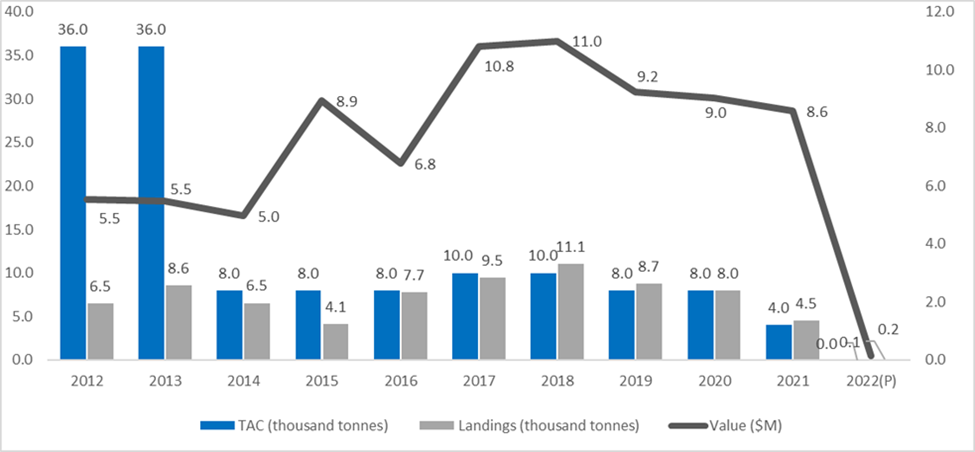
From 2000 to 2010, Canadian landings averaged 40,498 t, with fishing fleets in Newfoundland and Labrador consistently taking the majority of the catch. A drop occurred in 2011 and landings have been below 12,000 t since.
Text version
Canada’s Atlantic mackerel total allowable catch (TAC) and landings in thousands of metric tons (kilometric tons; kt), and the value of landings in millions of dollars ($M) from 2012 to 2021, with preliminary (P) data for 2022.
| Year | TAC (kt) | Landings (kt) | Value ($M) |
|---|---|---|---|
| 2012 | 36.0 | 6.5 | 5.5 |
| 2013 | 36.0 | 8.6 | 5.5 |
| 2014 | 8.0 | 6.5 | 5.0 |
| 2015 | 8.0 | 4.1 | 8.9 |
| 2016 | 8.0 | 7.7 | 6.8 |
| 2017 | 10.0 | 9.5 | 10.8 |
| 2018 | 10.0 | 11.1 | 11.0 |
| 2019 | 8.0 | 8.7 | 9.2 |
| 2020 | 8.0 | 8.0 | 9.0 |
| 2021 | 4.0 | 4.5 | 8.6 |
| 2022 (P) | 0.0 | 0.1 | 0.2 |
Ecosystem context
Atlantic Mackerel migration patterns and life history traits are affected by temperature, along with other factors such as prey availability. Northwest Atlantic Ocean surface and bottom water temperatures have increased across most of the Northern contingent’s habitat since the late 1990s.
Survival of juvenile Atlantic Mackerel depends on:
- stock biomass
- body condition of spawning females
- food availability for larvae
More larvae will survive if preferred prey are abundant at the right place (i.e., where most eggs are spawned) and at the right time (i.e., when larvae develop). Temperature often drives these patterns.
Atlantic Mackerel plays a critical role in the ecosystem by occupying a central position in aquatic food webs. Atlantic Mackerel is a key species for the transfer of energy from lower trophic levels (e.g., zooplankton) to higher order predators. It is vulnerable to a variety of predators including:
- fish (e.g., Atlantic Bluefin Tuna)
- marine mammals (e.g., Grey Seal)
- seabirds (e.g., Northern Gannet)
The amount of Atlantic Mackerel these predators consume can be substantial and have significant impacts when biomass is low. Predators may remove a relatively large proportion of the stock, and rises in natural mortality can affect stock rebuilding.
Variation in Atlantic Mackerel abundance can affect its predators. For example, Northern Gannet is the only predatory seabird known to feed mainly on Atlantic Mackerel. The decline in breeding success of Northern Gannet in the Southern Gulf of St. Lawrence has been associated with the decrease in Atlantic Mackerel spawning stock biomass.
Atlantic Mackerel body condition is related to prey availability; however, because Atlantic Mackerel growth does not vary much over time, the ecosystem factors driving changes are considered of minor importance.
Bycatch in the Atlantic Mackerel fishery is small and not known to significantly affect other species.
Science advice and research
Science advice and research for Atlantic Mackerel
Integrated Fisheries Management Plan and Rebuilding Plan
Integrated Fisheries Management Plan and Rebuilding Plan for Atlantic Mackerel
Sources
- Bernier et al. 2018. State of the Atlantic ocean synthesis report. Canadian Technical Report of Fisheries and Aquatic Sciences, 3167: 154.
- Brosset et al. 2020. A fine-scale multi-step approach to understand fish recruitment variability. Scientific Reports, 10, 16064.
- Bourret et al. 2023. Quantifying genetic differentiation and population assignment between two contingents of Atlantic mackerel (Scomber scombrus) in the Northwest Atlantic. Canadian Journal of Fisheries and Aquatic Sciences, 80: 1084-1097.
- Mbaye et al. 2020. Modelling Atlantic mackerel spawning habitat suitability and its future distribution in the north-west Atlantic. Fisheries Oceanography, 29: 84–99.
- Overholtz et al. 2011. Impacts of Interannual Environmental Forcing and Climate Change on the Distribution of Atlantic Mackerel on the U.S. Northeast Continental Shelf. Marine and Coastal Fisheries, 3: 219–232. http://doi.wiley.com/10.1080/19425120.2011.578485.
- Smith et al. 2020. Atlantic mackerel (Scomber scombrus L.) in NAFO Subareas 3 and 4 in 2018. Canadian Science Advisory Secretariat Research Document, 013: iv+37p.
- Ware and Lambert 1985. Early Life History of Atlantic Mackerel (Scomber scombrus) in the Southern Gulf of St. Lawrence. Canadian Journal of Fisheries and Aquatic Sciences, 42: 577–592. http://www.nrcresearchpress.com/doi/10.1139/f85-075.
Page details
- Date modified: