
Arctic Char (Salvelinus alpinus)
On this page
- Species overview
- Fishery history
- Ecosystem context
- Science advice and research
- Integrated Fisheries Management Plan
- Sources
Species overview
Physical description

Arctic Char is Canada’s most northern freshwater fish species, similar in shape to salmon or trout. Different forms of Arctic Char have been found in deep lakes such as Lake Hazen on the northern Ellesmere Island and Gander Lake in Newfoundland.
Arctic Char varies in colour depending on:
- time of year
- location
- stage of development
Usually, it has a dark-coloured back (dark blue, brown, or green) with silverish sides and a white belly. Their sides and backs sometimes have violet-pink or reddish spots. When spawning, Arctic Char often turns brilliant red or orange.
Sea-run Arctic Char weigh between 2.3 and 4.5 kilograms (kg). Freshwater Arctic Char weigh between 0.2 and 2.3 kg. They can live for 20 to 40 years.
Distribution
Arctic Char is found across the circumpolar northern hemisphere including:
- northern Canada
- Greenland
- Iceland
- northern Europe
- Asia
- Alaska, USA
In Canada, Arctic Char is found in:
- northern Labrador
- northern Quebec
- throughout the Canadian Arctic
Resident freshwater forms also exist in southern locations such as:
- Newfoundland
- southern Quebec
- Maine, USA
Life cycle
Arctic Char can be anadromous (feeds in marine waters and spawns in freshwater) or potamodromous (entire lifecycle in freshwater). Anadromous Arctic Char feed in shallow waters near the shore during summer for 4 to 8 weeks before returning to freshwater.
Arctic Char reaches sexual maturity between 8 to 15 years old. Spawning occurs in September or October over gravel beds. Females typically spawn every 2 to 3 years. Males arrive first on the spawning grounds to establish and defend their territories. Females arrive later and are courted by the males before digging a nest (also known as a redd) in waters between 3 to 6 meters deep to deposit their eggs. These eggs incubate under the ice for about 6 months. Fry emerge from the gravel in mid-July and are about 25 millimetres (mm) long.
Anadromous Arctic Char migrate to sea when they are 4 to 5 years old and reach a size of 150 to 250 mm. In the fall, Arctic Char return to freshwater to over-winter.
Fishery history
Arctic Char is an important commercial fish species in northern Labrador and Nunavut. Arctic Char is very important to the social connection, cultural definition and food requirements of Inuit.
Arctic Char stocks mix, and several stocks are potentially harvested at any given fishing location. For management purposes, all Arctic Char present within a given waterbody are treated as a single management unit.
Cambridge Bay
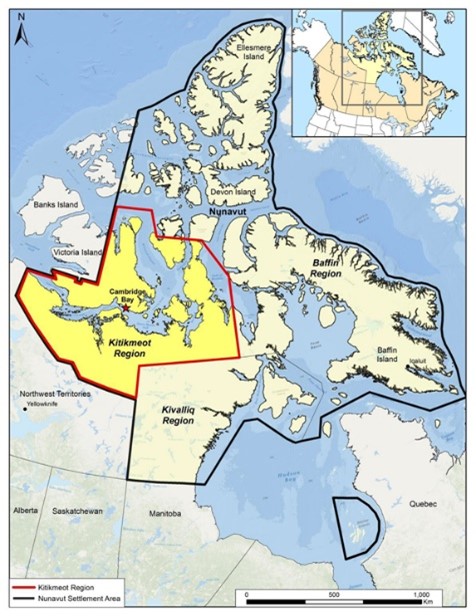
Cambridge Bay is located in the Kitikmeot Region of the Nunavut Settlement Area. The following rivers are commercially fished for anadromous Arctic Char:
- Paliryuak (Surrey)
- Halokvik (Thirty-Mile)
- Palik (Lauchlan)
- Ekalluktok (Ekalluk)
- Jayko (Jayco)
Arctic Char are typically harvested at or near the mouths of the rivers when fish are migrating downstream to marine waters in July (spring fishery) or while returning to freshwater in mid-August through mid-September (fall fishery).
Commercial harvests are conducted by either gillnet or weir, depending on geographic conditions. Where conditions are favourable, a weir is the preferred method.
Cumberland Sound
In Cumberland Sound, there are numerous waterbodies that are important for the commercial and subsistence harvest of Arctic Char. Ijaruvung Lake, Iqalujjuaq Fiord, and Irvine Inlet were declared commercially licensed water bodies in 1984-1985.
Ijaruvung Lake started as a winter gillnet commercial fishery, but has developed into a summer fishery since 1996-1997. It was first harvested in 1978-1984 as a test or exploratory fishery. The quota for Ijaruvung Lake Arctic Char was set around 450 kg in 1978. Since 1983-1984, the quota has been fixed at 2,000 kg, but it has been harvested up to quota only for a few years.
A test gillnet fishery was conducted in Iqalujjuaq Fiord in March 1981 and again in 1997. The annual commercial quota was set at 1,400 kg per year.
There is no record of any test or exploratory fishery or prior assessment in Irvine Inlet. Commercial harvest started in 1984-1985 with an annual quota of 4,500 kg. The fishery uses gillnets.
Ecosystem context
In freshwater, young Arctic Char feed mainly on freshwater shrimp and insect larvae. Adults feed on small fish and bottom organisms such as:
- snails
- clams
- insect larvae
Once at sea, Arctic Char feed on invertebrates and fishes.
Science advice and research
Science advice and research for Arctic Char
Integrated Fisheries Management Plan
Integrated Fisheries Management Plan for Arctic Char
Sources
- DFO. 2014. Integrated Fishery Management Plan. Cambridge Bay Arctic Char Commercial Fishery, Nunavut Settlement Area. Central and Arctic Region Resource Management and Aboriginal Affairs. p. 1-40.
- DFO. 2018. Stock Status and Sustainable Harvest Levels for Arctic Char in Ijaruvung Lake, Iqalujjuaq Fiord and Irvine Inlet, Cumberland Sound, Nunavut. DFO Can. Sci. Advis. Sec. Sci. Advis. Rep. 2018/021
- Harris et al. 2022. Arctic char in a rapidly changing North, Polar Knowledge: Aqhaliat Report, Volume 4, Polar Knowledge Canada, p. 34–57. DOI: 10.35298/pkc.2021.02.eng
Page details
- Date modified: