
Whalesafe fishing gear
On this page
- What is whalesafe gear
- Working together on solutions
- Looking ahead: Canada’s whalesafe gear strategy
- Progress up to now
- Industry information
- Approved modified gear
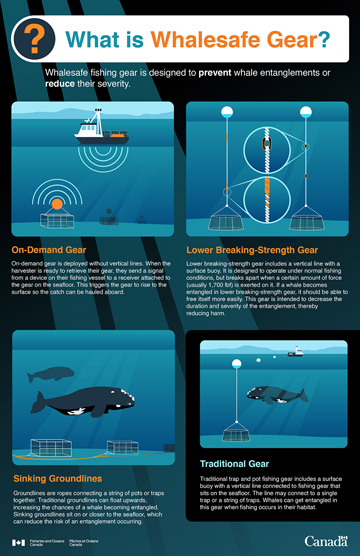
Infographic: What is Whalesafe Gear?
What is whalesafe gear
Whalesafe gear is modified fishing gear that helps reduce the risk of harm from entanglements to whales, such as the endangered North Atlantic right whale, making Canadian waters safer for these whales and other marine species.
Whalesafe gear falls into two general categories:
- On-demand gear: Uses acoustic signals from a fishing boat to bring up fishing pots from the ocean floor. This removes the need for vertical ropes in the water and helps reduce entanglement risk for whales.
- Lower breaking-strength or ‘weak’ rope or links: Designed to break at 1,700 lb. of force, making it easier for entangled whales to free themselves and reduce the risk of serious injury.
Working together on solutions
DFO is working closely with the fishing industry, whale experts, gear manufacturers, Indigenous groups, and other partners to identify and implement whalesafe gear for Canadian fisheries. There’s no single solution. We will keep working with industry to find and adapt solutions that meet the unique needs of each fishery, now and in the future.
Our efforts to protect whales
Implementing whalesafe fishing gear is just one of the actions DFO is taking to protect whales. North Atlantic right whale management measures, marine mammal response and efforts to clean up lost fishing gear all help make Canadian waters safer for whales, while supporting sustainable fisheries.
Looking Ahead: Canada’s whalesafe gear strategy
Canada’s 5-year Whalesafe Fishing Gear strategy provides a process to develop and implement innovative fishing gear in Canadian fisheries to help reduce the risk of harm to whales from entanglements while supporting sustainable, vibrant commercial fisheries. In the near term, the five-year plan focuses on protecting the endangered North Atlantic right whales in eastern Canada. The strategy will expand across Canada to address fishery-specific needs on east and west coasts.
The strategy was developed after extensive engagement and collaboration with the fishing industry, gear manufacturers, Indigenous communities, researchers and other partners, and DFO will continue to work with these groups to support the implementation of innovative fishing technology that works for industry and protects whales.
Progress up to now
Collaboration with domestic and international partners
The 2023 Whalesafe Gear Trial Results Symposium and the 2025 International Fishing Gear Summit brought together Indigenous partners, fish harvesters, non-government organizations and academic experts to share the outcomes of their work, including successes, challenges, lessons learned, and ways forward.
Fisheries management measures for North Atlantic right whales
Canada has fisheries measures and initiatives in place in Atlantic Canada and Quebec to prevent entanglements of North Atlantic right whales (NARW). These include opening fisheries before North Atlantic right whales arrive in our waters, by closing fishing areas where and when whales are detected, and by removing ‘ghost’ fishing gear.
Starting in 2024, voluntary whalesafe fishing gear pilots were introduced in select lobster and shallow water fisheries in Eastern Canada. The pilot allows harvesters to continue fishing following a confirmed NARW detection under certain conditions that will help reduce entanglement risk. These conditions include increasing trawl length and dropping endlines, and equipping the remaining endline with a lower breaking-strength gear modification.
Whalesafe gear adoption fund
The Whalesafe Gear Adoption Fund (WSGF) ended in 2023, but its impact continues. This two-year program (2021-23) invested up to $20 million to help purchase, test and improve, and the lessons learned still guide our work today. This program supported projects to test whalesafe fishing gear’s safety, operational effectiveness, potential effectiveness at reducing harm to whales, and readiness to support harvesters with the transition to new gear.
The fund also provided support to Canadian manufacturers to increase the domestic supply of commercially-ready whalesafe gear. Groups in the following categories were eligible to apply to the Whalesafe Gear Adoption Fund:
- Canadian not-for-profit and charitable organizations
- Canadian companies, businesses, organizations, and associations
- Indigenous organizations and communities
- Recognized research, academic, and educational institutions
Through 39 projects, the department provided support to industry and Indigenous partners to test modified fishing gear under real life conditions. These trials helped choose gear types that work best for the unique needs of different fisheries and pilot projects. Results of the Whalesafe Gear Adoption Fund projects were shared at the Whalesafe Gear Trial Results Symposium in 2023.
| Name | Area of work | Description | Total funding for 2021-2023 | Focus of work |
|---|---|---|---|---|
| Acadia University | Scotian Shelf, Bay of Fundy, Nova Scotia | This project is designed to test whalesafe gear and document successful gear configurations for the offshore lobster fishery. Low breaking strength rope and links will be tested in conditions that previous gear trials have not tested. This includes deep-sea, high-current conditions that create different patterns of stress through drag and torsion on trawl lines, which may cause gear to perform differently under different load conditions. Some of the strongest tides of Nova Scotia are in this region, as the waters here move in and out of the Bay of Fundy twice daily. Our tests will determine if either technology can withstand the fishing rigours of the deep-sea, high-current lobster fishery, and if so, what gear configurations work best to support adoption by offshore lobster fishers. | $271,188 | Low breaking-strength ropes/links |
| Area 19 Snow Crab Association | Cape Breton, Nova Scotia | The goal of this project is to purchase and test different types of whalesafe gear on snow crab fishing gear and to provide data on which type of whalesafe gear will work best on the gear in the specific conditions of the fishery. | $199,000 |
On-demand gear Low breaking strength ropes/links |
| Ashored Inc. | Throughout Atlantic Canada and Quebec | Ashored has been developing a rope-on-demand system for over 3 years. This project will help them increase their manufacturing capacity to meet the anticipated need for rope-on-demand fishing gear in the coming years. This also is expected to lower costs and make the system more affordable for harvesters. | $338,800 | On-demand gear |
| Association des Crabiers Gaspésiens | Gulf of St. Lawrence, Quebec | This team proposes to purchase and test three different rope-on-demand systems, to then train harvesters and fishery officers in their implementation and use for the snow crab fishery in the Gulf of St. Lawrence. The testing will include a system developed by a Canadian manufacturer, with the goal of informing and supporting the production of the system on a commercial scale. | $439,127.50 | On-demand gear |
| Association of Inshore Fishermen/Association des pêcheurs côtiers des Iles (APCI) | Gulf of St. Lawrence, Quebec | The APCI will conduct at-sea trials of different types of low breaking-strength gear modifications, to determine which type(s) will be best suited to the fishing conditions around the Magdalen Islands. | $149,200 | Low breaking strength rope/links |
| Canadian Centre for Fisheries Innovation (CCFI) | Newfoundland and Labrador | The CCFI represents harvesters, processors, aquaculture operators, business owners and academic leaders across Atlantic Canada. The purpose of this project is to test and evaluate a rope-on-demand system being developed by Ashored Inc. This will first be done by Centre researchers, and then in commercial lobster and crab fisheries. | $790,102.76 | On-demand gear |
| Canadian Whale Institute | Gulf of St. Lawrence, Bay of Fundy, Nova Scotia, New Brunswick | This project will contribute to the development of a virtual multi-manufacturer gear location marking system, to support the use of rope-on-demand fishing gear. This system allows fish harvesters and enforcement officers to locate equipment quickly when it does not have traditional surface buoys. This project seeks to inform manufacturers and decision makers about adaptations that will encourage the safe and economical use of rope-on-demand gear in multiple Canadian fisheries, including lobster, snow crab, hagfish and halibut. | $550,000 | On-demand gear |
| Canadian Wildlife Federation (CWF) | Bay of Fundy, Scotian Shelf, Gulf of St. Lawrence | CWF will create a gear-lending program with several types of whalesafe gear options (rope-on-demand systems, low breaking strength links, sleeves, low breaking strength rope, etc.) that will be available to fish harvesters across the Maritimes. The goal is to have at least 200 fish harvesters participate in trials of whalesafe gear. CWF will maintain a warehouse of the gear in NS and will hire technicians to support the maintenance and distribution of gear. | $3,513,800 |
On-demand gear Low breaking strength ropes/links |
| Cape Breton Fish Harvesters Association | Cape Breton, Nova Scotia | To determine whether low breaking strength technology will work in lobster, crab, and groundfish fisheries in Eastern Cape Breton, this project will test a variety of low breaking strength gear technology options. The goal is to find out the best ways to use the technology that has the least impact on harvesters. This work will expand on a pilot project that assessed the effectiveness and safety of each gear technology. | $102,928.07 | Low breaking-strength ropes/links |
| Clearwater Seafoods | Scotian Shelf offshore, Nova Scotia | Clearwater Seafoods plans to purchase 100 time tension line cutters (TTLC) to be installed on their offshore lobster fishing gear. During the 12 month fishing season, they will conduct laboratory tests as well as at-sea trials to refine the performance of the TTLCs to suit the conditions of this deep water fishery. | $250,000 | Low breaking strength rope/links |
| CoastLine Cordage Group Ltd. | Throughout Atlantic Canada and Quebec | This project aims to produce a cost-effective braided low breaking strength link that can be spliced in to existing vertical buoy lines, for use in any fixed gear fishery. WSGF supports Coastline Cordage to set up the manufacturing process to produce the low breaking strength link. The project will include trials with various lobster and crab harvesters, with the objective of making it available broadly to fishers by 2023. | $800,000 | Low breaking strength rope/links |
| Coldwater Lobster Association | Scotian Shelf, Nova Scotia | The Coldwater Lobster Association represents lobster harvesters in Southwest Nova Scotia. The purpose of the project is to test 4 low breaking strength rope and low breaking-strength link technologies as whalesafe gear options. | $426,478 | Low breaking strength rope/links |
| Conseil de la Première Nation des Innus de Nutashkuan | Quebec | The purpose of this project is to adapt and test a rope-on-demand buoy system that has been used in Europe's marine environment. The WSGF will support the improvement of the manufacturing process, to provide enough buoy systems for testing in four fishing zones. | $500,000 | On-demand gear |
| Coopérative des capitaines-propriétaires de la Gaspésie (ACPG) | Gulf of St. Lawrence, Quebec | ACPG will test new gear modification systems, with an emphasis on rope-on-demand systems and a ropeless airbag system. ACPG will test a variety of gear with the goal of adopting this state-of-the-art equipment for whale protection in the Gulf of St. Lawrence, specifically in the 12A snow crab fishery, and in the 4RST groundfish fishery. ACPG wants to adopt existing gear, devices and systems that are safer for marine mammals while supporting the coexistence of commercial fishing with marine mammals. | $270,000 | On-demand gear |
| Devocean | Gulf of St. Lawrence, Quebec | This project aims to develop an innovative rope-on-demand fishing system. The project will contribute to the main objective of the WSGF by commercialising a fishing system that will lower the risk of whales becoming entangled in crab fishing ropes. The Devocean system would remove the vertical line from the water column, except when the harvester wishes to retrieve the traps, supporting coexistence of fish harvesters and marine wildlife. | $153,318 | On-demand gear |
| Fisheries and Marine Institute of Memorial University | Newfoundland and Labrador | The Marine Institute will work with local fish harvesters to test low breaking strength rope/links, braided sleeves, hydraulic load-limiters, a spring tagline release, and time tension line cutters (TTLCs). They will host 15 demonstration sessions to reach at least 750 harvesters in Newfoundland and Labrador. | $1,169,000 | Low breaking strength rope/links |
| Fundy North Fishermen's Association (FNFA) | Bay of Fundy, New Brunswick | FNFA plans to test a variety of innovative low breaking-strength devices in their lobster fishing gear over two years. Their focus is to identify cost-effective solutions for longer term use in the fishery. | $247,650 | Low breaking strength rope/links |
| Grand Manan Fishermen's Association | Bay of Fundy | The purpose of this project is to test low breaking-strength rope in lobster and longline groundfish fisheries. The WSGF is supporting the purchase of low breaking-strength rope and the cost of sea trials by harvesters. | $763,836 | Low breaking strength rope/links |
| Homarus Inc | Gulf of St. Lawrence, New Brunswick | Homarus Inc. is the research unit of the Maritime Fishermen's Union and through this project, they will expand their current trials of the Edgetech rope-on-demand system. Their goal is to test the Edgetech system on various trap and trawl configurations in the crab and lobster fisheries. | $380,215 | On-demand gear |
| JASCO | Nova Scotia, Newfoundland and Labrador |
JASCO will support the development and adoption of ropeless fishing gear by providing a simple ropeless trap system that can be deployed and recovered quickly and easily by the harvester. This system incorporates a location marking system so fishery officers can identify the gear as needed. The project will also help position JASCO to mass-produce ropeless traps and to provide economic benefit in Atlantic Canada and to their project partner, Miawpukek First Nation. |
$270,097 | On-demand gear |
| Merinov | Gulf of St. Lawrence, Quebec | Merinov is working to develop and refine an innovative low breaking strength link and advance it toward commercial availability. The objective of the "Double Threshold Weak Link (MF2S)" project is to improve, for commercial use, an innovative link prototype designed to break when a whale exerts tension on a vertical rope. This prototype has an adjustable double threshold to resist breaking when harvesters haul up the trap (tensions of the order of 3,500 lbs), while being able to break at tensions of 1,700 lbs exerted by an entangled whale. The device will be installed on the vertical line at an optimal location. Its ease of use, cost and durability should encourage the use of this technology that is designed to reduce whale entanglement risk, while not impacting fishing activities. | $844,235 | Low breaking-strength ropes/links |
| Mi'gmaq Maliseet Aboriginal Fisheries Management Association (MMAFMA) | Gulf of St. Lawrence, Quebec | This project will expand on previous trials for the lobster fishery, involving other Indigenous fishers. WSGF funding will support the purchase of equipment for larger scale low breaking strength gear trials, and the purchase of ropeless fishing gear for comparative testing in their fisheries. | $300,000 |
On-demand gear Low breaking strength ropes/links |
| Miawpukek First Nation | Newfoundland and Labrador |
Netukulimk Fisheries Limited (NFL)/Miawpukek First Nation (MFN) will receive ropeless traps and training to conduct trials of ropeless traps with inflatable lift bags, and standalone acoustic systems supplied by project partner JASCO. NFL staff and crews will be trained to use the equipment, and collect 4-6 weeks of ropeless fishing and other data to help find solutions to improve the gear. Another goal of the project is to move toward full production of the system so it can be used by many harvesters. |
$275,000 | On-demand gear |
| Micmacs of Gesgapegiag | Gulf of St. Lawrence, Quebec | The purpose of this project is to test 3 different whalesafe gear modifications and identify which one will be most suitable to adopt in their fleet after trials are complete. | $360,000 |
On-demand gear Low breaking strength ropes/links |
| Millbrook First Nation | Gulf of St. Lawrence; Bay of Fundy Nova Scotia. | The purpose of this project is to test a variety of rope-on-demand systems, and low breaking strength devices, in snow crab and lobster fisheries. These gear trials will help Millbrook First Nation determine which systems best suit their fisheries, guiding the purchase of gear to outfit more vessels in their fleet. | $500,000 |
On-demand gear Low breaking strength ropes/links |
| Nova Robotics - project 1 | Throughout Atlantic Canada and Quebec | The WSGF is supporting Nova Robotics to increase their manufacturing, assembly and testing capacity for their low breaking strength Rope Spring Release and trials to fisheries in Atlantic Canada and Quebec. The project includes outreach to fishing communities for training on the use of the spring release, as well as conducting trials for different gear types and configurations. They also propose to develop a second device, a low cost rope-based “Shear Plane” low breaking strength link, designed to be spliced into any size rope and provide a calibrated 1,700 lbs breaking strength. Through this project they will increase production and testing of its reliability and flexibility. | $350,000 |
On-demand gear Low breaking strength ropes/links |
| Nova Robotics - project 2 | Nova Scotia; all areas | This funding supports Nova Robotics in a project to incorporate whalesafe technologies in commercial fisheries. For example, by modifying their weak rope spring release to make it more compatible with the large quantities of rope used in turbot fishing, a fishery that has to date not been testing new whalesafe fishing technologies. | $60,000 | Low breaking-strength ropes/links |
| OCEAN-CAM | Gulf of St. Lawrence, Quebec | OCEAN-CAM is developing an innovative rope-on-demand buoy system that it wishes to make commercially viable for fixed gear fisheries. The company will work with harvesters to test and refine their system. | $500,000 | On-demand gear |
| Passamaquoddy Recognition Group | Bay of Fundy, New Brunswick | Passamaquoddy Recognition Group is testing 12 rope-on-demand units, to refine them for their lobster fishery in the Bay of Fundy. | $121,600 |
On-demand gear Low breaking strength ropes/links |
| PEI Fishermen's Association (PEIFA) | Gulf of St. Lawrence, Prince Edward Island | This project takes a cost-sharing approach to identifying a whalesafe gear solution for PEI lobster fishers. Each harvester will be given $1,000 to purchase gear modifications of their choosing to test and determine which whalesafe gear will work best for their fishing conditions. The PEIFA will lead the distribution of gear for trials and deployment in fisheries as well as maintaining a database to track which modifications are tested and the results of these trials. | $2,250,000 |
On-demand gear Low breaking strength ropes/links |
| Polysteel Atlantic Ltd. | Throughout Atlantic Canada and Quebec | Polysteel Atlantic is a rope manufacturer for the fishing industry in Nova Scotia. The objective of this project is to produce a rope below 1,700 lbs breaking strength that will meet durability and longevity requirements for fisheries. With WSGF support, they will modify their existing technology/machinery, while identifying materials and production improvements that can lead to a commercially viable, competitively priced product. | $825,000 | Low breaking strength rope/links |
| Réseau des pêcheurs professionnels du sud de la Gaspésie (RPPSG) | Gulf of St. Lawrence, Quebec | Lobster and snow crab harvesters in the southern Gaspé region are testing fishing methods aimed at reducing the risk of whale entanglement. The tests include fishing with rope-on-demand systems, and fishing for snow crab with six lines of two traps (instead of one individual trap) connected to a low tension spring release system, which reduces the number of vertical lines in the water. For the lobster fishery, several types of weak link will be tested. A project manager will monitor progress, working closely with harvesters to collect data, prepare reports, and present the results to harvesters. | $107,176 |
On-demand gear Low breaking-strength ropes/links |
Industry information
Modified fishing gear that meet harvester conditions of licence requirements
Modified fishing gear may be authorized for use under specific licence conditions, which may vary by fishery and area.
It’s essential to always follow all licence conditions and manufacturers’ instructions for selecting, installing and using lower breaking-strength gear.
Lower breaking-strength gear is approved if it breaks at 1,700 lb of force, and if trial results show the fishing gear is safe and performs as well as conventional fishing gear. Footnote 1
Approved modified gear
This page lists the products currently approved for use by DFO and will be updated as new products are approved.
For more information on using this gear, or to discuss conducting new gear trials, harvesters may contact their regional DFO office.
Novabraid sleeve

Buoy line (grey) is inserted into each end of an orange hollow “sleeve”. The force to pull the ropes back out of this specially designed sleeve is 1,700 lb
- Manufacturer: Novabraid
- Gear type: Low breaking-strength rope
- Availability: Available in Canada at various fishing supply stores and online retailers, or through its manufacturer in Yarmouth.
- Contact: Please visit Novatec Braids Ltd. for more information.
- Details: Sleeve is a breakaway link made in Nova Scotia that consists of an orange woven covering into which two ends of conventional rope are inserted. This design will sustain forces up to 1,700 lb. during regular fishing activities and is intended to break apart if a whale becomes entangled.
- Novatec Braids Ltd. designed this sleeve to break under tension. When applied to fishing lines, the sleeve provides a weak knotless connection that is less likely to snag or tangle with marine life, including whales. Novabraid sleeves approved for use are the 3/8 and ½ inch models.
How to use

A close-up of where the orange Novabraid “sleeve” intertwines by a series of three tucks with the conventional rope of a buoy line.
To install the Novabraid sleeve to the regular buoy line:
- Cut the buoy line and melt the ends of the line to ease insertion.
- Make a 1-inch slice into the sleeve approximately 4 inches from each end. Insert each end of the buoy line through one of these 1-inch openings and guide both ends to meet at the center of the Novabraid sleeve, with no gap remaining between the ends of the line.
- Make sure the Novabraid sleeve is secure, and properly aligned such that the buoy line is not twisted within the sleeve.
- Tuck the 4-inch hollow ends of the Novabraid sleeve into the buoy line.
For more information, including a video of sleeve installation, visit SSLFA Novabraid Sleeve Demo, Courtesy of NOAA
Coastline Cordage break-away release link
- Manufacturer: Coastline Cordage
- Gear type: Weak link
- Availability: The Coastline Cordage Break-Away Release Link is available in Canada at various fishing supply stores and online retailers that specialize in fishing gear and equipment.
- Contact: Please contact Coastline Cordage Group Inc. for more information.
- Details: Break-Away Release Link is made in Nova Scotia. It is in the form of a 6-foot-long section of red braided rope with a stitched loop at each end.

A six foot length of red braided rope with loops at either end. The loops have black stitching encased in a clear protective plastic shrink wrap.

Close-up of two rope loops with black stitching and protective plastic shrink wrap. Stitching is calibrated to break at 1,700 lb.

An enlarged illustration of the Cordage Break-Away Release Link showing (circled in yellow) a rope-splicing technique (tuck eye splice) that is used to connect the loop to the buoy line. The link is 6 feet in length, with a trap buoy at one end and a sewn eye splice at the other end which attaches to the rope.
How to use
When using the Coastline Cordage Break-Away Release Link, a cut is made in the buoy line. Each cut end of the buoy line is attached to one of the stitched loops of the break-away release. The buoy line can be attached to a loop by any method, as long as the attachment does not reinforce the stitching. The link is designed to break under specific conditions, such as an entanglement or other source of excessive force.
Installation by use of an eye splice with the buoy line at each stitched loop is recommended.
For more information, including video of the Break-Away Release Link passing through a hauler, visit Coastline Cordage's website.
Oval in-line weak links

A close-up image of a black oval-shaped plastic link which is inserted in the buoy line (beige rope) by an eye-splice with a series of tucks at each end.
- Manufacturer: Several companies have developed breakaway oval in-line weak links including Brooks Trap Mill and Marine Mold & Machine Inc.
- Gear type: Weak links
- Availability: The oval in-line weak link is available in Canada at various fishing supply stores and online retailers that specialize in fishing gear and equipment. This product can also be purchased directly through the manufacturer.
- Contact: Please visit the manufacturers’ websites for more information:
- Details: Oval in-line weak links are a type of fishing gear designed to be weaker than the buoy line, allowing them to break under specific conditions, such as an entanglement or other source of excessive force.
- Several companies have developed breakaway oval in-line weak links, black plastic oval rings with a breaking point of 1,700 lb when used within a traditional buoy line. The oval rings are available to accommodate up to a 1/2-inch diameter buoy line.
How to use

The image shows two oval plastic rings (Maine Mold and Seaside) that can accommodate up to ½ inch diameter buoy line.
The oval ring is attached within the regular buoy line by cutting the line and passing the two cut ends through the weak link, and securing by a tuck eye splice with three to four tucks at each end. The oval in-line weak link is designed to pass through most haulers without interruption. The Maine Mold has one thin and one thick end and this oval link should be positioned so the end marked TOP is located towards the surface buoy. The Seaside oval weak links have a uniform thickness, which means either end of the oval can be positioned towards the surface buoy. Attachment methods that override the intended functionality of the weak link are prohibited.
National Oceanic and Atmospheric Administration (NOAA) has a video of an oval in-line link passing through a hauler.
Everson whale safe rope

Samples of 3/8 inch Everson lower breaking-strength sinking rope with coloured line markings for Lobster Fishing Areas 24 (top) and 26A (bottom).
- Manufacturer: Everson Cordage Works
- Gear type: Lower breaking-strength sinking rope
- Availability: Everson whale safe rope is available in Canada at various fishing supply stores and online retailers that specialize in fishing gear and equipment.
- Contact: Please contact Everson Cordage Works in Everson, Washington for more information.
How to use
Spliced in sections of lower breaking-strength rope in specific locations in the main buoy line.
Polysteel lower breaking-strength rope

A sample of Esterpro 5/8 inch low-break sink rope. The white polyester fibres spliced into main buoy line, green, provide its negative buoyancy.
- Manufacturer: Polysteel Atlantic Ltd
- Gear type: Lower breaking-strength rope
- Availability Polysteel low breaking-strength rope, also referred to as Esterpro low break rope, is available in Canada at various fishing supply stores and online retailers that specialize in fishing gear and equipment.
- Contact: Please contact the manufacturer Polysteel Atlantic Ltd. in Sydney, Nova Scotia for more information.
How to use
Spliced in sections of lower breaking-strength rope in specific locations in the main buoy line.
Time tension line-cutter

A sample Time Tension Line Cutter, a black cylindrical rope-release device with a 5/8 inch buoy line through its center. The device is designed to release fishing gear below its location in the buoy line, though does not put restrictions on a harvester’s hauling practices.
- Manufacturer: Blue Water Concepts Inc.
- Gear type: Breakaway device for hauling gear with regular breaking-strength rope
- Availability: Time tension line-cutters are available in Canada at various fishing supply stores and online retailers that specialize in fishing gear and equipment.
- Contact: Please contact Blue Water Concepts Inc. for more information.
- Details: The Time Tension Line Cutter (TTLC) is an innovative breakaway device that allows harvesters to haul their gear with regular breaking-strength rope. The TTLC is attached within the buoy line and when it is exposed to specific tensions for an unusually long duration, likely indicating a whale interaction, it cuts the rope.
- When a whale interacts with the fishing gear for a prolonged period of time beyond that normally needed to haul the gear, the TTLC will respond by severing the line, thus reducing the weight and drag of fishing gear restricting the whale’s movement.
- The TTLC is commercially available in two sizes to accommodate the range in rope diameters for pot/trap and gillnet fisheries. Each TTLC is calibrated for the specific conditions it will be used in, based on knowledge of normal fishing operations. The time and tension at which the blades will emerge is pre-set in the factory, to avoid having a TTLC cut the buoy line in non-entanglement situations.
How to use
Typically, the buoy line is fitted around the TTLC closer to the bottom (closer to the trap/trawl end of the buoy line) and the end of the line passes through an area with two cutting blades that become exposed when continuous tension is applied for a duration of time greater than what is experienced while hauling gear. The rope will also release if the force is consistent with an entangled whale towing the gear.
Installing this device takes approximately two minutes and does not require any line cutting or modification. It can bereadily installed and uninstalled on all line types in all deck conditions without the need for special tools.
The manufacturer has a video showing how the TTLC works.
Tag Line Spring Release

A black rectangle housing containing an adjustable spring with a metal release key attached to a small rope. The device permits setting gear with low breaking-strength rope, and conventional breaking-strength rope is used to retrieve the fishing gear. The tension in the spring can be adjusted to accommodate different fishing environments.
- Manufacturer: Nova Robotics
- Gear type: Device for controlled deployment of fishing gear with lower breaking-strength rope
- Availability: The tag line spring release is available in Canada at various fishing supply stores and online retailers that specialize in fishing gear and equipment.
- Contact: This product can be purchased directly through the manufacturer. Please contact Nova Robotics for more information.
- Details: The Tag Line Spring Release is an innovative spring release mechanism designed by Nova Robotics, a company based in Nova Scotia. It uses a tag line, which is a relatively weak (under 1,700 lb.) secondary line attached to the main buoy line which in turn is attached to the traps or other fishing gear. This design allows for a controlled deployment of fishing gear, including ropes, nets, and traps. If the tag line attached to the primary surface buoy is snagged, towed and severed by a whale or transiting vessel, it will trigger the release of the hard plastic buoy bringing the stored rope to the surface, where it can be observed and retrieved, thereby reducing the occurrence of lost fishing gear.
How to use
The Tag Line Spring Release is used in fishing gear configured with lower breaking-strength rope in the upper part of the buoy line. The Tag Line Spring Release is inserted in the buoy line between the weak and regular breaking strength rope. Hauling the weak rope activates the release, opening the attached bag which contains regular breaking strength rope (the ‘recovery rope’) attached to 1-2 hard plastic buoys, which then rise to the surface. The gear is then hauled using the regular breaking-strength rope. Additional rope (the lower breaking strength tag line) is required as part of the overall buoy line system.
The tension in the spring can be adjusted to accommodate different fishing environments.
For more information, including videos to further illustrate its deployment, visit:
- Tag line spring release: theory of operation
- Tag line spring release: underwater deployment
- Tag line spring release: setting and rigging
- Date modified: