
Recovered Gear Analysis of North Atlantic Right Whale Eg #5217 “Division”
On this page
- Executive summary
- Event details
- Recovered gear
- Contact with harvester
- Assessment of origin
- Entanglement status
- Active vs. Ghost Gear
- Method of initial entanglement
- Related information
- Photos of inspected gear
Executive summary
Eg #5217 ‘Division’, a 4 year-old male, was last seen gear free on July 5, 2025 in the southern Gulf of St. Lawrence, and was first observed entangled off the coast of Georgia, USA on December 3, 2025. Fishing gear was removed by authorized responders from the Georgia Department of Natural Resources, and the Florida Fish and Wildlife Conservation Commission on December 3 and 4, 2025 with support from the Clearwater Marine Aquarium Research Institute, the Center for Coastal Studies and NOAA Fisheries.
On January 14, 2026, Fisheries and Oceans Canada (DFO) examined the gear along with NOAA gear experts at the Greater Atlantic Regional Fisheries Office in Gloucester, Massachusetts.
Three segments of 5/8 inch diameter rope, totaling 302 ft (92 m), were removed along with a small orange buoy, and 95 inches (2.4 m) of 3/8 inch rope. Three occurrences of orange and yellow twine markings were observed interlaced along the removed rope, one in each segment. The coloured twine markings ranged in length from 7-8 inches (18-20 cm). Gear markings were consistent with those prescribed in the DFO conditions of licence for Snow Crab Fishing Area 12 (CFA 12). Available evidence indicates the juvenile male became entangled in ghost gear.
On January 27, an aerial survey team from the Clearwater Maritime Aquarium Research Institute spotted the floating partial carcass of Division 40 km off the coast of North Carolina. No attempt was made to remove any remaining gear as the carcass with unable to be retrieved due to inclement weather.
Conclusion of gear origin: Canadian Snow Crab Fishing Area 12 (CFA 12)
Event details
- ID and/or Date: December 3 and 4, 2025
- Event type (stranding, death, disentanglement): Disentanglement in U.S. waters
- Species: North Atlantic Right Whale
- Last seen gear free: July 5, 2025, in Shediac Valley, Gulf of St. Lawrence
- Entanglement Status: Deceased in U.S. waters
- Country of gear origin: Canada
- Active or ghost gear: Ghost Gear
- Harvester submitted lost gear report: No
Recovered gear
- Floats: A cracked hard spherical orange plastic buoy with a diameter 5 inches (12.7 cm) bearing a faded six digit vessel registration number (VRN) and the #41. There are recesses on opposite ends of the buoy in which rope was passed through as a means of attachment. The buoy had company inscribed markings revealing that it was made in Denmark by Nokalon Inc. and was designed to be used as a trawl net ball. The harvester presumably used it as a secondary buoy (Fig. 1-3) and the 41 was a means of identifying the specific set of gear. No other floats were recovered.
- Traps: None
- Trap tags: None
- Buoy line: In total, 302 ft (92 m) of 5/8 inch diameter light green rope (Fig. 1 and 2). Total length of positively buoyant (float) rope removed was 164 ft (50 m) and total length of negatively buoyant (sink) rope was 138 ft (42 m), the latter characterized by beaded lead running the length in each of its three strands. In addition, 95 inches (2.4 m) of 3/8 inch diameter float rope was removed that was attached to the 5 inch buoy.
- Weak Links: None
- Descriptions of the three rope segments removed: The ropes recovered were consistent with a single entanglement event. Other than one frayed end, ends of each rope segment were severed by cuts made by the response team (total of three cuts).
- Segment 1 - trailing rope from right side of body (December 3): 5/8 inch float rope (heavily biofouled, 95 ft (29 m)) with a small loop near one end made from an overhand knot. The rope was light green with yellow tracer, though the bioaccumulation gave it an appearance of dark green/black more noticeable in some parts than others (Fig. 1,2 and 4). Several long stalk barnacles were attached along its length and barnacles were also present on the other two rope segments at the time of removal from the whale (Fig. 5).
- Segment 2 - trailing rope from left side of body (December 4): 5/8 inch sink rope (light green, 138 ft; 42 m) with black tracer (Fig. 6). Beaded lead was present in each of its three strands (Fig. 7). At one end, the remnants of the original surface buoy system that included the small buoy were present (Fig. 8). There was a loop to which a 38 inch (97 cm) length of 3/8 inch polypropylene float rope (yellow with green tracer) was attached, connected to the 5 inch buoy (Fig. 9). Also attached to the loop was a 39 inch (99 cm) length of the 3/8 inch rope; of which 24 inches (61 cm) was unraveled.
- Segment 3 - further removal of the trailing rope from right side of body (December 4): 5/8 inch light green float rope (69 ft; 21 m) with yellow tracer including a telemetry loop placed on December 3, 2025 (Fig. 10 and 11).
- Ground line: None
- Line markings: Coloured twines interlaced among rope strands were present in each of the three rope segments. In segment 2, the gear mark was 93 ft (28.4 m) from the loop to which the surface buoy was attached. The distance between the other two gear markings observed on segments 1 and 3 was 88 ft 7 inches (27 m) when accounting for the cuts made on the rope trailing the right side of the body. These coloured buoy line markings were made of orange twine and yellow twine ranging in length from 7-8 inches (18-20 cm) (Fig. 12-14). DFO gear markings are to be at minimum 15 cm in length and three marks are required when using twine inserts (top, middle and bottom sections of a buoy line) or for specific fisheries one mark every 90 ft (27.4 m) with a minimum of three markings.
In 2018 and 2019, buoy line markings of orange twine were required in CFA 12. Beginning in 2020, orange and yellow markings were required in CFA 12.
Contact with harvester
Upon review of the fishing licences associated with this vessel, it was noted that the licence holder/harvester fished snow crab in CFA 12 in 2018 and 2020, but not in the past five years. This was confirmed in conversation with the harvester on January 27. The harvester provided additional descriptions of the snow crab gear used in 2020 which are given below.
The top 1/3 of a buoy line was comprised of sink rope and the bottom 2/3 of float rope which was attached to the bridle of a 6 ft (1.8 m) diameter conical snow crab trap. The float and sink ropes were connected by a splice. The harvester confirmed the use of the orange Nokalon secondary buoy.
The harvester stated he was fishing in the Shediac Valley of the southern Gulf of St. Lawrence in 2020 not more than 15-20 nautical miles (28-37 km) from shore in water depths ranging from 60-90 m. The harvester began the season along the New Brunswick coast. In late May the harvester fished closer to Prince Edward Island as result of North Atlantic right whale detections and associated fishery closures, setting his traps near the edge of the closed area. He completed the season in early June.
Assessment of origin
Canadian Snow Crab Fishing Area 12 (southern Gulf of St. Lawrence).
Entanglement status
The majority of rope was removed other than a wrap around the whale’s head which included rope running through its mouth. On January 27, an aerial survey team from the Clearwater Marine Aquarium Research Institute spotted the floating partial carcass of Division 40 km off the coast of North Carolina. No attempt was made to remove any remaining gear as the carcass was unable to be retrieved due to inclement weather.
Active vs. Ghost Gear
Gear was ghost gear. The gear was in the water for five years prior to Division’s entanglement. The most recent crab season the gear was fished (2020) was determined from the licence associated with the vessel registration number on the small buoy. Further evidence that the gear had been in the water for an extended time were the faded black markings on the buoy and the high degree of biofouling particularly of segment 1 including the presence of long stalk barnacles on each rope segment (Fig. 5). The biofouling of segment 1 (float rope) was more pronounced when the gear was initially removed from the whale (Fig. 1) compared to its appearance after approximately 6 weeks (Fig. 4). Conversation with the harvester confirmed the last time he fished snow crab was between opening day in April and early June, 2020. Although the harvester also fished for snow crab in CFA 12 in 2018, the coloured buoy line markings were not consistent for 2018 requirements, but were for 2020 requirements.
Method of initial entanglement
The method of initial entanglement was in the buoy line, as this fishery is comprised of single traps with no groundlines. It is unknown whether the entanglement occurred at the original set location, or if the gear was displaced prior to the entanglement.
The snow crab trap may or may not have been present during the entanglement event. In the frayed end of the rope section that would have led to the trap, the rope’s interior filaments were also biofouled (Fig. 15) compared to cut ends (Fig. 7 and 11). This suggests the frayed end had been present prior to 2025 and the remaining float rope with the attached trap had been torn off prior to entanglement.
It is plausible that a passing vessel may have dragged the gear, tearing off the trap including the primary buoy. At some point in time, the remaining secondary buoy cracked and filled with water, losing its buoyancy and, aided by the leaded rope, descended in the water column. This would have dragged down a section of the buoyant float rope which made up 2/3 of the buoy line. Some of the buoyant rope likely remained floating at the surface, because this portion became heavily biofouled over a period of 5 years.
Barnacles collected from the retrieved ropes were identified by an expert in barnacle biology (J. Zardus, Department of Biology, The Military College of South Carolina) (Fig. 5). Individuals of the pelagic barnacle species present on heavily biofouled segment 1 are commonly found attached to floating debris. Barnacle identification provides evidence that the positively buoyant rope, once leading to the attached trap, was floating at the time of the entanglement. Individuals of the species on segments 2 and 3 (Fig. 1 and 5) are known to be associated with whales (J. Zardus, pers. comm. via correspondence with NOAA Fisheries).
It is not clear whether Division first became entangled in rope floating on the ocean’s surface or in the leaded or non-leaded rope sections suspended in the water column. The positively and negatively buoyant rope sections remaining on Division after the conclusion of disentanglement efforts included the 1/3 connection point between the two rope types.
Related information
- Eastern Canada Mandatory Colour Scheme for non-tended, fixed gear fisheries
- NOAA Gear Marking for Northeast Lobster/Jonah Crab Trap Pots
Photos of inspected gear
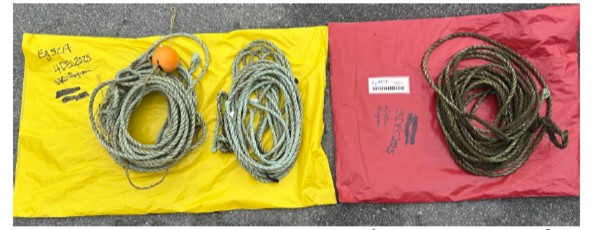
Fig. 1. Gear removed from Eg #5217 with its appearance on December 4, 2025 when it was initially stored at the Georgia Department of Natural Resources in Brunswick, Georgia prior to being transported to Massachusetts. Of note is the darker appearance of segment 1 compared to that after ~6 weeks in storage (Fig. 4). Segment 2 (L), 3 (M) and 1 (R). Photo credit: Georgia Department of Natural Resources.
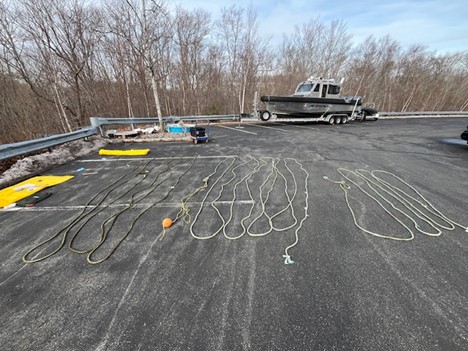
Fig. 2. Gear removed from Eg #5217 laid out at NOAA’s Greater Atlantic Region Fisheries Office in Gloucester, Massachusetts on January 14, 2026. Segment 1 (L), 2 (M) and 3 (R) (see text for descriptions). Photo credit: Ed Trippel, DFO.
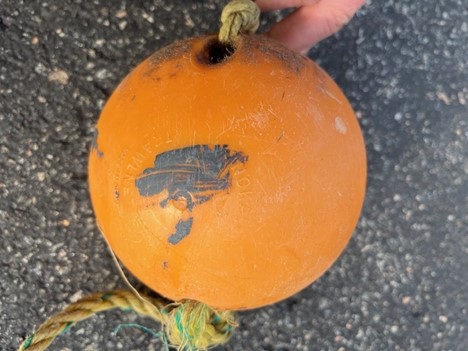
Fig. 3. Orange spherical buoy (diameter 5 inch; 12.7 cm) made of hard plastic. There are recesses located on opposite ends of the buoy through which 3/8 inch rope was passed as a means of attachment. The name and country of the manufacturer are visible (Nokalon, Denmark). The buoy had a crack in it. Photo credit: Ed Trippel, DFO.
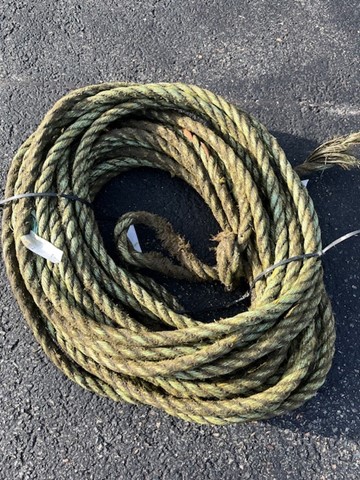
Fig. 4. Segment 1: 95 ft (29 m) of 5/8 in. float rope with a yellow tracer that included a DFO coloured buoy line mark. Photo credit: Ed Trippel, DFO.
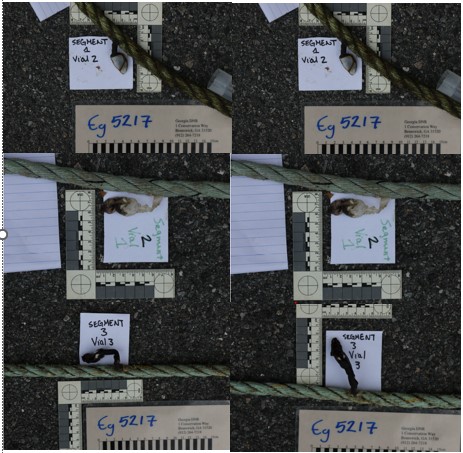
Fig. 5. Barnacles collected by Georgia Department of Natural Resources. Segment 1: Lepas anatifer and segments 2 and 3: Conchoderma auritum. Specimen identification provided by John Zardus, Department of Biology, The Military College of South Carolina. Photo credit: Florida Fish and Wildlife Conservation Commission.
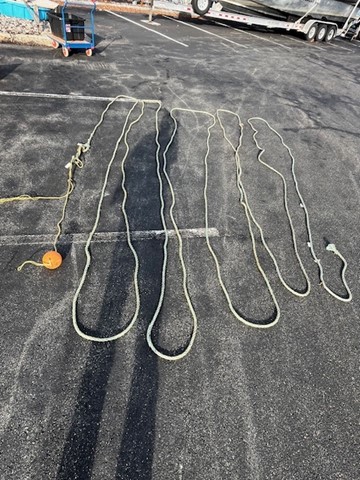
Fig. 6. Segment 2: 138 ft (42 m) of 5/8 in. sink rope with the remnants of the surface buoy system. 3/8 inch yellow polypropylene rope with green tracer was attached to an orange 5 in. (12.7 cm) diameter hard plastic buoy. A DFO coloured buoy line mark was present on the 5/8 in. rope. Photo credit: Ed Trippel, DFO.
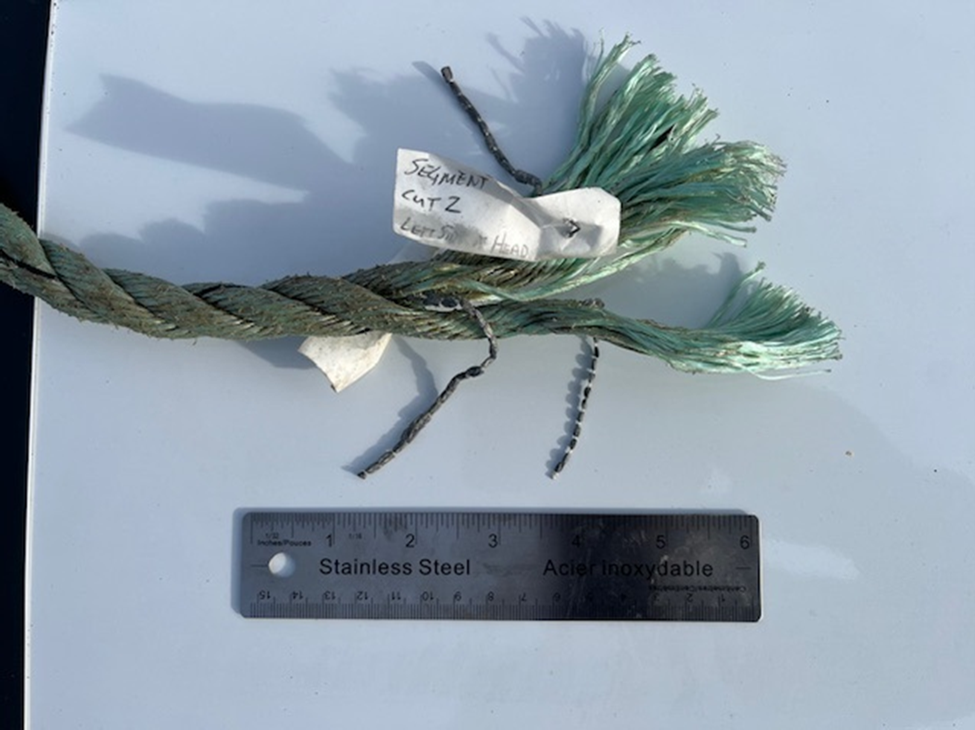
Fig. 7. Segment 2: A cut made by the disentanglement team of 5/8 in. sink rope. Beaded lead in each of the three strands are displayed. Photo credit: Ed Trippel, DFO.
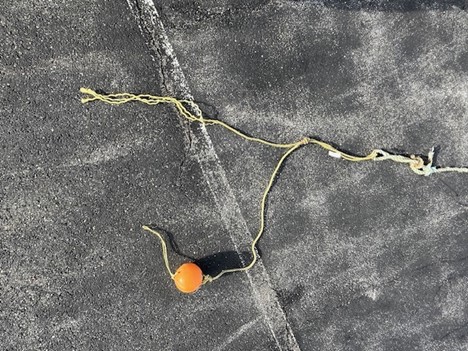
Fig. 8. Segment 2: Remnants of the surface buoy system including the 5 in. (12.7 cm) diameter orange buoy. Photo credit: Ed Trippel, DFO.
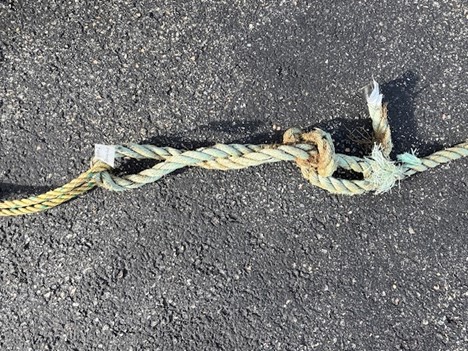
Fig. 9. Segment 2: Knotted loop of the 5/8 in. sink rope (with black tracer) to which the 3/8 in. Yellow polypropylene rope (with green tracer) was attached. Photo credit: Ed Trippel, DFO.
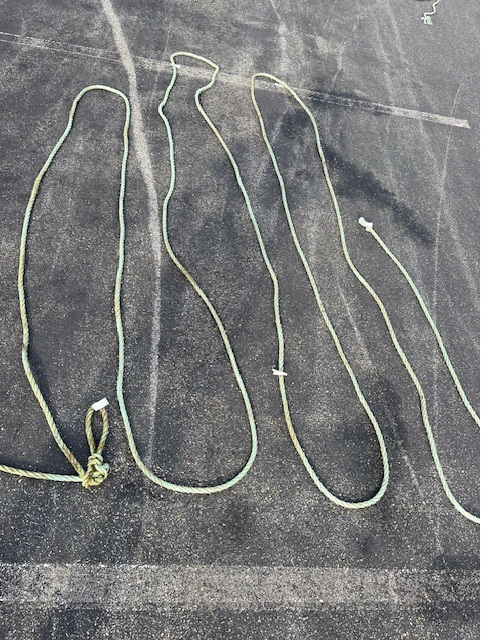
Fig. 10. Segment 3: 69 ft (21 m) of 5/8 inch float rope with a telemetry loop placed on December 3, 2025, this segment of rope included a coloured buoy line mark. Photo credit: Ed Trippel, DFO.
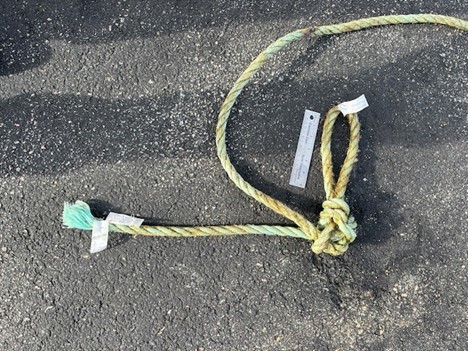
Fig. 11. Segment 3: Close-up of the telemetry loop. Photo credit: Ed Trippel, DFO.
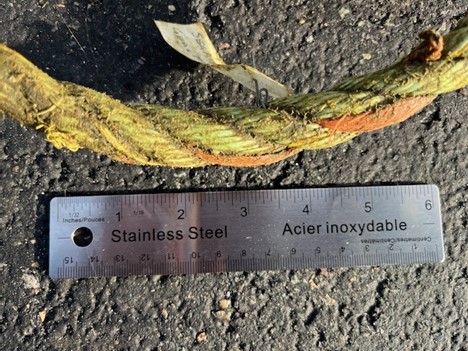
Fig. 12. Segment 1: Orange and yellow braided twines interlaced along a 7.9 inch (20 cm) section of 5/8 inch float rope. Twine sizes were 4 mm (orange) and 2.5 mm (yellow). Photo credit: Ed Trippel, DFO.
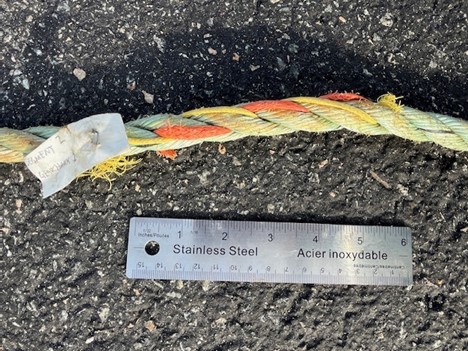
Fig. 13. Segment 2: Orange and yellow braided twines interlaced along a 7.1 inch (18 cm) section of 5/8 inch float rope. Photo credit: Ed Trippel, DFO.
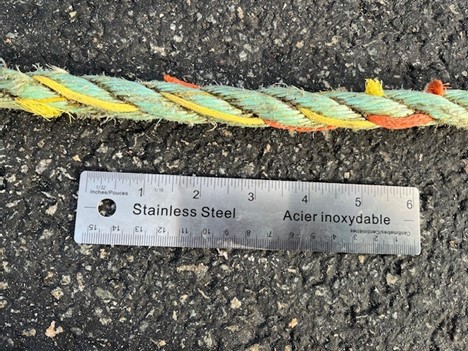
Fig. 14. Segment 3: Orange and yellow braided twines interlaced along a 7.1 inch (18 cm) section of 5/8 inch floating rope. Photo credit: Ed Trippel, DFO.
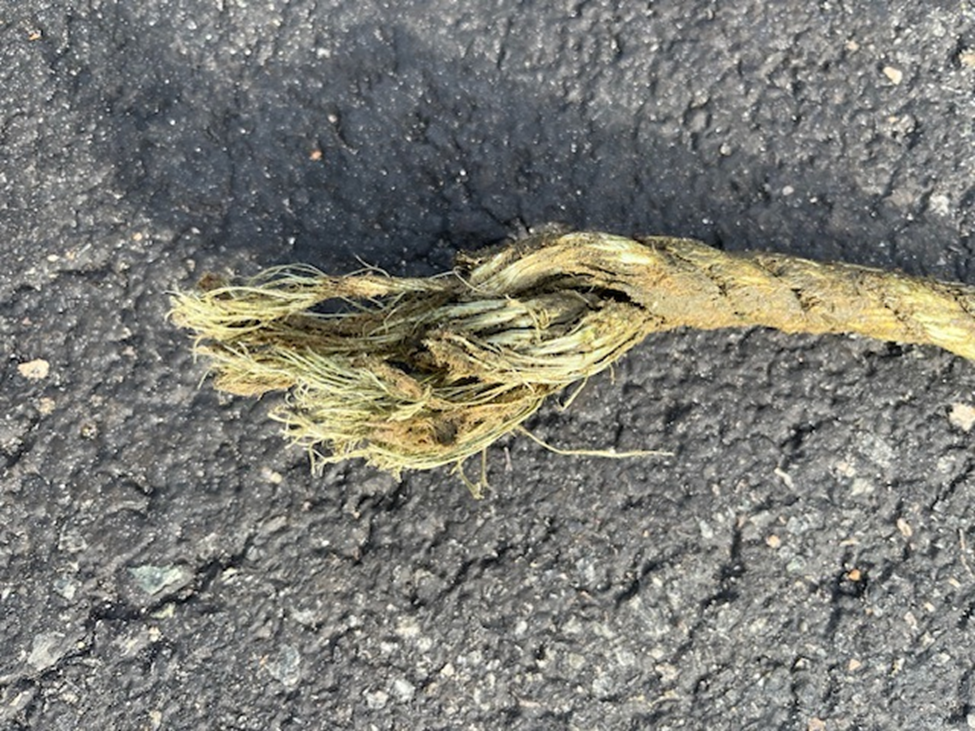
Fig. 15. Segment 1: Frayed end of 5/8 in. float rope, this was not one of the ends that was cut by the disentanglement efforts. This end would have led to the trap. Photo credit: Ed Trippel, DFO.
Page details
- Date modified: