
2026-27 Conservation Harvesting Plan - NAFO Sub-Division 3Ps
Groundfish Fixed Gear Vessels less than 27.4 metres (90ft.)
Contents
- Eligibility
- Fishing areas
- Fishing restrictions
- Catch limits
- Season
- Fishing gear
- Licensing policy
- Small fish and by-catch closure protocol
- Monitoring and reporting
- By-catch and incidental catch
- Closed and defined areas
- Species at Risk Act (SARA)
- Marine mammals
- Indigenous participation
- Safety at sea
- Footnotes
- References
1. Eligibility
Participation in the directed fixed gear groundfish fishery will be restricted to groundfish licence holders with a homeport in NAFO Sub-Division 3Ps, and those with overlap privileges with a homeport in NAFO Divisions 3KL, or Sub-Division 3Pn.
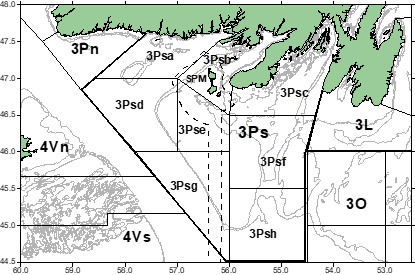
Description
Figure 1 Map of NAFO Subdivision 3Ps broken down into its unit areas. Subdivision 3Ps is located in the waters off of the southern part of the province of Newfoundland and Labrador. Unit areas are in alphabetical order and range from 3Psa through 3Psh. The dashed lines indicate the economic zone around the French islands of St. Pierre et Miquelon (SPM). Subdivision 3Ps is surrounded by NAFO divisions 3Pn, 4Vn, 4Vs, 3L and 3NO.
2. Fishing areas
- This Conservation Harvesting Plan (CHP) governs the directed fishery for all vessels less than 27.4 metres (m) (90 feet) in length, regardless of homeport, fishing groundfish in NAFO Sub-Division 3Ps using fixed gear, and is in effect for the management cycle which runs from April 1 to March 31 annually.
- The area of 3Ps SOUTH of a straight line joining the following points is referred to as the “offshore area” and consists of Sub-Division 3Ps units (d), (e), (f), (g) and (h), which are defined in Schedule 34 and attached to licence holders’ Groundfish General Licence Conditions..
- The area of 3Ps NORTH of the line above is referred to as the “inshore area” and consists of Sub-Division 3Ps units (a), (b) and (c), which are defined in Schedule 34 and attached to licence holders’ Groundfish General Licence Conditions.
- The coordinates of fishing area 10 and Sub-Division 3Ps units (a)-(h) are specified in Schedule 34 and attached to licence holders’ Groundfish General Licence Conditions.
3. Fishing restrictions
- This CHP applies to the following species:
- Atlantic halibut
- Cod
- Greenland halibut (Turbot)
- Monkfish
- Redfish
- Skate
- White hake
- Winter flounder (Blackback)
- A “fishing trip” is defined as starting from the time the vessel leaves port and ending when it returns to port for any reason, whether or not any fish has been caught.
- Once the amount of cod in the fish harvester’s Individual Quota (IQ) has been taken, from any fishery whether directed or by-catch, the fish harvester must cease fishing for all species of groundfish in NAFO Sub-Division 3Ps for the remainder of the management period (to March 31).
- In the offshore area of NAFO Sub-Division 3Ps, defined as units (d) to (h), when fishing any species of groundfish except Greenland halibut and skate/monkfish, all fishing gear must be returned to port with the vessel at the end of the fishing trip.
- The licence holder/operator is not permitted to fish in the French Maritime Area around Saint-Pierre and Miquelon unless a licence has been issued by France, and Fisheries and Oceans Canada (DFO) has authorized the licence holder/operator to conduct the fishing activity in the French Maritime area.
3.1 Atlantic Halibut
- Whether a directed fishery will be permitted is to be determined in consultation with FFAW/Industry on an annual basis.
- When it is decided that directed fishing can occur, fishing is only authorized in water depths greater than 91.44 m (50 fathoms).1
- When it is decided that directed fishing can occur, fishing is only authorized in that portion of NAFO Sub-Division 3Ps units (a) and (b) west of Boxey Point (47 degrees 24.3’ N, 55 degrees 35’ W) in Fortune Bay.2
- In an effort to reserve a portion of the <65’ fixed gear fleet allocation for the fall period, as total landings by this fleet approaches 70% of its fleet allocation, the Department will consult with stakeholders on temporarily closing the directed 3Ps Atlantic halibut fishery to that fleet and re-open in the fall. During this temporary closure, bycatch retention of Atlantic halibut in 3Ps by the fleet for all other fisheries will not be authorized.1,2
1, 2 In consultation with FFAW/industry, the Department has decided to permit a directed Atlantic halibut fishery during the 2026-27 season. As part of this decision, directed fishing for Atlantic halibut will be authorized in NAFO Sub-Division 3Ps, including east of Boxey Point and in water depths less than 91.44 m (50 fathoms).
3.2 Greenland halibut (turbot)
Fishing is not authorized in water depths less than 183 m (100 fathoms)
3.3 Redfish
- Fishing is only authorized in NAFO Sub-Division 3Ps units (a) and (b).
- Fishing is authorized in water depths greater than 183 m (100 fathoms)
3.4 Skate/Monkfish
Fishing is only authorized in water outside of 19 km of land unless the licence holder’s registered vessel eligibility is less than 12.2 m (40 feet) in length.
3.5 White Hake
- Fishing is not authorized in NAFO Sub-Division 3Ps unit (c).
- Fishing is only authorized in water depths greater than 137 m (75 fathoms).
3.6 Winter Flounder (Blackback)
- Fishing is only authorized in NAFO Sub-Division 3Ps units (a), (b) and (c).
- Fishing is only authorized in water depths less than 55 m (30 fathoms).
3.7 Atlantic Cod
- For those licence holders with a cod Individual Quota (IQ), all cod caught from any fishery, whether directed catch or by-catch, will be charged against the IQ for that licence.
- Fish harvesters are not authorized to fish cod in two NAFO Divisions or Sub-Divisions (e.g. 3Ps, 3Pn or 3KL) during the same fishing trip or on the same day.
- NAFO Divisions 3KL Overlap Vessels and NAFO Sub-Division 3Ps Equivalents are not permitted to direct for cod and are restricted to by-catch only while the TAC remains below 15,000 t, as per the Hearn Report. Overlaps are defined as those having access to NAFO Sub-Division 3Ps and fishing against an allocation for the particular fleet sector. Equivalents are defined as those having access to NAFO Sub-Division 3Ps and fishing against the same allocation as the resident NAFO Sub-Division 3Ps fleet sector.
- Groundfish licence holders in NAFO Divisions 3KL will have the option to exercise their fishing privileges in 3Ps, or participate in the 2J3KL Stewardship cod fishery, but not both.
- Inner St. Mary’s Bay overlap vessels are restricted to fishing within Area 29, which is that portion of Area 10 (as defined in Schedule 34 attached to the Groundfish General Licence Conditions) south of the area defined by straight lines joining the following points:
- 47 degrees 27.1’ N, 53 degrees 56’ W
- 47 degrees 21.5’ N, 54 degrees 11.5’ W
- 46 degrees 52.2’ N, 54 degrees 42’ W
- 46 degrees 56’ N, 55 degrees 14.3’ W
4. Catch limits
- Quota Reconciliation : Nominal quota over-runs from the previous year’s fisheries will be deducted from the current year’s quota prior to the start of the fishing season. This is done on an individual basis where there are IQs in place or for the fleet sector in competitive fisheries.
- Atlantic Cod : In consultation with the FFAW and fleet sector representatives, the management approach for 3Ps cod for the 2026-27 management period includes the following elements:
- IQs for the 3Ps-based and overlap and equivalent licence holders will be maintained at the same levels established for these licence holders in 2025-26. The resulting IQs for each fleet are specified in sections 4 b) ii to vi below.
- To account for a high level of inactivity in the inshore fixed-gear sector and to promote greater utilization of its available 3Ps cod quota, the IQs do not reflect an equal share of the current inshore fixed-gear fleet allocations within the sector and are instead over-allocated. As a result, IQs are not guaranteed and the ability for a licence holder to fish their cod IQ is subject to available fleet allocation.
- The 3Ps cod fishery may close to individual inshore fixed-gear fleets prior to the season end date if the respective fleet allocation is taken. If an individual fleet in the inshore fixed-gear sector approaches its respective fleet allocation, the sector’s landings will be assessed to determine if any flexibility exists for quota to be reallocated between the fleets within the sector. A decision in this regard will be made in consultation with the FFAW and fleet sector representatives. The fishery will close to the entire inshore fixed gear sector when the sector’s allocation is taken, regardless of whether the IQs are taken.
- In an effort to reserve a portion of the Area 10 (Placentia Bay) <35’ fleet allocation for the fall period, as total landings by this fleet approaches 60% of its allocation, the Department will consult with the FFAW and fleet sector representatives on temporarily closing the directed 3Ps cod fishery to that fleet and re-opening in the fall.
| Fleet Sector | Area 10 | Area 11 |
|---|---|---|
| < 7.6 m (<25’) | 1,918 kg (4,230 lbs) | 2,355 kg (5,191 lbs) |
| 7.6 to <12.2 m (25’- <35’) | 3,061kg (6,749 lbs) | 3,766 kg (8,303 lbs) |
| 12.2 to <19.8 m (35’- <65’) | 4,274 kg (9,423 lbs) | 7,851 kg (17,309 lbs) |
| Fleet Sector | 3KL Overlaps | 3Ps Equivalents |
|---|---|---|
| < 7.6 m (<25’) | NA | NA |
| 7.6 to 12.2 m (25’- <35’) | 1,269 kg (2,797 lbs) | 1,269 kg (2,797 lbs) |
| 12.2 to <19.8 m (35’- <65’) | 2,135 kg (4,707 lbs) | 2,135 kg (4,707 lbs) |
Table notes: Individual Quotas (NAFO Divisions 3KL Overlaps and NAFO Sub-Division 3Ps Equivalents) (Round weight)Note: As noted, 3KL Overlaps and 3Ps Equivalents are restricted to by-catch of cod only. The quotas below are maximum amounts of by-catch of cod that may be taken for the management period (to March 31) when directing for other groundfish species in 3Ps. |
||
| Fleet Sector | Branch/Point Lance |
|---|---|
| < 7.6 m (<25’) | N/A |
| 7.6 to <10.7 m (25’- <35’) | 1,646 kg (3,628 lbs) |
| >10.7 m (>35’) | 3,129 kg (6,899 lbs) |
| Fleet Sector | Inner SMB |
|---|---|
| < 7.6 m (25’) | 695 kg (1,533 lbs) |
| 7.6 to <10.7 m (25’- <35’) | 1,228 kg (2,708lbs) |
| 10.7 to 13.4 m (35’- 44’) | 2,214 kg (4,880 lbs) |
| >13.4 m (>44’) | 2,353 kg (5,187 lbs) |
| Fleet Sector | Maximum Yearly Harvest Caps |
|---|---|
| < 7.6 m (25’) | 1,585 kg (3,495 lbs) |
| 7.6 to <12.2 m (25’ - <35’) | 2,530 kg (5,577lbs) |
| 12.2 to <19.8 m (35’- <65’) | 4,274 kg (9,423lbs) |
Cod reallocation program
The cod reallocation program will remain suspended for the 2026-27 fishing season.
This program was established from 2013-14 to 2019-20 given the large annual percentage of unutilized cod quota within the inshore fixed-gear fleet sector. Under the program, 3Ps-based inshore fixed-gear groundfish licence holders were eligible for one full allocation once 75% of their original IQ was taken. It included possible suspension of further reallocations to licence holders within a 3Ps-based fleet once 75% of the fleet allocation had been reached. The cod reallocation program has been suspended since the 2020-21 season.
5. Season
- Atlantic Halibut:
- Mid-May1,2 to March 313
- Greenland Halibut (turbot):
- Mid-May1,2 to March 31
- Redfish:
- 3Ps portion of Unit 2: July 1 to March 31
- Spawning closure from April 1 to June 30 in all areas of 3Ps
- Skate/Monkfish:
- April 11,2 to March 31.
- White Hake:
- Mid-May1,2 to March 31
- Winter Flounder (blackback):
- Mid-May1,2 to March 31
- Atlantic Cod - 3Ps Based and Branch to Point Lance Based (3L):
- Inshore areas 3Ps (b), (c) and Offshore 3Ps (f), (g),(h): mid-May1,2 to February 28.4
- 3Ps (a),(d), and (e): mid-May1,2 to November 15.5
- Atlantic Cod (Inner St. Mary’s Bay Overlap vessels):
- September 1 to December 15
1 Specific opening date determined annually in consultation with the FFAW/industry
2 Opening may be delayed or staggered due to the DFO research vessel science survey
3As outlined in section 3.1, a directed fishery will be permitted during the 2026-27 season. Allocation used to cover catch in the directed fishery and by-catch in other groundfish fisheries.
4All areas - spawning closure March 1 to Mid-May1,2
5Closure beginning November 15th to protect Northern Gulf Cod that are mixing with 3Ps Cod. 3Ps(a) remains open to resident 3Ps (a) and (b) fishers until February 28th
6. Fishing gear
Below is a table summarizing the fishing gear limits by species and area. For complete details refer to the Groundfish General Licence Conditions and the species- specific licence conditions.
| Species | Minimum mesh size (mm) | Minimum Gape Size (mm) | Gear Limit |
|---|---|---|---|
| Atlantic Halibut | N/A | 15.4 | 4000 hooks at minimum spacing of 5.4 m (3 fathoms) |
| Greenland Halibut (turbot) | 152 (6 inches) in <732 m (400 fathoms) 191 (7.5 inches) in >732 m (400 fathoms) |
15.4 |
|
| Redfish | 140 (5.5 inches) | - | 20 nets |
| Skate/Monkfish | 305 (12 inches) when > 19 km from land 267 (10.5 inches) when < 19 km from land |
- |
|
| White Hake | 152 mm (6 inches) and not to exceed 215 mm (8.5 inches) | - |
|
| Winter Flounder (blackback) | 165 mm (6.5 inches) and not to exceed 216 mm (8.5 inches) | - | 20 nets |
| Atlantic Cod1 | 140 mm (5.5 inches) and not to exceed 165 mm (6.5 inches) | - |
|
Table notes: Fishing gear limits by species and area1 Cod traps - a maximum of 2 per enterprise may be fished for those licenced to fish cod traps |
|||
When fishing any species of groundfish, the licence holder/operator is required to report any lost fishing gear as per Schedule 38 – Marine Mammals Interactions and Management.
7. Licensing policy
The commercial fishery is guided by licensing policy which sets out requirements and eligibility criteria established by the Minister of DFO with respect to the licensing of commercial fishing and communal-commercial fishing in the Newfoundland and Labrador Region. The policies provide fish harvesters, Indigenous Organizations, and the Canadian public with a clear and consistent statement regarding DFO policy respecting commercial fishing enterprises, the registration of vessels, and the issuance of recreational and commercial fishing licences in the Newfoundland and Labrador Region.
8. Small fish and by-catch closure protocol
- Areas will be closely monitored and may be closed to fishing when the number of undersized fish caught exceeds 15% of the total number of the directed species, or when by-catch levels become a conservation concern.
- Closures due to small fish or by-catch will remain in effect for a minimum of 10 days.
- When a fishery is closed, it will not reopen until it can be effectively monitored and controlled.
- If a fishery in a particular area is closed twice during the year, it may remain closed for the remainder of the year.
- If a fishery is closed for the minimum 10-day period due to high by-catch levels or small fish, reopening will only be considered following a successful, observed, industry funded test fishery.
- Atlantic Halibut — 811 cm
- Greenland Halibut — 45 cm
- Redfish — 22 cm
- Atlantic Cod2 — 45 cm
1 All halibut less than the minimum size must be released, and where alive, in a manner that causes it the least harm.
2 The cod trap fishery is susceptible to small fish. If necessary, the cod trap fishery will be closed to ensure that the overall catches of small fish in cod traps do not exceed 30%.
9. Monitoring and reporting
- As per the Groundfish General Licence Conditions.
- At-Sea Observers: Unless otherwise stated, industry-funded observer coverage is required. The target level of coverage is 5% of the fleet sector.
- Satellite transponders will be required onboard vessels when requested by DFO.
10. By-catch and incidental catch
As per the Groundfish General Licence Conditions and the species-specific licence conditions.
11. Closed and defined areas
As per the Groundfish General Licence Conditions, refer to Schedule 34 - Closed and Defined Areas, and Schedule 36 – Closed Areas.
The Laurentian Channel Marine Protected Area falls within NAFO Division 3P. Commercial fishing is prohibited within the boundaries of the MPA.
12. Species at Risk Act (SARA)
The following species are considered at risk and listed under the Species at Risk Act (SARA) as either threatened or endangered:
- Northern wolffish (Anarchichas denticulatus ) – listed as threatened
- Spotted wolffish (Anarchichas minor) – listed as threatened
- Leatherback turtle (Dermochelys coriacea) – listed as endangered
- White shark (Carcharodon carcharias), Atlantic population – listed as endangered
In accordance with subsection 83(4) of SARA and the recovery strategy for northern wolffish, spotted wolffish, and leatherback turtle, and having met the conditions of sections 73(2) to (6.1) of SARA for white shark, the licence holder or vessel operator is permitted to carry out commercial fishing activities authorized under the Fisheries Act that may incidentally kill, harm, harass, or capture these species.
During these fishing activities, incidental catches of a these species must be returned to the place from which it was taken, and where it is alive, in a manner that causes the least harm. The licence holder or vessel operator is also required to complete the SARA section in the fishing logbook to provide information regarding any interactions with these species. Refer to the Groundfish General Licence Conditions for further information on these requirements.
13. Marine mammals
As per the Groundfish General Licence Conditions, refer to Schedule 38 – Marine Mammal Interactions and Management Measures.
14. Indigenous participation
Allocations will be negotiated with applicable Indigenous communities for food, social and ceremonial (FSC) purposes. Communal licences for FSC and commercial access will be issued under the Aboriginal Communal Fishing Licence Regulations.
15. Safety at sea
Safety at sea is a shared responsibility, with Transport Canada, Fisheries and Oceans Canada, the Canadian Coast Guard, and provincial authorities each playing a role; however, the primary responsibility for ensuring the safety of a fishing vessel and its crew rests with the vessel owner and operator. Operators are responsible for ensuring their vessel is seaworthy, properly registered and equipped, compliant with all applicable regulations, and operated within its safe limits, including stability, weather conditions, and crew competency. This includes maintaining valid certifications, approved safety equipment, written emergency procedures, trained crew, and safe operating practices at all times. Given the serious risks associated with commercial fishing, vessel operators are strongly encouraged to carefully review the complete Safety at Sea guidance document to fully understand their obligations and best practices. The guidance document should be read in its entirety before each fishing season and whenever vessel operations change.
- Date modified: