
Fisheries and Oceans Canada’s 2026-27 Departmental plan
On this page
Plans to deliver on core responsibilities and internal services
Department-wide considerations
Planned spending and human resources
Supplementary information tables
Copyright information
© His Majesty the King in Right of Canada, as represented by the Minister of Fisheries, 2026
Catalogue Number: Fs1-82E-PDF
ISSN 2371 6061
Aussi disponible en français sous le titre : Plan ministériels 2026-2027 de Pêches et Océans Canada
At a glance
This departmental plan details Fisheries and Oceans Canada’s (DFO) priorities, plans, and associated costs for the upcoming three fiscal years.
These plans align with the Government’s priorities outlined in the Speech from the Throne, Mandate Letter, and Budget 2025, as well as DFO’s Vision, mission, raison d’être, and operating context.
Comprehensive Expenditure Review
The government is committed to restraining the growth of day-to-day operational spending to make investments that will grow the economy and benefit Canadians.
As part of meeting this commitment, DFO is planning the following spending reductions:
- 2026-27: $54,470,344
- 2027-28: $101,906,152
- 2028-29: $193,821,958
It is anticipated that these spending reductions will involve a decrease of approximately 551 full-time equivalents by 2028-29.
DFO will achieve these reductions through the following measures:
- initiatives that optimize our workforce and operations
- streamlining functions, reducing duplication, and phasing out outdated and underperforming activities
- other measures to increase efficiency across the Department
The figures in this departmental plan reflect these reductions.
Highlights for DFO in 2026-27
DFO identified the following key priorities for 2026-27:
1. Helping coastal, rural, and Indigenous fishing communities grow their economies
DFO will modernize fisheries management through a comprehensive review of licensing policies and accelerated digital transformation, including the rollout of the Canadian Fisheries Information System and electronic logbooks to streamline operations and improve data collection. The Department will work collaboratively with provinces, territories, Indigenous Peoples, and industry to support market access, competitiveness, and the creation of innovative products, while also supporting small craft harbours that enhance climate resilience and food security. DFO will remain committed to maintaining strong relationships with Indigenous Peoples by supporting self-determination, regulatory frameworks, and capacity-building initiatives that enable Indigenous fishing communities to grow their economies, while promoting diversity and inclusion within its workforce. These efforts are supported by targeted investments, adoption of artificial intelligence and digital tools, and a focus on sustainable, science-based management practices that ensure long-term economic benefits for communities and uphold strong environmental safeguards.
2. Supporting small craft harbours to strengthen coastal infrastructure and economic resilience
DFO is prioritizing the strengthening of coastal infrastructure and economic resilience by supporting small craft harbours across Canada, recognizing their essential role in sustaining the fishing economy, food security, and the vitality of coastal communities. In 2026-27, DFO will deliver major repairs to key harbours such as North Rustico in Prince Edward Island, which is undergoing significant upgrades to enhance climate resilience and safety following hurricane damage, and will begin construction of a new harbour in Arctic Bay, Nunavut, to support northern fisheries, employment, and food sovereignty. DFO will also advance the federally announced infrastructure investments at Petty Harbour-Maddox Cove, Newfoundland and Labrador, supporting construction of a new breakwater and local economic activity. These initiatives are guided by a long-term infrastructure plan focused on preventative maintenance, lifecycle management, and climate-resilient design. By modernizing harbour infrastructure and operational practices, DFO aims to ensure these assets remain safe, functional, and adaptable to changing environmental conditions, thereby safeguarding the livelihoods of coastal, rural, and Indigenous communities and contributing to sustainable economic growth and prosperity for Canadians.
3. Modernizing fisheries enforcement to protect aquatic resources and enhance safety
DFO is modernizing fisheries enforcement by increasing on-water patrols, deploying body-worn cameras and aerial surveillance, and adopting digital technologies like drones and data analytics to better detect and deter illegal fishing. The Department is enhancing frontline coordination with the Canada Border Services Agency, expanding training and recruitment for fishery officers, and launching a new strategic plan that emphasizes intelligence-led enforcement, education, and targeted investigations. These efforts, combined with international collaboration and operational modernization, aim to safeguard aquatic resources, improve officer safety, and ensure effective, responsive enforcement across Canada’s fisheries.
4. Streamlining permitting, and supporting nation-building projects
DFO is modernizing its permitting processes to accelerate approvals for major infrastructure and routine projects, focusing on timely, science-based decisions that protect the environment and respect Indigenous rights. In 2026-27, the Department will introduce new guidance, standardized measures, and digital tools, including a concierge service and online portal, to expedite low-risk authorizations and complete significant project reviews within two years. Regulatory amendments and industry equivalency audits will further reduce burdens, while early Indigenous engagement and collaborative design ensure rights and interests are integrated. Through digital transformation and strong partnerships, DFO aims to support Canada’s growth, climate resilience, and sustainable development with efficient, inclusive regulatory oversight.
5. Fostering a diverse workforce and ensuring prudent fiscal management
DFO is advancing diversity, equity, and accessibility by implementing targeted training, auditing employment practices, and expanding tools to prevent discrimination, while also launching a new Accessibility Action Plan to improve workplace accommodations and ensure barrier-free services. The Department is committed to inclusive hiring, supporting Indigenous and 2SLGBTQIA+ employees, and tracking employee satisfaction to strengthen belonging.
On fiscal management, DFO is reducing operating costs and increasing efficiency through modernization, digital transformation, and the use of artificial intelligence, all in alignment with the Government’s Comprehensive Expenditure Review. Greening government principles are integrated into operations, with efforts to reduce energy use, repurpose equipment, and support climate-resilient infrastructure, ensuring DFO delivers high-quality, sustainable programs and services to Canadians.
In 2026-27, total planned spending (including internal services) for DFO is $1,885,760,141 and total planned full-time equivalent staff (including internal services) is 6,892.
Summary of planned results
The following provides a summary of the results the Department plans to achieve in 2026-27 under its main areas of activity, called “core responsibilities.”
Core responsibility 1: Fisheries
Departmental results:
- Canadian fisheries are sustainably managed
- Canadian aquaculture is sustainably managed
- The commercial fishing industry has access to safe harbours
- Fisheries, oceans, and other aquatic ecosystems are protected from unlawful exploitation and interference
- Scientific information on fisheries resources is available to inform management decisions
- Enhanced relationships with, involvement of, and outcomes for Indigenous Peoples
Plans for 2026-27:
- Continue to work with federal, provincial, and territorial partners to help the Canadian fish and seafood sector transition to meet growing market demands, both at home and abroad, for products that are high quality, value-added, and sustainably sourced
- Participate in multilateral negotiations to ensure a fair market for sustainable Canadian fish and seafood and the protection of fisheries, oceans, and other aquatic ecosystems from exploitation
- Support continued market access and competitiveness of Canadian seafood by continuing to implement fisheries management measures in support of North Atlantic right whale recovery and through the promotion of Whalesafe gear
- Initiate a comprehensive review of licensing policies and processes to improve efficiency and support digital innovation, while maintaining strong environmental protections and economic benefits for local communities
- Explore options for policy and licensing changes that will modernize west coast commercial fisheries to benefit working harvesters and their ability to adapt to change on a fishery-specific basis, starting with the commercial crab and prawn fisheries
- Invest in digital modernization, including online licensing forms and pilot projects using artificial intelligence to digitize fishing data and reduce administrative burden
- Develop a Plain Language Information Portal to centralize and simplify essential information for fishers, improving transparency and accessibility
- Expand implementation of electronic logbooks (ELOGs) for select fisheries, enabling real-time data collection and improved reporting
- Explore new conservation measures for the 2026 recreational groundfish season in Newfoundland and Labrador, prioritizing sustainability, safety, and recognition of cultural traditions
- Continue to support climate resilience, safety, and economic growth in coastal and northern communities through investments in small craft harbours, including North Rustico and a new facility in Arctic Bay, Nunavut
- Prioritize climate vulnerability research for fisheries, ecosystems, and coastal infrastructure
- Strengthen on-water enforcement presence and continue to deter and respond to illegal, unreported and unregulated fishing activities
- Continue to advance the divesture of the Freshwater Fish Marketing Corporation (FFMC) in a manner that promotes continued market access for rural, remote, and isolated harvesters, and economic reconciliation
- Co-develop Nunavut Fishery Regulations with Indigenous rightsholders, reflecting modern land claims agreements and supporting self-determination
- Support the priorities of Nunavut Tunngavik Inc. and the Inuit Nunangat Policy to advance self-determination by creating a modern fisheries management regime that further implements the respective land claims agreements and promotes sustainability and economic diversification
Planned spending: $1,169,011,070
Planned human resources: 3,548
More information about Fisheries can be found in the full plan.
Core responsibility 2: Aquatic Ecosystems
Departmental results:
- Negative impacts on Canada’s oceans and other aquatic ecosystems are minimized or avoided
- Scientific information on Canada’s oceans and other aquatic ecosystems is available to inform management decisions
- Mariners safely navigate Canada’s waters
- Enhanced relationships with, involvement of, and outcomes for Indigenous Peoples
Plans for 2026-27:
- Expedite reviews for major projects by establishing efficient processes and partnerships, ensuring environmental standards and Indigenous rights are upheld
- Streamline authorization for other projects by advancing regulatory amendments to better align information requirements with project risk and developing new guidance and tools (e.g. standardized measures) to reduce regulatory burden for low-risk works
- Advance conservation by working toward protecting 30% of Canada’s waters by 2030, establishing new marine protected areas and other effective area-based conservation measures, and supporting international biodiversity agreements
- Lead management of aquatic invasive species through early detection, targeted inspections, and decontamination programs at key border crossings and events
- Prioritize protection of aquatic species at risk by addressing Species at Risk Act decision backlogs and focusing on recovery planning and progress reporting
- Implement response trapping and research for invasive species such as European Green Crab and Quagga/Zebra mussels.
- Digitally enable the approval and audit of projects near water through an online portal that will allow DFO to reduce the time required to review and approve projects
- Provide hydrographic and geospatial tools to support Arctic navigation, defence, and commercial uses of new northern shipping routes
Planned spending: $329,744,920
Planned human resources: 1,789
More information about Aquatic Ecosystems can be found in the full plan.
For complete information on DFO’s total planned spending and human resources, read the Planned spending and human resources section of the full plan.
From the Minister

As Minister of Fisheries, I am pleased to present the 2026-27 Departmental Plan.
This plan outlines how Fisheries and Oceans Canada will ensure well-managed fisheries, aquaculture, and seafood sectors; uphold Indigenous rights and partnerships; maintain safe commercial harbours; advance major national projects; and support sustainable harvesting through strong science, technology, and collaboration.
It also highlights the Department’s work to protect fish and their habitats, support species at risk, manage protected areas and invasive species, deliver modern marine charts for safe navigation, and provide the science needed for informed, sustainable decisions.
Canada’s fish and seafood sector enjoys an exceptional global reputation for quality, safety, and sustainability. As demand for our products continues to grow, so does the opportunity to support the economic development of rural, coastal, and Indigenous communities across the country.
Fisheries and Oceans Canada is committed to expanding fish and seafood exports, increasing value-added production, and making export processes faster, more efficient, and more digital to help producers, harvesters, and processors reach new markets. This includes working directly with other countries to pursue new trade agreements and strengthen existing ones, addressing trade barriers, enhancing regulatory cooperation, and advocating for greater market access.
Of course, the health of our fish and aquatic resources depends on the health of the environment. If we want species and habitats to thrive, and to support greater economic prosperity in coastal communities, we must confront the challenges they face, including pollution, habitat loss, and the impacts of climate change.
Conservation is central to this work. This year, Fisheries and Oceans Canada will continue contributing to Canada’s goal of protecting 30 per cent of our waters by 2030. This includes collaborating to establish new marine protected areas and other effective area-based conservation measures, as well as managing and monitoring these protected spaces.
The Department will also continue supporting the United Nations Decade of Ocean Science for Sustainable Development, as well as working closely with the ocean community and other partners, both nationally and internationally, to advance science and deepen knowledge, required to support evidence-based policy and decision-making.
As we work to protect Canada’s fish and the habitats they depend on, we remain committed to sustainable management at home and abroad. We will continue advancing conservation and sustainable harvesting practices to ensure that future generations can enjoy and benefit from Canada’s rich marine resources.
The Department is strengthening enforcement through greater on-water presence, using more modern surveillance tools, and continuing to work with other enforcement partners. This includes rolling out body-worn cameras, renewing aerial surveillance, and supporting international efforts against illegal, unreported, and unregulated fishing. These measures reinforce Canada’s commitment to sustainable and healthy fisheries, bolster officer safety, and enhance compliance with conservation rules.
We will also play a key role in supporting major nation-building projects such as ports, mines, trade corridors, and other initiatives that unlock natural resources, expand market access, and strengthen domestic supply chains.
To do this, the Department is modernizing its permitting process by reducing regulatory burden, streamlining low-risk authorizations, and enhancing digital tools. Our aim is to complete reviews within two years while maintaining environmental protections, respecting Indigenous rights, and ensuring timely decisions that are informed by the best available science, and that support long-term economic growth.
The contributions of Indigenous Peoples are integral to marine conservation and the long-term sustainability of fisheries. In line with the Government of Canada’s commitment to reconciliation and true partnership, Fisheries and Oceans Canada will prioritize Indigenous involvement in oceans management and the protection of fish and fish habitat. Through collaboration, inclusive policy development, and capacity-building, the Department will continue supporting Indigenous self-determination and stewardship across fisheries, oceans, and aquatic ecosystems.
Fisheries and Oceans Canada will also continue its support of small craft harbours across the country. These harbours are essential to the fishing economy, food security, and the vitality of coastal communities, and we remain committed to ensuring they are fully operational, well-maintained, and supported by self-sufficient harbour authorities representing local interests.
Our scientists will continue conducting research to address emerging issues and provide the high-quality science monitoring and advice needed for decisions about our oceans and aquatic ecosystems. We will also continue to share scientific results and data with Canadians to ensure transparency and support public understanding of key priorities.
The year ahead promises to be active and productive. I am grateful to work alongside so many talented and dedicated public servants who are committed to deepening our understanding of ocean and freshwater ecosystems and safeguarding the species and habitats that sustain them. Their expertise and passion continue to drive our progress and strengthen our stewardship of Canada’s vital aquatic resources.
The Honourable Joanne Thompson, P.C., M.P.
Minister of Fisheries
Plans to deliver on core responsibilities and internal services
Core responsibilities and internal services
Core responsibility 1: Fisheries
In this section
Description
Manage Canada’s fisheries, Indigenous fisheries programs, aquaculture activities and support commercial fishing harbours while applying relevant legislation.
Quality of life impacts
Canada’s Quality of Life Framework provides a comprehensive lens for understanding and measuring the factors that shape well-being across the country. By organizing these factors into five distinct domains, the framework highlights the areas that Canadians value most in their pursuit of a high quality of life.
DFO’s Fisheries core responsibility contributes directly to the domain of Prosperity by supporting a sustainable and innovative marine industry, Indigenous participation in the marine economy, and the management of a national network of small craft harbours. These efforts are measured by the headline indicators such as gross domestic product (GDP) per capita and firm dynamism.
This core responsibility also advances the Environment domain in several ways. DFO integrates climate change adaptation into the management of harbours, fisheries, and aquaculture, and this can be measured by climate change adaptation - the proportion of core public infrastructure owners who factored climate change adaptation into their decision-making process. DFO will continue to publish the sustainable survey for fisheries and the work plan that tracks progress in the implementation of the sustainable fisheries framework.
Indicators, results and targets
This section presents details on the department’s indicators, the actual results from the three most recently reported fiscal years, the targets and target dates for Fisheries. Details are presented by departmental result.
Table 1: Canadian fisheries are sustainably managed
Table 1 provides a summary of the target and actual results for each indicator associated with the results under Fisheries.
| Departmental Result Indicators | Actual Results | 2026–27 Target | Date to Achieve Target |
|---|---|---|---|
| Percentage of prescribed fish stocks that have limit reference pointsFootnote1 | 2022–23: n/a 2023–24: n/a 2024–25: n/a |
At least 80% | March 31, 2027 |
| Percentage of prescribed fish stocks that were harvested at or below established levelFootnote2 | 2022–23: n/a 2023–24: n/a 2024–25: n/a |
At least 80% | March 31, 2027 |
Note: n/a in the “Actual results” column indicates that the performance indicator was not in effect at that time, and therefore, historical data may not be available. In cases where historical data is available, past results are presented.
Table 2: Canadian aquaculture is sustainably managed
| Departmental Result Indicators | Actual Results | 2026–27 Target | Date to Achieve Target |
|---|---|---|---|
| Percentage of aquaculture farms that are compliant with the Fisheries Act regulations | 2022–23: 96% 2023–24: 100% 2024–25: 100% |
At least 90% | March 31, 2027 |
Table 3: The commercial fishing industry has access to safe harbours
| Departmental Result Indicators | Actual Results | 2026–27 Target | Date to Achieve Target |
|---|---|---|---|
| Percentage of core harbours that are in fair or better condition | 2022–23: 90% 2023–24: 89% 2024–25: 88.5% |
At least 87% | March 31, 2027 |
Table 4: Fisheries, oceans and other aquatic ecosystems are protected from unlawful exploitation and interference
| Departmental Result Indicators | Actual Results | 2026–27 Target | Date to Achieve Target |
|---|---|---|---|
| Percentage of occurrences that have resulted in compliance actionsFootnote3 | 2022–23: 60% 2023–24: 63% 2024–25: 69% |
At most 60% | March 31, 2027 |
Table 5: Scientific information on fisheries resources is available to inform management decisions
| Departmental Result Indicators | Actual Results | 2026–27 Target | Date to Achieve Target |
|---|---|---|---|
| Percentage of scheduled Canadian Science Advisory Secretariat (CSAS) processes for peer-reviewed science advice on fisheries completed each yearFootnote4 | 2022–23: n/a 2023–24: n/a 2024–25: n/a |
At least 90% | March 31, 2027 |
| Percentage of sustainable aquaculture research projects which provide information to policy and decision makersFootnote5 | 2022–23: 79% 2023–24: 100% 2024–25: 100% |
At least 90% | March 31, 2027 |
Note: n/a in the “Actual results” column indicates that the performance indicator was not in effect at that time, and therefore, historical data may not be available. In cases where historical data is available, past results are presented.
Table 6: Enhanced relationships with, involvement of, and outcomes for Indigenous people
| Departmental Result Indicators | Actual Results | 2026–27 Target | Date to Achieve Target |
|---|---|---|---|
| Number of agreements / arrangements involving Indigenous groups | 2022–23: 517 2023–24: 701 2024–25: 677 |
464 | March 31, 2027 |
| # of Indigenous people trained through agreements / arrangements | 2022–23: 1,310 2023–24: 1,924 2024–25: 1,218 |
625 | March 31, 2027 |
| Number of Indigenous people employed through agreements / arrangements | 2022–23: 5,369 2023–24: 5,991 2024–25: 5,587 |
5040 | March 31, 2027 |
Additional information on the detailed results and performance information for the Department of Fisheries and Oceans’ program inventory is available on GC InfoBase.
Plans to achieve results
The following section describes the planned results for Fisheries in 2026-27.
Under the Fisheries core responsibility, DFO has a broad mandate to support conservation and healthy and sustainable fishing and aquaculture sectors. Programs in the Fisheries core responsibility ensure that fisheries, aquaculture, and the seafood industry are well-managed; that the rights of Indigenous Peoples are respected and Indigenous interests are supported (including enhanced fishing access in recognition of rights); that safe commercial small craft harbours support the industry; and that fish are harvested and farmed in a safe, orderly, and sustainable manner. On top of these ongoing responsibilities, the following are some of the Department’s plans for 2026-27.
Canadian fisheries are sustainably managed
Results we plan to achieve
Fisheries Management Modernization
Approximately 72,000 Canadians make their living directly from fishing and related activities. In 2026-27, DFO will advance improvements to service delivery and reduce regulatory burden for industry by continuing to modernize the fisheries management regime by:
- initiating a comprehensive review of all national and regional licensing policies and processes in response to a What we heard report: Vessel and related policies that support Owner-Operator. It aims to improve operational efficiency and support digital innovation while maintaining strong environmental protections and providing meaningful benefits to the fish and seafood sector, ensuring economic benefits flow to local communities. The review will identify and address outdated, duplicative, or inefficient policies and practices. Targeted streamlining efforts are already underway in regions such as the Gulf, where residency requirements for substitute operators are being simplified.
- investing in digital modernization to enhance service delivery and data management to improve how we manage licensing and the collection of fishing data. A pilot project between Quebec and Pacific Regions is exploring the use of artificial intelligence to digitize paper-based fishing data, which could significantly reduce administrative burden and improve data collection efficiency.
As detailed in DFO’s Red Tape Review Progress Report, these initiatives reflect the department’s commitment to modernizing its operations and regulatory frameworks in a way that supports industry compliance, fosters innovation, and strengthens Canada’s position as a global leader in sustainable fisheries management.
In direct response to feedback from stakeholders and partners, DFO will develop a Plain Language Information Portal. This digital format will centralize and simplify essential information and make information access easier for fishers at all stages of their operations, including new harvesters, active licence holders, and those preparing to retire. A draft pilot version is currently being developed for inshore licence holders in Eastern Canada and Quebec. This communication product will enhance usability for harvesters by effectively sharing information on operational efficiency, business risk management, and robust safety and conservation standards.
In 2026-27, the Department will continue investing in the accelerated delivery of the Canadian Fisheries Information System to modernize the licensing and quota, catch and effort, and reporting and analytics services used to manage commercial fisheries. DFO will also continue to work with industry and service providers to continue the implementation of the electronic logbooks (ELOGs) for select fisheries in Atlantic Canada, including lobster. Implementation of ELOGs will allow for real-time data collection and a reduction in processing time while improving reporting capabilities, allowing DFO staff to identify trends and make more timely decisions regarding commercial fisheries.
DFO will continue to support sustainable and prosperous fisheries managed according to the precautionary approach, based on input from Indigenous rights holders and partners, that are grounded in science. Canada has international and domestic commitments to implement the precautionary approach into its fisheries decision-making framework. In ongoing support of these commitments, starting in 2025-26, DFO received renewed funding of $33.5 million over 5 years to continue to implement the Fish Stocks Provisions (s. 6.1-6.3) of the modernized Fisheries Act.
To support conservation and ensure public safety, DFO will explore new measures for the 2026 recreational groundfish season in Newfoundland and Labrador. Currently, the fishery is regulated by per-person catch limits and a maximum boat limit, designed to prevent vessel overcrowding. DFO will assess both the interest in modernizing existing policies and the health of the province’s three cod stocks. While cod stocks on the south and west coasts remain in the critical zone, the Northern cod stock has shown signs of improvement. The overarching goal is to manage the fishery in a way that promotes sustainability, ensures safety, and respects the deep-rooted traditions of the region.
DFO will continue efforts to support Pacific salmon populations through ongoing modernization of fisheries management and hatcheries on the west coast, and by working collaboratively with First Nations in British Columbia and Yukon, harvesters, and external partners. This work will include advancing construction of new conservation hatcheries in partnership with First Nations to support recovery and rebuilding of stocks of conservation concern.
In the Pacific region, the Department will continue to support the advancement of innovative technologies to support the management and enforcement of the British Columbia recreational fishery by maintaining and enhancing the Fishery Regulation Information System (FRIS). FRIS is the central repository for all B.C. recreational tidal water variation orders, and through technical automation, this data is made available on the public-facing DFO Sport Fishing Guide webpages and on third-party smartphone applications. This work offers new ways the public can access critical information to ensure they are in compliance before embarking on a fishing trip.
In 2026-27, the Department will continue to support increased operating efficiency of the Pacific commercial and communal commercial salmon shared-based fisheries by modernizing targeted Pacific quota databases and consolidating or decommissioning legacy databases. Alignment to Pacific Quota Management Systems will automate processes and reduce manual effort required by various Departmental resources, improve in-season management decisions, and enable timely and efficient tracking of the fisheries.
Efforts to mitigate entanglement risks for North Atlantic right whales will remain a priority for DFO, alongside ongoing implementation of Canada’s Whalesafe Fishing Gear Strategy.
Wild Atlantic salmon is an iconic species that need healthy rivers and streams to thrive. DFO will advance work in the third year of Canada’s national strategy to ensure the future of Atlantic salmon 2024-2036. Key deliverables in 2026-27 will include the development of an information and data platform that allows for actions and funding commitments to be prioritized, tracked, and reported, as well as the development of governance structures for Atlantic salmon that respond to the needs of the Atlantic salmon community (including many Indigenous communities and organizations, five provincial governments, and diverse stakeholder groups). DFO will also establish conservation commitments that specify actions Canada (including DFO, Indigenous organizations, provincial governments, and stakeholders) will take to support Atlantic salmon conservation in order to fulfill Canada’s international obligations at the North Atlantic Salmon Conservation Organization. DFO will work on a scientific assessment of the risks of Atlantic salmon stocking on wild Atlantic salmon populations. Information obtained through this initiative will be used to develop a risk assessment framework, an important reference for the later development of guidance for Atlantic salmon stocking activities in Canada. In Quebec, DFO will focus on practical actions to restore and protect their habitats, including funding targeted restoration projects that could include reducing riverbank erosion, creating cool-water refuges, and reconnecting migratory corridors to allow free movement and spawning. First Nations leadership and knowledge will play a central role in planning and implementing these actions, recognizing their deep connection to salmon and commitment to healthy ecosystems.
In 2026-27, DFO will continue its work on addressing abandoned, lost, or otherwise discarded fishing gear (“ghost gear”), which poses a significant threat to endangered whales and other marine mammals, aquatic species, and marine ecosystems. DFO is developing a Ghost Gear Action Plan, a prevention-focused strategy to modernize Canada’s fisheries operations and regulatory framework to effectively address the impacts of ghost gear. The plan, informed by five years of program activities and feedback provided by partners and stakeholders through dedicated public engagement from 2024 to 2026, is scheduled for release in March 2027. It will outline regulatory tools, policies, and gear management practices to tackle ghost gear into the future, helping to ensure sustainable fisheries in Canada for generations to come.
Building on broad engagement with First Nations and commercial fisheries participants in 2024 and 2025 through its West Coast Commercial Fisheries Modernization initiative, DFO will continue to respond to concerns raised about the distribution of risks and benefits and about economic sustainability of commercial fisheries on Canada’s Pacific coast. As part of this initiative, DFO is working with commercial fishery advisory boards to ensure that board representation better reflects the range of participants in a given fishery. DFO is making licence and quota data more easily accessible to harvesters and gathering more socio-economic information to support DFO’s and industry’s decision-making. DFO continues to analyze and expand our understanding of the impacts of foreign ownership, concentration of access, and leasing in Pacific commercial fisheries.
Through bilateral engagement with international partners and regional fisheries management organizations (RFMOs), DFO will focus its efforts on protecting and expanding economic opportunities for Canadian harvesters, conserving ecosystems that sustain shared fish stocks, and strengthening international frameworks to prevent illegal and irresponsible activities. This includes continued close cooperation with the United States to co-manage shared fish stocks through long-standing bilateral treaties and arrangements.
Fostering a Strong Fish and Seafood Sector
Canada’s fish and seafood industry is critical to many coastal communities, contributing $11.9 billion to Canada’s economy and $8.1 billion in exports in 2024. In 2026-27, the Department will continue to prioritize assisting the fish and seafood sector in responding to market uncertainty. DFO will continue to work with federal partners such as Global Affairs Canada, Agriculture and Agri-Food Canada, and the Canadian Food Inspection Agency, as well as industry, provinces and territories, and other partners to foster innovation, expand market access, and support export diversification.
To promote Canada’s fish and seafood sector abroad, the Department will continue leading and organizing the Canadian delegation at Seafood Expo North America in Boston and will work closely with the Trade Commissioner Service at other major seafood trade shows, such as Seafood Expo Global in Barcelona. The Department will also provide concierge service to industry and individual businesses when they have questions or face market access challenges and will support other Government departments in addressing market access issues such as non-tariff barriers. These efforts will help diversify markets beyond the U.S. and China, strengthen industry resilience, and position Canada as a global leader in sustainable seafood, contributing to economic stability for coastal communities and long-term competitiveness.
To strengthen Canada’s collaboration with reliable trading partners and allies around the world, DFO will provide subject matter expertise to Global Affairs Canada to ensure that the fish and seafood sector receives the full benefits of bilateral and multilateral trade agreements; provide expert advice to the federal government on the impacts of foreign tariffs on Canada’s fish and seafood sector; monitor market conditions and assess economic risks to inform responsive policies; and actively promote Canada’s trade policy interests at international fora such as the World Trade Organization (WTO), Food and Agriculture Organization (FAO) Committee on Fisheries (COFI), and the Convention on International Trade in Endangered Species of Wild Fauna and Flora (CITES). Through these activities, DFO will seek to influence trade-related decisions that affect market access and competitiveness for Canadian seafood, promote global sustainability standards and, create favorable conditions for exporters, reinforcing Canada’s reputation as a trusted supplier of high-quality, sustainably sourced seafood.
In 2026-27, DFO will continue to work with the Canadian seafood industry and Indigenous Peoples to ensure domestic fisheries remain competitive in and compliant with international market access requirements, like the import provisions of the United States Marine Mammal Protection Act and the updated catch certification requirements under the European Union’s Illegal, Unreported and Unregulated Fishing Regulation.
The planned divestiture of DFO’s only Crown corporation, the Freshwater Fish Marketing Corporation (FFMC), is scheduled for 2026–27. This reflects the provincial moves towards open markets and the closure of Alberta’s commercial fishery in 2014. The Northwest Territories,- the sole remaining active signatory to the related legislation, continues to provide a small supply of fish to the FFMC while it advances its Great Slave Lake Revitalization Strategy, which includes its new fish processing plant in Hay River. These changes reflect the need to transform the ownership and governance model of the FFMC for it to be competitive in today’s open market and continue to meet the needs of harvesters into the future.
Canadian aquaculture is sustainably managed
Results we plan to achieve
Aquaculture, or fish farming, plays a role in Canada’s food production and is associated with economic and social activity in rural and coastal communities. DFO is responsible for managing and coregulating aquaculture activities with the provinces through federal and provincial legislation and related regulations. This aims to ensure they align with environmental, economic, and social considerations. Aquaculture science and international engagement form part of DFO’s work in this area. In 2026–27, DFO plans to engage with provincial, territorial, and Indigenous partners on ongoing efforts related to aquaculture management in Canada.
In 2026-27, the Department will ensure that aquaculture operators continue to meet environmental protection requirements to help protect our aquatic ecosystems and keep marine resources productive and available for the benefit of future generations. DFO will also continue to support important ongoing work at international forums related to sustainable aquaculture, strengthen our collaboration with reliable trading partners and allies around the world, and enhance our international partnerships on aquaculture. This work includes participating in the Five Country Partnership on Aquaculture with Norway, Scotland, Chile and the Faroe Islands; efforts to increase the focus on aquaculture at the Organization for Economic Cooperation and Development (OECD)’s Committee on Fisheries; and Canada’s continued participation as a long-standing member of the Food and Agriculture Organization of the United Nations Sub-committee on Aquaculture.
In 2024-25, the Canadian Food Inspection Agency (CFIA) confirmed the presence of two oyster diseases, Multinucleate Sphere Unknown X (MSX) and Dermo in the Atlantic provinces. While MSX and Dermo are not a food safety concern, they pose serious threats to Canada’s oyster industry, both farmed and wild. DFO will continue to work closely with the CFIA, provinces, oyster growers, harvesters, processors, and academic institutions to mitigate the evolving impacts of MSX and Dermo and respond to industry priorities related to these diseases.
The commercial fishing industry has access to safe harbours
Results we plan to achieve
DFO will continue the increasingly urgent work of repairing and maintaining small craft harbours by delivering the final phase of funding allocated through Budget 2024. This investment totals $463.3 million over three years, beginning in 2024–25, and is in addition to the program’s ongoing annual budget of $90 million.
In 2026–27, the North Rustico harbour in Prince Edward Island will continue to undergo major repairs due to damage caused by Hurricane Fiona in 2022, supported by a federal investment of approximately $14 million. This project reflects the Government of Canada’s commitment to strengthening the economy, supporting coastal communities, and ensuring resilient infrastructure that can withstand future climate events. The breakwater replacements are scheduled for completion by March 31, 2027. Once completed, the upgraded infrastructure will enhance safety and improve the reliability of commercial and recreational fisheries. Small craft harbours like North Rustico are vital to more than 45,000 Canadians employed in the fish and seafood industry. Maintaining their resilience is key to preserving the traditions and livelihoods of coastal, rural, and Indigenous communities across Canada, while ensuring they can continue to thrive and contribute to a more affordable and prosperous future for all.
DFO will also advance the federally announced infrastructure investments at Petty Harbour-Maddox Cove, Newfoundland and Labrador. Identified under Budget 2025, this project will support the construction of a new breakwater through the new Build Communities Strong Fund. The initiative will help protect and maintain existing harbour infrastructure while supporting local economic activity, such as job creation in the community.
In addition to maintaining and improving existing harbours, DFO will also invest in the construction of a small craft harbour in Arctic Bay, Nunavut. This five-year project (2025-26 to 2029-30) will build essential infrastructure such as breakwaters, a fixed wharf, a launch ramp, and float wharves. This investment will provide new opportunities for employment in long-term harbour operations and management, increase participation in the emerging commercial fishery, and help facilitate tourism. The harbour will assist with safe access to traditional harvesting and fishing activities, help improve food security and enhance food sovereignty for the community, and support intercommunity travel. It will also increase economic activity, particularly benefiting Northerners working in commercial fisheries, tourism, construction, and marine engineering sectors.
Through these investments, DFO remains committed to embedding climate-resilient design principles into all Small Craft Harbour projects, ensuring long-term sustainability and enhancing adaptability to changing environmental conditions.
Fisheries, oceans and other aquatic ecosystems are protected from unlawful exploitation and interference
Results we plan to achieve
In 2026-27, DFO will continue investing in Shared Ocean Fund projects under the Indo-Pacific Strategy that enhance governance, enforcement, and partnerships, with a goal of increasing maritime cooperation and creating a healthy marine environment. For example, Canada will participate in multilateral bodies to champion the adoption of stronger rules around international fishing and will continue to provide partner countries with access to Canada’s Dark Vessel Detection technologies. Effective international law enforcement protects the environment as well as fish stocks and the productivity legitimate fish harvesters.
For example, work will continue under the Joint Analytical Cell (JAC) to support efforts within the Indo-Pacific region to combat illegal, unreported, and unregulated (IUU) fishing by assisting vulnerable coastal states, Small Island Developing States, regional fisheries bodies and multilateral fisheries enforcement groups through the collection, analysis, and dissemination of actionable fisheries intelligence products, which will address both proactive and reactive regional and state requirements. Intelligence-led activities may include outputs that support port state vessel risk assessments, enhance maritime domain awareness, and compile intelligence on high-risk vessels and entities of interest.
As part of Canada’s engagement at Regional Fisheries Management Organizations (RFMOs) to develop strong rules to support Canadian economic and sustainability priorities, DFO will continue to prioritize efforts to increase compliance with international fisheries rules and curb IUU fishing. In 2026-27, the Department will:
- support the adoption of strengthened legally-binding measures related to:
- targeted catch of species of economic interest to Canada
- bycatch species, particularly sharks and dolphins
- marine pollution measures, including restrictions on the abandonment and discard of fishing gear and other pollutants
- leverage information from DFO’s participation in Operation North Pacific Guard to hold parties in violation of key international fisheries rules, including consideration of RFMO IUU listing, if appropriate action is not taken by the responsible flag state
This work makes it harder for illegal and irresponsible operators to catch and sell fish, thereby protecting Canadian and shared stocks that provide important fishing opportunities for Canadian harvesters while also reducing unfair competition on international markets.
DFO will also continue modernization efforts of Canada’s fisheries enforcement capacity by deploying surveillance tools (e.g., aerial drones and body-worn cameras), enhancing on-water presence, and addressing IUU fishing with international partners. Our front-line officers will continue to participate in Operation North Pacific Guard, an annual high seas enforcement initiative, and dark vessel monitoring.
To strengthen border enforcement and improve service delivery for the fish and seafood sector, DFO is embedding a senior program officer within the Canada Border Services Agency to enhance coordination at the border, ensuring DFO’s regulatory requirements are applied consistently and efficiently in real time. By improving frontline collaboration, the initiative will help streamline border operations, reduce delays, and better support trade and economic growth while ensuring regulatory compliance keeps pace with the sector’s evolving needs.
This proactive approach enables better-informed policy design and implementation, facilitates the use of digital surveillance tools through shared operational insights, and supports more effective on-water enforcement by streamlining import and export controls. This partnership also enhances Canada’s ability to detect and respond to IUU fishing activities while maintaining the fluidity of trade and protecting marine resources. Initial efforts of this partnership will focus on issues such as aquatic invasive species and elver management, with the aim of improving border services through practical, informed collaboration.
DFO is expecting to increase the number of fishery officer cadets from 45 in 2025-26 to 60 in 2026-27. This is the result of an ongoing recruitment strategy aimed at increasing awareness and inclusivity to attract potential fishery officer recruits from a broader scope of the population and the recent increase in the cadet training allowance from $350 to $1000 per week. DFO is also committed to increasing its general duty patrol hours on water, inland, in the air, and in the communities by 7.5 per cent compared to 2024-25 by September 2026.
DFO will finalize the launch of its first Conservation and Protection Strategic Plan in 2026-27. The plan outlines the program’s new mission statement and intelligence-supported delivery model premised on education, monitoring, and investigations to detect, address, and deter illegal and unauthorized fishing activities. This delivery model is designed to promote and verify compliance of the Fisheries Act using intelligence and risk-based priority setting in assisting enforcement operations towards the greatest threats, risks, and harms to fisheries resources. DFO is also taking steps towards the development and support of a more skilled, well-equipped, well-informed, safe, and effective workforce.
Scientific information on fisheries resources is available to inform management decisions
Results we plan to achieve
DFO will continue to conduct research to address emerging questions and deliver high-quality science to support effective decision-making concerning our fisheries, oceans, and aquatic ecosystems.
DFO will prioritize science and research into the climate vulnerability of fisheries, ecosystems, and coastal infrastructure, and will use monitoring and modelling of changing ocean conditions to project and respond to climate-related changes. This research will provide both decision makers and Canadians with information that can help to plan and adapt to a changing climate. In 2026-27, DFO will improve the inclusion of climate change considerations into fisheries management decision making through advancement of scientific work to develop a national framework for assessing species distribution shifts for priority species, including lobster, halibut, and cod. In addition, DFO is planning to integrate fisheries vulnerabilities into the Coastal Infrastructure Vulnerability Index to enhance the Department’s assessments of infrastructure assets and programs by informing climate change adaptation planning.
DFO will advance fisheries science monitoring projects under the Fish Stocks Provisions of the Fisheries Act. This work will advance the Department’s precautionary approach framework by continuing to establish reference points for commercial fish stocks, as well as other work required to prescribe species under the Fish Stock Provisions. Other priorities include the advancement of Open Data to improve transparency and accessibility of fisheries information and an ecosystem approach to fisheries management.
DFO maintains regular and proactive engagement with stakeholders, including harvesters, Indigenous Peoples, industry representatives, and rights-holders. This serves as an important mechanism for sharing information on DFO’s science activities. DFO is planning to increase the use of plain-language information tools and engagement opportunities when it shares and engages on science so that Canadians are better equipped to understand and participate in decision-making processes. DFO will engage in Town Halls and technical briefings and will provide opportunities for enhanced participation in post-season harvester meetings.
Enhanced relationships with, involvement of, and outcomes for Indigenous people
Results we plan to achieve
DFO remains firmly committed to a renewed relationship with Indigenous Peoples based on the recognition of rights, respect, collaboration, and partnership. The recognition and implementation of Aboriginal and treaty rights, including the right to fish in pursuit of a moderate livelihood, is an ongoing and incremental process.
In 2026-27, the Department will continue to advance the objectives of the United Nations Declaration on the Rights of Indigenous Peoples Act (UNDA) in line with commitments identified in Canada’s UNDA Action Plan (2023-2028). Key measures led by DFO relate strongly to supporting self-determination and self-government, the recognition of treaties, participation in decision-making, inclusion of Indigenous Knowledge, and the strengthening of Indigenous institutions, as well as other areas of rights. Highlights for 2026-27 include:
- supporting capacity-building initiatives that strengthen Indigenous participation in fishery and aquatic resource management
- supporting collaborative fisheries governance through programs and negotiated agreements, advancing Indigenous-led marine conservation, and advancing shared conservation goals
- advancing approaches for the negotiation and finalization of fisheries and conservation-related agreements that are better aligned with the UN Declaration and the principles of self-determination, including supporting Canada in concluding treaty tables
- continue to advance the divesture of the Freshwater Fish Marketing Corporation (FFMC) in a manner that promotes continued market access for rural, remote, and isolated harvesters, and economic reconciliation
The Department is also working to establish the Nunavut Fishery Regulations (NFR), which contributes to the ongoing reconciliation efforts, and the modernization of fisheries management in Canada’s North. These new regulations will replace outdated frameworks currently governed under the Northwest Territories Fishery Regulations, providing a more responsive and collaborative approach to managing fisheries in Nunavut and surrounding waters. Co-developed with Indigenous rightsholders, including Nunavut Tunngavik Inc., Makivvik, the Cree Nation Government, and the Government of Nunavut, the NFR will reflect the principles and provisions of modern land claims agreements, ensuring that fisheries management decisions are made in partnership with communities and closer to the wharf. Co-developing the NFR is also a departmental commitment under UNDA, Inuit Priorities Action Plan Measure 22.
In the future, DFO will continue collaborative regulatory design through the Nunavut Fishery Regulations Working Group, pursue necessary amendments to the Nunavut Agreement, and advance regulatory changes for Governor in Council approval. This initiative will support the priorities of Nunavut Tunngavik Inc. and the Inuit Nunangat Policy to advance self-determination by creating a modern fisheries management regime that further implements the respective land claims agreements and promotes sustainability and economic diversification in the Nunavut Settlement Area, Nunavik Marine Region, Eeyou Marine Region, and adjacent areas.
DFO is committed to strengthening and expanding the respectful incorporation of Indigenous Knowledge as a distinct knowledge system into its work to better inform decision-making. This commitment responds to DFO’s responsibility to implement Shared Priorities Measure 40 under the UNDA Action Plan and will contribute to improved fisheries management and environmental stewardship activities. In 2026-27, the Department will focus on identifying current practices and developing new ways to share, consider, and apply Indigenous Knowledge in fisheries management. A major priority is building cultural competency across DFO so staff can engage respectfully and effectively with Indigenous communities. This involves improving relationships through culturally-informed practices, closing learning gaps, clarifying roles and expectations, and embedding Indigenous perspectives on respecting Indigenous Knowledge and data.
Gender-based Analysis Plus
Programs under this core responsibility are focused on maintaining and enhancing existing practices, such as expanding engagement and refining data collection strategies to strengthen inclusivity. Programs that currently do not have sufficient data collection strategies are working to improve their ability to monitor and report impacts by gender and diversity. Recognizing opportunities to strengthen data across programs, the Department is implementing actions such as recommendations from recent evaluations, co-developing indicators with Indigenous Peoples, and integrating Gender-based Analysis Plus concepts into policy and operational design. Efforts will focus on redesigning systems, enhancing recruitment and training strategies for inclusivity, and expanding engagement and data collection methods. Some initiatives already collect diversity-related data, and others plan to introduce voluntary self-identification questions or improve processes. Overall, these measures aim to strengthen performance measurement and ensure more inclusive and informed program delivery.
Planned resources to achieve results
Table 7: Planned resources to achieve results for Fisheries
Table 7 provides a summary of the planned spending and full-time equivalents required to achieve results.
| Resource | Planned |
|---|---|
| Spending | $1,169,011,070 |
| Full-time equivalents | 3,548 |
Complete financial and human resources information for DFO’s program inventory is available on GC InfoBase.
Program inventory
Fisheries is supported by the following programs:
- Fisheries Management
- Aboriginal Programs and Treaties
- Aquaculture Management
- Salmonid Enhancement
- International Engagement
- Small Craft Harbours
- Conservation and Protection
- Fish and Seafood Sector
- Aquatic Animal Health
- Biotechnology and Genomics
- Aquaculture Science
- Fisheries Science
- Economics and Statistics
Additional information related to the program inventory for Fisheries is available on the Results page on GC InfoBase.
Summary of changes to reporting framework since last year
Following the transfer of the Canadian Coast Guard (CCG) to the Department of National Defence (DND) in September 2025, DFO updated its Departmental Results Framework to remove the two core responsibilities associated with CCG: Marine Navigation and Marine Operations and Response. As part of this process, performance metrics for both of the Department’s remaining two core responsibilities: Fisheries and Aquatic Ecosystems, were strengthened.
In core responsibility 1:
- The Department replaced its fisheries management indicators related to fish stock health with metrics on legislated (prescribed) stock management. This change ensures that performance reporting reflects outcomes within the Department’s direct control and continues to support a precautionary approach to fisheries management, in line with legislative requirements.
- The indicator for Canadian aquaculture production was removed to better align performance measurement with the Department’s current policy approach to aquaculture management.
- A fisheries science indicator related to the Department’s scientific advisory process was replaced with a new indicator that focuses on requests that have been scheduled for review rather than process that have simply been approved.
- A suite of other indicators and measurement methods were revised across multiple programs to improve clarity, use plain language, and ensure consistency with the current planning and operational context. These revisions are largely editorial and do not affect performance reporting or trend analysis.
Core responsibility 2: Aquatic Ecosystems
In this section
Description
Conserve and protect Canada’s oceans and other aquatic ecosystems and species from human impact and invasive species
Quality of life impacts
Under the Aquatic Ecosystems core responsibility, DFO strengthens the Environment domain by protecting marine and coastal areas, safeguarding species and habitats, encouraging community stewardship and sustainable industry practices, and restoring aquatic ecosystems. These activities can be measured by the headline indicators % of Canada’s marine area conserved and the Canadian Species Index. DFO’s incorporation of aquatic ecosystem science into decision-making can be measured by climate change adaptation and the health of marine and coastal ecosystems.
Finally, marine information and services facilitate safe and reliable navigation in Canadian waters, supporting an efficient marine transportation sector and contributing to Prosperity and Good Governance. This work can be measured by indicators such as GDP per capita and confidence in institutions.
Indicators, results and targets
This section presents details on the Department’s indicators, the actual results from the three most recently reported fiscal years, the targets and target dates for Aquatic Ecosystems. Details are presented by departmental result.
Table 8: Negative impacts on Canada’s oceans and other aquatic ecosystems are minimized or avoided
Table 8 provides a summary of the target and actual results for each indicator associated with the results under Aquatic Ecosystems
| Departmental Result Indicators | Actual Results | 2026–27 Target | Date to Achieve Target |
|---|---|---|---|
| Percentage of Canada’s oceans that are conserved | 2022–23: 14.66% 2023–24: 14.66% 2024–25: 15.54%Footnote6 |
At least 30% | December 31, 2030 |
| Percentage of development projects occurring in or near water that effectively avoid, mitigate or offset impacts to fish and fish habitat | 2022–23: 93% 2023–24: 90% 2024–25: 88.5% |
At least 100% | March 31, 2027 |
| Percentage of aquatic species / populations at risk listed under the Species at Risk Act for which a recovery strategy or management plan is published in Species at risk Public registryFootnote7 | 2022–23: 90% 2023–24: 89% 2024–25: 92% |
At least 80% | March 31, 2027 |
| % of surveyed priority areas without new detections of aquatic invasive speciesFootnote8 | 2022–23: n/a 2023–24: n/a 2024–25: n/a |
At least 60% | March 31, 2027 |
Note: n/a in the “Actual results” column indicates that the performance indicator was not in effect at that time, and therefore, historical data may not be available. In cases where historical data is available, past results are presented.
Table 9: Scientific information on Canada’s oceans and other aquatic ecosystems is available to inform management decisions
| Departmental Result Indicators | Actual Results | 2026–27 Target | Date to Achieve Target |
|---|---|---|---|
| Number of science products related to aquatic ecosystems that are available | 2022–23: 60 2023–24: 100 2024–25: 100 |
At least 100 | March 31, 2027 |
| Percentage of scheduled Canadian Science Advisory Secretariat (CSAS) for peer-reviewed science advice on aquatic ecosystems completed each yearFootnote9 | 2022–23: n/a 2023–24: n/a 2024–25: n/a |
At least 90% | March 31, 2027 |
Note: n/a in the “Actual results” column indicates that the performance indicator was not in effect at that time, and therefore, historical data may not be available. In cases where historical data is available, past results are presented.
Table 10: Mariners safely navigate Canada’s waters
| Departmental Result Indicators | Actual Results | 2026–27 Target | Date to Achieve Target |
|---|---|---|---|
| Percentage of official navigational products updated within the level of service standardsFootnote10 | 2022–23: n/a 2023–24: n/a 2024–25: n/a |
At least 80% | March 31, 2027 |
Note: n/a in the “Actual results” column indicates that the performance indicator was not in effect at that time, and therefore, historical data may not be available. In cases where historical data is available, past results are presented.
Table 11: Enhanced relationships with, involvement of, and outcomes for Indigenous Peoples
| Departmental Result Indicators | Actual Results | 2026–27 Target | Date to Achieve Target |
|---|---|---|---|
| Percentage of official navigational products updated within the level of service standards | 2022–23: n/a 2023–24: n/a 2024–25: n/a |
At least 80% | March 31, 2027 |
| # of Indigenous Peoples trained through agreements / arrangements | 2022–23: 211 2023–24: 916 2024–25: 1,098 |
380 | March 31, 2027 |
| Number of Indigenous Peoples employed through agreements/ arrangements | 2022–23: 53 2023–24: 2 2024–25: 60 |
60 | March 31, 2027 |
Additional information on the detailed results and performance information for the Department of Fisheries and Oceans’ program inventory is available on GC InfoBase.
Plans to achieve results
The following section describes the planned results for Aquatic Ecosystems in 2026-27.
Healthy oceans and the nearby environment that feeds water into them are vital to supporting the livelihoods of those who live near and rely on them. DFO has a significant responsibility to protect the health of Canada’s oceans and aquatic ecosystems in partnership with Indigenous Peoples, other levels of government, and in consultation with stakeholders and interested parties. The Department also helps build a united Canada through its commitments to advancing reconciliation, protecting nature, and supporting marine navigation.
Programs in the Aquatic Ecosystems core responsibility work to protect fish, fish habitats, and species at risk; establish and manage marine protected and conserved areas; manage aquatic invasive species; produce reliable, modern marine charts; and undertake scientific research and activities to support decision-making and inform the Department’s work on the sustainable use of marine resources. On top of these ongoing activities, the following are some of the Department’s plans for 2026-27.
Negative impacts on Canada’s oceans and other aquatic ecosystems are minimized or avoided
Results we plan to achieve
Expediting Projects
The Government of Canada is committed to building Canada strong by working closely with provinces, territories, and Indigenous Peoples to identify and catalyse projects of national significance that will connect Canada, deepen Canada’s ties with the world, and create high-paying jobs for generations. In support of a new governmental mandate under the Building Canada Act, the Department has an important role to advance major projects and projects deemed of national interest, while protecting the environment and respecting the rights of Indigenous Peoples. DFO will establish efficient review processes and build partnerships to assess and minimize environmental impacts of projects on or near water. These efforts will help meet the Government’s commitment to limit review periods for new projects of national interest to a maximum of two years, under the oversight of the new Major Projects Office. DFO will work to continue to uphold Canada’s world-leading environmental standards and constitutional rights of and obligations to Indigenous Peoples.
Beyond these large nation-building projects, DFO will continue work to implement the priorities set out in the Department’s Red Tape Review Progress Report to further streamline project reviews and permitting for all projects under the Fisheries Act, and to simplify approaches to low-risk and routine projects. This includes developing new guidance and online tools for regulators and project proponents to reduce the number of projects that require upfront review. DFO will also complete the first equivalency audit of industry Best Management Practices with the hydroelectric industry and is undertaking plans to expand equivalency audits to include other industries, with the goal of reducing regulatory burden for low-risk projects.
Conservation
In 2026-27, DFO will continue to work toward the goal of protecting 30% of Canada’s waters by 2030. Working in partnership with Environment and Climate Change Canada and Parks Canada, DFO will draft a collaborative federal framework to guide progress towards this target.
Efforts will focus on establishing new marine protected areas (MPAs) and recognizing areas as marine other effective area-based conservation measures (OECMs) while continuing to ensure effective management and monitoring of existing sites. For example, DFO will continue to advance work to establish the proposed Fundian Channel-Browns Bank and the Southampton Island MPAs. DFO will also continue to work closely with other federal departments, the Government of British Columbia, and First Nations to establish new protected and conserved marine areas in the Northern Shelf Bioregion as part of the implementation of the Great Bear Sea Project Finance for Permanence. DFO will also support the implementation of the SINAA Conservation Plan, including advancing work to establish the proposed Sarvarjuaq and Qikiqtait MPAs and continued collaboration with Parks Canada on the steps to establish National Marine Conservation Areas. In addition, DFO will continue to evaluate the wide-ranging benefits of marine conservation areas through evidence-informed methods that consider environmental outcomes, socio-economic impacts, and community well-being. To support the implementation of the MPA Protection Standard, which aims to provide greater consistency and clarity on prohibited activities in federal MPAs, DFO will develop department-specific guidance that outlines an approach that aligns with the legislative framework under the Oceans Act.
Canada will also continue to advocate for the protection of vital biodiversity of marine areas beyond national jurisdiction. DFO will support the implementation of the Agreement under the United Nations Convention on the Law of the Sea on the Conservation and Sustainable Use of Marine Biological Diversity of Areas Beyond National Jurisdiction.
DFO recognizes that climate change is affecting Canada's marine and coastal ecosystems. The Department is advancing efforts to integrate climate considerations into its marine conservation programs that are informed by the best available knowledge, including science and Indigenous Knowledge, and incorporate adaptive approaches to the planning and implementation of conservation measures. Protected and conserved areas play a critical role in building ecological resilience, helping ecosystems adapt to climate-related stressors.
In 2026-27, DFO will continue efforts to enhance marine environmental quality by working with other federal partners to address gaps in the coordination and management of ocean noise and other stressors such as nutrient enrichment, which pose a threat to marine life. This includes work towards the publication of the updated Statement of Canadian Practice for Mitigating Seismic Sound, the identification of interim underwater noise objectives in the Southern Resident Killer Whale’s critical habitat, and releasing a guideline to assess the trophicFootnote11 status of southern Gulf of St. Lawrence estuaries. Work on ocean noise will be guided by the Canadian Ocean Noise Strategy and its Federal Action Plan.
The Government of Canada recently endorsed the Blue NDC (Nationally Determined Contributions) Challenge, a global initiative encouraging countries to include ocean-based climate solutions in their national climate plans. By endorsing this challenge, Canada is committing to recognize the vital role oceans play in reducing greenhouse gas emissions and the importance of building climate change resilience through ocean-based solutions. For DFO, this means advancing projects that protect and restore marine ecosystems, such as seagrass beds and salt marshes, which store carbon and help communities adapt to climate change.
Aquatic Invasive Species
In 2026-27, DFO will continue to lead federal efforts for the management of aquatic invasive species across Canada, including through the Invasive Carp Program in the Great Lakes. The introduction of invasive carps into the Great Lakes poses a threat of altering habitat, competing for food and habitat, and carrying diseases or parasites that could spread to Great Lakes fishes. In 2026-27, DFO will continue to work with partners to supplement its own early detection surveillance with both environmental DNA collection and traditional surveillance using fishing nets.
In British Columbia, DFO will continue to work with partners to conduct early detection monitoring for European Green Crab (EGC) throughout the Salish Sea through its early detection monitoring network. DFO is also working with partners to implement response trapping in locations where EGC are newly detected and will provide advice to partners seeking to manage established populations of EGC in British Columbia. In 2026-27, DFO intends to continue research efforts to relate relative abundance to absolute abundance for European Green Crab using established tagging approaches to improve decision-making. Additionally, DFO intends to conduct acoustic tagging, which can be monitored remotely, to better characterize habitat use and straying rates.
DFO will actively work with provinces, territories, the Canada Border Services Agency, other federal partners, and stakeholders to manage the spread of Quagga and Zebra mussels into and within Canada. This will notably include implementing inspections at the Emerson-Pembina international border crossing in Manitoba for the fifth consecutive year, focused on ensuring that watercrafts entering Canada are free of Zebra and Quagga mussels and other aquatic invasive species, and the short-term deployment of watercraft inspection and decontamination teams at specific key locations, such as the Ontario-Manitoba interprovincial border.
In 2026–27, DFO will aim to publish final amendments to the Aquatic Invasive Species Regulations in Canada Gazette Part II to improve the authorized use of pesticides to control aquatic invasive species. Guidelines, policies, and other materials will also be developed to facilitate the implementation of the new provisions.
DFO will continue, in 2026-27, to lead efforts to control Sea Lamprey populations in the Great Lakes through the Sea Lamprey Control Program. Sea Lamprey are an invasive species that pose a significant threat to native fish populations by preying on large-bodied species like lake trout and salmon, impacting biodiversity and fisheries sustainability. The Department will work with binational partners (U.S. Fish and Wildlife Service and U.S. Geological Survey) under the Great Lakes Fishery Commission to implement integrated control measures, including lampricide treatments, barrier maintenance, and enhanced monitoring to reduce Sea Lamprey abundance and protect the ecological and economic health of the Great Lakes.
Species at Risk
DFO will continue to play a leadership role in protecting aquatic species at risk in Canada to maintain biodiversity and habitat resiliency for generations to come. The Department will work to ensure that the protections provided under the Species at Risk Act (SARA) are available to the species that need it most and will continue to prioritize eliminating the backlog of species awaiting a decision on whether they should be listed under SARA.
To support the implementation of recovery and management actions for species at risk, DFO will continue to fund stewardship initiatives through its grants and contributions programs, such as the Habitat Stewardship Program for Aquatic Species at Risk. These programs engage partners including Indigenous communities, provinces and territories, environmental organizations, industry, and academia in actions that directly support the recovery of aquatic species at risk.
As part of the Government of Canada commitment to transparency and open data, DFO’s Species at Risk program is working to develop public-facing interactive mapping to efficiently share accurate information on projects funded by Species at Risk grants and contributions funding.
The Framework for Aquatic Species at Risk Conservation was published in August of 2025 and is intended to identify opportunities where multi-species approaches may improve the conservation and recovery of aquatic species at risk. In 2026-27, DFO will continue developing and refining the tools needed to effectively implement the framework.
To protect vulnerable species like Pacific salmon populations, the Department will maintain targeted science initiatives and rebuilding measures aimed at conservation and restoration.
Scientific information on Canada’s oceans and other aquatic ecosystems is available to inform management decisions
Results we plan to achieve
DFO continues to support the United Nations Decade of Ocean Science for Sustainable Development 2021-2030 (Ocean Decade). In 2026-27, the Department will work with the ocean community and other national and international partners to advance efforts to stimulate ocean science and knowledge generation to support evidence-based policy and decision-making.
DFO will continue to provide high-quality scientific data, information, and advice to inform management decisions on Canada’s oceans and aquatic ecosystems. The Department will remain responsive to emerging pressures, ensuring continuity in core science and streamlined decision-making, while upholding the highest standards of integrity, openness, and transparency.
In keeping with the Government of Canada’s commitment to inform Canadians of the science that informs decision-making, the “Canada’s Oceans Now 2025” report, which presents on the latest status and trend information from the Arctic, Pacific, and Atlantic oceans, and the “Canada’s Oceans Now: Pacific Ecosystems, 2026” report on the latest status and trend information from the Pacific will both be released in early 2027.
Mariners safely navigate Canada’s waters
Results we plan to achieve
DFO contributes to the safety of mariners through the production of navigation charts and navigational publications, monitoring of tides and water levels, and helping determine Canada’s maritime boundaries and sovereignty. In 2026-27, DFO will continue to advance work towards modernized technologies and digital products, including working with relevant organizations and the international community to develop, implement, and operationalize new digital standards and modernize traditional products.
In 2025, the government committed to investments in the Arctic Economic and Security Corridor initiative. This network of all-weather, port-to-port, and land-sea corridors supporting both northern development and national defence readiness reflects a whole-of-government strategy to ensure that marine domain awareness, navigation safety, and environmental protection are integrated into national security and Arctic accessibility planning. DFO will provide the hydrographic and geospatial tools and expertise that are required to support these projects, including hydrographic surveys, charting, and marine geospatial intelligence in support of safe Arctic navigation, defence, and commercial uses of new northern shipping routes for trade diversification and northern development.
Canada is leading the way internationally in the transition to the next generation of navigational standards and is the first nation to offer modern data in real-time, providing detailed navigational information like water levels, currents, navigational warnings, and high-resolution bathymetry. The digital transformation of hydrography and nautical products will enable interoperability and dynamic layering of real-time, high-resolution data with benefits such as enhancing transportation efficiency and maritime safety, improved traffic fluidity through optimized voyage planning and execution with benefits to international shipping, reducing costs for mariners by increasing fuel efficiency and saving time, as well as contributing to CO2 reductions and a sustainable blue economy.
Enhanced relationships with, involvement of, and outcomes for Indigenous Peoples
Results we plan to achieve
The Government of Canada has reiterated its commitment to reconciliation and working in true partnership with Indigenous Peoples. DFO prioritizes Indigenous involvement in oceans management and the protection of fish and fish habitat and species at risk. For example, DFO will continue to work with Indigenous Peoples to better consider and weave Indigenous Knowledge systems in planning and policy decisions. In 2026-27, the Department will also continue to advance marine conservation partnerships with Indigenous groups. This will include working closely with Indigenous governments and organizations that have cooperative management agreements with DFO to identify what has worked well and to understand persistent barriers and challenges. Ultimately, this work is intended to support the co-development of solutions and refinements, as needed, in the short, medium, and long terms.
Canada’s Project Finance for Permanence (PFP) initiative, announced in December 2022, is helping to advance Indigenous self-determination and leadership in conservation. PFP provides sustainable, long-term financing for large-scale Indigenous-led conservation initiatives while respecting and supporting Indigenous interests, governments, and treaty responsibilities for planning and managing lands and oceans in their territories. In 2026-27, DFO will continue to support Indigenous leadership in marine conservation through the SINAA Qikiqtani Project Finance for Permanence and the Great Bear Sea PFP. As part of the implementation of these initiatives, and through meaningful consultation, collaboration, and partnership with Inuit and First Nations groups, DFO will work with partners to advance marine Indigenous and Inuit Protected and Conserved Areas, in line with commitments outlined in measure 42 of Canada’s United Nations Declaration Action Plan (2023-2028).
Under DFO’s Fish and Fish Habitat Protection Program (FFHPP), the Department will work with Indigenous Peoples to strengthen early engagement on proposed development projects that fall under the fish and fish habitat protection provisions of the Fisheries Act, the Species at Risk Act, and the Aquatic Invasive Species Regulations. DFO will implement a variety of approaches to build relationships and support early involvement of Indigenous Peoples in the FFHPP project review process. These approaches will be informed by engagement in 2025-26 and may include activities such as training, holding regular planning meetings, providing capacity funding, and identifying regional hotspots and priorities. This early engagement would complement, and not replace, the Crown’s duty to consult and accommodate.
Gender-based Analysis Plus
Programs under this core responsibility collect and report gender-based and diversity-related data to varying degrees. Some programs have established mechanisms to capture and report relevant information and some are focused on refining these processes by expanding the scope of data collected and data sources considered, improving reporting practices, and aligning performance measures with inclusivity objectives. For example, DFO will work to enhance how it captures and communicates the qualitative benefits of marine conservation, ensuring these reflect ecological, socio-cultural, and economic dimensions in a clear and transparent manner.
DFO is committed to taking proactive efforts to ensure that benefits and opportunities are equitably distributed. Planned actions include integrating GBA Plus considerations into policy and operational frameworks, developing performance indicators, redesigning systems, and embedding GBA Plus concepts into program design. Collectively, these measures aim to ensure consistent, meaningful data collection and reporting, supporting evidence-based decision-making, improving transparency, and delivering outcomes that reflect the diverse needs of Canadians.
The Species at Risk Program is a conservation initiative that delivers broad societal benefits by protecting and recovering aquatic species at risk. These efforts are especially impactful in coastal and inland communities where such species are vital to local ecosystems, economies, and cultures. The Program’s efforts to conserve species and restore habitats also support those whose livelihoods depend on healthy aquatic ecosystems, including fishing, harvesting, ecotourism, etc. Indigenous Peoples have a unique and enduring connection to these ecosystems, grounded in cultural, spiritual, and subsistence traditions. Protecting species at risk upholds Indigenous rights and interests while safeguarding Traditional Knowledge and ways of life.
The program relies on community-led stewardship initiatives that can help create opportunities for more inclusive environmental governance and enable gender-diverse participation. By incorporating various knowledge systems and empowering local leadership, the program enhances ecosystem function and supports both ecological and social sustainability. While the program is not targeted at any one group, it produces public good outcomes that intersect with multiple identity factors, including geography (rural/coastal), Indigeneity, and economic dependence on aquatic ecosystems.
Planned resources to achieve results
Table 12: Planned resources to achieve results for Aquatic Ecosystems
Table 12 provides a summary of the planned spending and full-time equivalents required to achieve results.
| Resource | Planned |
|---|---|
| Spending | $329,744,920 |
| Full-time equivalents | 1,789 |
Complete financial and human resources information for DFO’s program inventory is available on GC InfoBase.
Program inventory
Aquatic Ecosystems is supported by the following programs:
- Fish and Fish Habitat Protection
- Aquatic Invasive Species
- Species at Risk
- Marine Planning and Conservation
- Aquatic Ecosystem Science
- Oceans and Climate Change Science
- Hydrographic Services, Data and Science
Additional information related to the program inventory for Aquatic Ecosystems is available on the Results page on GC InfoBase.
Summary of changes to reporting framework since last year
Following the transfer of the CCG to DND in September 2025, DFO updated its Departmental Results Framework to remove the two core responsibilities associated with CCG: Marine Navigation and Marine Operations and Response. As part of this process, the Hydrographic Services, Data and Science Program (previously under Marine Navigation) was retained and moved under the Aquatic Ecosystems core responsibility while performance metrics for both of the Department’s remaining two core responsibilities, Fisheries and Aquatic Ecosystems, were strengthened.
In core responsibility 2:
- Following the transfer of the CCG from DFO to DND, the Hydrographic Services, Data and Science Program (previously under a the Marine Navigation core responsibility) was moved to the Aquatic Ecosystems core responsibility. A new departmental indicator related to the delivery of hydrographic services offers a more meaningful assessment of how well the Department meets client needs by measuring performance against established service standards and international best practices.
- The Aquatic Invasive Species science indicator was replaced with a new measure that assesses the Department’s ability to prevent the introduction of invasive species, which is a key factor in reducing their negative impact on aquatic ecosystems.
- An aquatic ecosystem science indicator related to the Department’s scientific advisory process was replaced with a new indicator that focuses on requests that have been scheduled for review rather than processes that have simply been approved.
- A suite of other indicators and measurement methods were revised across multiple programs to improve clarity, use plain language, and ensure consistency with current planning and operations. These revisions are largely editorial and do not affect performance reporting or trend analysis
Department-wide considerations
Related government priorities
Artificial Intelligence
Artificial Intelligence (AI) is transforming how DFO employees work, collaborate, and serve Canadians. In 2026-27, DFO will leverage AI to enhance program delivery and services to Canadians, while realizing efficiencies. Examples of key work in 2026-27 include leveraging AI to:
- improve fish stock assessments by analyzing large datasets to predict population dynamics, enabling more informed decisions on quotas and sustainable fishing practices
- detect illegal, unreported, and unregulated (IUU) fishing, strengthening enforcement and resource protection
- support climate adaptation by developing new methods to forecast changes in nearshore ocean conditions, e.g. to identify risks to marine habitats
- deploy machine learning algorithms to detect and track aquatic invasive species threats coming from vessels being moved over land from one body of water to another to inform management actions to protect native habitats
- process satellite imagery to map aquatic habitats and monitor changes, helping identify areas at risk from pollution or climate change
- reduce costs through efficiency savings in administrative processes and functions (e.g., translation, data analytics, records management, etc.)
- streamline data analysis and operational planning, helping the Department apply relevant legislation more effectively
To ensure successful AI enablement, DFO will invest in preparing its workforce at all levels to optimize AI adoption to the greatest extent possible. The Department will strengthen AI literacy and technical capabilities across its teams, enabling employees to use AI tools safely, ethically, and effectively. The Department will enhance data quality, availability, and governance to ensure datasets are compatible with AI applications. This includes securing access, managing data lifecycles, and upholding privacy and ethical standards, particularly in areas such as Indigenous data sovereignty. DFO will also provide access to approved AI tools for employees and build appropriate IT environments that support scalable AI development and deployment. Formalized assessments and frameworks will guide responsible and transparent AI use. These efforts will ensure that AI adoption aligns with Canadian values, supports departmental priorities, and delivers measurable benefits to the public.
Reconciliation
DFO is committed to advancing reconciliation with Indigenous Peoples to manage Canada’s fisheries, oceans, and aquatic ecosystems. The Department’s Reconciliation Strategy, launched in 2018-19 and continuously evolving, provides a roadmap to strengthen Indigenous engagement across programs and increase Indigenous Peoples’ participation in decision-making processes that reflect their priorities and values. Through cultural transformation within DFO and by building and maintaining trust-based relationships, the Department aims to establish enduring partnerships with First Nations, Inuit, and Métis. This approach guides the Department’s ongoing implementation of the United Nations Declaration on the Rights of Indigenous Peoples (the Declaration), the United Nations Declaration on the Rights of Indigenous Peoples Act (UNDA), and the UNDA Action Plan.
In 2026-27, DFO will continue leading the implementation of initiatives in support of UNDA Action Plan measures, including advancing Indigenous self-determination and collaborative fisheries governance, supporting Indigenous Knowledge and Data Sovereignty, and promoting Indigenous stewardship of aquatic ecosystems. DFO will also continue working in consultation and cooperation with Indigenous Peoples to take policy, program, and administrative actions to advance the Declaration’s objectives and ensure alignment with Indigenous rights and interests and to support the Government of Canada’s efforts to ensure that federal laws are consistent with the Declaration. DFO is committed to supporting a coordinated, whole-of-government approach. DFO will also actively support partner organizations in delivering initiatives aligned with its mandate as part of a collective path toward reconciliation.
The SINAA Qikiqtani and Great Bear Sea Project Finance for Permanence initiatives directly support the Government of Canada’s reconciliation priorities by advancing Indigenous self-determination and leadership in conservation. Through long-term, sustainable funding for Indigenous-led conservation projects, these initiatives empower First Nations and Inuit communities to plan and manage lands and marine areas in alignment with their governance systems and their treaty rights. This approach reflects commitments under the Declaration and responds to the Truth and Reconciliation Commission’s Calls to Action by fostering meaningful partnerships, respecting Indigenous Knowledge, and ensuring Indigenous voices guide decisions that affect their territories.
Through collaborative approaches, inclusive policy development, negotiated reconciliation and treaty agreements, and capacity-building initiatives, the Department will continue to support Indigenous self-determination and stewardship in areas related to fisheries, oceans, and aquatic ecosystems. For example, the Indigenous Collaborative Network will help the Department achieve positive conservation outcomes for aquatic species in consideration of Indigenous interests, perspectives, and rights. The Network creates greater opportunities for Indigenous leadership, which will support both the Species at Risk Program and the Fish and Fish Habitat Programs’ objectives through to 2026-27.
The Department will also explore processes for Indigenous nations to encourage participation and collaboration at fishery advisory boards. This supports UNDA Action Plan measure 37, which calls for closer partnerships to design, develop, deliver, and manage fisheries and protect fish habitats.
The Department will continue to prioritize the recruitment and retention of Indigenous Peoples. Although DFO does not currently have an Indigenous Peoples representation gap, Indigenous recruitment and retention will remain a priority to ensure a diverse workforce. The Department will continue to engage with external Indigenous Peoples on various events, share information, and make conscious efforts to implement best practices and lessons learned in future initiatives and recruitment activities.
Ongoing engagement with Indigenous Career Navigators (ICN) will provide Indigenous employees with guidance, resources, and a safe environment to explore career development and related topics. The departmental Student Recruitment Strategy prioritizes the recruitment of students who have self-declared as Indigenous, allowing DFO to recruit talented students with the potential for a future career pathway following graduation. In addition, the DFO National Talent Bank (NTB) will continue to serve as a pipeline for Indigenous applicants to create talent profiles for upcoming vacancies at DFO. Applicants from the NTB and to our Fishery Officer Initial Training program will continue to be linked with the ICN program.
The Department will continue to implement the actions identified in its ten-year (2023-2033) Inuit Employment Plan. In 2026-27, DFO will prioritize the retention of Inuit talent by including more culturally-relevant information to the employee onboarding experience.
By supporting Indigenous leadership, Indigenous Knowledge systems, and stewardship, reconciliation efforts contribute to more informed decision-making, sustainable resource management, and inclusive economic development. These actions benefit all Canadians by fostering trust, improving service delivery, and ensuring that government programs reflect the diverse realities and histories of the people they serve.
United Nations 2030 Agenda for Sustainable Development and the UN Sustainable Development Goals
More information on DFO’s contributions to Canada’s Federal Implementation Plan on the 2030 Agenda and the Federal Sustainable Development Strategy can be found in our Departmental Sustainable Development Strategy.
Key risks
DFO delivers programs and services from coast-to-coast-to-coast, supporting communities large and small, urban and remote. In this complex and dynamic environment, the Department faces a range of key challenges that pose a risk to its ability to achieve its objectives and planned results, such as: responding to changing priorities and fiscal restraints while advancing inclusivity; building and maintaining respectful Indigenous relationships while meeting commitments; adapting to the rising threat of climate change; managing information to enable decisions based on timely, accurate, and high-quality data; maintaining and upgrading aging infrastructure; addressing emerging cybersecurity threats.
To manage these risks, the Department will proactively monitor its operating environment, implement a targeted risk response, and work closely with partners and stakeholders to advance shared priorities. Mitigation measures will include aligning resources, optimizing service delivery, and strengthening workforce planning for equity and talent development. Engagement with Indigenous Peoples will be advanced by incorporating Indigenous Knowledge and advancing policy and training initiatives. Climate change impacts will be addressed by modernizing assets, strengthening ecosystem protection, and integrating climate change factors into planning and decision-making. Data governance and cybersecurity will be reinforced through centralized data management, leadership engagement, and improved oversight, while leveraging property and climate risk data to strengthen asset management. DFO remains committed to adapting its risk management strategies as new challenges emerge, ensuring that programs and services continue to meet the needs of Canadians and support healthy, sustainable fisheries and aquatic ecosystems.
Internal services
In this section
Description
Internal services are the services that are provided within a department so that it can meet its corporate obligations and deliver its programs. There are 10 categories of internal services:
- acquisition management services
- communications services
- financial management services
- human resources management services
- information management services
- information technology services
- legal services
- materiel management services
- management and oversight services
- real property management services
Plans to achieve results
This section presents details on the Department’s plans to achieve results and meet targets for internal services.
DFO is a large department with a wide variety of activities and responsibilities, and internal services support all programs to ensure that they have the resources needed to provide effective services to Canadians. Internal services ensure that the Department’s work is done in a fiscally responsible manner that effectively manages Canadian taxpayers’ dollars, and in a sustainable manner that protects Canada’s environment. On top of these ongoing activities, the following are some of the Department’s plans for 2026-27.
Internal Services Modernization
Results we plan to achieve
DFO will continue to streamline and modernize internal services by implementing digital platforms and tools to improve service delivery and user experience, enhancing interoperability across systems through enterprise architecture standards and accelerating the adoption of secure cloud solutions and digital identity management. The Department will also expand automation and AI-driven solutions to support streamlining internal processes, implement robust cybersecurity measures to safeguard digital assets, and promote digital literacy and training programs to build a workforce equipped for emerging technologies. These efforts will ensure that internal services are delivered efficiently, securely, and in alignment with the Government of Canada’s digital standards, supporting a culture of innovation and continuous improvement.
In 2026-27, DFO will complete a three-year project to deliver an Enterprise Grants and Contributions Solution that redefines grants and contributions for a digital era. Canadians will be able to easily and quickly discover, apply, and receive payment for all of DFO’s grants and contributions. Program staff will spend less time processing applications, and IT will spend less time supporting multiple systems. Enhanced reporting will allow visibility on client interactions across the entirety of DFO, avoiding duplication of effort and identifying client-based risks across programs.
To ensure continuity of authentication services, the Department will invest in a new Identity Access Credential Management solution in 2026-27, replacing the Government of Canada Credential Federation to ensure uninterrupted authentication services for all internal and external applications. The Department has a four-year roadmap to 2030 that includes adopting a new identity authentication solution and allowing sufficient time for all DFO application development teams to integrate it into both new and existing applications.
The Department will also modernize its web platform in 2026-27 to enable leveraging data for AI-driven insights, improved operational efficiency, and improved support for enterprise capabilities like corporate portal platforms.
DFO will also continue to streamline and modernize internal services by realigning/redefining its regional real property portfolios to ensure optimal program delivery following the transfer of assets that support the CCG to DND.
In 2026-27, the Department will advance procurement modernization by expanding the use of digital tools as part of its transformation agenda. Initiatives will focus on leveraging technology to streamline processes, reduce administrative burden, and strengthen compliance oversight. This includes implementing automation and exploring artificial intelligence tools to develop Statements of Work, improving and accelerating statutory reporting, procurement contract generation, and improving responses to Access to Information and Privacy (ATIP) requests and Parliamentary questions responses.
With a focus on automating various processes, DFO will continue to modernize various Human Resources services. This includes processes such as employee departures to reduce delays, security vulnerabilities, and financial risks; employee onboarding to ensure new hires are ready from day one with the information and equipment they need; and the development of a Student Hub, centralizing and showcasing all student recruitment and staffing information in one location to streamline recruitment efforts. The Fishery Officer Initial Training Program recruitment process will also be reviewed in an effort to modernize, innovate, and streamline both the recruitment and training processes to achieve more timely and efficient results, and increase our capacity to recruit new Fishery Officers.
Inclusion, diversity, equity, and accessibility
Results we plan to achieve
DFO will continue to promote a diverse and inclusive workforce that reflects the identities, backgrounds, and experiences of the communities it serves, ensuring services are delivered in a representative and equitable manner to all Canadians. The Department continues to implement the 2023-2027 Employment Equity, Diversity and Inclusion (EEDI) Action Plan.
The plan empowers leadership to drive change through an anti-racism strategy that addresses workplace barriers and systemic racism. This is supported by a unified communication approach that reinforces a single vision for EEDI objectives and relies on senior executives actively championing these goals.
For the final year of implementation (2026-27), the Action Plan will focus on concrete milestones that advance a diverse, inclusive, and respectful workplace. Key milestones include:
- strengthening cultural agility across the Department through specific training and resources
- regular employee engagement to identify and address emerging barriers
- expanded tools to prevent racism, discrimination, and bias, and reinforcing respectful behaviours
- audit of the organization’s employment practices to ensure they are fair and inclusive
- improving employees’ sense of belonging and feeling valued by tracking satisfaction metrics and responding to results
In 2026-27, DFO, in partnership with the Canadian Black Scientist Network, will develop a Black Student Recruitment Initiative aiming to strategically recruit Black university students in science-related programs on a national scale.
The Department continues to deliver and monitor completion of mandatory training to employees on accessibility, Indigenous cultural awareness, and 2SLGBTQIA+ inclusion in the workplace, which will allow employees to deliver accessible and inclusive programs and services to Canadians.
DFO will implement its newest Accessibility Action Plan (2026-2028), which has three main objectives. The First is fostering an inclusive workplace culture by offering learning opportunities and promoting accessible communication practices. The second is building a workforce that reflects the diversity of Canadians through inclusive hiring practices, equitable access to career development opportunities, and strengthened workplace accommodation processes. Finally, the plan seeks to ensure that programs and services are accessible by conducting accessibility audits and usability testing and by providing guidance on designing and delivering accessible programs and services. DFO will continue to support the adoption of the new Digital Accessibility Passport to improve confidentiality, consistency, and reporting in the accommodation process. The data capabilities of the Digital passport will facilitate the identification of systemic workplace barriers and support timely, proactive actions to address them. By fostering a more accessible and inclusive work environment, the Department is better positioned to deliver high-quality, barrier-free programs and services to Canadians.
Greening government and climate resiliency
Results we plan to achieve
The Department will continue to support the Greening Government Strategy, which aims to transition the Government of Canada to net-zero emissions by 2050, while also reducing environmental impacts beyond carbon, including on waste, water, and biodiversity.
Greening principles are a key part of the DFO’s digital transformation agenda. This includes aligning technology modernization with sustainability objectives, reducing energy consumption through cloud adoption, repurposing devices and equipment, and promoting digital solutions that minimize paper-based processes. DFO will also continue to plan and deliver projects that will make strong, measurable contributions to the Greening Governing Strategy and DFO’s net-zero commitments. Projects will integrate climate-resilient design, diversion of demolition materials, upgrades to energy efficiency, and reduction of greenhouse gas emissions
In partnership with Blue Carbon Canada, DFO will advance efforts to better understand and measure the carbon stored in coastal ecosystems like eelgrass meadows, kelp forests, and salt marshes. This collaboration will help us understand and account for how much carbon these systems store, filling critical knowledge gaps about their role in fighting climate change and supporting healthy oceans. By improving data on carbon storage and economic value, we can include this information in our emissions accounting along with overarching marine planning efforts. This will help guide decision-making around marine protected areas, conservation priorities, and habitat protection and restoration. The outcomes will help Canada meet its climate change commitments, further protect key biodiversity, and explore opportunities like conservation finance and blue carbon markets.
All of this work will contribute to reducing the risks posed by climate change, lowering greenhouse gas emissions, and supporting the Government’s environmental goals while ensuring the continued delivery of the Department’s programs and services to Canadians.
Official Languages
Results we plan to achieve
In 2026-27, DFO will continue its ongoing efforts to ensure compliance with the Official Languages Act and respect its obligations and equal rights in the use of both official languages. The Department continues to implement its 2025-2028 Official Languages Action Plan to support diversity, inclusion, and linguistic duality. Over the next few years, the Action Plan aims to achieve several key objectives: strengthening leadership and accountability across all levels, continuing efforts to build and retain a diverse workforce that reflects Canada’s linguistic duality, providing employees and managers with the necessary support and resources to understand their official languages rights and responsibilities, increasing education and awareness throughout all sections and regions of the Department about linguistic insecurity, and ensuring that the language rights of all employees are respected.
Notably, the Department will share clear, accessible information on language rights through internal and public channels, ensuring Canadians can access services in their preferred official language. Practical guides and workshops will be developed to reduce linguistic insecurity and foster an inclusive workplace. New key performance indicators will be implemented to monitor compliance and client service in both official languages, providing Canadians with assurance that their language rights are respected.
Planned resources to achieve results
Table 13: Planned resources to achieve results for internal services this year
Table 13 provides a summary of the planned spending and full-time equivalents required to achieve results.
| Resource | Planned |
|---|---|
| Spending | $616,192,140 |
| Full-time equivalents | 2,592 |
Complete financial and human resources information for DFO’s program inventory is available on GC InfoBase.
Planning for contracts awarded to Indigenous businesses
In alignment with the Government of Canada’s commitment to award a minimum of 5% of contract value to Indigenous businesses, DFO has adopted a structured and proactive approach to meet and, where possible, exceed this target. The Departmental procurement strategy integrates Indigenous considerations into procurement planning, fosters collaboration, and embeds Indigenous supplier considerations throughout the procurement process.
For 2026–27, DFO will advance Indigenous procurement through initiatives such as applying set-asides, incorporating participation plans, and using inclusive evaluation criteria when possible. These efforts aim to remove barriers and create meaningful opportunities for Indigenous businesses. To reinforce accountability and transparency, DFO is implementing actions across four key areas.
Strategic Planning and Policy Alignment:
DFO integrates Indigenous considerations into annual procurement planning to identify opportunities early. Participation plans and evaluation criteria are applied to promote inclusion through subcontracting, labor, and training opportunities. Indigenous considerations are documented in all procurement strategies and files, with particular attention to Comprehensive Land Claim Areas and the Nunavut Settlement Area.
Internal Audits and Evaluations:
Regular audits monitor compliance and identify opportunities to improve Indigenous procurement practices. Indigenous business listings are reviewed periodically for accuracy, with Indigenous Services Canada consulted on eligibility questions. Quarterly reviews of proactive disclosure results ensure accuracy and alignment with government policies.
Internal Governance Activities:
DFO has strengthened its governance framework to embed Indigenous participation into procurement policies and practices. Senior management oversight ensures Indigenous procurement remains a top priority, guiding opportunities and continuous improvement. Monthly results are published on an interactive dashboard, providing transparent sector- and region-specific insights that enable informed decision-making.
Outreach, Engagement and Collaboration:
DFO actively engages Indigenous businesses to build strong partnerships. DFO participates in networking opportunities and outreach activities with federal departments to share best practices and address barriers to participation. Internally, targeted training sessions and on-demand learning embed Indigenous procurement principles into daily practice.
Table 14: Percentage of contracts planned and awarded to Indigenous businesses
Table 14 presents the current, actual results with forecasted and planned results for the total percentage of contracts the Department awarded to Indigenous businesses.
| 5% Reporting field | 2024-25 Actual result | 2025-26 Forecasted result | 2026-27 Planned result |
|---|---|---|---|
| Total percentage of contracts with Indigenous businesses | 6.01% | 5% Source: Fisheries and Oceans Canada’s 2025-26 Departmental Plan |
5% |
Planned spending and human resources
This section provides an overview of Department of Fisheries and Oceans Canada’s planned spending and human resources for the next three fiscal years and of planned spending for 2026-27 with actual spending from previous years.
Spending
This section presents an overview of the Department's planned expenditures from 2023-24 to 2028-29.
Budgetary performance summary
Table 15: Three-year spending summary for core responsibilities and internal services (dollars)
Table 15 presents DFO’s spending over the past three years to carry out its core responsibilities and for internal services. Amounts for the 2025–26 fiscal year are forecasted based on spending to date.
| Core responsibilities and internal services | 2023–2024 Actual expenditures | 2024–2025 Actual expenditures | 2025–2026 Forecast spending |
|---|---|---|---|
| Fisheries | 1,322,353,195 | 1,248,016,428 | 1,595,104,589 |
| Aquatic Ecosystems | 458,649,029 | 650,678,379 | 667,698,436 |
| Marine Navigation | 361,292,498 | 341,970,776 | 149,313,152 |
| Marine Operations and Response | 1,798,672,442 | 2,371,659,831 | 1,315,397,547 |
| Subtotal (s) | 3,940,967,163 | 4,612,325,415 | 3,727,513,724 |
| Internal services | 605,095,244 | 602,705,639 | 684,637,871 |
| Total (s) | 4,546,062,407 | 5,215,031,054 | 4,412,151,595 |
Analysis of the past three years of spending
The $669 million increase in expenditures from 2023-24 to 2024-25 is primarily related to spending on the Canadian Coast Guard fleet projects and the Great Bear Sea Initiative.
The $803 million decrease from the 2024-25 expenditures to the 2025-26 planned spending is primarily related to the transfer of the Canadian Coast Guard to the Department of National Defence (DND).
As of September 2nd 2025, the Order in Council 2025-0639 decreed to transfer the control and supervision of the CCG and its Support Services Group to DND.
More financial information from previous years is available on the Finances section of GC Infobase.
Table 16: Planned three-year spending on core responsibilities and internal services (dollars)
Table 16 presents DFO’s planned spending over the next three years by core responsibilities and for internal services.
| Core responsibilities and internal services | 2026-27 Planned spending | 2027-28 Planned spending | 2028-29 Planned net spending |
|---|---|---|---|
| Fisheries | 1,169,011,070 | 862,285,706 | 806,867,780 |
| Aquatic Ecosystems | 329,744,920 | 283,313,118 | 259,314,191 |
| Subtotal | 1,498,755,990 | 1,145,598,824 | 1,066,181,971 |
| Internal services | 387,004,151 | 368,855,527 | 324,538,996 |
| Total | 1,885,760,141 | 1,514,454,351 | 1,390,720,967 |
Analysis of the next three years of spending
The change in trend is attributable to planned changes in funding profiles as projects approach or arrive at their completion.
The ($2,526) million decrease in planned spending from 2025-26 to 2026-27 is primarily related to:
- the Canadian Coast Guard transition to the Department of National Defence
- ongoing negotiations related to Indigenous programs and planned completion of associated agreements
- the scheduled conclusion in 2025-26 of the Pacific Salmon Strategy Initiative
The ($371) million decrease in planned spending from 2026-27 to 2027-28 is primarily related to:
- funding changes to the Small Craft Harbours Program, as Budget 2024 funding is set to conclude in 2026-27
- ongoing negotiations related to Indigenous programs and planned completion of associated agreements
The ($124) million decrease in planned spending from 2027-28 to 2028-29 is primarily related to:
- reductions related to the Comprehensive Expenditure Review exercise
- funding changes related to implementation of Canada's Indo-Pacific Strateg
More detailed financial information on planned spending is available on the Finances section of GC Infobase.
Funding
This section provides an overview of the Department's voted and statutory funding for its core responsibilities and for internal services. For further information on funding authorities, consult the Government of Canada budgets and expenditures.
Graph 1: Approved funding (statutory and voted) over a six-year period
Graph 1 summarizes the Department's approved voted and statutory funding from 2023-24 to 2028-29.
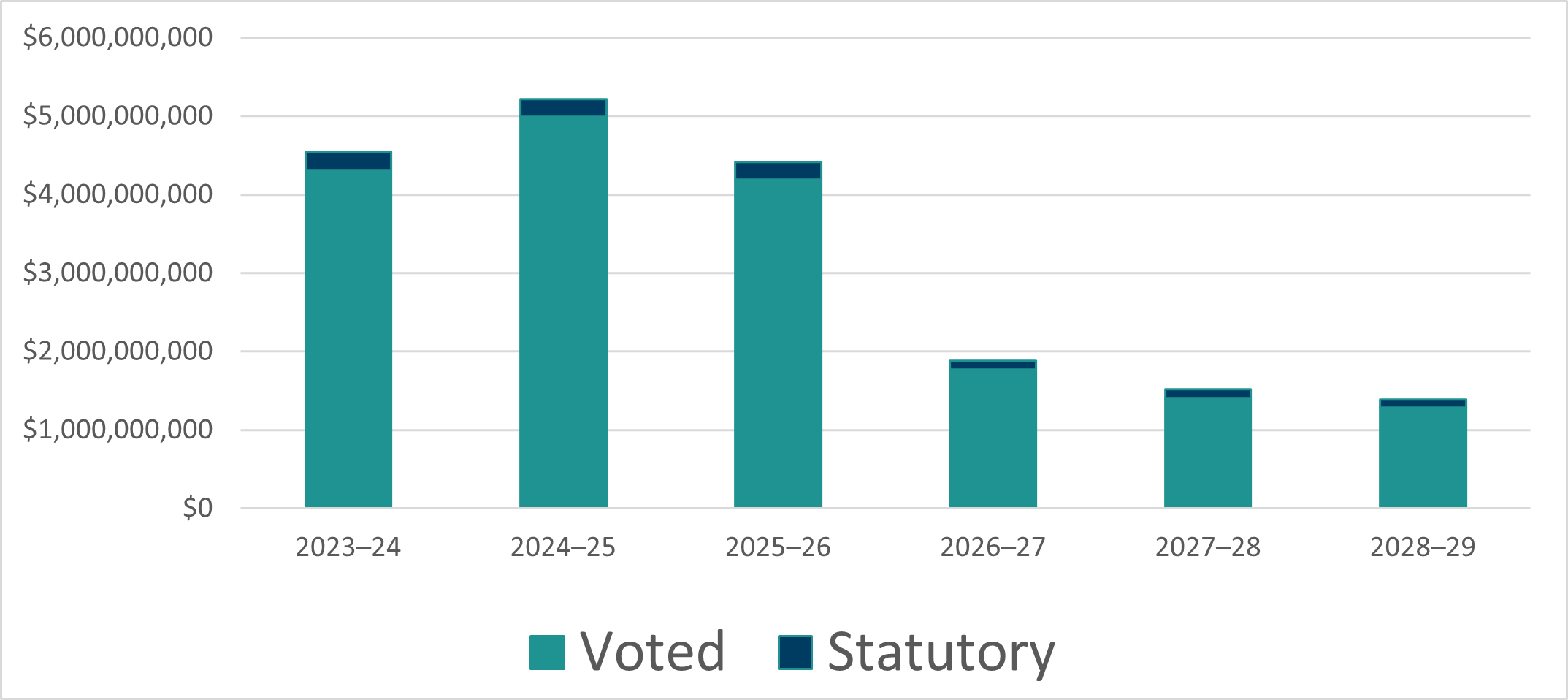
Text description of graph 1 (numbers are in thousands)
| Fiscal year | Total | Voted | Statutory |
|---|---|---|---|
| 2023-24 | 4,546,062,407 | 4,309,443,705 | 236,618,702 |
| 2024-25 | 5,215,031,054 | 4,990,084,701 | 236,618,702 |
| 2025-26 | 4,412,151,595 | 4,188,789,415 | 223,362,180 |
| 2026-27 | 1,885,760,141 | 1,770,741,081 | 115,019,060 |
| 2027-28 | 1,514,454,351 | 1,402,449,239 | 112,005,112 |
| 2028-29 | 1,390,720,967 | 1,287,626,576 | 103,094,391 |
For further information on DFO’s departmental appropriations, consult the 2026-27 Main Estimates.
Future-oriented condensed statement of operations
The future-oriented condensed statement of operations provides an overview of DFO’s operations for 2025-26 to 2026-27.
Table 17: Future-oriented condensed statement of operations for the year ended March 31, 2027 (dollars)
Table 17 summarizes the expenses and revenues which net to the cost of operations before government funding and transfers for 2025-26 to 2026-27. The forecast and planned amounts in this statement of operations were prepared on an accrual basis. The forecast and planned amounts presented in other sections of the Departmental Plan were prepared on an expenditure basis. Amounts may therefore differ.
| Financial information | 2025–26 Forecast results | 2026–27 Planned results | Difference (planned results minus forecasted) |
|---|---|---|---|
| Total expenses | 3,493,945,416 | 1,803,491,461 | (1,690,453,955) |
| Total revenues | (17,642,269) | (0) | 17,642,269 |
| Net cost of operations before government funding and transfers | 3,476,303,147 | 1,803,491,461 | (1,672,811,686) |
Analysis of forecasted and planned results
The Net Cost of Operations in 2026-27 is projected to be $1,803.5 million, a decrease of $1,672.8 million compared to $3,476.3 million in 2025-26. This decrease is mainly attributed to an overall decrease in authorities available for spending (excluding Capital votes) of $1,489.7 million ($1,573.1 million in 2026-27 compared to $3,062.8 million in 2025-26) and a net decrease of $200.8 million in the total estimates for items not affecting authorities, such as amortization expense and changes in accrued liabilities not charged to authorities.
Total revenues is projected to be nil in 2026-27, a decrease of $17.6M compared to $17.6M in 2025-26. This decrease is primarily attributable to the reorganization of the CCG to DND, as revenue-generating activities previously under CCG are no longer part of Fisheries and Oceans Canada’s operations.
Authorities available for spending in 2026-27 do not include items such as Supplementary Estimates and carry forwards.
A more detailed Future-Oriented Statement of Operations and associated Notes for 2026-27, including a reconciliation of the net cost of operations with the requested authorities, is available on DFO’s website.
Human resources
This section presents an overview of the Department’s actual and planned human resources from 2023-24 to 2028-29.
Table 18: Actual human resources for core responsibilities and internal services
Table 18 shows a summary of human resources, in full-time equivalents, for DFO’s core responsibilities and for its internal services for the previous three fiscal years. Human resources for the 2025–26 fiscal year are forecasted based on year to date.
| Core responsibilities and internal services | 2023-24 Actual full-time equivalents | 2024-25 Actual full-time equivalents | 2025-26 Forecasted full-time equivalents |
|---|---|---|---|
| Fisheries | 3,822 | 3,882 | 3,679 |
| Aquatic Ecosystems | 1,994 | 1,997 | 1,906 |
| Marine Navigation | 1,784 | 1,713 | 1,007 |
| Marine Operations and Response | 4,714 | 4,715 | 2,353 |
| Subtotal | 12,314 | 12,307 | 8,945 |
| Internal services | 2,543 | 2,573 | 2,314 |
| Total | 14,857 | 14,880 | 11,259 |
Analysis of human resources over the last three years
The FTE increase between 2023-24 and 2024-25 is primarily related to planned changes to in-year funding.
The FTE decrease between 2024-25 and 2025-26 is primarily attributable to the transition of the CCG to DND.
As of September 2nd 2025, the Order in Council 2025-0639 decreed to transfer the control and supervision of the CCG and its Support Services Group to DND.
Table 19: Human resources planning summary for core responsibilities and internal services
Table 19 shows information on human resources, in full-time equivalents, for each DFO’s core responsibilities and for its internal services planned for the next three years.
| Core responsibilities and internal services | 2026-27 Planned full-time equivalents | 2027-28 Planned full-time equivalents | 2028-29 Planned full-time equivalents |
|---|---|---|---|
| Fisheries | 3,548 | 3,487 | 3,293 |
| Aquatic Ecosystems | 1,789 | 1,697 | 1,534 |
| Subtotal | 5,337 | 5,184 | 4,827 |
| Internal services | 1,555 | 1,527 | 1,365 |
| Total | 6,892 | 6,711 | 6,192 |
Analysis of human resources for the next three years
The FTE decrease between 2025-26 and 2026-27 is primarily attributable to the transition of the CCG to DND and the Comprehensive Expenditure Review.
The FTE decrease between 2026-27 and 2027-28 is primarily attributable to planned reductions in funding and reductions related to Comprehensive Expenditure Review.
The FTE decrease between 2027-28 and 2028-29 is primarily attributable to planned reductions in funding and reductions related to Comprehensive Expenditure Review.
Supplementary information tables
The following supplementary information tables are available on Fisheries and Oceans Canada’s website:
- Details on transfer payment programs
- Up-front multi-year funding
- Regulatory and Permitting Efficiency for Clean Growth Projects
Information on DFO’s departmental sustainable development strategy can be found on DFO’s website.
Federal tax expenditures
DFO’s Departmental Plan does not include information on tax expenditures.
The tax system can be used to achieve public policy objectives through the application of special measures such as low tax rates, exemptions, deductions, deferrals and credits. The Department of Finance Canada publishes cost estimates and projections for these measures each year in the Report on Federal Tax Expenditures.
This report also provides detailed background information on tax expenditures, including descriptions, objectives, historical information and references to related federal spending programs as well as evaluations and GBA Plus of tax expenditures.
Corporate information
Departmental profile
Appropriate minister(s): The Honourable Joanne Thompson, P.C., M.P.
Institutional head: Kaili Levesque, Deputy Minister (Interim)
Ministerial portfolio: Fisheries and Oceans Canada
Enabling instrument(s):
- Oceans Act
- Fisheries Act
- Species at Risk Act
- Coastal Fisheries Protection Act
- Fishing and Recreational Harbours Act
- Canada Shipping Act, 2001 (Transport Canada-led)
- Wrecked, Abandoned or Hazardous Vessels Act (Transport Canada-led)
Year of incorporation / commencement: 1979
Departmental contact information
Fisheries and Oceans Canada
Communications
200 Kent Street
13th Floor, Station 13E228
Ottawa, Ontario K1A 0E6
Telephone: 1-833-212-1438
TTY: 1-800-465-7735
Fax: 613-990-1866
Email: info@dfo-mpo.gc.ca
Website(s): http://dfo-mpo.gc.ca/
Definitions
List of terms
- appropriation (crédit)
- Any authority of Parliament to pay money out of the Consolidated Revenue Fund.
- budgetary expenditures (dépenses budgétaires)
- Operating and capital expenditures; transfer payments to other levels of government, departments or individuals; and payments to Crown corporations.
- core responsibility (responsabilité essentielle)
- An enduring function or role performed by a department. The intentions of the department with respect to a core responsibility are reflected in one or more related departmental results that the department seeks to contribute to or influence.
- Departmental Plan (plan ministériel)
- A report on the plans and expected performance of an appropriated department over a 3year period. Departmental Plans are usually tabled in Parliament each spring.
- departmental result (résultat ministériel)
- A consequence or outcome that a department seeks to achieve. A departmental result is often outside departments’ immediate control, but it should be influenced by program-level outcomes.
- departmental result indicator (indicateur de résultat ministériel)
- A quantitative measure of progress on a departmental result.
- departmental results framework (cadre ministériel des résultats)
- A framework that connects the department’s core responsibilities to its departmental results and departmental result indicators.
- Departmental Results Report (rapport sur les résultats ministériels)
- A report on a department’s actual accomplishments against the plans, priorities and expected results set out in the corresponding Departmental Plan.
- full-time equivalent (équivalent temps plein)
- A measure of the extent to which an employee represents a full person-year charge against a departmental budget. For a particular position, the full-time equivalent figure is the ratio of number of hours the person actually works divided by the standard number of hours set out in the person’s collective agreement.
- gender-based analysis plus (GBA Plus) (analyse comparative entre les sexes plus [ACS Plus])
Is an analytical tool used to support the development of responsive and inclusive policies, programs, and other initiatives. GBA Plus is a process for understanding who is impacted by the issue or opportunity being addressed by the initiative; identifying how the initiative could be tailored to meet diverse needs of the people most impacted; and anticipating and mitigating any barriers to accessing or benefitting from the initiative. GBA Plus is an intersectional analysis that goes beyond biological (sex) and socio-cultural (gender) differences to consider other factors, such as age, disability, education, ethnicity, economic status, geography (including rurality), language, race, religion, and sexual orientation.
Using GBA Plus involves taking a gender- and diversity-sensitive approach to our work. Considering all intersecting identity factors as part of GBA Plus, not only sex and gender, is a Government of Canada commitment.
- government priorities (priorités gouvernementales)
- For the purpose of the 2026-27 Departmental Plan, government priorities are the high-level themes outlining the government’s agenda in the 2025 Speech from the Throne.
- horizontal initiative (initiative horizontale)
- An initiative where two or more federal departments are given funding to pursue a shared outcome, often linked to a government priority.
- Indigenous business (entreprise autochtone)
- Requirements for verifying Indigenous businesses for the purposes of the departmental result report are available through the Indigenous Services Canada Mandatory minimum 5% Indigenous procurement target website.
- non-budgetary expenditures (dépenses non budgétaires)
- Non-budgetary authorities that comprise assets and liabilities transactions for loans, investments and advances, or specified purpose accounts, that have been established under specific statutes or under non-statutory authorities in the Estimates and elsewhere. Non-budgetary transactions are those expenditures and receipts related to the government's financial claims on, and obligations to, outside parties. These consist of transactions in loans, investments and advances; in cash and accounts receivable; in public money received or collected for specified purposes; and in all other assets and liabilities. Other assets and liabilities, not specifically defined in G to P authority codes are to be recorded to an R authority code, which is the residual authority code for all other assets and liabilities.
- performance (rendement)
- What a department did with its resources to achieve its results, how well those results compare to what the department intended to achieve, and how well lessons learned have been identified.
- performance indicator (indicateur de rendement)
- A qualitative or quantitative means of measuring an output or outcome, with the intention of gauging the performance of a department, program, policy or initiative respecting expected results.
- plan (plan)
- The articulation of strategic choices, which provides information on how a department intends to achieve its priorities and associated results. Generally, a plan will explain the logic behind the strategies chosen and tend to focus on actions that lead to the expected result.
- planned spending (dépenses prévues)
For Departmental Plans and Departmental Results Reports, planned spending refers to those amounts presented in Main Estimates.
A department is expected to be aware of the authorities that it has sought and received. The determination of planned spending is a departmental responsibility, and departments must be able to defend the expenditure and accrual numbers presented in their Departmental Plans and Departmental Results Reports.
- program (programme)
- Individual or groups of services, activities or combinations thereof that are managed together within the department and focus on a specific set of outputs, outcomes or service levels.
- program inventory (répertoire des programmes)
- Identifies all the department’s programs and describes how resources are organized to contribute to the department’s core responsibilities and results.
- result (résultat)
- A consequence attributed, in part, to a department, policy, program or initiative. Results are not within the control of a single department, policy, program or initiative; instead they are within the area of the department’s influence.
- statutory expenditures (dépenses législatives)
- Expenditures that Parliament has approved through legislation other than appropriation acts. The legislation sets out the purpose of the expenditures and the terms and conditions under which they may be made.
- target (cible)
- A measurable performance or success level that a department, program or initiative plans to achieve within a specified time period. Targets can be either quantitative or qualitative.
- voted expenditures (dépenses votées)
- Expenditures that Parliament approves annually through an appropriation act. The vote wording becomes the governing conditions under which these expenditures may be made.
- Date modified: