
Exploring innovative tools to support Pacific salmon management and recovery
Through our work addressing the decline of Pacific salmon with the Pacific Salmon Strategy Initiative (PSSI), we are exploring how new technology, like artificial intelligence (AI) and machine learning, can make our processes more efficient and promote collaboration among professionals, governments and organizations involved in restoring and protecting salmon populations and their habitats. At the heart of this effort is the promise of these technologies to sift through vast amounts of data. Our researchers review millions of data points gathered through sensors and cameras, including information on environmental conditions, salmon migration, and genetics. Analyzing these datasets can be a time-consuming process, often requiring the expertise of highly trained scientists.
Several exciting pilot projects are now underway that are using AI and machine learning technology to develop new tools that will help inform salmon conservation and management decisions. By allowing us to identify trends and key information quicker, these new tools will increase our ability to share data with our partners, supporting real-time analysis and action.
How the “Chumputer” is helping us gauge the health of chum salmon populations
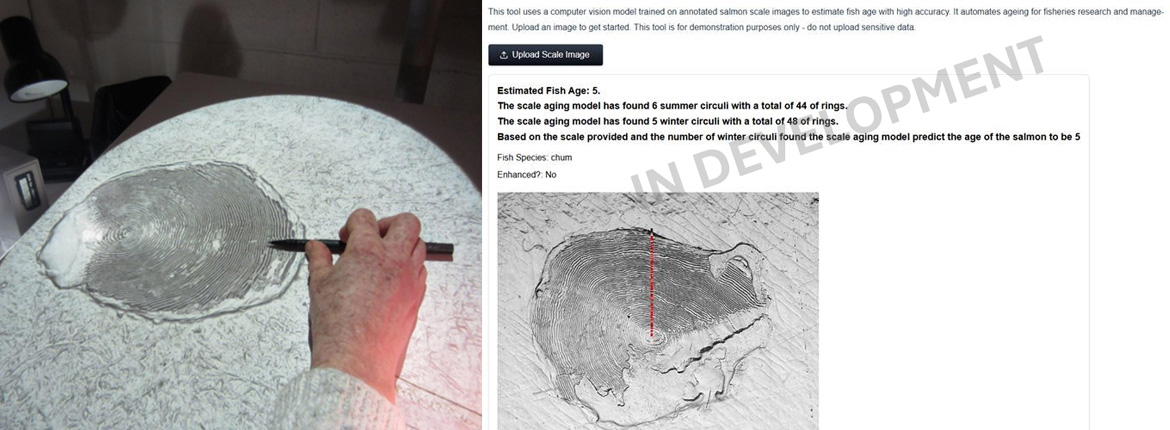
Salmon age assignment is currently a time-intensive process conditional on species and scale condition, requiring highly trained experts for growth pattern interpretation (left). The introduction of trained AI models can increase output numbers in a reduced time frame (right).
One remarkable application of AI technology we are researching is its use in determining the age of salmon; information that is crucial for fisheries management. The growth rings on a fish’s scales—much like the growth rings in a tree—tell a story of its life history. Each ring, or circulus, reflects periods of fast summer growth and slower winter growth. Scientists have long relied on these patterns to estimate the health of salmon populations and assess stock numbers; information that is used by fisheries managers to make informed, timely decisions about salmon stock health and conservation measures. Current methods of age estimation require subject matter experts to manually interpret scale growth; this skill requires specialized training available only through direct experience under long-term mentorship. With more than 80,000 salmon scales to assess each year, demand for these services regularly exceeds program capacity, requiring age requests to be managed on a priority basis.
Enter the Chumputer vision project. We have started training AI to interpret growth patterns on digitized images of chum salmon scales, since chum salmon scales are simpler to age than the scales of other salmon species. Using deep learning computer models, particularly pattern recognition and classification known as Convolutional Neural Networks, this project is a first step towards developing an AI model to assess all salmon species. The Chumputer vision AI models, once operational, will assist with processing a significant portion of chum salmon age requests, allowing technicians to focus on more difficult scales from other salmon species and groundfish. We are planning to build on the Chumputer vision models and adapt them for ageing scales from Chinook, sockeye, and coho salmon.
Developing automated salmon identification technology for salmon migration cameras
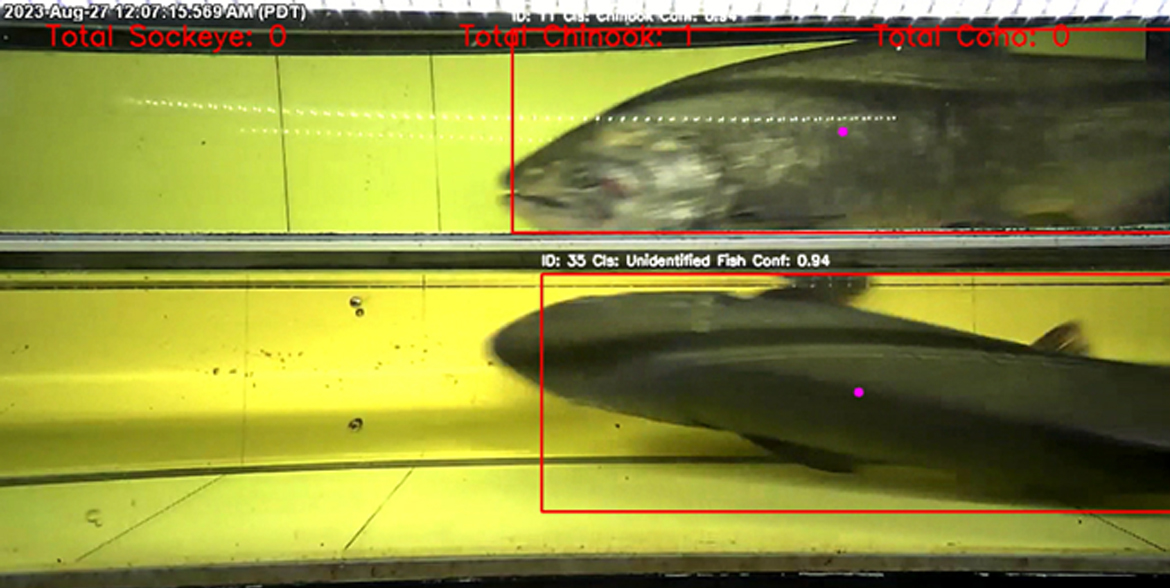
Trained staff count and identify salmon when reviewing the video footage of salmon swimming past an underwater camera, whereas computer vision using artificial intelligence can help automate the counting and identification of salmon with comparable or better accuracy.
Another crucial aspect of managing salmon populations is monitoring their movements. Fish counting fences, or “weirs,” are structures placed across rivers to direct migrating salmon into specific channels and have long been a vital tool for tracking population numbers. Underwater cameras are placed at these fences to record footage that experts painstakingly analyze, frame by frame. To modernize this process, we are developing technology using AI-powered computer vision that will have the potential to analyze video footage in real time, automatically counting and identifying fish as they pass through the salmon fences.
To develop this technology, we are training computer vision to count and accurately identify salmon by species, using existing camera footage. For example, we are using footage from the underwater cameras at Sproat and Stamp River fish ladders on Vancouver Island to train computer vision to identify sockeye, coho and Chinook salmon. Automating how we track salmon movement will help us efficiently collect and process data. With more timely and accurate information, our fishery managers will be better able to meet regulatory requirements and provide more transparent decision-making in salmon conservation efforts.
Faster insights for collaborative salmon processes
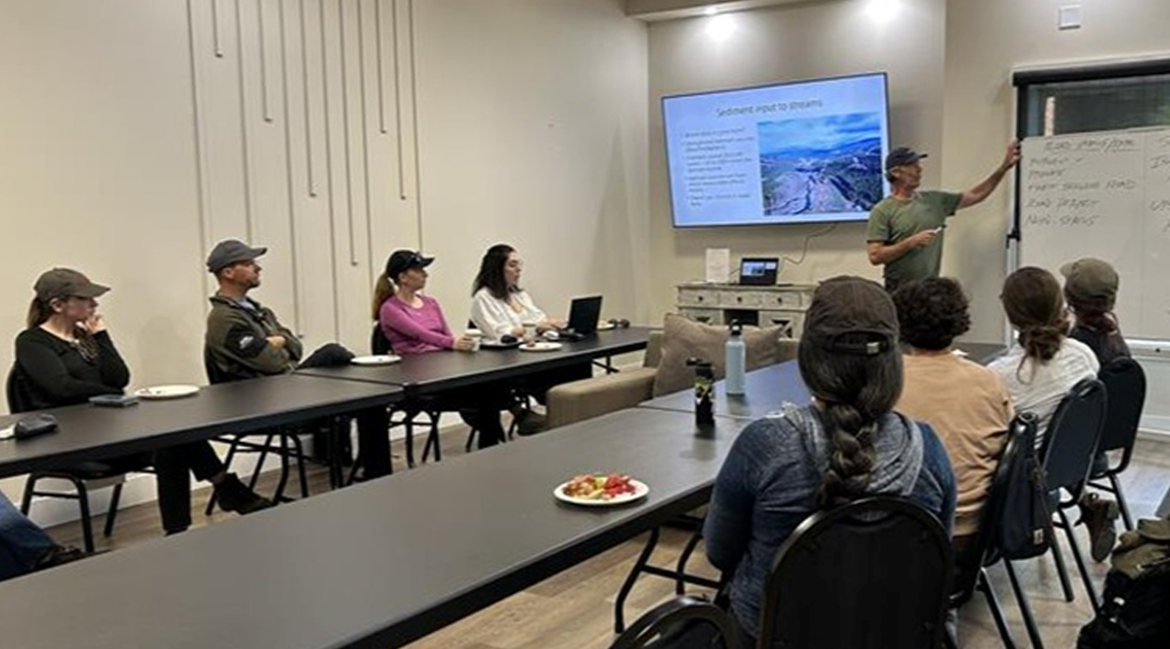
The Integrated Planning for Salmon Ecosystems’ workshop in Merritt brought together partners to support salmon ecosystem health in the Nicola region. The Factoid Finder was used to gather background information to support the development of the Nicola Watershed Integrated Salmon Ecosystem Strategy. (Photo provided by IPSE)
AI’s role in salmon conservation doesn’t stop at counting fish and scale growth rings. PSSI’s Integrated Planning for Salmon Ecosystems (IPSE) is also experimenting with using AI to support collaborative planning processes in key watersheds. Through partnerships, IPSE is co-developing Integrated Salmon Ecosystem Plans, using innovative science-based and technological solutions to establish mutually agreed-upon objectives and priority actions for salmon ecosystems in British Columbia and the Yukon.
IPSE’s work requires reviewing, analyzing, and synthesizing numerous reports, scientific studies, and policy documents. To streamline this process, IPSE created the Factoid Finder, an AI tool that quickly reads, understands, and collates information from large literature collections. The tool increases the efficiency of reviewing documents by instantly searching large volumes of PDFs and extracting the required information, automatically using specific prompts. The tool can search for concepts and ideas, not just keywords, and return relevant document segments, or ‘factoids’, thus significantly reducing the hours required to compile references or conduct a thorough literature review.
IPSE’s use of AI enables the IPSE team to quickly conduct desktop reviews and produce background materials to inform the co-development of strategic plans with partners. This directly benefits salmon by increasing capacity and supporting efficient and effective partnerships with First Nations and Provincial/Territorial governments.
- Date modified: