
Canada leading the fight to save Pacific salmon from illegal fishing in 2024
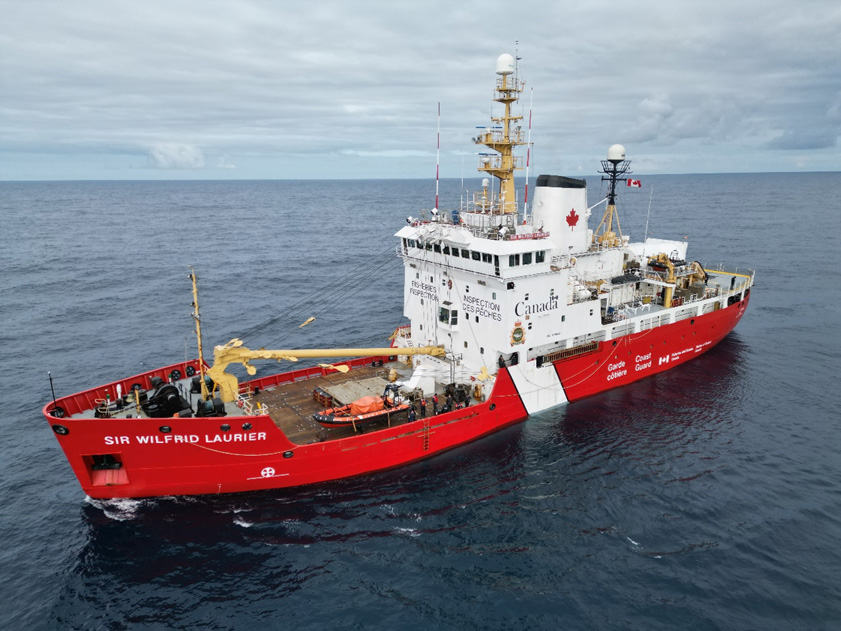
Over the course of Operation North Pacific Guard in 2024, officers and support personnel patrolled approximately 20,000 km in the North Pacific Ocean while onboard Canada’s Canadian Coast Guard Ship Sir Wilfrid Laurier. While at sea, fishery officers conducted inspections under international law of 15 large-scale fishing vessels.
The North Pacific Ocean, a realm of extraordinary marine diversity, is also a critical migratory area for Pacific salmon—a species deeply woven into the cultural, ecological, and economic fabric of the Pacific Northwest. Yet, beneath its waves is a lesser-known threat: illegal, unreported, and unregulated (IUU) fishing. The North Pacific Ocean is in an area beyond the jurisdiction of individual countries or states, also known as international waters or the high seas. Worldwide, the United Nations estimates that between USD $10 billion and $23 billion worth of illegal fishing is occurring in international waters each year, undermining the livelihoods of legitimate fish harvesters around the globe.
Enforcing international laws and monitoring activities in the high seas can be challenging due to the immense size of the area. In the summer of 2024, Canada led a high-seas mission as part of Operation North Pacific Guard, an annual multinational initiative to combat IUU fishing through coordinated fisheries enforcement efforts for the protection of global fish stocks. For two months, Canadian fishery officers, with support from the Canadian Coast Guard, the United States Coast Guard (USCG), and the National Oceanic and Atmospheric Administration (NOAA), patrolled over 20,000 km aboard the Canada’s Canadian Coast Guard Ship Sir Wilfrid Laurier. Our mission: to enforce international fisheries regulations, investigate illegal driftnet fishing, and collect critical data to protect species like Pacific salmon.
Protecting Pacific salmon in the high seas
Pacific salmon are far more than a resource; they are a lifeline for ecosystems, communities, and cultures across the Pacific Rim. But these salmon face a perilous future, threatened by habitat loss, climate change, and overfishing. A huge and relatively unknown portion of their life cycle is spent in the high seas, making them vulnerable to the impacts of IUU fishing. For decades, IUU fishing has evaded regulation, targeting vulnerable stocks and devastating ecosystems. This illegal activity adds further pressure to Pacific salmon populations already in sharp decline.
We have been addressing this issue as part of the Pacific Salmon Strategy Initiative (PSSI) to restore vulnerable salmon populations, supporting sustainable fishing opportunities, and strengthening partnerships to achieve better outcomes for Pacific salmon. Our high seas surveillance efforts under Operation North Pacific Guard directly supports PSSI goals by addressing threats to salmon stocks and the marine ecosystem they rely on.
Operation North Pacific Guard
Canadian fishery officers have participated in Operation North Pacific Guard since its inception in 2019, but only on United States Coast Guard vessels. In 2023, for the first time, Canada led a mission on a chartered patrol vessel, and 2024 marked a milestone as we led a mission outside of our 200 nautical mile exclusive economic zone on a Canadian Coast Guard ship. During the 2024 patrols, fishery officers conducted inspections under international law of 15 large-scale fishing vessels, documented instances of marine pollution and flagged violations of conservation measures. They found evidence of fishing during a closed season, unreported catch, and illegally harvested shark fins. The boardings also presented Canadian officers with their first opportunity to observe operations, the types and amounts of fish being harvested and to enforce the newly adopted ban on Pacific salmon retention, which has been in force for North Pacific fishing fleets since July 2024.
Air surveillance also played a vital role. Operating from Japan, and in collaboration with fishery officers from Japan and Korea, Canadian officers and air crew flew a total of 50,419 nautical miles, conducted 34 aerial patrols, and visually inspected 407 vessels. This effort helped to strengthen collaboration and ensure a united front against illegal fishing with enforcement partners across the vast expanse of the North Pacific.
Beyond enforcement, Operation North Pacific Guard also served as a platform for environmental research. Canadian officers gathered water samples and other environmental data to improve our understanding of high-seas ecosystems. The data collected during the mission has implications for Pacific salmon conservation. This information will help scientists map migration patterns and assess the broader impact of IUU fishing on Pacific salmon.
International collaboration to protect Pacific salmon
The stakes for Pacific salmon could not be higher. These iconic fish are vital not only to marine ecosystems but also to the culture and livelihoods of Indigenous communities across the Pacific Northwest. By uniting to uphold the rule of law on the high seas, this mission strengthens global enforcement and highlights Canada’s leadership in safeguarding ocean ecosystems. In the vast, borderless expanse of the North Pacific, international collaboration is key. With efforts like Operation North Pacific Guard, funded in part through PSSI, Canada is proving that protecting these vital fish isn’t just a national priority—it’s a global one.
Related links
- Video: Operation North Pacific Guard wrap-up 2024
- Illegal, Unreported and Unregulated (IUU) Fishing - International Fisheries
- Canadian-led high seas mission finds illegal harvesting of shark fins and “dark vessels” in North Pacific
- Date modified: