
Aquatic Species at Risk, Northern Brook Lamprey (Ichthyomyzon fossor)
Description: Aquatic Species at Risk, Northern Brook Lamprey (Ichthyomyzon fossor)
Aquatic Species at Risk, Northern Brook Lamprey (Ichthyomyzon fossor)
SARA Status: Designatable Unit DU1 Special Concern
COSEWIC Status: DU2 Endangered
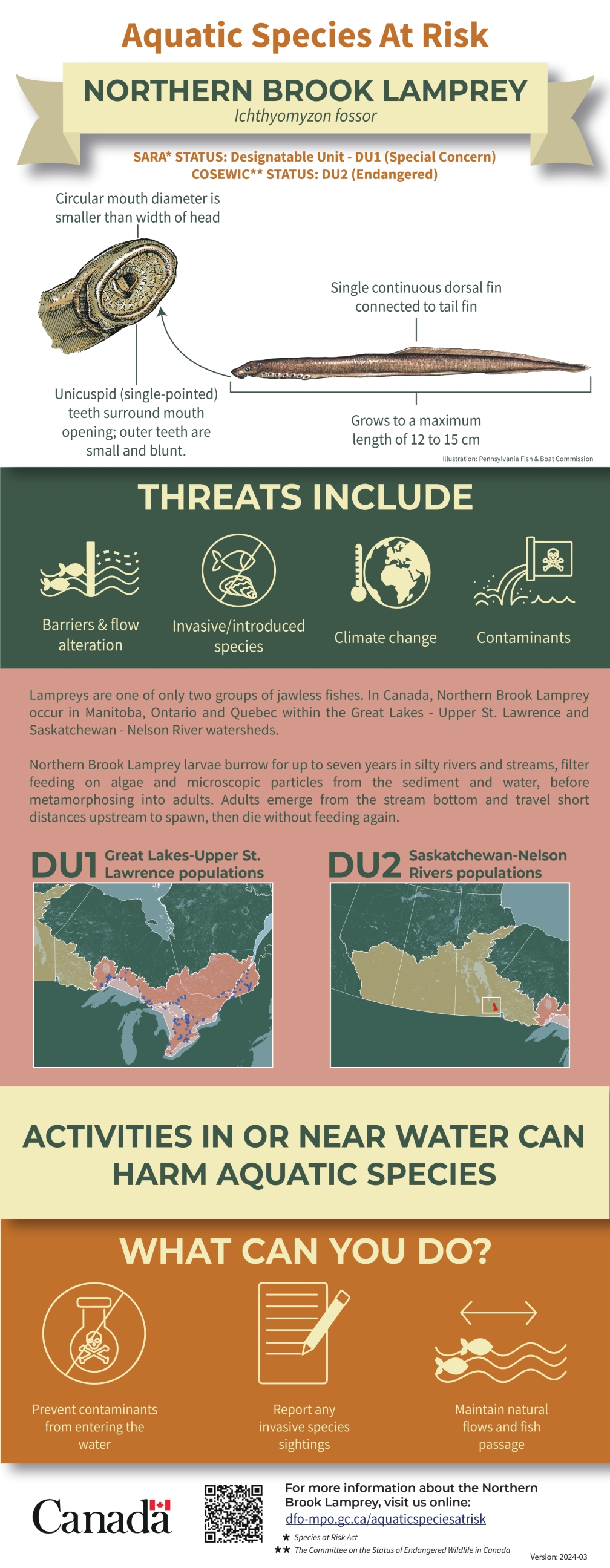
Several horizontal sections on this infographic show the following:
Two illustrations of the Northern Brook Lamprey (Ichthyomyzon fossor), with the first showing the following aspects labelled:
- circular mouth diameter is smaller than width of head
- unicuspid (single-pointed) teeth surround mouth opening; outer teeth are small and blunt
The second illustration shows the following aspect labelled:
- single continuous dorsal fin connected to tail fin
- grows to a maximum length of 12 to 15 cm
The next section lists threats, including:
- barriers and flow alteration
- invasive/introduced species
- climate change
- contaminants
A further section explains that Lampreys are one of only two groups of jawless fishes. In Canada, Northern Brook Lamprey occur in:
- Manitoba
- Ontario
- Quebec within the Great Lakes – Upper St. Lawrence and Saskatchewan – Nelson River watersheds.
Northern Brook Lamprey larvae burrow for up to seven years in silty rivers and streams, filter feeding on algae and microscopic particles from the sediment and water, before metamorphosing into adults. Adults emerge from the stream bottom and travel short distances upstream to spawn then die without feeding again.
Below this explanation are two infographics, on the left is a map centred on:
- the Great Lakes with portions of Ontario and Quebec showing DU1 Great Lakes – Upper St. Lawrence populations
by use of a shaded outline and splotch markings showing where the populations are found.
On the right is a map focused on:
- Alberta
- Saskatchewan
- Manitoba
- a portion of Ontario showing DU2 Saskatchewan – Nelson Rivers populations
by use of a shaded outline, and in an overlaying rectangle near the border of Manitoba and Ontario, splotch markings showing where the population is found.
A final section on the infographic notes that activities in or near water can harm aquatic species, and lists what you can do:
- prevent contaminants from entering the water
- report any invasive species sightings
- maintain natural flows and fish passage
The logo for the government of Canada is in the bottom left corner of the infographic.
Version 2024-03
Related link
- Date modified: