
Strengthening the Inshore Regulations - Understanding use, control, and transfer

Context
- Use, Control, and Transfer are central concepts under the Inshore Regulations.
- Licence holders are expected to decide when, where, and with whom to fish (use) and be in full control of the enterprise.
- Licence holders cannot transfer the Rights and Privileges under the licence to any other third party.
- Third parties (processors, buyers, private lenders) cannot use or control the rights and privileges under the licence.
- DFO’s objective: ensure that use, control, and transfer are well understood and reflect practical application.
What are the rights and privileges
Rights and privileges: When a licence is issued, the licence holder receives limited rights and privileges. Only the licence holder can use and control them.
Rights
- the right to engage in an exclusive fishery under the conditions imposed by the licence (including decision-making over fishing activities authorized by the licence)
- the proprietary right to the fish caught under the licence (including, but not limited to, decision-making over the benefits resulting from their catch)
Privileges
Granted through policy, include but are not limited to, the ability to make requests:
- for substitute operators
- licence renewal
- licence reissuance
- quota transfers
Understanding what it means to use a licence
The current definition of “use” is found within the Commercial Fisheries Licensing Policy for Eastern Canada:
Use: means, including but not limited to, carrying out (in person or through a designated or substitute-operator) the activities authorized under the licence or making decisions related to these activities and the results of these activities (catch and earnings).
Simply put, “use” means: Doing the activities allowed by the licence (such as the fishing, supervising crew onboard the vessel, and selling the catch) or making choices about these activities.

Image 1 - Text version
Illustration showing a person holding a licence card, surrounded by icons representing fishing activities and outcomes, including a fish on a line, a fishing vessel, a ship wheel, and an exchange of money, indicating the use of a licence to fish, operate a vessel, and generate income.
Discussion question
In your own words/from your own experience, how else can DFO show what it means to “use” a licence?
Understanding what control means
The current definition of “Control” is found within the Commercial Fisheries Licensing Policy for Eastern Canada:
Control: means, including but not limited to, directing, managing, overseeing, restricting, or influencing any of the rights or privileges conferred to an individual or entity under a licence issued in their name (i.e. making decisions related to the licence's use, the catch, or earnings without Departmental authorization).
Simply put, “control” means: Making choices about the licence or telling someone else how to use it.
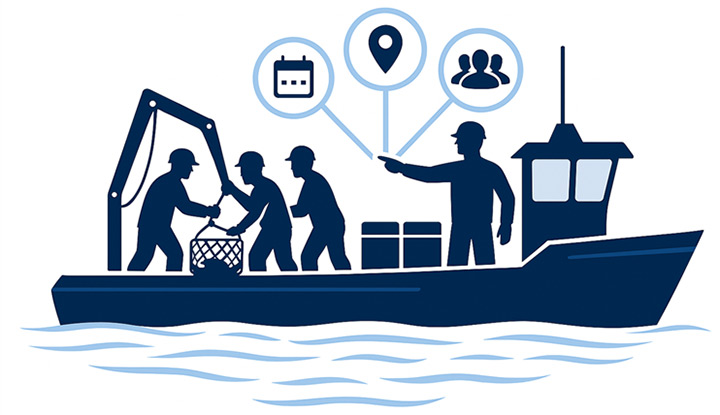
Image 2 - Text version
Blue-toned illustration of a fishing boat on open water with several crew members working together to hoist a net using deck machinery and stow containers, while another person points toward graphic icons above the deck representing scheduling, geographic location, and team coordination.

Image 3 - Text version
Illustration of a person in fishing gear standing centered, with three thought bubbles above representing key considerations: a dollar sign for income, a checklist for requirements or compliance, and a fish for fishing activity, indicating the balance between financial, regulatory, and operational aspects of fishing.
Discussion question
In your own words/from your own experience, how else can DFO show what it means to “control” a licence?
Understanding transfer of rights and privileges
- Licence holders cannot transfer the rights and privileges under a licence and third parties are prohibited from using or controlling them.
- But, understanding when an agreement crosses the line and results in a transfer is not always straight forward.
- DFO is trying to develop practical examples of when an agreement goes too far and would be deemed a transfer of rights and privileges.
Discussion question
Are there any examples that could show what a “transfer” looks like in practice?
Some examples include:
- 60% of revenue goes to paying debt associated with a lending agreement;
- Loan principal (the amount borrowed) grows even when you make payments;
- In an Individual Transferable Quota fishery, the licence holder transfers all their quota every season and never fishes in person
Clauses that can lead to control
- Certain types of clauses (the agreement’s terms and conditions) are more likely to lead to control.
- Rather than focusing on specific words, we want to get to the effects certain clauses have.
| Defaults | Fishing Choices | Reissuance | Licence Rights | Future Deals |
|---|---|---|---|---|
| Clauses that say you lose or “default” just because fish are not available, or because you must land your catch in one special place. | Clauses that let the lender tell you who can work on your boat, and when, where, or how you can fish. | Clauses that let the lender help decide who gets the fishing licence after you. | Clauses that say licence benefits go to the lender, like paying the lender with fish instead of money. | Clauses that force you to sign new agreements later that you have not seen yet, or to pay costs later that no one can explain now. |
Discussion question
What are your views about these clauses (terms and conditions)?
Are there other types of clauses you think should be added to the list?
Page details
- Date modified: