
Strengthening the Inshore Regulations - Intergenerational transfers
 Strengthening the Inshore Regulations - Intergenerational transfers
(PPTX, 761 KB)
Strengthening the Inshore Regulations – Engagement Video Series: Intergenerational transfers
Context
- The Inshore Sector is aging.
- Many licence holders are nearing retirement.
- New entrants are needed but it takes time to become a full owner operator.
- Intergenerational transfers are necessary to keep knowledge and skills within the fishery and to renew the fleet.
- DFO’s objective: identify options to facilitate the transition of licences from one generation to the next, including for families.
Intergenerational transfer
“Intergenerational transfer” refers to passing on the business from a current licence holder to a new entrant
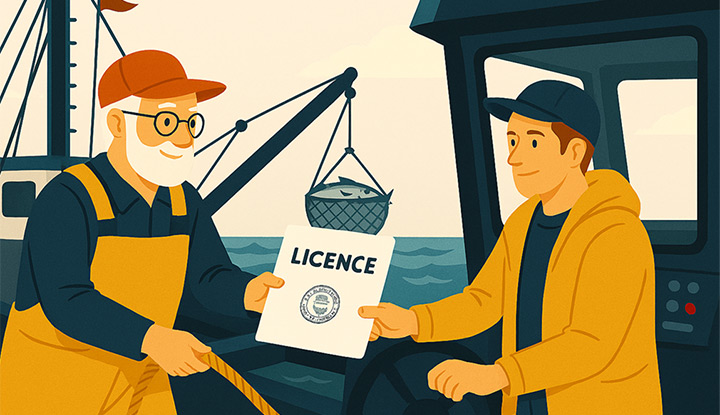
Image 1 - Text version
Illustration of two people on a fishing vessel transferring a licence document. One individual in fishing gear hands a “Licence” paper to another person (a new entrant) at the wheel of the boat, with fishing equipment and a catch of fish visible in the background, representing the transfer of a fishing licence from one generation to the next.
Challenge: Access to Capital
- Costs are high: Inshore licences, vessels, and gear are expensive.
- Loan options are limited: Traditional lenders may be more cautious when it comes to lending.
- Credit history may not be enough: Younger or prospective licence holders may lack the assets or borrowing history needed to secure financing on reasonable terms.
- Reliance on non‑traditional financing: New harvesters may depend on buyer or processor loans.
Challenge: Single enterprise model
- Handover can be abrupt with limited the opportunities for training and mentorship.
- Pay-as-you-go or (rent to own) transfer options are not currently supported.
- Upfront costs are significant and one individual to assume all risks.
- In families, only one child can receive the enterprise, even if more than one wants to continue fishing.
- The current approach means children may have limited hands-on learning opportunities before the business is fully transferred.
- Need to ensure that if any shifts from the single enterprise model, it does not increase third party control or influence.
Challenge: A standard definition of family
- Only those members who meet the formal definition can be included in the inshore family fishing corporation (IFFC).
- In reality, fishing skills and responsibility are often passed between aunts, uncles, cousins, nieces, nephews, or other close relatives, who do not meet the current definition.
- When these members are excluded, families may be unable to share the benefits with others in their family, which can interrupt intergenerational continuity of family enterprises.
- At the same time, it’s important that some limit be placed on the definition to maintain the objectives of an IFFC (sharing the benefits amongst families).
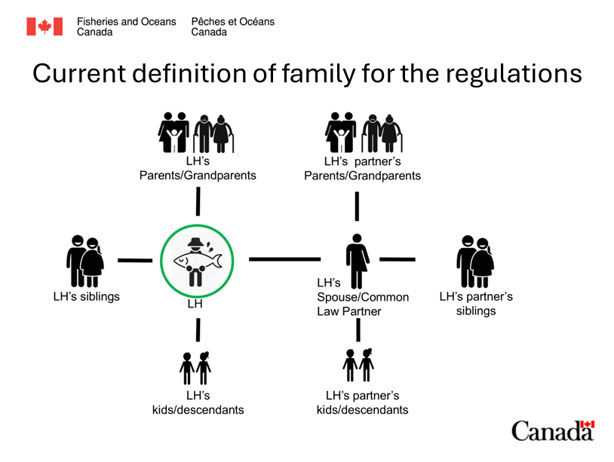
Image 2 - Text version
Infographic from Fisheries and Oceans Canada titled “Current definition of family for the regulations,” showing a central licence holder connected to family relationships, including parents and grandparents, siblings, children or descendants, spouse or common-law partner, and the partner’s parents, siblings, and children.
Discussion questions
Are there other barriers you see for intergenerational transfers?
What could help remove the challenges people face when trying to get financing to become a licence holder?
Areas for discussion
- Identify supports to attract and retain new entrants
- Allow shared ownership or partnerships to support transition planning.
- Expand the scope of who can be included as family
Discussion questions
What actions could DFO take to help new licence holders follow the Owner Operator rule and stay independent throughout their fishing career?
What actions could DFO take to help people join the fishery (from starting as crew and moving up to an Owner-Operator) such as training with and learning from current licence holders?
Page details
- Date modified: