
Strengthening the Inshore Regulations - Using money to control a licence
 Strengthening the Inshore Regulations - Using money to control a licence
(PPTX, 4.7 MB)
Strengthening the Inshore Regulations - Engagement Video Series: Using money to control a licence
Context
- Starting and running an inshore fishing enterprise can be expensive.
- Many harvesters rely on loans from third parties to fund their enterprise and often use the licence as collateral and security.
- Loans become the main way for third parties to try to control the licence holder depending on the terms and conditions of the loan.
- Control can also be indirect.
- For new entrants, there is a heightened risk of "easy" loans being used to control a licence.
- DFO's objective: maintain access to capital while upholding licence holder independence.
How money leads to control or influence
While the licence holder must be the one using and controlling the licence, sometimes lenders can insert themselves and use the financing (money) as leverage to make operational decisions.
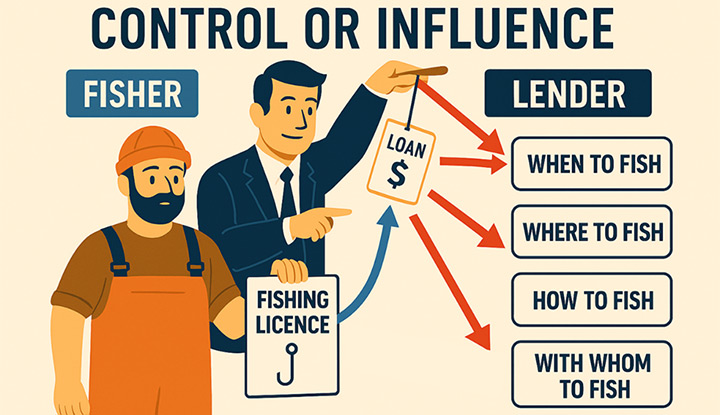
Image 1 - Text version
Illustration titled "Control or influence" showing a fisher holding a fishing licence beside a lender holding a loan agreement. Arrows from the loan point to decisions controlled by the lender, including when to fish, where to fish, how to fish, and with whom to fish, illustrating lender influence over fishing activities.
Integrated supply and loan agreements
One of the most common ways DFO has seen money being used to control a licence holder is by making the loan agreement linked to a supply agreement.
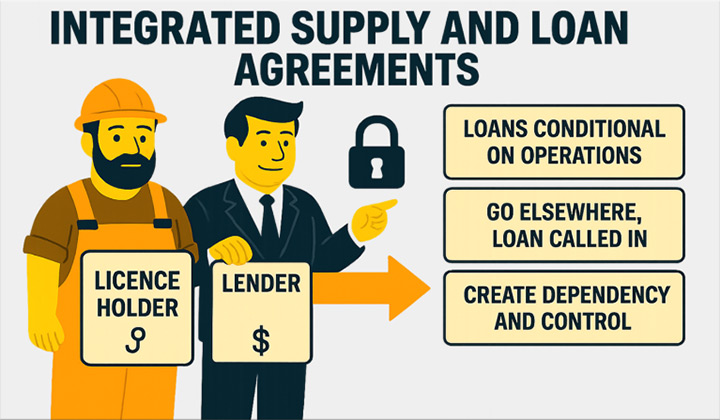
Image 2 - Text version
Infographic titled 'Integrated Supply and Loan Agreements.' On the left, a licence holder in work clothing is shown next to a lender in a suit. An arrow and lock icon connect the two, indicating restricted or binding conditions. On the right, text boxes list impacts of the arrangement: loans are conditional on how the business operates, loans may be called in if the licence holder goes elsewhere, and the arrangement creates dependency and control.
Exclusivity
Another concern is when the supply agreement creates exclusivity by not allowing the licence holder to freely exercise their rights and privileges.
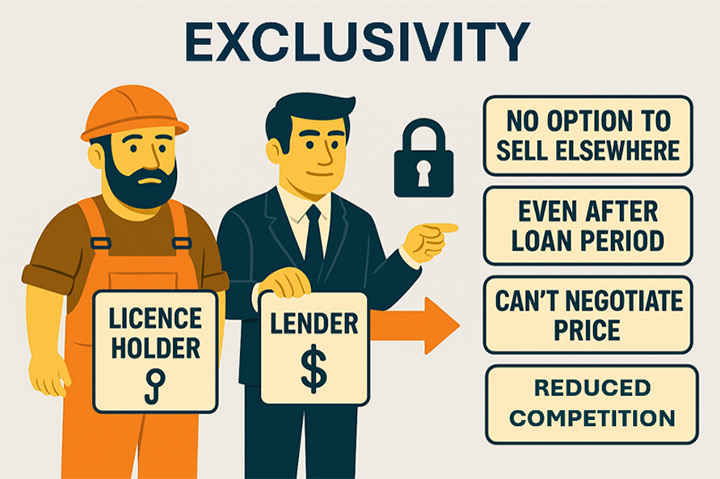
Image 3 - Text version
Illustration labeled "Exclusivity" showing a licence holder and a lender connected by a locked arrangement. The licence holder stands beside the lender, and an arrow points to a list of impacts: no option to sell elsewhere, requirement that terms continue even after the loan period, inability to negotiate price, and reduced competition.
Guarantors and co-signers
More recently, concerns have been raised around the need for licence holders to require a guarantor or a cosigner.
Guarantors and co-signers are people or organizations that promise to repay a loan if the borrower cannot.
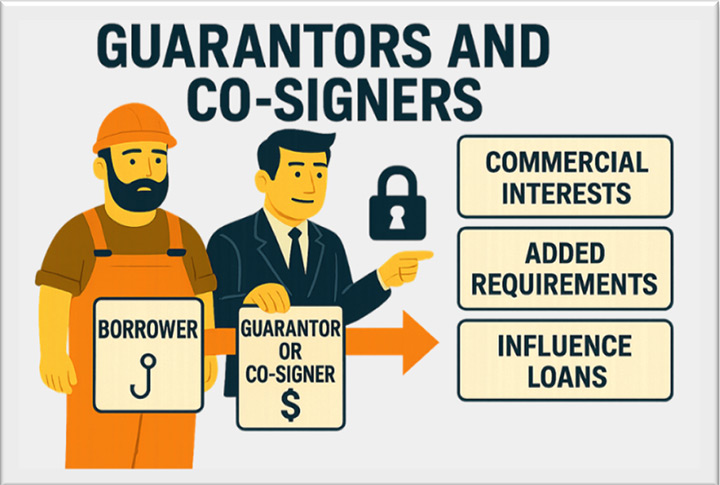
Image 4 - Text version
Illustration titled 'Guarantors and Co-signers' depicting a borrower and a guarantor or co-signer. The guarantor points toward a list reading 'Commercial interests,' 'Added requirements,' and 'Influence loans,' illustrating how guarantors or co-signers can affect loan conditions.
Discussion question
Are there any other ways you have experienced loans being used to control a licence holder?
Areas for discussion
- Work towards increasing access to recognized lenders.
- Work with fisher associations to explore options to negotiate financial services.
- Let associations set requirements for third party lenders
- Or having harvester-led funding mechanisms.
- Place stronger limits on non-recognized lenders.
- Limit or ban certain agreement terms and conditions
- Set different rules for lender-types (processors; family members; other harvesters)
- Require guarantors or co-signers to disclose their commercial interests, or prohibit supply-side agreements when acting as a guarantor or co-signer
Discussion questions
What are your thoughts about these areas?
Are there any other options that you think DFO should consider?
Page details
- Date modified: