
Book 2, Tab B8 - Aquaculture in Canada
On this page
- Aquaculture in Canada
- Canada’s aquaculture production (2023)
- Aquaculture management in Canada
- Federal Regulatory Responsibilities (National)
- Mandate commitments
- Salmon Aquaculture Transition Plan for British Columbia
Aquaculture in Canada
45 different species of finfish, shellfish, and marine algae cultivated commercially; finfish accounts for most production (mainly salmon).
Finfish production fell to 107,144 tonnes in 2023, a 15.3% decline from 2022. This is in addition to the previous year’s decline of 14.9% from 2021 to 2022.
Total export value in 2023 for aquaculture was $970M, with a total production value of $1.26B. Exports represent 77% of production value.
Industry provides 3,675 well-paying, year-round direct jobs, many in remote coastal and Indigenous communities.
Production percentage by province, 2023 (tonnes)
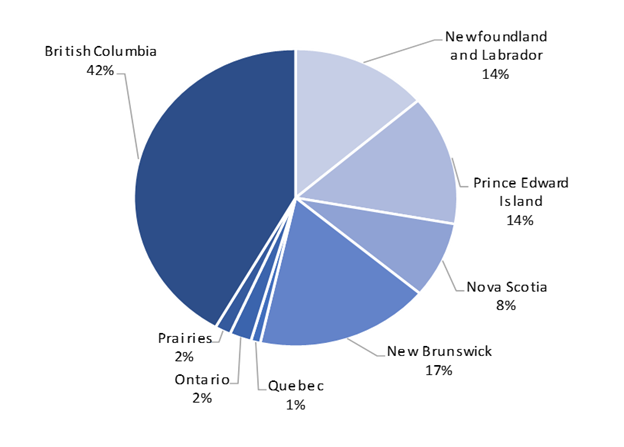
Text version: Production percentage by province, 2023 (tonnes)
Production:
- British Columbia 42%
- New Brunswick 17%
- Prince Edward Island 14%
- Newfoundland and Labrador 14%
- Nova Scotia 8%
- Ontario 2%
- Quebec 1%
- Prairies 2%
Canada’s aquaculture production (2023)
- Volume: 145,985 tonnes
- Value: CDN $1.26 billion
British Columbia
- Production: 60,962 tonnes
- Value: $557.9 million
- Top Species: Salmon, Trout, Clams, Oysters, Mussels
Alberta, Saskatchewan and Manitoba
- Production: 2,324 tonnes
- Value: $13.9 million
- Top Species: Rainbow Trout, Steelhead Trout, Tilapia
Ontario
- Production: 3,194 tonnes
- Value: $34.4 million
- Top Species: Rainbow Trout, Arctic Char, Sturgeon, Shrimp, Tilapia
Quebec
- Production: 1,377 tonnes
- Value: $12.1 million
- Top Species: Trout, Oysters, Mussels, Scallops
Newfoundland and Labrador
- Production: 19,942 tonnes
- Value: $185.3 million
- Top Species: Salmon, Mussels
Prince Edward Island
- Production: 20,684 tonnes
- Value: $51.2 million
- Top Species: Clams, Oysters, Mussels
Nova Scotia
- Production: 12,084 tonnes
- Value: $120.5 million
- Top Species: Salmon, Trout, Clams, Oysters, Mussels
New Brunswick
- Production: 25,420 tonnes
- Value: $284.3 million
- Top Species: Salmon, Oysters
Source: Statistics Canada
Aquaculture management in Canada
How fish farming is managed in Canada
Fish farming is managed by federal, provincial and territorial governments. How it’s managed varies across provinces and territories.
Table 1: How fish farming is managed in Canada
| Activities | BC | Rest of Canada | PEI |
|---|---|---|---|
| Site approval: Determining where a farm can be located |
Shared | Provincial | Shared |
| Land management: Overseeing the land (seabed) where a farm is located |
Provincial | Provincial | Shared |
| Day to day operations and oversight: Monitoring of farm activities |
Federal | Provincial | Federal |
| Introductions and transfers: Managing the planned movement of live eggs and fish |
Shared | Shared | Shared |
| Drugs and pesticides approvals: Determining which drugs and pesticides are approved for use |
Shared | Shared | Shared |
| Food safety: Monitoring and ensuring the safety and quality of fish harvested and sold in Canada and international markets |
Federal | Federal | Federal |
- Aquaculture management in Canada is a shared responsibility.
- Constitutional authorities and legal rulings have resulted in three different aquaculture management regimes in place across the country:
- As the principal regulator in British Columbia since 2010, DFO issues aquaculture licences and oversees operational requirements, while the Province issues leases for seabed use.
- As a result of a 1928 MoU in Prince Edward Island, DFO issues aquaculture leases and licences in collaboration with and on behalf of the Province.
- Elsewhere, provincial departments are the lead, issuing both leases and licences.
- Conditions of lease and licence set out operational and reporting requirements to help ensure that aquaculture sites are managed in an environmentally sustainable manner.
- Federal-Provincial-Territorial coordination via bilateral MOUs and collectively through the Canadian Council of Fisheries and Aquaculture Ministers (CCFAM) and its Strategic Management Committee on Aquaculture (SMC).
Federal Regulatory Responsibilities (National)
DFO is the overall federal lead ensuring that interactions between aquaculture, and wild fish and the marine environment are managed sustainably across Canada.
- The Aquaculture Activities Regulations under the Fisheries Act manage impacts, including the deposit of drugs and pesticides (i.e., to manage pathogens and parasites) and the release of organic matter (i.e., fish feces and uneaten feed) into fish-bearing waters.
In coastal provinces and Yukon, DFO authorizes intentional movements of live fish into fish-bearing waters and fish-rearing facilities.
- Federal-provincial/territorial Introductions and Transfers Committees, established in each province and Yukon, follow the National Code for Introductions and Transfers of Aquatic Organisms to assess risks associated with proposed movements.Footnote *
The Canadian Food Inspection Agency, Health Canada, and Transport Canada play roles in mitigation of the introduction and spread of aquatic diseases; regulation of pesticide and drug approvals; and navigation, respectively.
Mandate commitments
DFO Minister’s Mandate Letters included the commitment to:
- (2019) Work with the province of BC and Indigenous communities to create a responsible plan to transition from open net-pen salmon farming in coastal BC waters by 2025 and begin work to introduce Canada’s first-ever Aquaculture Act.
- (2021) Continue to work with the province of BC and Indigenous communities on a responsible plan to transition from open net-pen salmon farming in coastal BC waters by 2025 and work to introduce Canada’s first-ever Aquaculture Act.
Salmon Aquaculture Transition Plan for British Columbia
On June 19, 2024, Minister Lebouthillier announced a ban on open net-pen salmon aquaculture in BC coastal waters by June 30, 2029. Licences that were set to expire on June 30, 2024, were renewed for five years until the ban comes into force.
Innovation, Science and Economic Development Canada (ISED) released a draft Salmon Aquaculture Transition Plan on September 20, 2024, launching an engagement and consultation period intended to discuss a responsible approach and needed supports to transition from open net-pen salmon aquaculture to more sustainable and innovative approaches.
ISED created an Interdepartmental Task Force, which is leading engagement and the development of advice to inform a final version of the transition plan, expected to be released in 2025.
The intent is to foster collaboration and partnership to jointly explore and identify sustainable, long-term economic opportunities for BC's coastal communities.
Page details
- Date modified: