
Book 2, Tab B4 - Enforcement 101
Purpose
To provide an overview of:
- The Conservation & Protection (C&P) Program
- Core functions and priorities
- Enforcement decision-making
An Overview of C&P
C&P’s Mandate
From coast-to-coast-to-coast, fishery officers serve Canadians by carrying out DFO’s enforcement functions under several legal instruments:
- Legislative, regulatory, and management measures under the Fisheries Act which govern Indigenous, commercial, and recreational harvesting
- Protection of species and habitat under the Species at Risk Act
- Monitoring and protection of Marine Protected Areas under the Oceans Act
- Support for Indigenous harvesting under Aboriginal and Treaty Rights
- Compliance verification of foreign fishing vessel requirements and international enforcement under the Coastal Fisheries Protection Act and various international treaties (e.g., NAFO Convention)
Our team
- Over 800 full time equivalents (FTEs) in 7 regions and 109 locations across Canada, most of whom are fishery officers (of which over 500 are front line fishery officers).
- C&P trains its new recruits/cadets at the Atlantic Police Academy in PEI, with 74 new Fishery Officer cadets graduating in 2023-24, in addition to training new instructors.
- C&P’s work is carried out in partnership with many other government agencies and departments, such as the Canadian Coast Guard (CCG) and Canada Border Services Agency (CBSA).
- C&P works extensively across several regional fisheries management organizations (RFMOs) to augment binding fisheries conservation measures, specifically as it relates to Canada's participation in Northwest Atlantic Fisheries Organization (NAFO) and the North Pacific Fisheries Commission (NPFC).
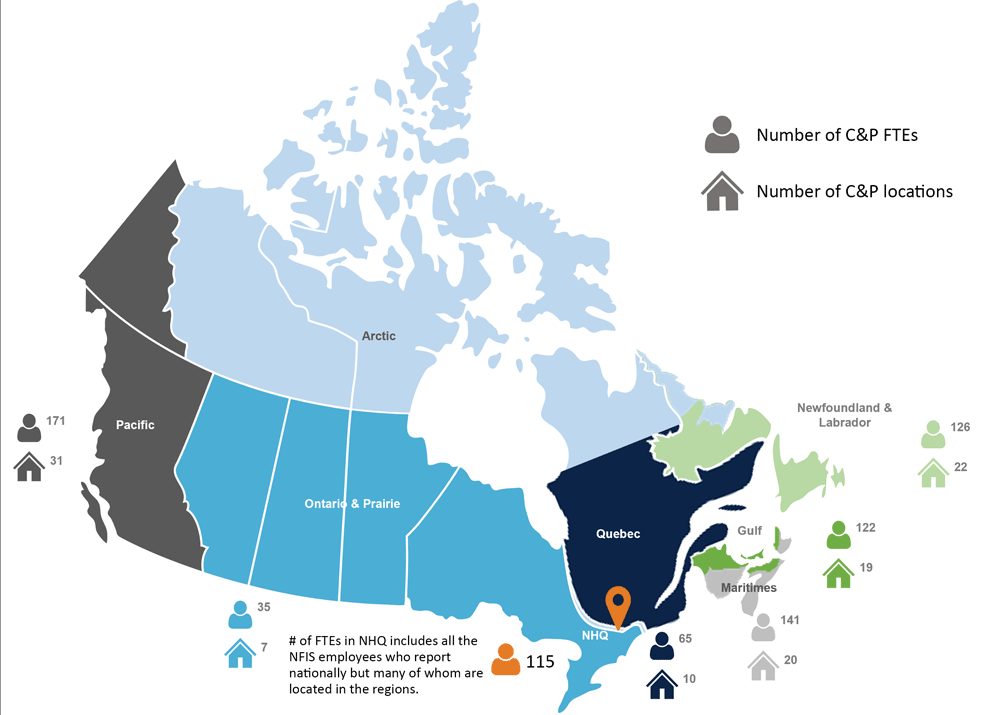
Description:
Map showing number of C&P FTEs and locations across Canada. The NHq figure also includes all FTEs of whom report to headquarters but are located in the regions.
| Region | FTEs | Locations |
|---|---|---|
| NHQ | 115 | 1 |
| Pacific | 171 | 31 |
| Newfoundland & Labrador | 126 | 22 |
| Gulf | 122 | 19 |
| Maritime | 141 | 20 |
| Quebec | 65 | 10 |
| Ontario & Prairies | 35 | 7 |
| Arctic | - | - |
# of FTEs in NHQ includes all the NFIS employees who report nationally but many of whom are located in the regions.
Our assets
Operational assets include:
- Program vessel fleet (~500 craft under 45’)
- Four surveillance aircraft
- Satellite remote sensing (DVD)
- Operational vehicles (e.g., trucks, ATVs, snowmobiles)
- CCG fleet support (as well as charters)
Collaboration with CCG to support C&P operations:
- Inshore Vessels
- Mid-shore Patrol Vessels
- Offshore Patrol Vessels
- Small Craft Acquisition Program (SCAP)
Core functions & priorities
National C&P delivery model
Key Elements:
- Government of Canada and Departmental Results
- Compliance Outcomes / Data
- Education / Shared Stewardship
- Monitoring, Control & Surveillance
- Special Investigations
- Intelligence
- Reconciliation
- Program Support
National enforcement priorities
Supporting Rights-Based Fisheries
- Maximizing collaboration with Indigenous partners
Achieving Marine Conservation Targets
- Enforcing Marine Protected Areas and marine refuges
Strengthening International Enforcement
- Combatting Illegal, Unreported and Unregulated Fishing (IUU)
Protecting Priority Species and Activities
- Protecting critical habitat, salmon, whales, and higher risk or targeted species
Enforcement decisions
Pursuant to the Fisheries Act and other statutes, the range of action taken by fishery offices may include:
- Warnings
- Seizures of fish, fishing gear, vessel or other things
- Ticketing
- Remediation and stop work orders
- Arrest of serious or repeat offenders
- Seizure of boats and vehicles
- Prosecution
- Where a matter is determined as serious and warrants prosecution, an informed review process may be undertaken. This review involves more senior officers, and other internal experts (where necessary) who provide independent input on relevant aspects of the matter at hand. It may also include consultation with Public Prosecution Service of Canada where the matter relates to complex files (including Rights-based Indigenous matters).
Fishery officer enforcement decisions
- Similar to other police services in Canada, the discretion on what action to take is with the individual officer, guided by policies and training and the particular circumstances.
- Fishery officers consider the following when violations are encountered to choose an appropriate enforcement measure:
- severity of the offence, compliance history, aggravating or mitigating factors, and the anticipated effectiveness of the action in achieving compliance
Alternative Measures / Restorative Justice
- Seek voluntary compliance
- Reminder of the duty to take corrective measures
- Issue a warning letter/Ticket
- Require corrective measures
- Seek an injunction or make a ministerial order
- Refer for prosecution
Intelligence supported enforcement
- The National Fisheries Intelligence Service (NFIS) supports Fisheries and Oceans Canada (DFO’s) Conservation and Protection (C&P) Directorate through the provision of timely, high quality actionable intelligence in support of strategic, operational, and tactical decision-making.
- The primary objective of the NFIS is to collect and analyze all-source information to produce intelligence products that supports knowledgeable and informed decision making.
- In essence, intelligence provides advice about those aspects of the operational environment on which the decision makers should focus attention.
- NFIS has 78 FTE boxes spread across the country, composed of Intelligence Officers (IOs), Intelligence Analysts (IA's) and other support staff such administrative assistants and managerial positions.
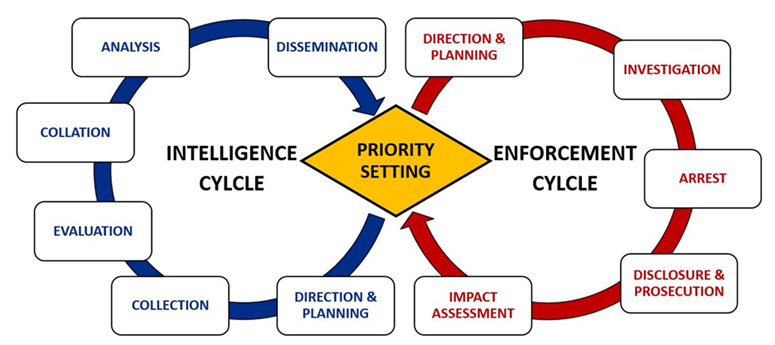
Description:
Diagram illustrating two interconnected processes:
- Intelligence Cycle:
- Priority Setting
- Direction & Planning
- Collection
- Evaluation
- Collation
- Analysis
- Dissemination
- Priority Setting
- Enforcement Cycle
- Priority Setting
- Direction & Planning
- Investigation
- Arrest
- Disclosure & Protection
- Impact Assessment
- Priority Setting
At the centre of both cycles is a ‘Priority Setting’, indicating that this function informs and connects both cycles.
Examples of intelligence supported enforcement
- Strategic
- assessment of market trends, fisheries threats, setting priorities
- Examples:
- Strategic Threat Risk Assessment
- Program Analysis ( Review of the Observer Program)
- Market Analysis - (understand potential C&P impacts)
- Examples:
- assessment of market trends, fisheries threats, setting priorities
- Tactical
- inform the day-to-day tactics, actionable, tangible
- Examples:
- Entity Profiles
- Confidential Human Sources
- Officer Safety Bulletins
- Examples:
- inform the day-to-day tactics, actionable, tangible
- Collaboration With Partners
- NFIS regularly collaborates with enforcement partners intelligence groups to share information on subjects of interest
- Financial Transactions and Reports Analysis Centre of Canada (FINTRAC).
- Financial intelligence (FININT) is the collection and analysis of information about the financial affairs of entities of interest, to understand their nature and capabilities, and predict their intentions.
- The NFIS is C&Ps subject matter expertise as it relates to FINNT and FINTRAC
Recent accomplishments
- Enhanced enforcement activity in support of the closure of the elver fishery.
- Supporting Canada's Indo-Pacific Strategy, including:
- Expand the reach of the innovative Dark Vessel Detection (DVD) program – including capacity development (Ecuador, Philippines)
- North Pacific Guard – International leadership through joint IUU enforcement operations in the North Pacific – sea/air patrols and satellite detection (U.S., Korea, Japan)
Page details
- Date modified: