
Book 2, Tab A2 - Crown-Indigenous relationship overview
On this page
- Purpose
- The Department has important relationships with Indigenous Peoples
- Indigenous Priorities and Expectations
- DFO's relationships with Indigenous peoples have changed over time...
- '...and have a strong regional and operational dimension'
- The Department has a range of tools to support renewed relationships and partnerships and is enhancing existing tools and developing new approaches to support the implementation of the United Nations Declaration on the Rights of Indigenous Peoples Action Plan in line with partner aspirations:
- Key areas of work moving forward
- Annex A: Court decisions and treaty obligations
- Annex B: Map of “Historic Treaties” (pre-1975)
- Annex C: Map of Comprehensive Land Claim Agreements and Self-Government Agreements (“Modern Treaties”)
- Annex D: Duty to Consult
Purpose
- Provide an overview of Indigenous rights and how they pertain to the Department's mandate and relationships with Indigenous Peoples
- Outline departmental initiatives and programs supporting Indigenous rights, interests and relationships
The Department has important relationships with Indigenous Peoples
The Minister of Fisheries, Oceans and the Canadian Coast Guard is responsible for:
- Fish access and allocation, including to Indigenous communities and organizations
- Collaborating in the management of Indigenous fisheries;
- Decisions on major project proposals that impact Indigenous rights and interests;
- Responding to litigation involving Indigenous rights; and
- Negotiating and implementing treaties and time-limited rights recognition agreements
Fisheries in Canada are…
- Of great social, cultural, and economic significance to many Indigenous communities;
- A public resource to which Indigenous Peoples have unique rights and interests;
- An important focus at Treaty and other negotiating tables; and,
- An economic driver and opportunity for self-determination for Indigenous Peoples
Spotlight: Canadian Coast Guard (CCG)
The CCG works in partnership with Indigenous coastal communities to ensure marine safety. In particular, some Indigenous communities play a key role in the Coast Guard Auxiliary by responding to emergencies in their local waters.
Indigenous Priorities and Expectations
Indigenous Peoples have expressed an interest in increased and diversified fisheries opportunities, Indigenous-led conservation, and a greater role in decision-making and management activities, including:
- More access to fish for food, social and ceremonial (FSC) and commercial purposes as well as aquaculture opportunities
- Flexibility to choose how to fish
- Means with which to harvest, add value, grow, and diversify economically;
- Greater self-determination and self-government in their traditional territories and waters through joint or shared decision-making;
- Greater roles in fisheries, oceans, aquatic habitat, and marine waterways management activities; and,
- Management of legal risk related to the assertion of the right to fish and sell fish in certain regions (e.g., BC).
DFO’s relationships with Indigenous Peoples have changed over time...
From responding to rights recognized through court decisions related to fisheries
- Targeted policies and programs that supported collaborative management and increased fish access (e.g., Aboriginal Fisheries Strategy/Allocation Transfer Program, Aboriginal Aquatic Resource and Oceans Management, Marshall Response Initiative).
- Rights-based discussions at mainly treaty negotiating tables.
- Limited oversight of modern treaty implementation.
To proactively building relationships that enable the expression of Indigenous rights and interests across an array of activities.
- Renewed investment in Indigenous commercial and collaborative fisheries programming contributes approximately $100M annually to Indigenous capacity and relationship building.
- Continued implementation of the Marshall decisions (moderate livelihood) with 34 Mi’kmaq and Wolastoqey First Nations in the Maritime provinces and Gaspé region of Quebec and the Peskotomuhkati Nation at Skutik.
- Negotiating tables have moved toward the recognition of rights and interests as a starting point for negotiations, with more non-treaty tools available.
- New fisheries policies to support self-determination (e.g., preferred means, single allocation), and enable Indigenous led-conservation regimes.
- Increasing oversight and accountability mechanisms to ensure the timely and effective implementation of modern treaty obligations.
...and have a strong regional and operational dimension
North:
- The North is mostly covered by comprehensive land claim agreements and self-government agreements (i.e., “modern treaties”)
- DFO-Indigenous relationship in the North is primarily related to implementing these agreements
East:
- Implementing court decisions for FSC fishing and the right to fish for commercial purposes (moderate livelihood) in specific locations and circumstances
- Some historic treaties and three Modern Treaties (Quebec and Labrador) - some Indigenous groups are currently negotiating time-limited agreements
Inland:
- Inland area is largely covered by pre-1975 treaties with First Nations (“historic treaties”)
- Provinces and territories manage inland fishing – including Indigenous fishing - in most cases, while inland aquatic habitats remain under federal jurisdiction
West:
- Implementing court decisions for FSC fishing and the right to fish for commercial purposes in specific locations and circumstances
- Few existing treaties - multiple First Nations are negotiating treaties or time-limited agreements.
The Department has a range of tools to support renewed relationships and partnerships and is enhancing existing tools and developing new approaches to support the implementation of the United Nations Declaration on the Rights of Indigenous Peoples Action Plan in line with partners aspirations:
Indigenous Programs
Includes a range of programs such as the Atlantic, Pacific, and Northern Integrated Commercial Fisheries Initiatives and the new Indigenous Habitat Protection Program.
Policy and Legislation
Encompasses legislative reviews, policy initiatives, and specific decisions that may affect Aboriginal and Treaty rights and interests.
Treaty Negotiations
Generally, address issues such as access/allocations (e.g., moderate livelihood), collaborative management, and oceans management. Self-government agreements are also negotiated.
Non-Treaty Negotiations
Includes time-limited agreements that generally address similar issues as treaties but do not define rights and are not perpetual; intended to build relationships, develop capacity, and/or manage legal risk. Implemented through the Reconciliation Agreement Program, among other programs.
Engagement/Consultation
Touches on fisheries management plans and activities marine safety and emergency response science fisheries and habitat protection and marine use planning.
Meaningful Change
Changes sought to fisheries and marine safety legislation, regulations, and policy that provide for more meaningful implementation of Indigenous fishing rights and decision-making in the marine safety regime.
Collaboration
New mechanisms and agreements in the management of fisheries, the protection of fish habitat and marine safety that allow for collaborative governance and shared decision-making.
Capacity Funding
The need for long-term capacity and support for partners through our Indigenous programs is another key theme that has emerged.
Voice at the Table
Incorporation of Indigenous Knowledge in decision-making for fisheries and oceans management and marine safety.
Key areas of work moving forward
- Participating in fisheries, oceans, aquatic habitat, and marine waterways negotiations at over 50 negotiation tables nationally and seeking negotiation mandates as needed to conclude agreements.
- Exploring new approaches for fisheries collaborative management in partnership with Indigenous groups
- Litigation management related to active or potential court cases initiated by Indigenous communities
- Developing internal and external capacity for ongoing collaboration with Indigenous partners
- Implementing the DFO-Coast Guard Reconciliation Strategy and accompanying results model
- Developing approaches to ensure we are meeting United Nations Declaration on the Rights of Indigenous Peoples (UNDRIP) obligations
- Advancing UNDA Action Plan initiatives
Annex A: Court Decisions and Treaty Obligations
Court Decisions:
Affirmed Aboriginal right to fish for food, social and ceremonial purposes (FSC)
Affirmed Aboriginal and Treaty rights to fish for commercial purposes in specific circumstances
Treaty obligations:
Fisheries-related issues are often a key component of treaty negotiations
DFO works to implement over 2,700 obligations arising from 25 modern treaties.
See Annexes B and C for more information on historic and modern treaties
Annex B: Map of “Historic Treaties” (pre-1975)
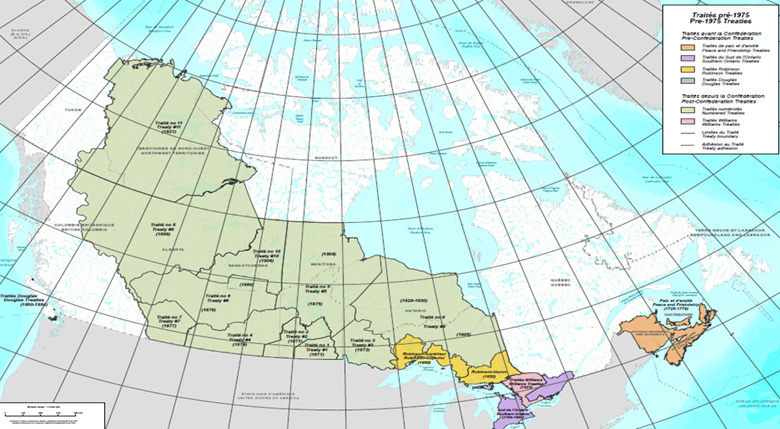
Description:
Pre-1975 Treaties
- Pre-Confederation treaties
- Peace and friendship treaties
- Southern Ontario treaties
- Robinson treaties
- Douglas treaties
Post-1975 Treaties
- Numbered treaties
- Williams treaties
- Treaty boundary
- Treaty adhesion
Annex C: Map of Comprehensive Land Claims Agreements and Self-Government Agreements (“Modern Treaties”)
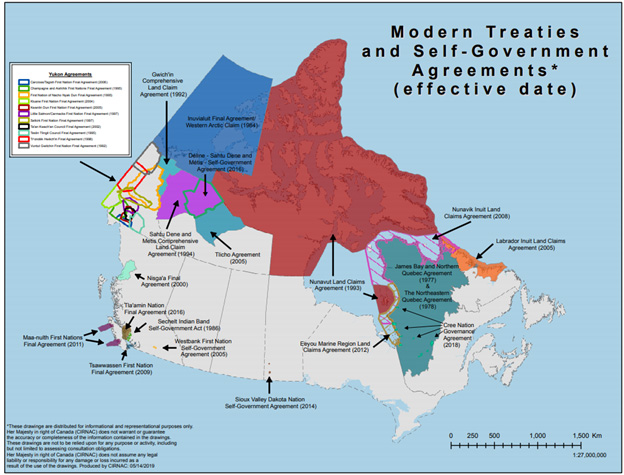
Description:
This map illustrates the amount of Canada's land mass covered by modern treaties and self-government agreements. Note: this map does not include the Déeline Self-Government Agreement.
- Newfoundland and Labrador
- Labrador Inuit Land Claims Agreement (2005)
- British Columbia
- Maa-nulth Final Agreement (2011)
- Nisga'a Final Agreement (2000)
- Tla'amin Final Agreement (2016)
- Tsawwassen First Nation Final Agreement (2009)
- Sechelt Indian Band Self-Government Agreement (1986)
- Westbank First Nation Self-Government Agreement (2005)
- Nunavut
- Nunavut Agreement, formerly Nunavut Land Claims Agreements (1993)
- Northwest Territories
- Gwich'in Comprehensive Land Claim Agreement (1992)
- Sahtu Dene and Métis Comprehensive Land Claim Agreement (1994)
- Tlicho Land Claims and Self-Government Agreement (2005)
- Inuvialuit Final Agreement Western Arctic Claim (1984)
- Déline Final Self-Government Agreement (2016)
- Québec
- James Bay and Northern Québec Agreement (1977)
- Northeastern Québec Agreement (1978)
- Nunavik Inuit Land Claims Agreement (2008)
- Eeyou Marine Region Land Claims Agreement (2012)
- Yukon
- Yukon First Nations Final Agreements
- Champagne and Aishihik First Nations (1995)
- First Nation of Na-cho Nyak Dun (1995)
- Teslin Tlingit Council (1995)
- Vuntut Gwitchin First Nation (1995)
- Little Salmon/Carmacks First Nation (1997)
- Selkirk First Nation (1997)
- Tr'ondëk Hwëch'in First Nation (1998)
- Ta'an Kwäch'än Council (2002)
- Kluane First Nation (2004)
- Kwanlin Dün First Nation (2005)
- Carcoss/Tagish First Nation (2006)
- Yukon First Nations Final Agreements
- Manitoba
- Sioux Valley Dakota Nation Self-Government Agreement (2014)
Annex D: Duty to Consult
Government is subject to the constitutional duty to consult and accommodate, and the requirement to justify any infringements of rights.
Duty to consult
Where the Crown contemplates conduct that might have an adverse impact on established or potential Aboriginal or treaty rights, it has a legal duty to consult with those Indigenous groups who hold (or potentially hold) those rights, and, where appropriate, accommodate their interests or concerns.
Duty to justify infringements of rights
Where legislation, its implementation or other government action infringes an Aboriginal or treaty rights, the infringement must be justified in accordance with the test set out by the Supreme Court of Canada.
Page details
- Date modified: