
Tab A6 - Regional Profiles
On this page
- DFO Administrative Regions
- DFO – Newfoundland and Labrador Region
- DFO – Maritimes Region
- DFO – Gulf Region
- DFO – Quebec Region
- DFO – Ontario and Prairie Region
- DFO – Arctic Region
- DFO – Pacific Region
- Canadian Coast Guard Regions
- Coast Guard – Atlantic Region
- Coast Guard – Central Region
- Coast Guard – Western Region
- Coast Guard – Arctic Region
DFO administrative regions
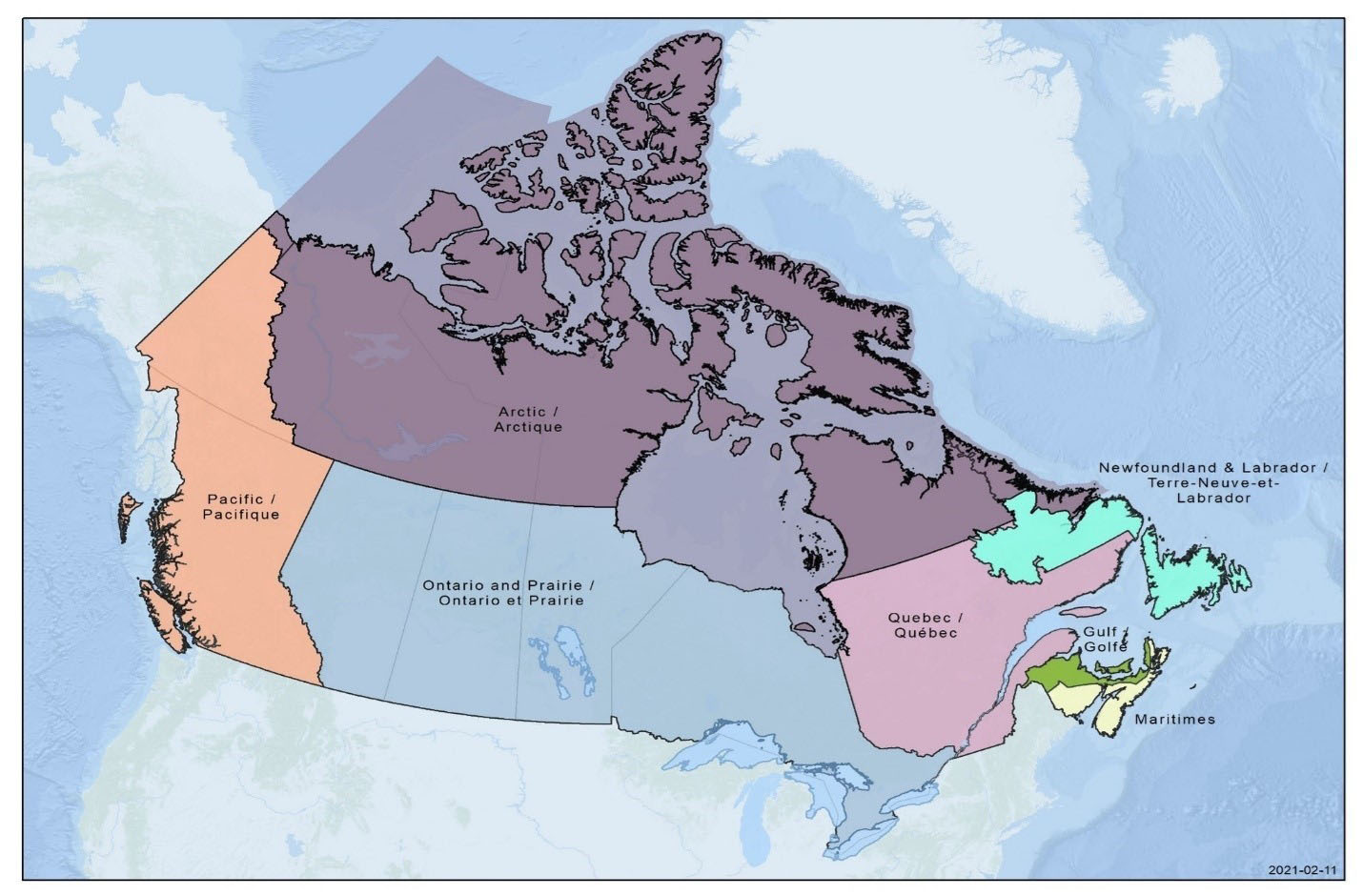
Description:
The Arctic Region is inclusive of the Yukon North slope, Northwest Territories, Nunavut, Nunavik, Nunatsiavut, and Hudson and James Bay. This boundary is inclusive of Inuit Nunangat.
The Pacific Region consists of British-Columbia and Yukon, minus the Yukon slope.
The Ontario and Prairie Region consists of Ontario, Manitoba, Saskatchewan and Alberta.
The Quebec Region consists of Quebec, minus the Nunavik region in northern Quebec.
The Gulf Region extends from the New Brunswick-Quebec border to the northern tip of Cape Breton.
The Maritimes Region extends from the northern tip of Cape Breton to the New Brunswick-Maine border.
The Newfoundland and Labrador Region consists of Newfoundland and Labrador, minus the Nunatsiavut region in Labrador.
DFO – Newfoundland and Labrador (NL) Region
Regional HQ
- St. John’s, NL
Three Area Offices
- Grand Falls-Windsor
- Corner Brook
- Happy Valley-Goose Bay
688 employees and an operating budget of $130.9 million.
- Province of NL has 29,000 km of coastline and ~18% of Canada’s total ocean area
- Three Marine Protected Areas and 14 Marine Refuges towards Marine Conservation Targets
- 315 Small Craft Harbours
- Top species: snow crab, lobster, and clams
- Approximate employment by the fishery, processing and aquaculture sectors* (2023): 13,700
- Total landed value of the commercial fishery (2023): $727 million
- Total value of aquaculture in Newfoundland (2023): $185 million.
*in Newfoundland
Key Priorities:
- Supporting sustainable and commercially viable fisheries
- Working with fishers and communities to enable continued prosperity from fish and seafood
- Advancing reconciliation through partnerships in fisheries, conservation, and habitat restoration
- Strengthening ocean science
- Protecting biodiversity and advancing clean energy
DFO – Maritimes Region
Regional HQ
- Dartmouth, NS
Three Area Offices
- Sydney, NS
- Yarmouth, NS
- St. George, NB
884 employees and an operating budget of $142.2 million
- 8,600 km of coastline from the tip of Cape Breton to the Can (NB)-US border
- Three Marine Protected Areas (MPAs) + Two Areas of Interest (AOI) and an advanced bioregional conservation network planning process
- 171 Small Craft Harbours
- Top species: lobster, scallop, and halibut
- Approximate employment by the fishery, processing and aquaculture sectors* (2023): 28,800
- Total landed value of the commercial fishery (2023): $1.36 billion**
- Total value of aquaculture* (2023): $405 million
*In Nova Scotia and New Brunswick /**Estimate based on 2023 preliminary figures
Key Priorities:
- Supporting sustainable and commercially viable fisheries
- Working with fishers to enable continued prosperity from fish and seafood
- Advancing reconciliation and implementing rights-based fisheries
- Supporting an orderly and sustainable elver fishery
- Protecting biodiversity and advancing clean energy
DFO – Gulf Region
Regional HQ
- Moncton, NB
Three Area Offices
- Tracadie, NB
- Antigonish, NS
- Charlottetown, PEI
523 employees and an operating budget of $74 million.
- 7,000 km of coastline includes New Brunswick’s eastern coast, the Northumberland Strait coast of Nova Scotia, western Cape Breton Island, and Prince Edward Island. Rivers, lakes and wetlands represent over 17,000 km2 of freshwater habitat.
- One Marine Protected Area (MPA) + five Marine refuges
- 114 Small Craft Harbours
- Top species: lobster, snow crab
- Approximate employment by the fishery, processing and aquaculture sectors* (2023): 34,900
- Total landed value of the commercial fishery (2023): $679 million
- Total value of aquaculture* (2023): $456 million
*In Nova Scotia, New Brunswick, and Prince Edward Island
Key Priorities:
- Supporting sustainable and commercially viable fisheries
- Advancing reconciliation and implementing rights-based fisheries
- Protecting North Atlantic right whales while supporting sustainable fisheries
- Supporting Small Craft Harbours and maintaining infrastructure
- Protecting biodiversity
DFO – Quebec Region
Regional HQ
- Quebec City, QC
Three Area Offices
- Sept-Îles
- Gaspé
- Cap-aux-Meules
683 employees and an operating budget of $106 million.
- Province of Quebec and a large part of the Gulf of St. Lawrence
- One Marine Protected Area (MPA)
- 78 Small Craft Harbours
- Top three species: lobster, snow crab, and halibut
- Approximate employment by the fishery, processing and aquaculture sectors* (2023): 4,600
- Total landed value of the commercial fishery (2023): $360 million
- Total value of aquaculture* (2023): $12 million
*in Quebec
Key Priorities:
- Finalize the development rebuilding plans for shrimp stocks
- Implementing rights-based fisheries
- Supporting Small Craft Harbours and maintaining infrastructure
- Protecting biodiversity and advancing clean energy
DFO – Ontario and Prairie Region
Regional Offices
- Winnipeg, MB
- Burlington, ON
- Sarnia, ON
Local Offices
- Edmonton, Regina, Sault Ste. Marie
590 employees and an operating budget of $82.6M.
- 20% of world’s freshwater supply is in the Great Lakes; 63% of Canada’s GDP; and 57% of Canada’s population
- 155 Small Craft Harbours
- Top species: whitefish, yellow pickerel and perch
- Approximate employment by the fishery, processing and aquaculture sectors* (2023): 3,400
- Total landed value of the commercial fishery (2023): $86 million
- Total value of aquaculture* (2023): $48 million
- Direct expenditures attributable to recreational fishing (2020): over $1.7 billion
*In Ontario, Manitoba, Saskatchewan, and Alberta
Key Priorities:
- Advancing environmental and critical minerals work
- Working with U.S. counterparts and the Great Lakes Fishery Commission on collaborative management
- Protecting freshwater biodiversity and fish and fish habitat
DFO – Arctic Region
Regional HQ
- Inuvik, NT
Additional Offices
- Iqaluit, NU
- Rankin Inlet, NU
- Yellowknife, NWT
- Hay River, NWT
- Various satellite locations
270 employees and an operating budget of $65.5M.
*In Northwest Territories (data on other territories unavailable) / **Northwest Territories and Nunavut
Key Priorities:
- Establishing governance frameworks with northern partners
- Building a workforce that is representative of northern and Indigenous communities
- Implementing land claim obligations in the North
- Working with U.S. counterparts on scientific research, monitoring and enforcement coordination
DFO – Pacific Region
Regional HQ
- Vancouver, BC
Four Area Offices
- South Coast
- Fraser and Interior
- North Coast
- Yukon and Transboundary
2,160 employees and an operating budget of $271 million.
*In British Columbia
Key Priorities:
- Protecting Pacific salmon
- Sustainable aquaculture development
- Advancing reconciliation and implementing rights-based fisheries
- Protecting biodiversity and enhancing the region’s aquatic ecosystems
Canadian Coast Guard Regions

Description:
The Arctic Region is inclusive of the Yukon North slope, Northwest Territories, Nunavut, Nunavik, Nunatsiavut, and Hudson and James Bay. This boundary is inclusive of Inuit Nunangat.
The Pacific Region consists of British-Columbia and Yukon, minus the Yukon slope.
The Ontario and Prairie Region consists of Ontario, Manitoba, Saskatchewan and Alberta.
The Quebec Region consists of Quebec, minus the Nunavik region in northern Quebec.
The Gulf Region extends from the New Brunswick-Quebec border to the northern tip of Cape Breton.
The Maritimes Region extends from the northern tip of Cape Breton to the New Brunswick-Maine border.
The Newfoundland and Labrador Region consists of Newfoundland and Labrador, minus the Nunatsiavut region in Labrador.
Coast Guard – Atlantic Region
Regional Office
- St. John’s, NL
2,100 employees and an operating budget of $249 million.
The region spans NB, NS, PEI, and NL, with a Search and Rescue (SAR) zone extending halfway across the Atlantic.
Regional Assets:
- 21 large vessels
- 6 small vessels
- 23 SAR lifeboats
- 8 helicopters
- 2 operational bases
- 2 Integrated Service Centres
- 16 SAR stations
- 9 seasonal inshore rescue boat (IRB) stations
- 5 marine communication & traffic service (MCTS) centres
- 5 staffed marine environmental and hazards response (MEHR) depots
- 1,489 fixed aids
- 5,220 floating aids
- 24 staffed lighthouses
Key Priorities:
- Ensure shore-based infrastructure is able to welcome new vessels in preparation for the future fleet.
- Adapt to increasing extreme weather events by providing essential services and coordinating relief efforts.
- Continue collaborating with commercial shipping and fishing industries, ferries, and four provincial governments to provide icebreaking and other key services.
Coast Guard – Central Region
Regional Office
- Montreal, QC
The region has approximately 1,670 employees and an operating budget of $200 million.
The region covers the five Great Lakes and their connecting channels, as well as the St. Lawrence River to the Gulf of St. Lawrence.
Regional Assets:
- 7 large vessels
- 12 small vessels
- 19 SAR lifeboats
- 7 helicopters
- 2 hovercrafts
- 10 operational bases
- 15 search and rescue stations
- 15 lifeboat stations
- 12 inshore rescue stations
- 4 ER bases and depots
- 4 MCTS centres
- 6,282 floating aids
- 2,310 fixed aids
Key Priorities:
- Work cooperatively with US Coast Guard in the Great Lakes and St. Lawrence Seaway to provide essential icebreaking capabilities in a zone of great economic importance
- Adapt to climate change impacts resulting in extended navigation season and increasing demands on CCG services
- Foster a bilingual work environment
Coast Guard – Western Region
Regional Office
- Victoria, BC
The region has 1,400 employees and an operating budget of $158 million.
The region spans Alberta, and includes Lake Winnipeg in Manitoba; the region continues to support operations on the Mackenzie River in conjunction with the Arctic Region.
Regional Assets:
- 6 large vessels
- 16 small vessels
- 18 SAR vessels
- 7 helicopters
- 2 hovercrafts
- 2 leased emergency towing vessels
- 7 operational bases
- 15 SAR stations (1 under construction)
- 4 IRB stations
- 2 MCTS centres
- 5 ER depots
- 2,250 aids to navigation
- 25 staffed light stations
Key Priorities:
- Building Indigenous partnerships with 60+ coastal First Nations
- Prepare for increased shipping on the west coast due to Major Resource Projects.
- Continue to advance strategic relationships in the North Pacific with like-minded allies.
Coast Guard – Arctic Region
Regional Office
- Yellowknife, NWT
120 employees, 69 of whom are in the Arctic, and an operating budget of $30 million.
The boundaries for the Arctic Region were announced in 2021, making it the first GoC region to encompass all of Inuit Nunangat, in alignment with the recently endorsed Inuit Nunangat policy.
The region consists of the four regions of Inuit Nunangat (Inuvialuit, Nunavut, Nunavik, Nunatsiavut), the Yukon North Slope, Northwest Territories, Hudson & James Bay. Seasonal operations are conducted on the Mackenzie River, NWT.
Available Assets:
- 6-8 icebreakers
- 2 seasonal buoy tenders
- 7 ER vessels
- Up to 8 helicopters
- 1 year-round CCG base
- 1 Arctic Marine Response station
- 1 MCTS seasonal centre
- 11 remote communication sites
- 3 staffed & 2 unstaffed ER depots
- 28 caches of ER equipment – with small response vessels
- 1 rapid air transportable
- Over 2,000 aids
Key Priorities:
- Improve operational readiness, Maritime Domain Awareness & marine safety in the Arctic in collaboration with Inuit, First Nations and Metis governments and organizations.
- Advancing Indigenous reconciliation.
- Increase representative workforce by reducing barriers for Northern employment
- Date modified: