
Fisheries and Oceans Canada - Quarterly financial report for the quarter ended June 30, 2025
Table of contents
- Introduction
- Highlights of fiscal quarter results
- Risks and uncertainties
- Significant changes in relation to operations, personnel and programs
- Approval by senior officials
- Appendix
1. Introduction
This quarterly financial report has been prepared as required by section 65.1 of the Financial Administration Act. The quarterly report should be read in conjunction with the current year’s Main Estimates.
This quarterly report has not been subject to an external audit or review.
Further details on Fisheries and Oceans Canada’s authority, mandate and programs may be found in the Departmental Plan.
1.1 Basis of presentation
This quarterly report has been prepared using an expenditure basis of accounting. The accompanying Statement of Authorities includes Fisheries and Oceans Canada’s spending authorities granted by Parliament and those used by the Department consistent with the 2025-26 Main Estimates.
The authority of Parliament is required before money can be spent by the Government. Approval is given in the form of annually approved limits through appropriation acts or through legislation in the form of statutory spending authority for specific purposes.
The Department uses the full accrual method of accounting to prepare and present its annual departmental financial statements that are part of the departmental results reporting process. However, the spending authorities voted by Parliament remain on an expenditure basis.
2. Highlights of fiscal quarter results
The following section highlights the financial results and provides explanations for the fiscal quarter ended June 30, 2025, as compared to the same period last year.
| 2024-25 Authorities as at June 30, 2024 | 2025-26 Authorities as at June 30, 2025 | Variance in Authorities | 2024-25 Expenditures as at June 30, 2024 | 2025-26 Expenditures as at June 30, 2025 | Variance in Expenditures | |
|---|---|---|---|---|---|---|
| Vote 1 – Net Operating expenditures | 2,175,846 | 2,266,709 | 90,863 | 459,121 | 455,922 | (3,199) |
| Vote 5 – Capital expenditures | 1,826,756 | 2,650,017 | 823,261 | 249,588 | 693,961 | 444,373 |
| Vote 10 – Grants and Contributions | 491,765 | 913,847 | 422,082 | 67,422 | 52,406 | (15,016) |
| Statutory Authorities | 190,813 | 221,974 | 31,161 | 47,803 | 56,114 | 8,311 |
| Total | 4,685,180 | 6,052,547 | 1,367,367 | 823,934 | 1,258,403 | 434,469 |
2.1 Significant changes in authorities
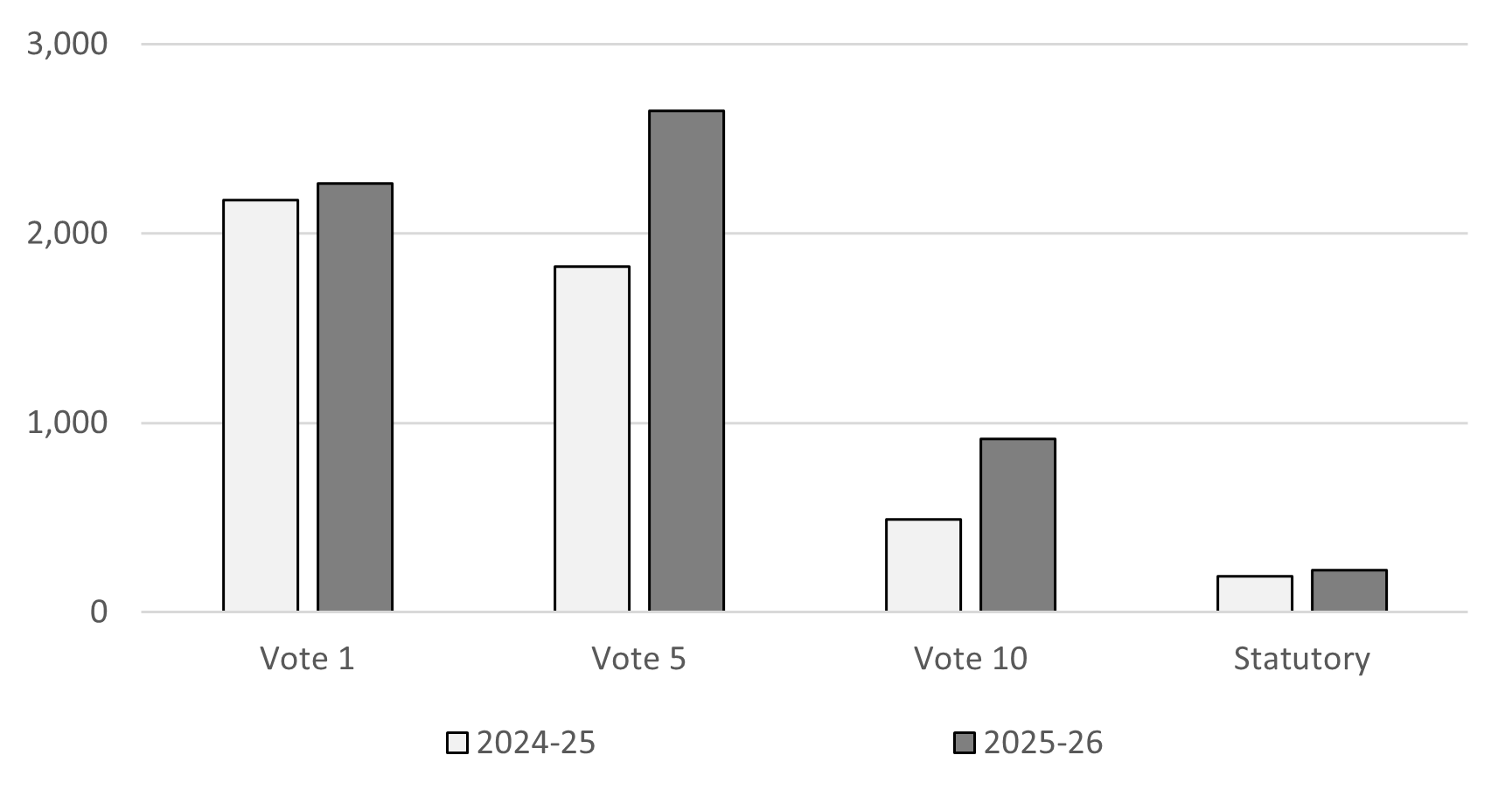
In the first quarter of 2025-26, total budgetary authorities available for use increased by $1,367.4 million (29.2%) compared to the same period in the previous year:
- Vote 1 authorities increased by $90.9 million
- Vote 5 authorities increased by $823.3 million
- Vote 10 authorities increased by $422.1 million
- Statutory authorities increased $31.2 million
Comparison of net budgetary authorities, by Vote, as at June 30 of fiscal years 2024-25 and 2025-26 (in millions of dollars)
Text version
| Dates | 2024-25 | 2025-26 |
|---|---|---|
| Vote 1 | 2,176 | 2,267 |
| Vote 5 | 1,827 | 2,650 |
| Vote 10 | 492 | 914 |
| Statutory | 191 | 222 |
Note: Funding presented reflects approved reference levels at the time of Main Estimates.
The following table provides a detailed explanation of these changes.
| Explanation of Changes (2025-26 compared to 2024-25) |
Change (thousands of dollars) |
|---|---|
| Vote 1 – Net Operating | |
| Funding for signed collective bargaining agreements | 44,685 |
| Funding for Canadian Coast Guard's fleet projects | 43,253 |
| Funding to repair and maintain small craft harbours (Budget 2024) | 34,803 |
| Funding for Canadian Coast Guard's fleet operations | 20,171 |
| Funding to modernize the Fisheries Act | 4,706 |
| Funding to implement an Inuit Impact and Benefit Agreement | 3,518 |
| Funding to support the transition from open net-pen salmon aquaculture in British Columbia | 2,822 |
| Funding for the Pacific Salmon Strategy Initiative | 2,368 |
| Planned funding profile change to strengthen environmental protections and address concerns raised by Indigenous groups regarding the trans mountain expansion project | (5,766) |
| Transfers to other government departments | (12,026) |
| Planned funding profile change for extending the lease of the emergency towing vessels on the West Coast and completing the National Strategy on Emergency Towing | (12,678) |
| Planned funding profile change related to the Refocusing Government Spending exercise | (17,072) |
| Planned funding profile change for federal contaminated sites | (21,976) |
| Other Departmental Adjustments | 4,055 |
| Sub-total Net Operating | 90,863 |
| Vote 5 – Capital | |
| Funding for Canadian Coast Guard's fleet projects | 738,833 |
| Funding to repair and maintain small craft harbours (Budget 2024) | 117,124 |
| Funding to design, construct, and maintain a small craft harbour in Arctic Bay in the Qikiqtani Region, Nunavut | 10,240 |
| Planned funding profile change for the Oceans Protection Plan | (4,154) |
| Planned funding profile change to strengthen environmental protections and address concerns raised by Indigenous groups regarding the trans mountain expansion project | (12,356) |
| Planned funding profile change to implement an Inuit Impact and Benefit Agreement | (23,727) |
| Other Departmental Adjustments | (2,699) |
| Sub-total Capital | 823,261 |
| Vote 10 – Grants and Contributions | |
| Funding for the Qikiqtani Inuit Association | 295,677 |
| Funding for Indigenous programs | 166,733 |
| Funding for the Oceans Protection Plan | 7,896 |
| Planned funding profile change for the Fish Funds | (5,538) |
| Planned funding profile change for the Pacific Salmon Strategy Initiative | (8,043) |
| Planned funding profile change to strengthen environmental protections and address concerns raised by Indigenous groups regarding the trans mountain expansion project | (36,507) |
| Other Departmental Adjustments | 1,864 |
| Sub-total Grants and Contributions | 422,082 |
| Statutory | |
| EBP Adjustment | 15,809 |
| Funding for increase in personnel related to the Canadian Coast Guard's fleet projects | 8,230 |
| Funding for signed collective bargaining agreements | 7,187 |
| Other Departmental Adjustments | (65) |
| Sub-total Statutory | 31,161 |
| Total Authorities | 1,367,367 |
2.2 Significant changes in expenditures
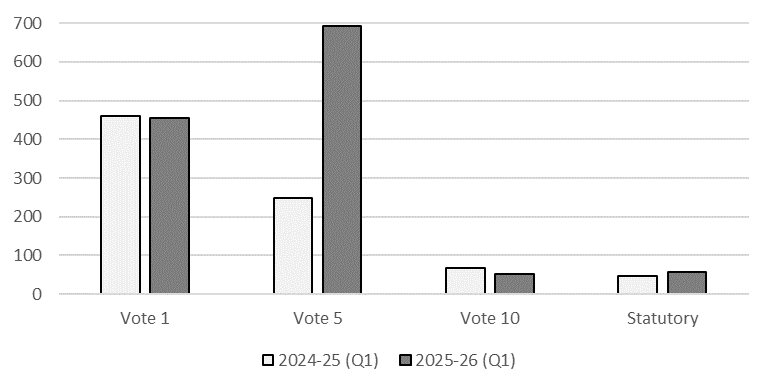
In the first quarter of 2025-26, total budgetary expenditures amounted to $1,258.4 million compared to $823.9 million reported in the same quarter of 2024-25. This represents an increase of $434.5 million, or 52.7%.
- Vote 1 - Net Operating expenditures (decrease of $3.2 million or 0.7%)
This variance is mainly explained by payments related to the Great Lakes Fisheries Commission now under Global Affairs Canada.
- Vote 5 - Capital expenditures (increase of $444.4 million or 178.0%)
This variance is mainly explained by expenditures associated with the procurement activities related to the Polar Max vessel as well as an increase in the amount of work in construction engineering and architectural services related to the Arctic Offshore Patrol Ships and the advancement of the Polar Icebreaker project.
- Vote 10 - Grants and Contributions expenditures (decrease of $15.0 million or 22.3%)
This variance is mainly attributed to a decrease of expenditures related to the Trans Mountain Expansion Project. In addition, there was a decrease in payments related to Indigenous Reconciliation Priorities due to delays in the signing of agreements as a result of enacting the Caretaker Convention during the federal election.
- Statutory – Authorities used (increase of $8.3 million or 17.4%)
This variance is mainly attributed to an increase in contributions to Employee Benefit Plans which is related to the growth in salary expenditures.
Comparison of authorities used, by Vote, as at June 30 of fiscal years 2024-25 and 2025-26 (in millions of dollars)
Text version
| Dates | 2024-25 (Q1) | 2025-26 (Q1) |
|---|---|---|
| Vote 1 | 459 | 456 |
| Vote 5 | 250 | 694 |
| Vote 10 | 67 | 52 |
| Statutory | 48 | 56 |
As reflected in Table 2: Departmental Budgetary Expenditures by Standard Object (unaudited), the net increase by standard object is mainly attributed to:
- Professional and Special Services (increase of $45.8 million)
This variance is mainly attributed to an increase in the amount of work in construction engineering and architectural services related to the Arctic Offshore Patrol Ships and the advancement of the Polar Icebreaker project.
- Repair and Maintenance (increase of $6.1 million)
This variance is mainly explained by a timing difference in the work performed under the Vessel Refit Program. In addition, there was an increase in marine installation costs due to the timing of work and invoices related to annual dredging and shore maintenance.
- Acquisition of Machinery and Equipment (increase of $371.5 million)
This variance is mainly explained by expenditures associated with the procurement activities related to the Polar Max vessel.
- Transfer Payments (decrease of $15.0 million)
This variance is mainly attributed to a decrease of expenditures related to the Trans Mountain Expansion Project. In addition, there was a decrease in payments related to Indigenous Reconciliation Priorities due to delays in the signing of agreements as a result of enacting the Caretaker Convention during the federal election.
- Other Subsidies and Payments (increase of $7.2 million)
This variance is mainly explained by a timing difference in the processing of financial transactions between departments.
3. Risks and uncertainties
Fisheries and Oceans Canada operates in a dynamic environment that is affected by a number of factors, including: northern development; evolving relationships with Indigenous partners; navigating waters; climate change; demographics; technological advances; changing maritime safety and security demands; and global geopolitical and economic conditions. The Department maintains a Departmental Risk Profile which assesses corporate strategic risks, which if not managed and mitigated, could impair DFO-CCG’s ability to deliver on its mandate and achieve results under the Department’s core responsibilities. Additional information regarding the Department’s key risk areas is presented in the 2025-26 Departmental Plan.
Certain risks would have financial impacts should they materialize such as affecting the timing of transfer payments or delays in the delivery of shipbuilding projects, which lie outside the control of the Department and could require funds to be shifted to future years to meet program requirements. To minimize these impacts, the Department continuously monitors program funding and expenditures throughout the year. In addition, the Department has put strategies in place such as the National Shipbuilding Strategy to ensure accountability and objectives are met.
As the Government maintains its efforts to manage growth and ensure efficient use of taxpayer money, Fisheries and Oceans is focused on reducing spending in strategic areas, with minimal impact to service standards. With continued fiscal constraint measures on the horizon, the focus on efficiency and value for money will be at the forefront to reflect an evolving financial and socio-economic landscape, as well as the continual support of regional representation, including a diverse public service workforce.
4. Significant changes in relation to operations, personnel and programs
The following changes in personnel were made since the last published quarterly report:
- The appointment of Peter Lambertucci as Chief Enforcement Officer, Conservation and Protection, as of April 1, 2025 (as announced on February 17, 2025).
- The appointment of Anna Classen as Regional Director General, Pacific Region, as of April 1, 2025 (as announced on February 21, 2025).
- The appointment of the Honourable Joanne Thompson as Minister of Fisheries, Oceans and the Canadian Coast Guard, as of April 1, 2025 (as announced on March 14, 2025).
- The appointment of Joanne Garrah as Assistant Deputy Minister, Ecosystems and Oceans Science, as of May 26, 2025.
5. Approval by senior officials
Approved by:
Original signed by
Annette Gibbons,
Deputy Minister
Ottawa, Canada
Original signed by
Richard Goodyear,
Chief Financial Officer
Ottawa, Canada
6. Appendix
Table 1: Statement of authorities (unaudited)
(in thousands of dollars)
| Fiscal year 2024-25 | Fiscal year 2025-26 | |||||
|---|---|---|---|---|---|---|
| Total available for use for the year ending March 31, 2025* | Year to date used at quarter-end | Used during the quarter ended June 30, 2024 | Total available for use for the year ending March 31, 2026* | Year to date used at quarter-end | Used during the quarter ended June 30, 2025 | |
| Vote 1 – Net Operating expenditures | 2,175,846 | 459,121 | 459,121 | 2,266,709 | 455,922 | 455,922 |
| Vote 5 – Capital expenditures | 1,826,756 | 249,588 | 249,588 | 2,650,017 | 693,961 | 693,961 |
| Vote 10 – Grants and Contributions | 491,765 | 67,422 | 67,422 | 913,847 | 52,406 | 52,406 |
| Statutory Authorities | ||||||
| Statutory - Contributions to employee benefit plans | 190,714 | 47,678 | 47,678 | 221,872 | 55,468 | 55,468 |
| Statutory - Minister of Fisheries and Oceans – Salary and motor car allowance | 99 | 25 | 25 | 102 | 25 | 25 |
| Statutory - Spending of proceeds from the disposal of surplus Crown assets | 0 | 96 | 96 | 0 | 9 | 9 |
| Statutory - Refunds of amounts credited to revenues in previous years | 0 | 4 | 4 | 0 | 612 | 612 |
| Total Statutory Authorities | 190,813 | 47,803 | 47,803 | 221,974 | 56,114 | 56,114 |
| Total Authorities | 4,685,180 | 823,934 | 823,934 | 6,052,547 | 1,258,403 | 1,258,403 |
* Includes only Authorities available for use and granted by Parliament at quarter-end.
Table 2: Departmental budgetary expenditures by standard object (unaudited)
(in thousands of dollars)
| Fiscal year 2024-25 | Fiscal year 2025-26 | |||||
|---|---|---|---|---|---|---|
| Planned expenditures for the year ending March 31, 2025* | Year to date used at quarter-end | Expended during the quarter ended June 30, 2024 | Planned expenditures for the year ending March 31, 2026* | Year to date used at quarter-end | Expended during the quarter ended June 30, 2025 | |
| Expenditures: | ||||||
| Personnel | 1,572,803 | 407,627 | 407,627 | 1,672,113 | 424,103 | 424,103 |
| Transportation and communications | 89,417 | 16,725 | 16,725 | 92,610 | 19,450 | 19,450 |
| Information | 6,456 | 1,917 | 1,917 | 9,100 | 1,746 | 1,746 |
| Professional and special services | 1,081,957 | 211,596 | 211,596 | 1,620,268 | 257,366 | 257,366 |
| Rentals | 64,053 | 14,999 | 14,999 | 75,576 | 12,125 | 12,125 |
| Repair and maintenance | 186,675 | 18,751 | 18,751 | 178,221 | 24,825 | 24,825 |
| Utilities, materials and supplies | 150,147 | 21,967 | 21,967 | 159,154 | 21,542 | 21,542 |
| Acquisition of land, buildings and works | 310,550 | 16,461 | 16,461 | 424,686 | 19,283 | 19,283 |
| Acquisition of machinery and equipment | 740,434 | 57,526 | 57,526 | 920,593 | 429,006 | 429,006 |
| Transfer payments | 491,765 | 67,422 | 67,422 | 913,847 | 52,406 | 52,406 |
| Other subsidies and payments | 30,934 | (954) | (954) | 26,390 | 6,274 | 6,274 |
| Public Debt Charges | 0 | 15 | 15 | 0 | 0 | 0 |
| Total gross budgetary expenditures | 4,725,191 | 834,052 | 834,052 | 6,092,558 | 1,268,126 | 1,268,126 |
| Less Revenues netted against expenditures: | ||||||
| Sales of goods and services | 40,011 | 10,118 | 10,118 | 40,011 | 9,723 | 9,723 |
| Total Revenues netted against expenditures | 40,011 | 10,118 | 10,118 | 40,011 | 9,723 | 9,723 |
| Total net budgetary expenditures | 4,685,180 | 823,934 | 823,934 | 6,052,547 | 1,258,403 | 1,258,403 |
* Includes only Authorities available for use and granted by Parliament at quarter-end.
- Date modified: