
What We Heard Report: Adapting Quebec fisheries to changing climate
Note: Fisheries and Oceans Canada (DFO) held a series of 7 regionally focused workshops to discuss climate change impacts, barriers to adaptation, and actions to support the resilience of Canada’s wild-capture fish harvesters and harvesting industry.
What we heard report: Regional perspectives on adapting Canadian fisheries to a changing climate
On this page
- Disclaimer
- Executive summary: key takeaways
- Report
- Impacts of a changing climate and barriers to adaptation
- Looking to the future
- Results of the polling exercise
- Question 1: Choose all of the following that apply to you and your role
- Question 2: On a scale from 1 to 5 (1 being the lowest and 5 being the highest), please indicate the extent to which you agree or disagree with the following statements
- Question 3: What could increase the agility and flexibility of the fisheries management regime to respond to future challenges
- Participant list
Disclaimer
The following report contains opinions expressed by those who attended the regional workshop sessions and do not necessarily reflect the views of Fisheries and Oceans Canada (DFO).
Throughout this report, participant views are represented as received by DFO. However, in some instances there are discrepancies between participant interpretations and what is authorized by DFO. As such, participant comments may not correspond to the statutory, regulatory, and policy framework as understood by DFO. In addition, participant recommendations noted below reflect general consensus but should not be interpreted as having received unanimous consent.
Executive summary: key takeaways
Participants reported several impacts of climate change, including:
- Environmental changes (increased water temperature, decreased oxygen levels in the water, and changes in ice cover).
- Changes in species distribution, life cycles, and fishing conditions and seasons.
- Increased costs for industries in terms of infrastructure and investment.
Participants reported several threats to Quebec's fisheries due to climate change, including:
- Slow and rigid management and regulatory systems, as well as concerns about the science that guides forecasting and decision-making for fishing activities.
- Challenges in terms of resource abundance (increase for some and decrease or even closure of fishing for others).
- Species-specific models and market unsuited to the continual changes of the ecosystem.
- Concerns for the health and safety of harvesters who face more difficult fishing conditions and spend more and more time at sea.
Participants are taking several actions to adapt to changing conditions, including:
- Developing new markets in order to create better market diversification.
- Working to diversify licence portfolios to better adapt to changing environmental conditions.
- Putting greater emphasis on the valuation of catches: fishing less but adding value to the product.
Participants identified several key barriers to adaptation, including:
- An increase in the operating costs of a fishing business, which leads to a culture of overfishing, bankruptcy situations, and impacts on the mental health of harvesters.
- Slow and inflexible licensing and regulatory system, unable to keep pace with climate change.
- A perceived lack of cooperation between Fisheries and Oceans Canada (DFO) and the many other players in the fishing community.
- Lack of essential knowledge and data on the ecosystem and on the evolving environmental conditions.
Participants identified several key actions to help fisheries adapt to the changes, including:
- Amending policies and regulations to allow for simultaneous multi-species fishing and to develop methods to add value to bycatch that will minimize waste and encourage conservation.
- Improving Indigenous representation in the decision-making process, allowing for better knowledge sharing to improve the status of the fishery.
- Greater collaboration between DFO and the various stakeholders in the fishing community to improve data collection and use, while increasing at-sea sightings.
- Promoting Quebec fishery products and prioritize local markets.
- Being proactive in actions that respond to climate change and mitigate uncertainty.
- Developing the aquaculture sector to reduce pressure on resources and to be more resilient.
- Bettering support from DFO to enhance the value of the fishing profession and ensure their safety.
Report
Impacts of a changing climate and barriers to adaptation
What is the impact of climate change on your fisheries
The discussion identified a variety of impacts of climate change on fisheries in the Quebec region. The most notable environmental change already being noticed by the participants are changes in water temperature. Some participants noted that the increase in water temperature seems to lead to a decrease in catches in some cases and seems to be ideal for the recruitment and life cycle of other species. Decreasing oxygen levels in the water was also raised. They also noted that the acidity level of the water has already changed, leading to difficulties for the growth of some species (e.g., bivalves that rely on calcium carbonate to build and maintain their shells). Harvesters also reported that ice cover appears to be generally retreating earlier in the season, which may have positive effects (opening of harbours and fishing activities earlier), but may also have negative effects on some species and fisheries. Finally, increasing coastal erosion has been observed, which has an effect on habitat.
Participants reported that they have noticed changes in the distribution of species, with these shifts having positive impacts for some but negative impacts for others. For some species, their yield and population have increased (resulting in larger landings), while other species have seen a significant decrease (some fisheries have even been closed altogether). Many harvesters reported that the movement of species have led to changes in fishing seasons, compared to previous years. This redistribution of species also has an effect on predator-prey relationships, with some even noticing the arrival of new predatory species, thus impacting the entire ecosystem. The redistribution of species was also reported to be affecting major commercial fisheries and their infrastructure, which in turn affects the harvesters and their communities. Finally, participants pointed out that changes in the distribution of species also have broader impacts, such as the presence of whales that influence a variety of fishing activities in the region.
Participants noted that climate impacts in the region are increasing the uncertainty about seasonality, fishing conditions and the species that can be fished. They explained that the abundance of some species can vary from year to year and unreliable data is making it difficult to plan future fishing activities. They pointed out that it remains difficult to say whether these variations in abundance are actually related to climate change or rather to other normal changes in the ecosystem or other factors. Participants pointed out that fishing patterns have changed in recent years, shifting the fishing locations for some species. They noted that warming waters, which currently seem ideal for the recruitment of certain species in the region, could eventually become too warm if water temperature continues to rise, which could lead to a reduction in catches. Additionally, the workshop discussions reported that people in the region are seeing an increasing number of storms and that they are also stronger than before. Harvesters must be on alert at all times, as conditions can change quickly.
Participants shared that the impacts of climate change are being felt by industry through rising costs. They noted that climate change has an impact on commercially-fished species, as well as on fisheries infrastructure (such as harbours and processing plants). Participants also emphasized that growing uncertainty complicates investments that involve greater risk-taking. Harvesters noted that vessels are getting larger to be better adapted to stronger currents and winds resulting from climate change, which also leads to increased costs.
In addition, participants mentioned that the impacts of climate change are affecting the growth and life cycle of some species, which no longer appear to be growing at the same rate or are laying eggs much earlier in the season. These changes are affecting harvesters, who are reporting challenges with finding the stocks towards the end of their fishing season. Additionally, participants noted that some species are having more difficulty adapting than others, which limits the ability to make accurate projections for these fisheries. In some cases, participants explained that the declines of some species are affecting the ability of communities to maintain full fishing seasons.
What are your main challenges and concerns? What has changed the most in your fisheries
Several challenges and concerns were raised, mainly in relation to the abundance of the resource, issues related to science and management of the resource, the adaptability of industry, and the safety of fish harvesters.
Participants spoke of significant decreases in certain species, as well as the warming of the water temperature, making them fear the potential collapse of some fisheries. Changes in ice cover are also a concern, as they are not predictable and can vary from year to year. With all these changes, fish harvesters have greater concerns about losing more fishing gear (ghost traps).
Participants also raised several challenges and concerns related to science and resource management. In the context of climate change, they feel that it is becoming even more important to have adaptive fisheries management, in order to better adapt to the impacts in the region. Given the variety of impacts in the Quebec region, participants suggested that the centralization of management decision-making could cause problems in terms of adaptation. They noted that management measures of the past no longer seem to “do the trick” and that the relative importance of different indicators is difficult to distinguish. Additionally, they were adamant that decisions must be made quickly to allow for effective adaptation.
Participants expressed concern that environmental changes appear to be occurring faster than the rate at which DFO can adapt its policies and regulations. There is also a concern about whether climatic factors, as well as other uncontrollable factors, are reflected in DFO's approach (e.g., predator/prey linkages and bycatch information). In terms of management, participants are concerned that they will have to repeat all of the work that has already been done to adapt their fisheries to North Atlantic Right Whale patterns. They worry about whether the whole process will have to be repeated every time new endangered species arrive in the area (e.g., the white shark). Regarding the licensing regime, they noted that climate change is occurring at such a rapid rate that it is felt to be exacerbating inequalities of the licensing system. They shared that long-term forecasting and operations planning are difficult and present a real challenge, especially when it comes to dredging harbours. Some also shared concerns about overfishing practices, which they felt is an important factor explaining the current state of fishing in the region. Harvesters noted that fishing has become an increasingly complex activity.
Participants expressed concern that the industry's reliance on a single-species model is ill-suited to the continual changes in the ecosystem. They noted that when new opportunities arise, responsibility should not rest solely with DFO; the industry itself must also be ready and adapt its infrastructure to climate change (e.g., vessels, equipment, and processing plants). Participants highlighted that the rapid pace of change presents many challenges, including complicating investment predictions and risk profiles from the perspective of lenders. In particular, participants reported that they are having difficulty deciding where to invest, both in terms of equipment and licenses.
Finally, participants are concerned that many harvesters will become exhausted more quickly, given that fishing conditions are more difficult. They reported that they often must go further out to fish for the resource and spend more time at sea, while also binding themselves to a greater number of rules. They also mentioned that a recent study highlights that the mental health of fishers in Quebec is affected by climate change.
What steps are you taking to respond to or adapt to changing conditions
Participants shared a variety of different measures they have taken to adapt to changing conditions. They agreed that all players in the chain have a responsibility to play in the current context, regardless of what led to this situation, and that major changes will have to be put in place.
It was noted that industry has developed, or is in the process of developing, new markets to foster market diversification and reduce dependence on United States markets. Some participants also shared that they will adjust their activities due to changes in the species harvested. Harvesters are noticing an increased prevalence of species that were not previously found in their fishing areas, which could result in access to new fisheries for some harvesters. As a result, some harvesters reported that they are working to diversify their license portfolio in order to better adapt to the changing conditions of their environment. In addition, participants want to focus on making better use of their catches: fishing less but adding value to the product.
What do you see as the main barriers to adaptation
Participants identified several barriers to adaptation in the Quebec region, including industry, markets, government, historical traditions and management.
At the industry level, it was noted that there is a problem related to labour and new operating costs. Participants noted that the expenses of a fishing company are no longer the same as in the past. For example, they have to pay more for security costs, insurance and employment insurance costs. In addition, the current market situation is a stressor for the fishing community. Participants explained that because fishing activities are currently concentrated on harvesting a very large volume of resources in a short period of time, it is not possible to sell all this volume locally in such a short period, even if there is a good market in Quebec. They noted that this demonstrates how the system seems to be more oriented towards an export market, even though the market is growing rapidly in Quebec. Participants explained that there is overfishing because harvesters have to repay their loans. All of this has an effect on the mental health and anxiety of harvesters, which is palpable right now, as is the uncertainty in the fishery, which also weighs heavily on communities. By being so closely linked to the market and investment, participants indicated that industry also has a role to play in the problem of adapting to climate change.
Participants highlighted that climate change is occurring at such a rapid pace that it is leading to inequalities in the sector, which are further exacerbated by the slow and stringent licensing system and affect the adaptive capacity of the environment. Harvesters noted that licences that are specific to species limit access to the resource and create a system that operates in a seesawing pattern alternating between boom-and-bust cycles. For example, it was expressed that shrimp harvesters should have been able to transfer their shrimp quota to redfish directly, but that was not possible with the current structure of the system. In addition, harvesters have noticed that the value of licences have changed a lot: the return on investment is no longer always there, and they fear that this new reality does not encourage the next generation of harvesters to enter the industry. Participants also noted that the financial incentives put in place to help new entrants to the fishery sector could even potentially contribute to the problem, as licence “sellers” adjust their prices based on these incentives. Furthermore, they noted that the high value of licences combined with the increase in prices in recent years makes it very difficult for new entrants to access the fishery. They explained that industry is currently struggling to be economically prosperous as species are becoming increasingly scarce. Participants felt that major improvements that could benefit the sector would be to update the licensing system, which would allow for greater flexibility and the ability for adaptation and business planning.
In addition to this financial burden, more harvesters indicated that they are looking to diversify their activities, which implies an additional investment in their licences. Some even see their business put at risk in order to diversify their licences and activities. Harvesters find themselves putting additional pressure on the resource by overfishing in order to be able to repay their funding. Participants stressed that they do not know whether the resource will sustain their communities for a long time (fisheries often provide support, for example, in terms of education and social programs in communities). They also explained that they feel subject to over-regulation, which is expensive, and they do not have enough at-sea observers to enforce these regulations. Uncertainty and the difficulty of predicting what is coming remains a major barrier.
Participants admitted to feeling trapped by the regulations: species are adapting to climate change, but government needs to adapt at a more rapid pace. Participants suggested that increased speed in making changes to management rules are key to allow for adaptation and improved profitability (e.g., fleet rules, restrictions on simultaneous fishing and the obligation to release bycatch). They also noted that it is important to develop and implement intervention plans for species. Participants stated that DFO policies and regulations need to adapt more quickly to allow harvesters and industry to benefit from new species in their region.
Participants noted that there is opportunity for DFO to capitalize on harvester expertise. It was suggested that developing more inclusive and accessible approaches to receiving and considering information would increase collaboration, ease the facilitation of new projects, reduce the complexity of bureaucracy, and allow flexibility within the existing system. Participants also noted that there does not seem to be a sufficient number of at-sea observers to adequately cover the territory and the regulations in place. This, coupled with a lack of fulsome ecosystem data, leaves harvesters concerned that there may be too many resources being fished now—more than should actually be removed.
Many expressed that the ways of doing things still seem to be based on tradition, despite the fact that conditions have changed. They feel that fishing gear and seasons need to change, as do the quantities of fish removed. Participants noted that they are still working in a culture of quantity, where buyers (the vast majority of whom are American) want large quantities of fish, rather than smaller, higher-quality products. Canada should examine other countries who have made this change in culture, particularly as has been done in Europe.
Looking to the future
What is your vision for the future of the region's climate-smart fisheries? What does success look like
The vision of the future for fisheries in the Quebec region is one of collaboration, adaptation and enhancement. Many would like to see DFO develop methods to add value to bycatch to minimize waste and encourage the conservation of all bycatch. They would also like DFO to amend its policies and regulations to allow for a simultaneous harvest of multiple species at once, maximizing profitability by balancing costs and revenues and reducing operational costs. Participants want faster adaptation and more flexibility, as well as less centralization in management. Finally, participants said that there should be increased Indigenous representation in the decision-making process. They would like to be inspired and work together with Indigenous Peoples because they believe that the Indigenous harvesting system is in a fairly good position and seems to offer an interesting model of harvesting for their communities and of sharing resources.
Industry is interested in increasing their collaboration with DFO to improve the collection and use of data, as well as increase the number of at-sea observers. They suggest further exploring the option of hiring scientific staff for data collection on board fishing vessels. They think that the deployment of innovations and new technologies in the fishery, such as cameras and electronic logbooks, could improve data collection and sharing between DFO and industry. In the future, and in order to ensure success, the regions should all work more together and have more discussions with Indigenous peoples and harvesters’ associations. Participants would especially like to have better predictive capabilities in order to be more proactive, and want to see decisions based more on science and less on policy.
According to the participants, an important element in ensuring a better future would be to conduct a communication campaign to help change the mindset of consumers to encourage the principle of "fish less, but fish better." People in the industry want Quebec products to be highlighted over imported products at the various sale outlets. They also want to see better promotion of Quebec products in provincial and federal institutions (e.g., in early childhood centres, hospitals and prisons).
We heard that, currently, the vision for success for the industry would be to have the ability to cover all its expenses and to be able to prepare for the next season. The industry would also like to see its image upgraded, which seems to have lost luster in recent years. Participants indicated that in the future, there may be a need to consider increasing the presence of aquaculture in the province. Quebec has great water bodies and aquaculture could be a way to extend the seasons and be more resilient, while reducing pressure on natural resources. The participants noted that more and more products consumed are coming from aquaculture. There is also the possibility of encouraging greater market value for wild products as luxury products compared to farmed products. It was also mentioned that the future could lie in lesser-known species and that it could be interesting to innovate to develop new fisheries (e.g., starfish). Another vision for success would be to focus on local markets and further develop the province's food self-sufficiency. Participants would also like to see incentives to reduce vessel emissions, as they note that the trend seems to be going in the opposite direction with larger and larger fishing vessels.
The health and safety of harvesters is also an important consideration for the future. Participants want to see an improvement in mental health and a reduction in anxiety among harvesters for whom the uncertainty of the fishery currently weighs heavily within the community. They would like to see support from DFO to enhance the value of the fishing profession, as well as to ensure their safety and to further help them with new technologies.
What are the best opportunities to support adaptation to achieve this? These can include individual and/or collective actions
The workshop discussions raised several opportunities to support adaptation in the Quebec region. Whether in terms of new species, management options or industries, a wide range of options were proposed by the participants. Given that there seems to be fewer resources to be fished, adding value to catch could be a way to maintain incomes. In addition, participants reiterated the importance of encouraging responsible, local and proud fishing, while taking advantage of new opportunities that may also arise from climate change (e.g., with the arrival of new species in Canadian waters and fishing activities in new seasons).
Several participants suggested regulatory changes to the licensing system and emphasized the need to address administrative delays. They would like the emphasis to be placed on the development of fisheries and on greater regulatory flexibility, both in terms of access to new species and for the adjustment of fishing seasons. They noted that the amendments should include concrete measures to encourage a multi-species and more diverse fisheries, with smaller quantities that would be taken at once for a single species. Several mentioned the importance of portfolio diversification and bycatch management for the future. They indicated that they should be able to conserve and value bycatches, as in some other countries. This would require changes to the content of the licence (i.e., licences that are issued by species), in order to allow the possibility of concurrent and simultaneous fishing. Participants also suggested that DFO should consider the possibility of implementing a fishing model where all catches must be retained and reported. They believe this model could allow for the commercialization and use of by-products from a variety of species. The desire to implement fishing quotas for all landed species was also raised. Participants noted that the biodiversity of an ecosystem is essential for the resilience of communities and that communities must be considered in these approaches. There is also a desire to explore options that facilitate diversification and reduce industrial and single-species fisheries.
Participants also want to see a reflection on the value of licences or how to ensure a pension for harvesters without it depending on the value of the licence. It was also suggested that other fishing structures could also be explored in order to keep fishing revenues in the community. For example, participants suggested considering a collective multi-species pool model where licences could be leased to fleets in difficulty or to the next generation to help them get started. In addition, some participants expressed concerns with the voluntary surrender process intended to advance reconciliation. They noted that it has an impact on the value of the licences of certain groups and does not allow the young independent successor to be able to buy back these licences compared to certain groups that are in a more favourable financial position. Participants proposed nationalizing licences, which equates to a system of returning licences to DFO for the use of future generations and new entrants. Some participants suggested that licences should be rationalized and bought back in order to reduce the number of harvesters in the future since there are not enough resources to support everyone. However, others proposed instead to work more together to distribute the resource to all harvesters, in order to keep the same number of harvesters within the communities.
The industry would like to see DFO relax its regulations and administrative timelines so that trials for new fishing methods can be done by the industry. They also want to see an acceleration of the process from an exploratory fishery to a commercial fishery under the New Emerging Fisheries Policy. Participants also recommended the use of an ecosystem approach for the fisheries management system and a communal fisheries licensing system, including for Indigenous Peoples. They further explained that an ecosystem approach to fisheries management should not be used in silos but should be a more holistic approach and should also be used in advisory committees. With climate change and species redistribution, participants stated that it is important to promote an ecosystem approach that takes into account the departure and arrival of different species, environmental changes (such as ice cover), and the challenges that all this entails for the region's fishing industries. Finally, participants want to have de facto access to new species with their existing licences that could allow all species to be harvested using gillnets.
From an industry perspective, participants believe that there should be a focus on domestic markets and that provincial markets should be further developed. The participants would like to see a reduction in exports and to be able to find a better balance between import and export markets. Participants also want to see the industry focus on the quality of the product landed and market it to maximize its value instead of focusing on the quantity of product landed. The industry's vision is to have a better added-value of the product. The way forward for fisheries also involves processing. The industry wants to be more proactive in its actions to respond to climate change and wants to be better informed about the risks and consequences of climate change, particularly in relation to the licence renewal process. In fact, some fishing companies and industries are currently operating at a loss and they suggest putting in place a system to help them be more resilient to climate change in order to overcome certain factors such as the cost of licences. Participants mentioned that it would be possible to draw inspiration from the model used by farmers with the implementation of a regulatory tool such as "Farm Credit Canada," in place to help agricultural businesses with climate change by helping with their investments. Harvesters are also subject to enormous unpredictability, such as species redistribution, management measures and the influence of federal policies. Putting such a structure in place could really help businesses and industries in the region be more resilient. Participants expressed a desire to add value to bycatches and the establishment of infrastructure adapted to environmental changes. They also explain that they would like to see more incentives to reduce their greenhouse gas emissions, to counter the current trend of seeing bigger and bigger fishing vessels. Finally, taking Prince Edward Island as an example, some explained that aquaculture could be another option to explore in order to reduce pressure on the resource, increase certain stocks, extend fishing seasons and be more resilient with other species.
Collaboration and communication were also two themes that came up strongly during the workshop discussions. Participants explained that fish harvesters have a lot of experience in their community and it would be beneficial to see greater collaboration between industry and DFO in the context of climate change. They further stated that the industry wants to be more involved and contribute more to scientific data collection activities. It was highlighted that harvesters, with the right tools, are the eyes on the water and should be able to contribute to data collection, especially when several reports in recent years indicate a lack of DFO data. They point out that it is important to be able to quantify the impact of climate change, in order to be able to adjust models and obtain the right data. Overall, participants want to see greater collaboration between the federal and provincial governments, industries, different fishing organizations and harvesters. They stated that better education, accountability and communication for harvesters, but also between different groups, would also be necessary and would allow for the faster imposition of penalties for those who have bad intentions. Some have suggested that collaboration between harvesters should be encouraged in order to compensate for the current reduction in the labour force in the area.
What's the best way to continue these conversations
Several participants reported on the importance of holding face-to-face meetings with DFO, industry and Indigenous Peoples. Workshops outside of industry-DFO advisory committee meetings could also be held to reduce red tape. Some suggested that the best way to continue these conversations would be in a more informal environment, with refreshments, to encourage good collaboration and the free exchange of ideas. Focus groups should include members of government, industry, but also the public. The participants added that committees should also be held and the level of decision-making should be brought closer to the harvesters, particularly in the maritime sectors. There was general agreement that there should be more opportunities to have these conversations and not just within DFO. These conversations could also be used to educate some of the fishery and the public about the role of harvesters and industry, as well as about Indigenous fisheries, in order to better represent reality and break down preconceived notions.
Results of the polling exercise
During the workshop, participants were asked to take part in an anonymous polling exercise. Participant responses are displayed below. Please note that Question 3 required participants to provide an open-text response; responses reflect the text as submitted.
Question 1: Choose all of the following that apply to you and your role
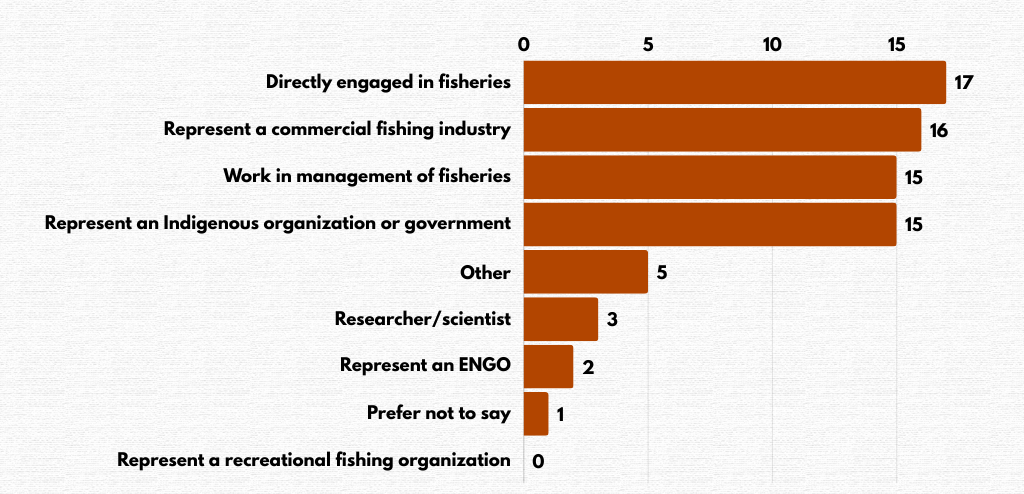
- 17 participants were directly engaged in fisheries
- 16 participants represented a commercial fishing industry
- 15 participants worked in fisheries management
- 15 participants represented an Indigenous organization or government
- 5 participants selected ‘other’ as their role
- 3 participants were researchers or scientists
- 2 participants represented an environmental non-governmental organization
- 1 participant selected ‘prefer not to say’ as their role
Question 2: On a scale from 1 to 5 (1 being the lowest and 5 being the highest), please indicate the extent to which you agree or disagree with the following statements
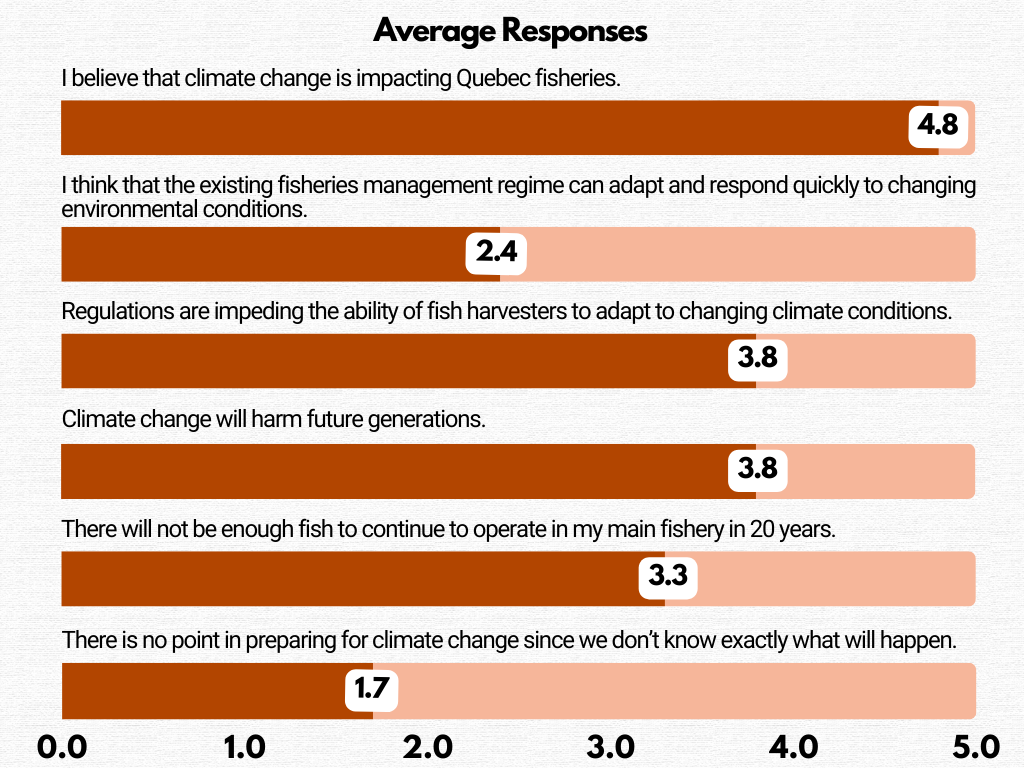
- I believe climate change is impacting Quebec fisheries. Average response: 4.8
- I think that the existing fisheries management regime can adapt and respond quickly to changing environmental conditions. Average response: 2.4
- Regulations are impeding the ability of fish harvesters to adapt to changing climate conditions. Average response: 3.8
- Climate change will harm future generations. Average response: 3.8
- There will not be enough fish to continue to operate in my main fishery in 20 years. Average response: 3.3
- There is no point in preparing for climate change since we do not know exactly what will happen. Average response: 1.7
Question 3: What could increase the agility and flexibility of the fisheries management regime to respond to future challenges
Open text responses:
- More flexibility.
- Increased involvement of Indigenous communities in decision making processes.
- Ecosystems approach, diversity and increase value of current quota.
- Bring decisions closer to regional offices.
- Collaborate with an industry-based committee.
- Check how fisheries are managed elsewhere. Need more flexible regulation; ecosystem approach, including predator/prey relations is a must.
- An ecosystem approach, be more inclusive, less divide between Indigenous and commercial harvesters, more access to resources, etc.
- Be quicker to review management measures.
- Review the rules that govern harvesting. Avoid the waste that comes from harvesting for quantity rather than quality.
- Streamline regulatory processes and try to predict the future.
- Continuous environmental and ecosystem monitoring.
- Collaboration with fish science.
- Listen to harvesters and their needs.
- Better partnership between harvesters and DFO.
- Change in license management, allow flexibility, include harvesters in data acquisition models.
- Increased data collection in collaboration with industry to enable rapid adaptability.
- Planning to adapt to change, diversify.
- Better knowledge and electronic tools.
- Frequent meetings with harvesters and associations to understand the realities on the ground and work together on solutions.
- Better scientific knowledge of the marine ecosystem, take account of knowledge in the field, let bycatch be kept.
- Diversity and acceptance of bycatch.
- Simultaneous harvesting, relaxed administrative rules, zero discards.
- Collaboration with harvesters who have eyes on the water.
- A regional committee of harvesters from each coastal region, with regulations on management flexibility.
- Latitude in decision-making. Climate change impacts are local and cannot be dealt with uniformly. Flexibility and contextualization are needed.
- Decentralization based on different regional realities.
- Listen to harvesters: they have the right ideas and observations of climate change. Their observations are just as valuable as those of scientists.
- Greater predictability of stock status.
- Multi-species fleets and management approach.
- Conserving resources for future generations.
- Diversification of fishing activities and technology.
- More flexible and adaptive management by the department. A paradigm shift, avoiding waste and rationalizing fleets, because there are already too many players.
Participant list
Representatives from the following organizations, groups, environmental non-governmental organizations, institutions, and/or governments attended the workshop. In alphabetical order:
- Agence Mamu Innu Kaikusseht
- Association des pêcheurs de la Basse Côte-Nord
- Association des crabiers Gaspésiens (ACG)
- Association de gestion halieutique autochtone Mi'gmaq et Wolastoqey
- Association des capitaines-propriétaires de la Gaspésie Inc.
- Association des pêcheurs de crabe de la zone 17
- Association des pêcheurs propriétaires des Iles-de-la-Madeleine / Association of inshore fishermen of the Magdalen Island (Inshore)
- Comité de gestion de la zone 16 inc.
- Conseil de la Première Nation des Innus d'Essipit
- Conseil des Innus de Ekuanitshit
- Conseil des Innus de Nutashkuan
- Conseil des Innus de Pakua Shipi
- Conseil des Innus de Pessamit
- Conseil des Innus d'Unamen Shipu
- Conseil Innu Takuaikan Uashat mak Mani Utenam
- Groupe de pêcheurs de la zone F Inc.
- Listuguj Mi'gmaq Governement
- Micmacs of Gespgapegiag Band
- Municipalité régionale de comté de Côte-de-Gaspé
- Première nation Micmac de Gespeg
- Première nation Wolastogiyik (Malecite) Wahsipekuk
- Rassemblement des pêcheurs et pêcheuses des Côtes des Iles
- Regroupement des pêcheurs professionnels de la Haute et Moyenne Côte-Nord
- Rassemblement des pêcheurs et pêcheuses des Îles (RPPIM)
- Regroupement des pêcheurs professionnels de homard du sud de la Gaspésie (RPPSG)
Page details
- Date modified: